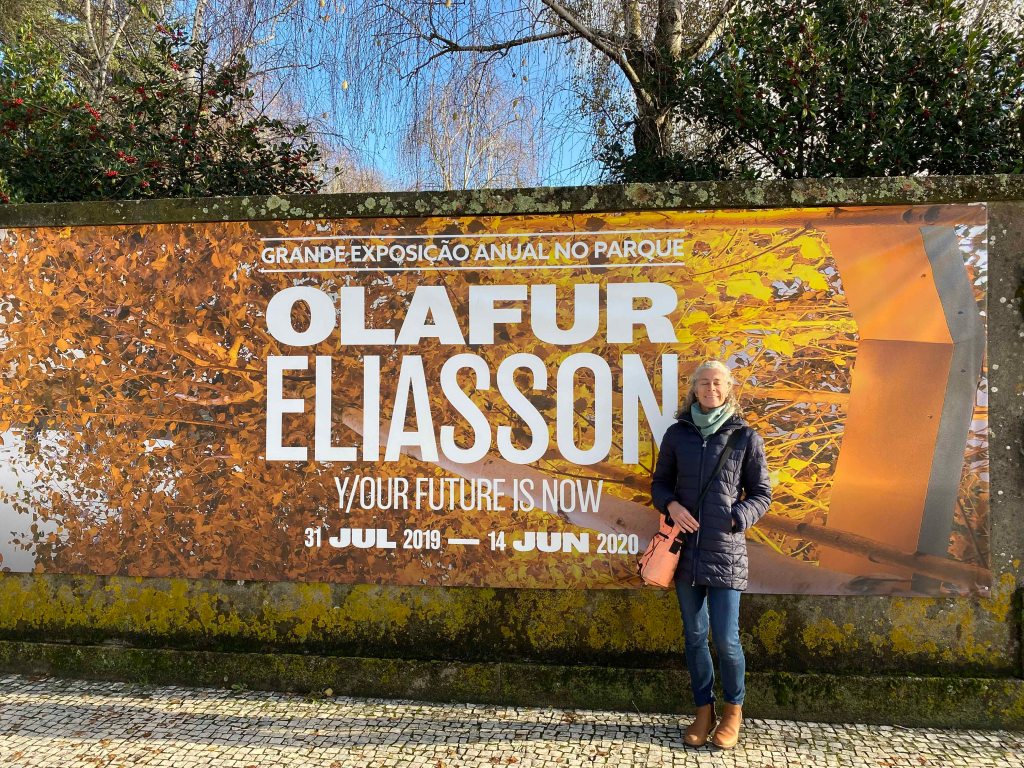
Finally, I managed to see an exhibition by Danish- Icelandic artist Olafur Eliasson- an artist whose installations have become known all over the world (his exhibition at Tate Modern in 20013 drew 2 million visitors) and left me very curious of what I would actually feel when seeing something in the flesh.
The theme of the exhibition at Serralves in Porto is “Y/our future is now” and as all Eliassons work is focused on the relationship between humankind, nature, art, science, architecture and society.
I started by exploring the sculptures in the park and first encountered “ The curious vortex” from 2019.
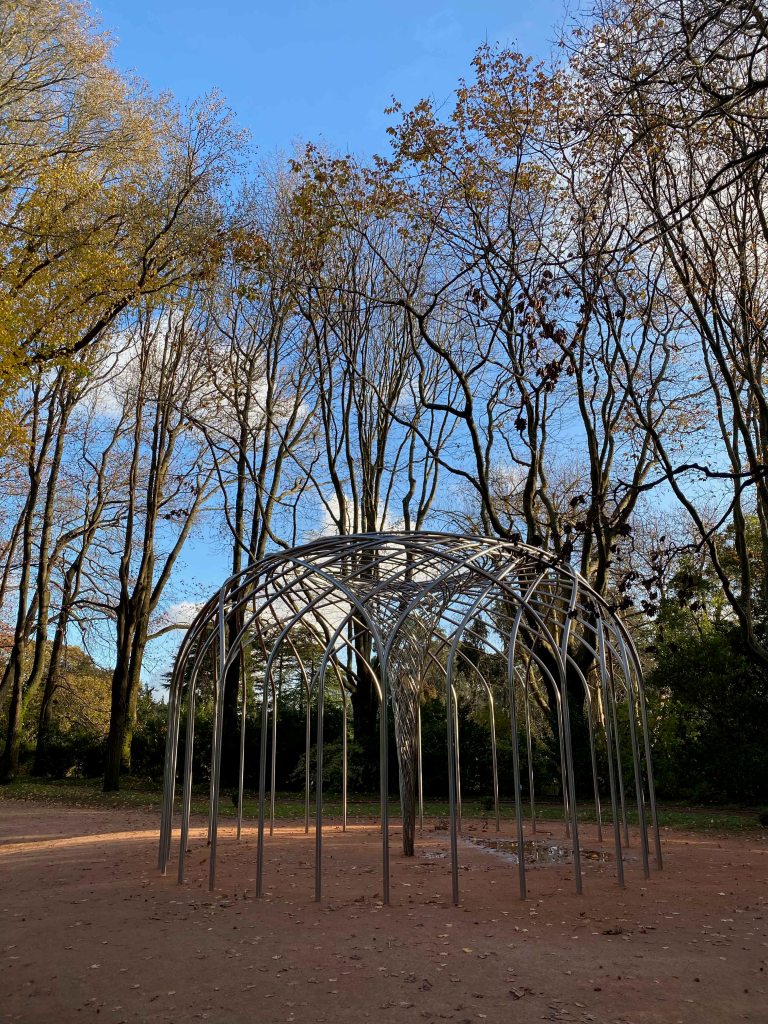
This is a huge stainless steel swirling vortex, erupting like a geyser . Standing inside the centre of the vortex and looking up towards the moving trees and clouds, I could feel a sense of movement, and see how this heavy structure evokes a sense of lightness and perpetual movement.
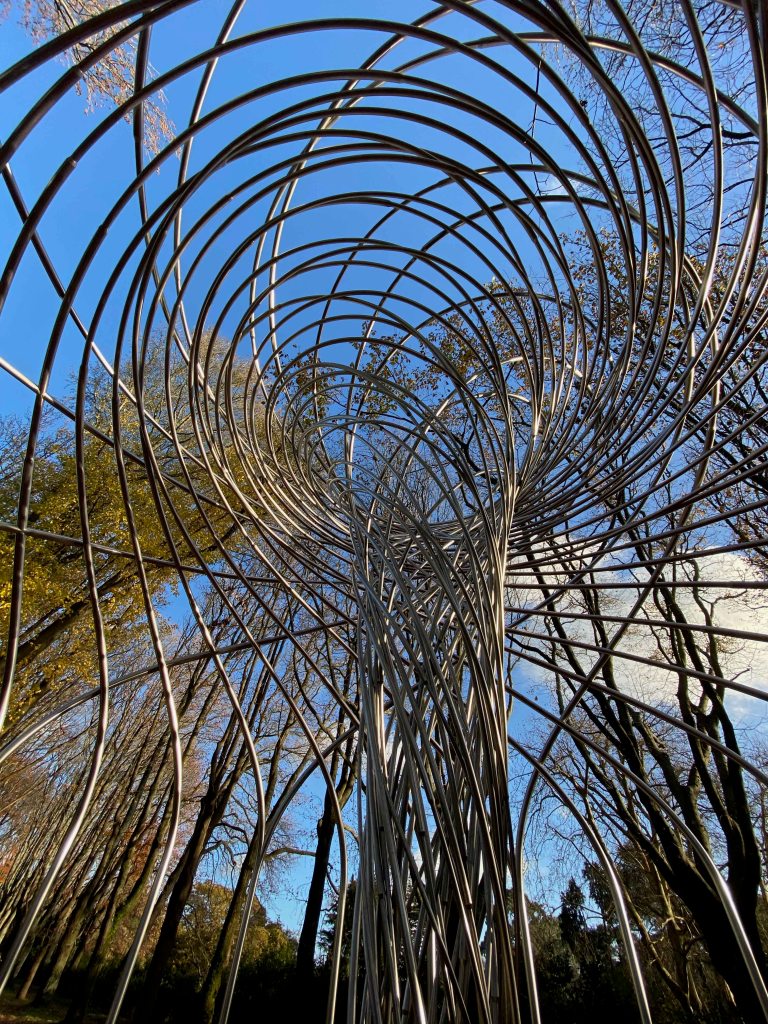
There was also a beautiful glittering added by the reflecting moving leaves, of the surrounding trees that also added a sound to the experience and reinforced the sense of it moving.
Further, three large black and white steel spirals form the work “Human time is movement (winter, spring and summer) .
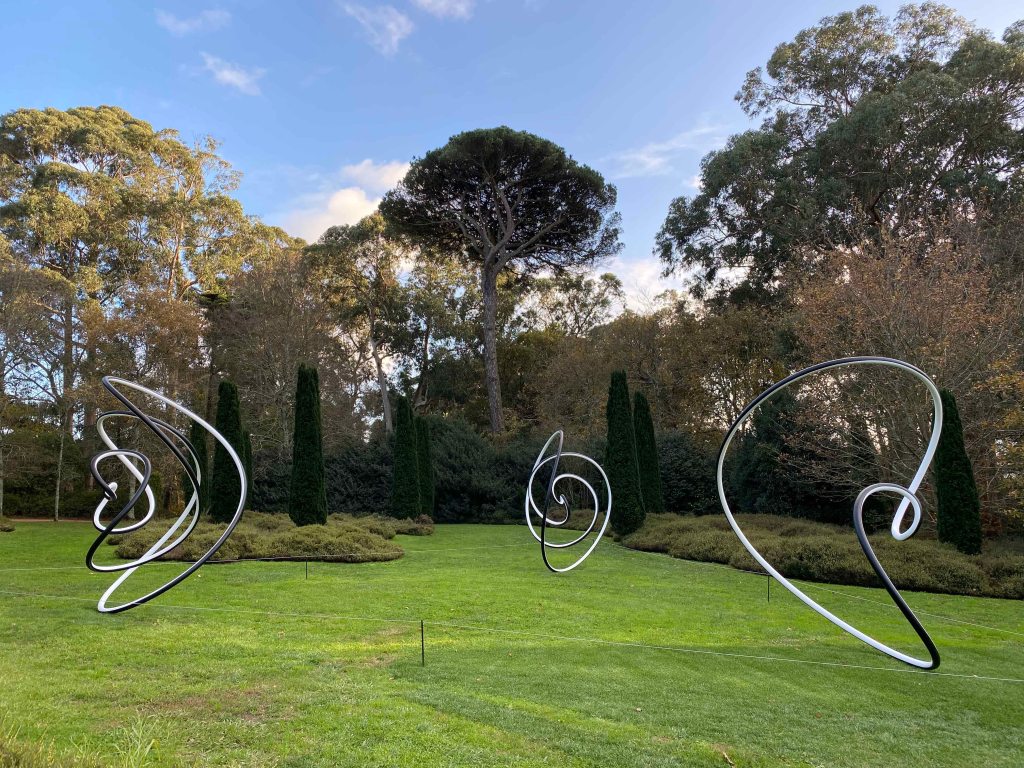
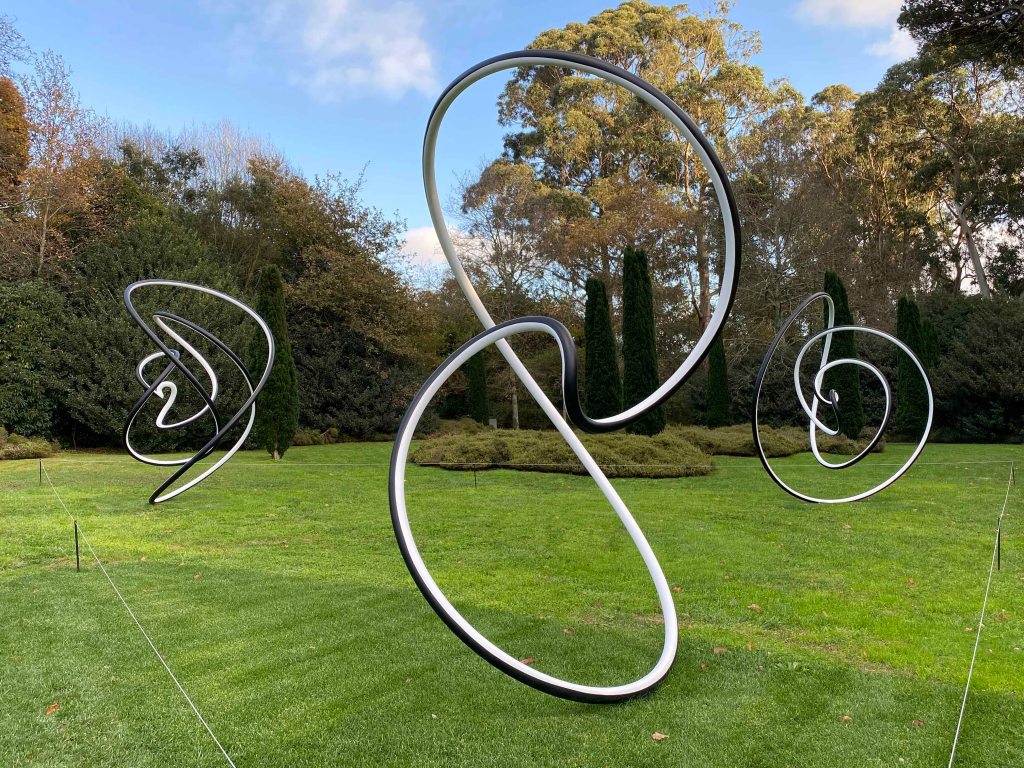
They looked like lightdrawings photographed with a long exposure and I liked this idea of lines in space. There was something joyful in the movements of these sculptures, I felt a smile when looking at them. And yes, I could feel how the movement of my eyes along the forms became a n experience of time.
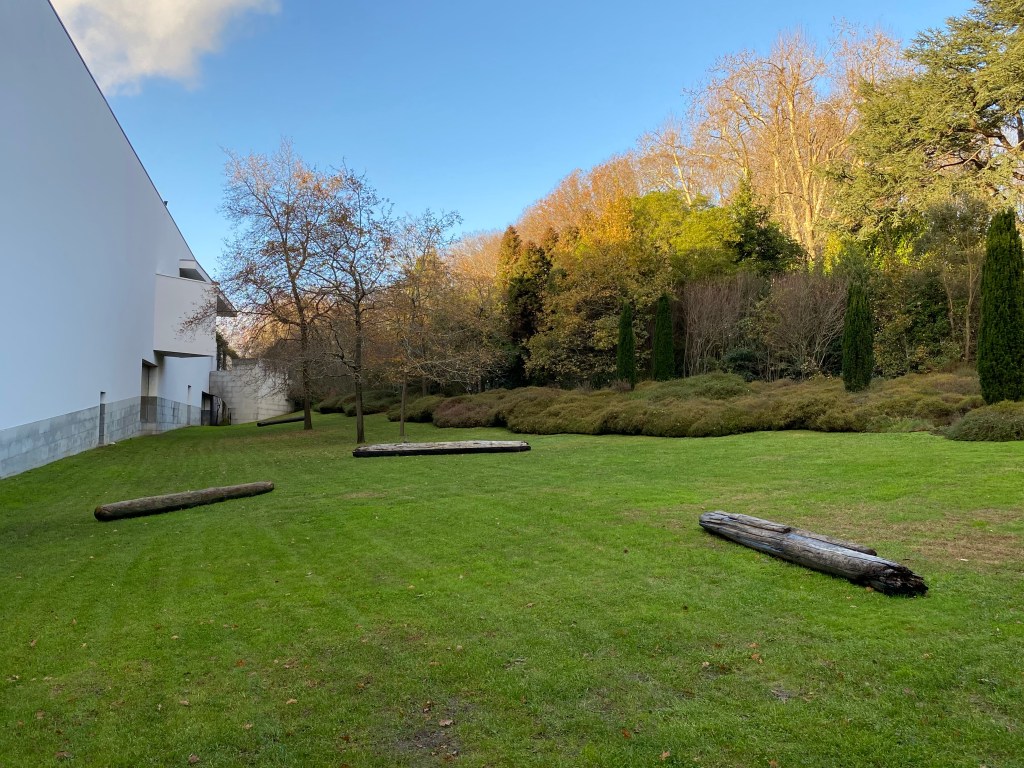
The work “arctic tree horizon” composed of logs in the grass around the museum building did not have the same visual impact at all. Probably because they looked very much at home in a park with huge ancient trees around. It was not until reading about them and their significance that I paid attention to them. Iceland has very little or no trees and yet these huge logs come floating ashore there, carried by the currents of the sea and drifting ice. Eliasson collects the logs and transports them to yet other surroundings . After knowing this, the work evokes thoughts about migration, circulation as well as about our ecological system.
Inside the museum building , in the central atrium, I could walk on a tiny path through the “Yellow forest”- a small artificial forest of birchtrees in pots. It was lit by a huge ring of yellow light that looked very warm and inviting. In the centre, this light altered my perception of colour and everything around looked either grey or yellow.
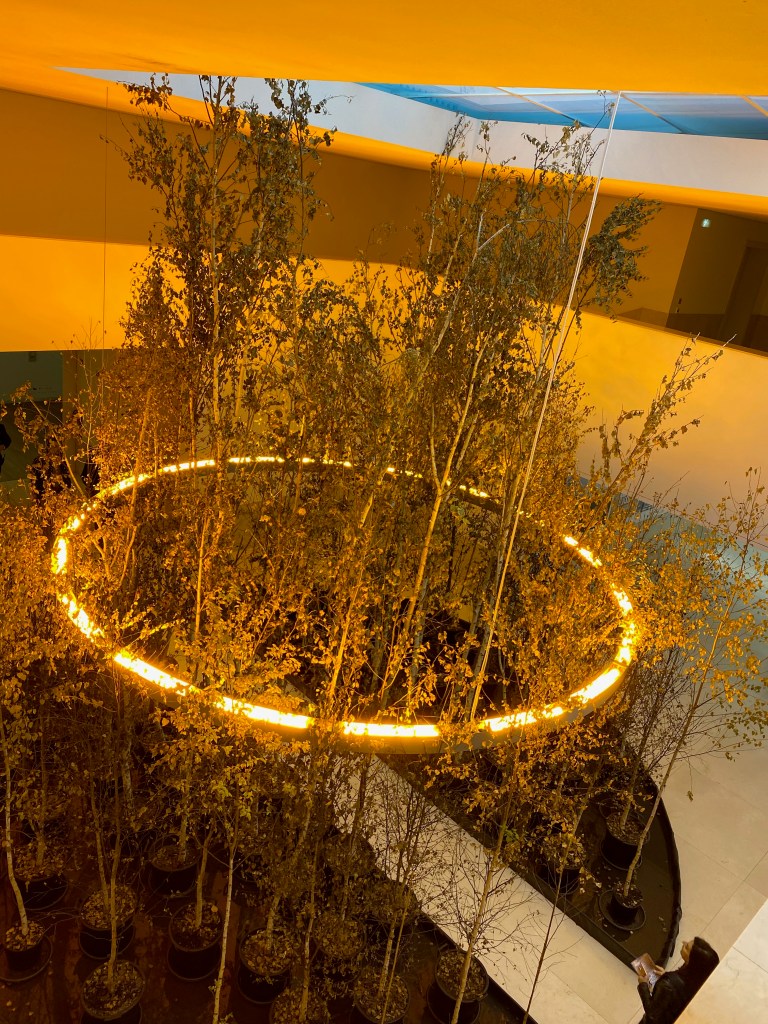
The work is supposed to evoke the dreamlike space of the forest as a place of relationship between humans and the Earth. I missed the feeling of forest, although I grew up in the North of Sweden and have many memories connected to birch tree forests. Here the rather thin ring of rather scrawny trees still had a very artificial feeling and I reacted more to the large plastic pots that held the trees. Looking back at this work mirrored in the next one had a larger impact. Seen in the mirrors from afar, this oasis of warmth and trees definitely looked like an attractive, warm, safe place.
“The listening dimension (orbit 1, orbit 2, orbit 3) is composed of wall sized mirrors with large golden and black rings that makes it look much ,much larger than the room.
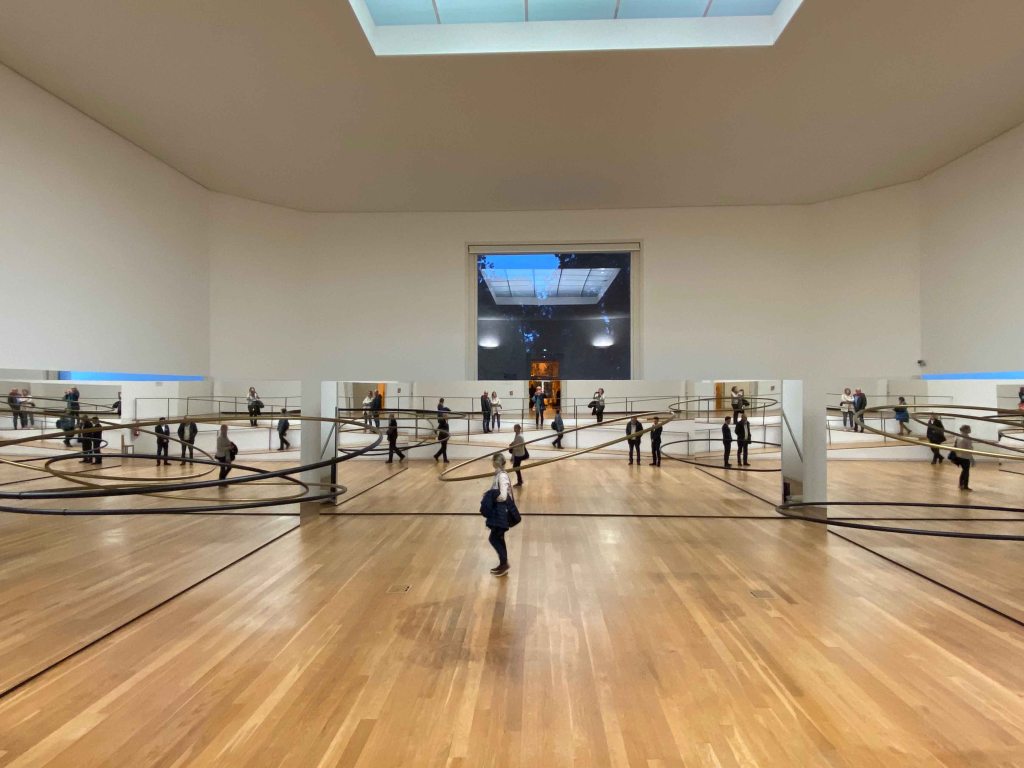
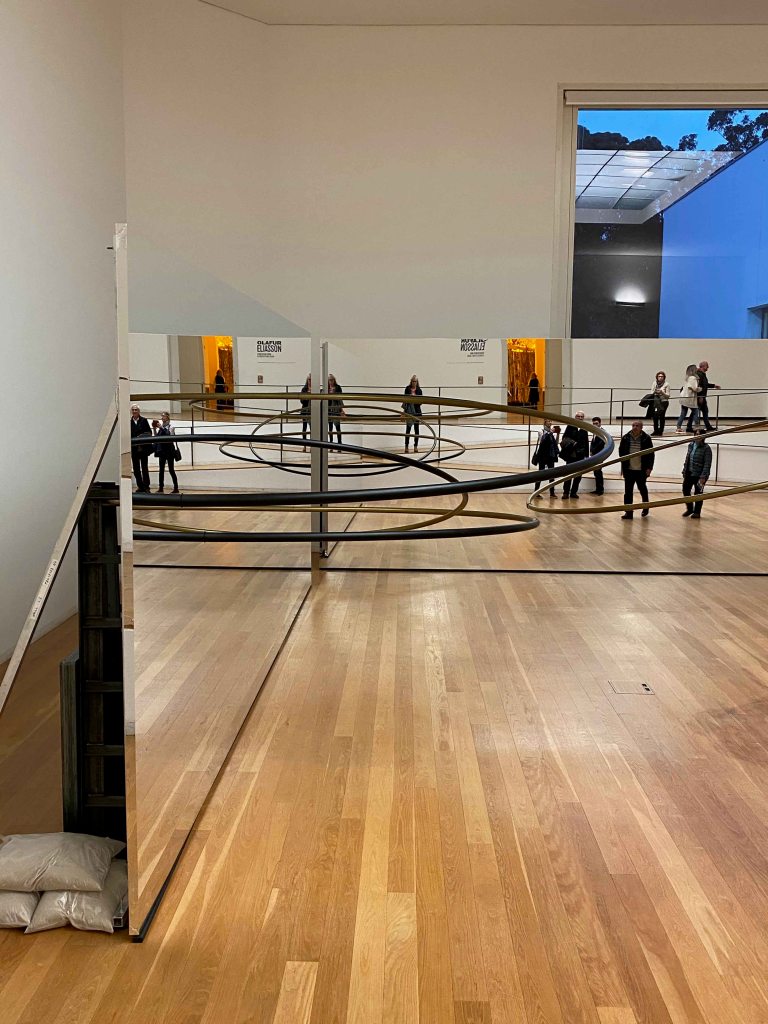
Seen from above it is a peculiar geometrical space, but when walking down into it, and becoming part of the reflections, another level of perception happens. My own image , as well as the one of the rings and the other visitors is reflected into infinity and looks as if it is moving. Here I am seeing my father who was with me reflected into infinity.
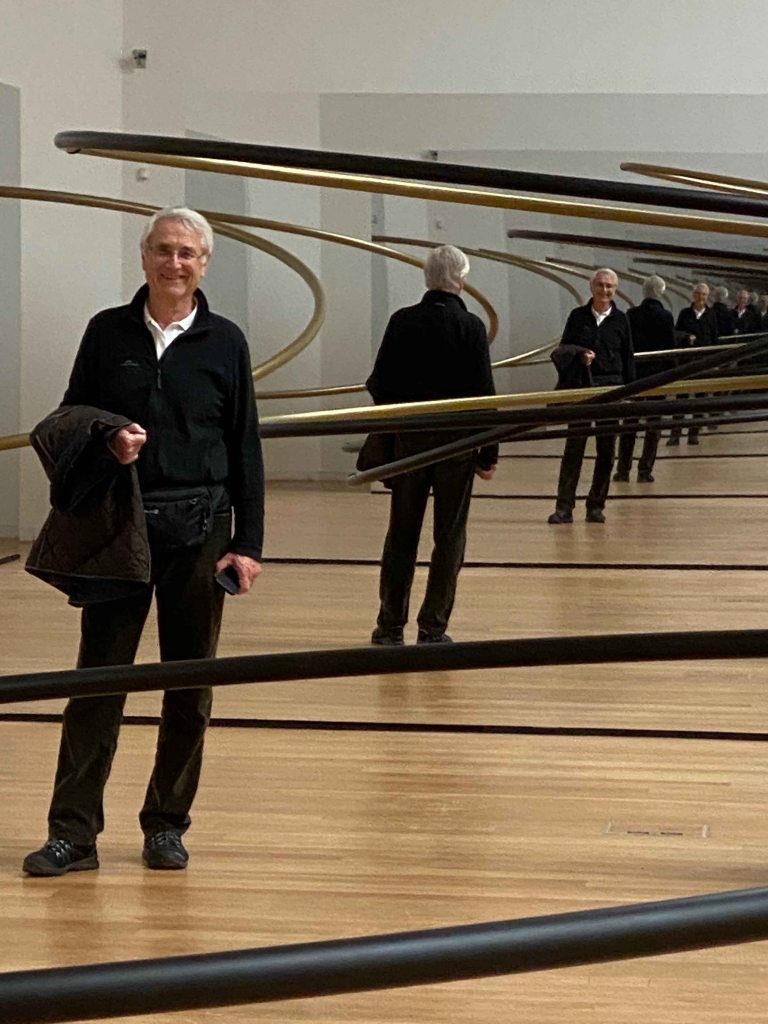
The sense of space and reality become unsure. I feel like I am floating in space with an infinite number of rings and elements floating around me.
I have read on Olafur Eliassons website that he has a studio in Berlin employing over 80 people, which sounds an incredible endeavor in itself. I was really happy to have the opportunity to see some of his works, although having to big expectations maybe lowered my experience a bit. I would be very curious about my experience if I were to walk through the fog tunnel made of food additives at the Tate Britain.
In any case, I enjoy the sculptural and experiential way Olafur Eliasson addresses the subjects of our relationship to nature, to what surrounds us and calls for more awareness in a way that engages the viewer and makes him a part of the experience, also then someone with a part of the issues and a responsibility to continue interacting.
Eliasson, O. 2019. https://wwwolafureliassonnet. %5BOnline%5D. %5B27 November 2019]. Available from: https://www.olafureliasson.net
Go back and edit info
 Clara's Drawing 2