The artists below all make work which both creates and denies three dimensions at the same time. Take a look at their websites then make notes in your learning log about these artists, your response to their work and how their work relates to what you’ve been attempting in this project.
Angela Eames: http://www.angelaeames.com/
Angela Eames is a drawer, and uses the computer to draw. In a video interview with Miles Corley available on You tube (https://www.youtube.com/watch?v=mDriWgY9Gd0) she states:
“Manipulating virtual lines in space- for me that is drawing, it is a constructed approach to drawing. And a virtual approach to drawing. And a head approach.”
On my first approach, I find Eames’ art difficult to engage with. I see grids and objects manipulated in space and find it very organized and intellectual. I do not have an emotional response to it. Eames works in series, here are excerpts from the series “Red Skyripper” and “Green Skyripper”:


It seems very mathematical, and I can find a certain pleasure in the rhythm of the images.
In the series “Spoon”, I can recognize a red spoon being manipulated in the gridlike structure:


I find it more interesting with this recognizable object.
Maybe it is because of the familiarity of the view that I also like the series “Sand” exploring the waves created in the sand in different shades, like here “Black sand”:
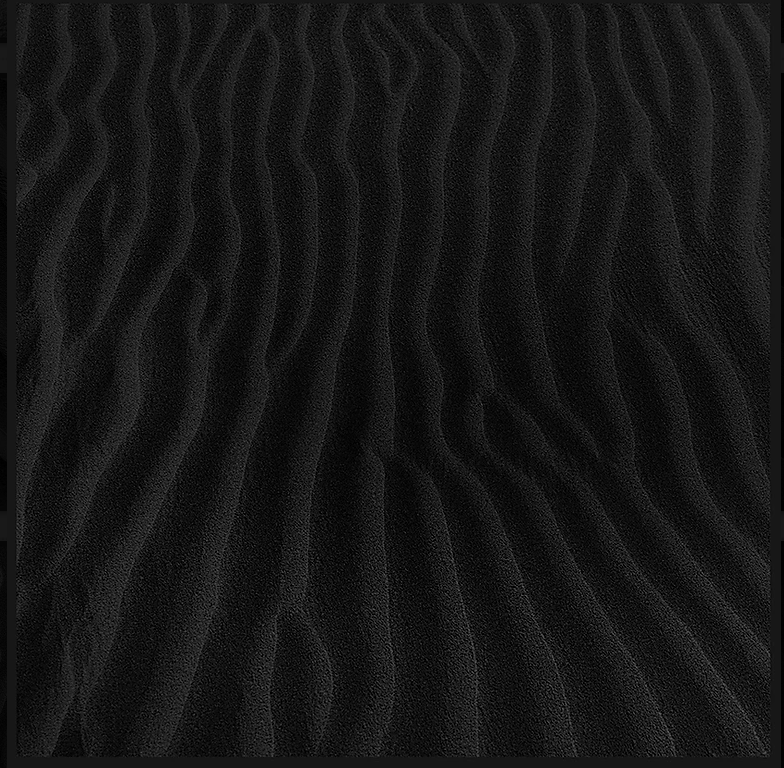
This feels like a view that I have seen and photographed myself.
I understand why we are asked to look at Angela Eames’ work in relationship to “work which both creates and denies three dimensions at the same time“.
When working in the computer, the work does not have a size or a shape. Eames works within the computer, a 3D space, using photographs she has taken in the past- which adds an element of time and 2D elements to the work, then she wants to see it in physical space and prints it on canvas, where it becomes 2 D again, and receives a size and a surface.
In the video mentioned above, she speaks about her series “Puddles”: “The puddles are constructs in 3D space, they reflect something that comes from 2D imagery that I have taken in the past, and then you bring it out flat- on canvas, a soft absorptive surface that has nothing to do with that screen space.”
Eames’ is often using grids or tiles, and bend them in space so that there is a 3D illusion. She names that her work is about the inbetween of 2D and 3D.
Looking at this aspect of the work has made it more interesting and accessible to me than it was when I was looking for an emotional response.
(All images from: 2017. Angela Eames. [Online]. [19 March 2020]. Available from: https://www.angelaeames.com/)
Michael Borremans: http://www.zeno-x.com/artists/MB/michael_borremans.html
Michael Borreman’s art feels like the opposite of Angela Eames’s- it goes straight to the gut. At a first glimpse, his drawings might look like from some historical archive, like part of some research maybe, but very quickly it becomes strange and exciting, often scary. There is a mysterious narrative in the work. It always contains figures that are performing some sort of ritual that remains unclear. I find Borreman’s work fascinating!
“Fire from the sun” below is probably the most macabre series of paintings, with children gathered, blood spilled, the story unclear:
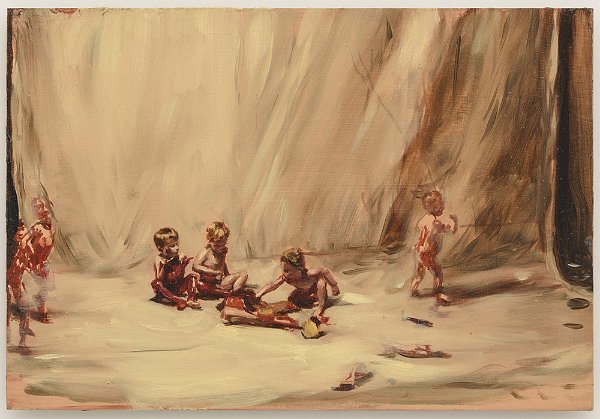
It does not deny that it is set up as a sort of stage, so in that sense removed from reality.
I am also fascinated by the many paintings where the faces or sometimes whole bodies of the figures are covered in some sack like masks, like “Amy” or “Melon” from 2017:


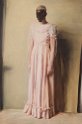
I particularly like the “The Angel” from 2013, where the blackened covered face and defeated posture contrasts to the pretty pink dress and also to the title. There is a fascinating tension in this contrast.
I really enjoy watching movies about the artists as it often shows their method of working and their spaces. Here I watched the documentary “Michaël Borremans: A Knife in the Eye” from 2011, available on Youtube: https://www.youtube.com/watch?v=dhhUmwmlMtc&t=2191s.
Borreman’s method is to create his scenarios with models and take pictures, that he then paints. He said in this movie, that painting is rather fast, although he is incredibly skilled at painting in a very classical manner. The idea, and the time between the photo session and knowing how he wants to paint it, in what scale and tones, is what takes the longest time.
He often introduces different planes in his imagery- like a model biting into a glass plate, or the model being cut off at the waist by a box created. I think here there is an interesting play between 2D and 3 D, because in a way Borreman creates dimensions that do not exist, or that we are not used to seeing.
The hidden parts becomes mysteriously absent, exciting our imagination.
Borreman’s first passion is drawing though. He sais in the above movie that he has always drawn- it is a “literary function”. His drawings are full of narrative too, and I particularly like how freely Borreman is combining elements of different scale.
Here in “The House of opportunity-Vodoo” the house becomes small enough for the person to manipulate.
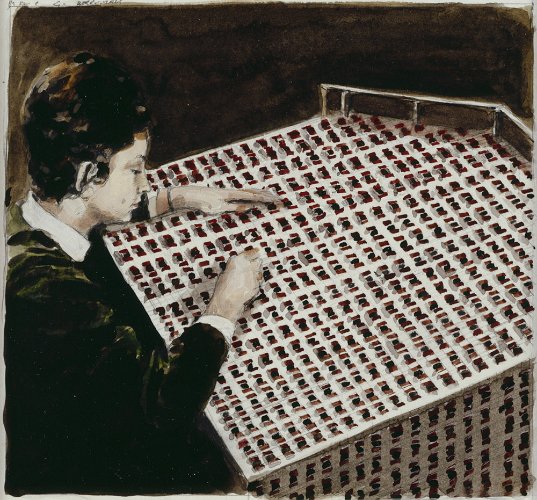
In many drawings there is a lot of “unfinished” space, something that always catches my attention, but then I go on filling up my own drawings.
Here in “Square of despair”, all the cattle are lying on their side with tiny persons walking around, and I like how the drawing is becoming less finished til the edges.
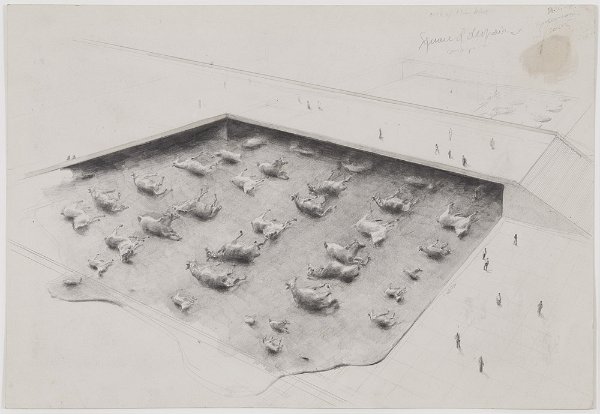
I found it interesting that Borreman always draws on found paper, he never buys blocks of paper. He likes when the paper is imperfect, with some spots or grease. Similarly he never starts a painting on a white canvas. He always puts down a beige or grey foundation. That way he can leave parts open rather freely and they will still blend into the image. This is definitely something to remember!
Borreman also works with film, but they are special films that he calls “tableau vivant”- living paintings. There is no plot or no activity whatsoever in the film. A model is placed in a position and then he films it rotating around the model. This way the figure is reduced to an object maybe, it is a mysterious, unusual way of looking at a person. So if his paintings are very cinematographic, his movies are very much like paintings.
(All images from: 2019. Zeno X Gallery, Antwerp. [Online]. [23 March 2020]. Available from: http://www.zeno-x.com/artists/MB/michael_borremans.html)
Jim Shaw: http://www.simonleegallery.com/Artists/Jim_Shaw/Selected_Works
Jim Shaw’s work plays with a very different spectrum of feelings than Michael Borreman’s. Here there is satire, a sharp commentary of especially American society and politics.
“The Trump smear”, from 2018 is a brilliant really poignant and critical portrait of the American president, with a black and white line drawing on plywood.
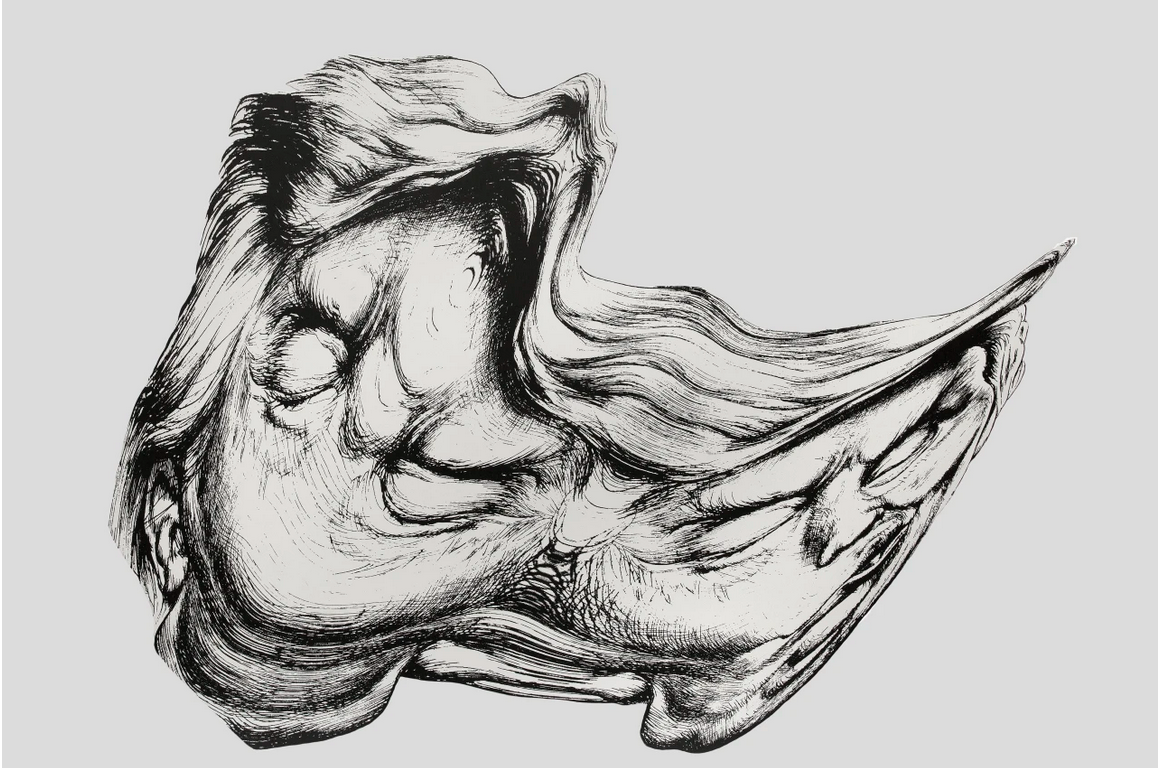
Shaw is often working in installations with these drawing cutouts. In that sense he is playing with a shift from 2D to 3D, as the figures appear as objects in space, while still remaining only 2D though.
These are installation views from “Issue of my loins ” 2019 and “The Wig museum” 2017, where you can see how Shaw is creating this interplay between 2D and 3D impressions.


Shaw mixes influences from art history, crackpot science, conspiracy theories and his own personal experiences into the work that then becomes an apocalyptic, end of the world narrative. He can be very meticulous and spend a decade researching his subjects.
One of his most famous subjects is the invented religion “Oism” with its mythical beasts and false history.
I find many of Jim Shaw’s pieces brilliant- his work is personal and at the same time closely bound to current events with sharp humor and criticism.
(Images from: 2020. Simon Lee. [Online]. [23 March 2020]. Available from: https://www.simonleegallery.com/artists/jim-shaw/)
ALL IMAGES REPRODUCED FOR EDUCATIONAL PURPOSE ONLY
 Clara's Drawing 2