After my own trials with creating some simple drawing machines, it was really interesting to explore Rebecca Horns’ work.
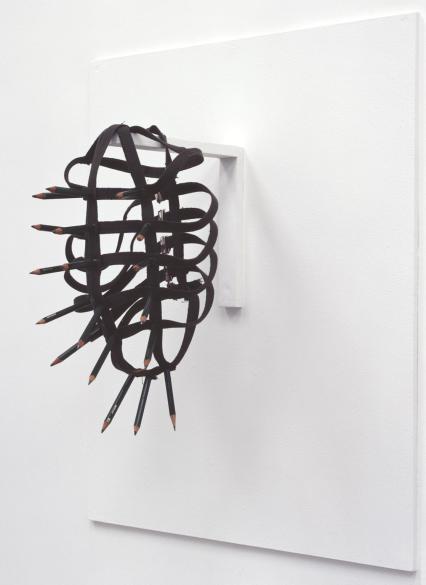
In her earlier works from the 1970’s, she created sculptural constructions that were most often extensions of her own body, like “Pencilmask” below, or a variety of feather masks.
(Image from: 2020. Tate, Art, artworks. [Online]. [13 April 2020]. Available from: https://www.tate.org.uk/art/artworks/horn-pencil-mask-t07847)
This Pencilmask still required the artists’ presence and physical movements to leave marks. In that way, Horn explored her own body and limitations or feelings when extended. While wearing these constructs, she could also explore various levels of control and interaction. Some masks, like her “Black Cockfeathers mask” or “Cocatoo mask” were designed to look at and meet another person with the altered vision that these masks would give the wearer, questioning her own views and subjectivity. After severe lung poisoning she spent a year very sick and in isolation. After that a lot of her work deals with interaction. She used a variety of media, but came to fame through these sculptural constructions that were then used in performances and for films.
In “Finger gloves” from 1972, Horn created gloves with really long fingers. She is exploring the limitations of her own body by reaching beyond it, and also exploring the space beyond the own body and the objects she can reach with her constructed fingers.
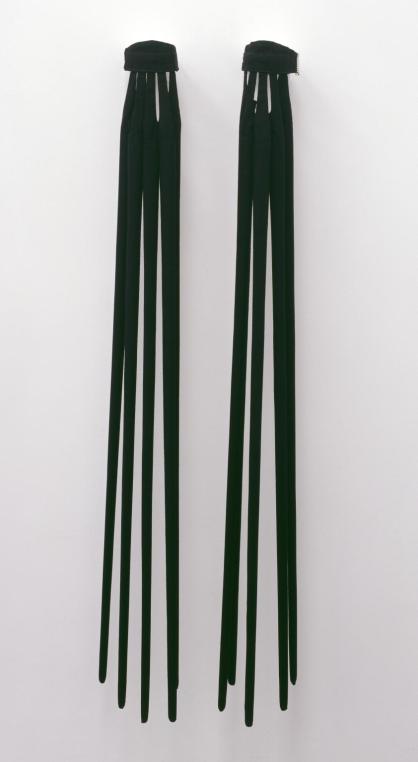
“I feel myself touching, see myself grasping, and control the distance between myself and the objects.” (Quote and image from Tate website: 2020. Tate, Finger Gloves Rebecca Horn. [Online]. [13 April 2020]. Available from: https://www.tate.org.uk/art/artworks/horn-finger-gloves-t07845).
I find these constructs fascinating and would just love to try any of them!
I am watching the beautiful documentary about Rebeccas journey called “Rebecca Horn is travelling” on You Tube. ( https://www.youtube.com/watch?v=2vqiFRZfCMw)
For many of her installations, Horn used very varied objects- from violins and a piano to hospital beds. She likes to combine very fragile objects, like feathers, and others that evoke a feeling of danger to create tension between them. The violin that plays itself is a recurring object- a symbol of a person, or a person that has left. In the documentary, we follow the installation of “Free as a bird” from 1999, a spiral of hospital beds where violins play. She increasingly withdrew from performing herself, letting the objects take center stage and creating mechanical sculptures with movements and sounds. These sculptures are not perfect- and she explains how their imperfections and hesitations make them more human.
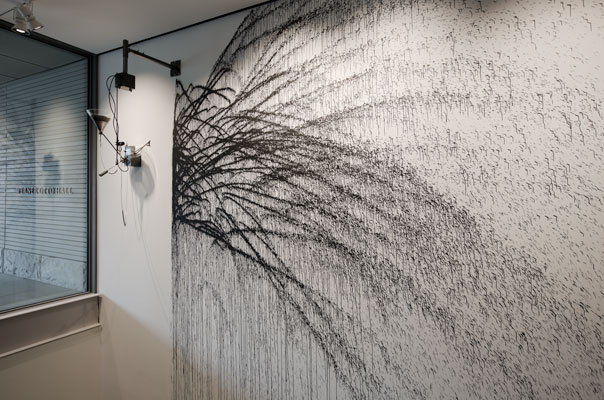
Later she started constructing automated drawing machines, where she has removed more of her own control. In “Flying books under Black rain painting” from 2015 at Harvard University, she lets a machine spray black paint over a white wall and three books.
(Image from: 2020. Harvard Art Museums, Collections, Rebecca Horn. [Online]. [13 April 2020]. Available from: https://www.harvardartmuseums.org/collections?q=Rebecca+Horn+)
There is an interesting tension in the drawing machines, between the cold, mechanical, calculated construction, and then the element out of control, the way the drops fall through gravity and mark the wall. This feels like a big step away from the control of the earlier works where the body was still initiating the movement and in itself an essential element of the investigation. The artist seems to imbue the machines with almost human qualities though, and sees how they can express emotions.
 Clara's Drawing 2