Research point:
“The Abstract Expressionists’ use of gesture was caught up with notions of authenticity and even of purity of intent. The influential critic Clement Greenberg wrote in his article ‘Avant Garde and Kitsch’ in 1939 about the good artist painting ‘cause’ and the bad artist painting ‘effect’. He also talks about what he describes as ‘the inflections of the personal’ becoming a legitimate subject. For example, the artist Jackson Pollock talked about wanting to paint from his emotions, not to illustrate them. What’s your response to these comments?”
I first researched Abstract Expressionism for the Practice on Painting course- a shortlink to the blogpost is here: https://wp.me/p94hP8-Z1
The essence of Abstract Expressionism is a spontaneous, highly charged, impulsive way of painting, where the artist works with large gestures without a pre-concieved plan or sketch or even idea. Guided by emotions and impulse, the artist allows and exploits accidental effects.
The documentary made by Hans Namuth (http://www.youtube.com/watch?v=6cgBvpjwOGo) is a great way to understand Pollock’s way of painting .Jackson Pollock developed his individual form of spilling and dripping paint onto a canvas usually placed on the ground. Hans Namuth shows this brilliantly in the movie in a moment where he has placed the camera under a glass onto which Pollock is working so we witness the action from the perspective of the canvas.
In the movie Pollock sais that he enjoys working on a large canvas because he can feel part of it. This is something that I am only myself beginning to explore, and the statement really felt true. A large canvas, that allows much larger and less controlled gestures, invites me into being part of it in a very different way than a smaller controlled painting can.
This is Autumn Rythm from 1950:
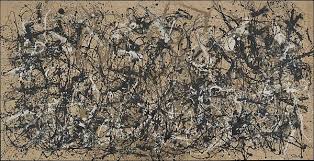
(Image from: 2020. The Metropolitan Museum of Art. [Online]. [15 April 2020]. Available from: https://www.metmuseum.org/pt/art/collection/search/488978)
For POP1, I tried out Pollocks’ method to feel how it feels- using sticks to drip and splatter household enamel paint onto brown wrapping paper on the floor:

This is my painting when it felt complete:

Pollock said: “I want to express my feelings rather than illustrate them”. I think he found a method of painting, where he could literally pour his feelings onto the canvas, as in letting his motions be guided by his emotions and then let himself react to that immediately, instead of trying to create an image of what he was feeling, that would become an illustration. An illustration in that sense would have a gap, a time of thinking and planning, between the feeling and the painting, whereas with an abstract expressionist method, there is no such gap. It is a simultaneous feeling and painting. The focus is on the moment, on the physical act of painting, as much as on the resulting painting.
I believe this is what the art critic Clement Greenberg was referring to when he talks about the good artist painting ‘cause’ and the bad artist painting ‘effect’. He compares the impact of a painting by Picasso that requires patience and dedication to understand and a painting by Repin where there is a story told and even exaggerated for effect, on an ignorant Russian peasant. His article ‘Avant Garde and Kitsch’ was written in 1939, so before the dripping experiments of Jackson Pollock and the rise of other Abstract Expressionist painters though.
“It has been in search of the absolute that the avant-garde has arrived at “abstract” or “nonobjective” art — and poetry, too. The avant-garde poet or artist tries in effect to imitate God by creating something valid solely on its own terms, in the way nature itself is valid, in the way a landscape — not its picture — is aesthetically valid; something given, increate, independent of meanings, similars or originals. Content is to be dissolved so completely into form that the work of art or literature cannot be reduced in whole or in part to anything not itself. ” (Quote from: 2020. Academiaedu on AVANT-GARDE_AND_KITSCH-_Clement_Greenberg. [Online]. [15 April 2020]. Available from: https://www.academia.edu/7515241/AVANT-GARDE_AND_KITSCH-_Clement_Greenberg)
Later, Greenberg would redefine some of the concepts in his essay and it is interesting to think of how “Kitsch” rose to high art through the Pop art movement.
Revisiting the Abstract Expressionists and especially Jackson Pollocks’ work, has unlocked some new enthusiasm in me to let emotion and accidental movements guide me through the next projects, and especially Assignment 3, where I plan to use a very large paper to move and draw intuitively to music.
 Clara's Drawing 2