Course Manual: “Select a piece of music (preferably classical or at least rhythmically complex) and allow your movements to be affected or generated by it whilst producing a drawing. To begin with, generate your lines and marks solely in response to the music. After the first hour, develop this further. For example, you could introduce an observational element such as self-portraiture and begin to explore the interplay between gesture and representation. Alternatively you might decide to video yourself making the work to emphasise the performative nature of gesture.”
I always listen to music in my headphones when I draw or paint, often as a tool to close out other sounds from what is happening around me.
I do not think I have ever made a drawing solely as a response to the music though, without a pre-concieved idea.
For this assignment, I created a playlist with music from Philipp Glass, mixed from the three albums Koyaaniqatsi, Solo Piano and Powaqqatsi. I choose this composer, as his music is definitely rhythmically complex and because it brings me through a very wide range of emotions with anything from very dark, hard stomping sounds, to light flute or calming piano. This is the playlist:
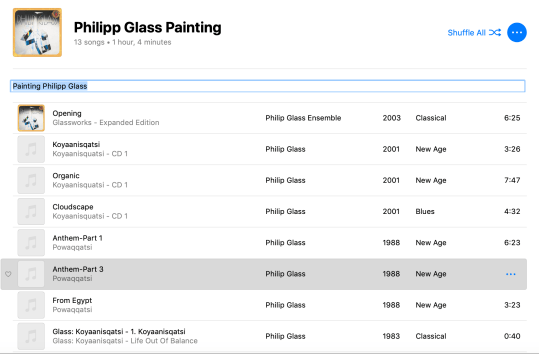
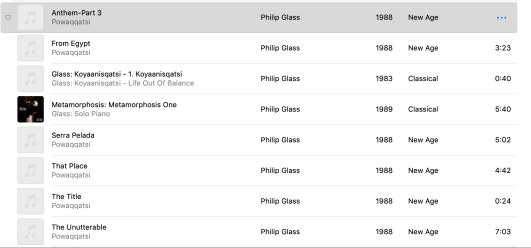
The whole is a few minutes over one hour long, and I plan to play it twice. The first round, I will just draw wildly, mainly keeping my eyes closed and really letting myself go and just feel the music. The focus will be entirely on the process. Then after that first hour, I will step back and see if I can pick out any figurative elements in the drawing. Then, I will listen to the same playlist again for the next hour, accentuating those figurative elements, while still moving to the music and letting the music inform my marks.
I start with a few test marks on approximately A2 papers while listening to the beginning of each song to see what materials feel appropriate.


I am going to move and dance to the music while drawing- so I prepare a large sheet of paper- it is approximately 150×300 cm.
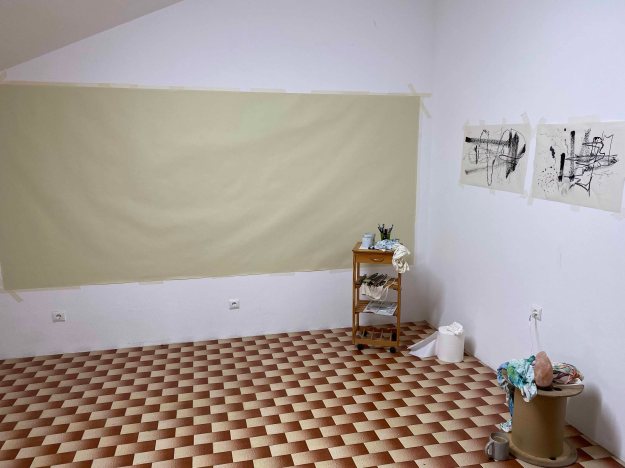
I prepare a wide array of black and white media- charcoal, graphite pencils, markers, Indian ink, watercolour and acrylics with lots of different brushes. As for the previous emotional response exercise, I decide to use only black and white media, to emphasize the focus on the mark-making rather than colour.
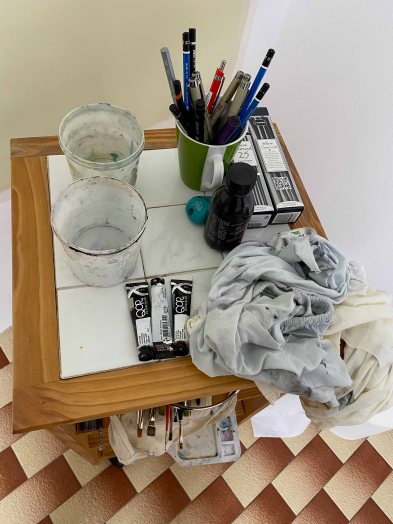
I am ready to start!
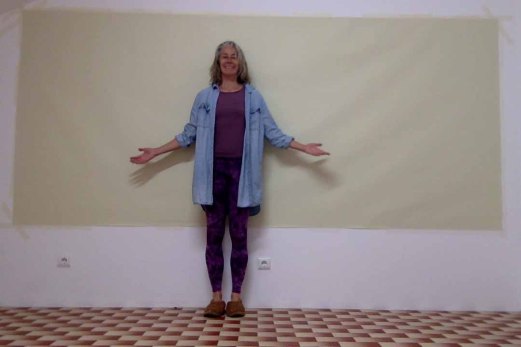
I am aware that this is more of a performance, focusing on the dancing and moving my body while translating movement and emotions into physical marks on the paper, rather than expecting any finished “good” drawing as an outcome.
Luckily, Tom is in COVID 19 lockdown with us and he agrees to document the process by filming it.
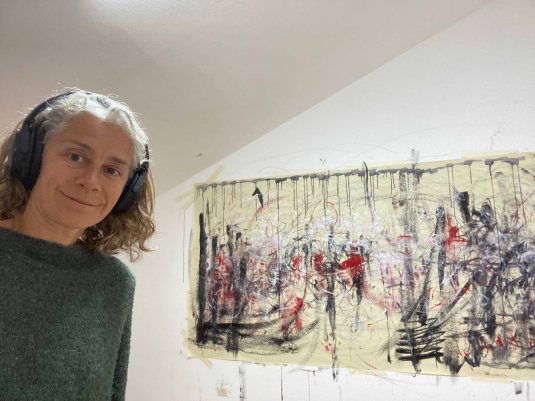
After one hour of non stop dancing and drawing, I am exhilarated and exhausted! I take a 15 minute break, shower and have a look if we can find some figurative elements. It seems like a face hovering over Hong Kong harbor is coming out.


I am ready for round 2 and set the music to play again. This time I work more aware of the figurative elements. I still move intuitively in pace with the music, but keep track of what I do. My granddaughter wakes up from her nap and joins in the dancing and drawing.
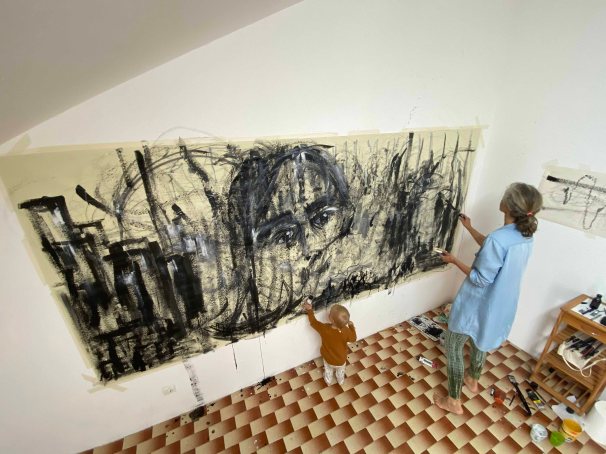
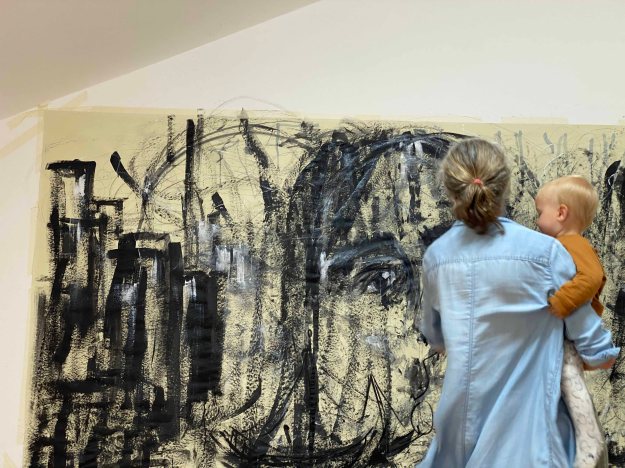
After the second hour, this is how the drawing looks (150x300cm):

This movie, documenting the process, filmed and edited by Tom Woodfin (@perceptionarchitecture), is my final piece for Assignment 3:
Drawing for two hours intensely to music was an absolutely incredibly profound process. I was tingling of excitement and exhaustion after these two hours, and can not begin to tell what rollercoaster of emotions I experienced during the drawing.
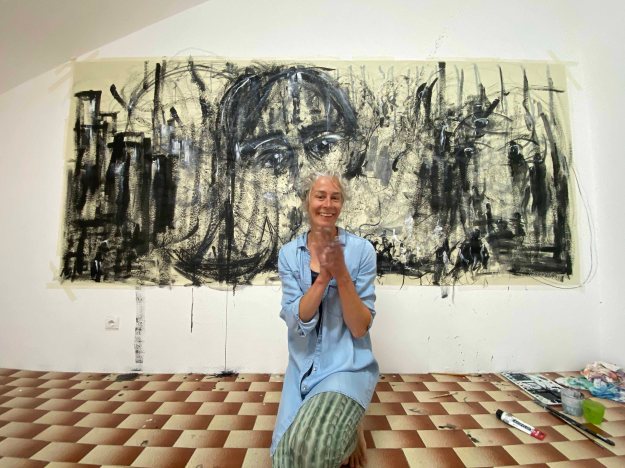
It was very interesting for me to experience the difference between my state of almost trance during the first hour, where I felt no need to even look at the result, and could just loose myself in the music, and the second hour, where I was still dancing, but remaining focused on the outcome. This opens up to a new, intense and rich way of approaching drawing and painting. I am really surprised that something as figurative as this could come out of this dance. And I am pleased to see that the final drawing still transmits the movement and the power of the dance.
Tom who was present and filming during large parts of the process, was so fascinated by what was happening, that he asked me to repeat the experience for his breathwork session. Tom is a breathwork facilitator, and is working on Zoom from my studio at the minute, due to the Covid 19 restrictions.
So the very next day, we set up two large papers on opposite walls, one for each of us.
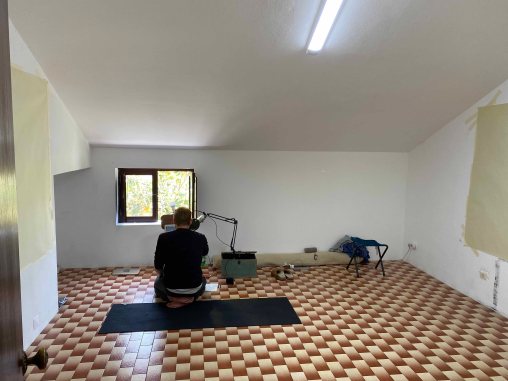
42 people from various parts of the world joined the session over Zoom, and all through the one hour 20 minute long session of music and breath exercises, Tom and I were dancing and drawing. This time, I pushed the concept of a performance even further, by having an audience, even if this audience was online and mostly eyes closed while they were breathing.
This is how my drawing looked after the 1 hour 20 minutes very varied music.
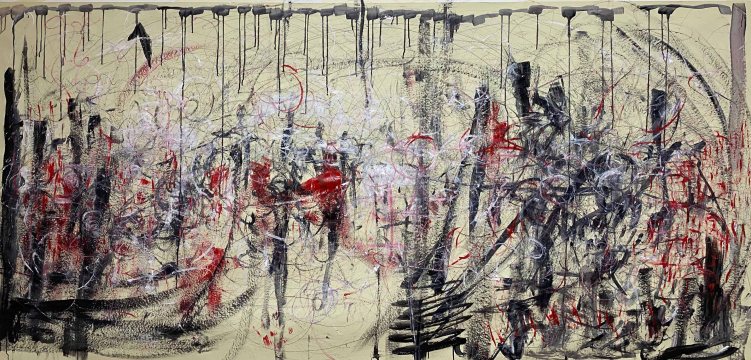
I decided to repeat the exercise above, and came back alone the next day, playing the same tracks while continuing the drawing consciously.
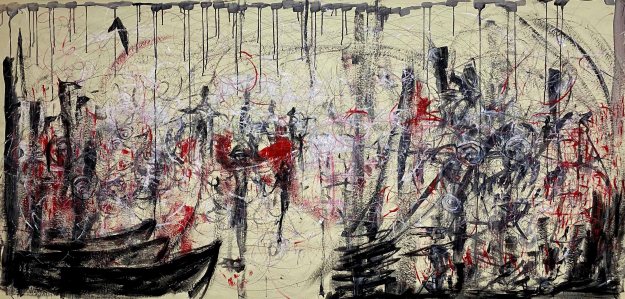
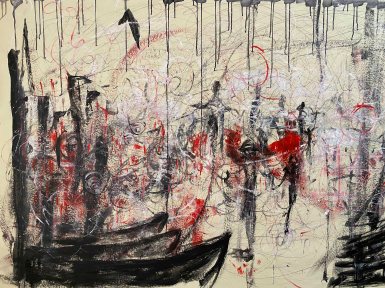
This time I had a really hard time seeing any figurative elements to start with, except for three boats in the left bottom corner. I decided to not change the overall composition,by inventing what I did not see, but lift out elements that jumped out at me.
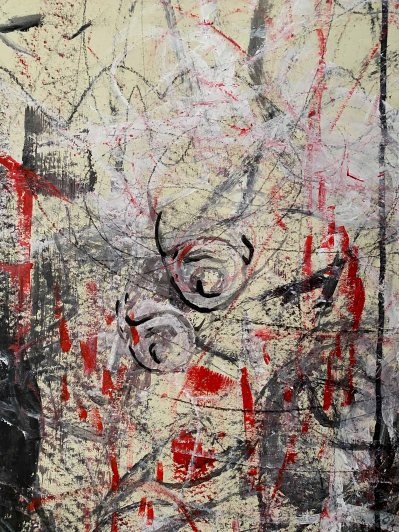
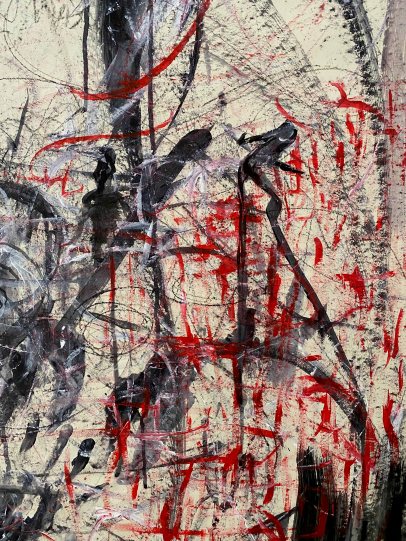
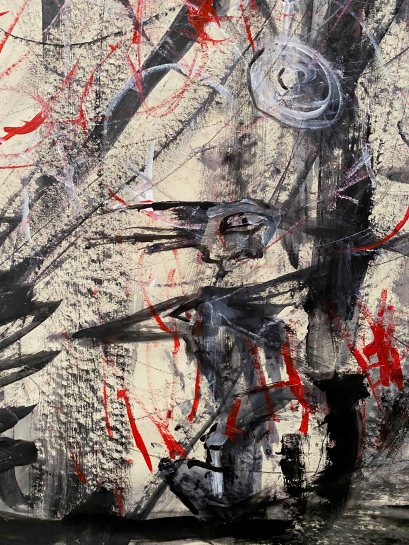
This is the final drawing- rather apocalyptic with Covid 19 masks appearing again (150×300 cm):
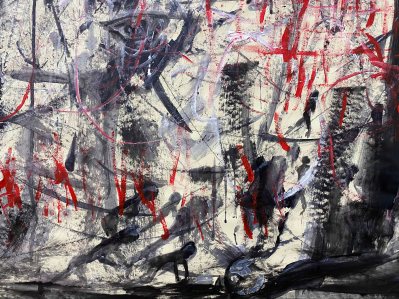
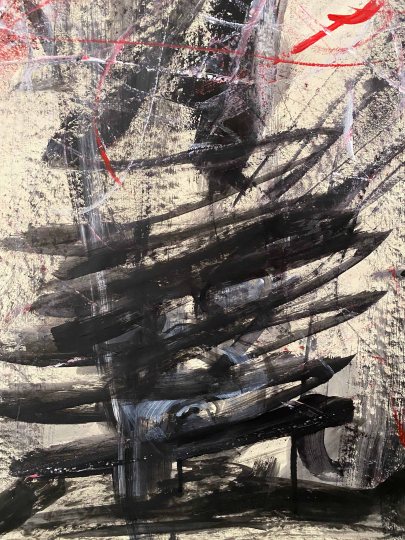
Here are some details that I like:
The experiences of these drawings to music have been profound. They have pushed me further towards performance and let me loosen the need for a clear or “good” outcome. I feel like a whole new ways of approaching drawing and painting are opening up here, a more intuitive and gestural approach. I am curious to explore how I can incorporate these experiences into more conceptual work as well.
 Clara's Drawing 2