Course manual: Aim: Drawing in a favourite or inspiring place can be very rewarding, but a great deal of translation goes on – in terms of scale, for example, as well as the information from other senses than the visual which is harder to convey. Creating a site-specific artwork enables the artist to manipulate the participant’s experience of the actual environment, rather than presenting a simulacrum in two dimensions for the spectator to reconstitute imaginatively, or a remnant left over from the artist’s own experience.
Method: Take a walk in a place you know well and make five different small drawn interactions in the environment using only what you find around you and your own body and without damaging any plants or animals in the process. Try to do things which will affect the way a visitor to the space would perceive it, either by directing their gaze or by changing the qualities of the place.
After eight weeks of Covid 19 related lockdown, we can finally go to the beach legally! I do not hesitate long in the choice of where to go for this project!
BEACH WALK nr 1:
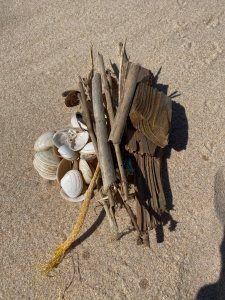
I start by collecting an array of sticks and white shells that I find on the beach.
Inspired by the many ways of drawing a line in Land art, for example the beautiful line of dandelions on a tree trunk by Andy Goldsworthy, I place the shells in a line.
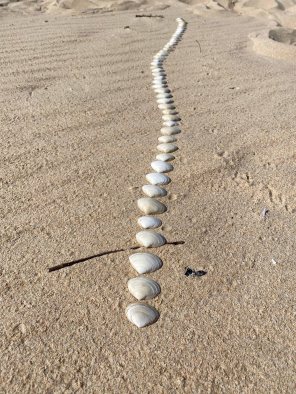
It is so simple, but I find it quite effective. It reminds me of a spine.
I then try a different arrangement, where the shells are placed in a double line, a little like footsteps in the sand.
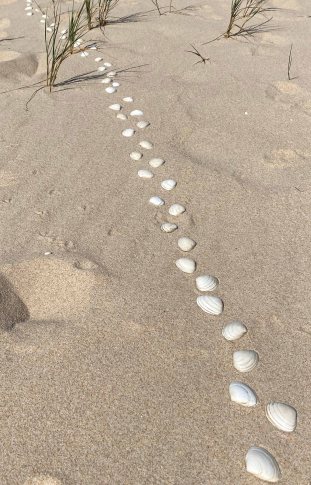
Both of these “drawings” would definitely direct the gaze of an onlooker and awaken curiosity.
I create a small installation with some of the driftwood, that I find respond to a certain harmony:
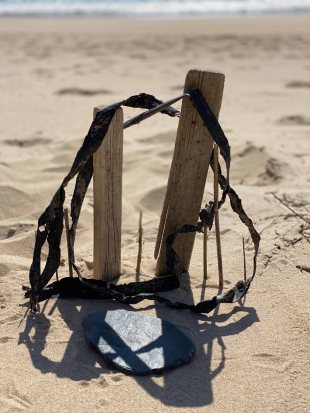
The sun is getting lower, and I realize that the shadow is becoming an integral part of the drawing. I create a figure from some driftwood and a piece of string.
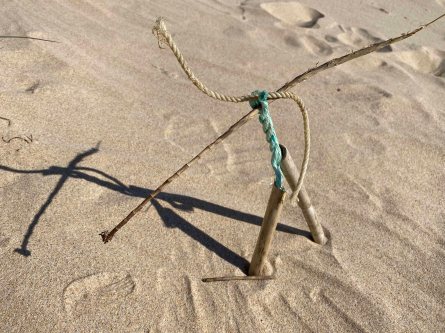
The wind is gently rocking the string, so that it actually looks like a moving figure.
For my next piece, I focus entirely on the shadow- it becomes a running figure:
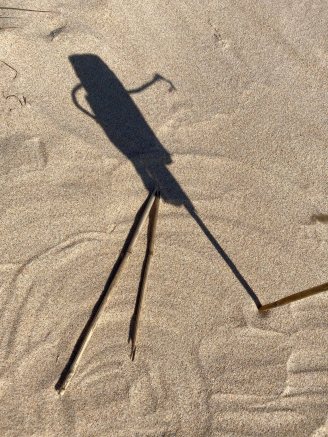
I continue using the shadows as part of the drawings. I like the very ephemeral nature of this and the movement that the change of the light brings to it.
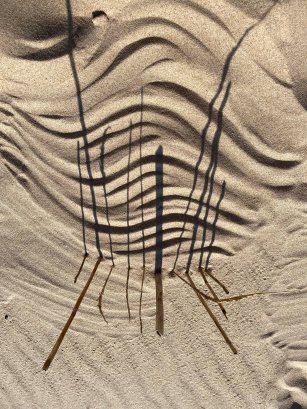
For a final piece, I join the shells to this shadow and sand drawing:
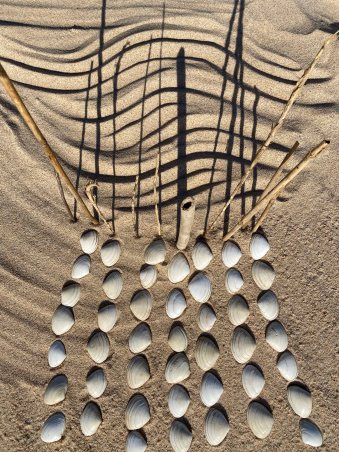
I love the immediacy and the connection to the place and the elements, that I feel while creating these little pieces with parts that I find randomly, and the sand and the light.
BEACHWALK NR. 2
Sand drawings is an integral part of many traditions. I have just researched Emily Kame Kngwarreye who started with aboriginal sand drawing and body painting before she moved on to painting on canvas. I love drawing in the sand, and have discovered quite a lot of contemporary artists that do this too. One of them is Atsuko Tanaka, that I discovered while researching the exhibition On Line from 2010.
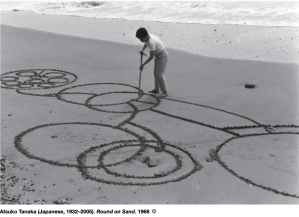
2020. MoMa/On Line. [Online]. [1 June 2020]. Available from: https://www.moma.org/interactives/exhibitions/2010/online/#works/02/54)
I will not use a stick to draw however- I love feeling the sand on my hands and body. Continuing the large format drawings on paper that I explored for Part 1, and the body prints for Part 2, I will draw with my hands and feet reaching as far as I can while stretching out in various poses. The drawings will record the lines my body makes in the sand.
I walk til I find a most untouched stretch of sand, big enough for several large drawings beside each other.
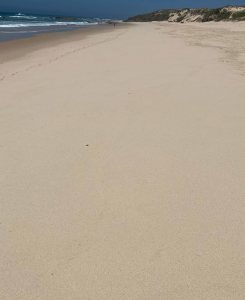
I jump as far as I can feet together into the sand and lie down, stretching as far as my arms and legs reach symmetrically. This is the first drawing:
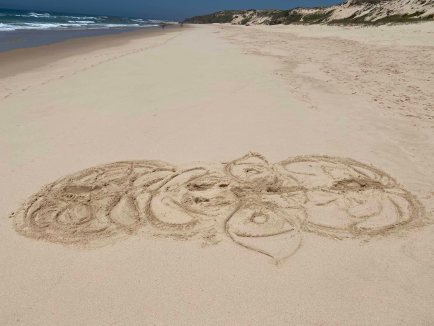
front view:
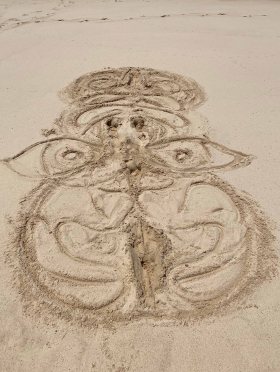
While on my second drawing, my partner Andre takes some pictures of this simple process, that show the scale of the drawings:
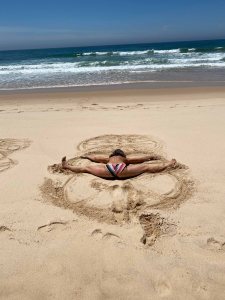
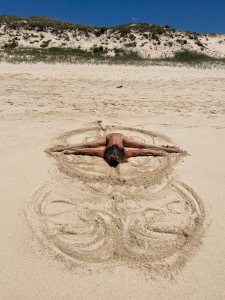
Drawing nr 2:
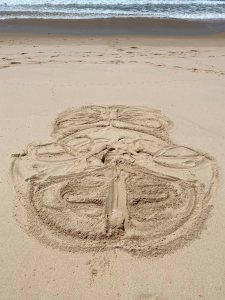
Drawing nr 3:
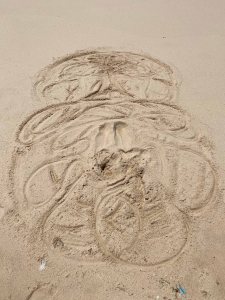
I am allowing the movement and the sensations of the sand guide the drawing, more than any idea of a visual shape. This is very much spontaneous, sensory drawings.
Drawing nr 4:
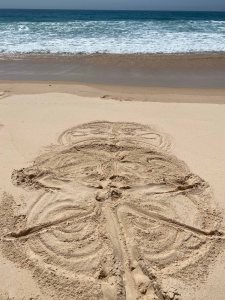 And drawing nr 5:
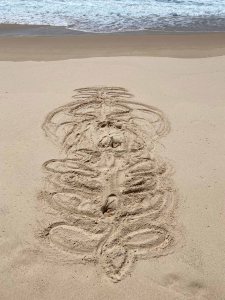
All five drawings in a line (it is difficult to take a picture of this as I am standing on the same level as the drawings)
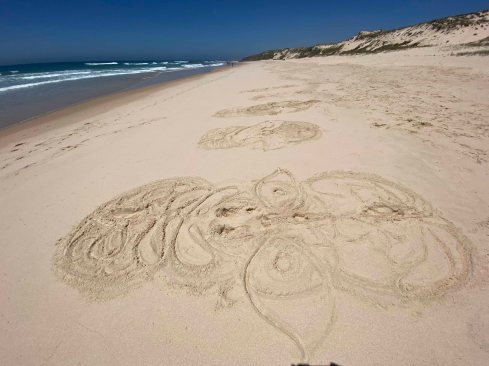
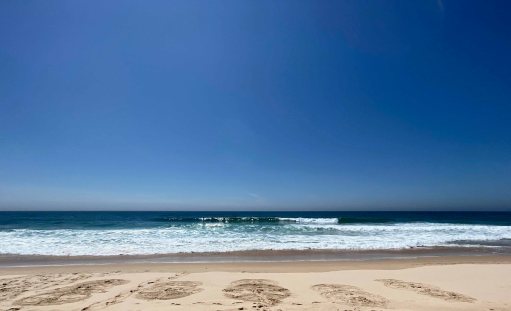
I am trying to put myself in the place of a viewer, and believe that anyone walking past now would see these lines as drawings. They have a ritualistic, symbolic character, even if there is no clear meaning. Drawing in sand is very ephemeral, very soon the tide will rise and wash them away. That it is so easy to wipe them out is one of the main allures of drawing in the sand- the experience becomes light and playful, and a direct connection to the sensory feeling and the moment.
 Clara's Drawing 2