Emily Kame Kngwarreye was one of Australia’s most significant contemporary artists. Her life story is absolutely fascinating. An indigenous woman, she grew up in a small, remote community named Utopia where she became an established Elder with a lead role in ceremonies. She was often using ceremonial sandpainting and painting on bodies, and later batik.
She was already over 80 years old when she started painting on canvas, but still produced over 3000 paintings in the 8 years to her death, which means in average at least one painting per day! Having started painting late in life myself, this is an incredibly inspiring story!
The shapes and the colours of Kngwarreyes paintings are all taken from the land surrounding her. In “Yam” for example, she builds up multiple layers of dots, each dot a seed from a plant, and each layer symbolic of ancestors.
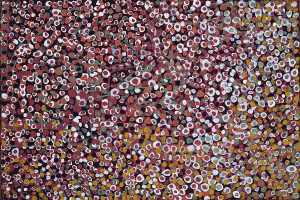
Her painting “Earths Creation” from 1994, brought immediate international recognition and broke records at auction.
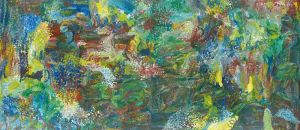
(Images from: 2008. National Museum Australia. [Online]. [8 June 2020]. Available from: https://www.nma.gov.au/exhibitions/utopia/emily-kame-kngwarreye)
It is fascinating to see how an artist who had so little contact with the outside world and with art history, was exploring painting that could be compared to Pointillist or Impressionist works.
I think the impact of these paintings must be so much stronger if you can stand before them as they are really large in size. Emily was painting them with the canvases laying on the ground, and herself sitting on top of the pieces, like if she was a part of the canvas, just as she was a part of the story and of the surroundings. Because of this, they can also be seen from different directions and are hung differently in various exhibitions. I feel very attracted to this idea of painting directly while sitting on the canvas- something to explore.
The fascination of Kngwarreye’s paintings come from the strong sense of connection and love for the land that emanate from them. There is a clear feeling of how much respect and love lies behind the dedication of the dots and lines and choices of colours, reflecting the surrounding land. I believe that strong feeling of belonging, and of connection to nature, is something so many of us crave in our contemporary lives and that is why these paintings affect us so.
This importance of place and belonging is something I am exploring in my own work as well. My parallel project is centered around the stories of a house and a village that I have just moved to in the south of Portugal, and how my own story and the story of my family is intertwining with it now.
In this context, I will continue the research about other artists exploring belonging and home in separate blogposts.
 Clara's Drawing 2