The exhibition “On Line” in the MoMa in 2010-2011 explored “Drawing through the 20 th Century” and ” argues for an expanded history of drawing that moves off the page into space and time.”
I found the linking of drawing and thought fascinating in the following quote from the description of the exhibition on MoMa’s website : “Line, like thought, once understood as linear and progressive, has evolved into a kind of network: fluid, simultaneous, indefinite, and open.”
(quotes from: 2020. MoMa/ On Line. [Online]. [1 June 2020]. Available from: https://www.moma.org/interactives/exhibitions/2010/online/)
Seen like this, almost anything can be a drawing, which opens up exhilarating possibilities.
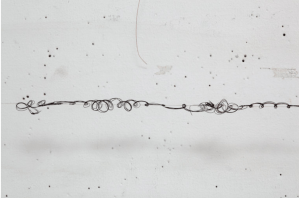
During this chapter of the course, I have become more sensible to seeing lines and drawings all around me. In many works of this exhibition, a spontaneous or accidental line , is moved back into the art context. So for example Pierrette Bloch’s five sculptures, titled “Horsehair lines” , each made of a horsehair extended on a nylon thread. I imagine the horsehair curls up naturally, and Bloch then took this scribbled line in space and mounted it and presented it as the sculpture it is.
(Image from: 2010. MoMa/On Line. [Online]. [8 June 2020]. Available from: https://www.moma.org/interactives/exhibitions/2010/online/#works/02/55)
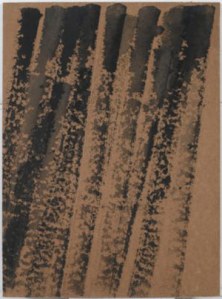
It looks like something could be written in space. Pierrette Bloch is described as using “Poor materials” as besides these horsehair drawings, she is often using ink on found paper or cardboard. She is also very sparse in her mark-making, and very repetitive, using repeated dots, lines or hyphens. I feel that, because she is not “elevating” the marks she makes to a painting, or a fancy drawing on thick paper with an expensive frame- they transport more a message of being a written note, a message or a musical chord, that seems like it should be easily readable, but then has the intriguing elusive quality of only being understood by the artist herself.
2009. Artcriticalcom. [Online]. [8 June 2020]. Available from: https://artcritical.com/2009/05/11/pierrette-bloch-at-haim-chanin/)
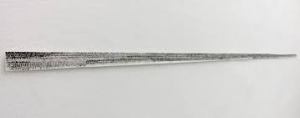
The support also becomes an important part of the message, for example in her very, very long drawings, where the paper is already a very long line. Here it is an interesting tension between the line, the paper, and the repetitive dots that punctuate it, with the paper being as much the drawing as the ink.
2009. Musee Fabre en Montpellier. [Online]. [8 June 2020]. Available from: https://museefabre-en.montpellier3m.fr/Exhibitions/Pierrette_Bloch).
Robert Rauschenbergs’s “Automobile Tire Print” from 1953, is also presented on a long scroll of paper.
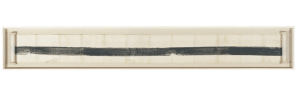
Here, he let a friend drive through a pool of black paint and then over the prepared paper. This piece is closer to performance art, than to the gestural approach of Pierrette Bloch. The drawing is a direct record of the movement of the tyre over the paper. This work was a pioneering piece between a ready-made, a performance and an automated drawing.
This long format, adds a feeling of representing a landscape, an idea that then collides with the subjects of a mark made by a tyre.
Ellsworth Kelly was represented with some automated drawings, like here a drawing from pine branches from 1950 :
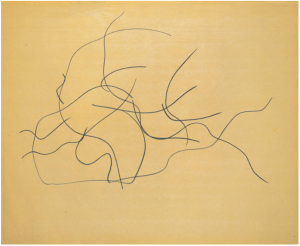
It was really fun exploring different ways of producing automated drawings for Part 3 of this course, but I am not sure I would be so fascinated at looking at them in an exhibition.
I found the following piece by the same artist much more interesting- here he has intervened and cut up the drawing in 49 different pieces and then placed them together randomly. I find this piece more engaging and exciting with the interesting pattern it creates, as well as being attracted to the idea of trying this.
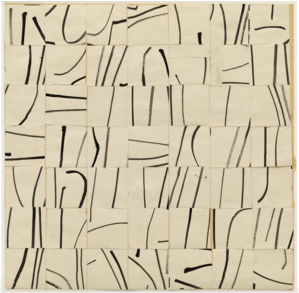
(Images from: 2010. MoMa/On Line. [Online]. [8 June 2020]. Available from: https://www.moma.org/interactives/exhibitions/2010/online/#works/02/45)
As described in the course manual, Edward Krasinski extends his lines into the environment, so his drawings exist somewhere between 2 D drawings and sculpture.
His signature is the use of blue line, which can be drawn with tape or cable.
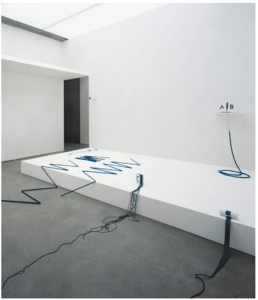
2010. MoMa/On Line. [Online]. [8 June 2020]. Available from: https://www.moma.org/interactives/exhibitions/2010/online/#works/02/66)
His paintings are site-specific, in that they connect the work with the surroundings through the tape, but in many works, like here in “Intervention 15” from 1975, by the geometrical form on the painting relating to the architectural shapes in the gallery around it.
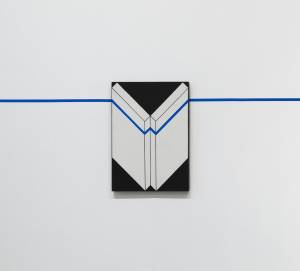
Intervention 15 1975 Edward Krasinski 1925-2004 Presented by Tate International Council 2007 http://www.tate.org.uk/art/work/T12568
The stripe of tape does not just pass through the painting, but follows the contours of the form depicted, so that it emphasizes the 3-dimensional form.
(Image from: 2010. Tateorguk. [Online]. [8 June 2020]. Available from: https://www.tate.org.uk/art/artworks/krasinski-intervention-15-t12568)
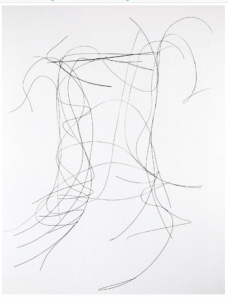
I became quite fascinated with the wireworks of Czech artist Karel Malich .
The name of this drawing from 1974 is “Energy”, and I can certainly feel the swirling energy emanating from it.
(Image from: 2010. MoMa/On Line. [Online]. [8 June 2020]. Available from: https://www.moma.org/interactives/exhibitions/2010/online/#works/02/68)
If this drawing would have been two-dimensional on a piece of paper, it would not have the impact as it has when the space around it becomes part of the drawing, and when a light is directed towards it, it adds shadows that are another new level of the drawing.
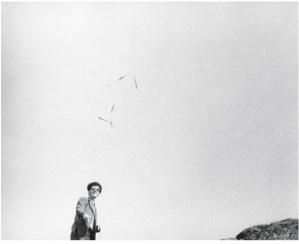
Another work that I found fascinating from the exhibition is Tom Marioni’s “One second sculpture”.
2010. MoMa/On Line. [Online]. [8 June 2020]. Available from: https://www.moma.org/interactives/exhibitions/2010/online/#works/02/69)
Here the artist holds a metal line in his hand and throws it in the air where it forms a shape for one second and then falls flat to the ground. This work exists in an interesting crossroads of drawing in the sky, momentary ephemeral sculpture, performance and even music with the sound it creates in the air. Adding this element of time really stretches the concept of drawing to a place that I had not considered before.
After studying these works from the exhibition On Line and further, and seeing how a drawing can extend into space, I would consider Louise Bourgeois “Spider” from 1995 a drawing without hesitating.

Spider 1994 Louise Bourgeois 1911-2010 ARTIST ROOMS Tate and National Galleries of Scotland. Lent by the Easton Foundation 2013 http://www.tate.org.uk/art/work/AL00354
2016. Tateorguk. [Online]. [8 June 2020]. Available from: https://www.tate.org.uk/art/artworks/bourgeois-spider-al00354)
This monumental bronze sculpture truly feels like a line drawing that has stepped out from the confinement of a two- dimensional drawing into space.
ALL IMAGES REPRODUCED FOR EDUCATIONAL PURPOSES ONLY
 Clara's Drawing 2