Aim: The aim of this exercise is to open up your mind to new possibilities in terms of understanding what line can be. So often, nature does it better. This is your chance to go out and look at how drawings reflect life, and at life drawings in the observed world.
Method: Look for natural processes that produce a drawing, for example the opening of the gills of a mushroom to release its spores, the dropping of lily pollen, animals scratching against trees or footprints in wet mud. Even the silhouette of tree branches against the sky can be read as a drawing. Collect photos and sketches of nature’s drawings. If you prefer, you can do the same thing for industrial or urban processes.
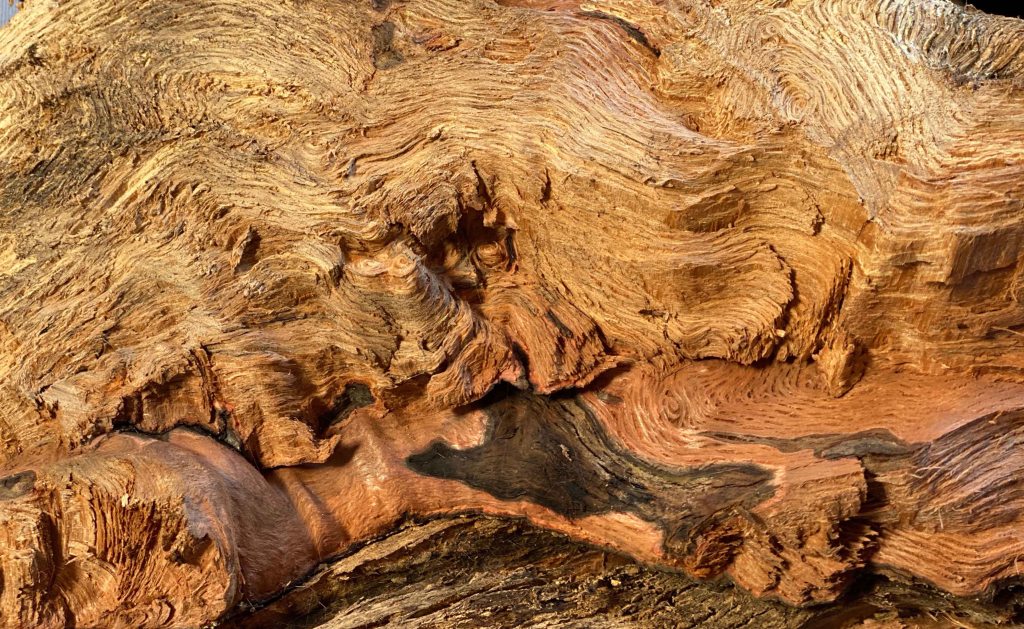
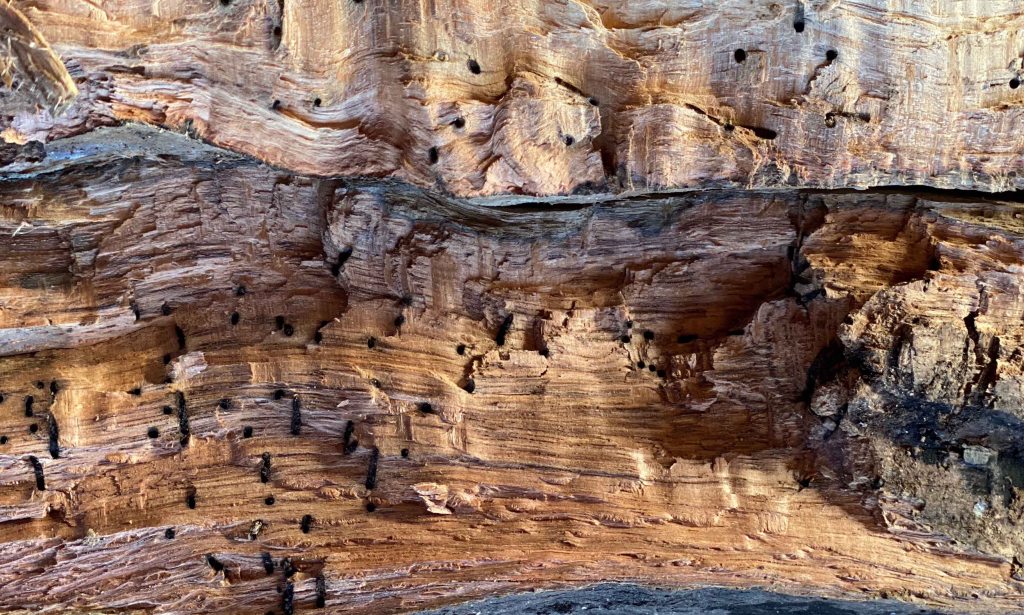
Now this is a project that I absolutely love. I see lines and drawings everywhere. While lighting a fire, I see a drawing in the logs:
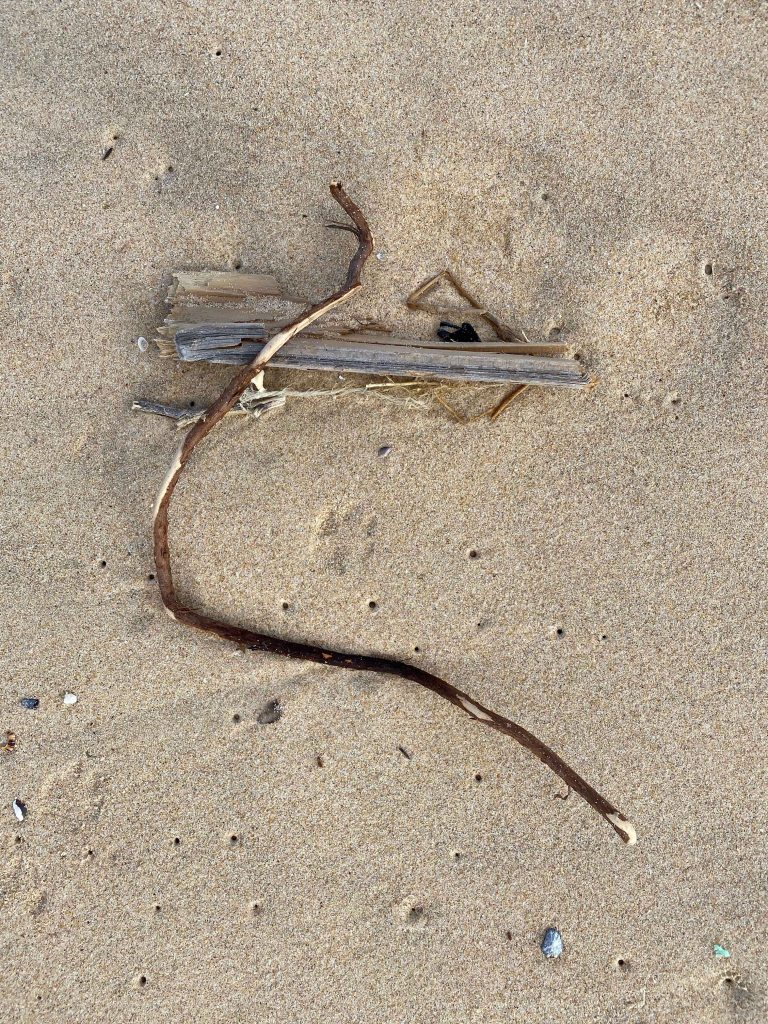
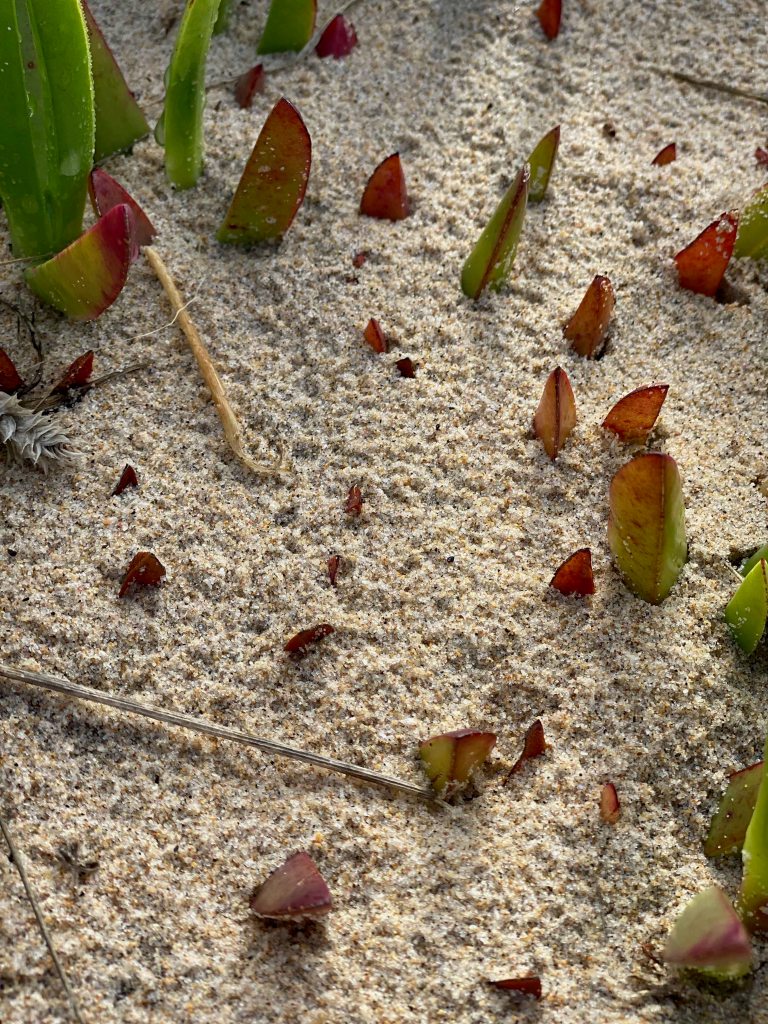
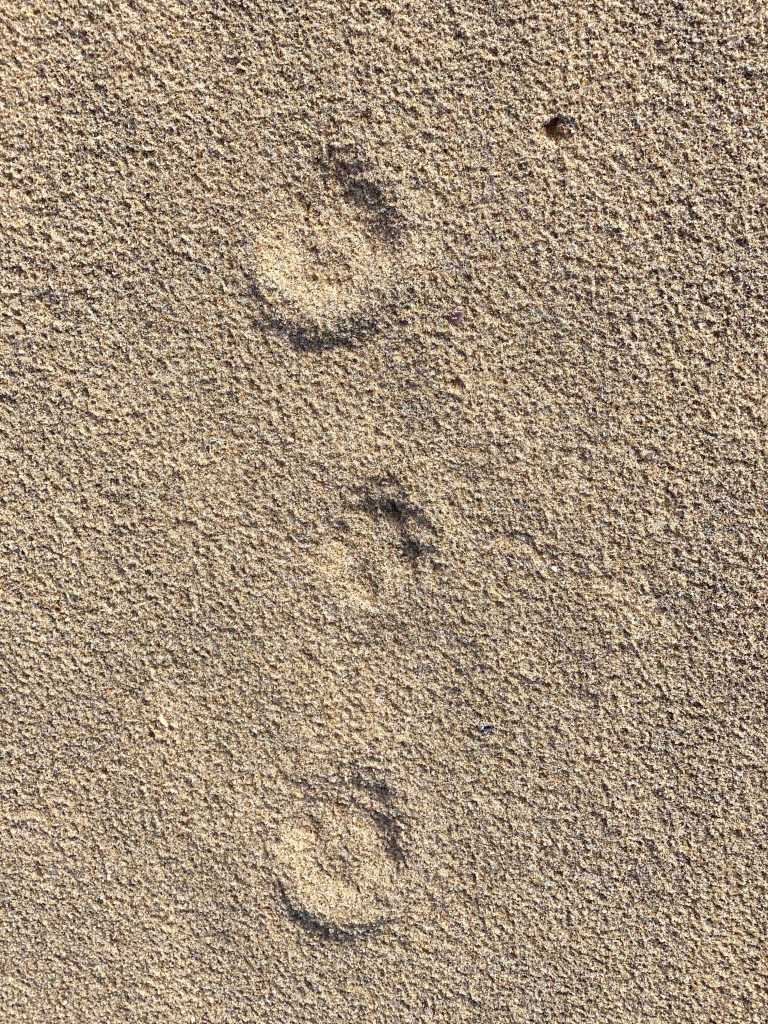
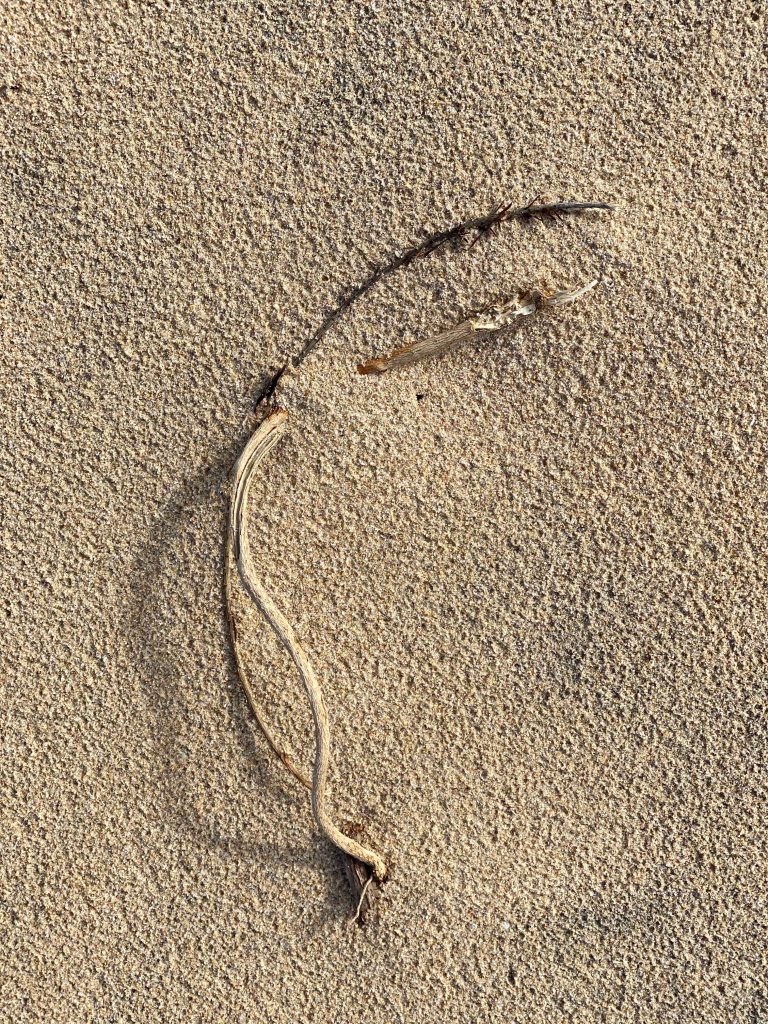
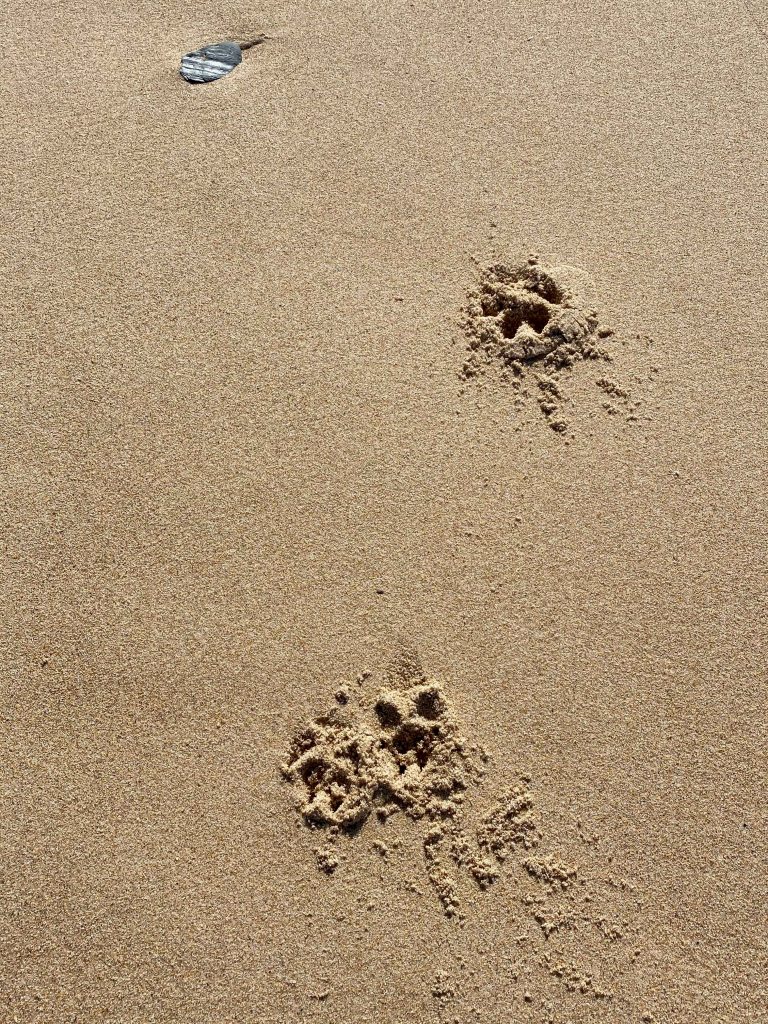
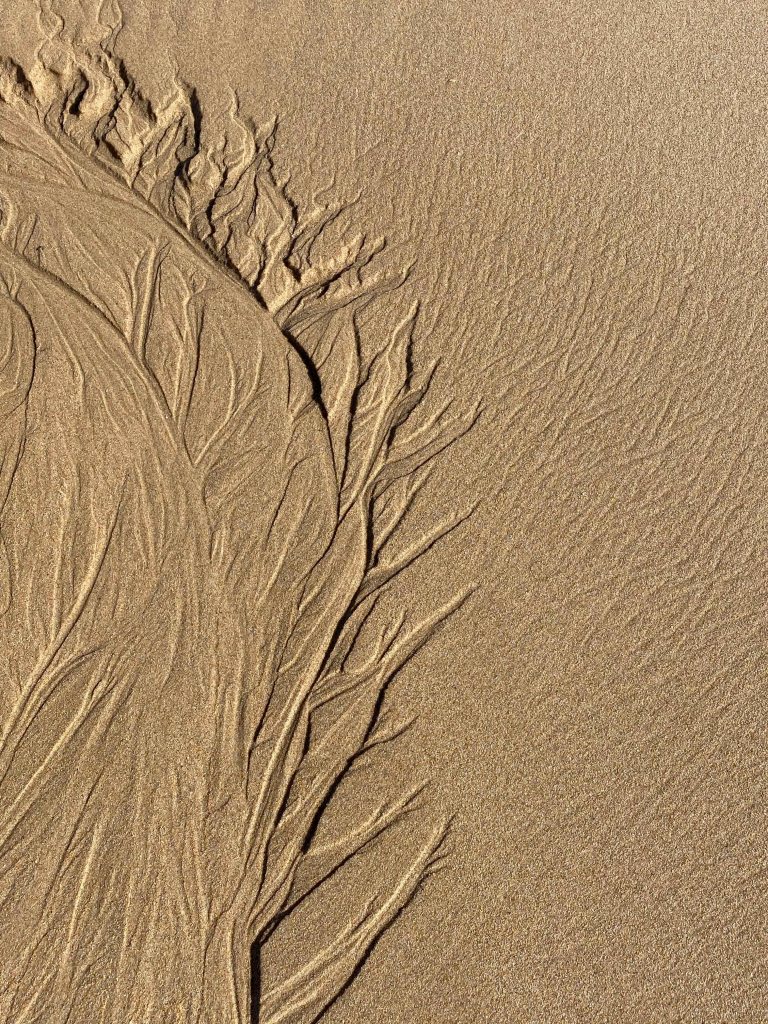
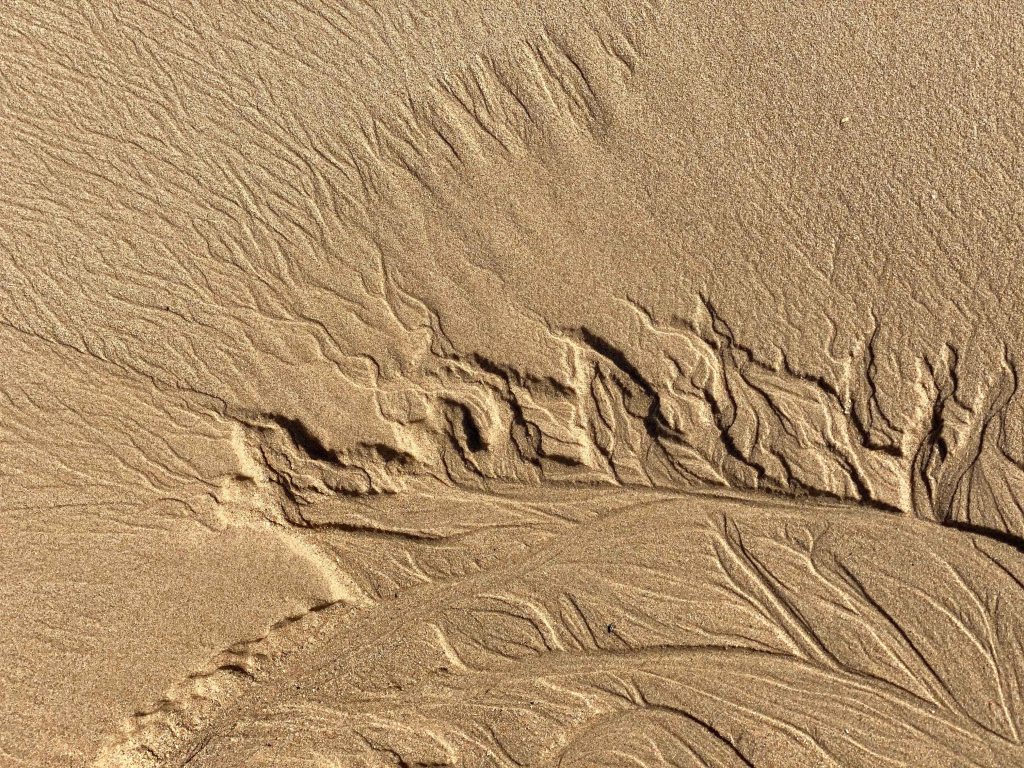
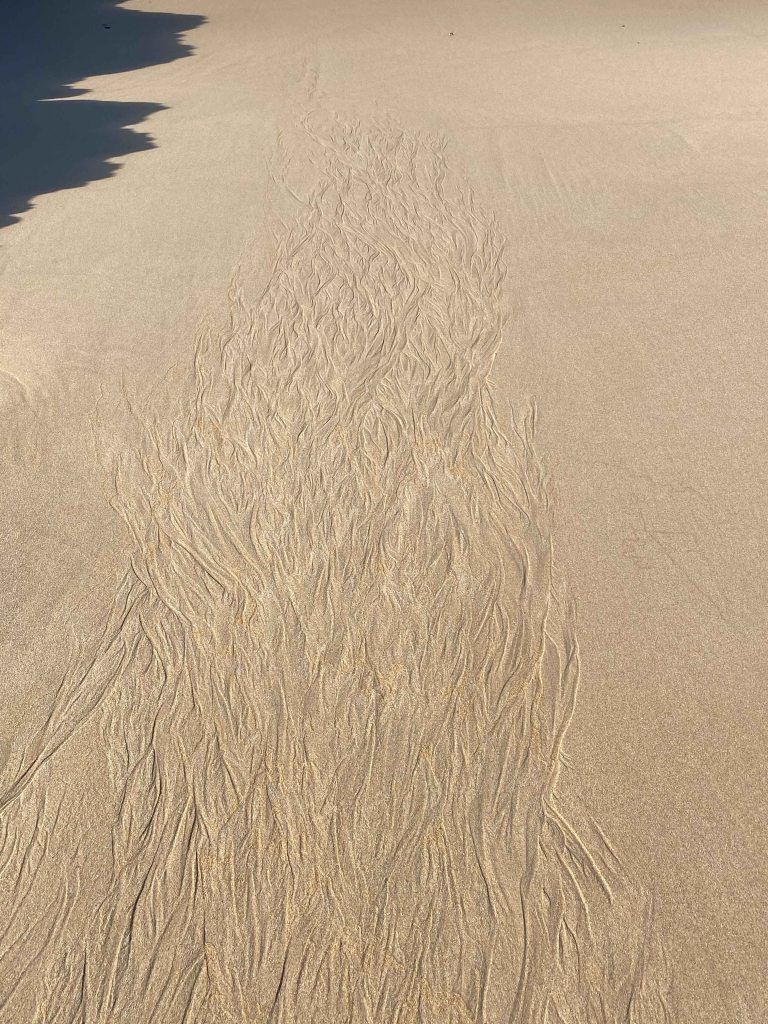
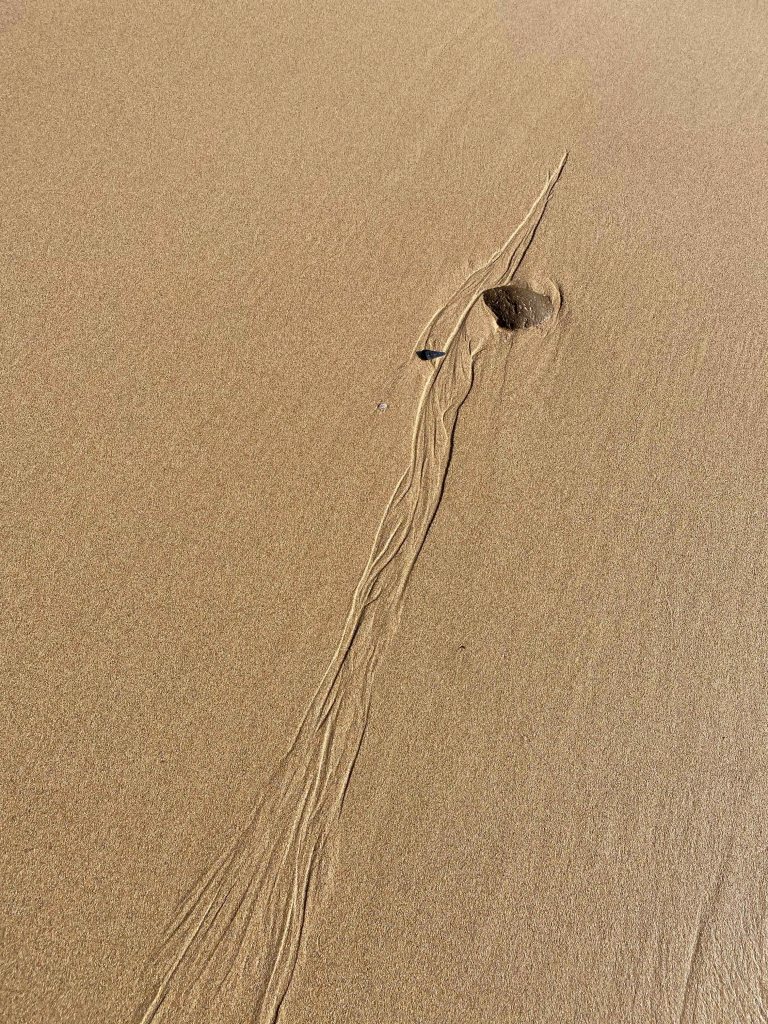
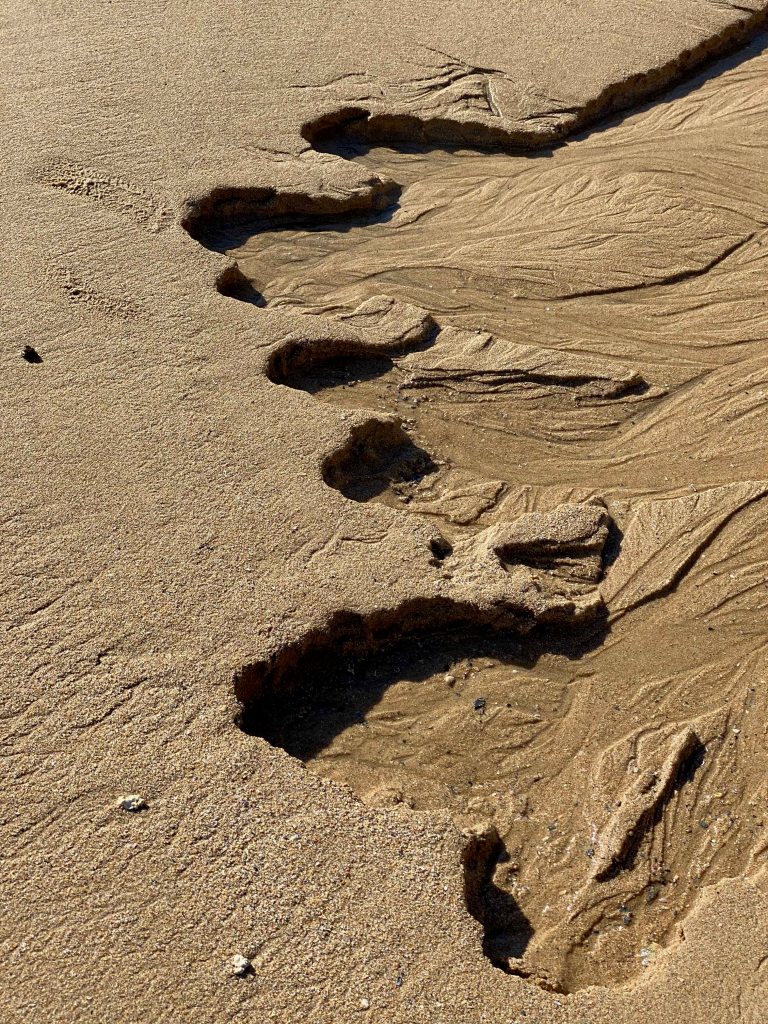
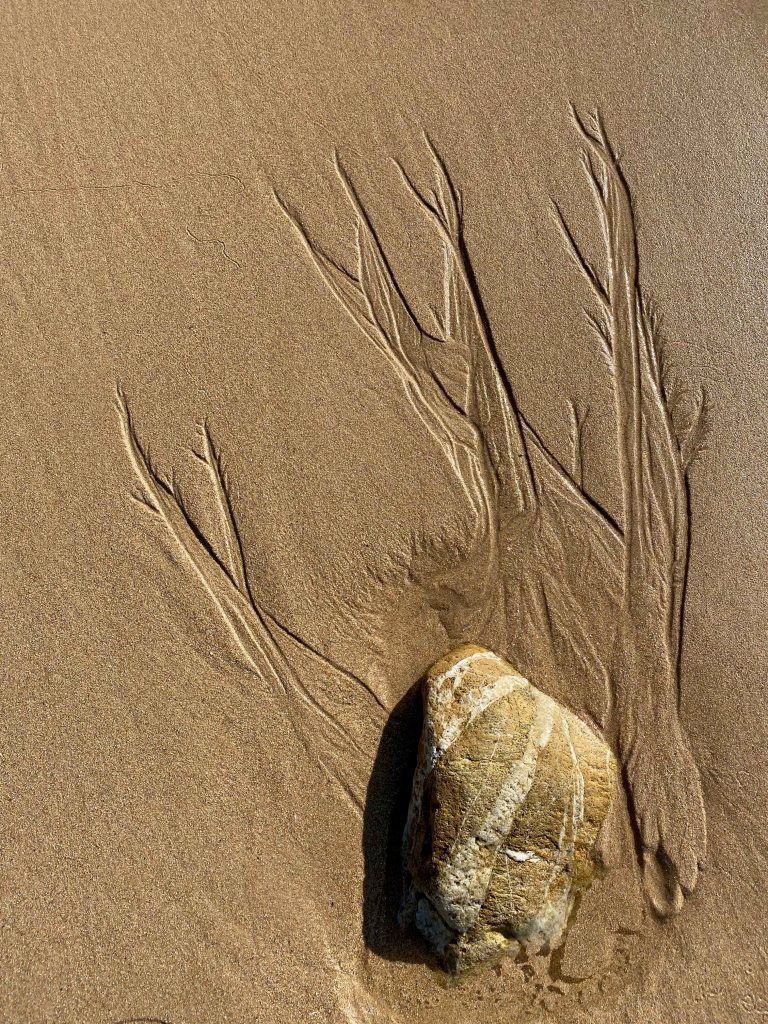
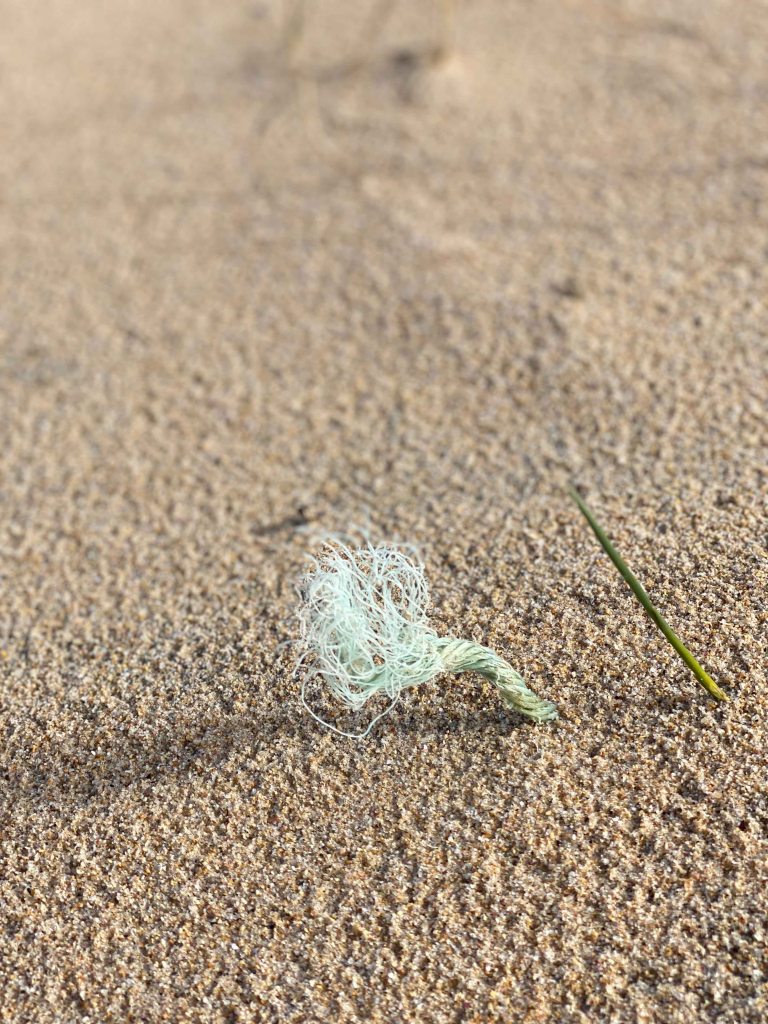
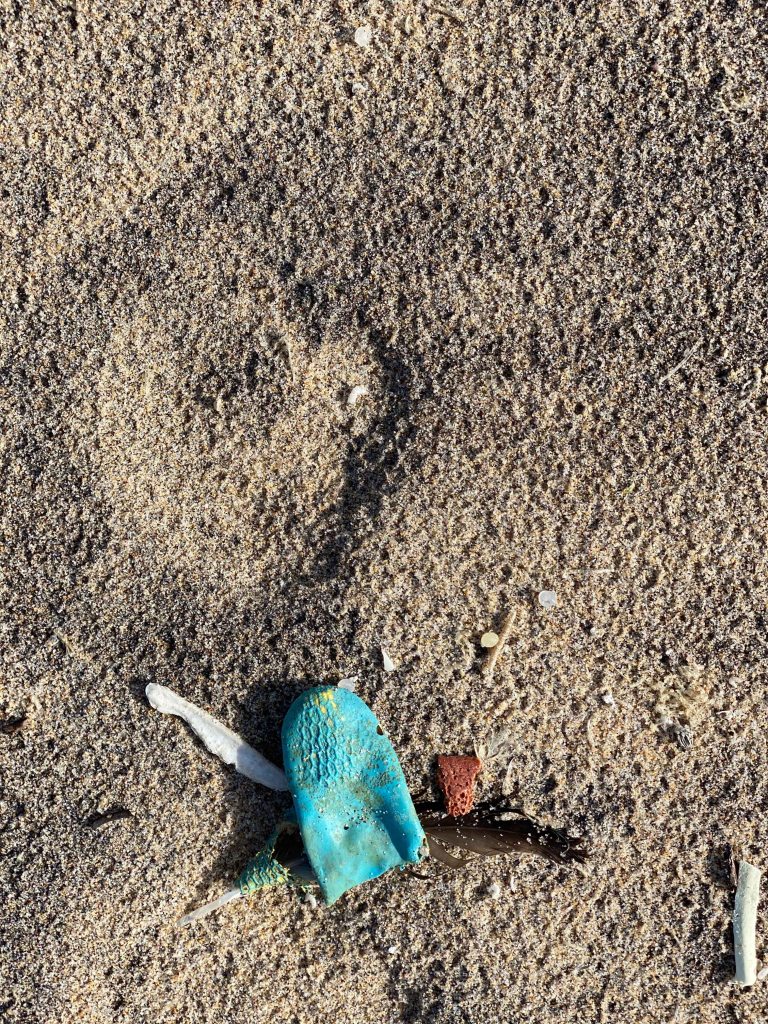
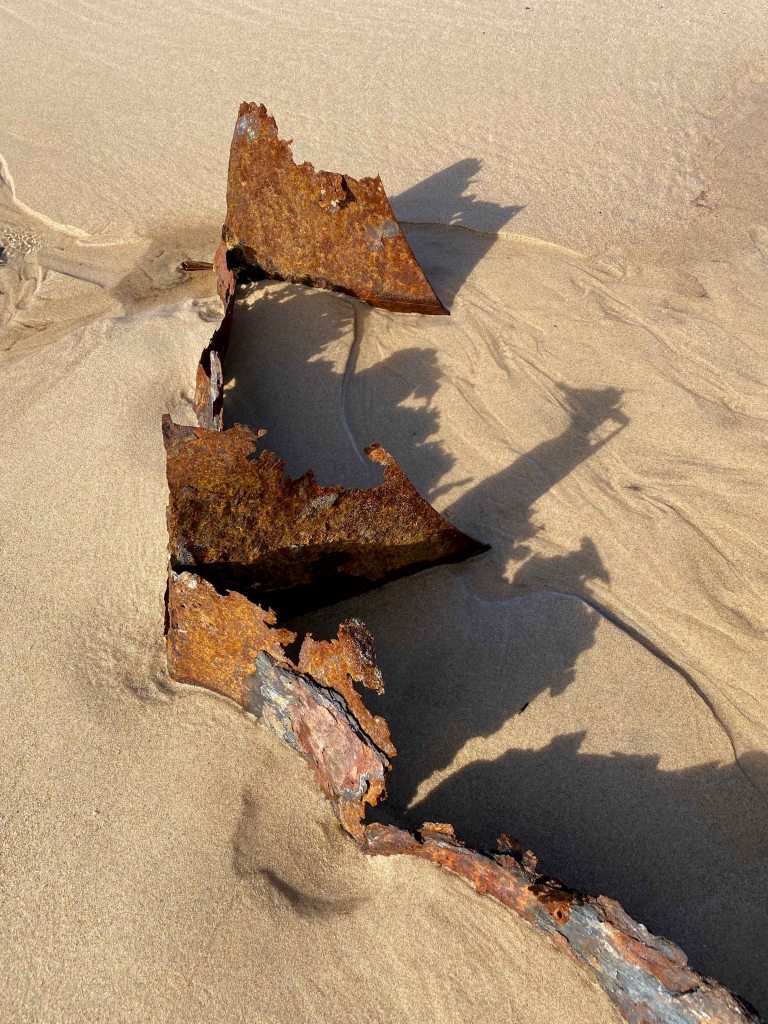
As it is finally, finally allowed to walk on the beach after a long quarantine, I immediately set off. The traces in the sand and debris washed ashore show endless possibilities of lines- thin delicate lines, thick, messy lines:
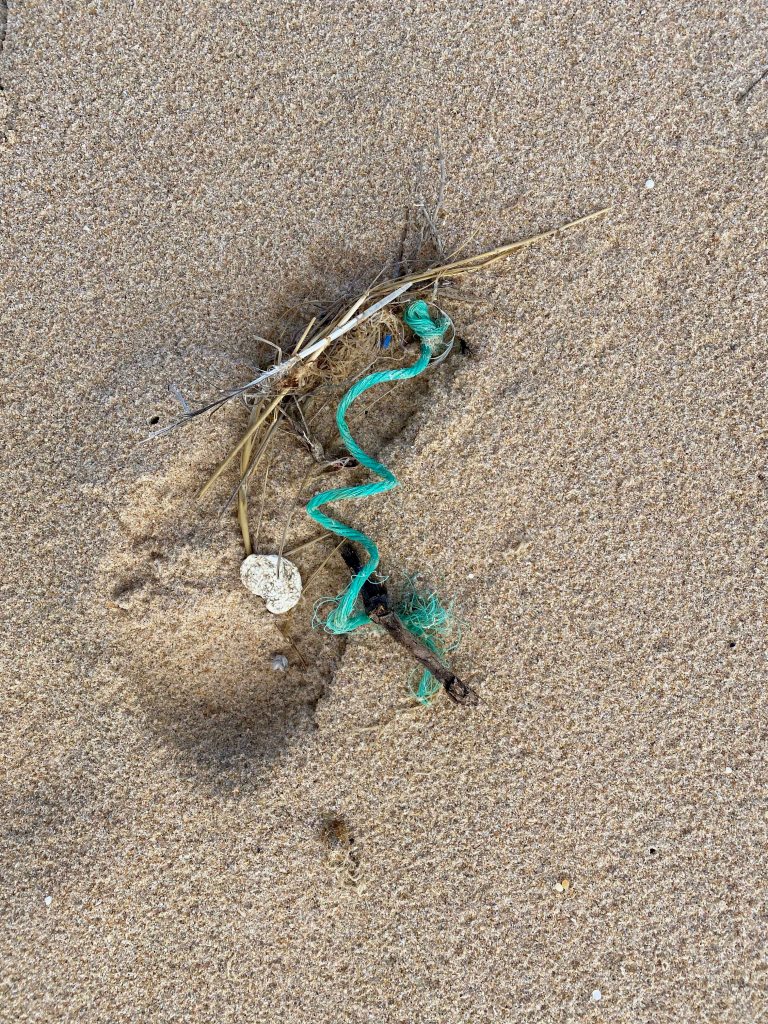
Washed up on the sand, a mixture of man made debris and sticks and stones form new drawings:
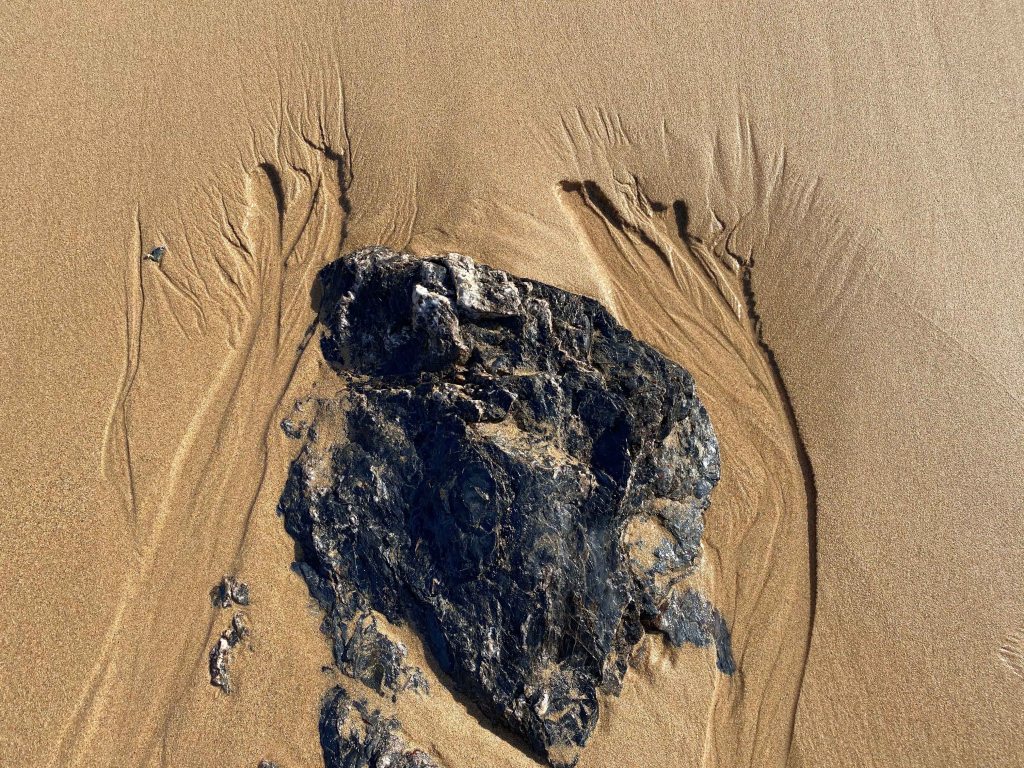
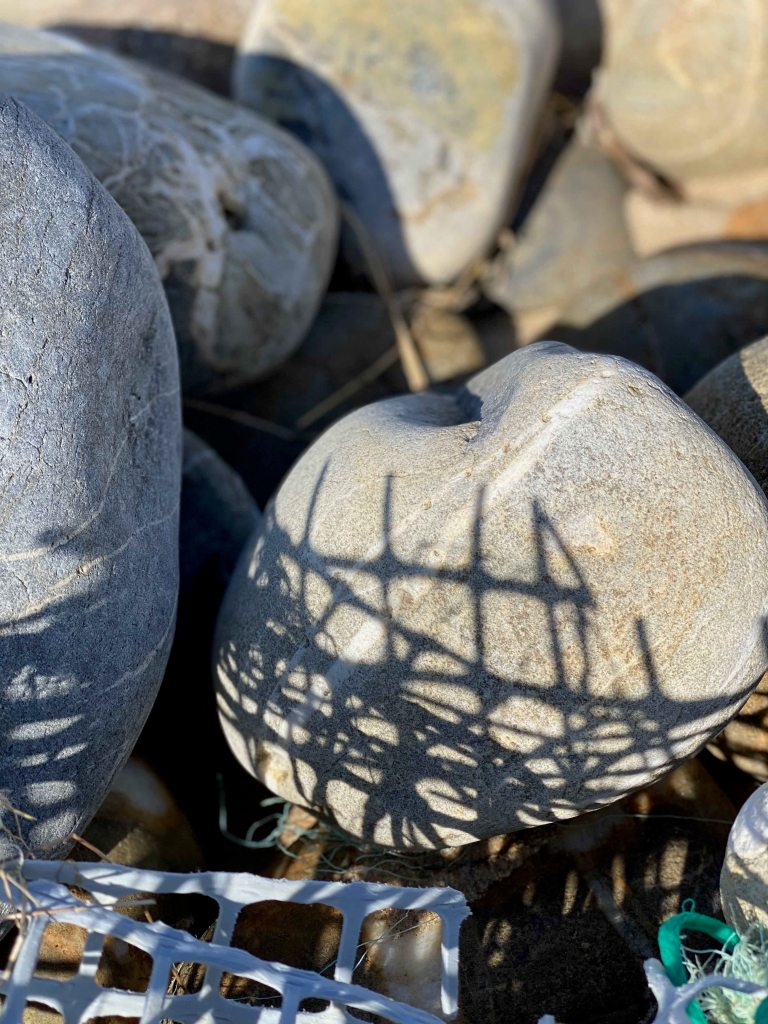
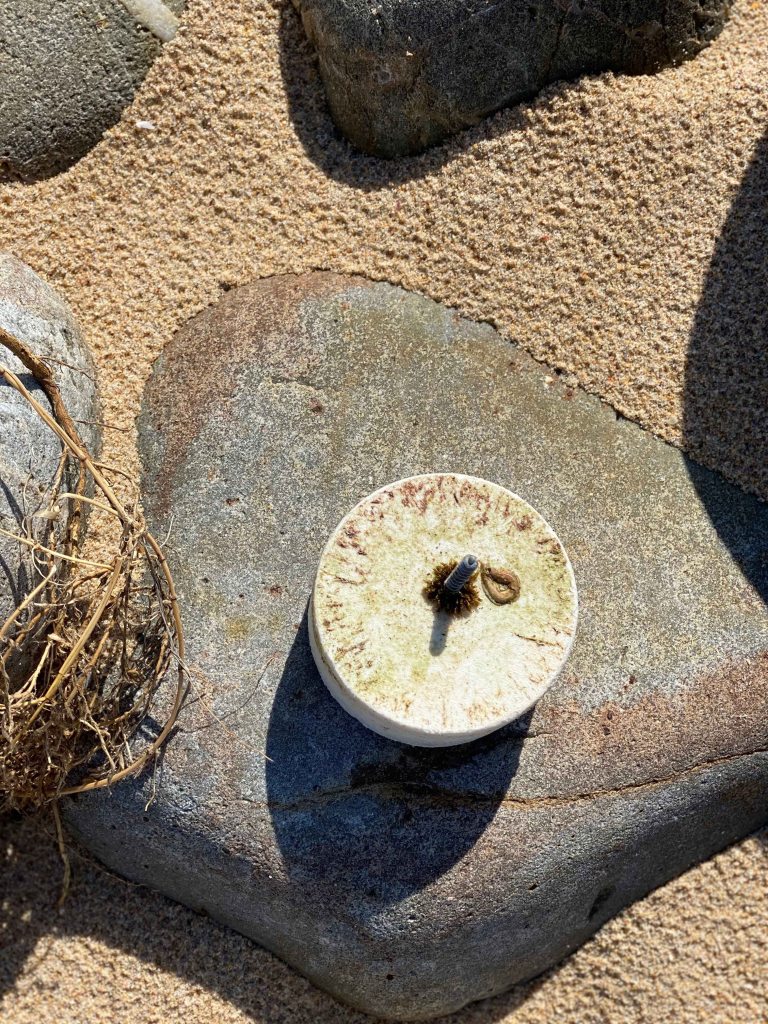
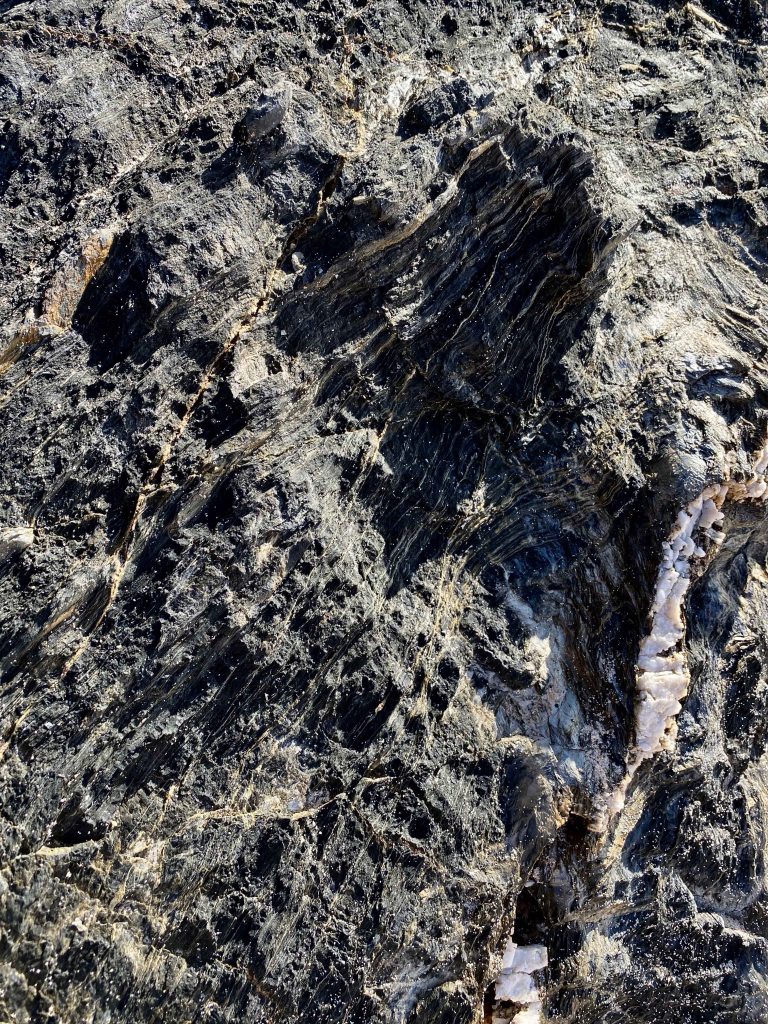
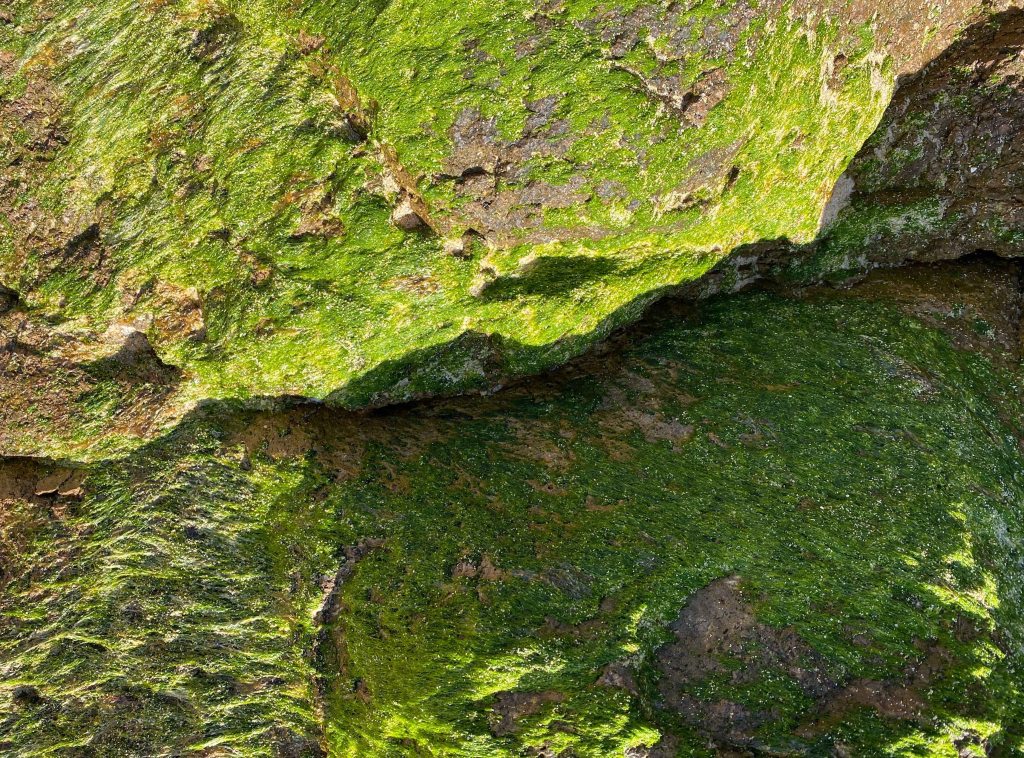
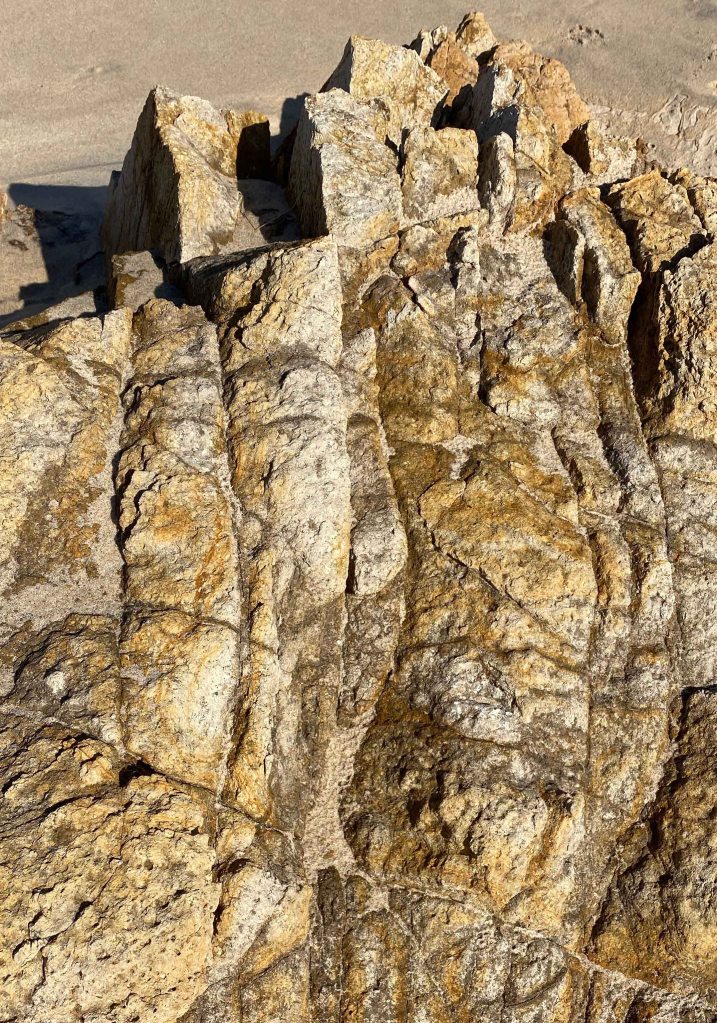
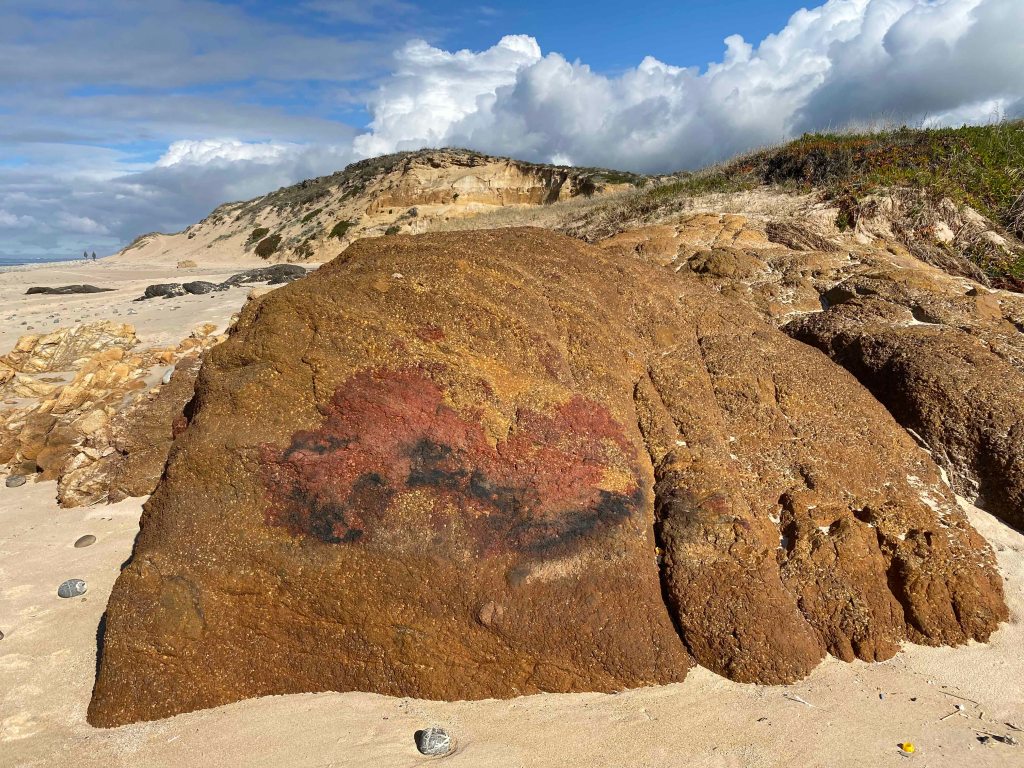
I also find drawings in the cracks and lines and patches on stones and rocks:
Nature really does it better!
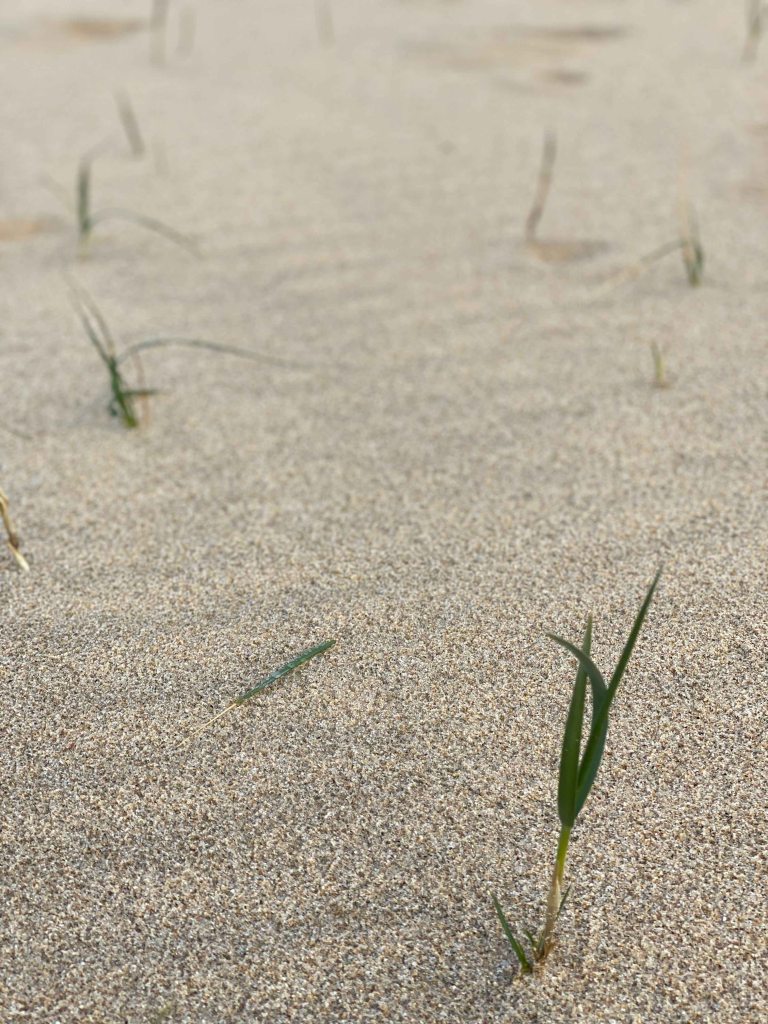
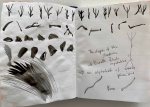
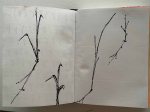
I use Indian ink and a thin brush to draw the lines formed by grasses sticking out of the sand and their sharp shadows in my various small sketchbooks:
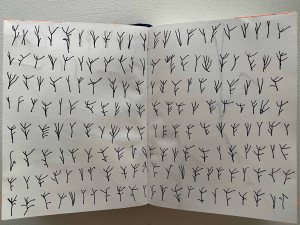
I have just looked at Pierrette Bloch’s abstract drawings and her repetitive use of line. I see how I can produce a collection of grass straws in a similar drawing. This is a first attempt in my A5 sketchbook:
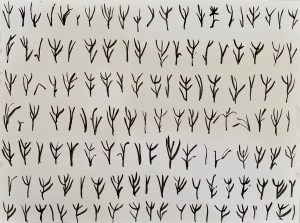
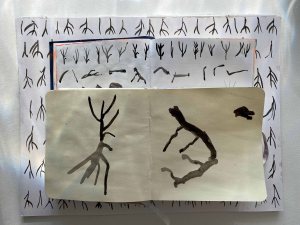
The various shapes of grass presented like this in the form of a chart, become a new alphabet, a new language. I refine the shapes in a drawing on A4, in Indian ink:
When I place the sketchbooks in a pile, I see another pattern emerging:
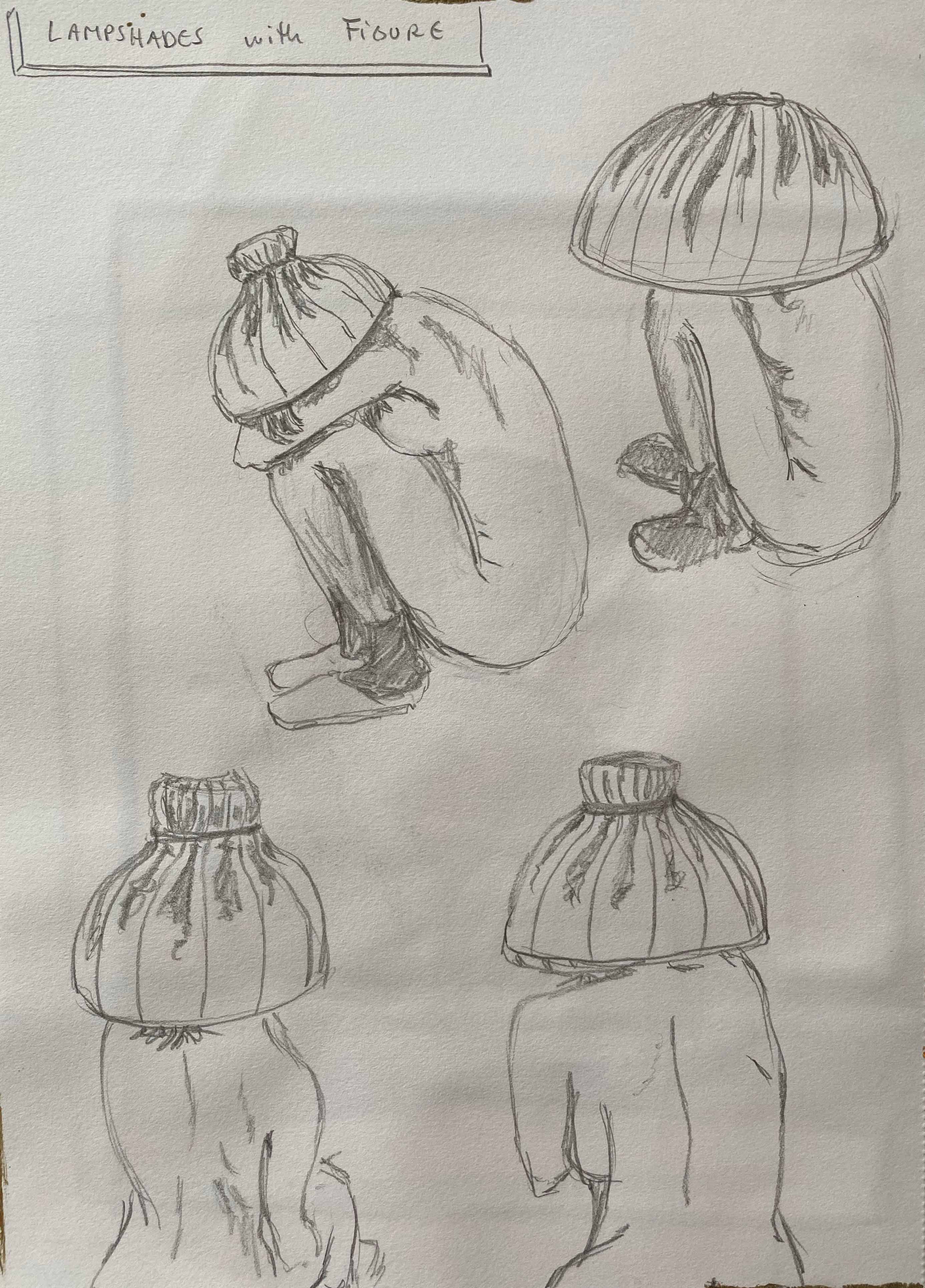
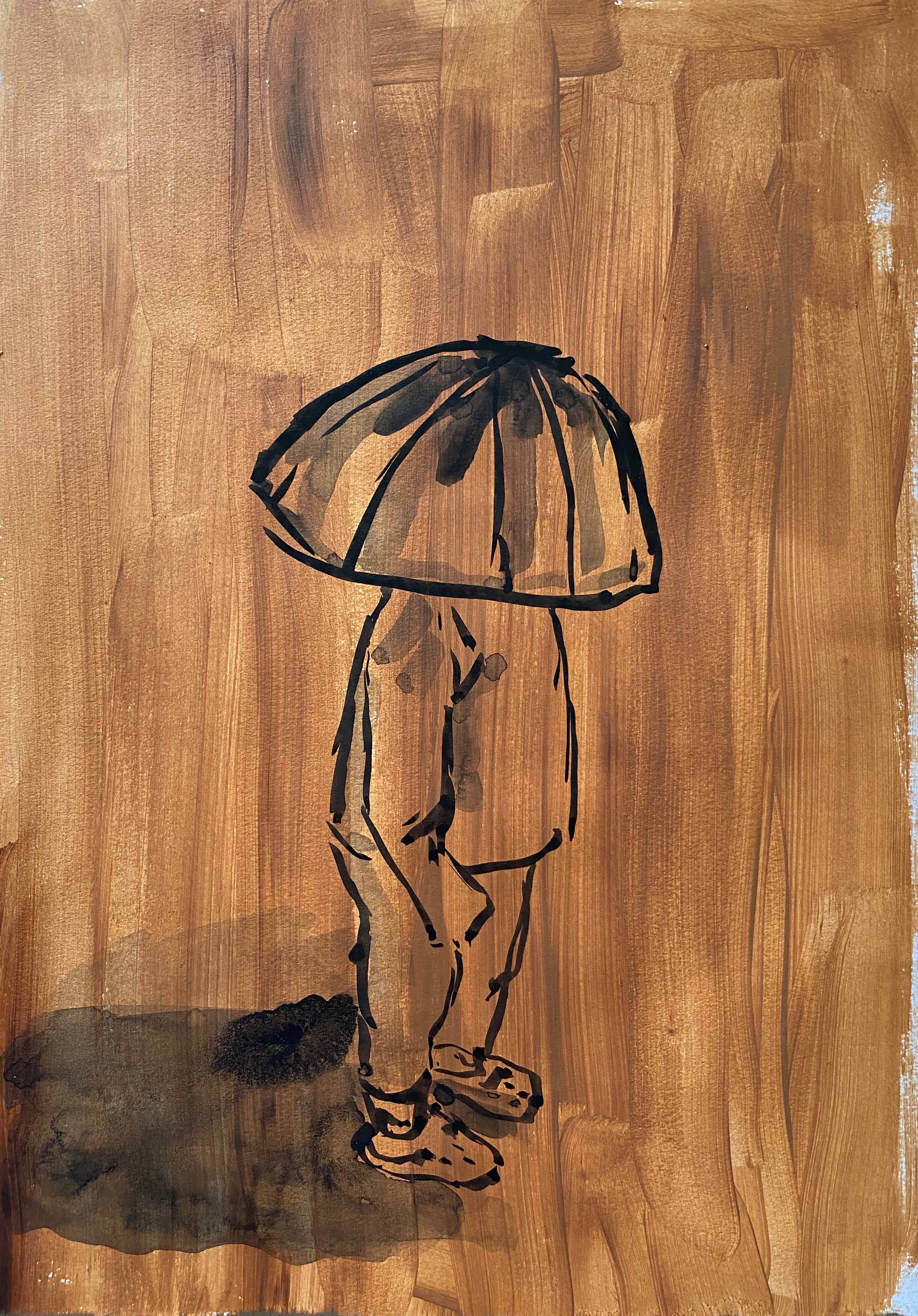
In some of the rooms, a solitary lampshade was left dangling when we arrived here. I have collected them and planned to use them both as a support to paint on and as a subject for still life.
They first appeared in Part 3, Project 2, Experiments with mark-making:
And I used one as a support for a fun way to close my rather dark drawings with masks in 2.3 Narrative:
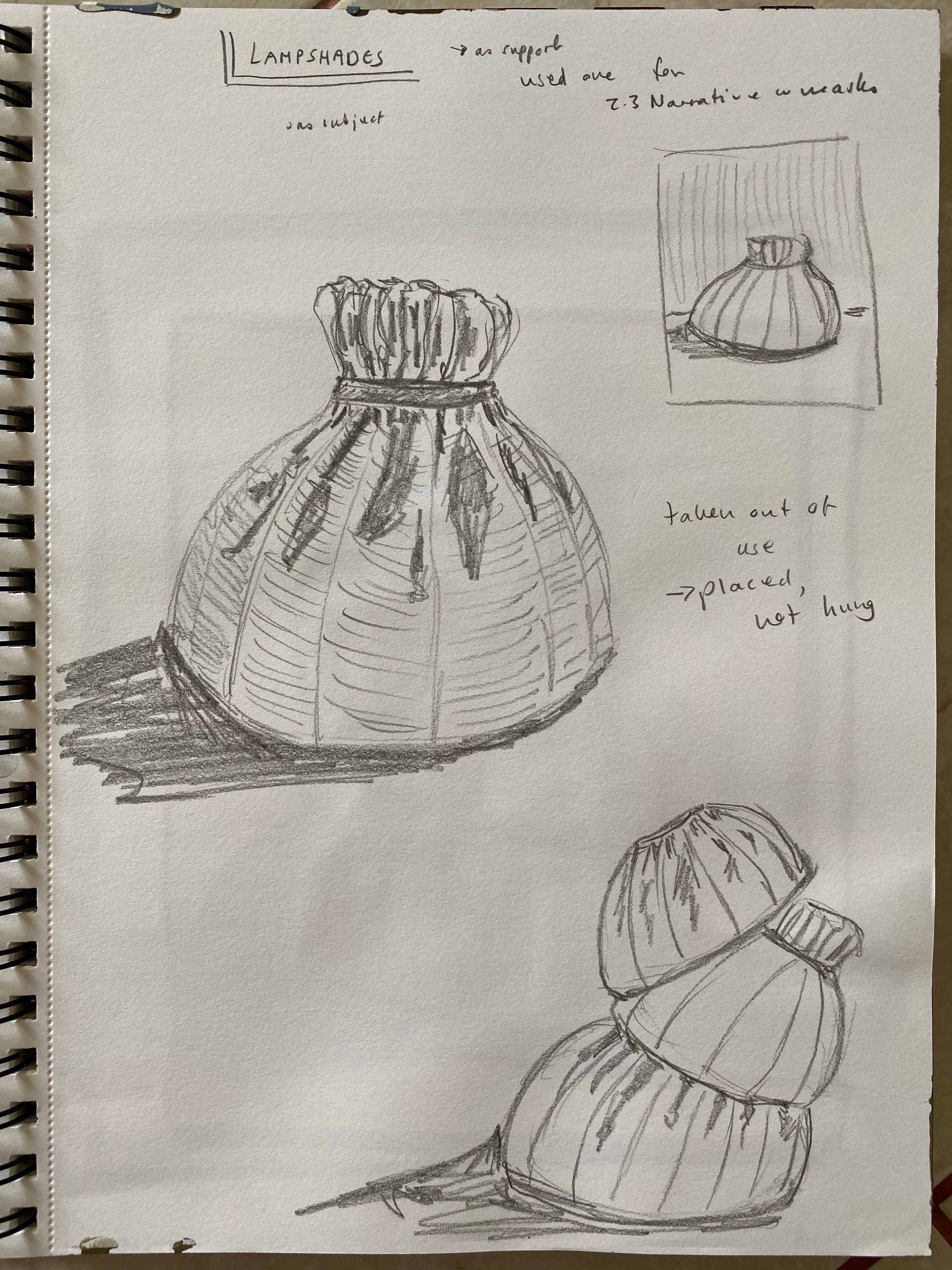
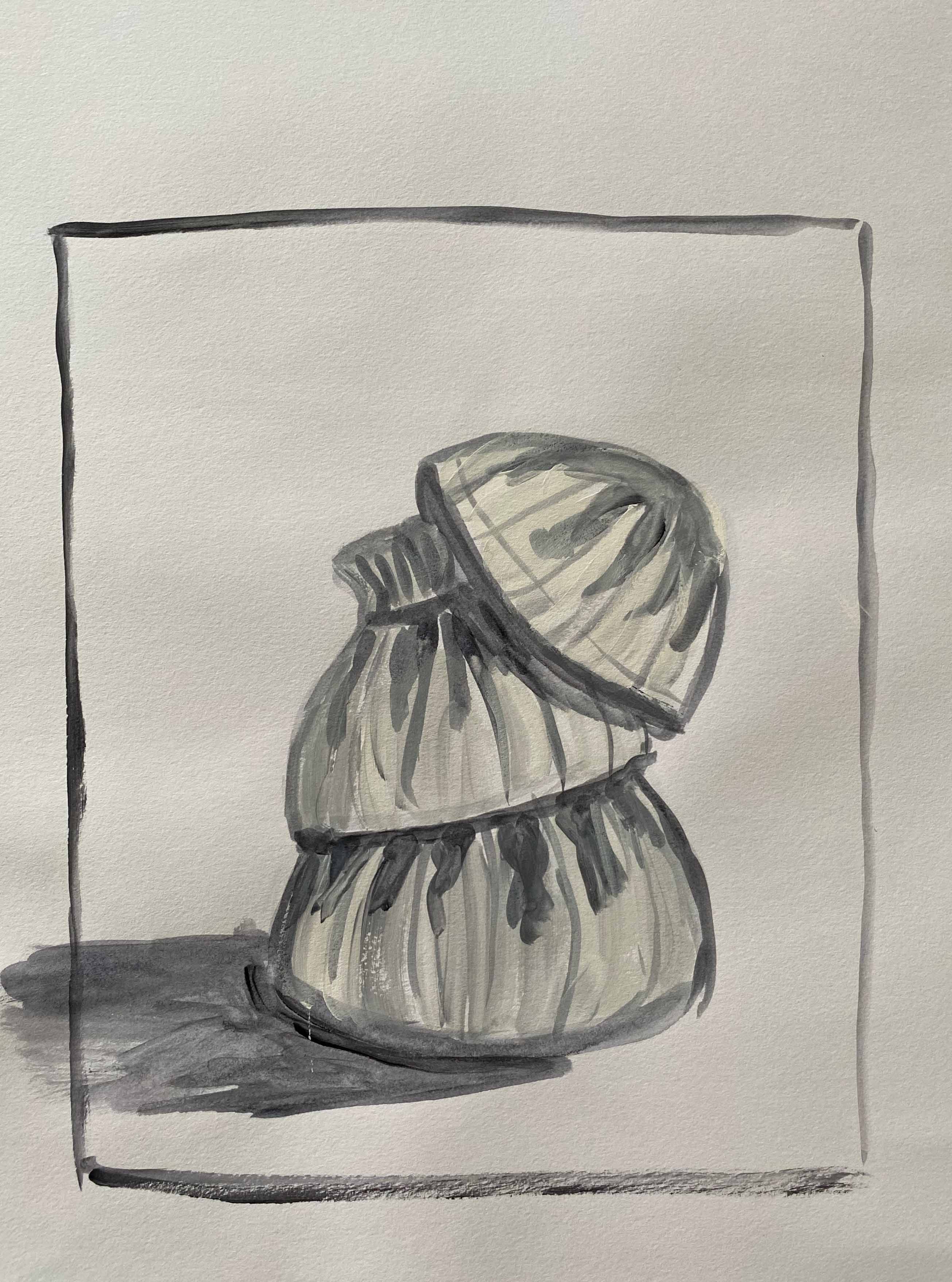
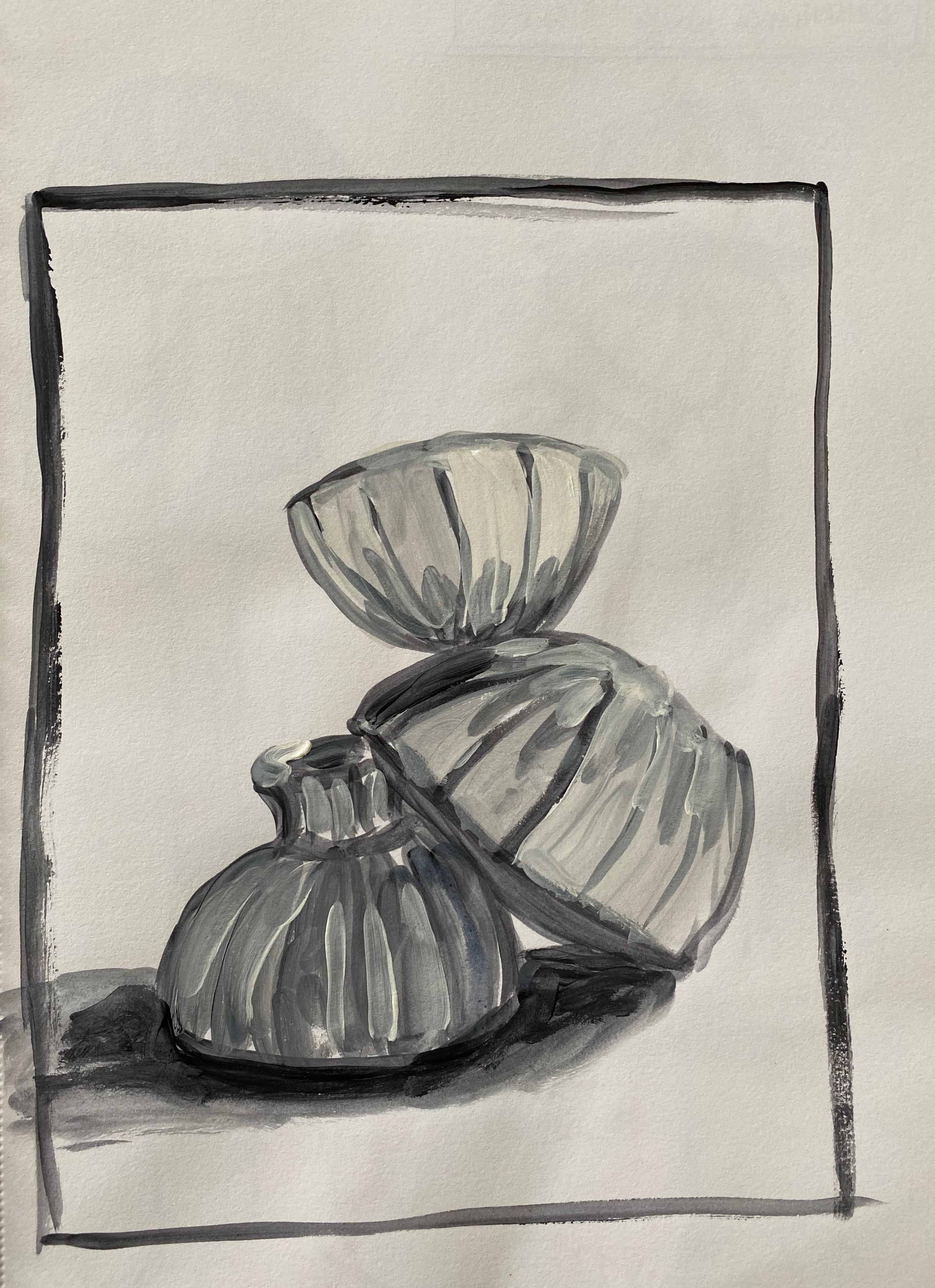
I am now arranging the lampshades in various ways for still life, piling them up instead of hanging them to take them out of their context.
Pencilsketches A4:
Sketches in Payne’s grey and Titanium White acrylics, A4:
I like these shapes and see that they have potential, but it is when I imagine to include the figure that I really start getting excited about this subject.
One advantage with the Covid 19 lockdown, is that my daughter and granddaughter have time to model.
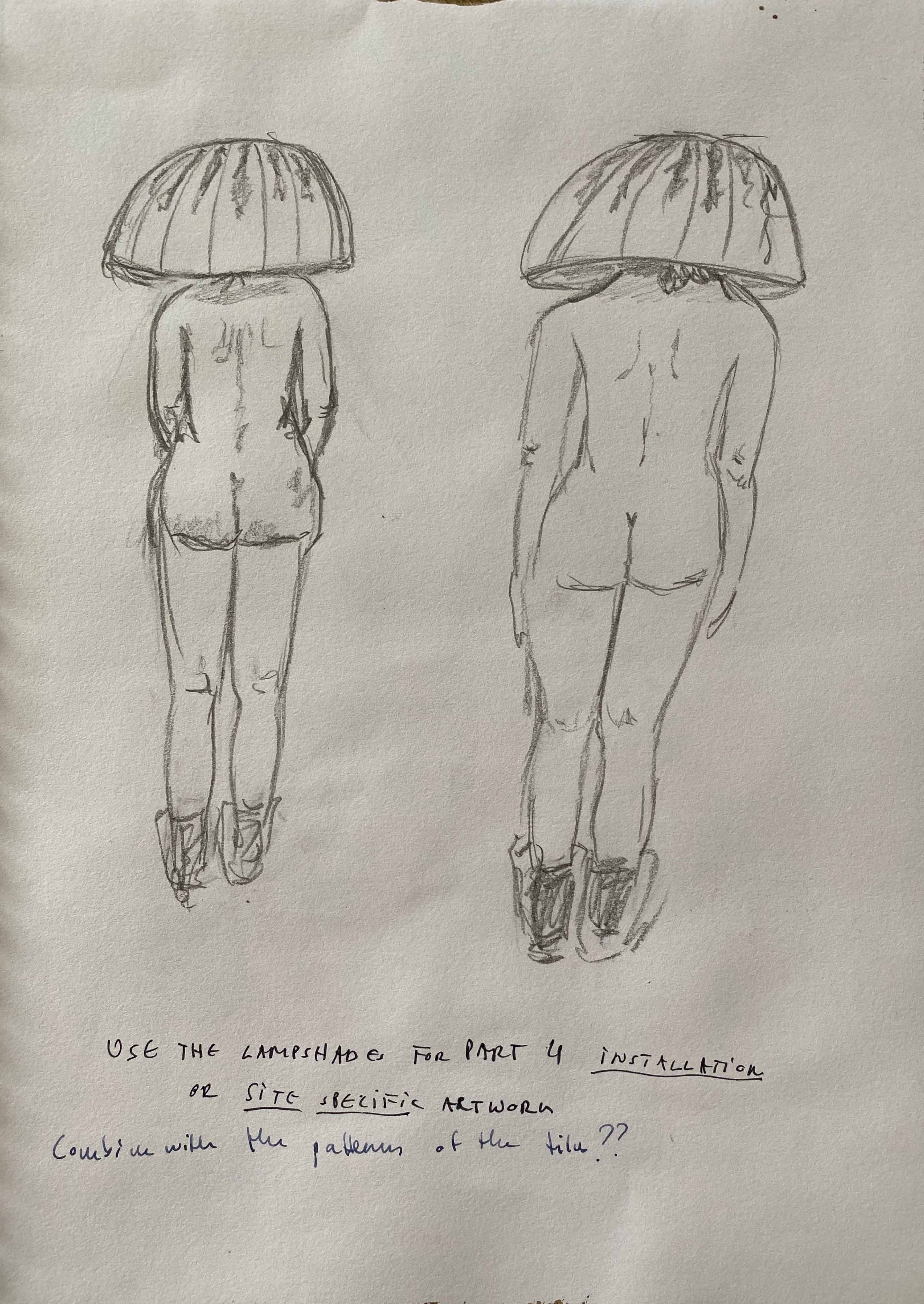
Pencil sketches A4 in sketchbook:
Sketches on the walls of “Parallel project- empty room, modern cavepainting” ( see separate post):
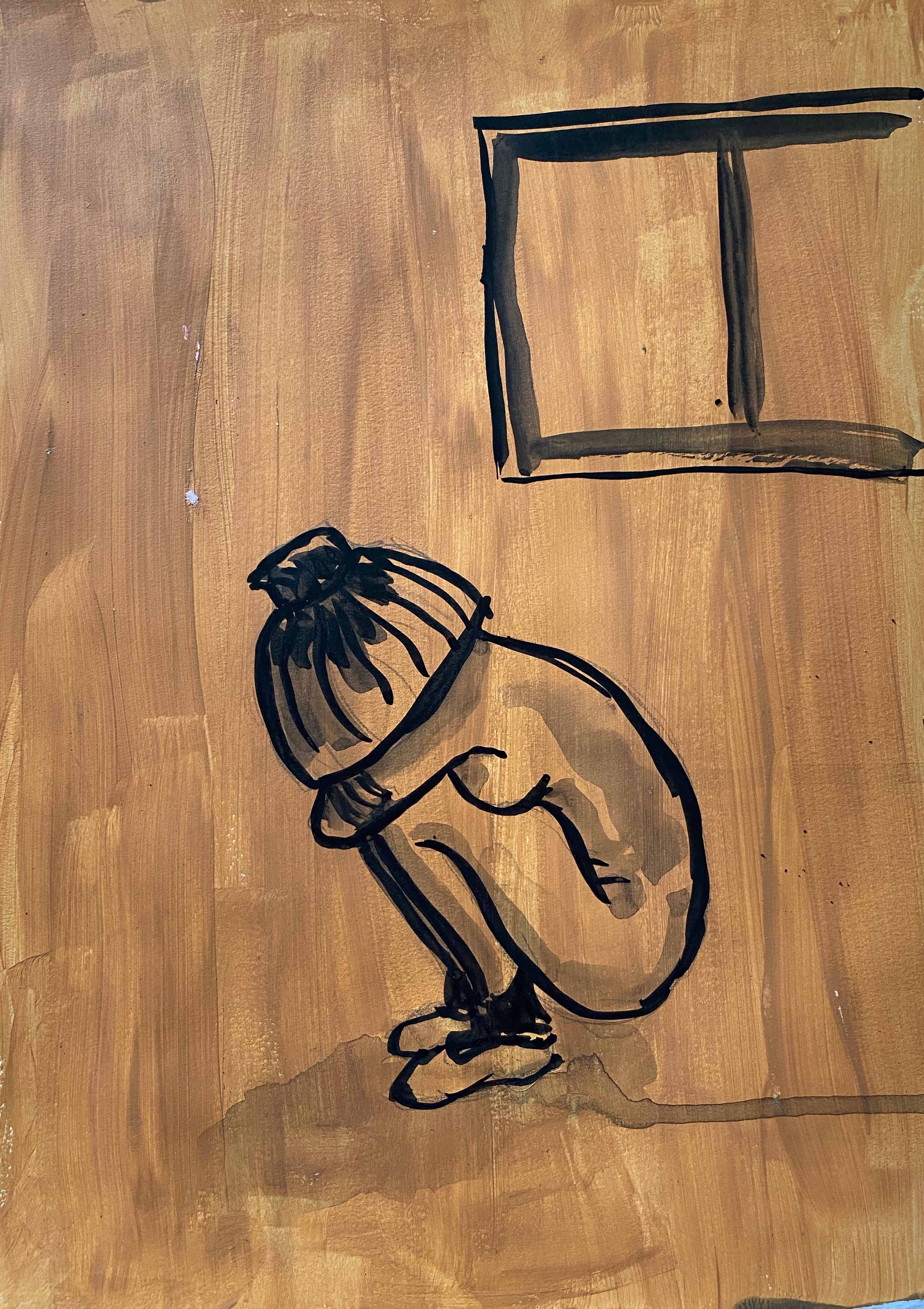
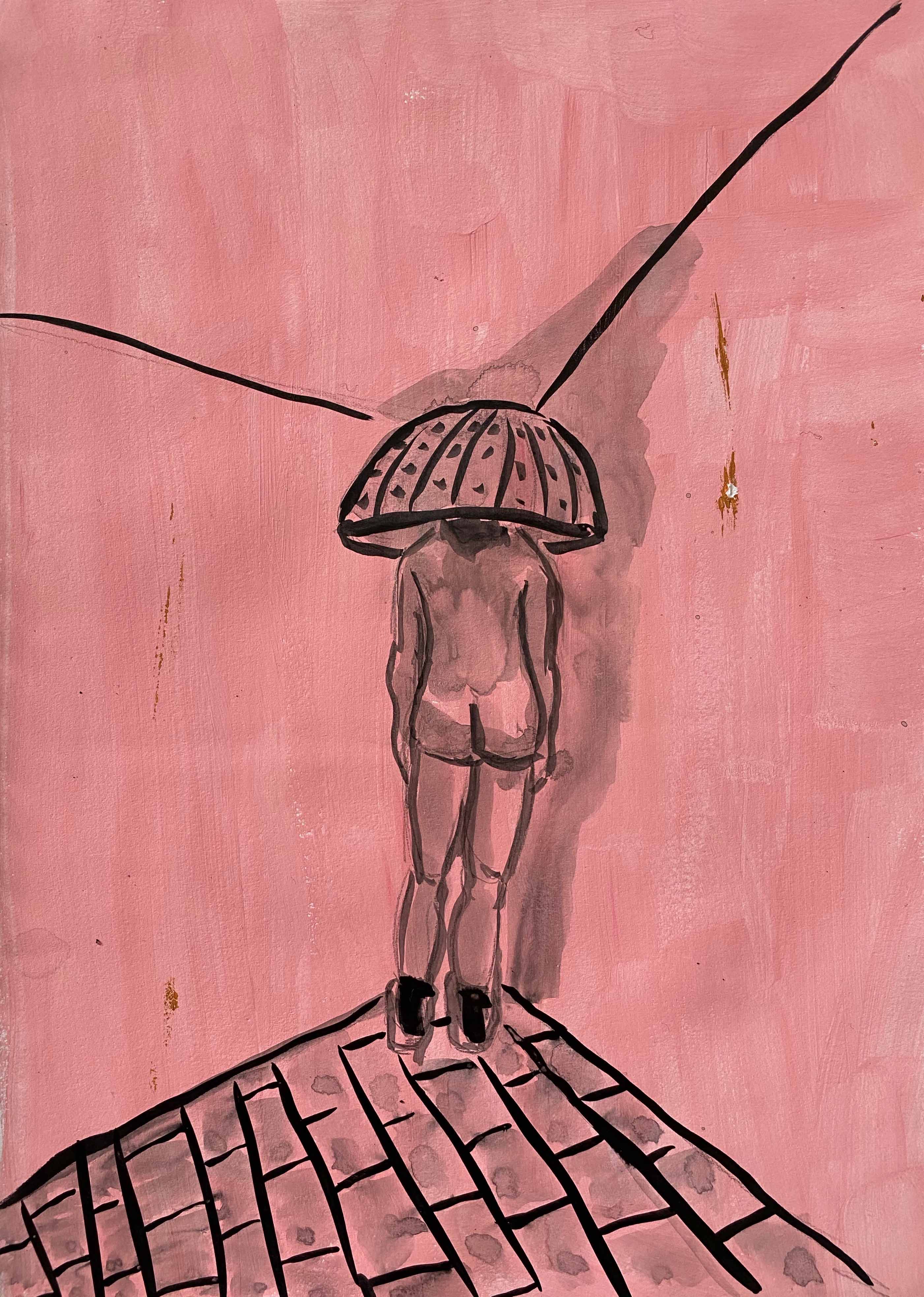
A4 sketches in acrylics with Indian ink:
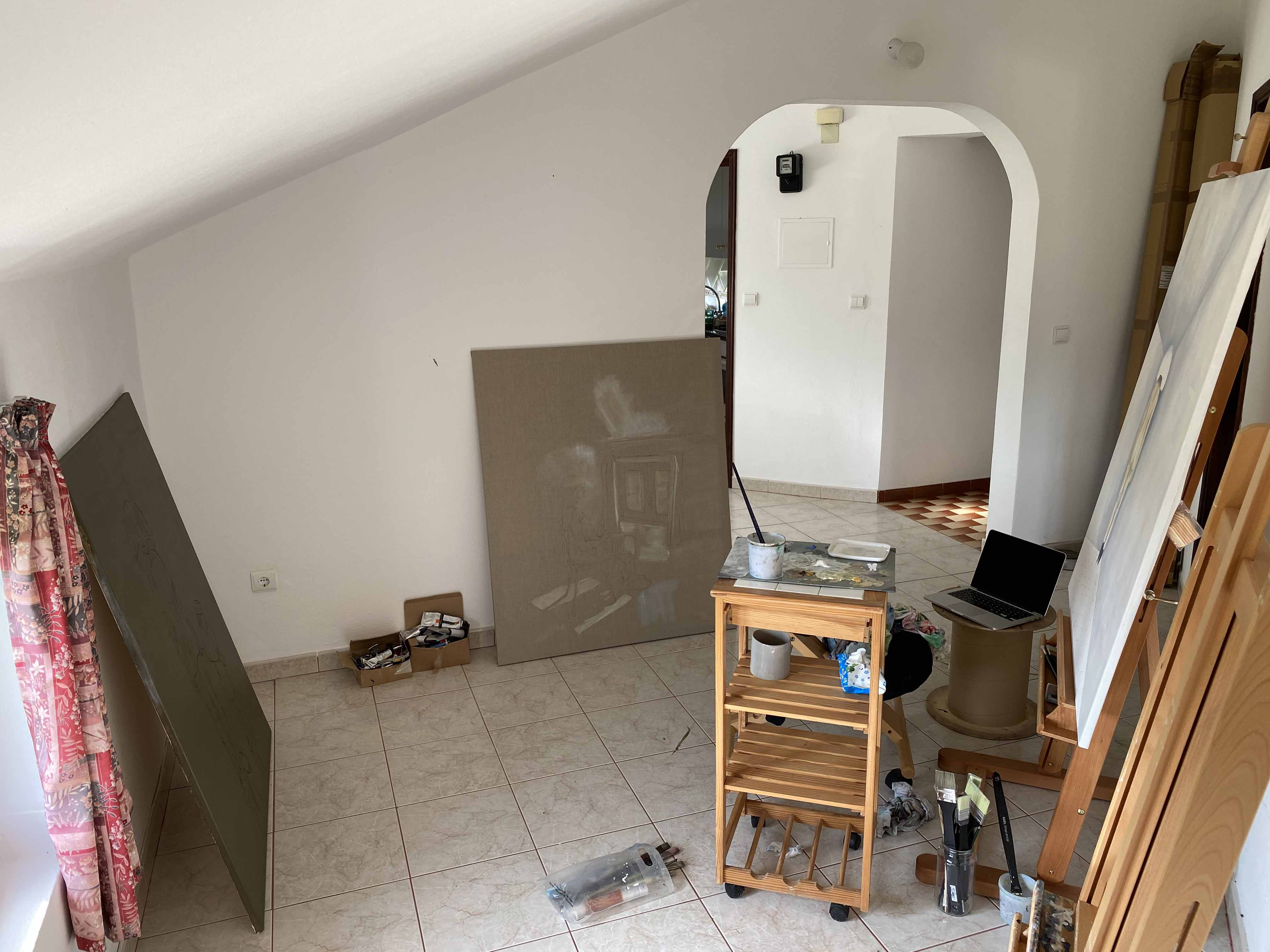
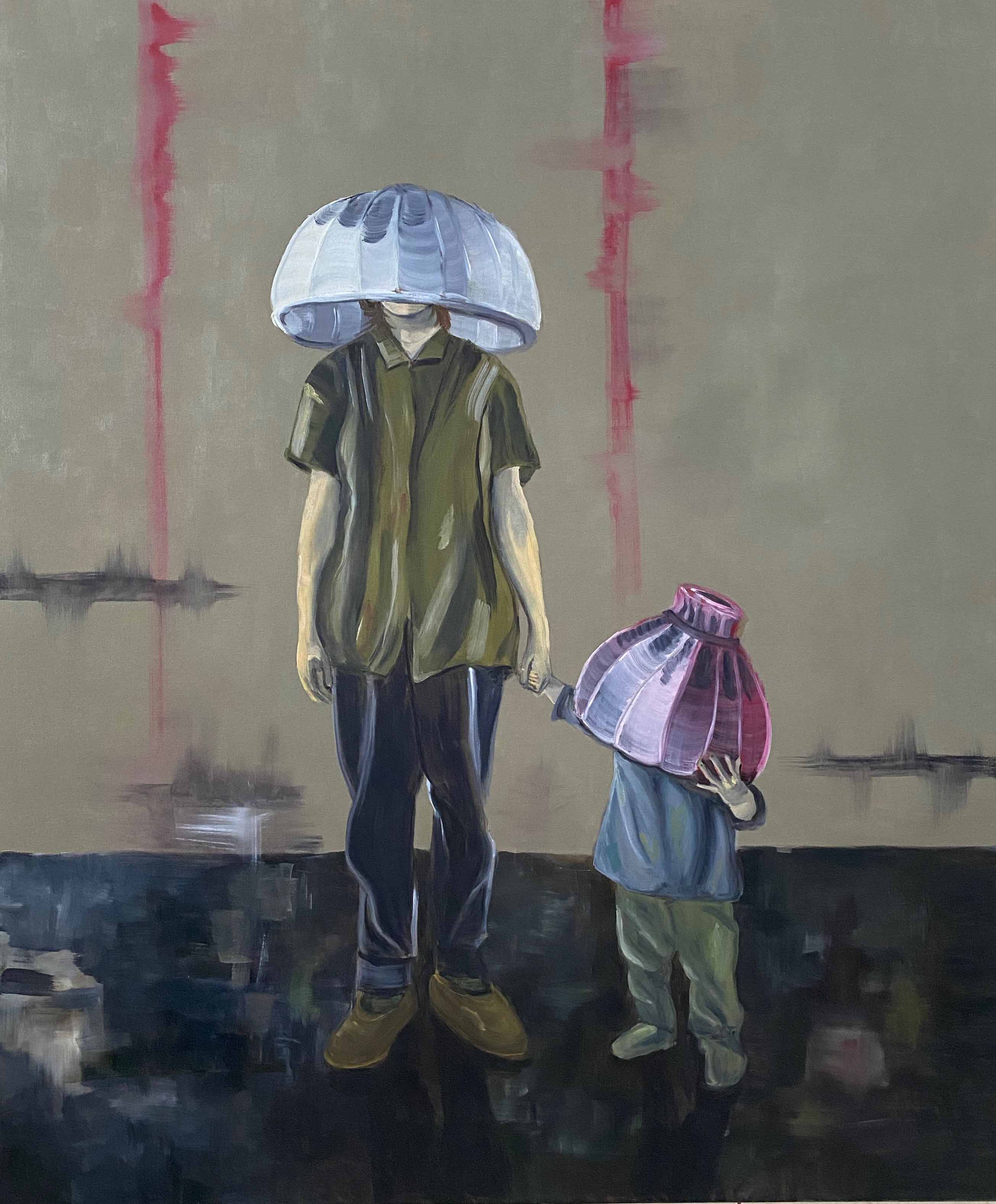
From here, I took a big leap to starting three big (100×120 cm) paintings in oil on canvas all at the same time:
This is unprecedented. What is happening here is that I am making a very clear and loud statement to the universe that “I am going to paint!”. I spent the last 20 years doing very sensible things before finally starting, so I am not ready to stop. Being in a household where very suddenly we do not have any foreseeable income at the moment, could bring up different ideas, but no- I will food garden and renovate and babysit and work- and I will definitely paint- on big expensive canvases in oil even 🙂
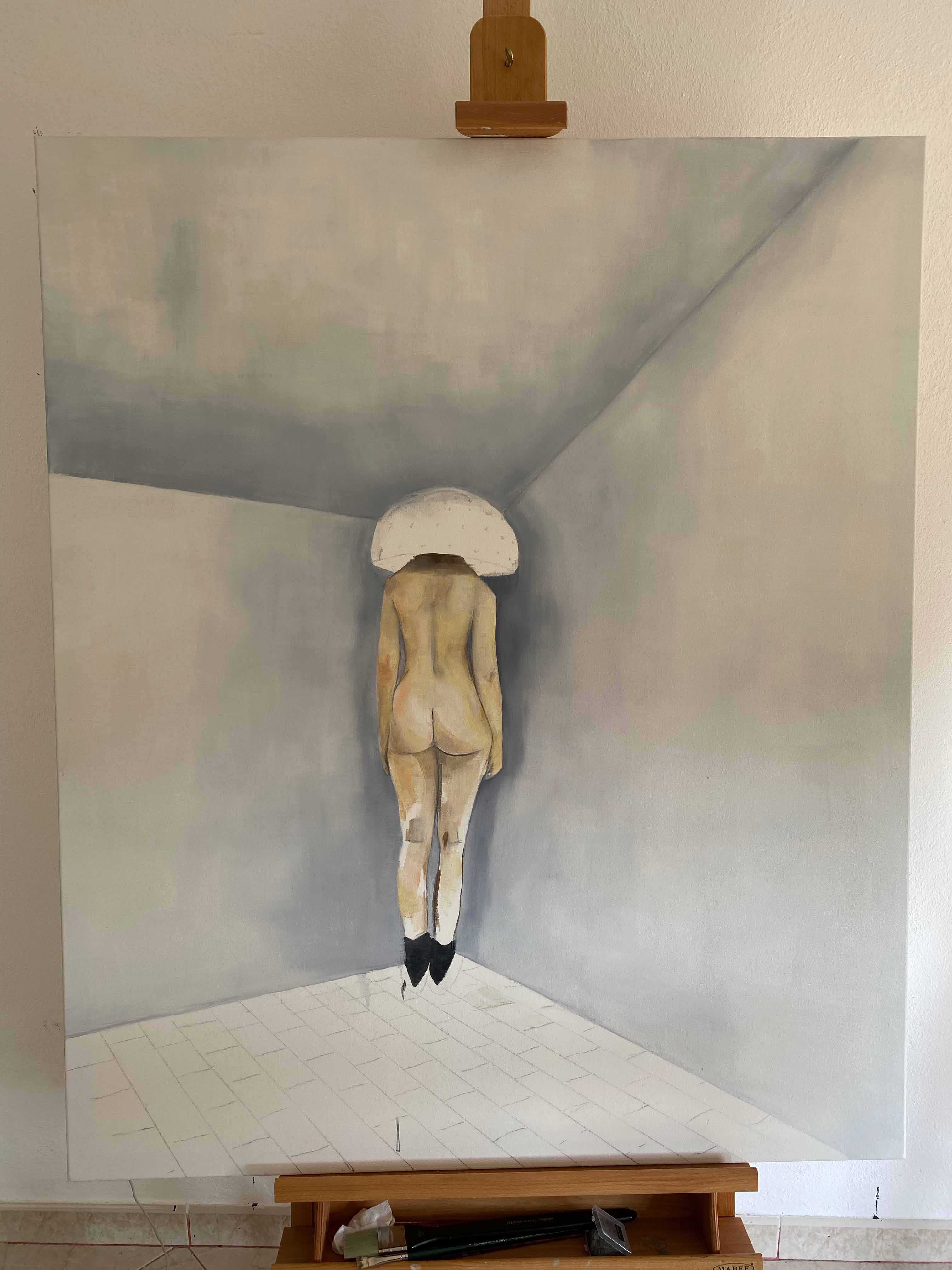
Letting my daughter and the little One wear the lampshades on their heads is a way I find to speak about a lot of the feelings coming up in these times. There is the feeling of not seeing where we are going, or even standing in front of a wall. There is an element of hiding as well. In one motive, my daughter poses nude, emphasizing the vulnerability of the now. In the other, where I photoshop my daughter and granddaughter together before painting them, they are wearing the soggy casual sweatpants that I see almost every day.
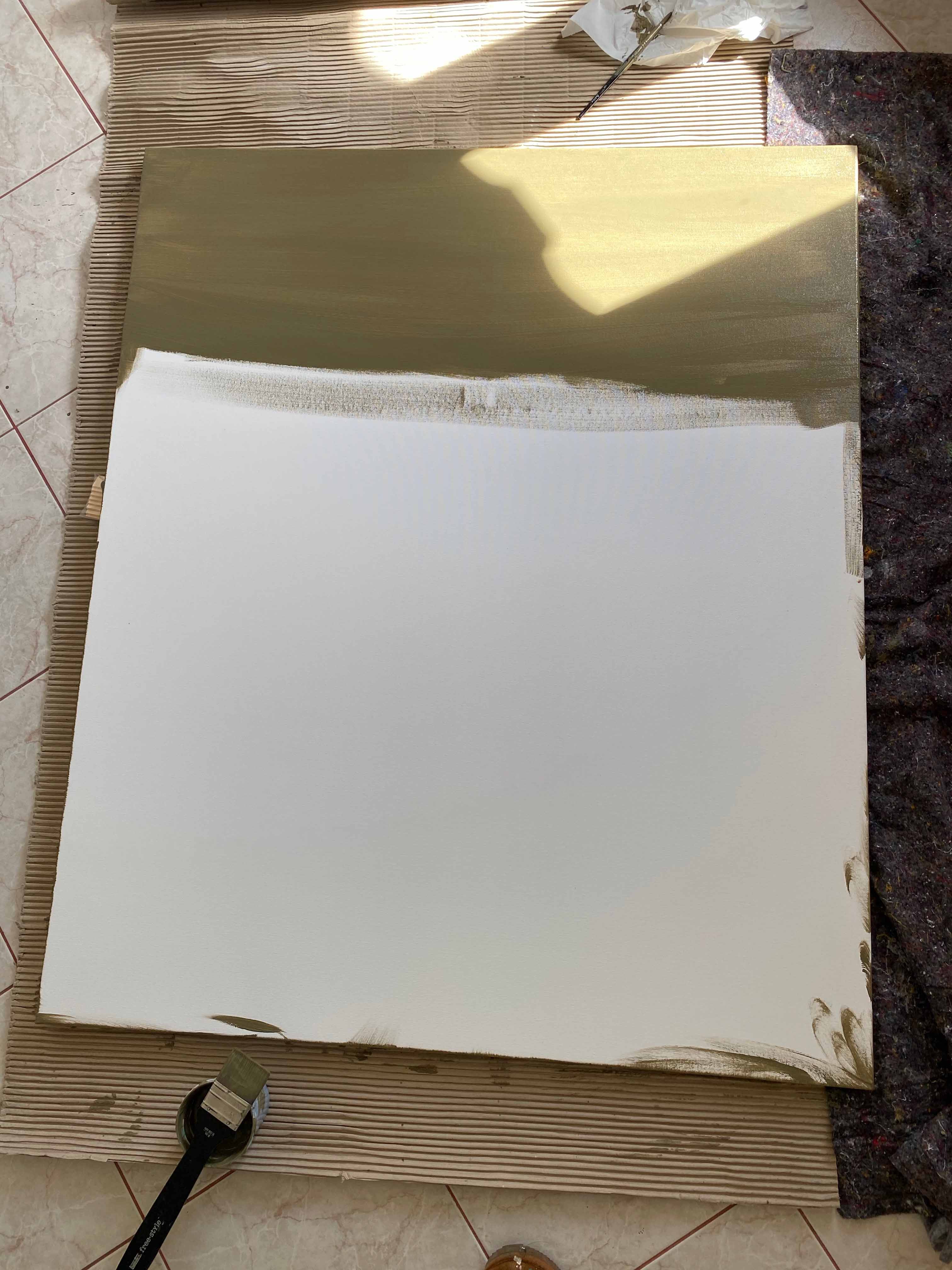
I start by covering a white canvas 100×120 cm with a military green acrylic coat.
Once starting in oils, I struggle for a really long time with the background. I have the idea to use a camouflage pattern, but then smudge it, so it is a camouflaged camouflage pattern.
I try this is many unsatisfying ways.
Finally I cover up the whole background with a rather monotonous military green in oil, similar to the acrylic background I started out with 2 days prior. The red stripes just happened, after I listened to a podcast about statistics on Soundcloud, which had similar wave patterns.
I am using a big flat brush all along for the figures, to avoid overworking.
This is the final painting.
I call it “Spring Summer 2020” like a fashion collection. I really like this painting myself. It shows the mixture of humor and fear I feel at the moment and I have captured something very personal in both my daughters and granddaughters postures that make them recognizable to me even with their heads covered. I also like that this painting connects us and our unplanned time here all together with some of the odd old elements of the house that I connect to this parallel project- the lampshades.
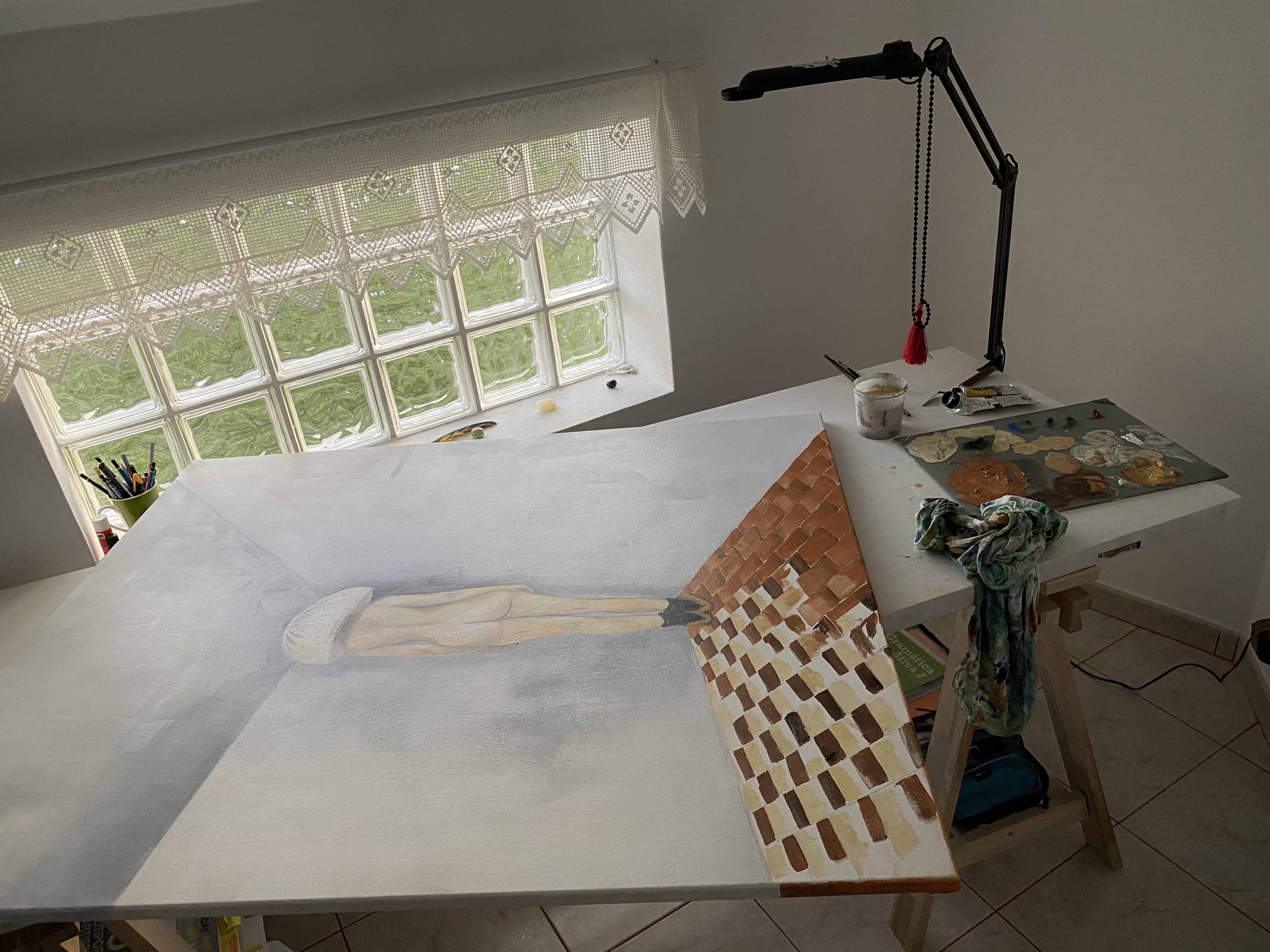
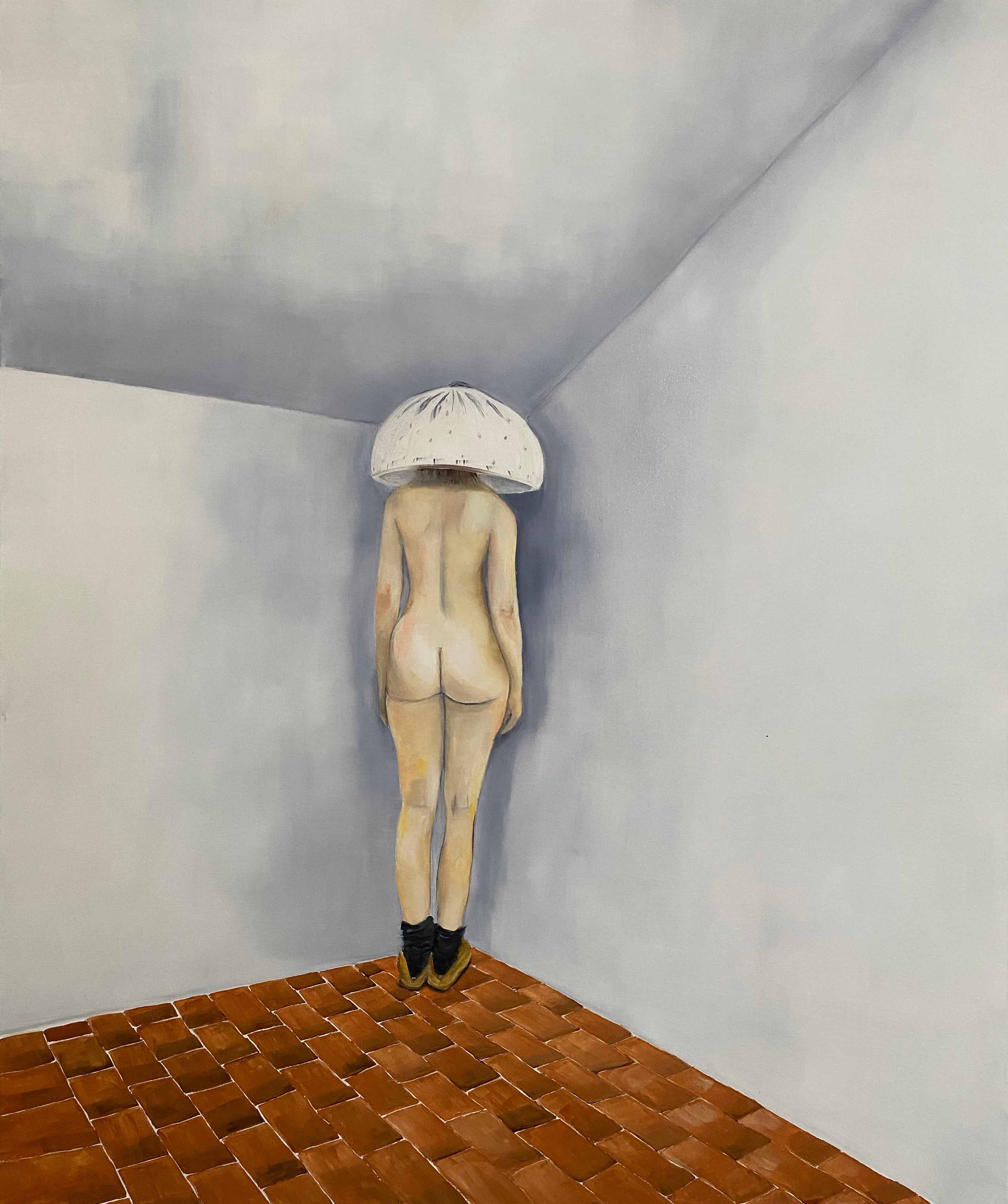
The second painting is a nude with lampshade. I choose to paint this much more carefully and try to achieve the right flesh tones. I find that the more careful approach reflects the more vulnerable feeling of this painting.
I placed her in the corner, feeling trapped or without direction. The walls are crashing down on her, there is no spaciousness. I hesitate long about what to do with the floor, but decide to paint brick coloured tiles similar to the ones that are really here, to have a solid floor, instead of letting her hover in something more grey or non distinct.
These brickcoloured tiles could also be outside, which maybe brings more confusion to the painting, which I like.
This is the final painting:
I am happy with the motive and the feeling this painting transmits, but I was too careful in my choice of colours and precious little brushstrokes. I enjoy a bolder approach more.
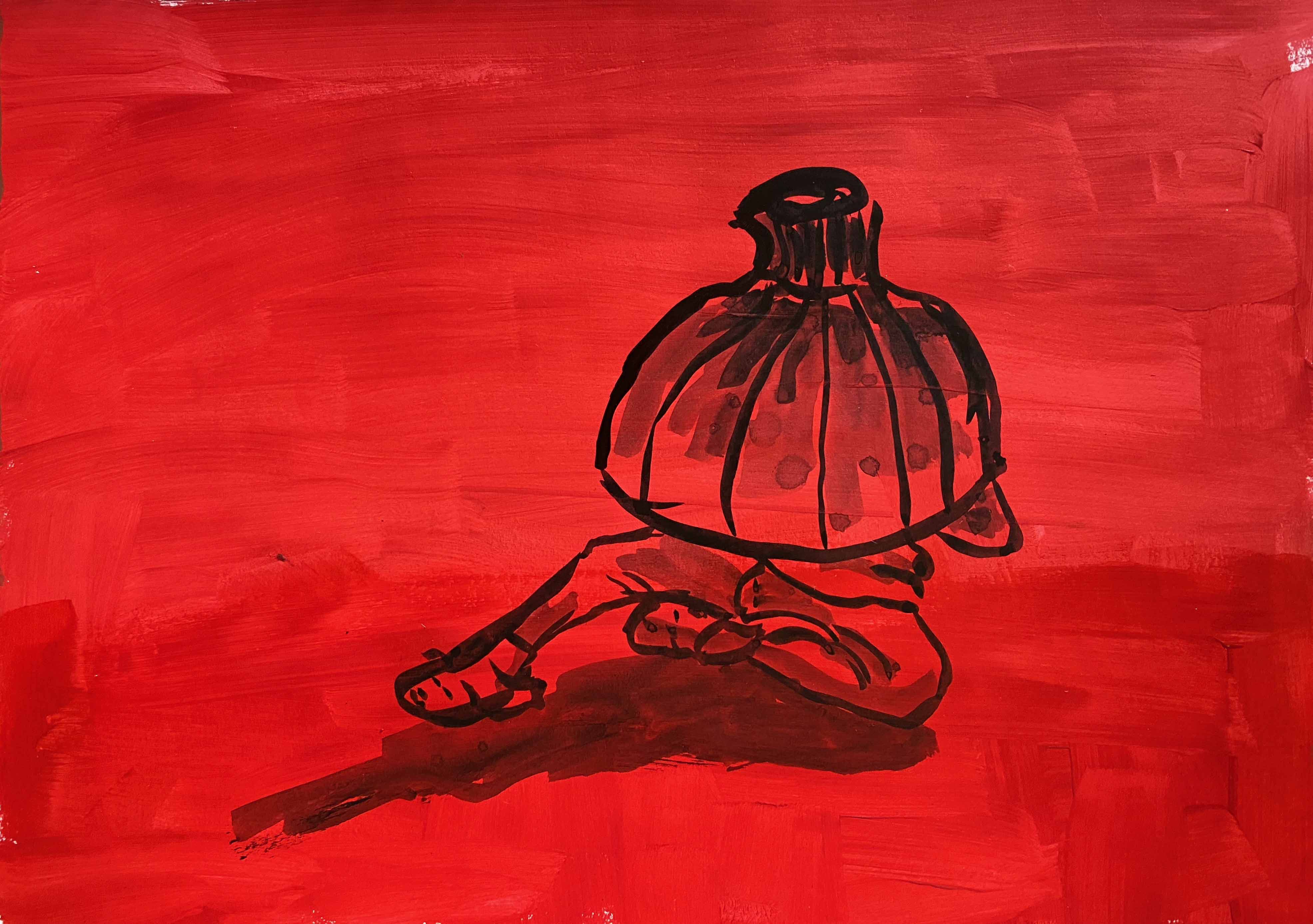
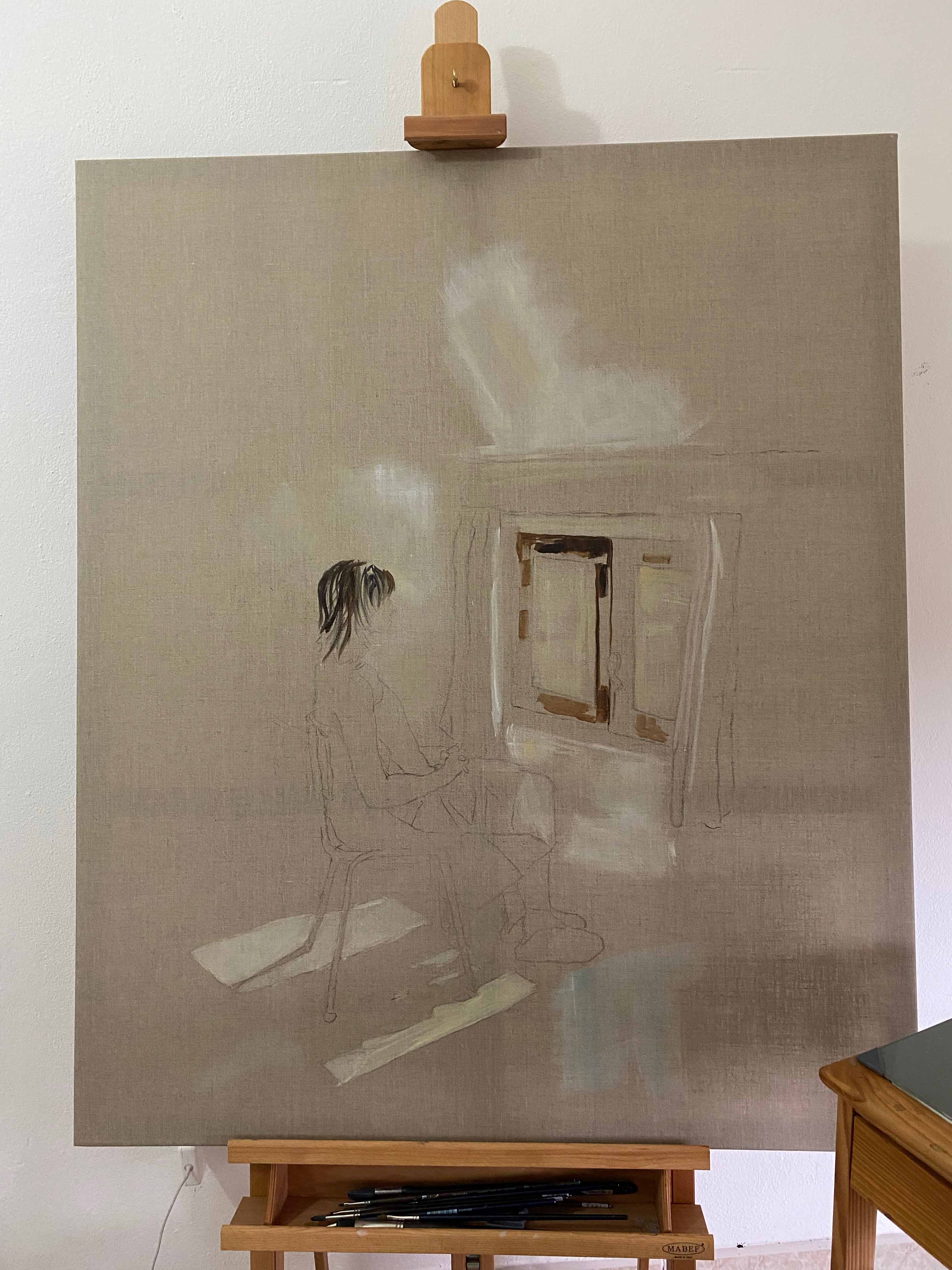
The last painting does not exactly belong to this post, as it has lost the lampshade. I place it here though because it is a part of the same experience and just a few photos before the one that I chose for this painting, Ria was actually wearing the lampshade, but I prefer to paint her longing expression.
In all three , Ria is also wearing the same slippers and socks- an allusion to this time closed in the house.
I have started this last painting on a linen canvas that I have stretched ( also a new experience.)
I will post the painting here once completed.
At this point, I am just starting on Part 4 of the course, and can see how these lampshades may reappear in the project of Installation or maybe be used for the site specific artwork fro Assignment 4.
I also want to experiment further with using the lampshades as supports.
Course Manual: “Select a piece of music (preferably classical or at least rhythmically complex) and allow your movements to be affected or generated by it whilst producing a drawing. To begin with, generate your lines and marks solely in response to the music. After the first hour, develop this further. For example, you could introduce an observational element such as self-portraiture and begin to explore the interplay between gesture and representation. Alternatively you might decide to video yourself making the work to emphasise the performative nature of gesture.”
I always listen to music in my headphones when I draw or paint, often as a tool to close out other sounds from what is happening around me.
I do not think I have ever made a drawing solely as a response to the music though, without a pre-concieved idea.
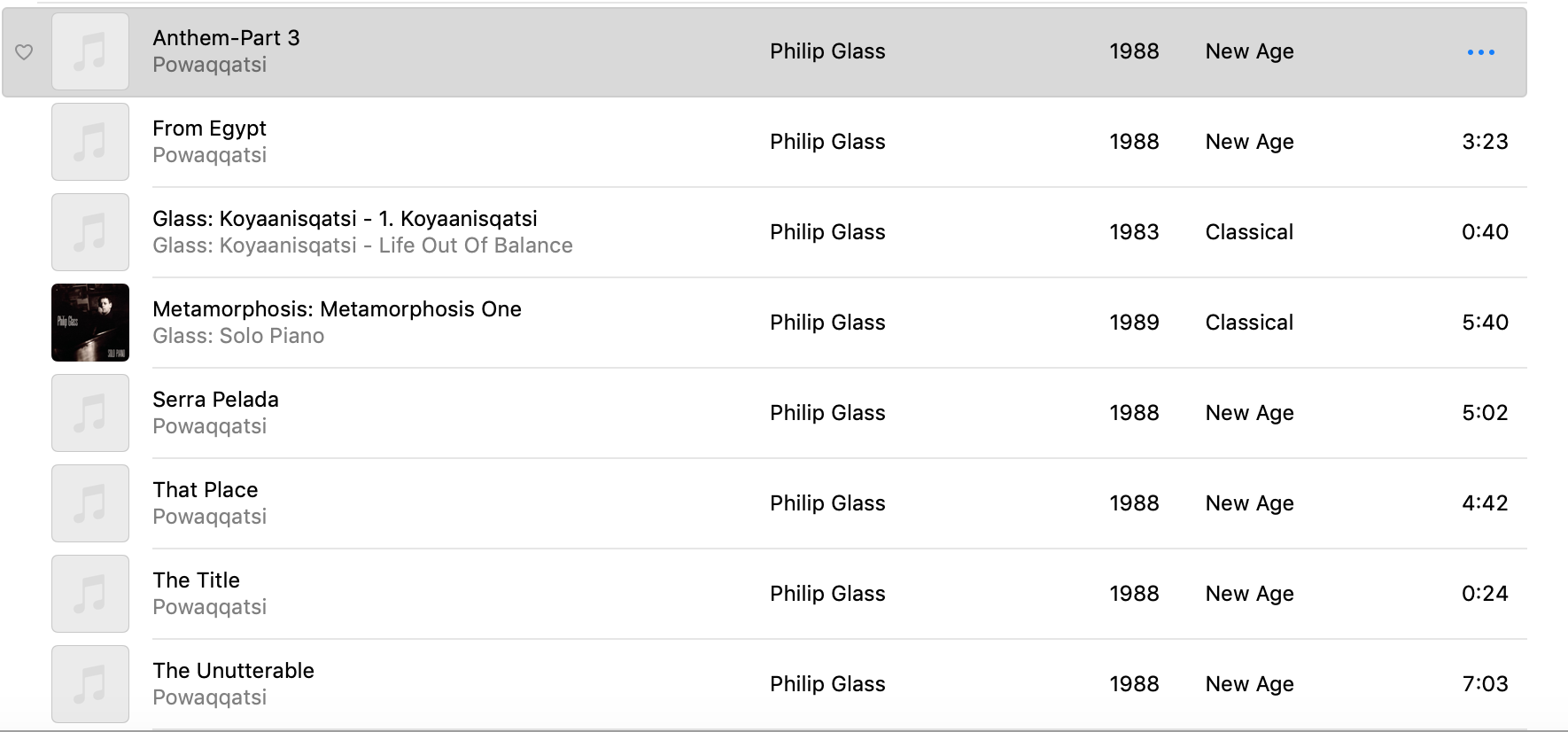
For this assignment, I created a playlist with music from Philipp Glass, mixed from the three albums Koyaaniqatsi, Solo Piano and Powaqqatsi. I choose this composer, as his music is definitely rhythmically complex and because it brings me through a very wide range of emotions with anything from very dark, hard stomping sounds, to light flute or calming piano. This is the playlist:
The whole is a few minutes over one hour long, and I plan to play it twice. The first round, I will just draw wildly, mainly keeping my eyes closed and really letting myself go and just feel the music. The focus will be entirely on the process. Then after that first hour, I will step back and see if I can pick out any figurative elements in the drawing. Then, I will listen to the same playlist again for the next hour, accentuating those figurative elements, while still moving to the music and letting the music inform my marks.
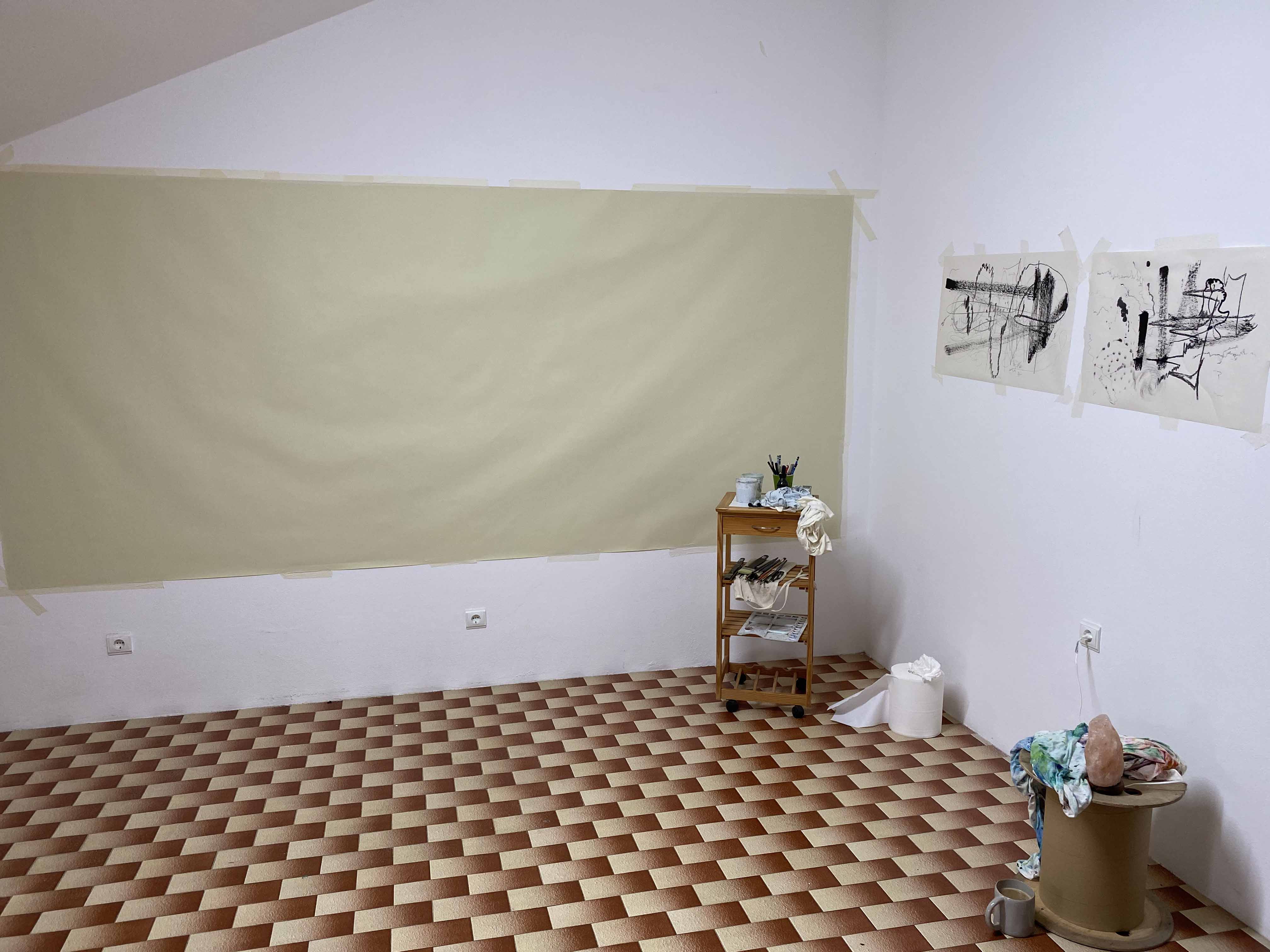
I start with a few test marks on approximately A2 papers while listening to the beginning of each song to see what materials feel appropriate.
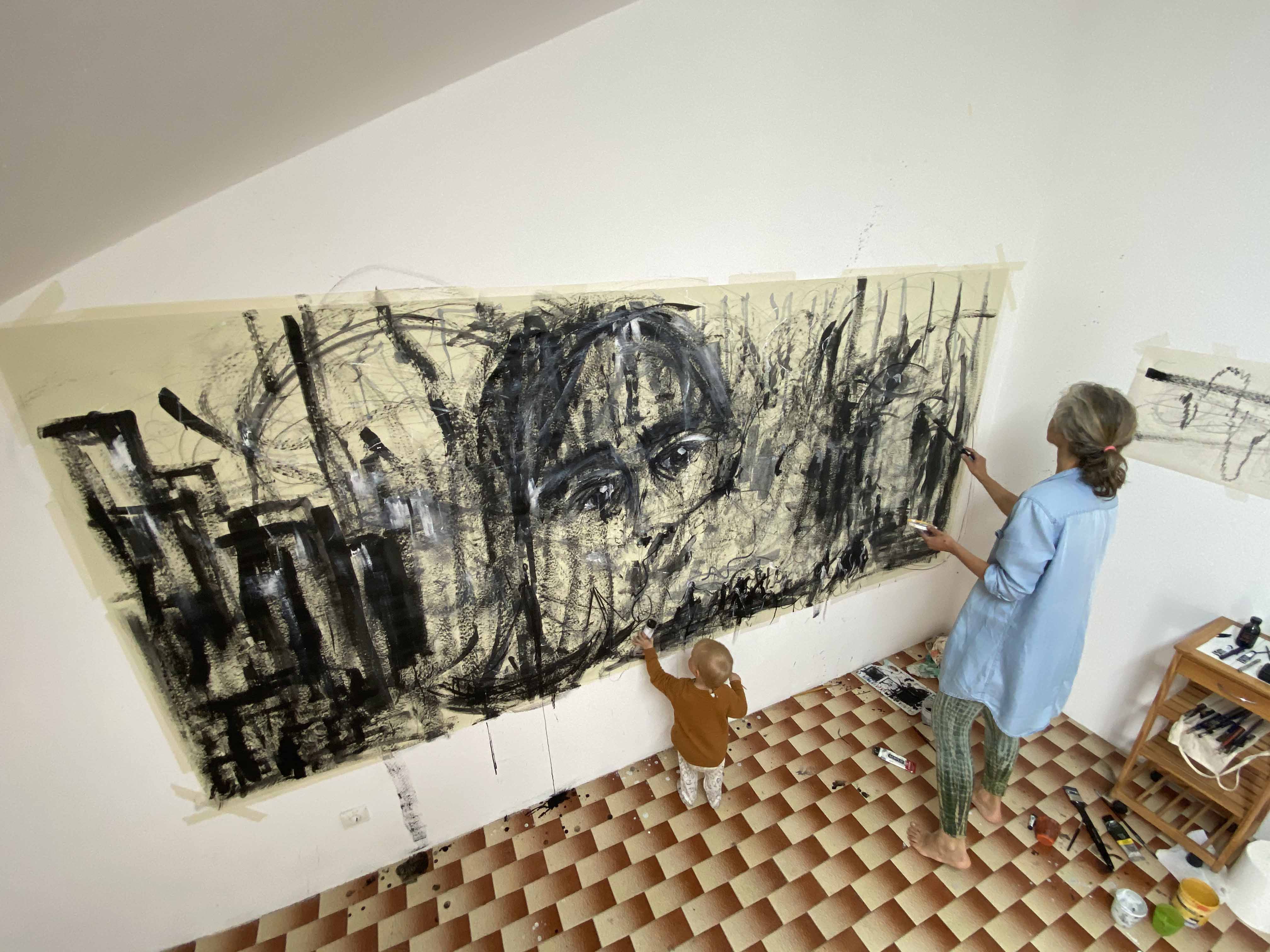
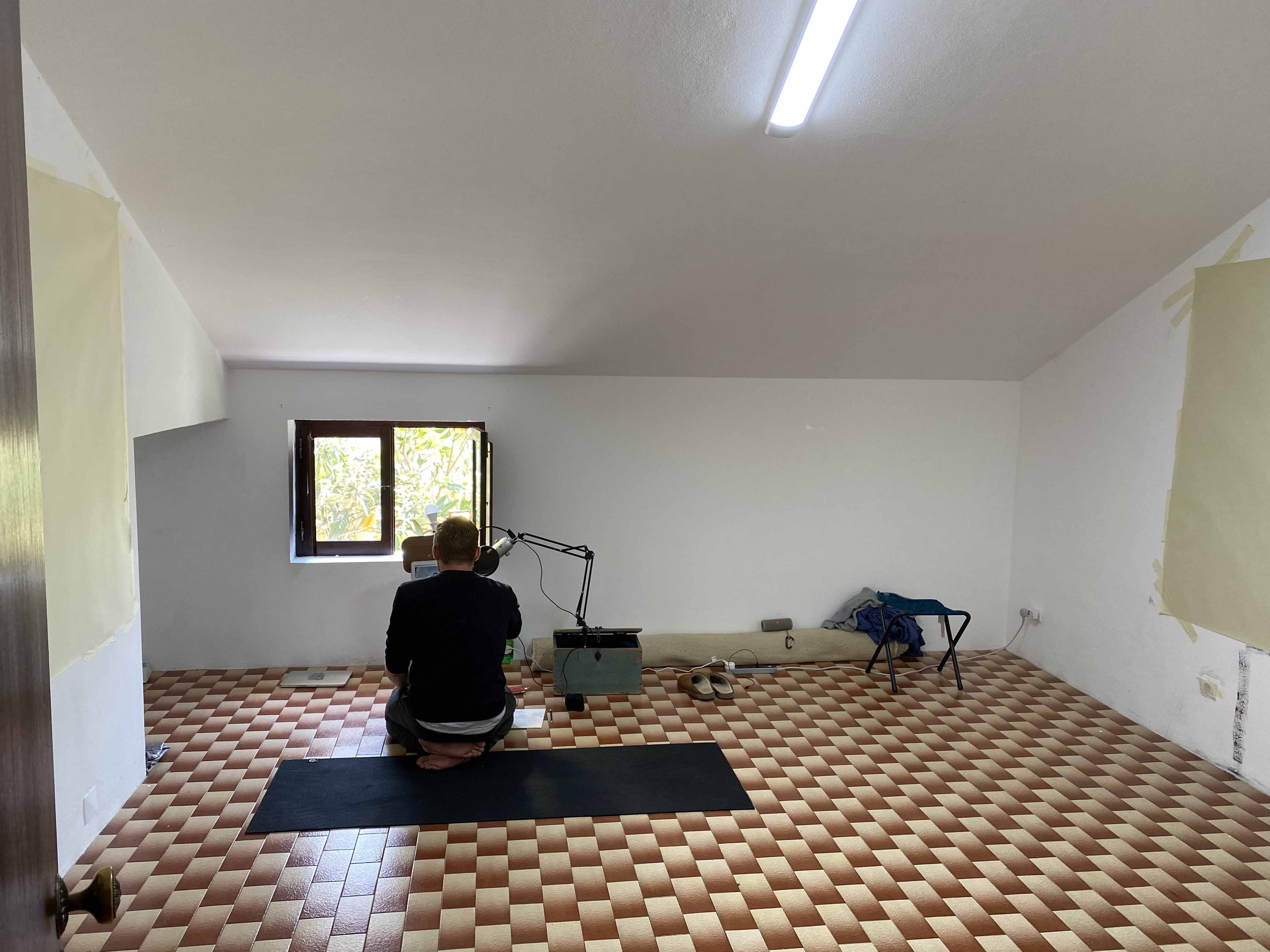
I am going to move and dance to the music while drawing- so I prepare a large sheet of paper- it is approximately 150×300 cm.
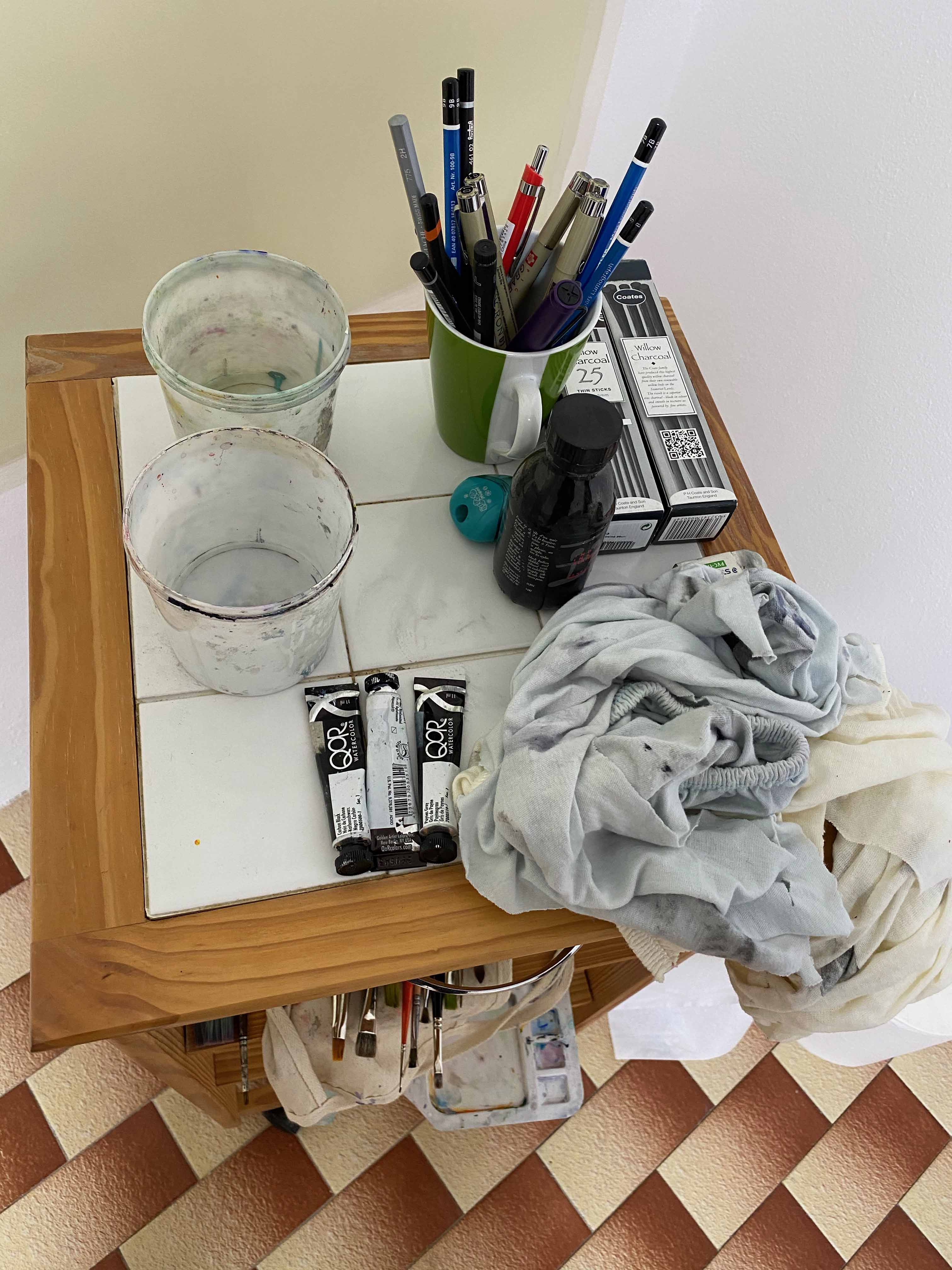
I prepare a wide array of black and white media- charcoal, graphite pencils, markers, Indian ink, watercolour and acrylics with lots of different brushes. As for the previous emotional response exercise, I decide to use only black and white media, to emphasize the focus on the mark-making rather than colour.
I am ready to start!
I am aware that this is more of a performance, focusing on the dancing and moving my body while translating movement and emotions into physical marks on the paper, rather than expecting any finished “good” drawing as an outcome.
Luckily, Tom is in COVID 19 lockdown with us and he agrees to document the process by filming it.
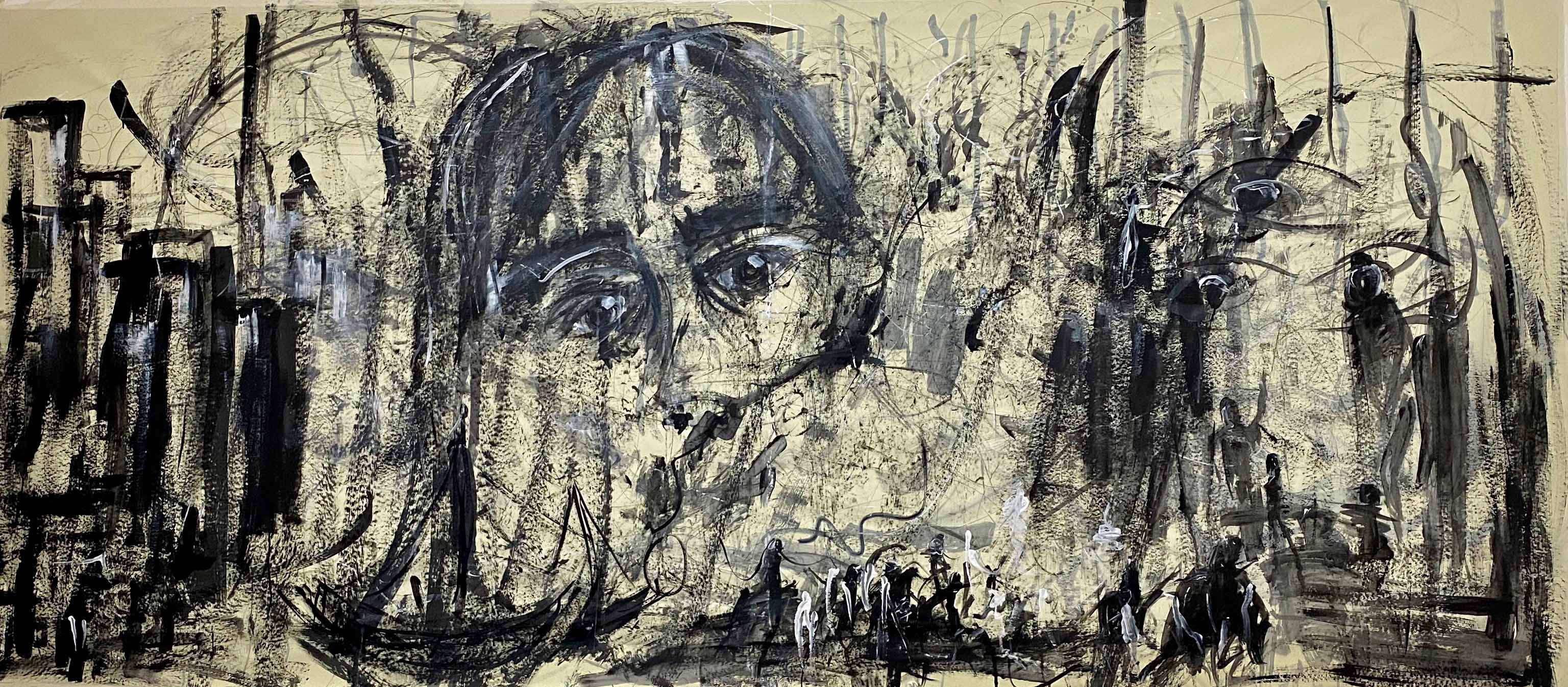
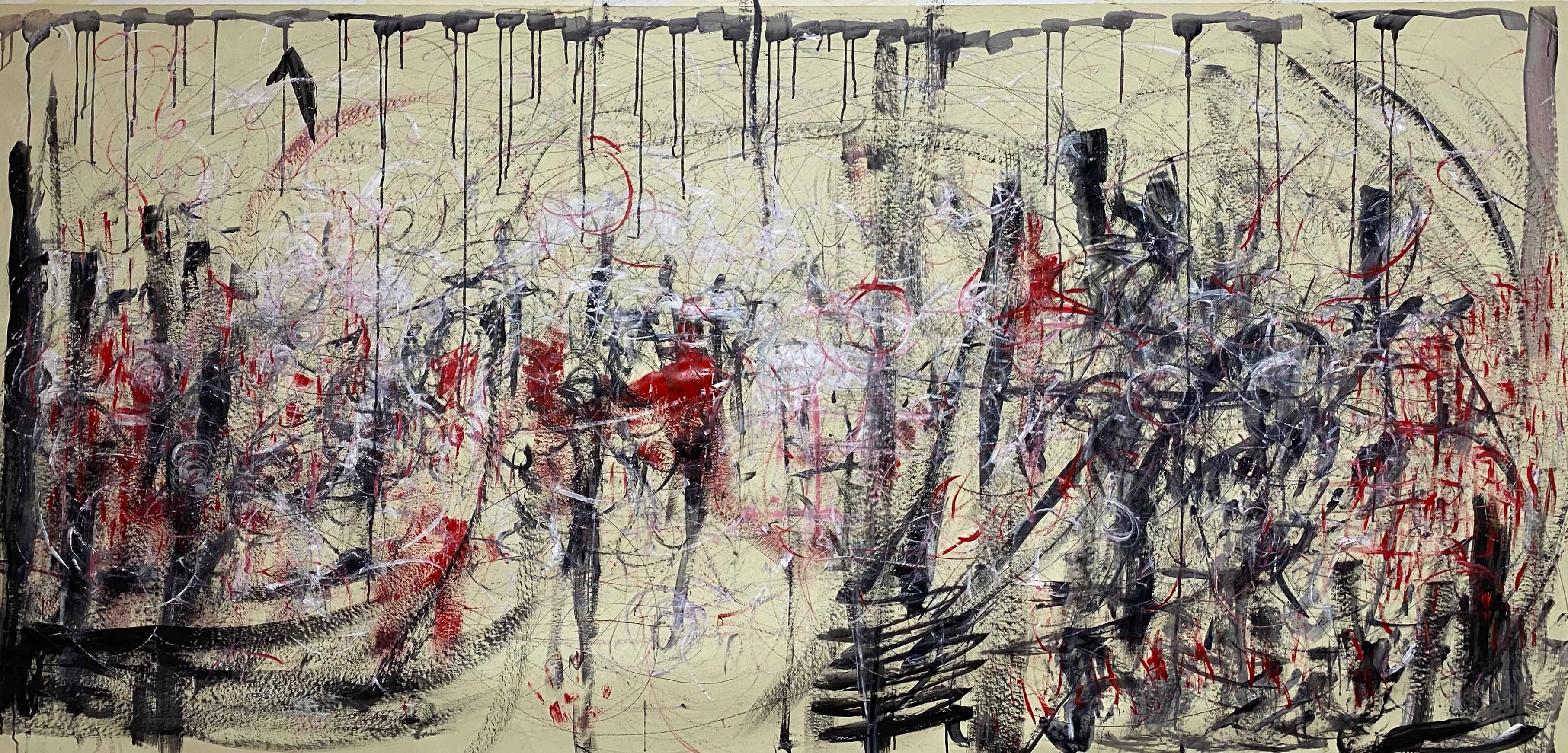
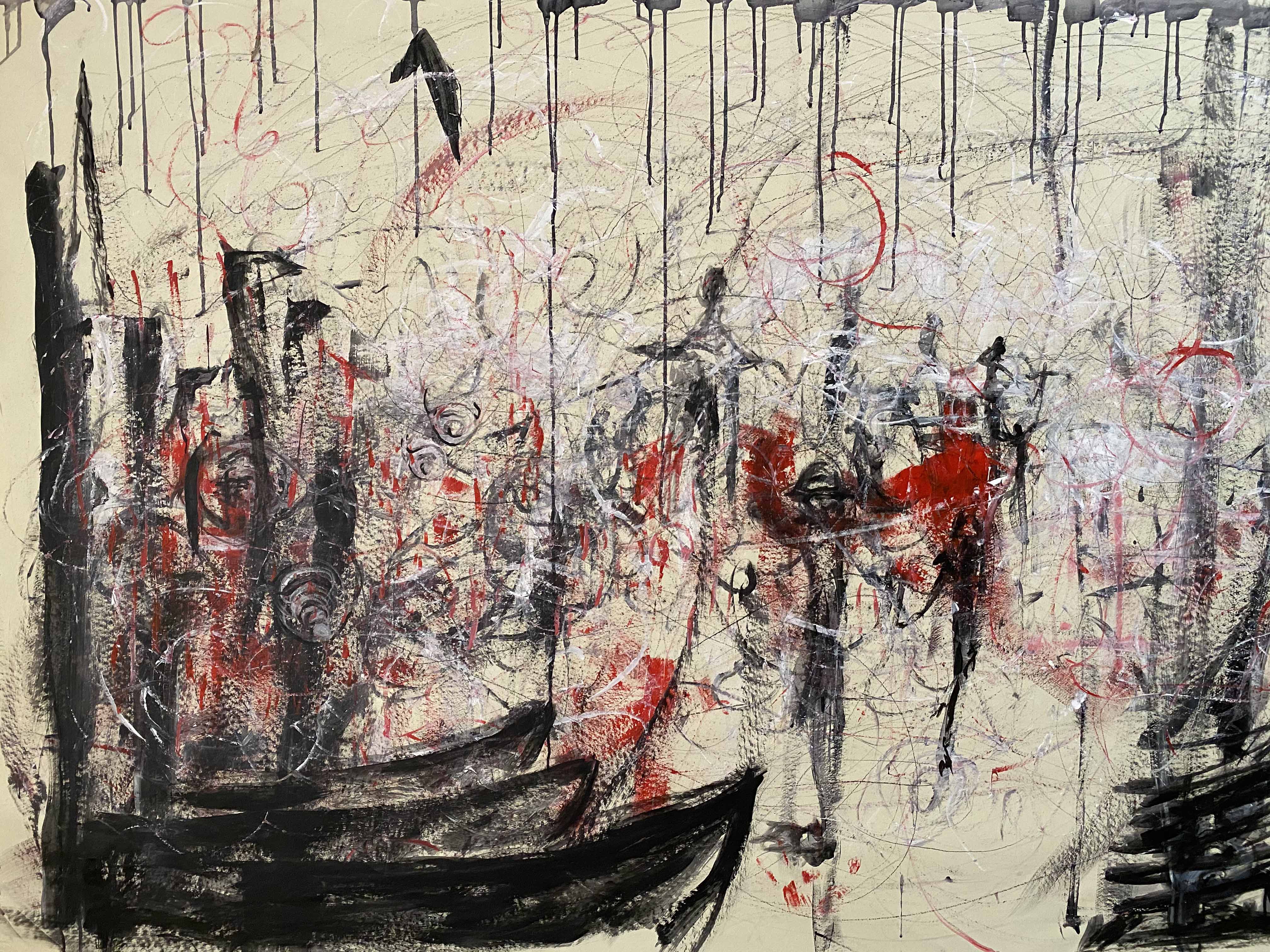
After one hour of non stop dancing and drawing, I am exhilarated and exhausted! I take a 15 minute break, shower and have a look if we can find some figurative elements. It seems like a face hovering over Hong Kong harbor is coming out.
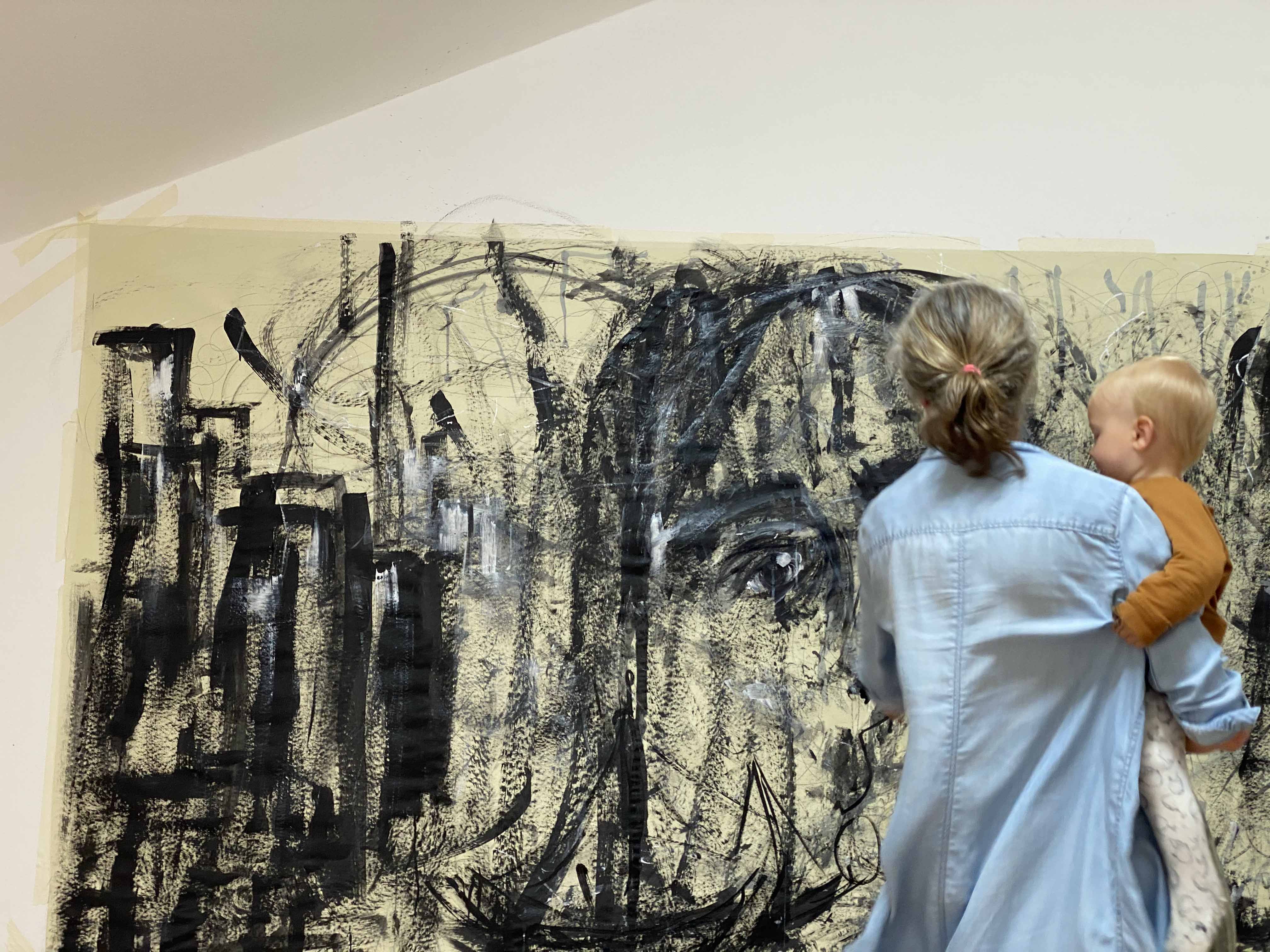
I am ready for round 2 and set the music to play again. This time I work more aware of the figurative elements. I still move intuitively in pace with the music, but keep track of what I do. My granddaughter wakes up from her nap and joins in the dancing and drawing.
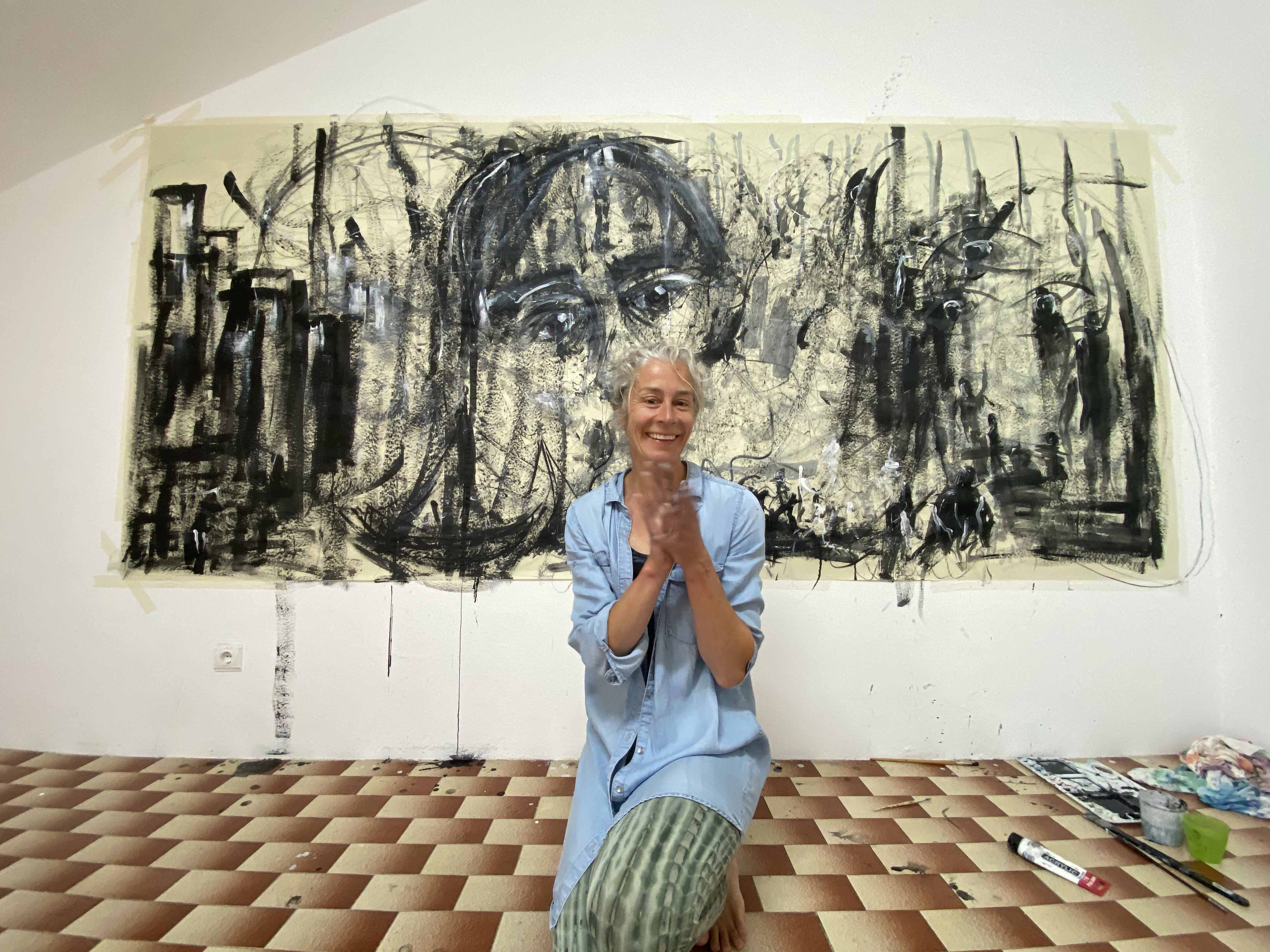
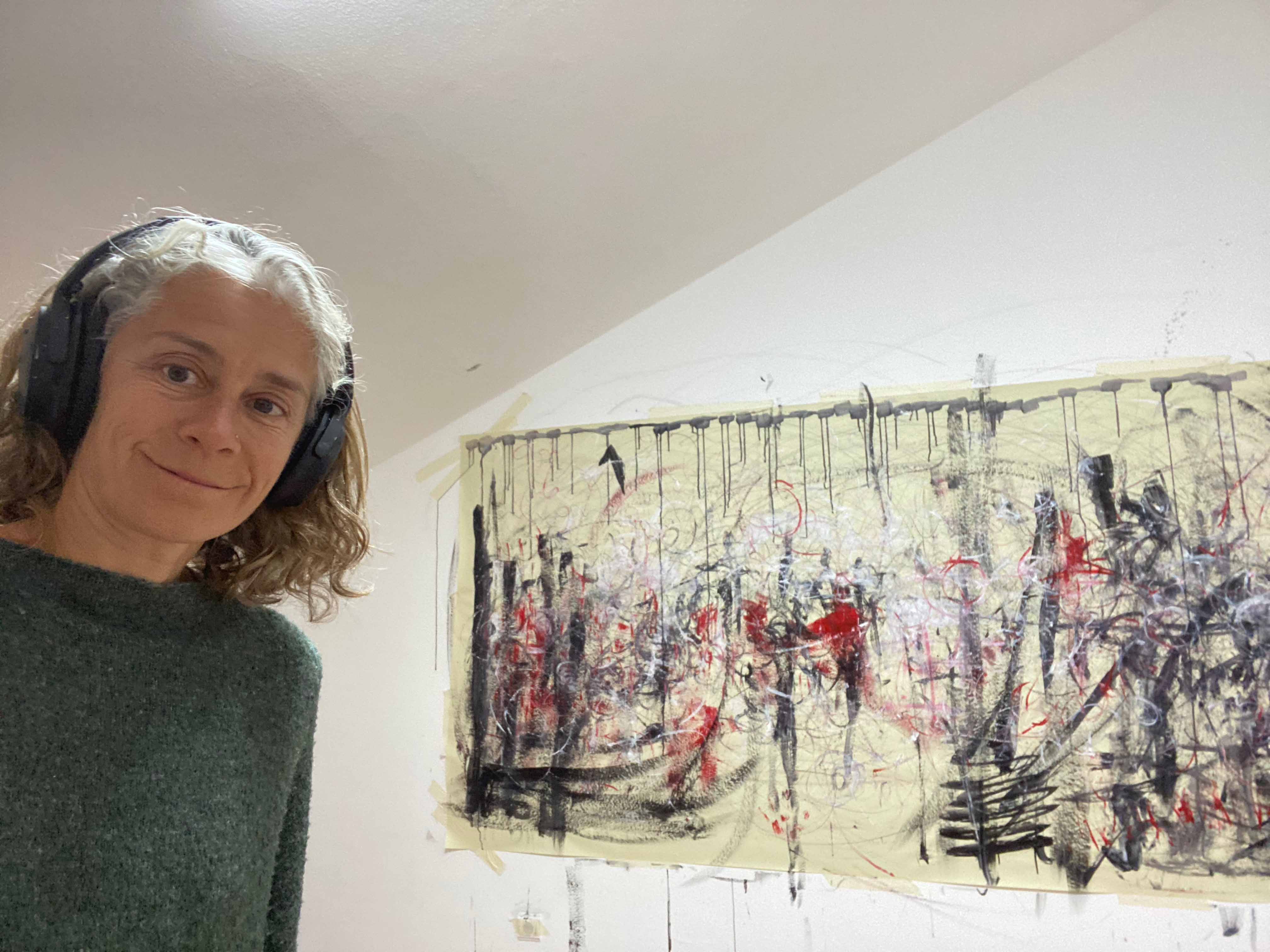
After the second hour, this is how the drawing looks (150x300cm):
This movie, documenting the process, filmed and edited by Tom Woodfin (@perceptionarchitecture), is my final piece for Assignment 3:
Drawing for two hours intensely to music was an absolutely incredibly profound process. I was tingling of excitement and exhaustion after these two hours, and can not begin to tell what rollercoaster of emotions I experienced during the drawing.
It was very interesting for me to experience the difference between my state of almost trance during the first hour, where I felt no need to even look at the result, and could just loose myself in the music, and the second hour, where I was still dancing, but remaining focused on the outcome. This opens up to a new, intense and rich way of approaching drawing and painting. I am really surprised that something as figurative as this could come out of this dance. And I am pleased to see that the final drawing still transmits the movement and the power of the dance.
Tom who was present and filming during large parts of the process, was so fascinated by what was happening, that he asked me to repeat the experience for his breathwork session. Tom is a breathwork facilitator, and is working on Zoom from my studio at the minute, due to the Covid 19 restrictions.
So the very next day, we set up two large papers on opposite walls, one for each of us.
42 people from various parts of the world joined the session over Zoom, and all through the one hour 20 minute long session of music and breath exercises, Tom and I were dancing and drawing. This time, I pushed the concept of a performance even further, by having an audience, even if this audience was online and mostly eyes closed while they were breathing.
This is how my drawing looked after the 1 hour 20 minutes very varied music.
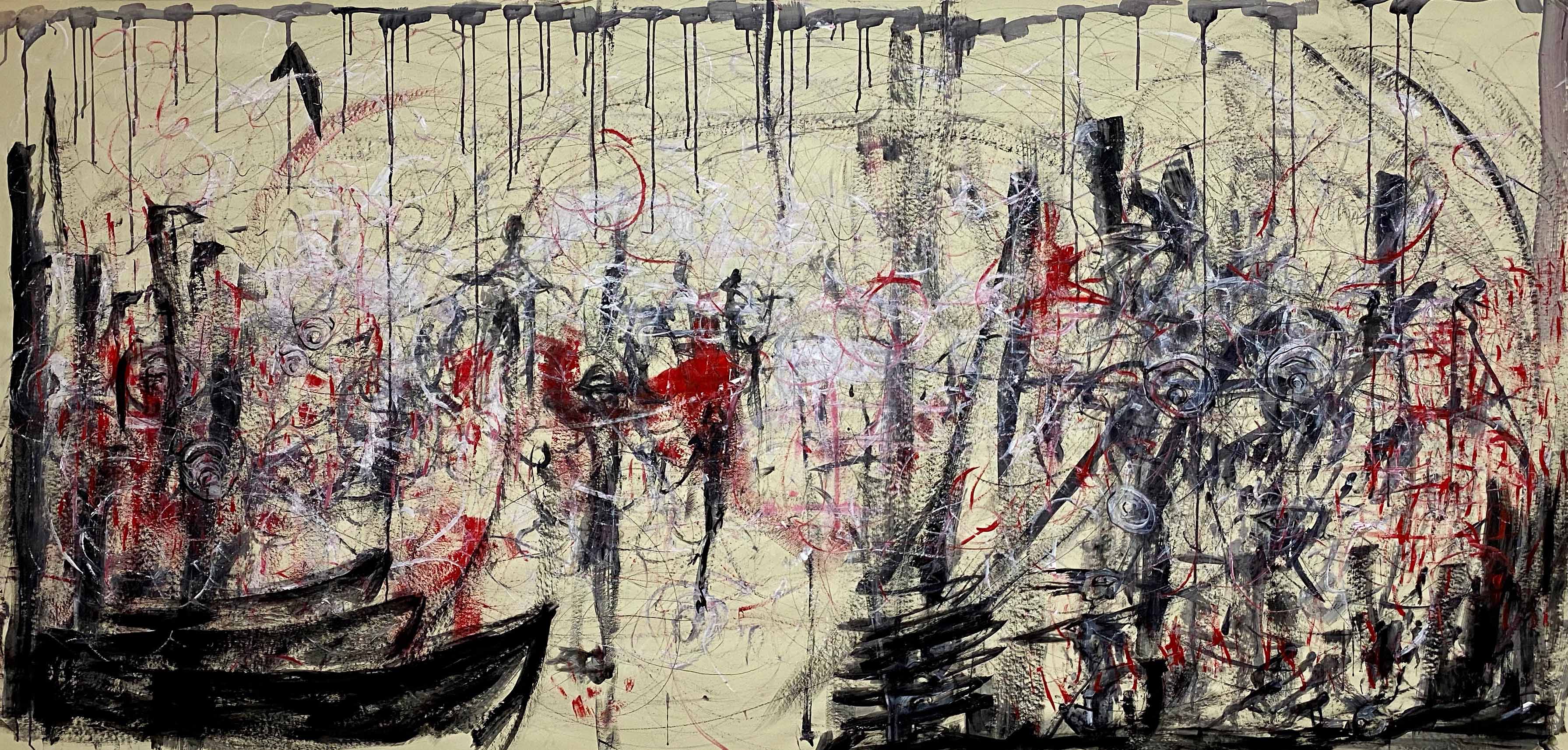
I decided to repeat the exercise above, and came back alone the next day, playing the same tracks while continuing the drawing consciously.
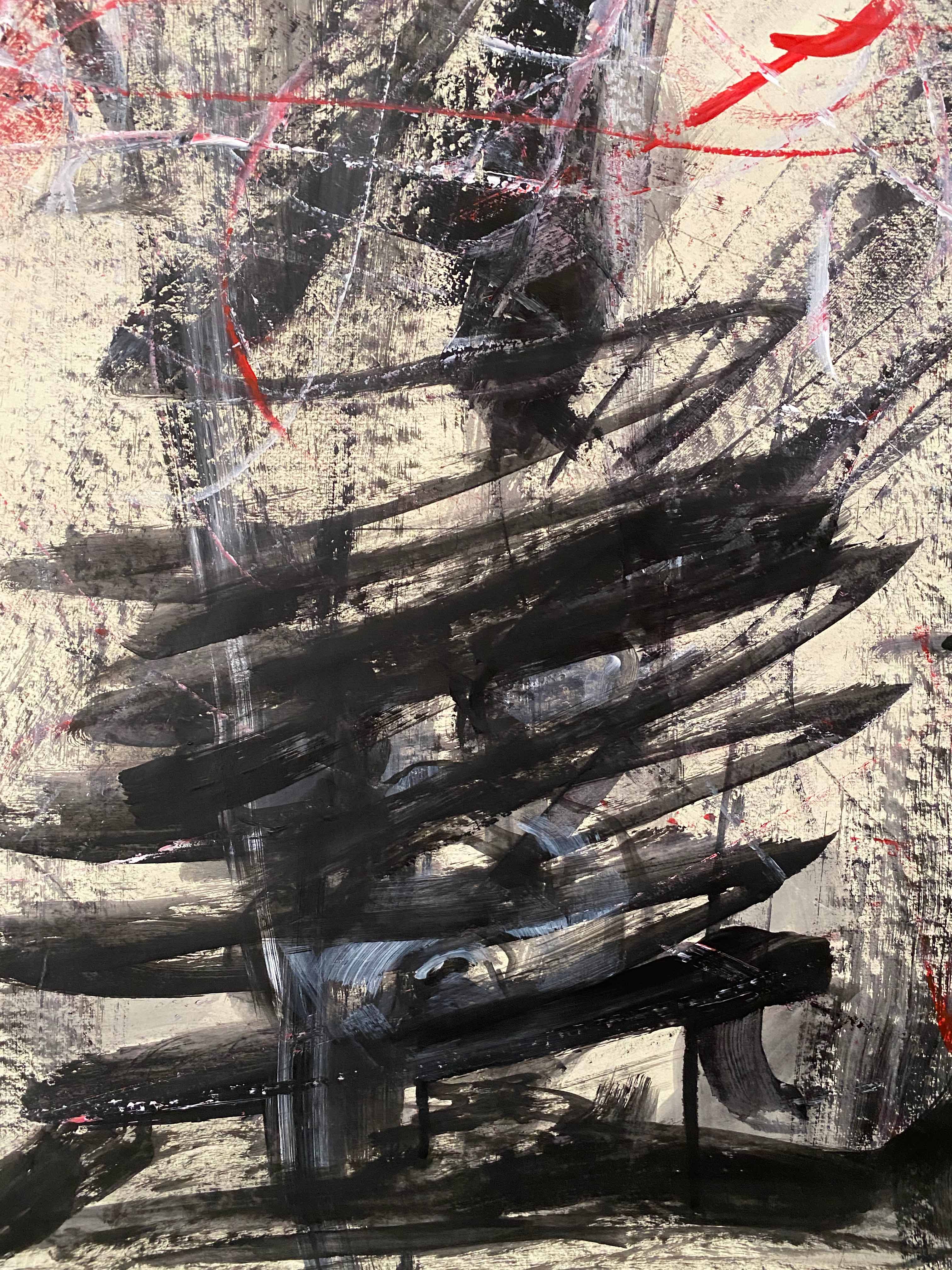
This time I had a really hard time seeing any figurative elements to start with, except for three boats in the left bottom corner. I decided to not change the overall composition,by inventing what I did not see, but lift out elements that jumped out at me.
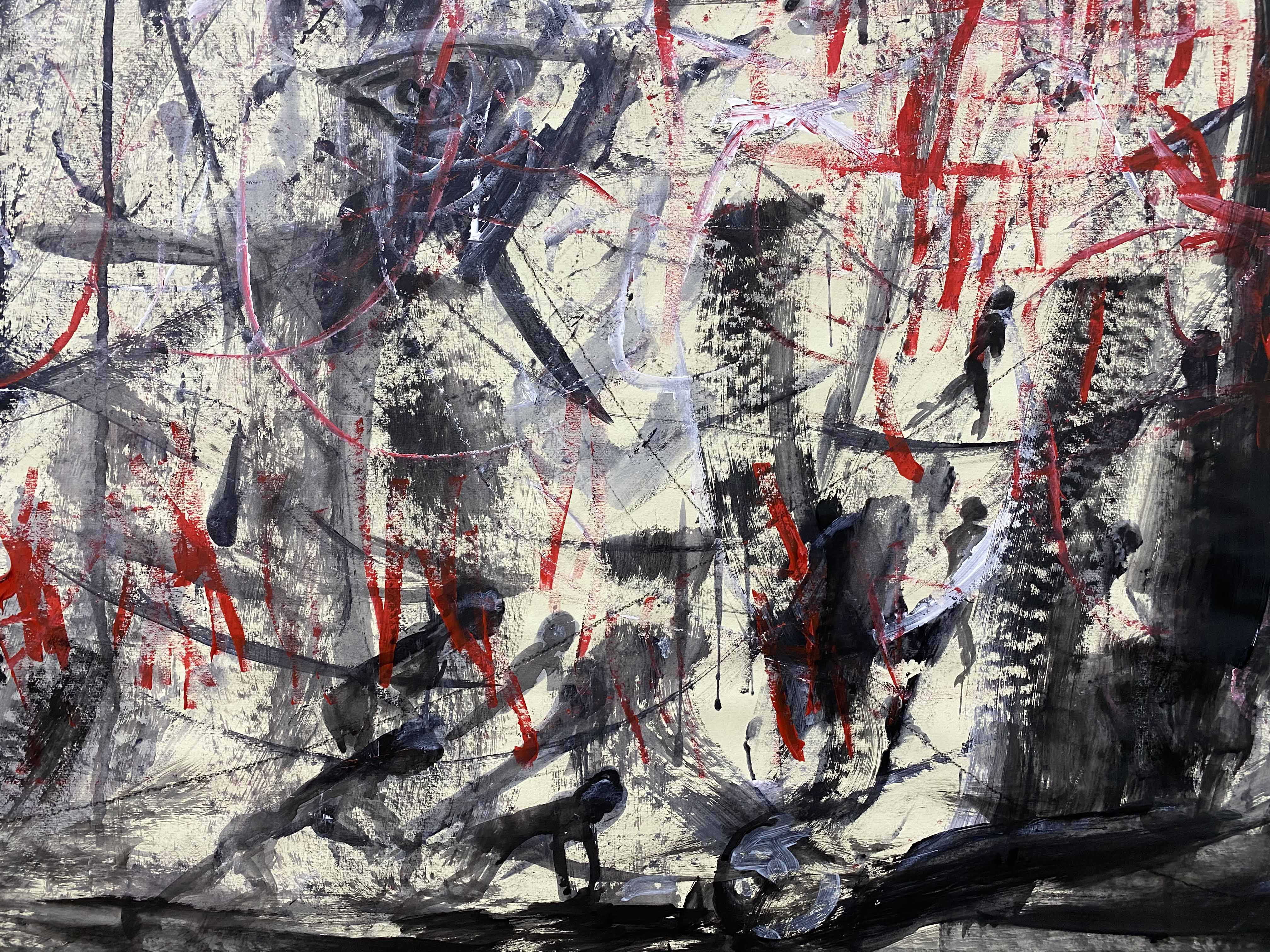
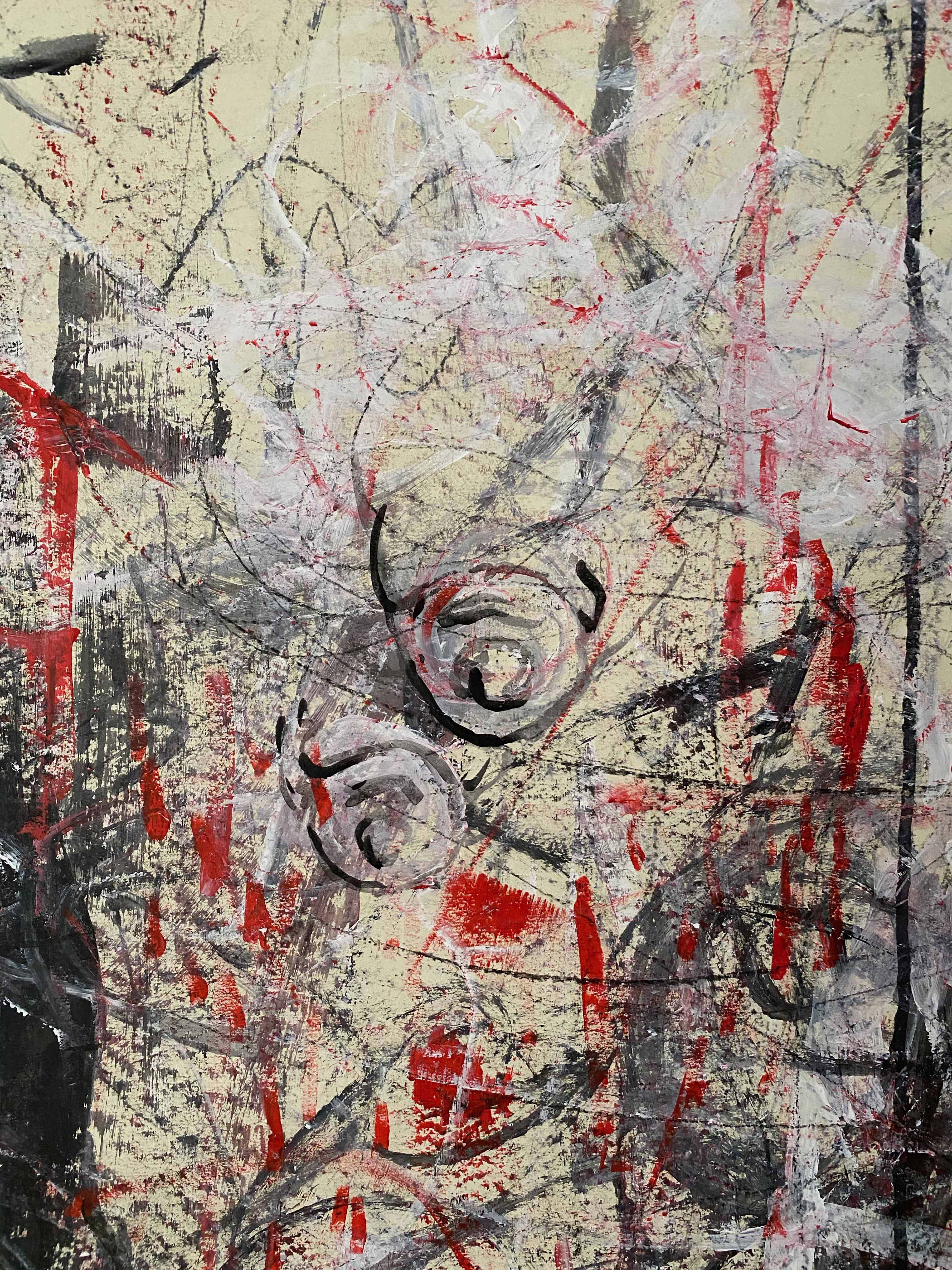
This is the final drawing- rather apocalyptic with Covid 19 masks appearing again (150×300 cm):
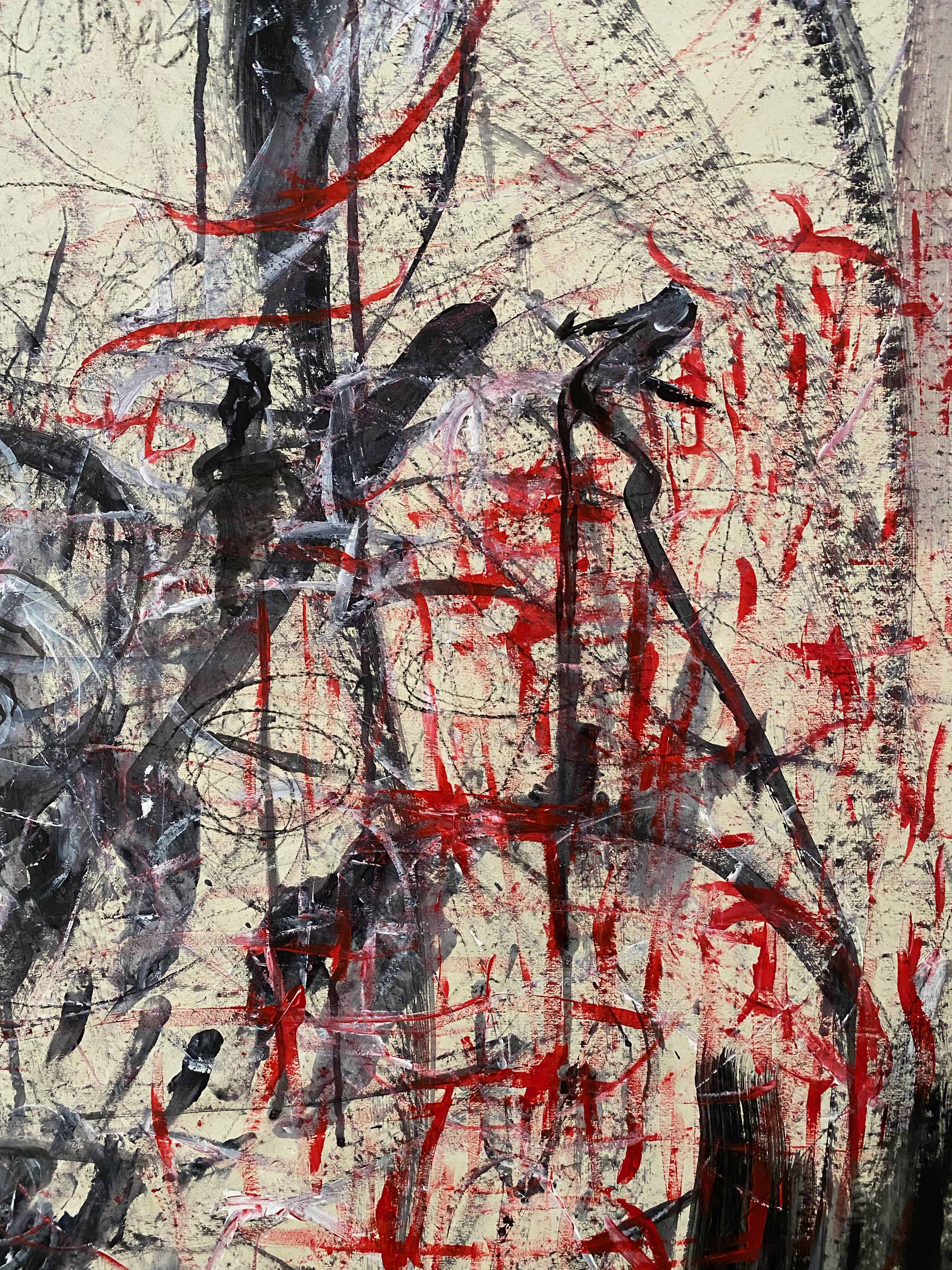
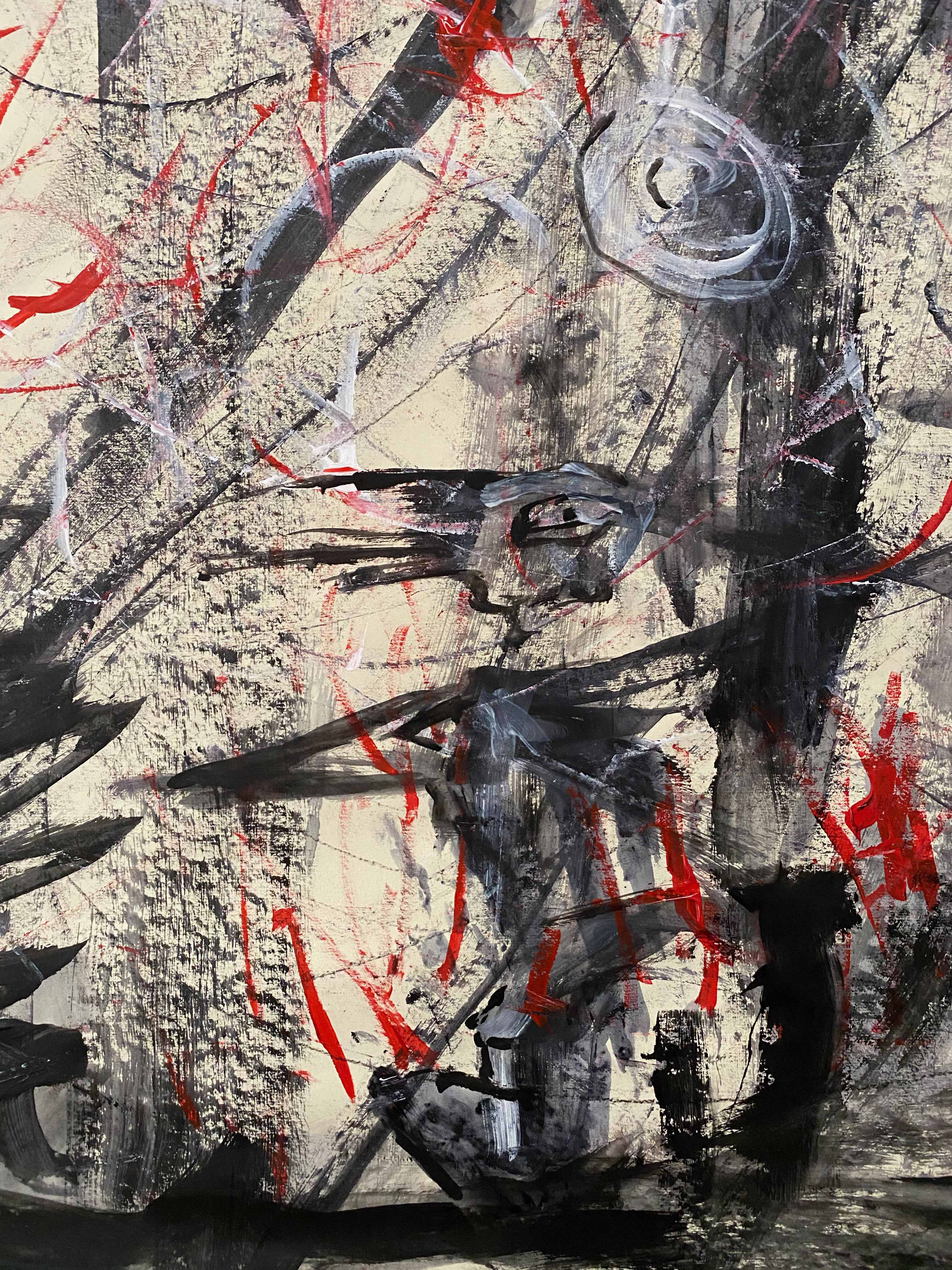
Here are some details that I like:
The experiences of these drawings to music have been profound. They have pushed me further towards performance and let me loosen the need for a clear or “good” outcome. I feel like a whole new ways of approaching drawing and painting are opening up here, a more intuitive and gestural approach. I am curious to explore how I can incorporate these experiences into more conceptual work as well.
The drawings for Part 2 took me to quite personal and vulnerable places, so I was not quite sure what feedback to expect. I was delighted to receive a very encouraging and positive report from my tutor Emma Drye.
She recognized that I am exploring new ground and saw potential to develop new tools and find new ways forward with performance drawings and animations. Her advice: “Continue to let your conceptual content direct your process though.”, feels very important. So far I have chosen either a more conceptual approach or allowed for performance drawings, and it is an exciting meeting point to let these approaches come together.
I was experimenting with video for project 2.1 Space Depth and Volume, where I created a stop motion of a Wave crashing. This was a new approach that I will develop further.
Emma pointed out how in the portraits inspired by Auerbach for the same exercise- the Auerbach lines did not support the construction of the head- which was the missing link I needed to see.
My tutor formulated, how the large paintings with my body for Assignment 2, unlocked the way that my relationship with my body had been affected by my experiences and how important that was.
She recognized, that some of the paintings were too chaotic, and how the ones of a single moment that showed a clear iconographic image were easier to read for the viewer.
I guess, I was worried they were too empty or too simple , so it felt like a recognition that I can go on and explore single movement drawings. For sure, this opens up new possibilities and there are so many ways to continue this exploration!
For the final painting in red on linen, there is also a too hidden narrative. Emma writes “This is something that would need to be worked on and developed to find its own place as a figurative painting.”
For Project 3 Narrative, where I produced a series I called “Family picnic” where I portrayed my family with a COVID mask, I agree with my tutor, that the drawings would have benefited from a different type of line. She suggested that a slightly more faltering , slightly more vulnerable and variable line would have given more information and would have conveyed something more about how the situation felt. I can absolutely see that now. I think at the time, I felt safer when choosing a rather boring way of drawing.
Similarly in the series of paintings for the same narrative, Emma really liked the surface that I have laid down, but was not convinced by the way that I actually painted the masks. I absolutely agree with that, and am quite surprised myself in hindsight about the difference in painting techniques between the backgrounds and the masks. I can’t believe this was not obvious to me while painting. I was really so taken myself by the conceptual idea, the narrative, that I navigated towards some calm safety in the techniques without meaning to.
By painting the COVID masks onto objects in a humorous way, my tutor recognized how I was working through the feelings that came up with this difficult subject and seeing the power of art that way. I found it really helpful to get this reflected back at me, as it was a spontaneous decision at the time.
Another helpful reminder was to not overwork the pieces- something I definitely have a tendency to do! There is the value of space!
I have a long list of artists to research, which I am really excited to start with:
Louise Bourgeois, Ana Mendieta, Yoko Ono, Marina Abramovic, Ulay, Carolee Schneeman, Rose Finn-Kelcey, Helen Chadwick, Cathy de Monchaux
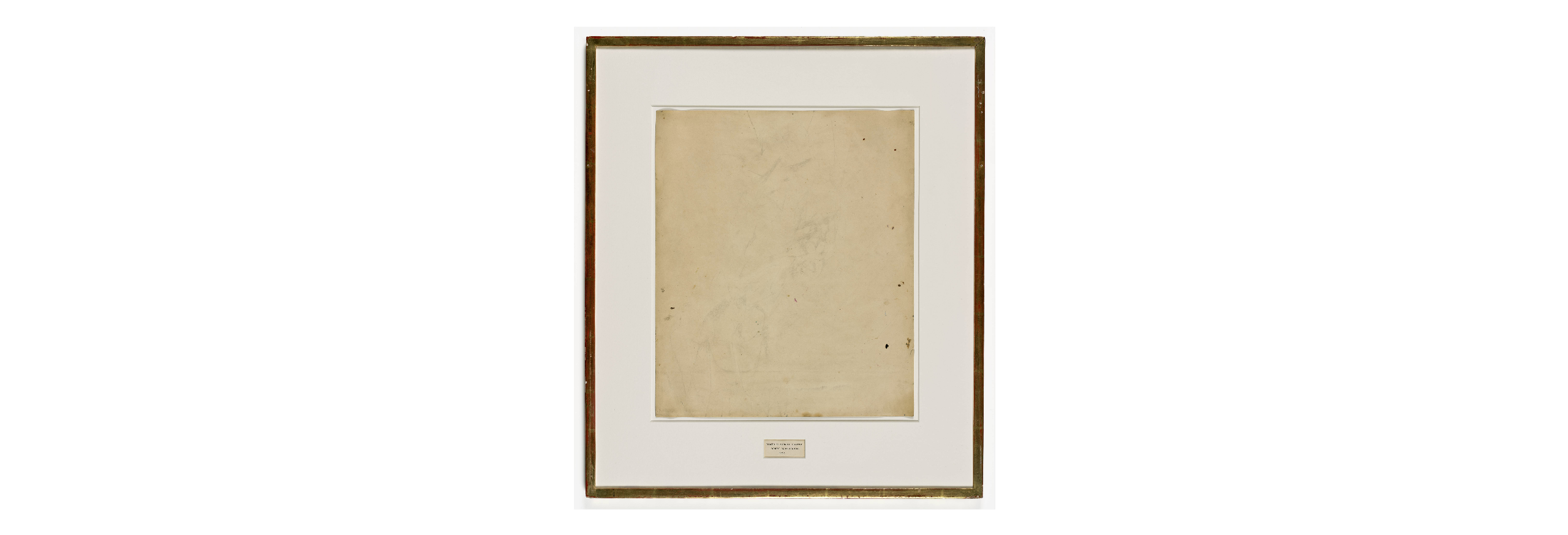
In 1953, Robert Rauschenberg asked Willem De Kooning for one of his drawings. Amazingly, he agreed. Rauschenberg then proceeded to rub out De Kooning’s drawing and exhibit the resulting near blank sheet. This is such a beautiful moment in art history as it brings together the mood of the time and the lasting legacy of both Abstract Expressionism and what would later become post modernism. Find a reproduction of this drawing on the web and make notes on how you feel about it at first sight. Then look a little into the background and try to get an understanding of why Rauschenberg might have done this. There are video interviews online with both artists. Use Google to find the videos and make notes on your thoughts about what happened.
I was lucky enough to see the “Erased De Kooning” drawing in the flesh in the Robert Rauschenberg exhibition at Tate Modern in London in 2017, even if there is not that much to look at.
The erased drawing is framed in a golden frame and bears an inscription “Erased de Kooning drawing” by Robert Rauschenberg. By framing it and labelling it, it becomes elevated to a piece that we can look at and understand the process behind. Without this, we would have no clue what we are looking at.
Robert Rauschenberg was experimenting with different art forms at the time, and stretching the limits of what could be an art work- continuing the legacy of the ready made by Duchamps. The question was, if the act of erasure could create an artwork. Rauschenberg understood that he would have to begin with a drawing that was recognized as art to start with that he would then erase, so he contacted de Kooning who was already recognized in the art world, and greatly admired by Rauschenberg.
In an interview on You tube (https://www.youtube.com/watch?v=tpCWh3IFtDQ), Rauschenberg explains that if de Kooning had not been home that day- that would have been the work. If he would not have been willing to give out a drawing to erase- then that would have been the work. But de Kooning agreed, and added that it would have to be a drawing that he would miss. Rauschenberg sais that the drawing was VERY difficult to erase. It had crayons and charcoal and took a month to erase.
Hearing these interviews added another level of understanding of the work for me- that whatever had happened, if De Kooning would not have been home or not given a drawing, would have been the work. Here the process is really the work. These other situations would not have been possible to frame and hang in a museum half a century later- but they would still have been the work.
I am only beginning to grasp the importance of process in my own drawings, as I am experimenting with drawings where the process is more important than the final drawing, like the body prints I did for Assignment 2. I am excited to push this further by drawing to music for Assignment 3, without being focused on an outcome, but accepting the marks inspired in the moment.
“The Abstract Expressionists’ use of gesture was caught up with notions of authenticity and even of purity of intent. The influential critic Clement Greenberg wrote in his article ‘Avant Garde and Kitsch’ in 1939 about the good artist painting ‘cause’ and the bad artist painting ‘effect’. He also talks about what he describes as ‘the inflections of the personal’ becoming a legitimate subject. For example, the artist Jackson Pollock talked about wanting to paint from his emotions, not to illustrate them. What’s your response to these comments?”
I first researched Abstract Expressionism for the Practice on Painting course- a shortlink to the blogpost is here: https://wp.me/p94hP8-Z1
The essence of Abstract Expressionism is a spontaneous, highly charged, impulsive way of painting, where the artist works with large gestures without a pre-concieved plan or sketch or even idea. Guided by emotions and impulse, the artist allows and exploits accidental effects.
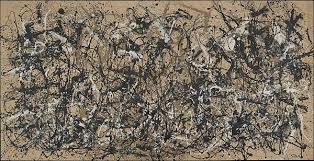
The documentary made by Hans Namuth (http://www.youtube.com/watch?v=6cgBvpjwOGo) is a great way to understand Pollock’s way of painting .Jackson Pollock developed his individual form of spilling and dripping paint onto a canvas usually placed on the ground. Hans Namuth shows this brilliantly in the movie in a moment where he has placed the camera under a glass onto which Pollock is working so we witness the action from the perspective of the canvas.
In the movie Pollock sais that he enjoys working on a large canvas because he can feel part of it. This is something that I am only myself beginning to explore, and the statement really felt true. A large canvas, that allows much larger and less controlled gestures, invites me into being part of it in a very different way than a smaller controlled painting can.
For POP1, I tried out Pollocks’ method to feel how it feels- using sticks to drip and splatter household enamel paint onto brown wrapping paper on the floor:
This is my painting when it felt complete:
Pollock said: “I want to express my feelings rather than illustrate them”. I think he found a method of painting, where he could literally pour his feelings onto the canvas, as in letting his motions be guided by his emotions and then let himself react to that immediately, instead of trying to create an image of what he was feeling, that would become an illustration. An illustration in that sense would have a gap, a time of thinking and planning, between the feeling and the painting, whereas with an abstract expressionist method, there is no such gap. It is a simultaneous feeling and painting. The focus is on the moment, on the physical act of painting, as much as on the resulting painting.
I believe this is what the art critic Clement Greenberg was referring to when he talks about the good artist painting ‘cause’ and the bad artist painting ‘effect’. He compares the impact of a painting by Picasso that requires patience and dedication to understand and a painting by Repin where there is a story told and even exaggerated for effect, on an ignorant Russian peasant. His article ‘Avant Garde and Kitsch’ was written in 1939, so before the dripping experiments of Jackson Pollock and the rise of other Abstract Expressionist painters though.
“It has been in search of the absolute that the avant-garde has arrived at “abstract” or “nonobjective” art — and poetry, too. The avant-garde poet or artist tries in effect to imitate God by creating something valid solely on its own terms, in the way nature itself is valid, in the way a landscape — not its picture — is aesthetically valid; something given, increate, independent of meanings, similars or originals. Content is to be dissolved so completely into form that the work of art or literature cannot be reduced in whole or in part to anything not itself. ” (Quote from: Mehdi hamedi/greenberg, C.2020.Academiaedu on AVANT-GARDE_AND_KITSCH-_Clement_Greenberg.[Online].[15 April 2020].Available from: https://www.academia.edu/7515241/AVANT-GARDE_AND_KITSCH-_Clement_Greenberg)
Later, Greenberg would redefine some of the concepts in his essay and it is interesting to think of how “Kitsch” rose to high art through the Pop art movement.
Revisiting the Abstract Expressionists and especially Jackson Pollocks’ work, has unlocked some new enthusiasm in me to let emotion and accidental movements guide me through the next projects, and especially Assignment 3, where I plan to use a very large paper to move and draw intuitively to music.
Course manual: “Aim: This project is in some ways the antithesis of the previous one. Last time, you used an object to draw ‘for’ you; this time you’ll allow your own emotional responses to direct your physical mark-making.
Method: Take 10 pieces of card and give them to friends. Ask them to write down a characteristic of someone in a novel or newspaper article in the first person. Ask them to choose something which might engender an emotional or physical response. Examples might be ‘I killed 15 women’ or ‘I won the lottery’ or ‘I feel nervous at parties’.Ask someone to sit for you as a model. Every 10 minutes ask them to read from one of the cards. As they read the statement out, try to change the way you use your materials to respond to the statement. Make angry, scared, joyful marks as prompted.
I used this project as a quarantine game for the family again, so all agree to write some of the cards containing statements engendering an emotional response.
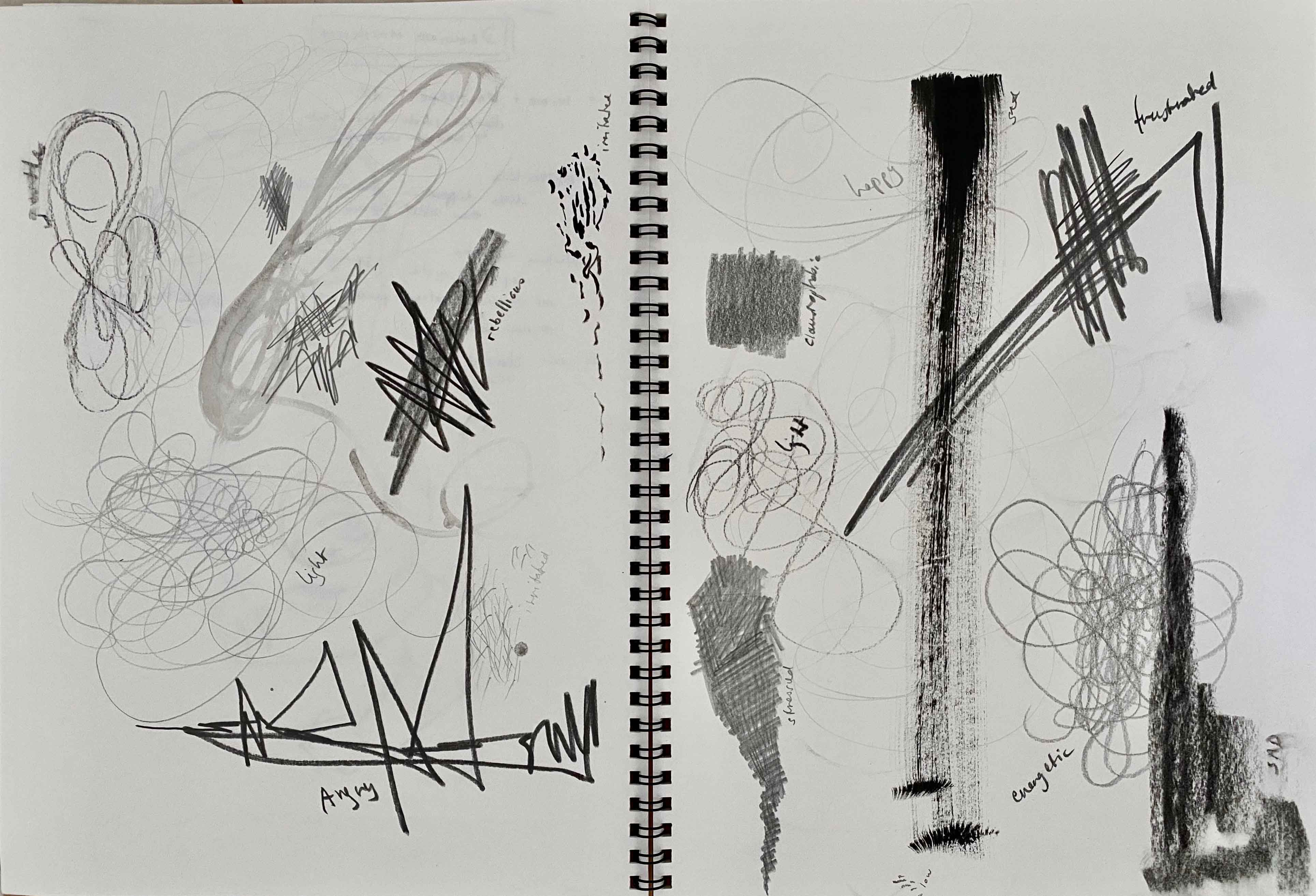
I start by trying out different marks as a response to different emotions in my A4 sketchbook. I am not using the cards yet- I do not want to spoil my first reaction to them by having read them before drawing the model.
These are marks in answer to sad, angry, happy, dreamy, elated, furious, scared, claustrophobic etc:
I have decided to stay monochrome and only use grey or black materials, to really let the marks be the focus, not any colours.
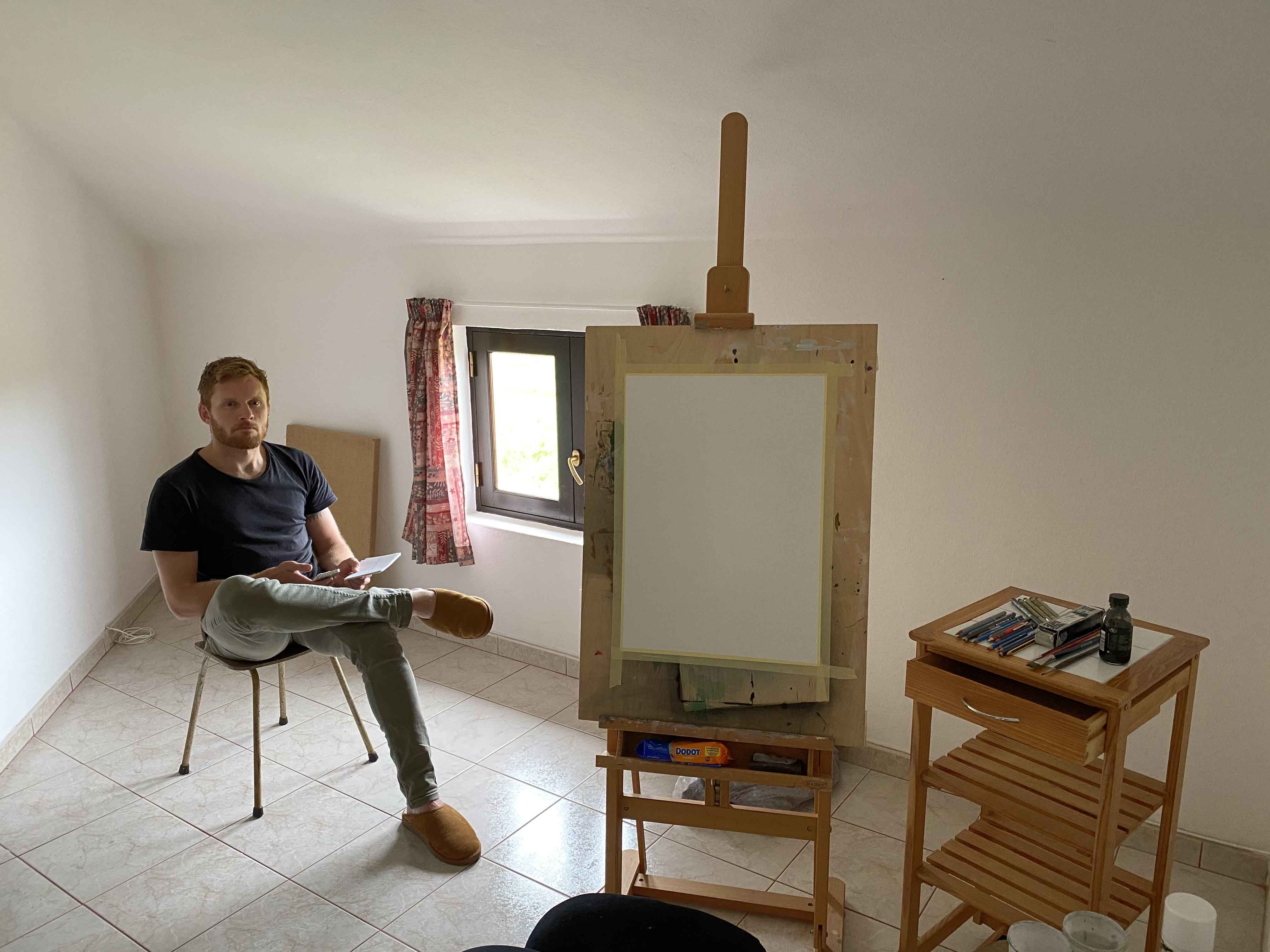
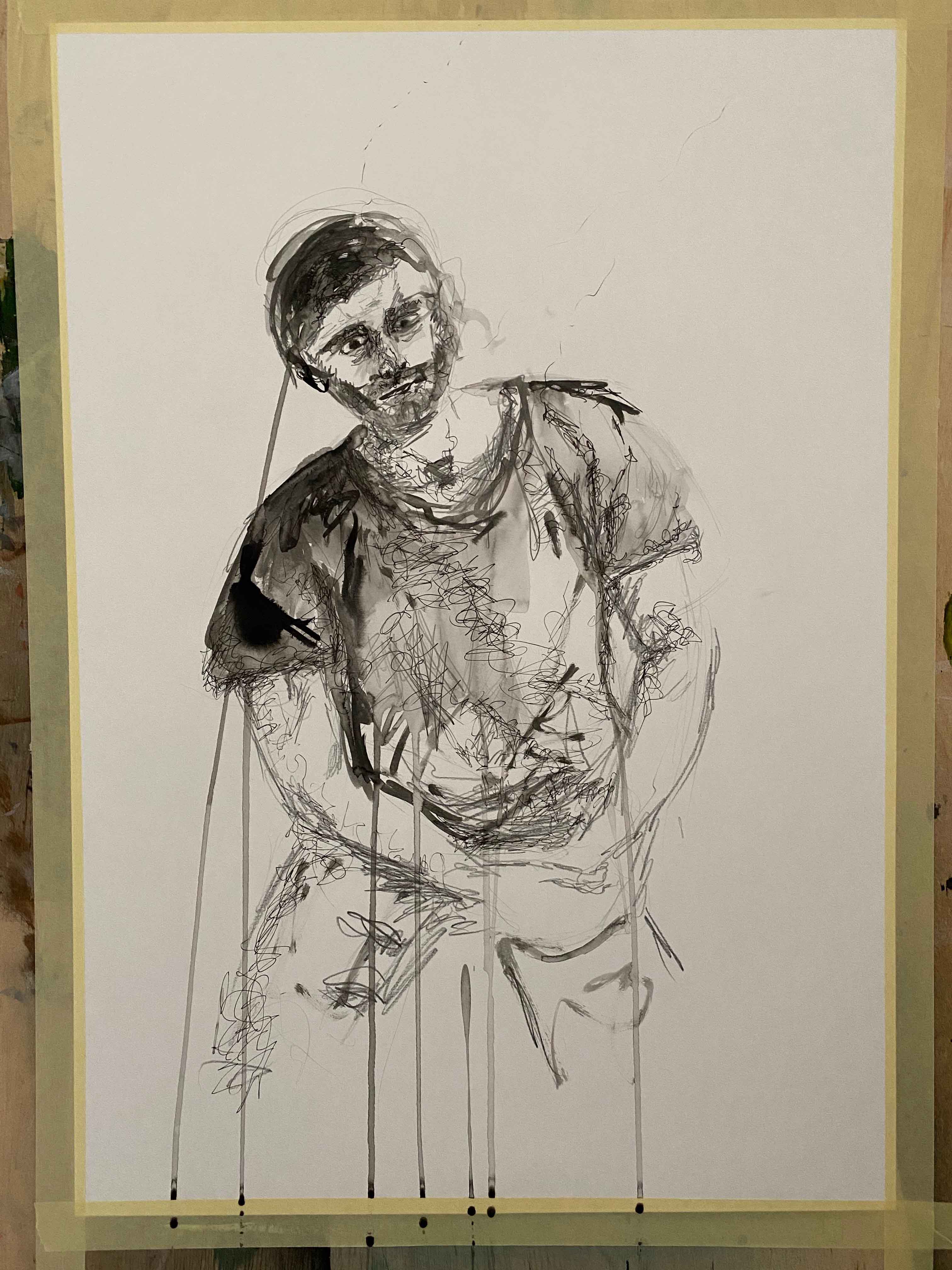
Today Tom has agreed to sit for me (while listening to a podcast). I prepare an A2 sheet of paper on a board and graphite pencils in different grades, charcoal sticks, some Indian ink and different brushes and an array of black markers.
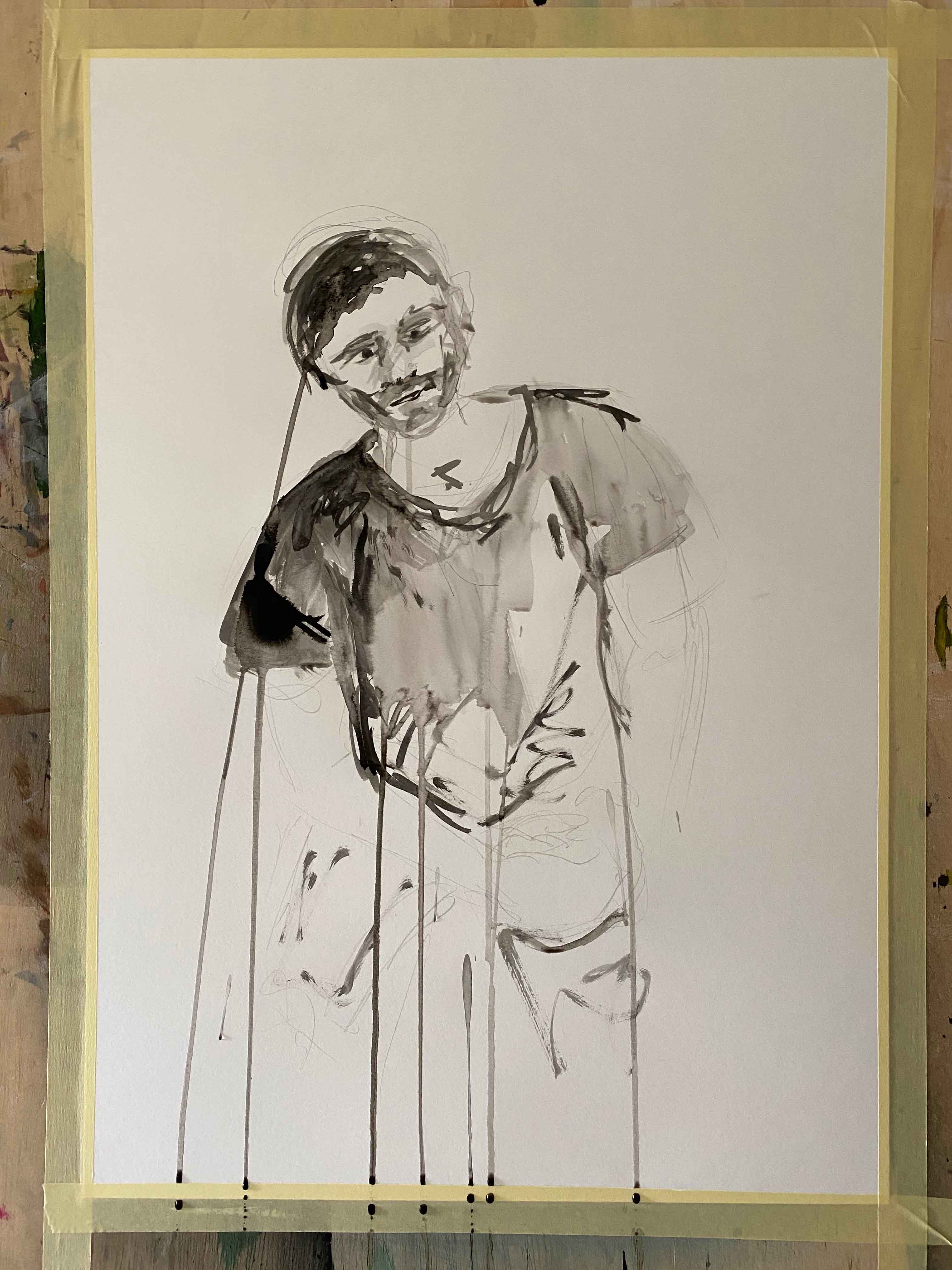
The first 10 minute card that he pulls out reads: “I sometimes wish I had never been born at all”.
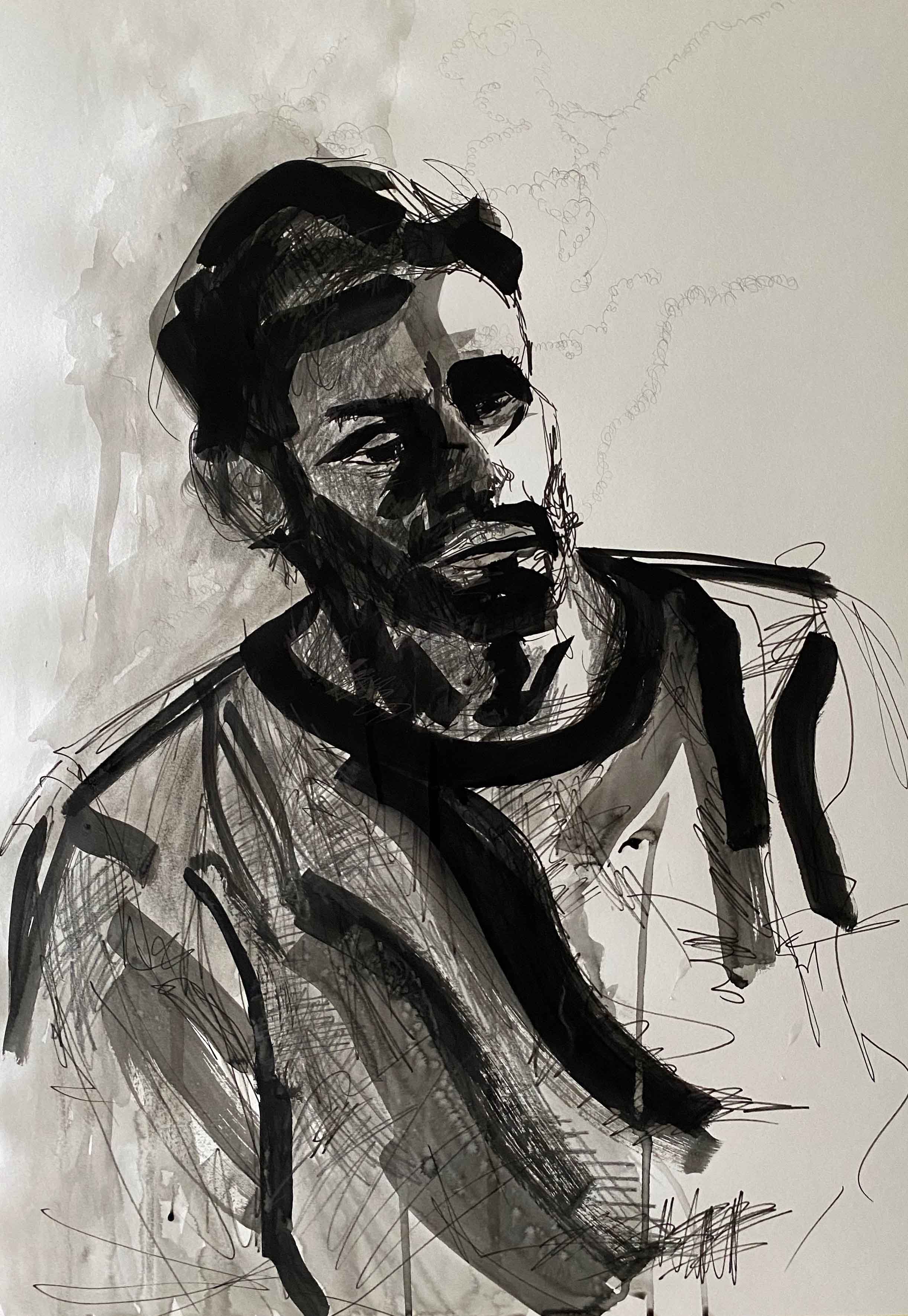
I can feel tears here and decide to start with ink and water that I can let run down over the face like tears, using a rather small brush, like a not so loud voice. So this is how the drawing starts:
I think the defeated and teary look caught the emotion of the statement.
Next card reads: ” I am wood”.
For this card, I use a 7B pencil, wanting to touch the wood of the pencil and letting my marks be both soft and hard as if feeling the surface of wood. My pencil is moving as if sanding the surface.
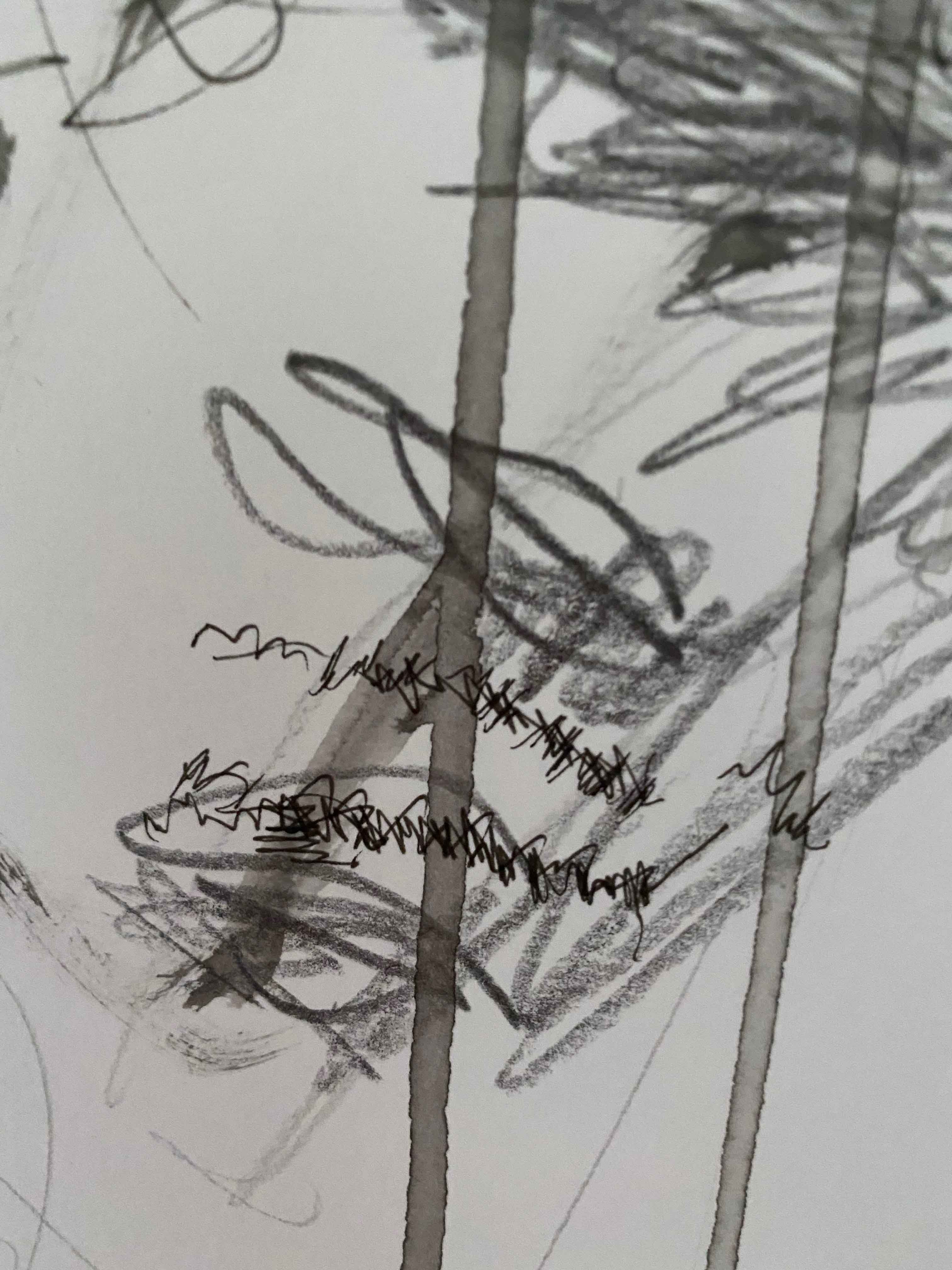
Close- ups:
Third card: “I like to eat the birds” (What??) I do not know what I am feeling here, it is very confusing. There is a strange spiraling of thoughts here, so I decide to capture that spiraling motion. I choose a black 01 marker.
A closer look:
Fourth card: “I wish someone would love me”. For this statement, I feel deep sadness again, and it is a quiet voice. I choose a thinner black marker and make very tight, tense, small marks:
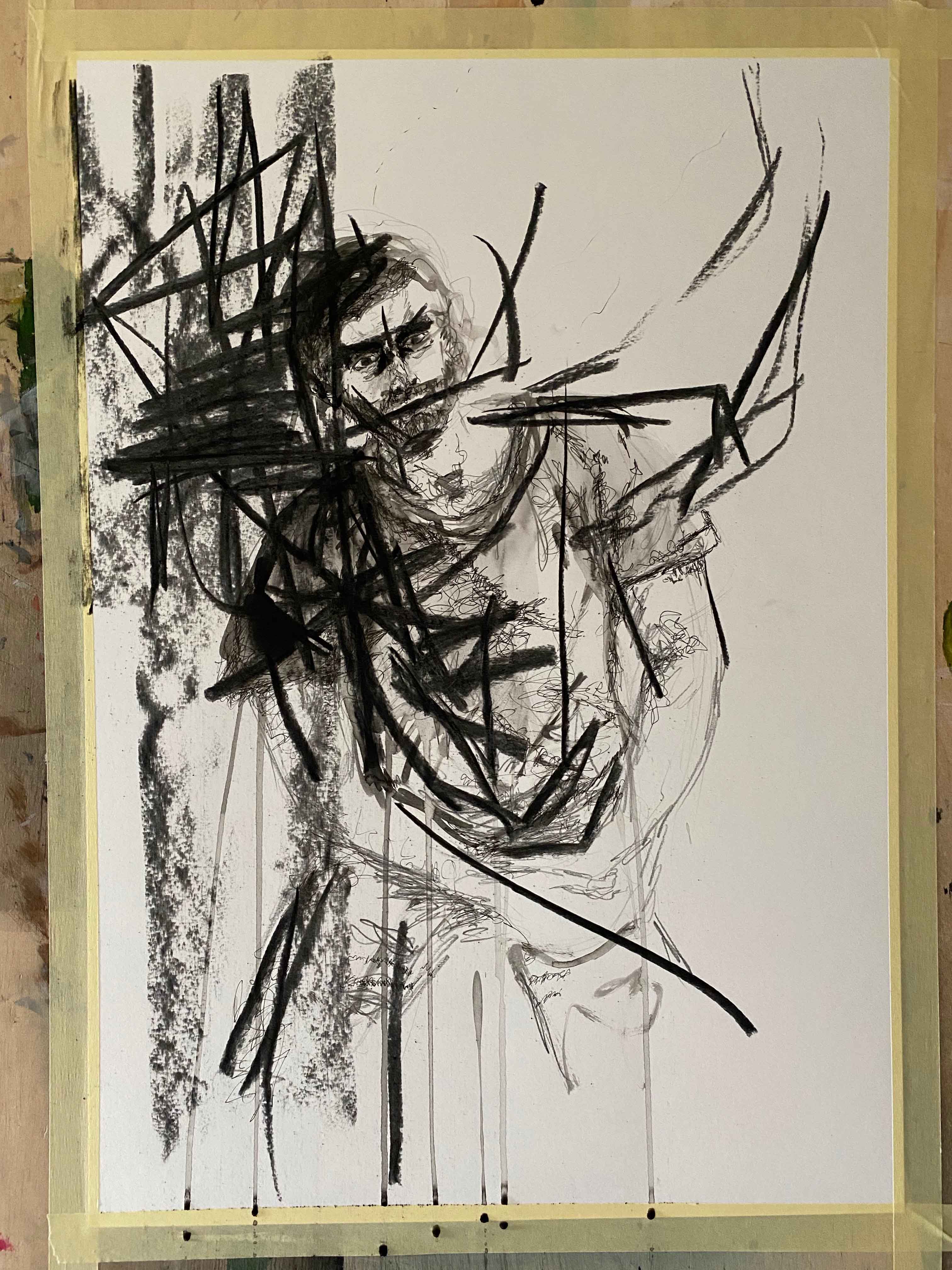
Fifth card: “It is time for me to revolt”
It is time to take a thick charcoal stick and move in strong, revolting, angular, decisive marks:
I let the figure raise the arms and straighten up the shoulders from the slumped position, also there is a new decisive trait over the eyes.
Having arrived here, I decide that this drawing is complete and decide to start on a new A2 paper for the next 5 cards with statements.
Card number 1: “I say- hey fuckface- this ebook will change your life in like 5 minutes or something” (Seriously, family?)
This statement feels very arrogant. I respond by grabbing a nr 1 black marker and make bold, big, sweeping marks with my nose held high.
This looks rather terrible and has no likeness at all to my sitter.
Card nr 2: “I am stuck in mental traffic”
This is definitely a subtler, swirling, spiraling mark. I use a 0,5 technical graphite pencil for very intricate swirling, repetitive marks, leaving the figure and spinning around the head.
This is the drawing at this stage:
Third card: “I will shoot anyone who breaks quarantine” (actually said by Philippine President Duterte).
I am relieved at finding such a strong, hard statement that I can respond to with a thick brush loaded with Indian ink in strong, hard strokes- just what this drawing needs.
This arranged the shape of the figure and brought back a certain slight likeness.
Fourth card: “I think everything will be ok.”
For this soothing and calming feeling, I go back to a graphite pencil, in 9B for a darker mark. I use more classical cross hatching as my marks, for a certain feeling of familiarity.
The fifth and last card: “I lost myself between your legs.” I almost feel like I should grab some flesh-coloured pastels here, but decide to stay with my monochrome idea and instead add water with a thin brush, letting very diluted ink flow down the background and figure.
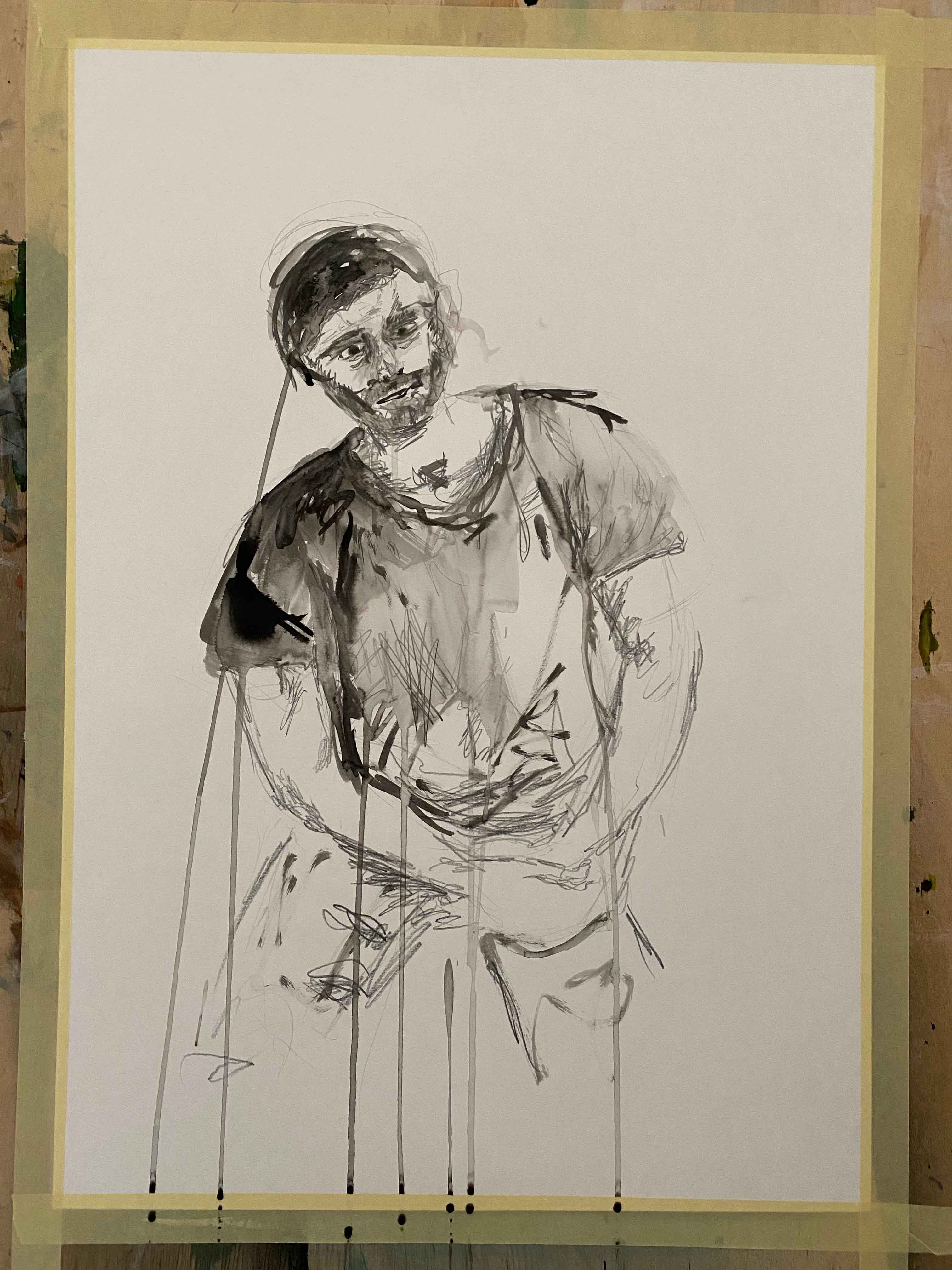
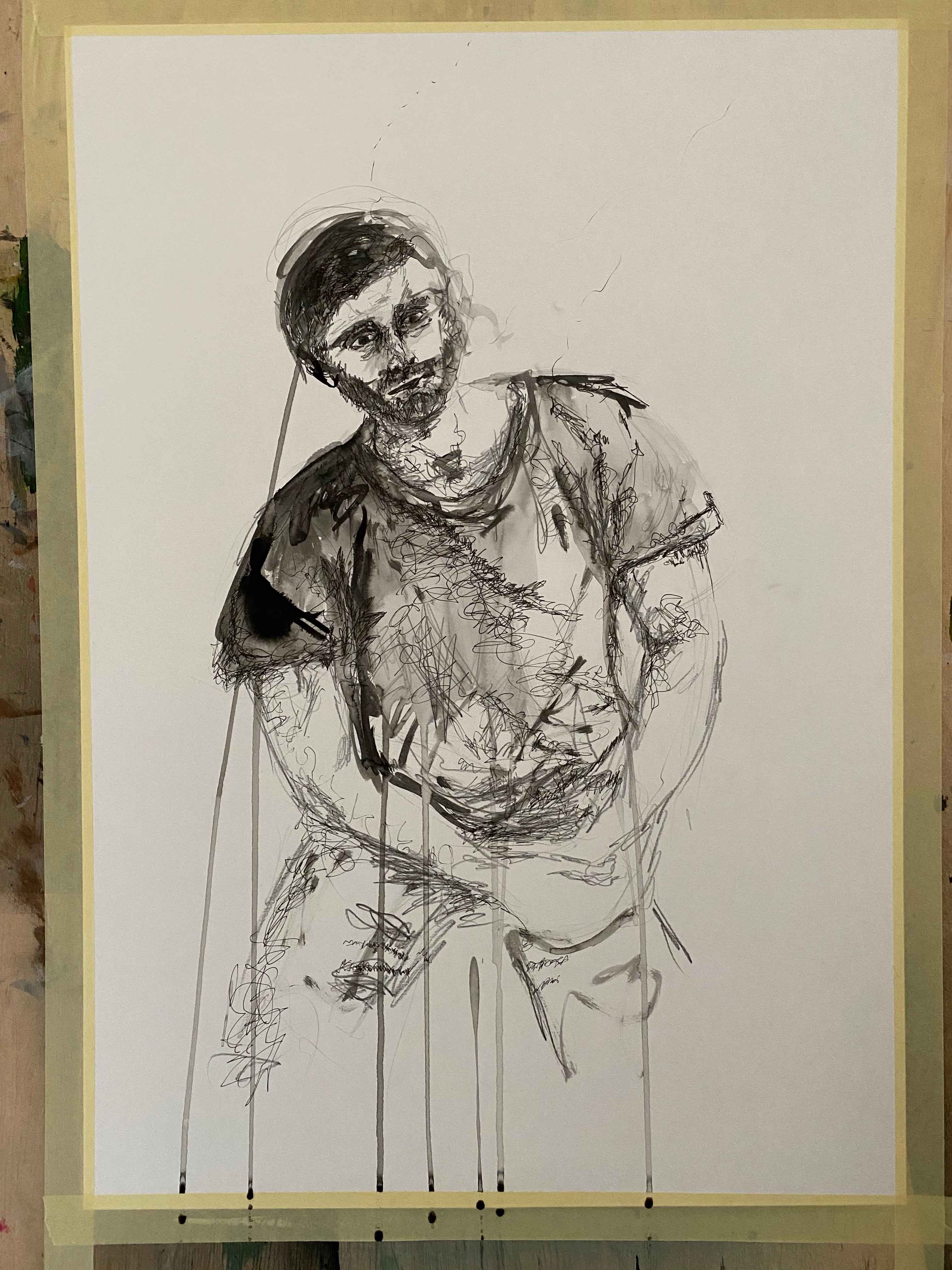
This is the final drawing:
This was a really interesting exercise in pushing my mark-making further and especially in translating an emotional response into a physical one. It depended quite strongly on the statements how accurately it felt that I could translate them. The clearer the emotional response, the easier it was to turn the feeling into physical mark making.
I think both drawings show a wide range of emotional responses and different marks, but I think the second one feels more coherent as a portrait of the sitter AND as a translation of the statements.
Course manual: “Aim: Push the concept of marks as a tracery of movement to its logical conclusion by making marks incidental to your own movement.
Method: Find something which moves and attach a drawing medium to it so that it creates a drawing by itself. You might use a remote control car, a clock face, a door which is opened regularly, the foot of a dancer. Develop these automatic drawings using source material from your sketchbook or simply by responding to what you find as you experiment. Note carefully what happens when you shift the drawing from automatically produced marks to considered ones.”
LINE IN THE WIND
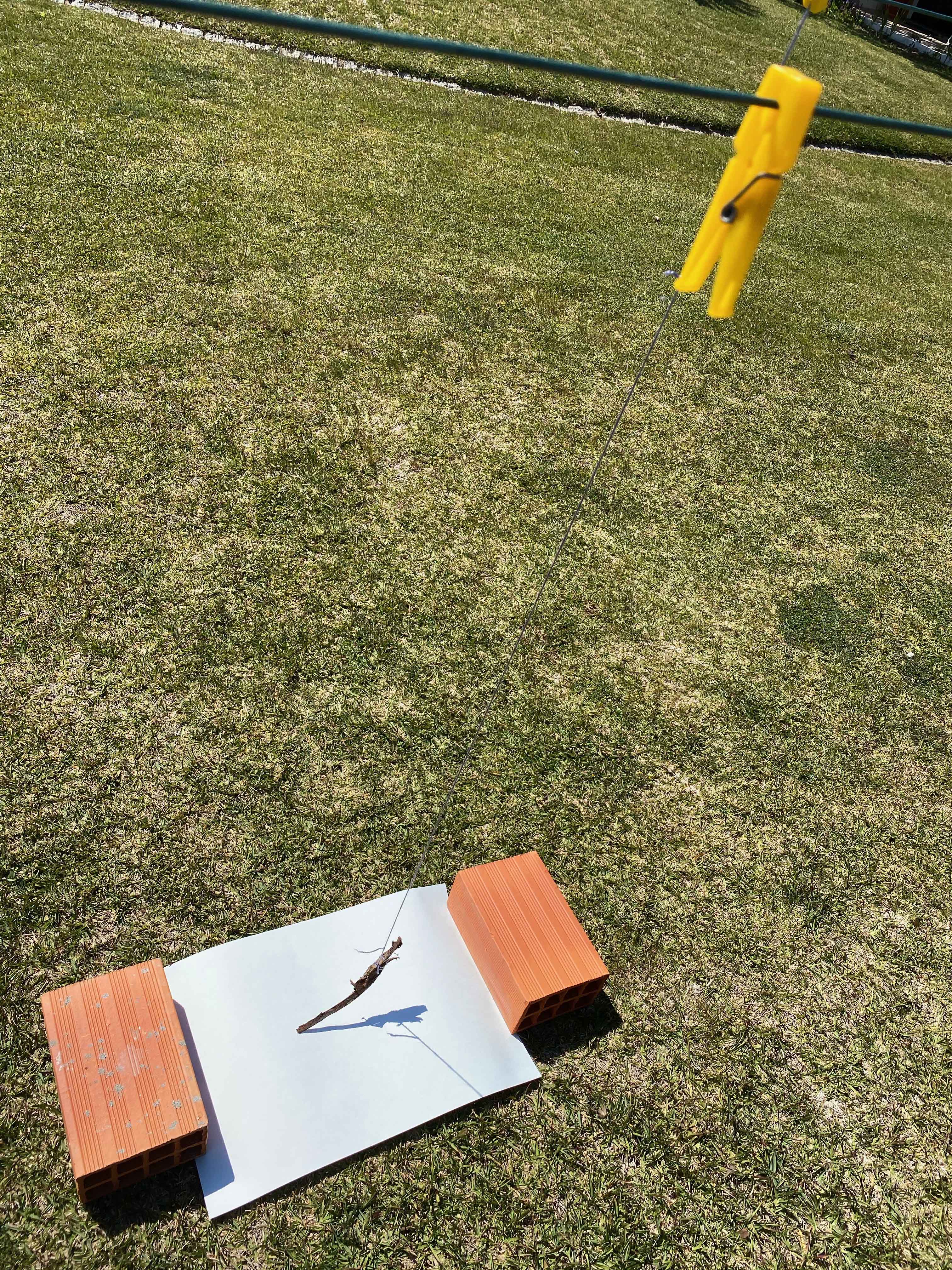
I am observing a bed sheet flapping on the clothesline in the wind, and decide to try a first “drawing machine” experiment there.
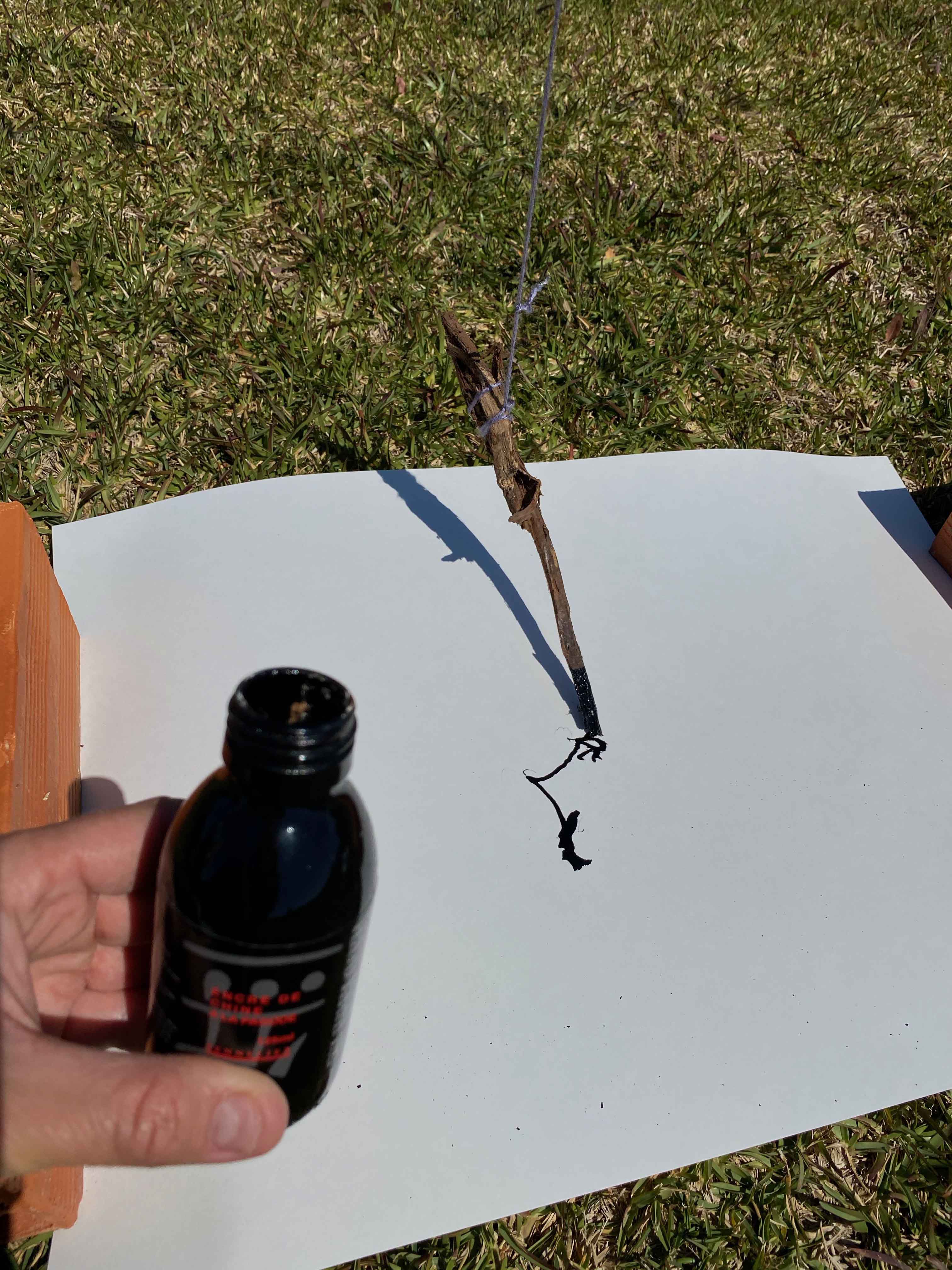
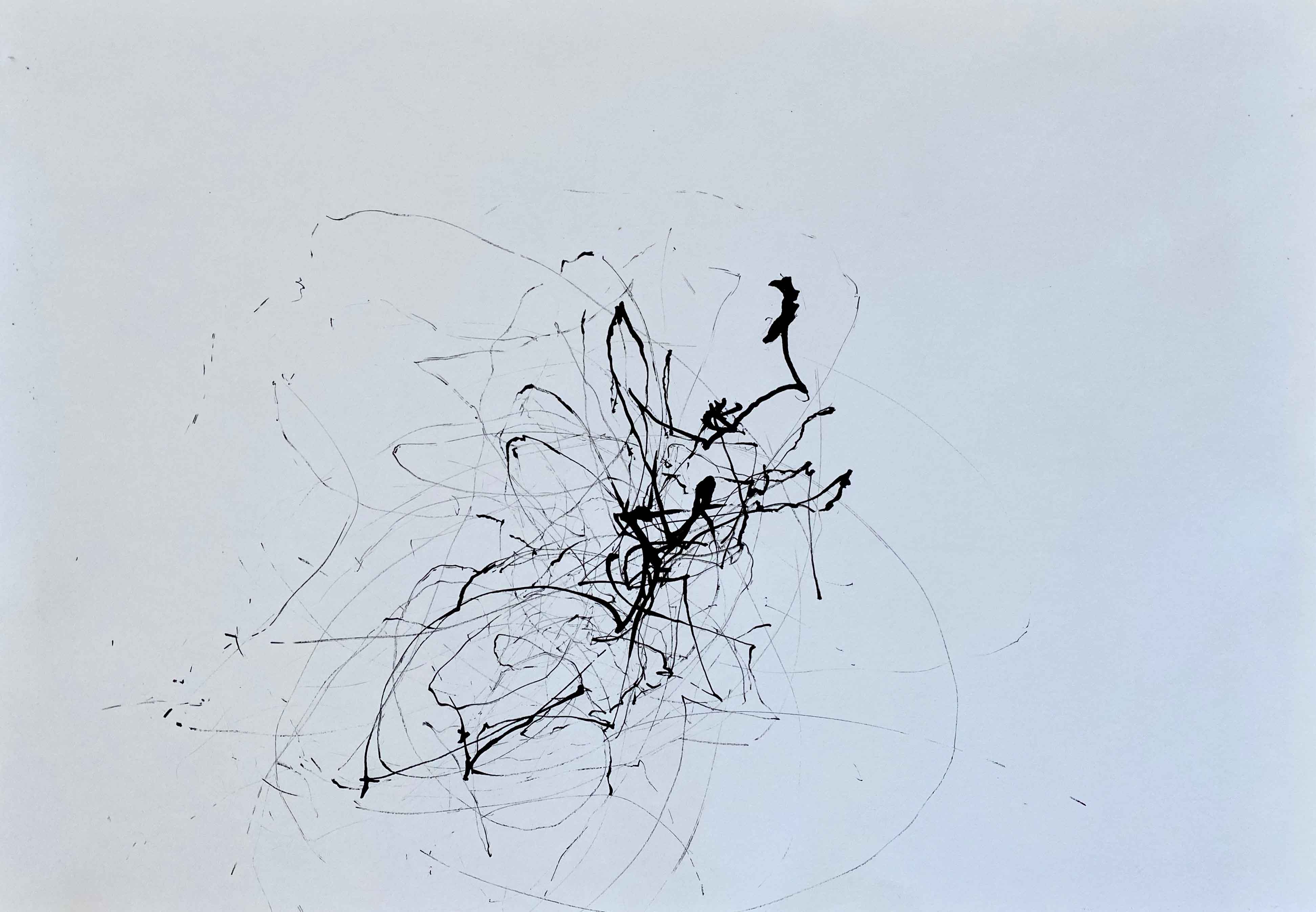
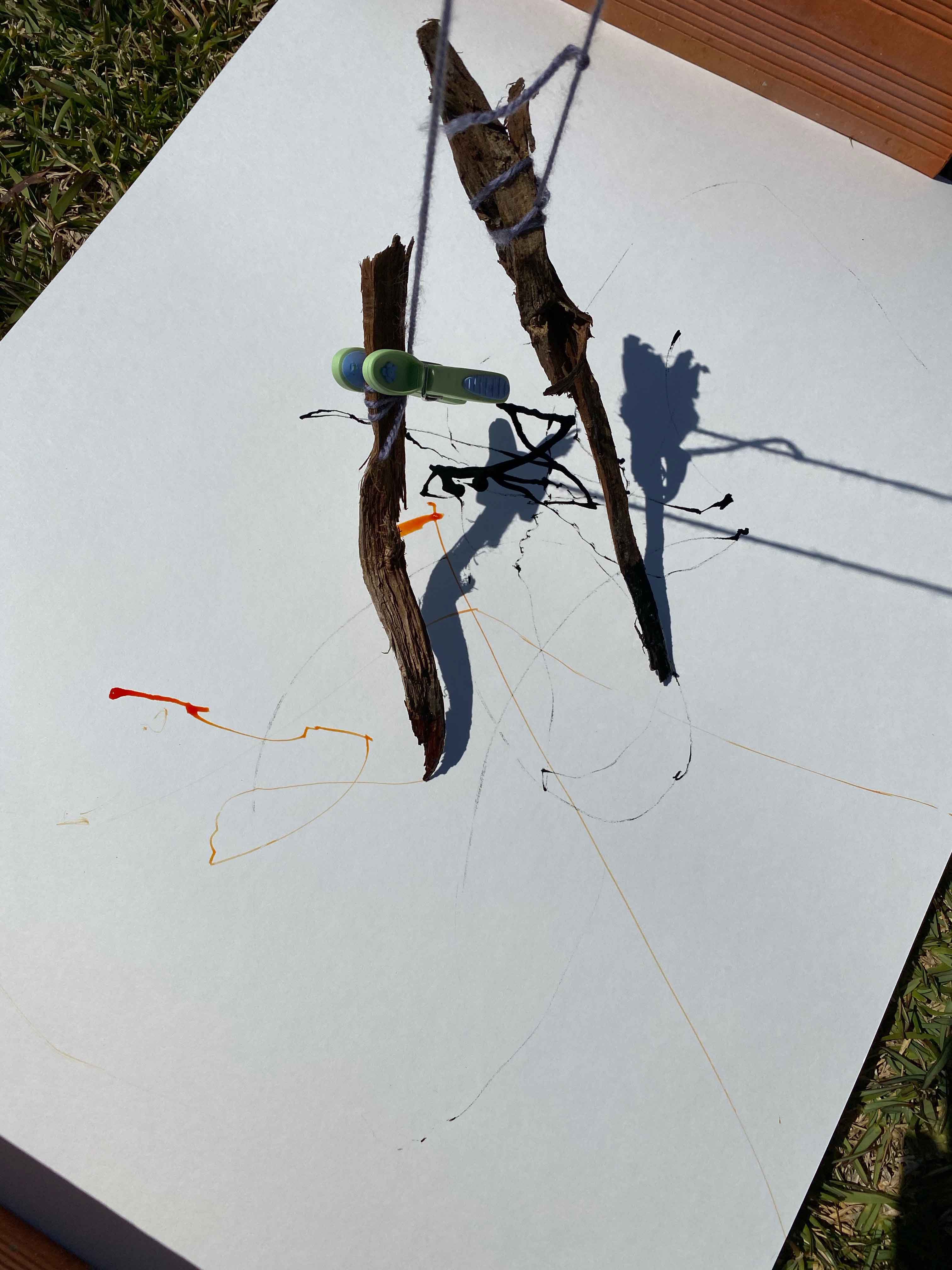
As the wind is quite strong, a charcoal stick or a pencil are too light- they would just fly around. I attach a stick to a string and dip the end in Indian ink. I attach a Canson A2 paper between two bricks.
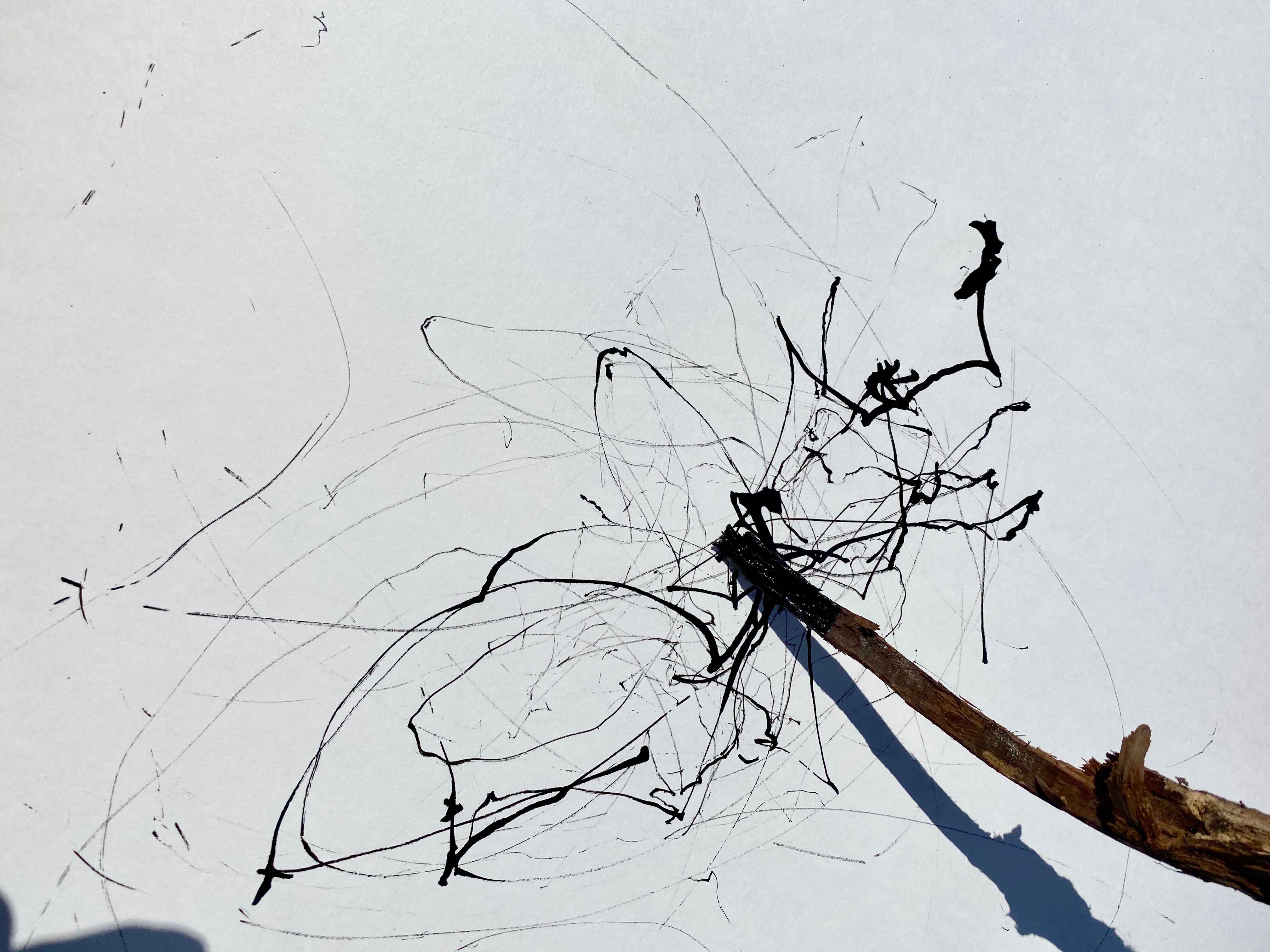
I am really pleased with the variety of marks and shapes the stick is drawing.
The ink dries in the wind, so I have to dip the point in ink a few times.
This is the point where I decide that the drawing is finished:
I see a delicate flower and am really happy with this first drawing machine drawing.
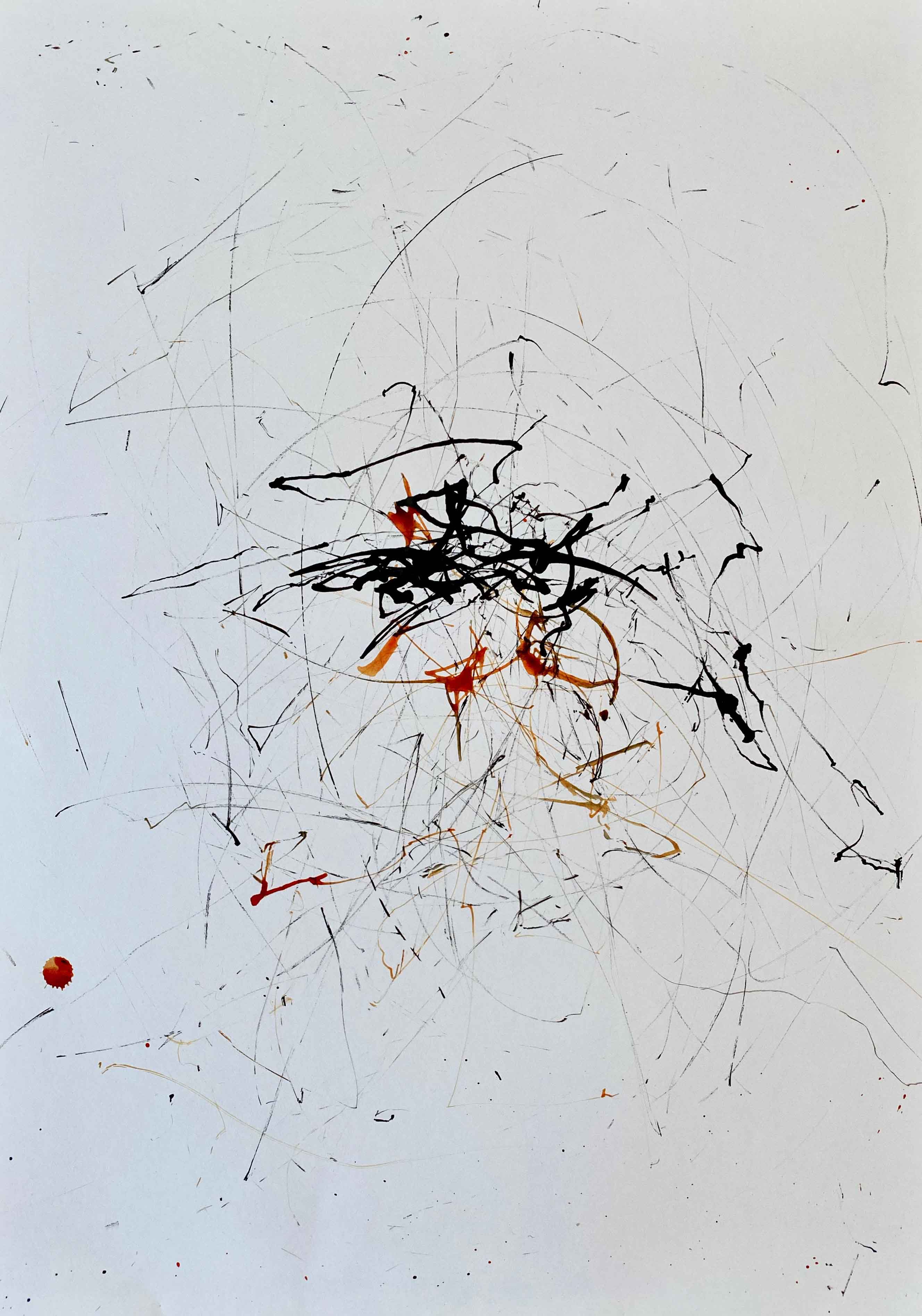
For a second drawing, I add another stick, which I dip in W&N Vermellion ink, besides the first stick with Indian ink:
This is the result:
It is more chaotic than the drawing with only one stick, but I am pleased at the result. It has a clear center and the composition is held up by the accidental red dot on the left.
PLANT IN THE WIND
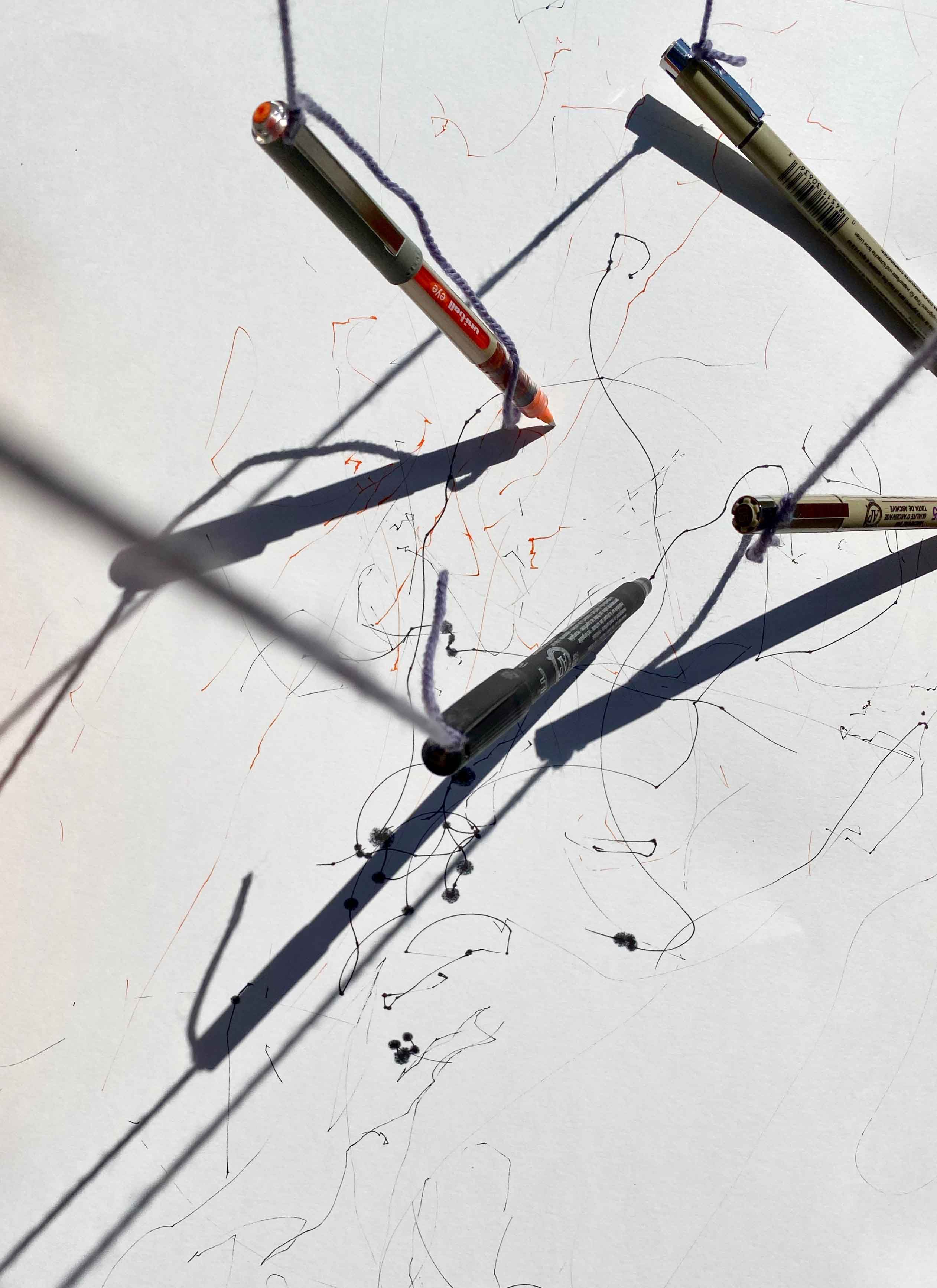
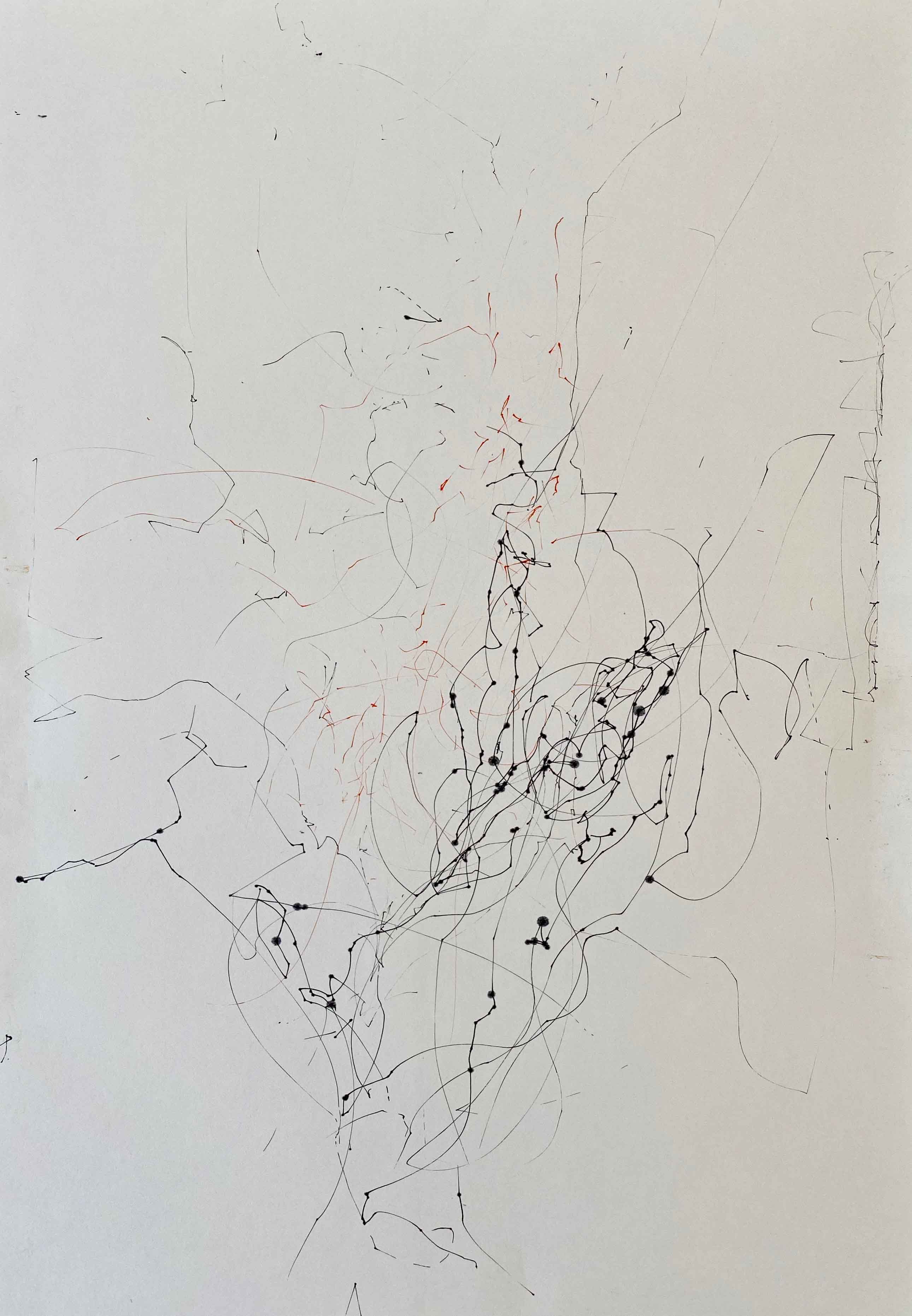
I decide to complicate the drawings further by attaching four thin markers- three black and one orange- to a small plant that is waving wildly in the wind.
I am really quite fascinated by the marks and patterns created. When the markers stop, as if reflecting where to swing next, they leave a stronger dot.
This is plant drawing number one:
It looks like a complicated constellation or map- I really like what came out of this.
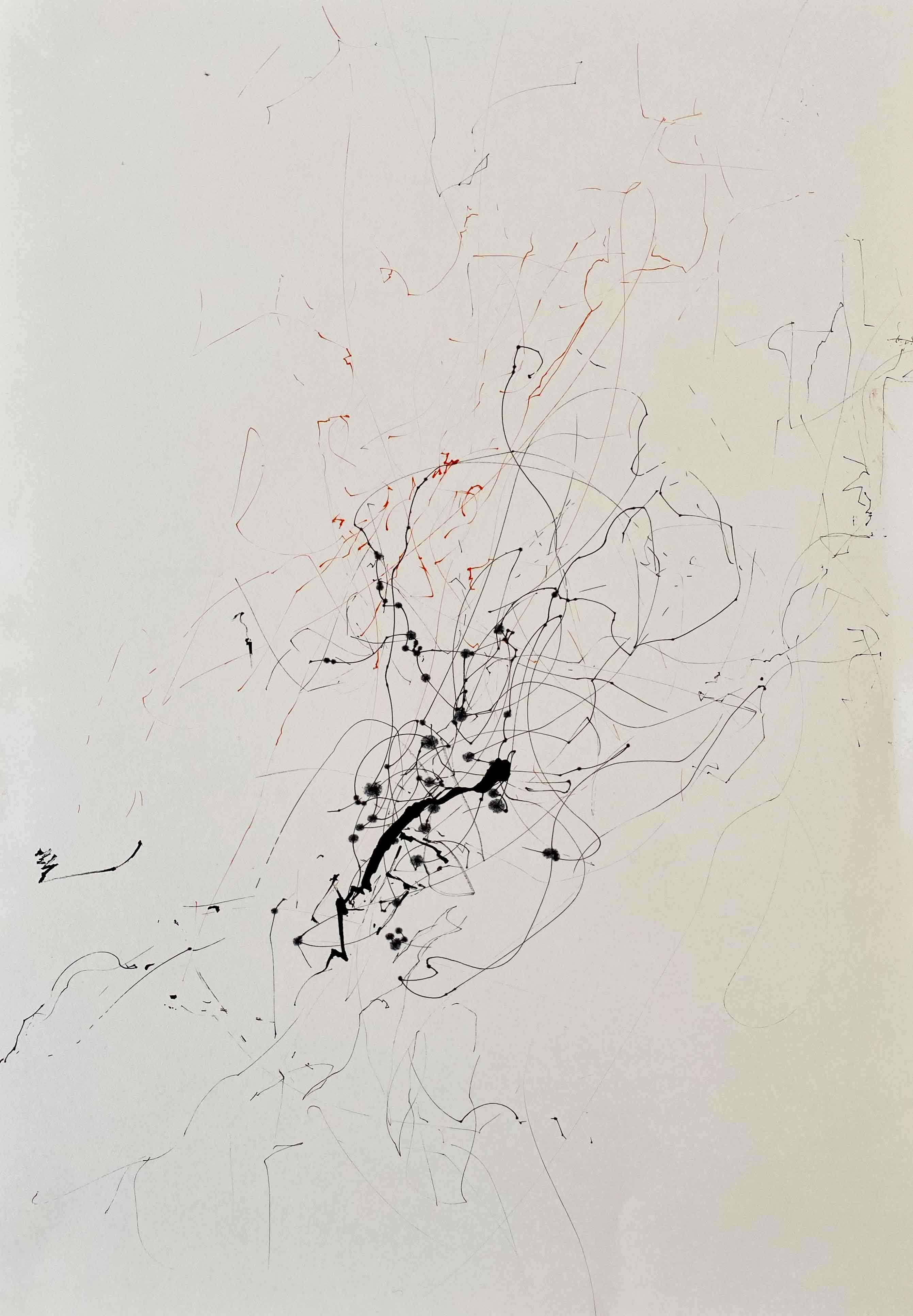
I try this a second time, and add the stick dipped in ink for a short moment in the end- to create different values to the marks:
WASHING MACHINE
Our washing machine has a whole life of its own during the spinning cycle, so I decide to explore this as a drawing machine.
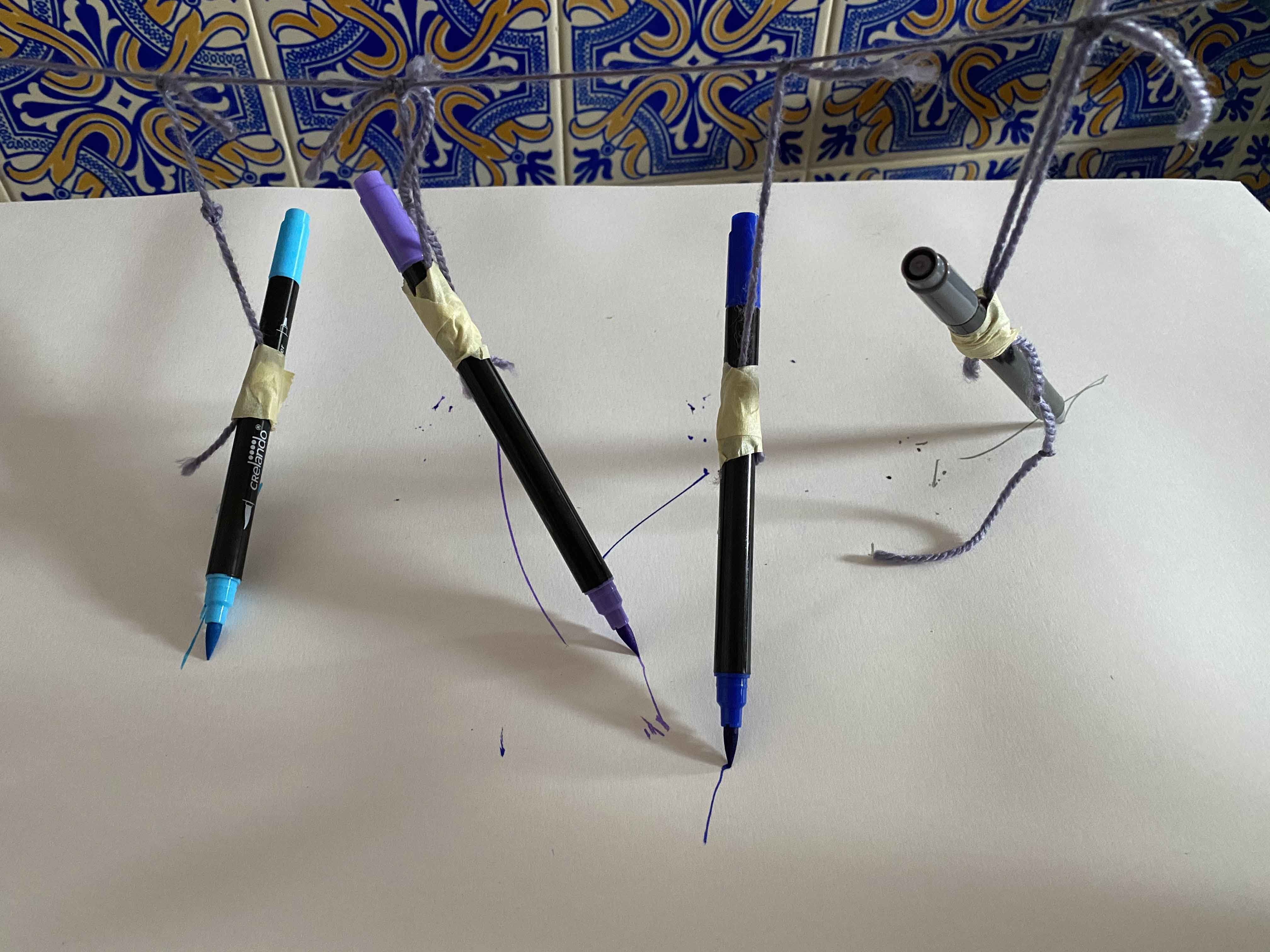
I suspend a row of coloured pencils and oil pastels, all in different blue shades, over the machine.
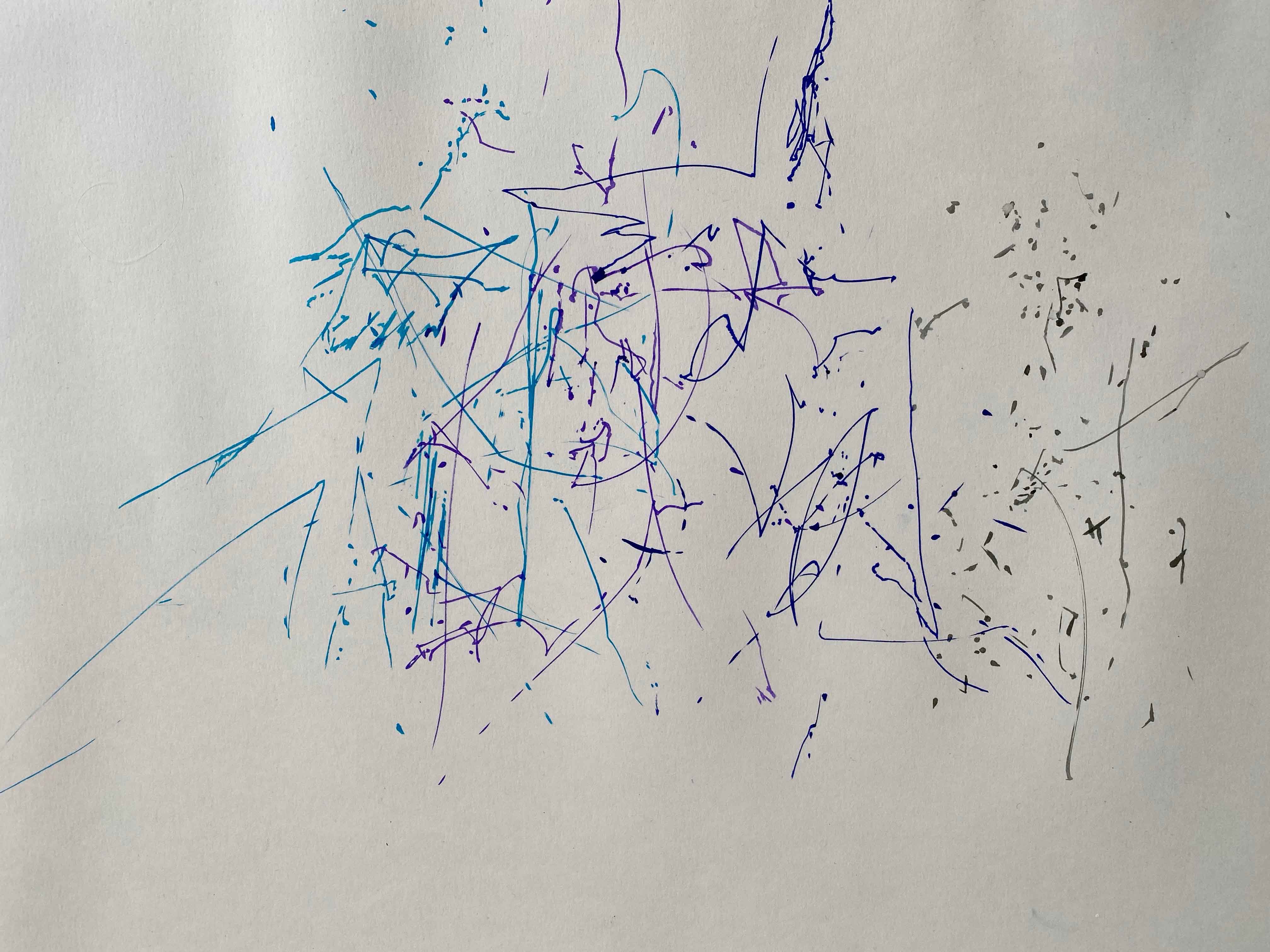
Although the machine has moved a good 20 cm forwards during the cycle, there are hardly any marks on the paper. The drawing materials are too light and make too faint a mark. I decide to repeat the experiment with coloured markers instead:
This time the result is more exciting:
As a drawing, I am less fascinated by it than by the more harmonious wind drawings both from the clothesline and from the little plant. The marks form less of a coherence here, but there are some interesting, almost cartoon figures within the lines.
THE BLENDER
Watching the blender shudder and swirl, I have another drawing tool.
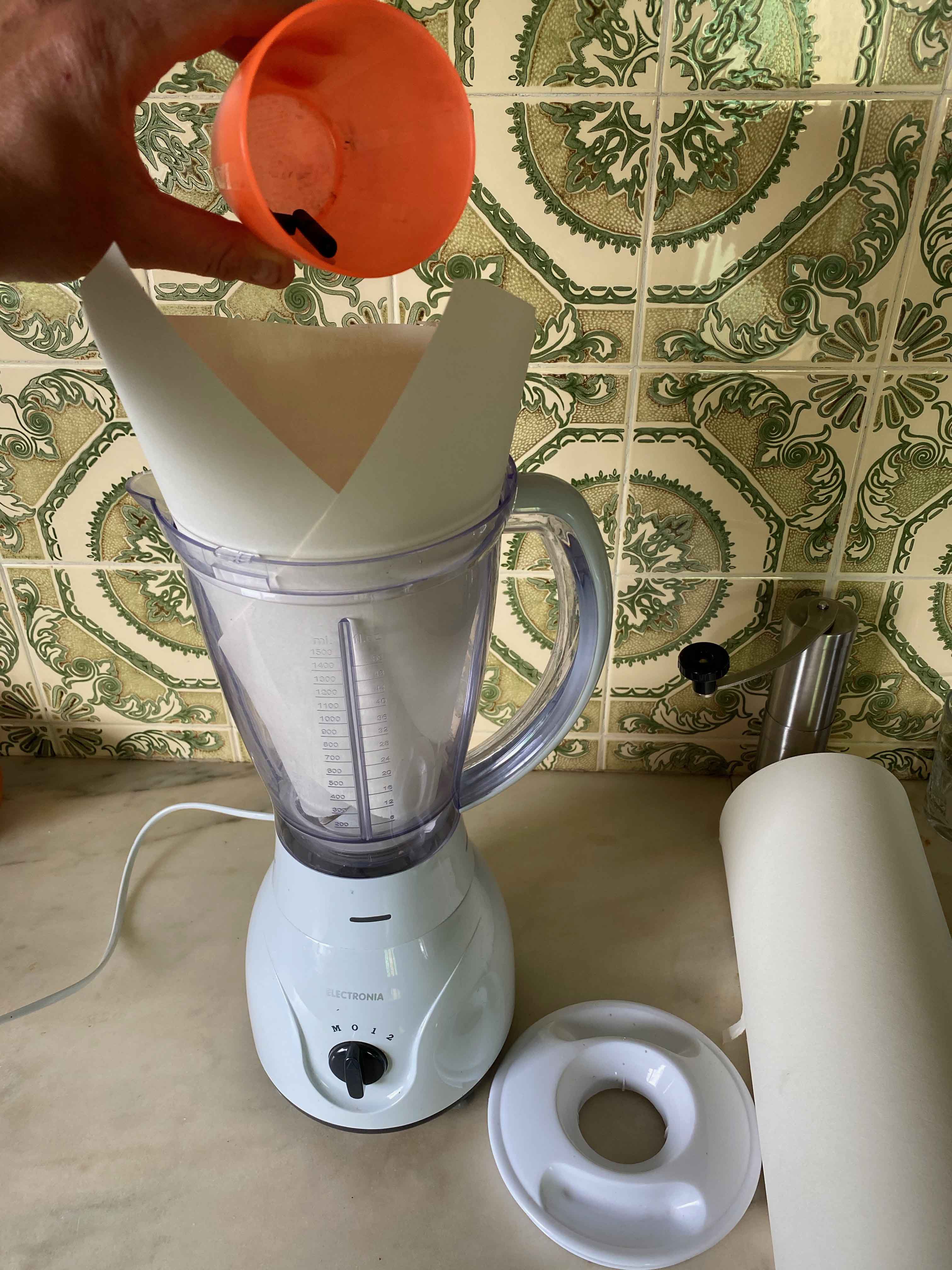
Here I am using a thin paper roll from IKEA that can easily be bent and formed in the shape of the blender.
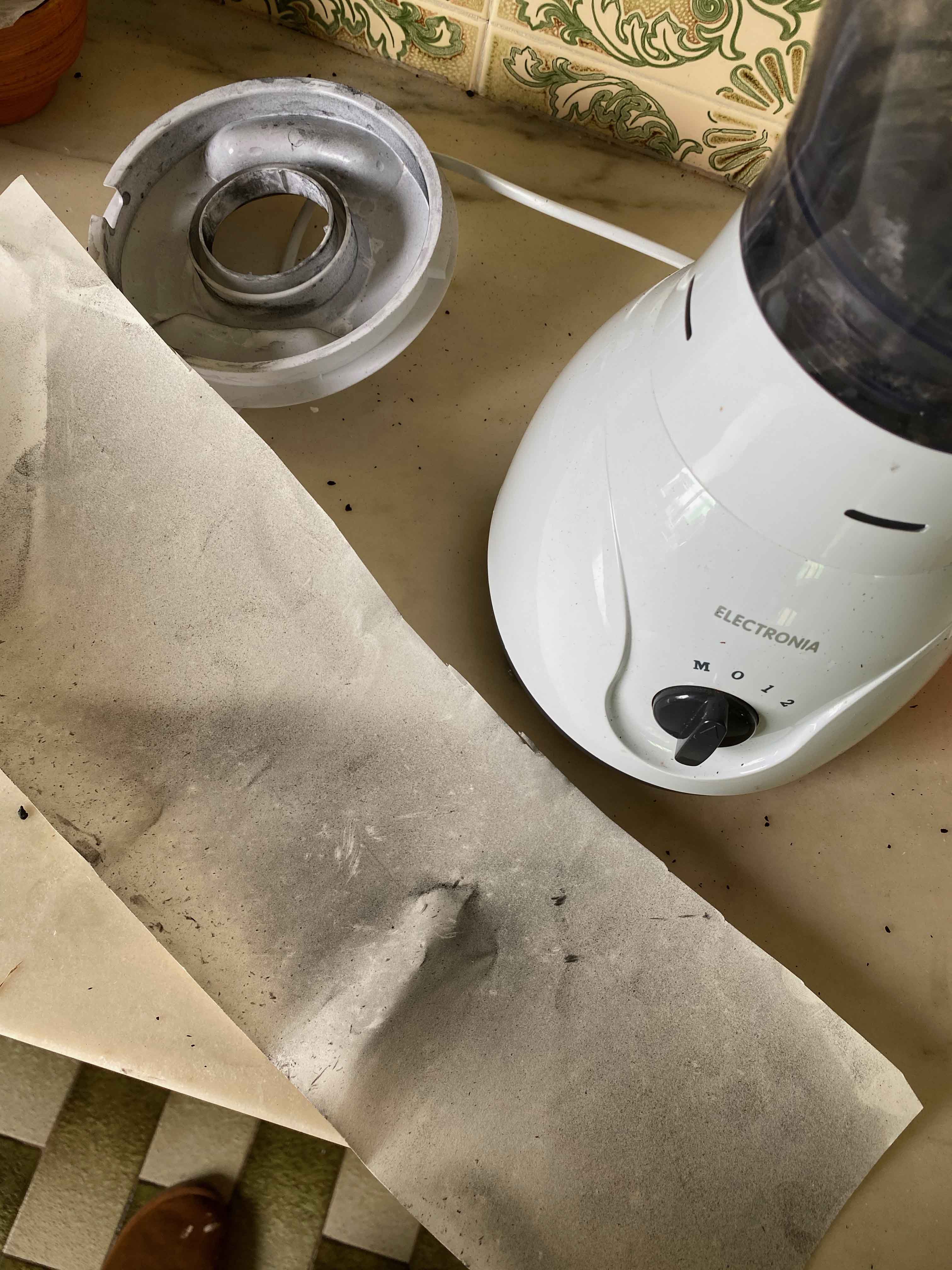
I first start by using some left overs of charcoal sticks that I simply throw in and start:
I am not sure what I was expecting, but the result is disappointing:
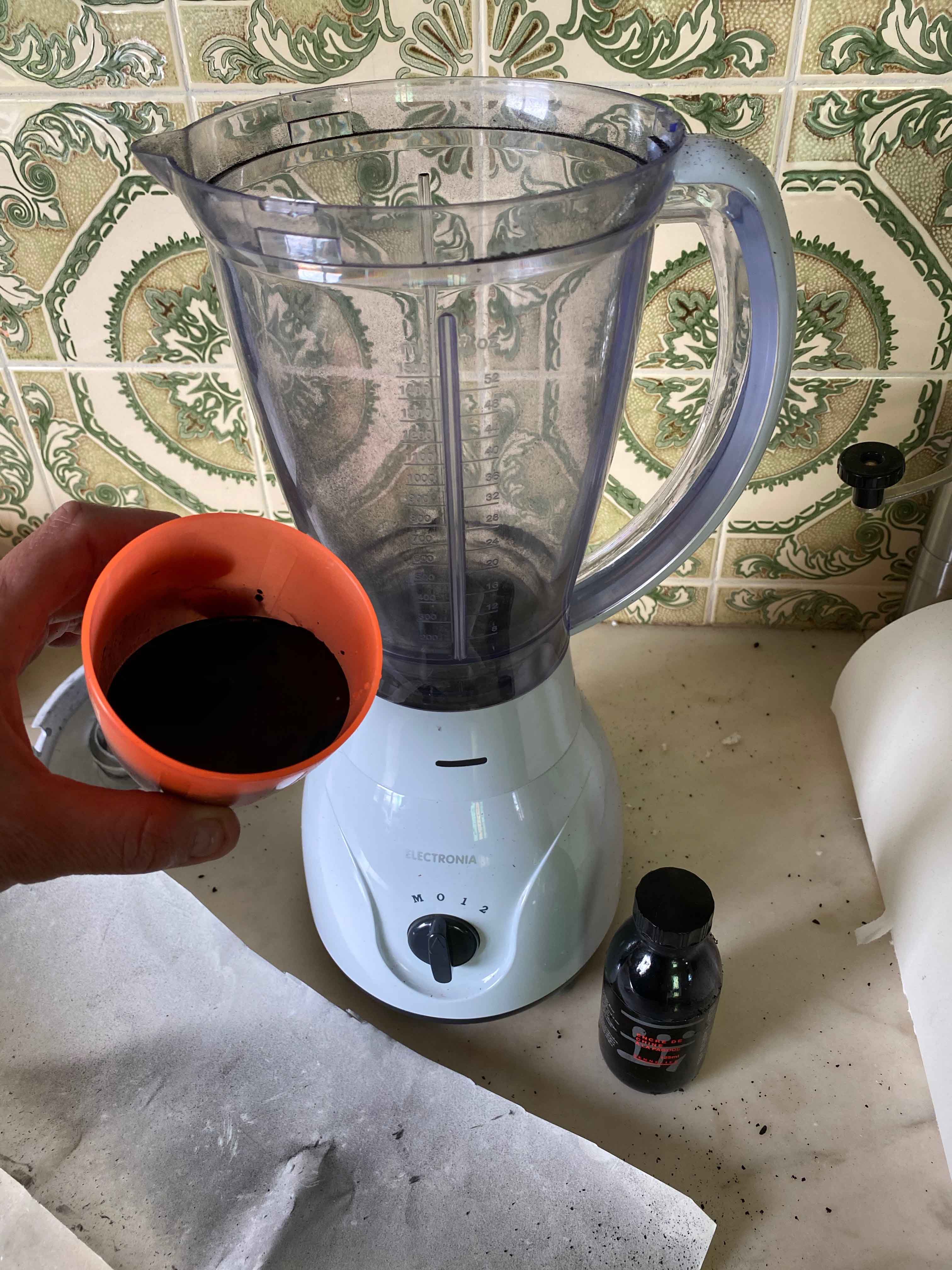
Next, I try some diluted Indian ink:
I place the paper on top of the bowl instead of inside, and use the pulse function, swirling the ink up to touch the paper.
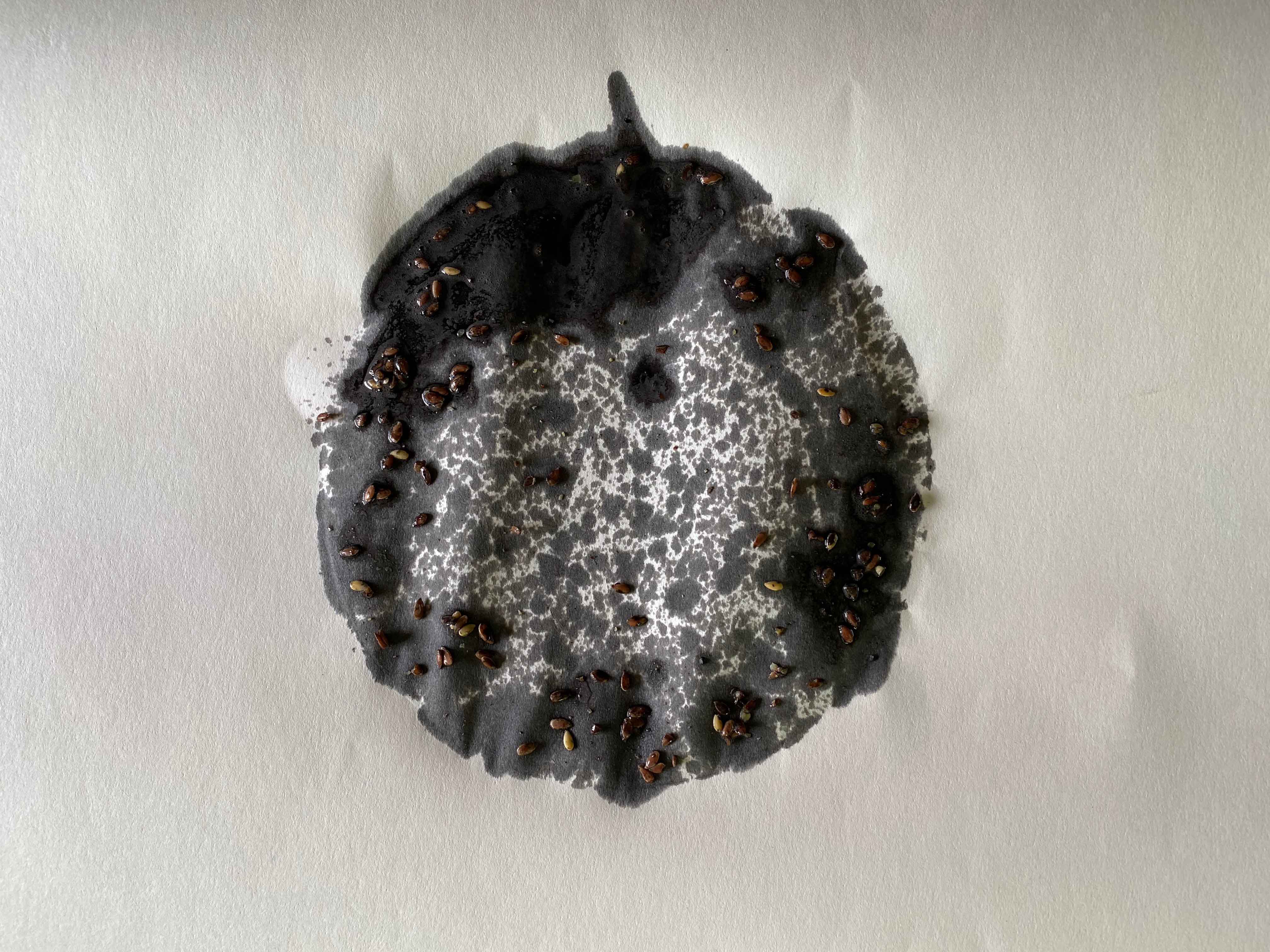
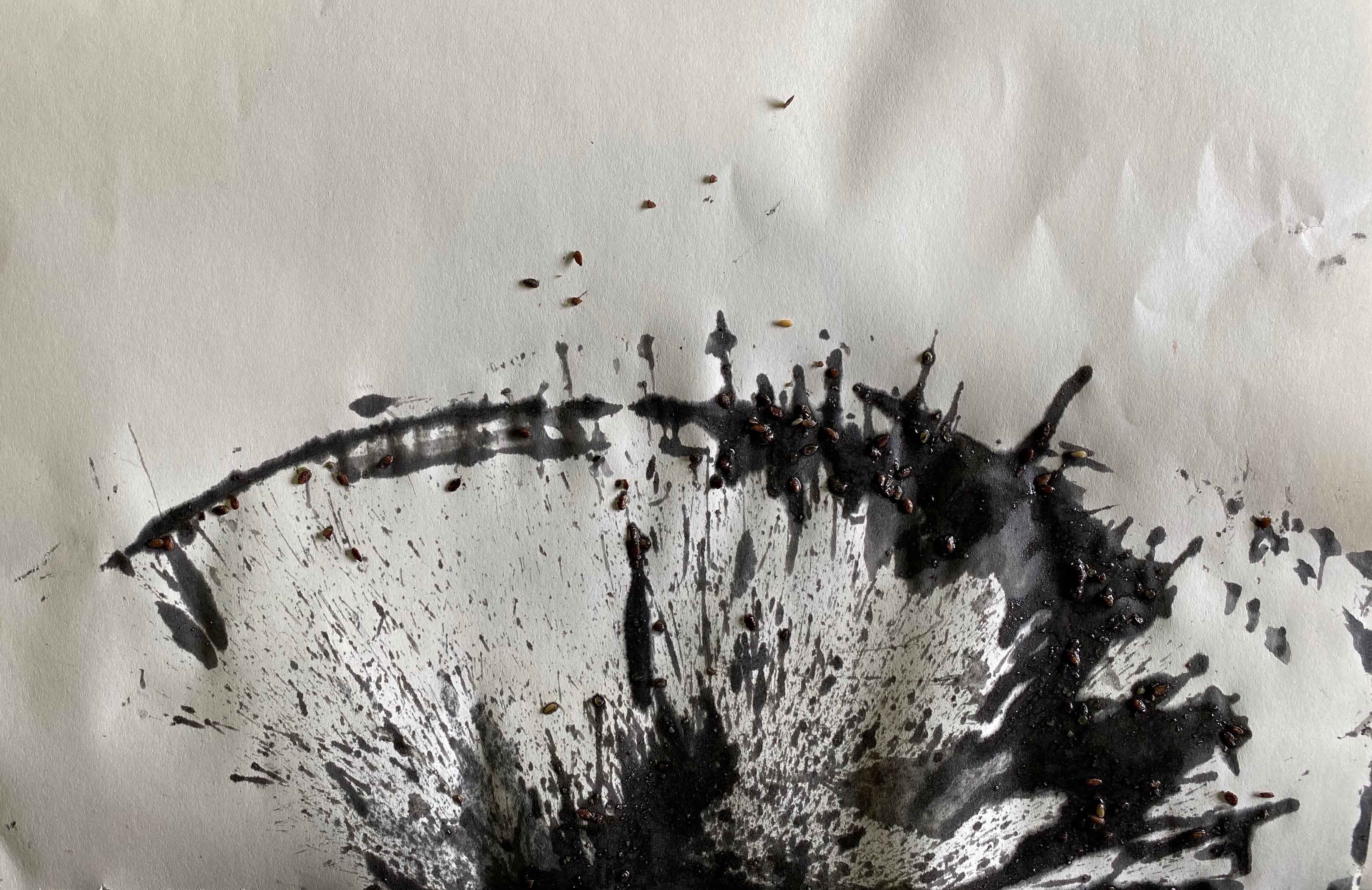
These two trials are more interesting than the charcoal one. I need something small and hard to swirl up with the motion and touch the paper though. I decide to add flaxseeds to my ink mixture.
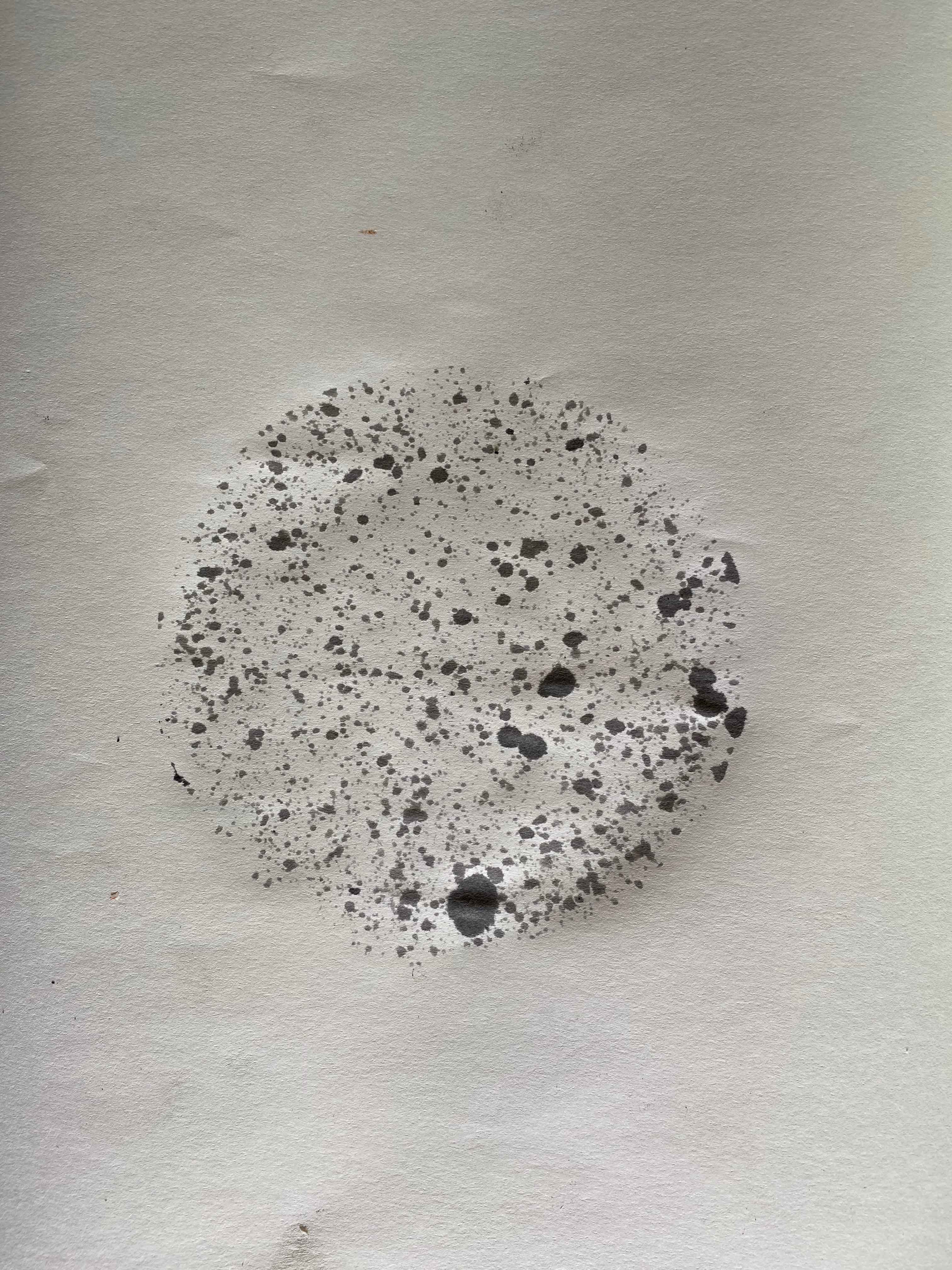
This worked quite well- I like the explosive patterns:
As the paper is thin, it even comes with a texture .
One more attempt:
For a last experiment, I place the paper inside the blender:
This was a fun experiment, and reflects well the explosive force of the blender.
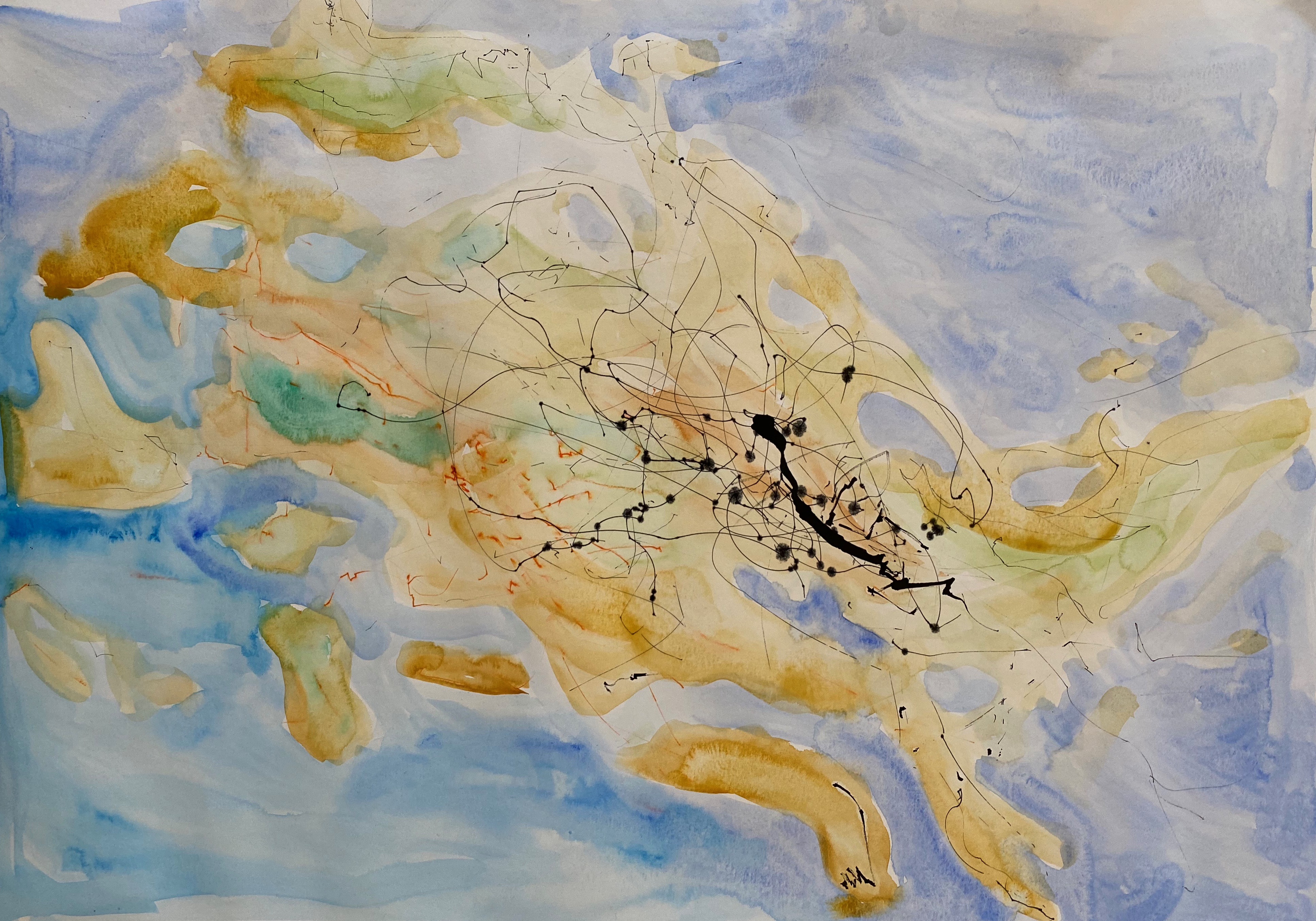
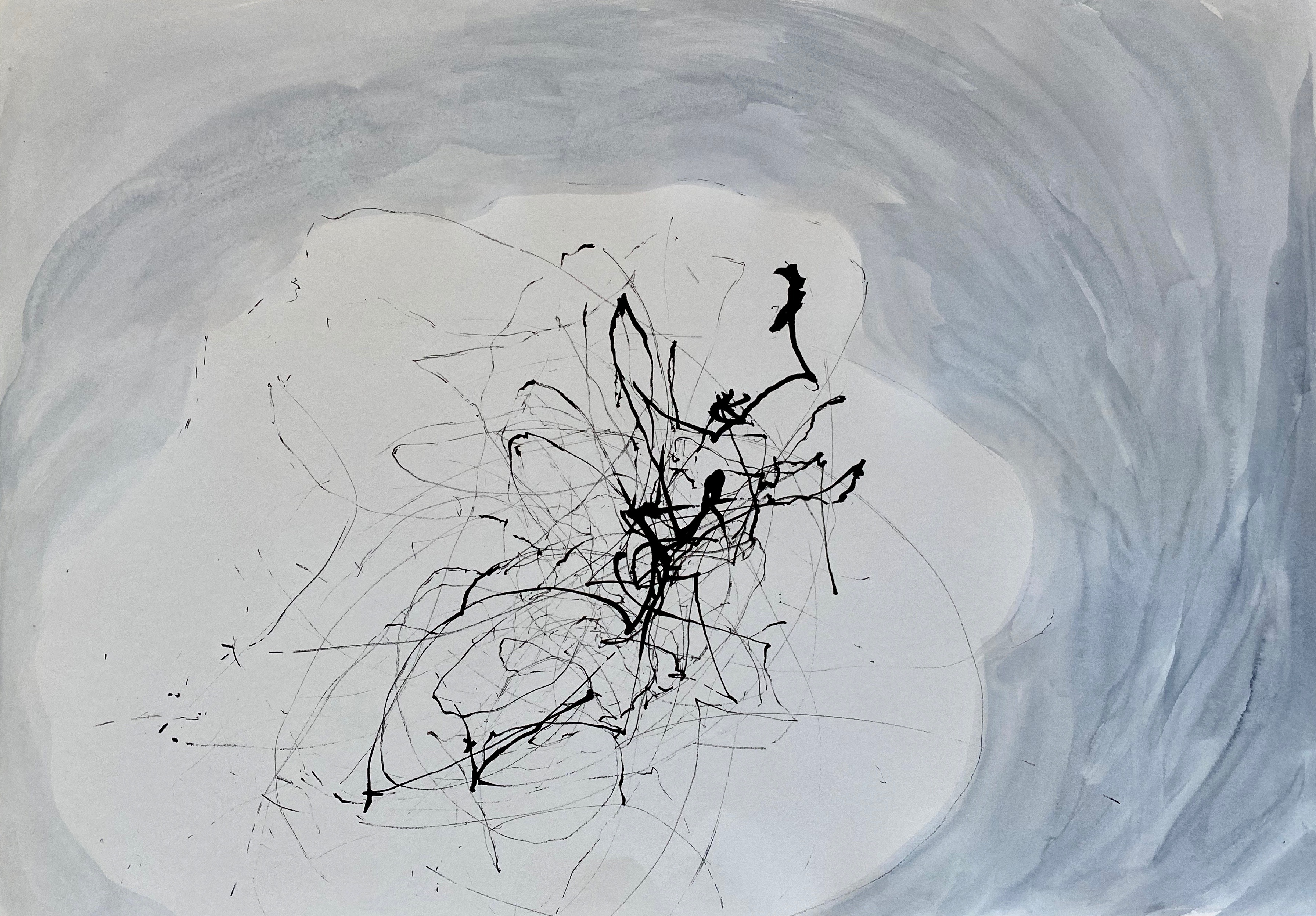
I am still mostly pleased with the four first ones created by the wind. They all have very delicate and intricate patterns with a variety of marks. I choose to continue working on these, seeing a pattern like flightlines over a map.
For the first one, I recreate a map under the lines using watercolour.
The result is too literal, to illustrative. For a next trial, I will only use Payne’s grey and black watercolours- aiming more for a schematic map.
I prefer this result, but I do still not think that the original drawing has improved.
For the last one where I recognize a delicate flower, I will only colour in the background to lift out the lines- again using Payne’s grey watercolour:
Unfortunately, I think all these drawings were more interesting before I started changing them. I liked the variety and “hesitation” of the marks, where they would suddenly change direction, something which I would not use if I was drawing consciously myself.
After my own trials with creating some simple drawing machines, it was really interesting to explore Rebecca Horns’ work.
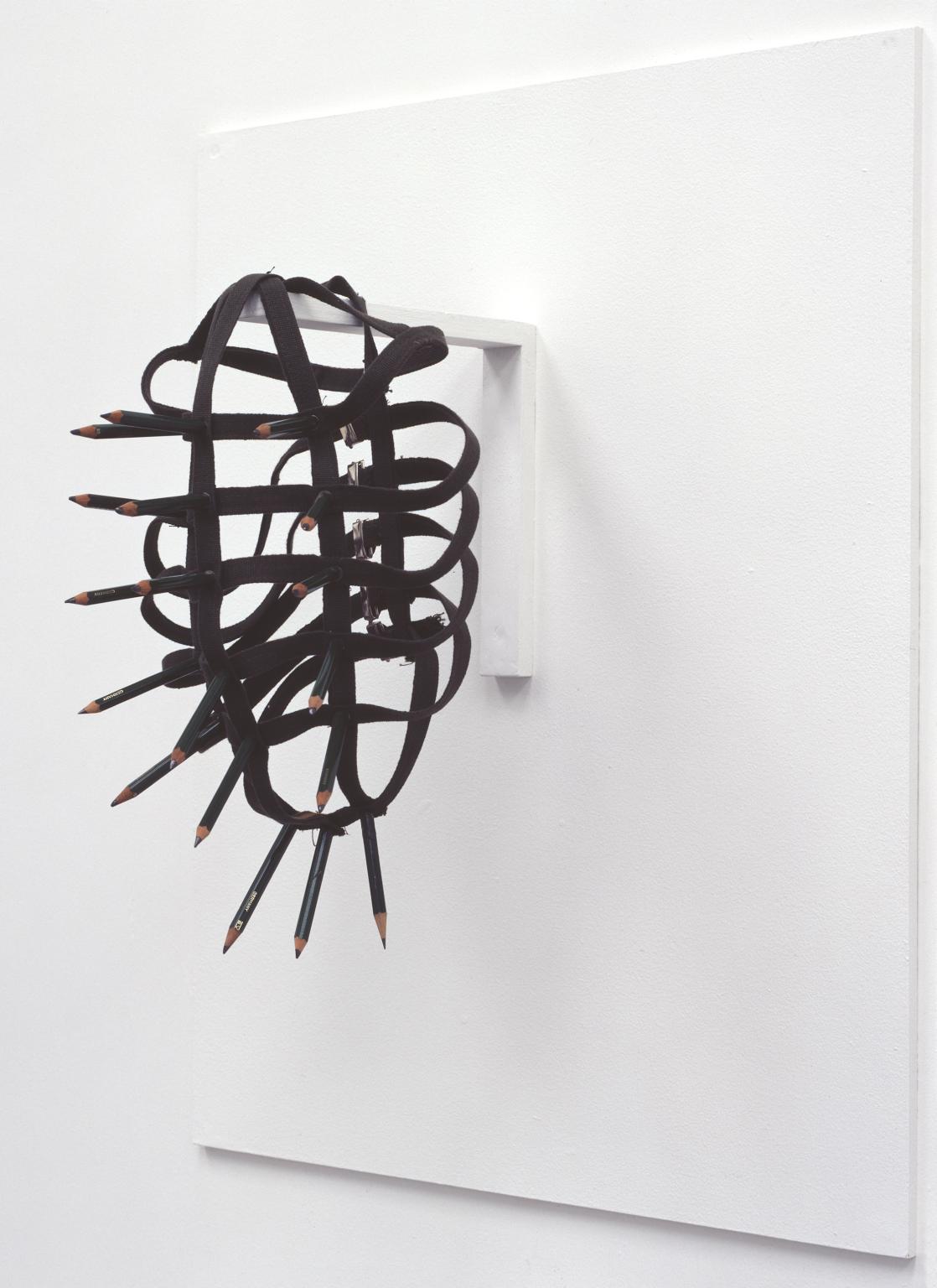
In her earlier works from the 1970’s, she created sculptural constructions that were most often extensions of her own body, like “Pencilmask” below, or a variety of feather masks.
This Pencilmask still required the artists’ presence and physical movements to leave marks. In that way, Horn explored her own body and limitations or feelings when extended. While wearing these constructs, she could also explore various levels of control and interaction. Some masks, like her “Black Cockfeathers mask” or “Cocatoo mask” were designed to look at and meet another person with the altered vision that these masks would give the wearer, questioning her own views and subjectivity. After severe lung poisoning she spent a year very sick and in isolation. After that a lot of her work deals with interaction. She used a variety of media, but came to fame through these sculptural constructions that were then used in performances and for films.
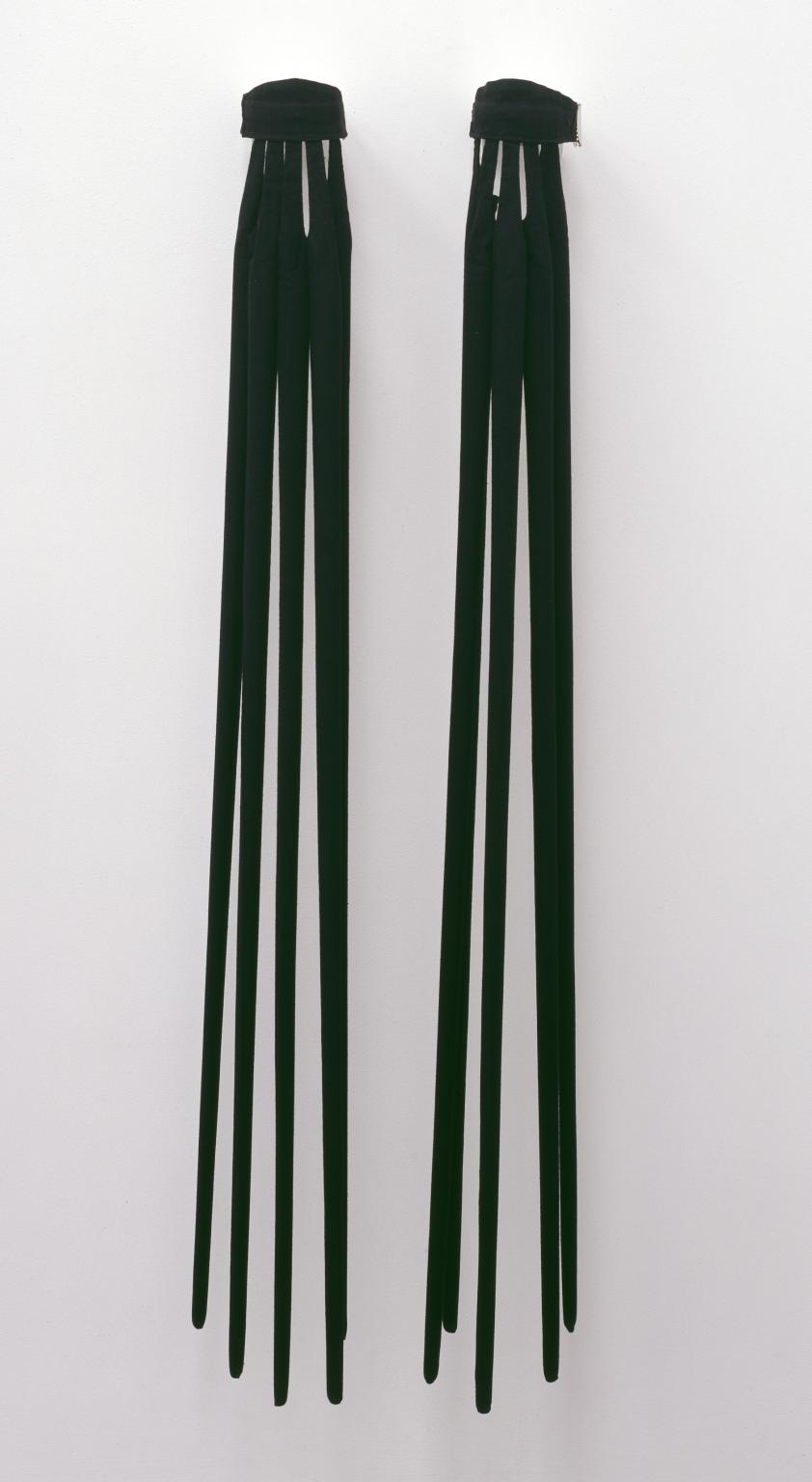
In “Finger gloves” from 1972, Horn created gloves with really long fingers. She is exploring the limitations of her own body by reaching beyond it, and also exploring the space beyond the own body and the objects she can reach with her constructed fingers.
“I feel myself touching, see myself grasping, and control the distance between myself and the objects.” (Quote and image from Tate website: Tate.2020.Tate, Finger Gloves Rebecca Horn.[Online].[13 April 2020].Available from: https://www.tate.org.uk/art/artworks/horn-finger-gloves-t07845).
I find these constructs fascinating and would just love to try any of them!
For many of her installations, Horn used very varied objects- from violins and a piano to hospital beds. She likes to combine very fragile objects, like feathers, and others that evoke a feeling of danger to create tension between them. The violin that plays itself is a recurring object- a symbol of a person, or a person that has left. In the documentary, we follow the installation of “Free as a bird” from 1999, a spiral of hospital beds where violins play. She increasingly withdrew from performing herself, letting the objects take center stage and creating mechanical sculptures with movements and sounds. These sculptures are not perfect- and she explains how their imperfections and hesitations make them more human.
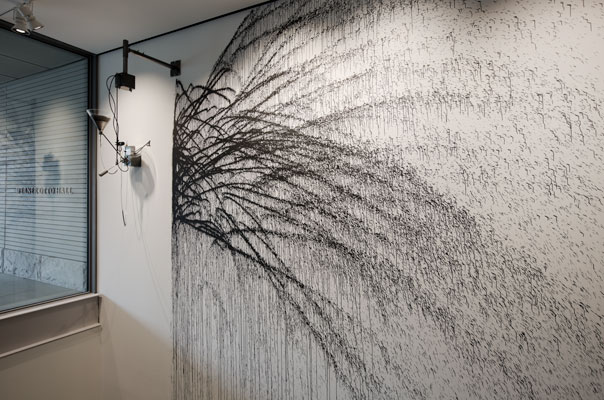
Later she started constructing automated drawing machines, where she has removed more of her own control. In “Flying books under Black rain painting” from 2015 at Harvard University, she lets a machine spray black paint over a white wall and three books.
There is an interesting tension in the drawing machines, between the cold, mechanical, calculated construction, and then the element out of control, the way the drops fall through gravity and mark the wall. This feels like a big step away from the control of the earlier works where the body was still initiating the movement and in itself an essential element of the investigation. The artist seems to imbue the machines with almost human qualities though, and sees how they can express emotions.
Course manual: “Aim: This project continues the theme of focusing attention on your own physicality and opening up your method to new ways of moving.”
I used my own physicality to explore mark-making for the body paintings in Assignment 2 – applying the paint on various body parts and pressing them to paper or canvas.
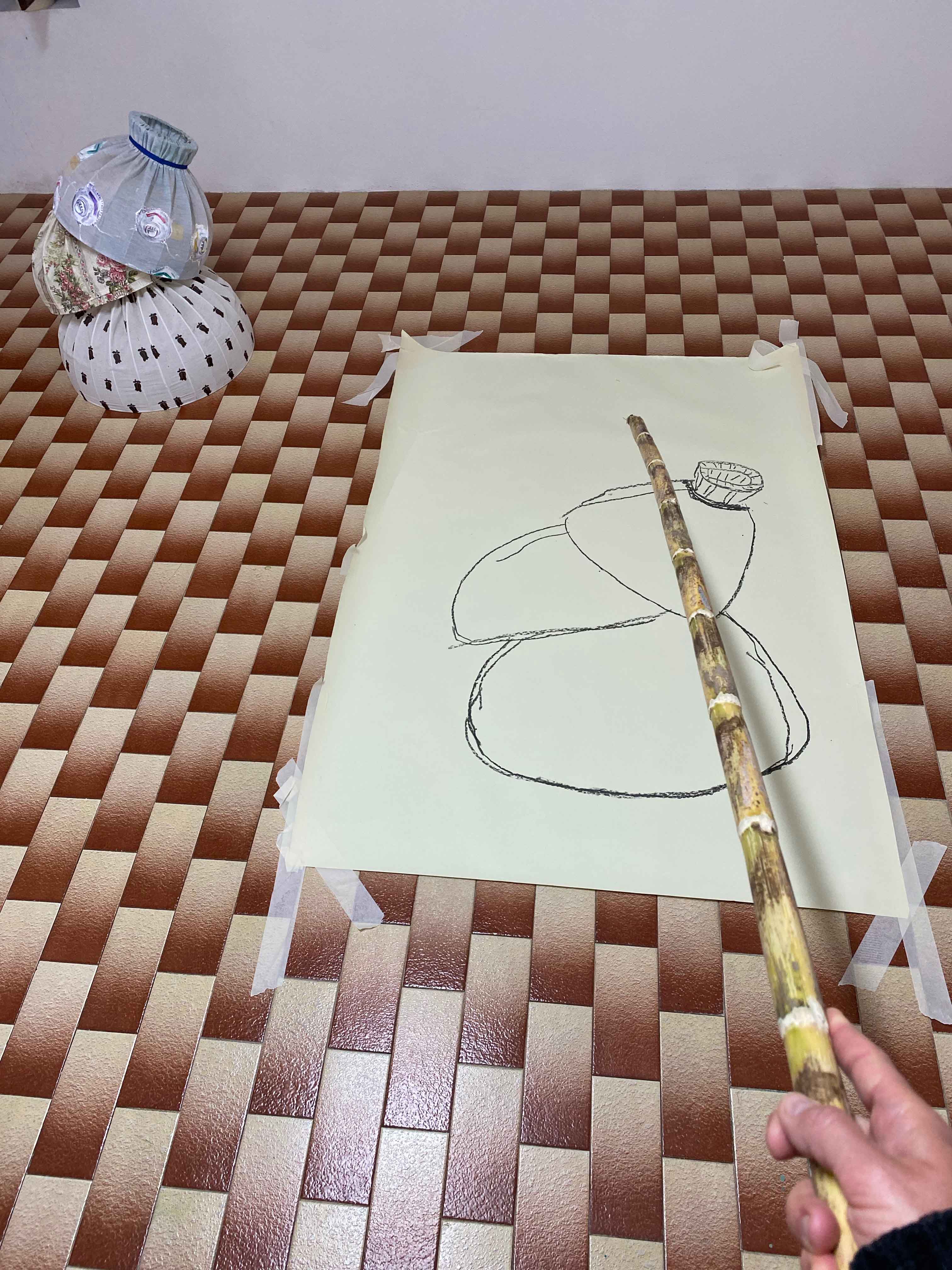
This exercise is asking me to remove control in another way- by applying the drawing material on a long stick that will require my whole body to move while making the marks.
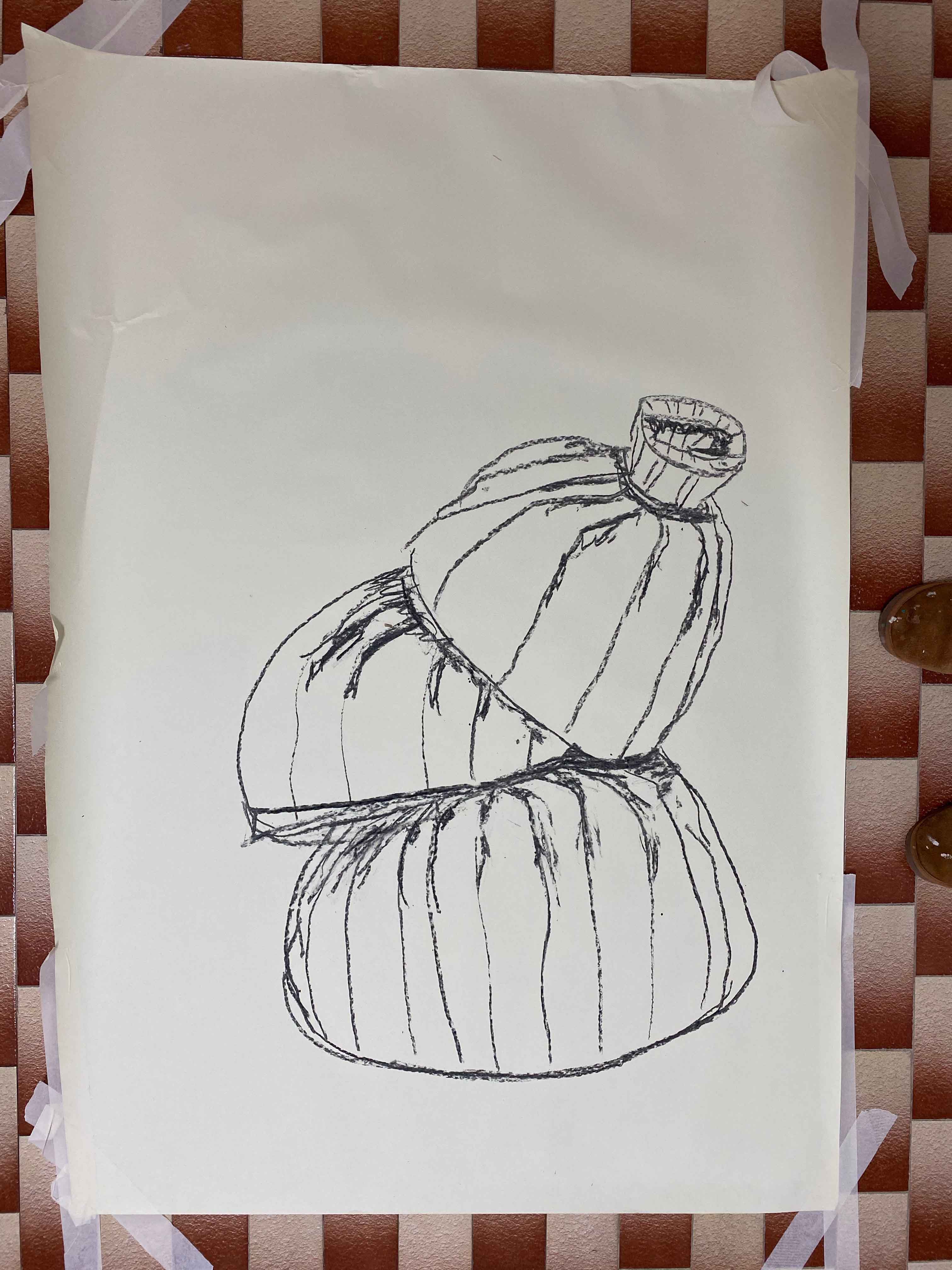
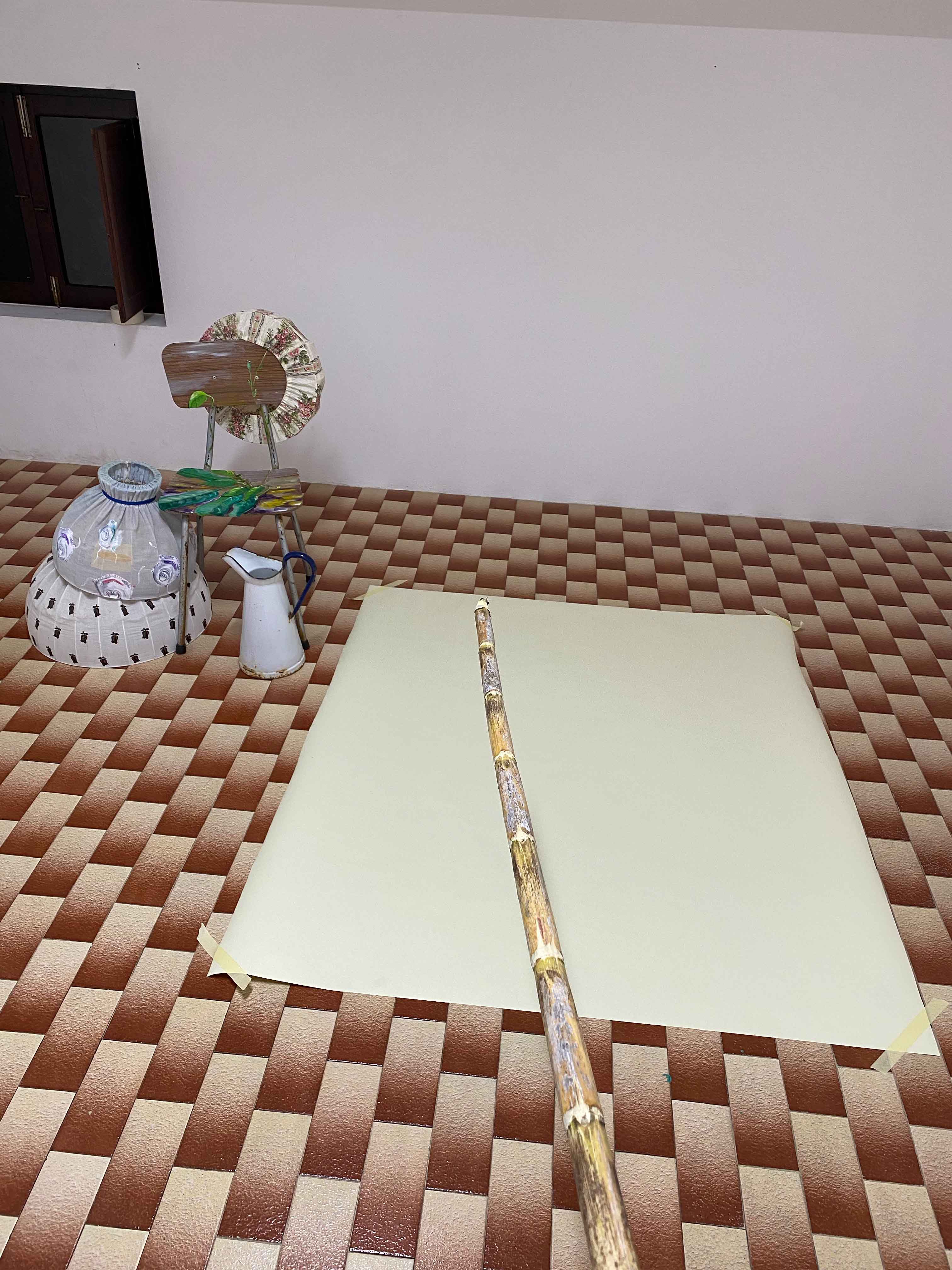
I set up a still life with three lampshades- a subject that I want to explore as part of my parallel project as well. I attach a charcoal stick to the end of a long bamboo stick ( approx 2,5 m long) and stretch a large piece of paper on the floor:
This is the outcome:
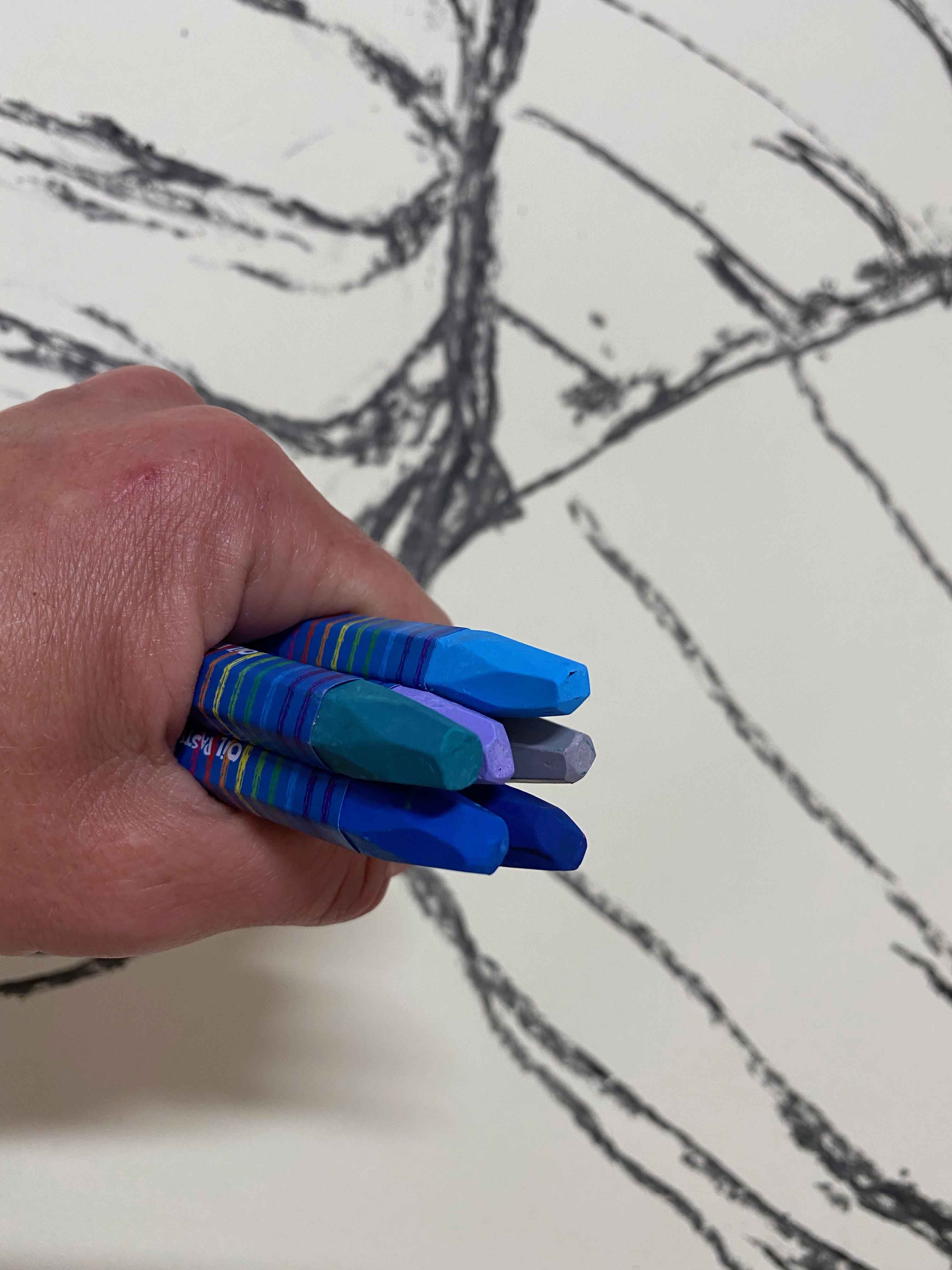
In a second phase, I attach a whole bundle of oil pastel crayons together in different combinations.
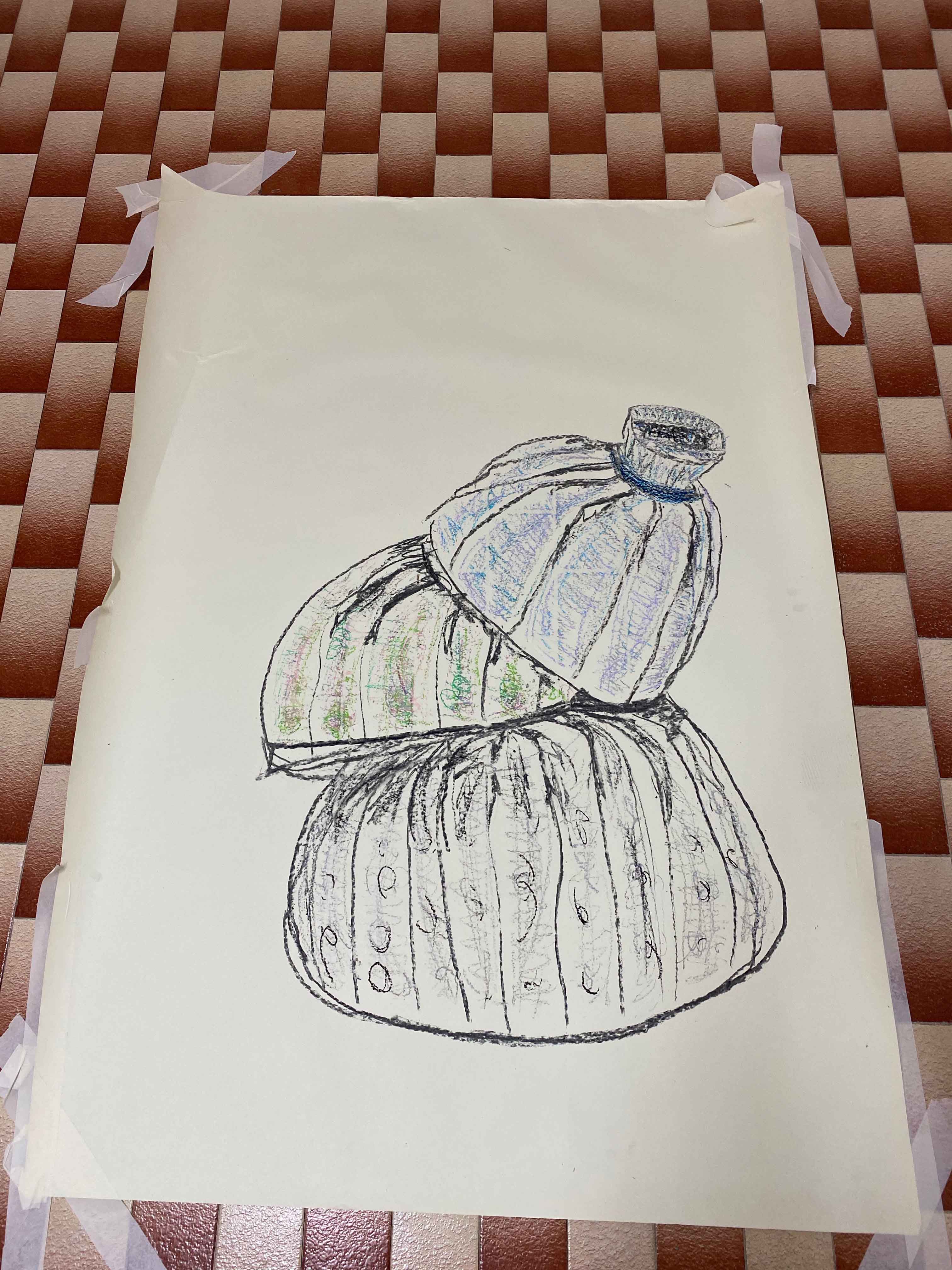
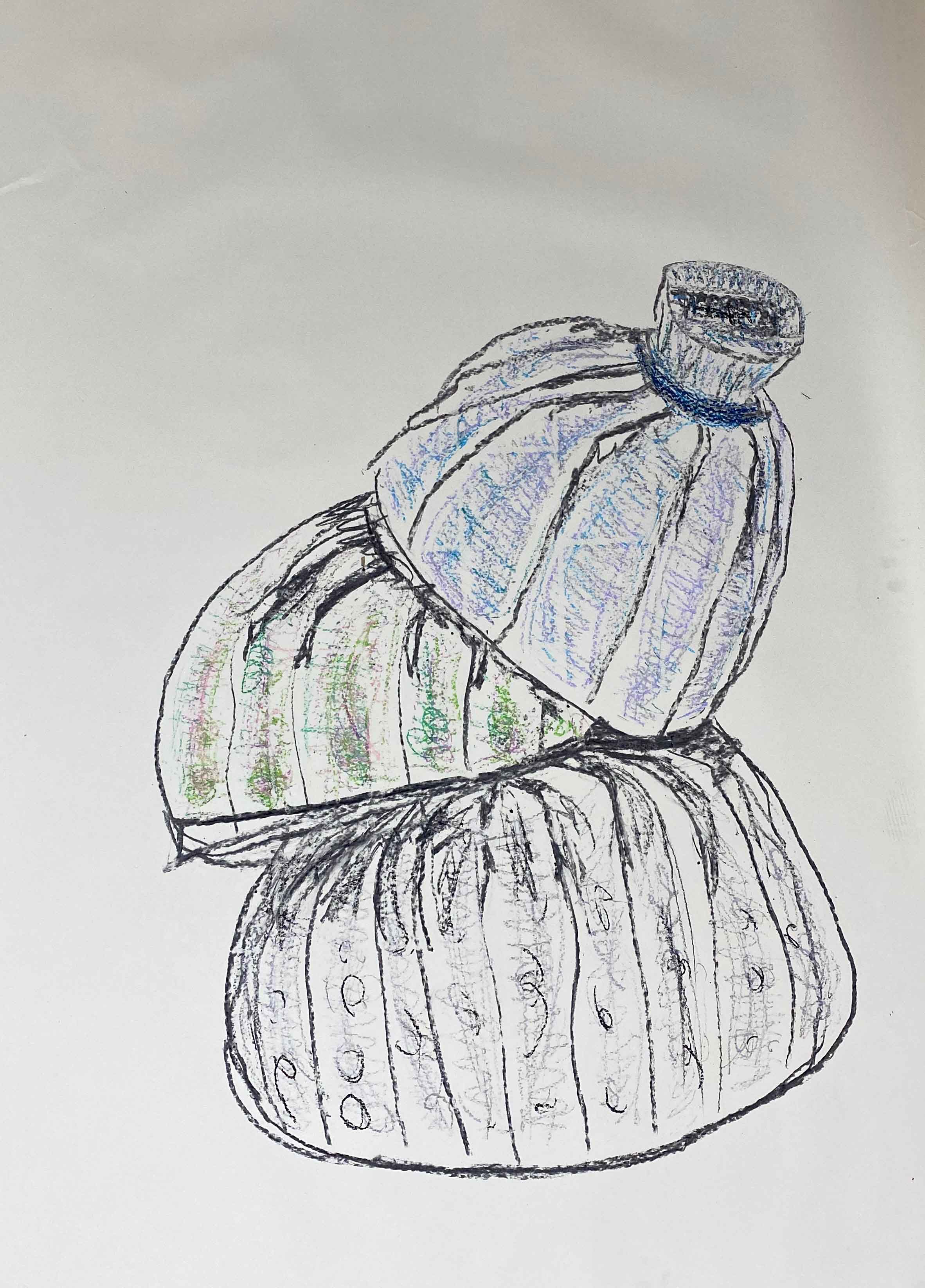
This is the finished drawing:
The lines are somewhat wobbly, but other than that, this could have been a large version of a quick charcoal drawing in my sketchbook. I am not sure it is a record of my struggle.
I enjoy the coloured “woven” effects that appear from the bundle of crayons, and also the shape of the tiles on the floor appearing in the drawing as a rubbing.
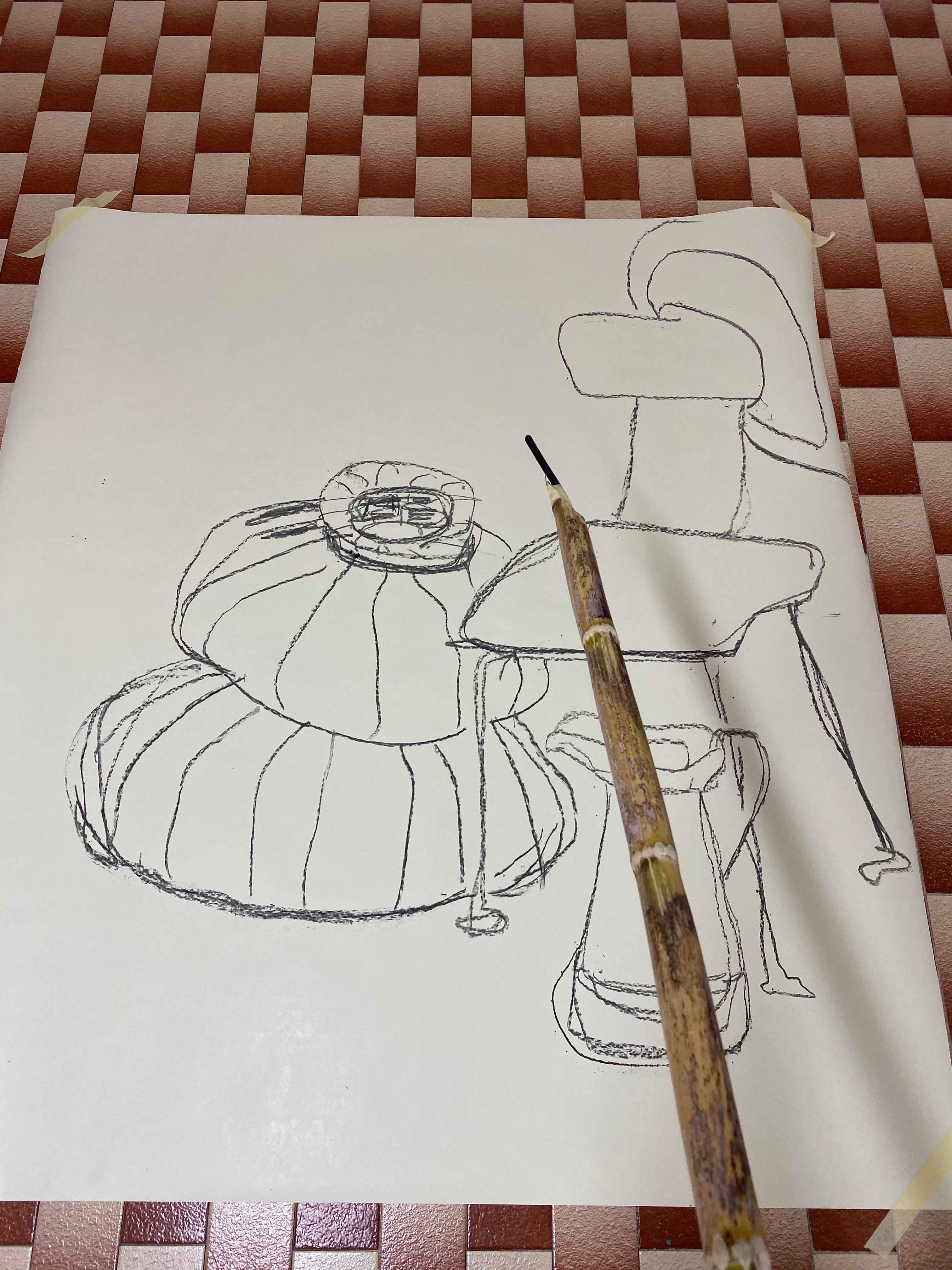
I decide to complicate the situation with introducing a chair and a pitcher to the composition.
I think this time I achieved a super-accurate representation of my own struggle! (Especially on the chair!)
I notice a struggle for control while making these drawings. The brain does not quite want to let go and allow ‘free” marks to happen- looking at the still life there is still a struggle to represent it accurately.
In the end, these more free lines, that show how I had to wriggle my whole body to manipulate the stick with the charcoal, feel more fresh and interesting than a more accurate drawing. Definitely a find to carry forward.



















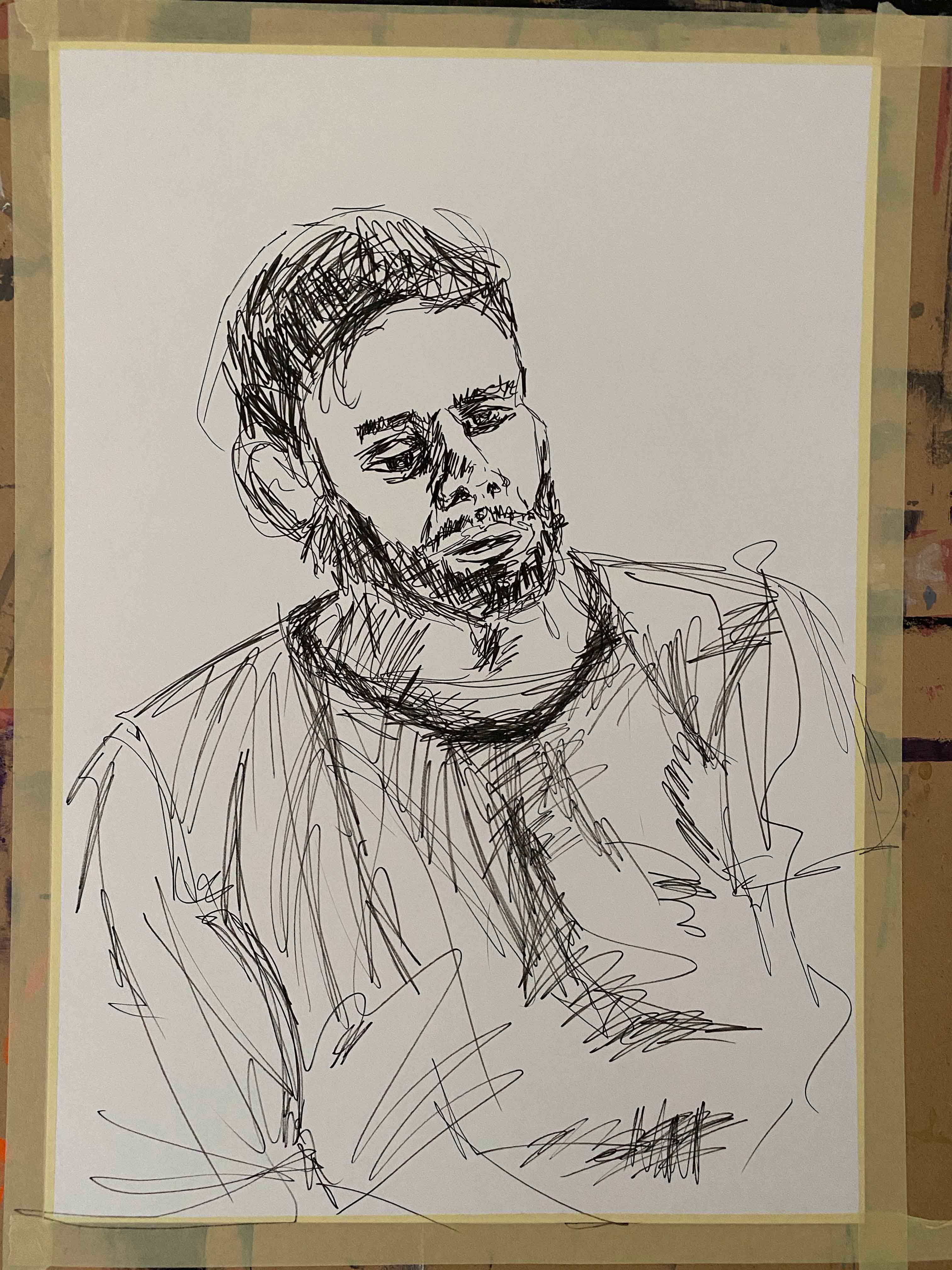


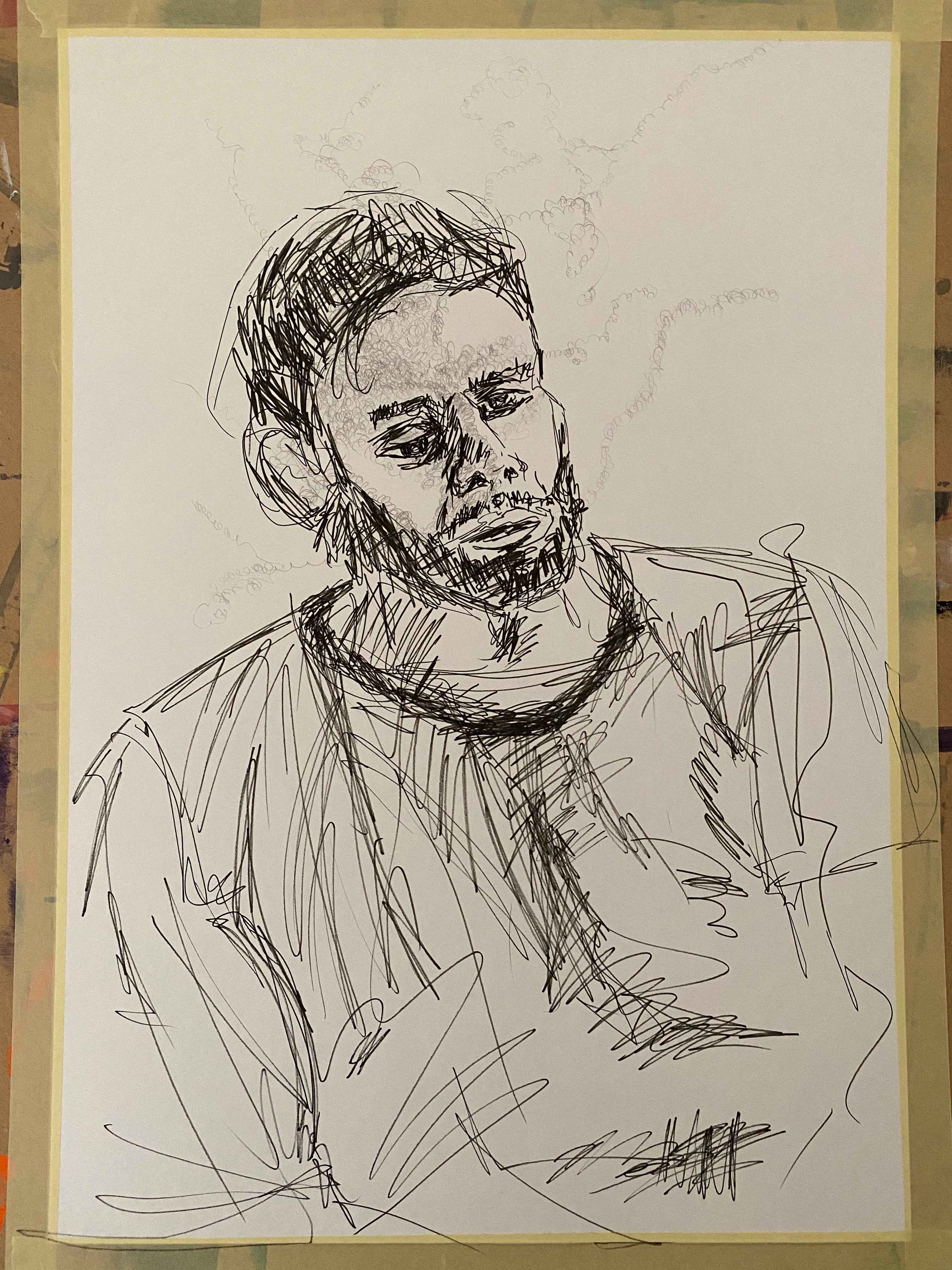
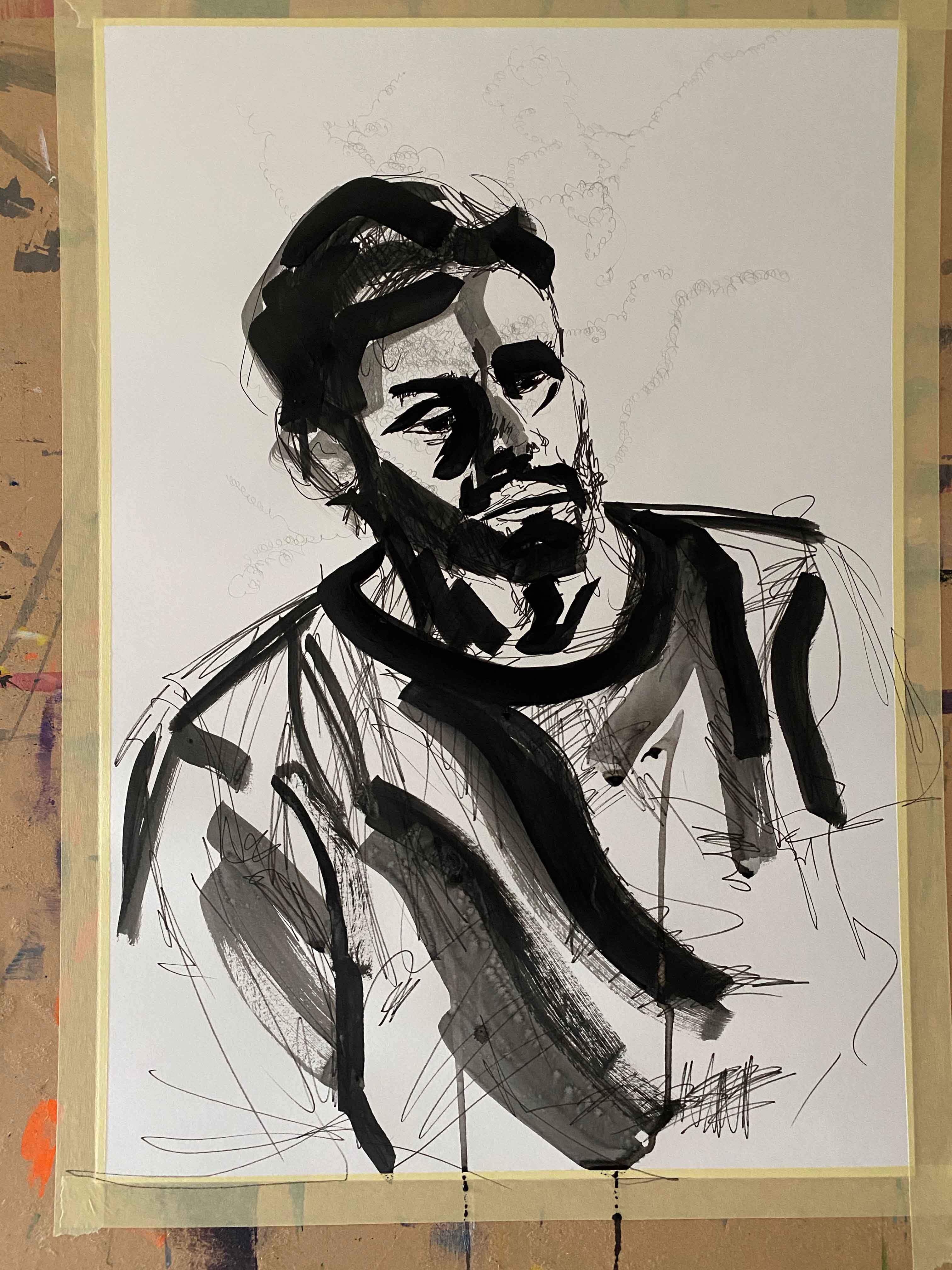
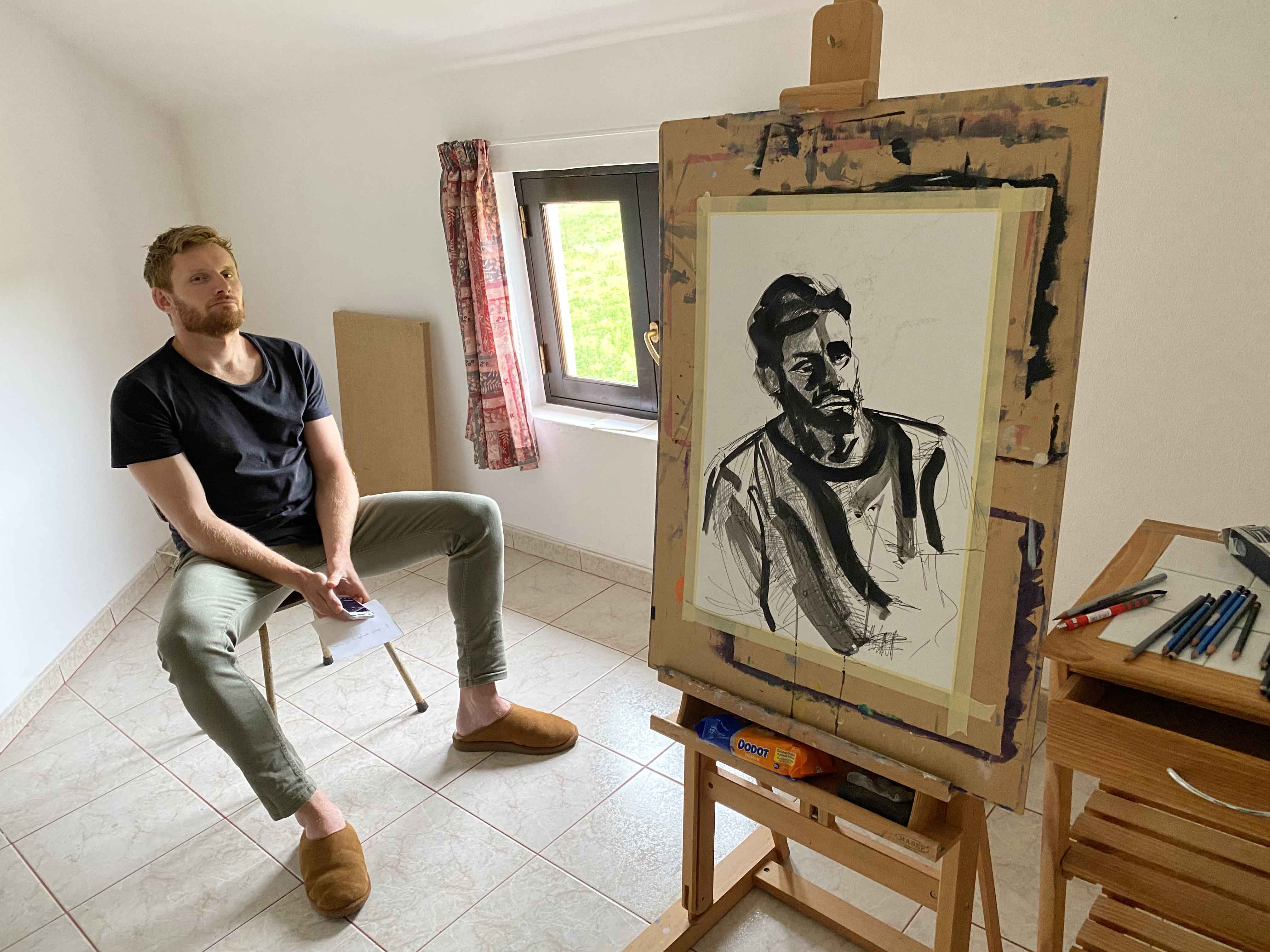










 Clara's Drawing 2