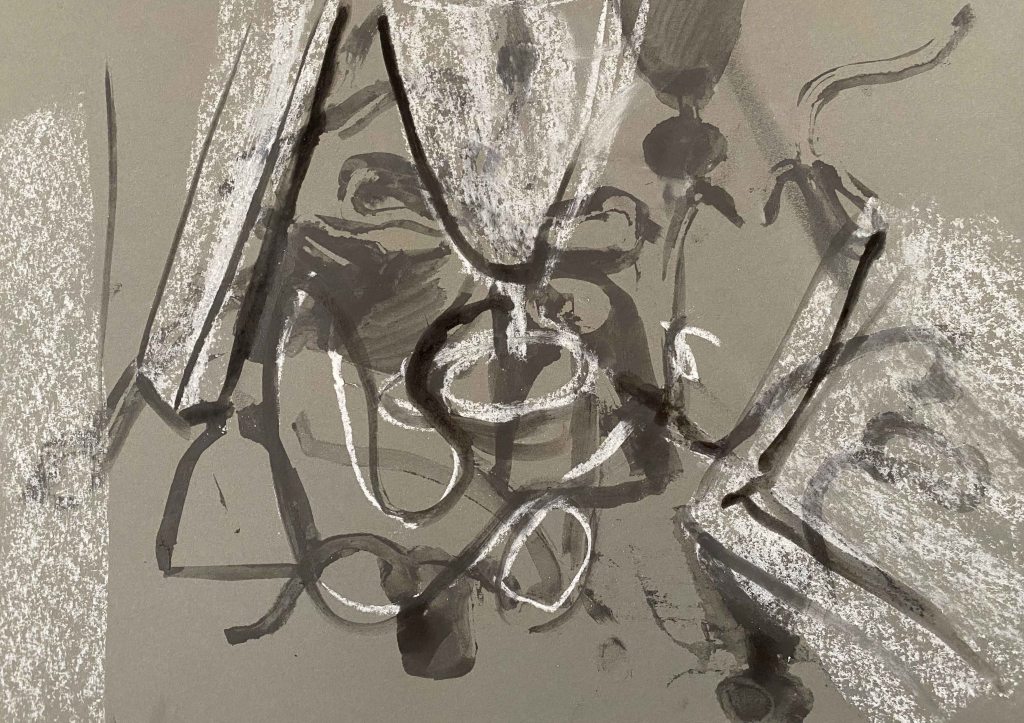
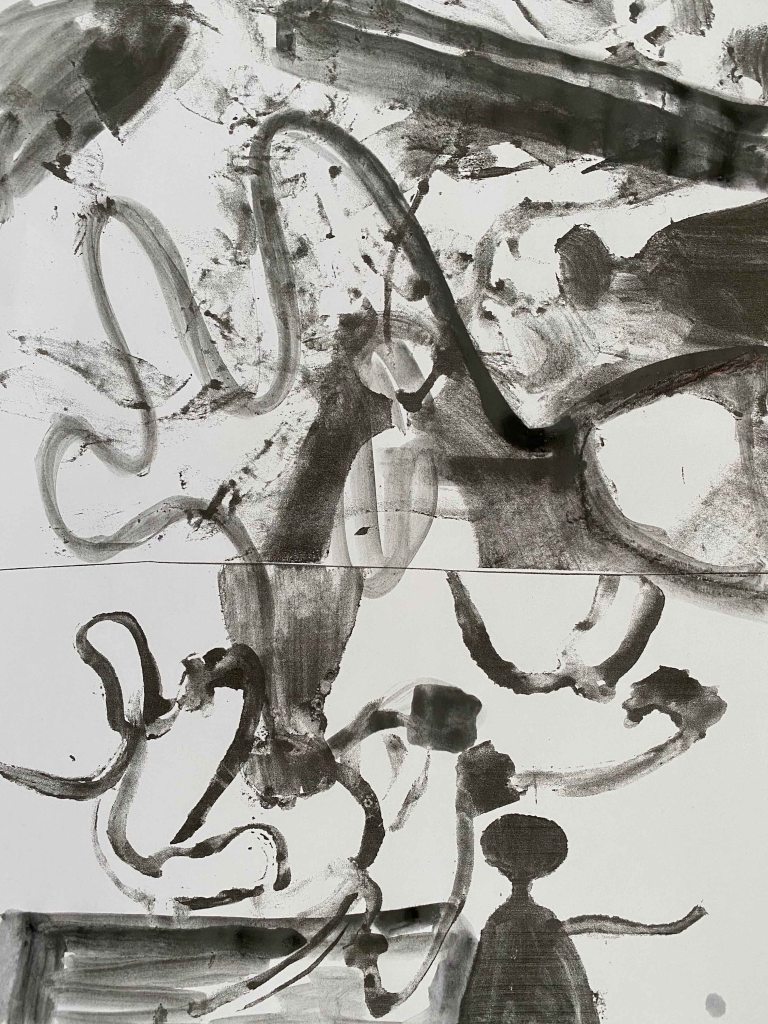
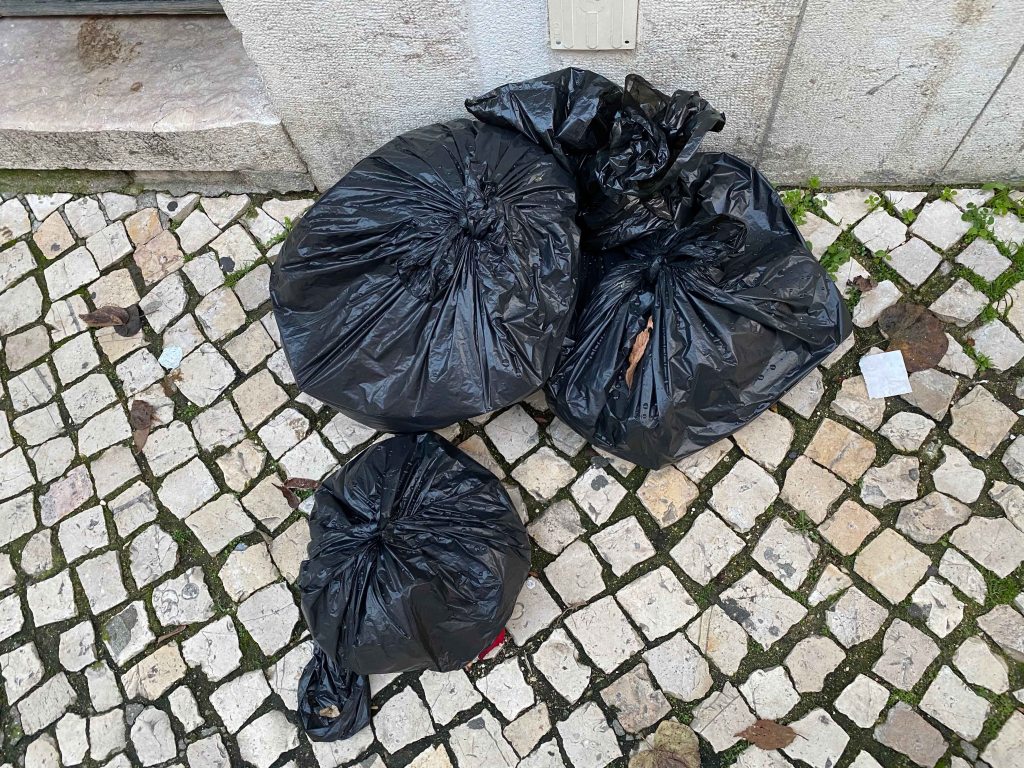
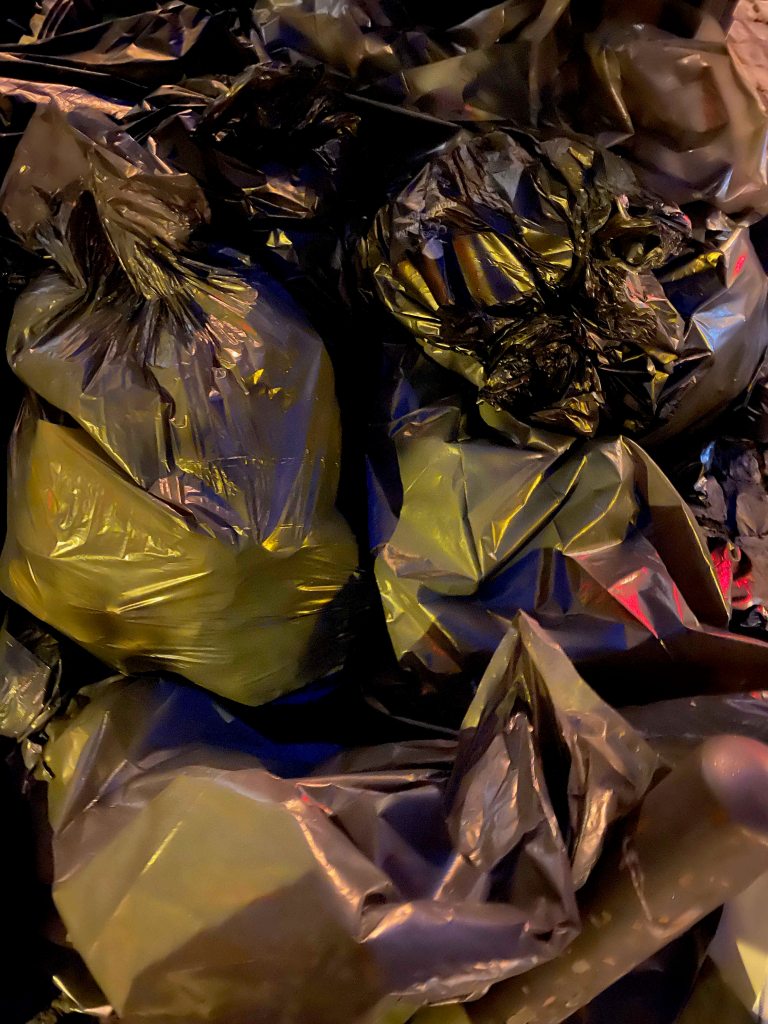
Category Archives: Coursework

2.3 Narrative

Course manual:  “Aim: Materials and the way they are applied can be very expressive and can imply a narrative without using words. Thickly plastered encaustic or finely dusted chalk – each imparts information about itself and, through association, the subject or your response to it. Take time to experiment with the expressive potential of a range of materials and then make a selection to create a piece where the materials contribute significantly to the way the piece is read.

Method: Think of a person for whom you have strong feelings or hold a strong opinion. Find an object or item of clothing that reminds you of that person. Make a piece of artwork that uses the object to provide the imagery but uses the materials to give the viewer a sense of the person. In effect, you’re making a portrait of a person as an item of clothing. You could use your daughter’s first shoes, your mother’s hat. Thinking more widely, you could use a blue tooth device and tie to make a piece of work about bankers or an old school tie wrapped around a silver spoon for our political class. Experiment widely and produce as many pieces as you need to until you arrive at something which you think fits.”

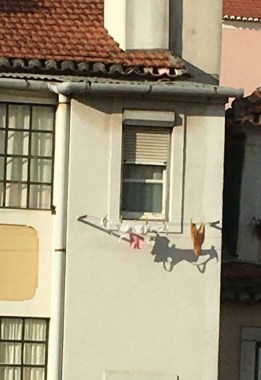
My first idea for this project was to portray my 104 year old Lisbon neighbor, Donna Hortense, through her laundry.
IMG_4270


She hangs out some pieces of personal underwear from her window every day (possibly the rest of the laundry gets taken care of), and these intimate pieces drying also function as a flag saying- “I am up and about and well”.

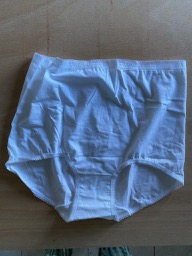
I was too shy to ask Donna Hortense to borrow her underwear, so I went as far as buying a pair of giant underwear …
IMG_2591


I will definitely come back to this idea.. But for now COVID- 19 swiftly changed our lives. We packed up the family and within a day are living in quarantine in the countryside.

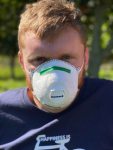
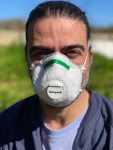
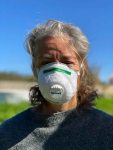
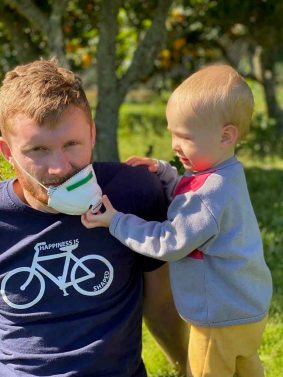
The virus has infected all of our thoughts and conversations to start with. I managed to buy one mask for the five of us, and this lonely mask has become a symbol of this whole situation and the start of my new narrative.

On the exact opposite of a personal item, the mask blocks out part of the features and our personality seems to fade away behind it. In that sense, I want to use the mask to give a sense of the absence of the person, rather than the presence.I will draw it as if on the face though, not as if placed on a surface.

I start by trying out different materials.

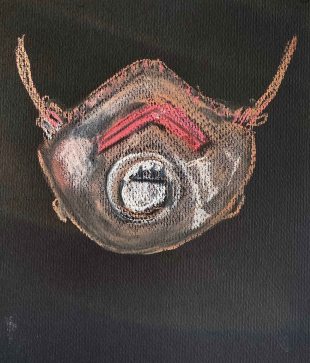
Rembrandt dry pastel in skin tones on black paper ( a silky touch like skin):
IMG_3448

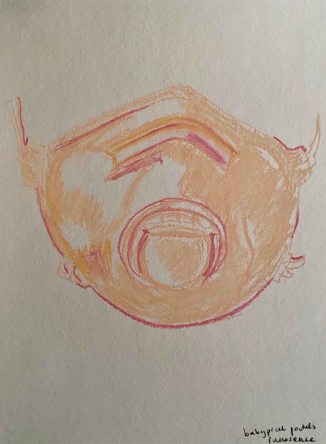
I try baby pink pastels on white paper too- aiming at a connotation of innocence:
IMG_3504

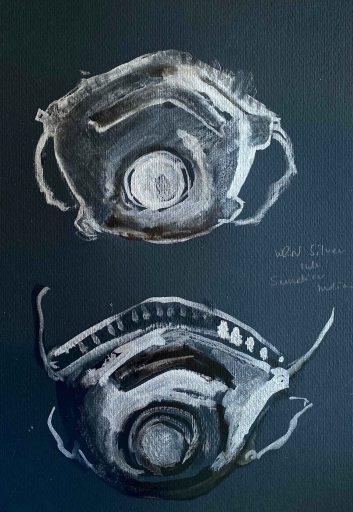
I continue experimenting with Winsor&Newton silver ink and Sennelier Indian ink for a metallic, shiny surface on black paper:
IMG_3474

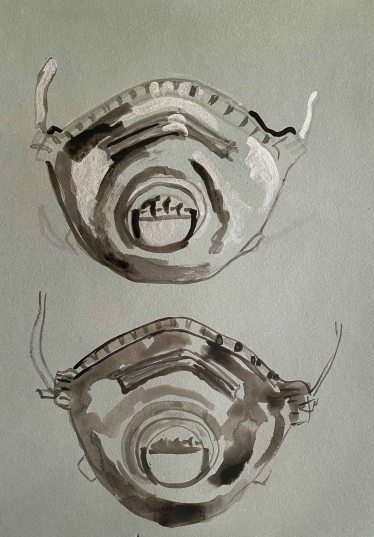
The same inks seem much warmer and softer on a warm grey paper:
IMG_3485

I change for a transparent paper, with Indian ink and acrylics:


I like how the transparent paper wrinkles like a more alive surface. I also like the idea that I can hold it up to any face.

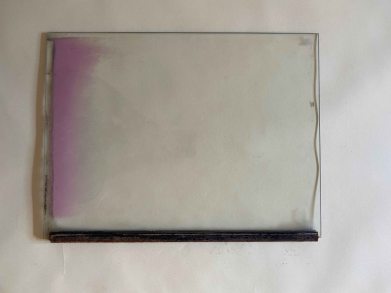
I push this idea of a mask that I can hold in front of a face further by using oil paints on glass. This ties in with a part of the parallel project where I have used oil paints for portraits of faces under water. I am using an old glass pane with some pink spray paint and a rusty border, which is quite creepy.
IMG_3547

I want to try dripping the paint on the surface and allow it to pool, inspired by paintings by Genevieve Figgis.

Hmm, this looks like some sort of insect, interesting maybe, but not what I was aiming for. I have too little control when dripping on the glass.

I have another go using a brush and then just drop a few drops:
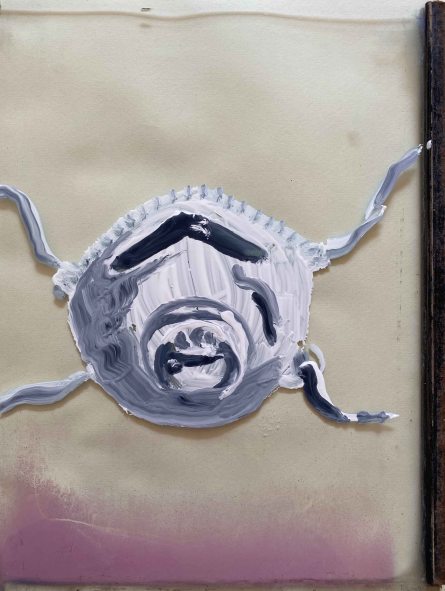
IMG_3625

This is closer to what I was aiming for. The thick oilpaint looks chunky and velvety and the fluid brushmarks are very visible:
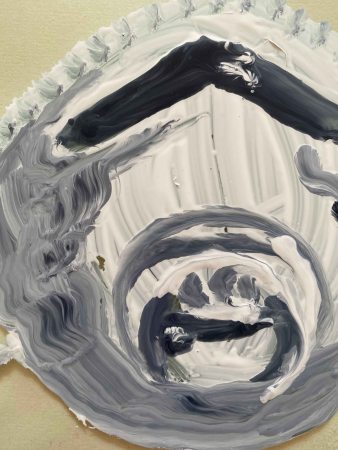
IMG_3628

A very different surface is a rough burlap that I have stretched over a frame of 60x80cm

The burlap is so rough that I will place a sheet of paper under and use very diluted oilpaints, imagining that the paint that seeps through the holes onto the paper also could create an interesting ghost image. (It didnt’t, just some puddles)

Besides the really rough surface, that you really would not like to touch your face, the size is different here.
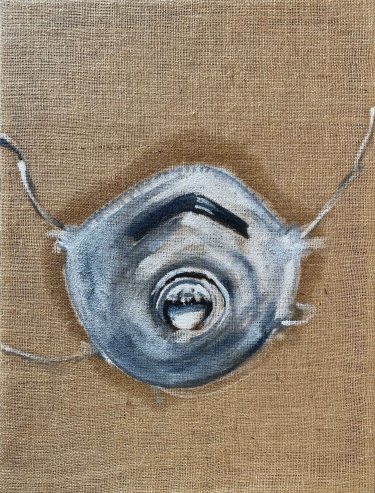
IMG_3621

All the previous trials were roughly A4, but this is big enough to cover my whole head if I would use it, which is repelling.

I guess I could return this burlap to the use of a sack transporting potatoes or so, which would make them unappetizing immediately.

I am not really drawn to any of the media I have explored so far because I already started off with a clear idea- and none of this has convinced me to see it differently.

I imagine a series of my family members behind the same (one and only) mask we have. The portraits all very classical, passport picture shaped, to emphasize the impersonal, and I would choose simple pencil drawings. Everyone has a pencil and it is so everyday shopping list familiar which in normal times would be so comfortingly incongruous with using a mask.

We are so lucky to have a garden we can still walk out into in these strange quarantine times and I start by taking a series of photos that I call “family picnic”: ( or “Dejeuner sur l’herbe 2020”)
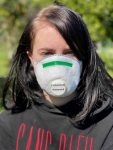
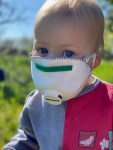
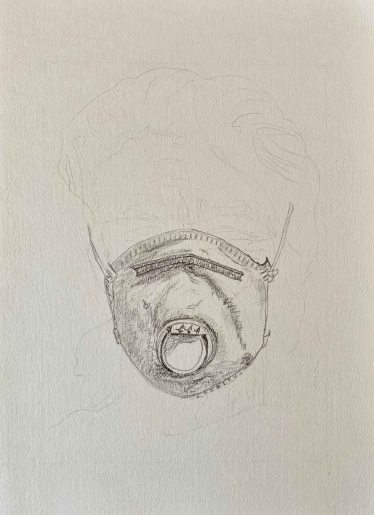
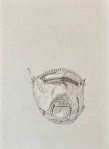
I have the idea to use video again for this subject – drawing the faces lightly in pencil- which also feels impersonal- and then slowly erasing them til only the masks are left. I think using video that adds a dimension of (short) time to the images, is a very fitting media to describe the process of fading of the personality behind fear, rules and statistics in these strange times of quarantine.

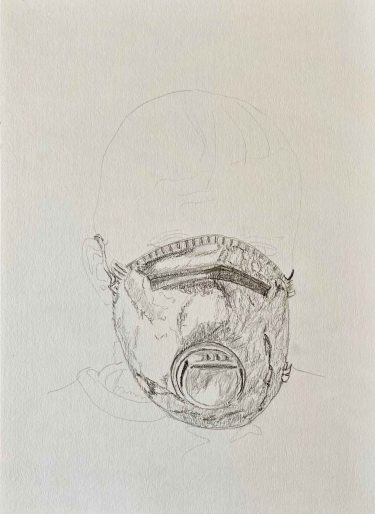
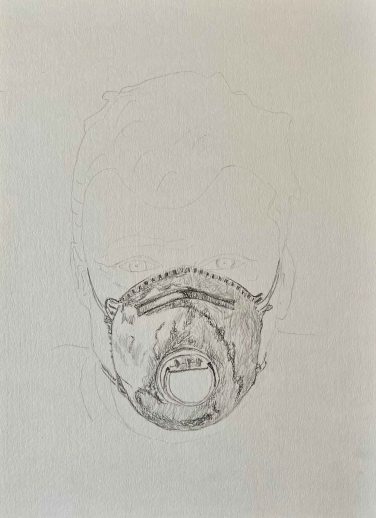
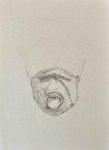
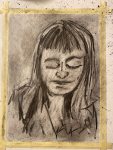
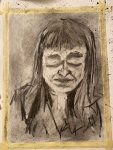
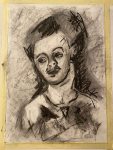
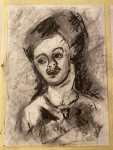
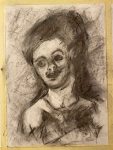
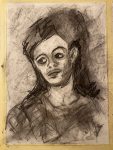
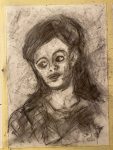
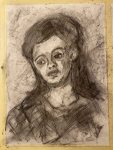
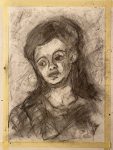
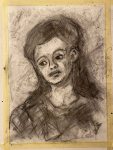
I start by creating a series of pencildrawings, using pencils HB, 3B, 5B and 8B for a tonal drawing of each mask on our faces.
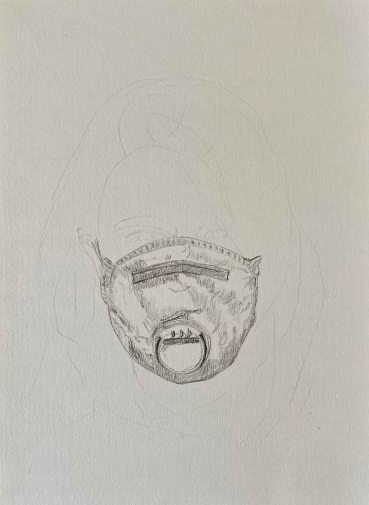
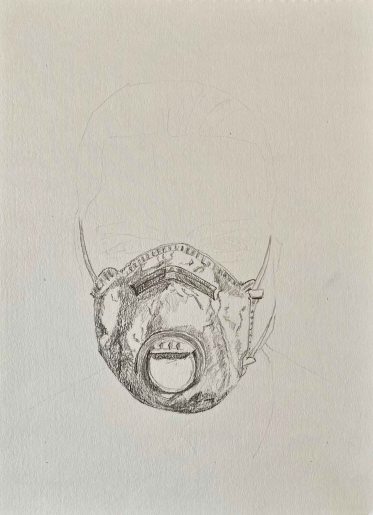
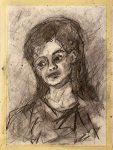
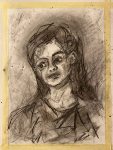
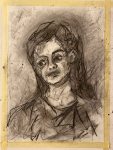
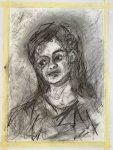
IMG_3016IMG_3037IMG_3050IMG_3056

IMG_3027

This is how they look all together in a series:
Keeping the drawings as a series instead of one big painting of a family picnic is showing the isolation and separation of this time too.

I continued with finishing the portraits of me and my partner and started with the fading of these in the below video. (The soundtrack is my granddaughter’s loud reaction to my daughter trying to wean her off breastfeeding when bringing her to sleep. )


This simple stop motion video creates so many feelings of fear and became unsettling to a point that I decided to stop here and not pursue my original idea of continuing this process with drawings of the kids. It is actually way more unsettling than I had expected and I am quite chocked at where this inquiry brought me.

In the BBC Scotland movie “Cornelia Parker- What do artists do all day”  (available on Youtube https://www.youtube.com/watch?v=tf7plwgxAzw), Cornelia Parker says about her work: “I am trying to unpick something that is a bit too hard to swallow”. It feels like what I am trying to do with this narrative.

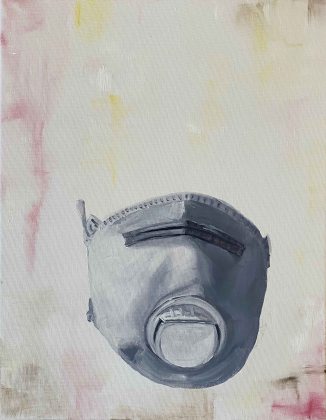
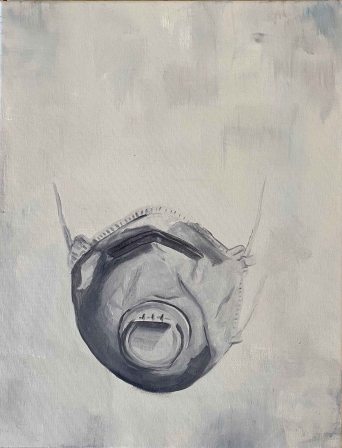
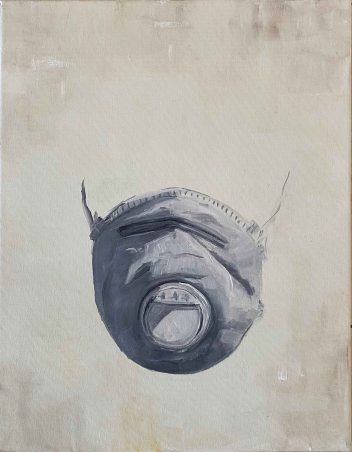
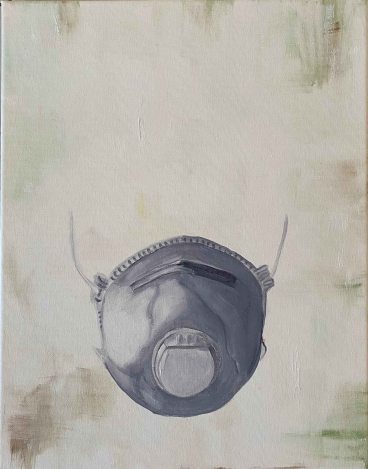
Instead of continuing with the fading of drawings, I seek comfort in painting. I continue in oil on canvas, keeping this passport picture format, but with only the masks visible. The faces remain present in their absence from the classical portrait sized painting. It feels slightly incongruous to dedicate a series of oil paintings to a flimsy object like the mask. What I am painting here is my fears.

I am taking inspiration in the almost monochrome paintings of items like pill packs or pillows by Alex Hanna. I am also thinking of the row of soup cans by Warhol- a pop symbol of consumerism at the time and translating it into THE consumer product of 2020- the mask- so desirable that it is not available to purchase anymore.

Originally, I thought of keeping the paintings as impersonal as possible by leaving the background white, but hearing of Michael Borreman never starting on a white background, I decide to give each background a slight tint of colour, matched with the person. In that way this background becomes symbolic of the person.

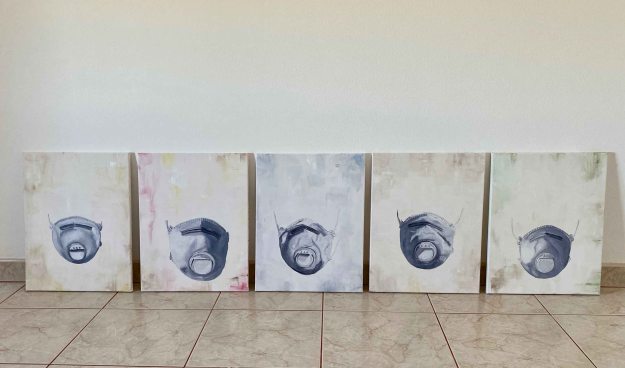
This are the final paintings , oil on mounted canvas 5 times 35x45cm:
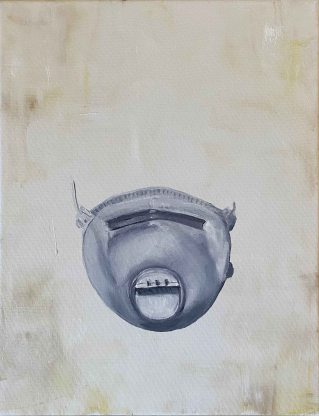
IMG_2956

IMG_2932

IMG_2927

IMG_2910

IMG_2896

This is how the paintings look beside each other:
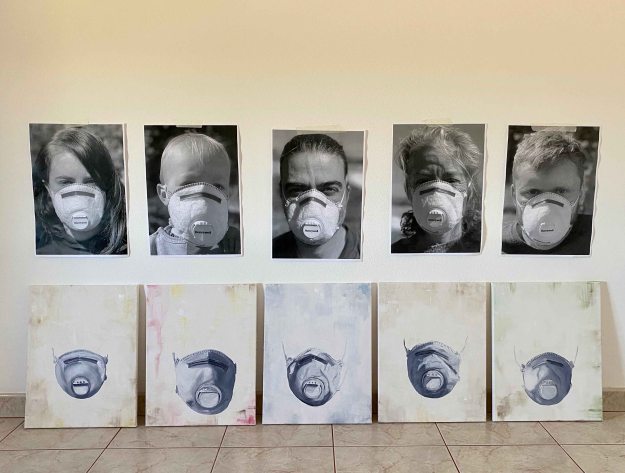
IMG_2888

IMG_2875


This series worked out the way I wanted and expresses the loss of personality behind the masks that I was aiming for. There is a certain helplessness in the way the masks are hanging in space, as if on invisible faces, rather than placed somewhere tangible with a cast shadow.


At this point, I realize that I have gotten so moved by the subject that I played it too safe with the materials and lost track of the aim of this project. I have not achieved any real sense of relationship , nor of incongruity between the subject and the material .

This mask is white, clean, soft, so it seems that a mask that would be dark, hard, in metal for example could be incongruous. But it just makes me think of another type of mask- a gas mask for example. The most incongruous I can think of would be a mask made of leaves and flowers or other natural materials. This mask speaks of danger and is artificial. Leaves would speak of nature. I created a Photoshop version of this idea:

Mask leaf

I feel that I come dangerously close to a carnival mask though and will not pursue this.

Instead I think of the mask on incongruous supports. This connects to my parallel project, where I am using old items left behind by the former owners in my house between others, to explore the change happening here.

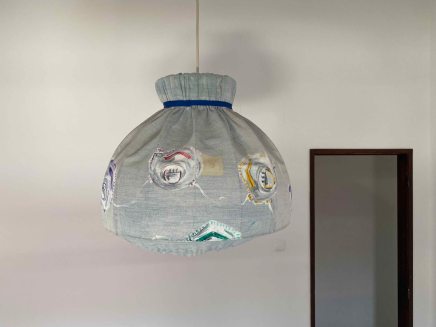
I decide that using the mask as  motive on an old vase or as a pattern of a lampshade will push it out of it’s normal reality in an interesting way.

I am using acrylics and start with the vase:
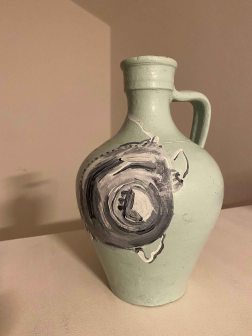
IMG_3524

To “normalize” the jug, I will add some grapes and grapeleaves:

I think this got quite funny by being absurd.

For the lampshade, I created the new pattern of 2020- colourful masks:
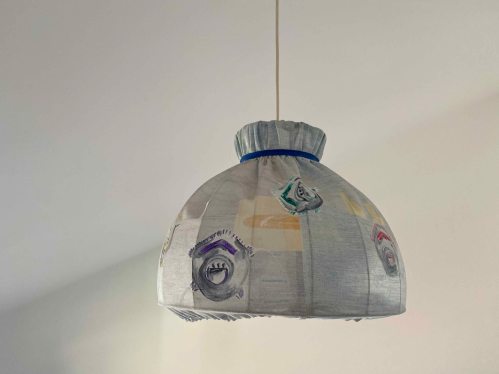
IMG_3578

IMG_3579


I could go on to Assignment 2 by using the mask as a tool to paint itself. That would actually work rather well as I have both soft parts to smear with and hard parts for interesting marks. I have seen more masks than I can stand for some time at this point though and am looking forward to a change. I am happy that I found a way to have some laughs about it in the end though- with the jug and the lampshade designs- as this narrative took me to darker places than I expected.

After two weeks of quarantine, all is well here!
IMG_1742


2.2 Markmaking materials

Course manual: Method: Build up a variety of surfaces using whatever comes to hand that has two differently coloured layers. Make several drawings by scratching through into the second layer. You can use wax and acrylic paint, oil glazes on board, household paint on wood, varnish on metal. Vary the scale of the drawings depending on your support. Choose a subject from your sketchbook or learning log and push through to make complete drawings, not just squares of texture with random marks. That way you’ll really learn what the materials can do.

I am on a worktrip to Rome and extend my stay a few days to visit my friend and painter Ellen Strasser in her studio in the Italian countryside.

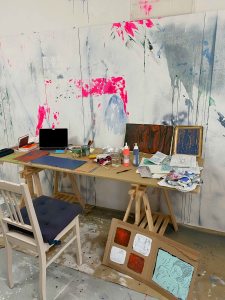
Her studio is light and spacious and my dream.

Ellen clears a table for me to work on and I start on exercise 2.2- exploring mark-making materials.

Ellen has a treasure box full of suitable materials to scratch into the surface.

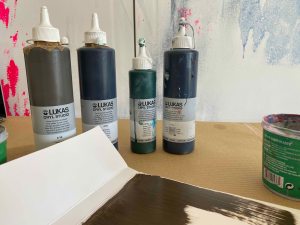
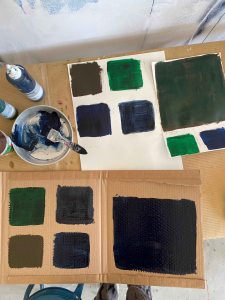
I am not staying long enough for oilpaints to dry, so I chose to work in acrylics- discovering Lukas Cryl brand that I have not tried before.

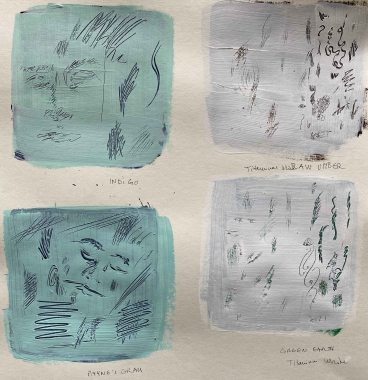
I start by exploring different marks on different colored surfaces on a cardboard box, and two different thicker glossy papers.

The result is much better scratching quickly into the still wet paper.

I have a problem with the scratching tool piercing too far into the paper and damaging it.

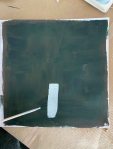
I will need to build up several layers of acrylics to create a solid base.A little frustrated by this discovery, I scratch into the left over paint on my metal palette, which is more successful:

This is really a fun experience. I will wash this away now, but I will look for some metal when home to try this again.

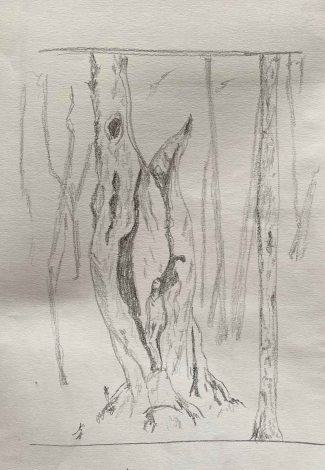
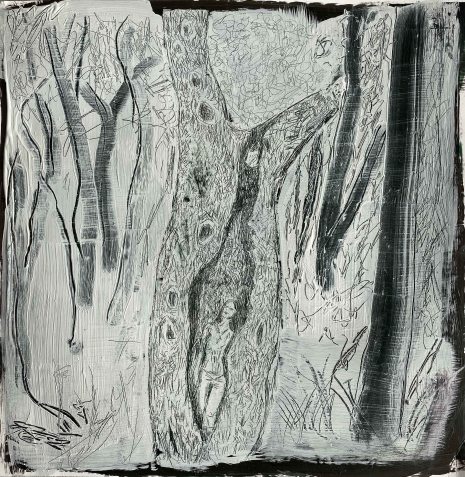
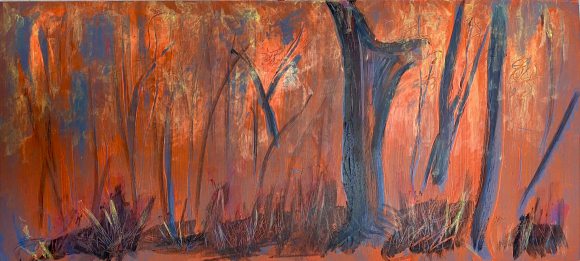
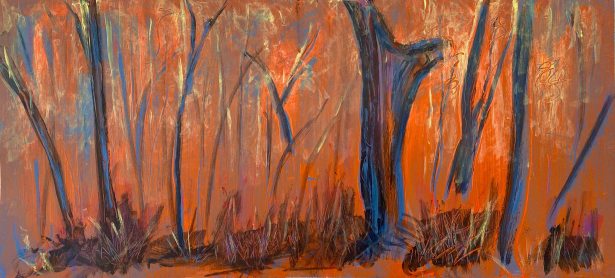
As for my subject, I am working from a photo that my friend Isa has sent me from her trip to Australia, where she is standing inside the trunk of a tree. I am fascinated by this forest, especially considering the recent tragic forest fires.

I start by an A4 sketch in pencil:

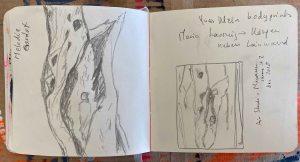
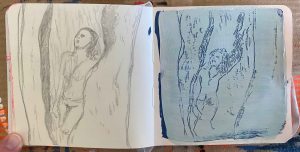
And some close ups of the figure in my pocket sketchbook:

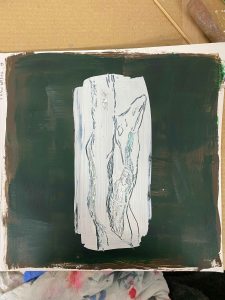
Then I prepare one of the supports with several layers of Sap green and Burnt umber Lucas Cryl. The top layer is Titanium White mixed with a little of these two colours.

I apply the top layer in small steps and scratch along the way, as the acrylics dry very fast and I can make much more free marks in the wet paint.

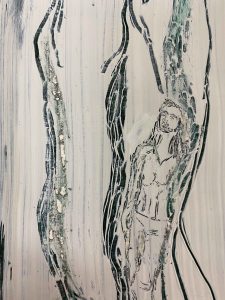
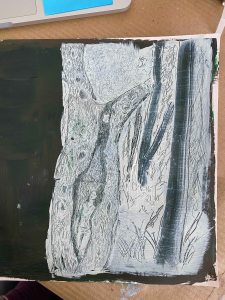
I am using very fine detailed marks and am spending a lot of time developing this into something very boring. I decide to start making larger, rougher marks. This is the whole drawing:

I am much happier with the rougher marks on forest on the sides. The detailed figure in the tree is too precious and looks like a lace curtain.

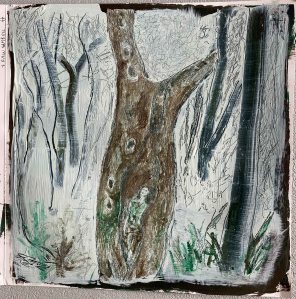
I try to add some colour:

This made it even more awful. I cover the other colours with Payne’s Grey.

I will stop here because it is just a rather awful drawing. I am happy for the mark making experiments though- this is definitely an example of many different marks:

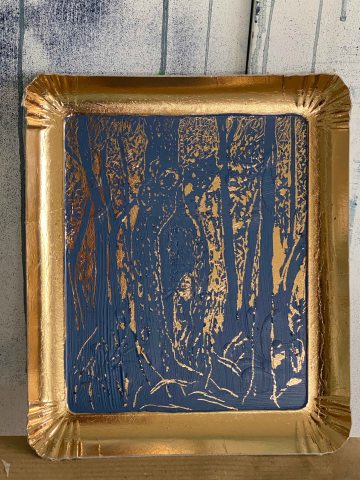
I have found a gold paper cake tray that I am hoping will allow me to do something close to the metal palette above (if treated more carefully).

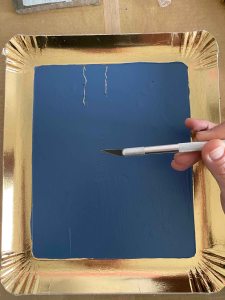
I start by covering it in Lukas Cryl Steel blue- an amazing blue tone.

I am using the drawing of Isa in the tree above and a scalpel to carefully scratch out a variety of marks.

The result here is more fun and fitting to the golden frame, but it is still not a drawing that I like.

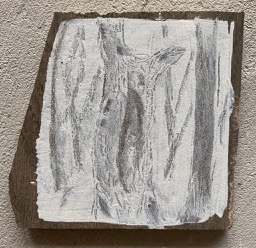
I have also found a broken tile and try using it as a background, covering it with Titanium white with some burnt umber.

The drawing remains a little unclear here, which adds a small note of mystery that I like. I also like to hold the drawing in my hand like a precious object.

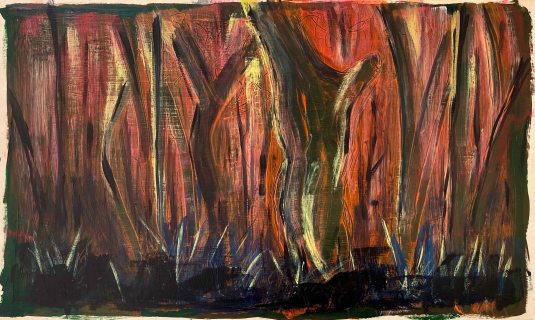
So far, I was most happy with the roughly wiped marks for the forest around the main tree. I prepare two larger new backgrounds to try out this quicker wiping and scratching- one in Steel Blue and another with the same mix of Sap green and Raw Umber as above.

Experimenting in my sketchbook, I discover the effect of a Luminescent Orange- it is really shifting things.

I start with the brown background. As before , I apply the paint piece by piece to avoid it drying before I can manipulate it.

I enjoy the larger swiping marks! Then i add structure, grass and leaves using different thickness of wooden sticks. This is the first drawing:

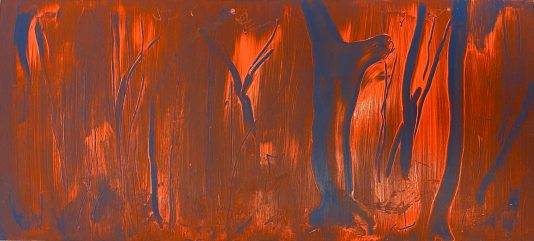
And the second one on Steel blue:

I like the minimalist and almost abstract character of these drawings. But then I am also curious to see how I can push it further and add paint on top that I then continue making marks in.

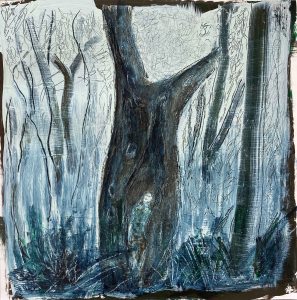
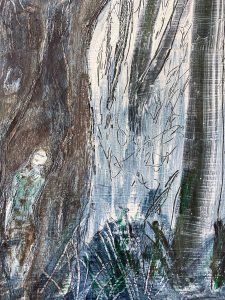
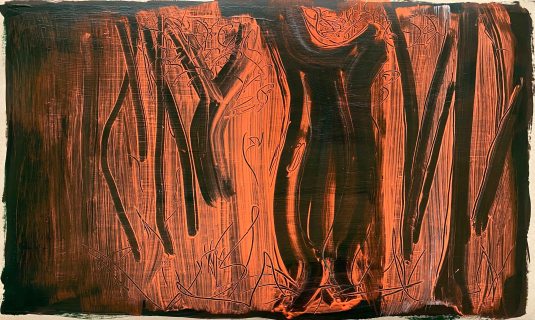
I have gone from the romantic hide away in a tree trunk to a blazing bush fire and feel that this is a much truer drawing. I feel that there is depth lacking on the right side and add a few more trees in the foreground and more marks in the ground.

For the drawing on a brown background, the bushfire develops like this:

In hindsight, I think the strongest drawings were the very simple almost abstract first versions of these drawings, especially the blue one. Pushing them further allowed me to add many layers of different marks though.

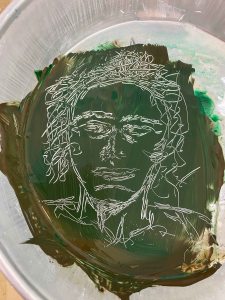
I need to change subject, and decide to turn to some portraits under water that I developed for a story about drowning,  painting on glass for the parallel project. I am looking at the photos of these facial expressions under water again and continue with some mark making experiments on another of the prepared boards.

In my A5 sketchbook:

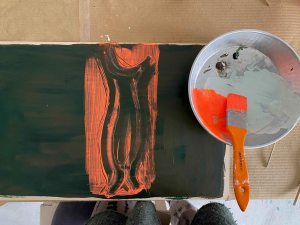
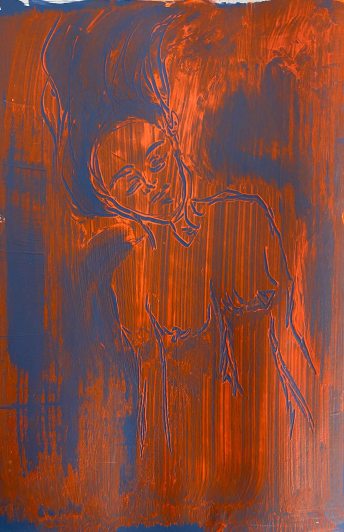
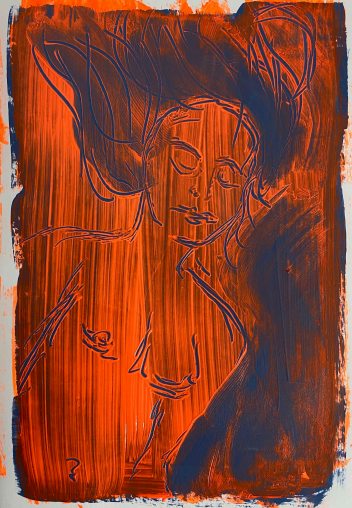
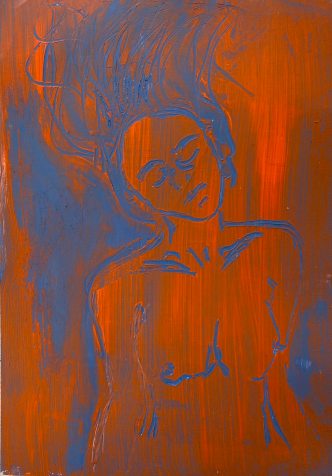
I am really fascinated by the Fluorescent Signal Red and will try it out for this subject too. It reminds me of the colour of a life west too, connecting it to the subject from another side too.


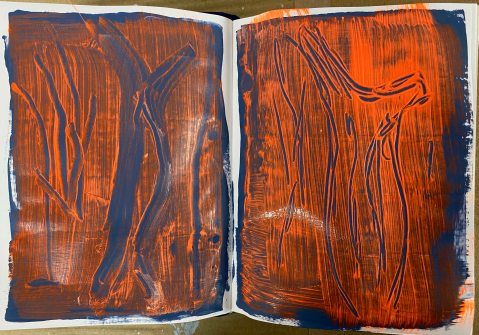
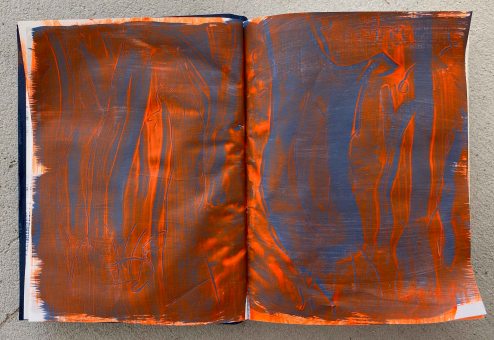
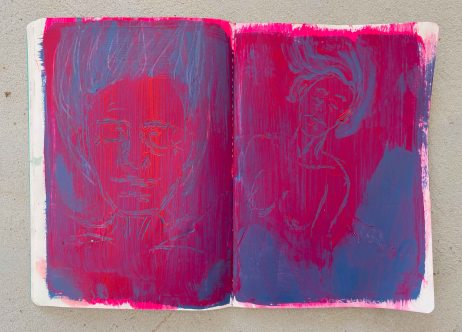
I also try out the combination of Steel blue and Fluorescent Signal Red in the A5 sketchbook:

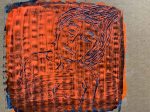
I prepare a thicker page of A4 in Steel blue and then Fluorescent Signal Red.

The paint is pushed to the sides by my wooden stick and it almost looks like a woodcut or similar. This is the drawing I am most happy with so far. I like the expression and how the blue and orange is divided in and around the figure.

I discover that there is a Fluorescent Magenta as well, so need to try out this colour too..although the Fluorescent Signal Red carries more meaning for the subject.

I have really enjoyed working in two colours only, and also enjoyed “rediscovering” acrylics. I would like to try out this technique with oil paint or wax that dries much more slowly as well.

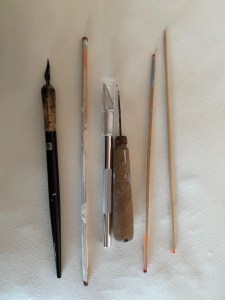
I have had the chance to try out many different markmaking tools, but these are the ones I used most:

It is time to pack and leave. I have absolutely loved working alongside an artist friend, although we were working on very different things, it is wonderful to share the joy of making.

3 weeks later

Only three weeks later, a joyful trip to Italy seems like from another lifetime. We are in the midst of corona virus Covid 19 measures and in a lock down here in Portugal and in most surrounding countries.

I finally manage to restart with this exercise and will try out scratching into oil paint on wood.

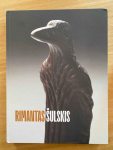
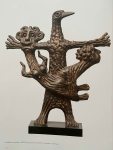
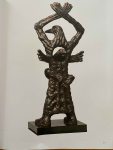
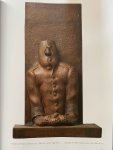
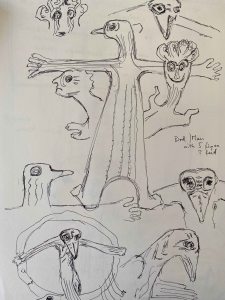
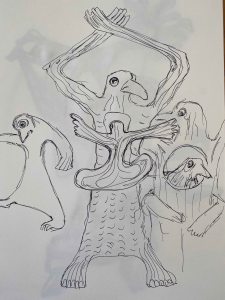
I am inspired by a book about the work of Lithuanian sculptor Rimantas Sulskis that was gifted to me recently. I am really touched by his bronze sculptures expressing the oppression under the Soviet Union through bird-men or birds and men in various intertwined forms.

They are humorous and touching and really expressing the struggle and pain and I find them fantastic.

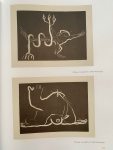
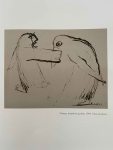
The same figures reappear in Sulskis monoprints and ink drawings:

(Images from the book “Rimantas Sulskis” : Andriusute-zukiene, R & Morenaite, D (2019). Rimantas Sulskis. Lithuania: Vilniaus Dailes Akademijos Leidykla, reproduced with permission of Rimantas Sulskis estate.)

I am wondering how I can develop a drawing about the oppression of today- the Corona virus- inspired by Sulskis without copying his work too closely.

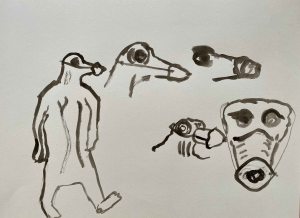
I start by drawing from the book just to familiarize myself with the figures:

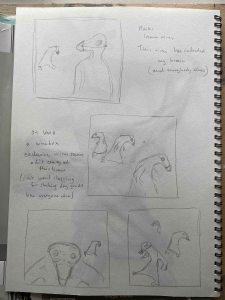
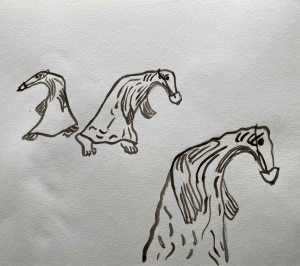
Then the idea comes to place a mask over the bird mans beak, symbolizing what is happening to the world now.

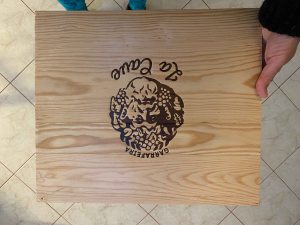
I am going to paint with oil on the lid of a wooden box:

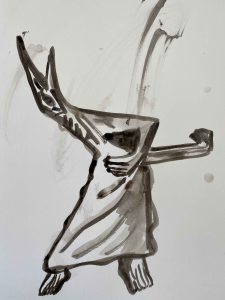
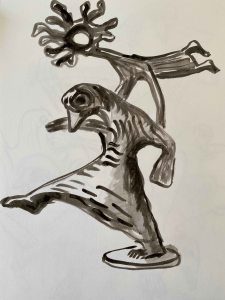
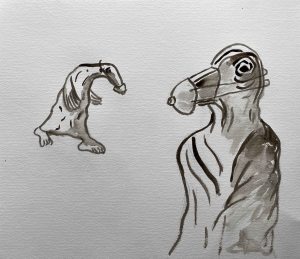
I cut two watercolour papers to the the size of the board to try out two different compositions in Indian ink:

I choose the one on the right.

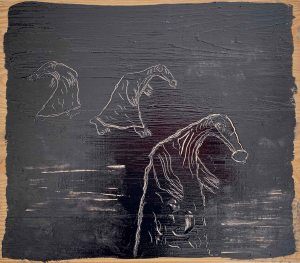
I then try out different ways of applying paint and scratching into the surface on the underside of the panel.

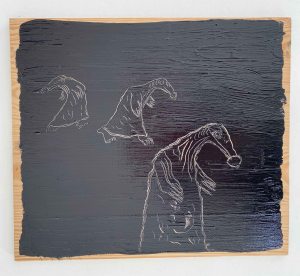
I see that I need to apply a coat of Transparent Gesso so that the paint does not seep into the wood. I am using a Liquitex transparent gesso. When dry, I apply a thick coat of Payne’s Grey Cobra oil paint to the wooden lid.

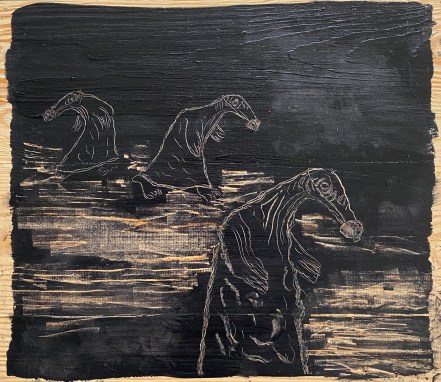
This is the final drawing, oil on wood:

I like how the feeling of the wooden surface comes through, and I quite like the playful, cartoon like figures that help me express a serious subject that has definitely infected my mind.

Again, this has been a project that has pushed me to explore a method of drawing that I would not consider otherwise, and I could just go on varying surfaces and media, but it is time to move on to the next project.


2.1 Space, depth and volume

D2 manual: “Aim: A significant period of western art history has been dominated by the attempt to create a believable illusion of space and depth in two dimensions. The idea of the picture frame as a window onto a simulated vista has long been regarded as just one of many possible interesting routes but the relationship between drawings on surfaces and drawings of surfaces is still absolutely vital and many artists make use of that interplay.

The description of space, depth and volume relies on depicting the way in which light operates on objects and the change in tonality that this produces. In the pitch dark, we see nothing. Natural light tends to fall on an object from one side and the sense that we make of the shadows it casts is how we judge three dimensions. The human mind is sophisticated at reading tone, which makes it hard for an aspiring artist to create a convincing visual illusion – the viewer is not easily fooled.The first step for any student is to correct any over-reliance on outline. What we translate as an outline is actually just the moment that something disappears from view – either because something has come in front of it or because its surface has changed direction and slipped from view to reveal what is behind. Either way, being able to sit the two planes next to each other without ringing one of them with a black outline will immediately give a sense of volume and space. An outline pulls us back to the picture plane. This is not a problem in itself but, as it is so often used by students, use this project to try not doing it.

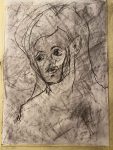
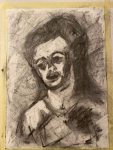
Method: Cover a whole sheet of paper with charcoal so that you have a blank black rectangle. Make a drawing from a subject of your choice by drawing into the charcoal using a rubber or selection of rubbers. When you’ve worked into the charcoal for about an hour using just a rubber (depending on how fast you work), go back to your charcoal and begin to redraw in darker tones using the side of the charcoal. Continue in this way using the rubber as a white to the charcoal’s black and develop the drawing until you’re happy with it. Try to avoid using outlines – instead, use sweeps of the rubber or the side of the charcoal to build up patches of tone. If you do use an outline, look at the two neighbouring tones, decide which is the darker and then blend the outline into that one. Bear in mind that as you move along the object’s silhouette, the relationships might change and the outline might switch allegiance.

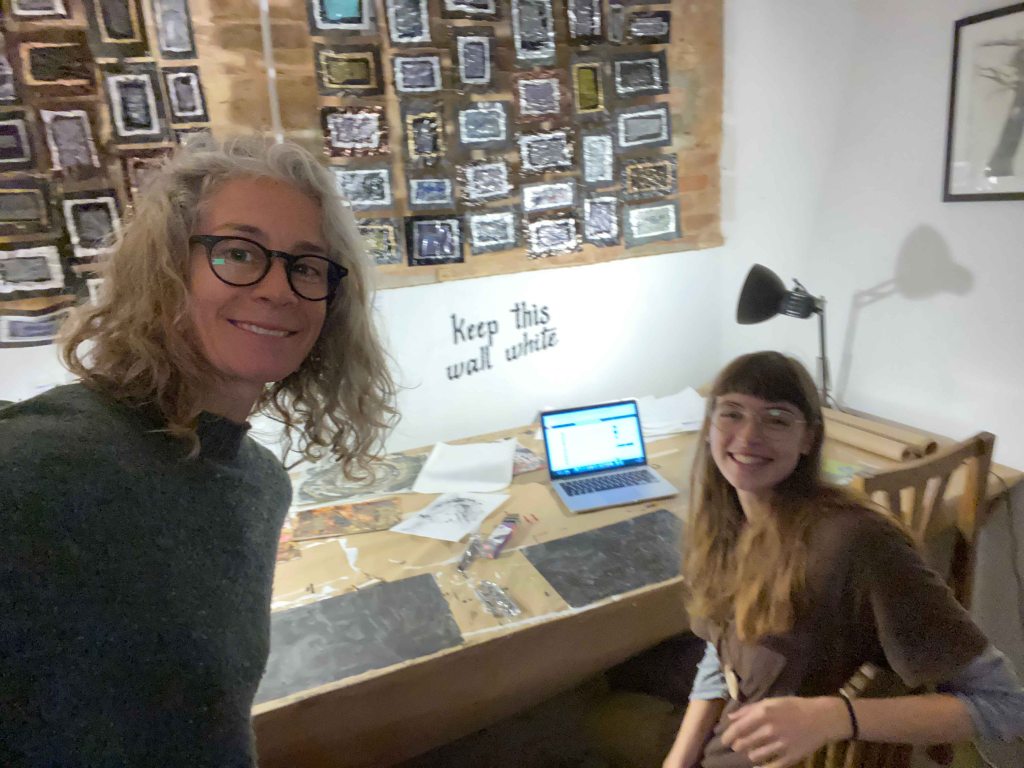
I am approaching this project while visiting my artist friend Constanca in her studio and we use this method to draw a portrait of each other while drawing.

We only have medium size willow sticks of charcoal and a simple eraser available

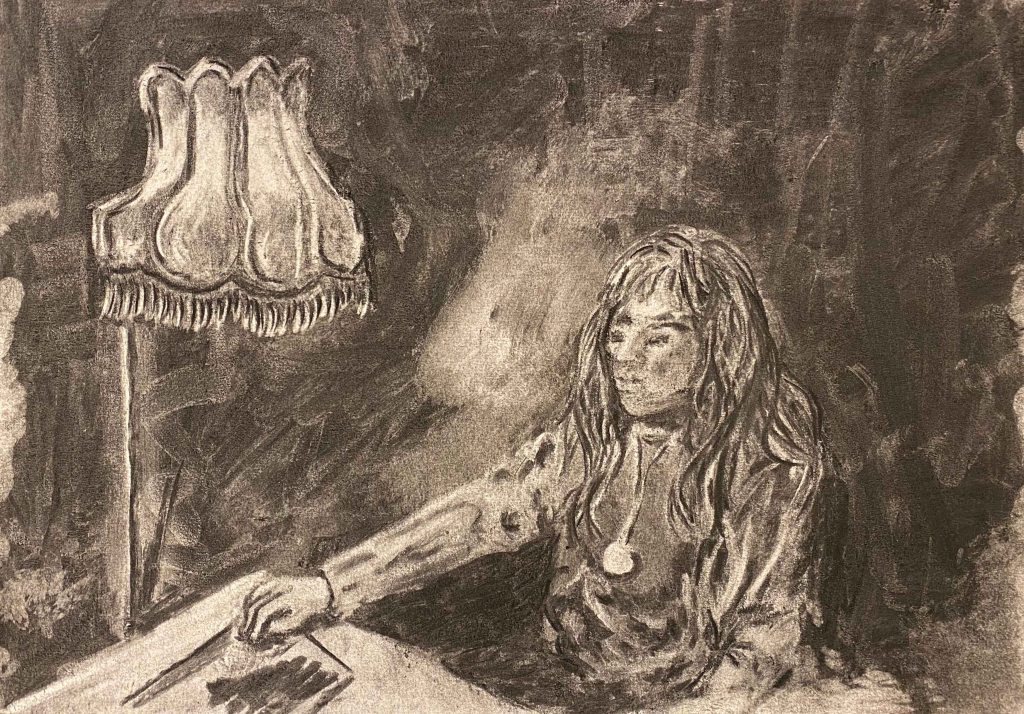
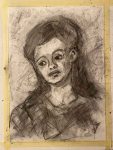
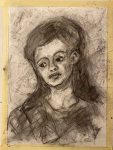
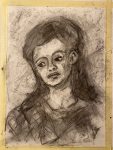
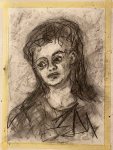
This is my final portrait of Constanca, and a big lampshade behind her, after much rubbing and filling in.

I am not happy with this drawing, it was hard to capture any likeness while she was moving and this drawing does really not make her beauty any justice. I am also annoyed at myself for enjoying working in shade only, and then still having the impulse to add line at the very end.

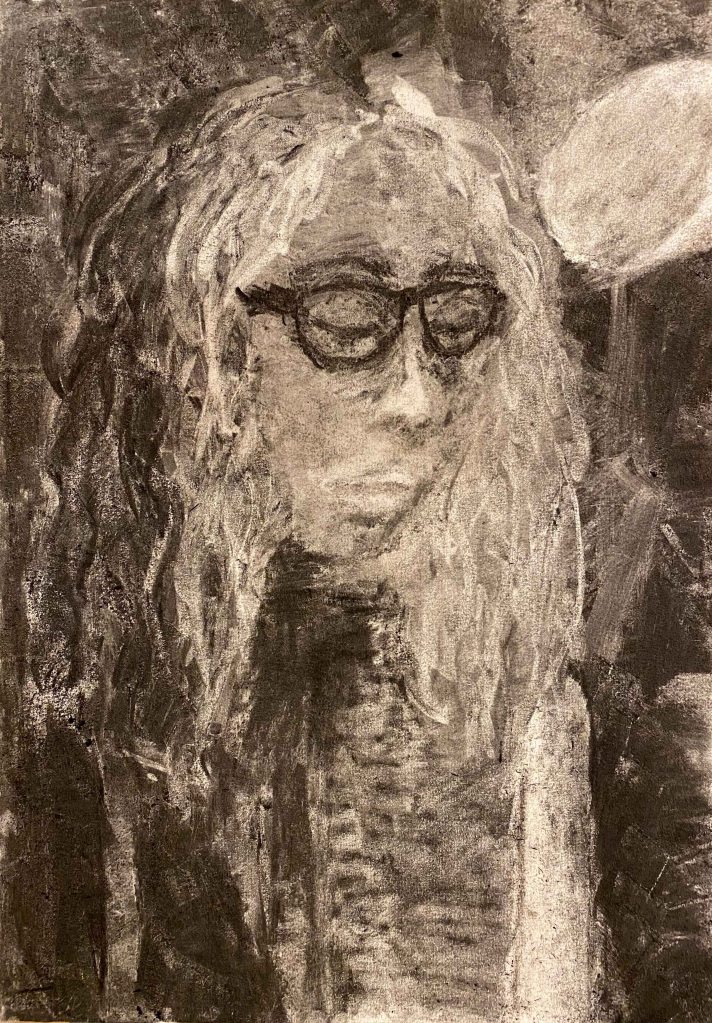
This is Constancas portrait of me:

I felt very happy at “rediscovering” charcoal through this project, and it was wonderful and playful to share the experience. We will definitely draw more together in the future!
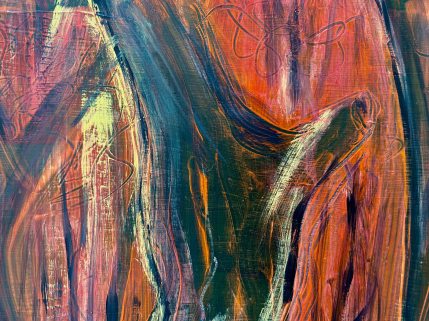
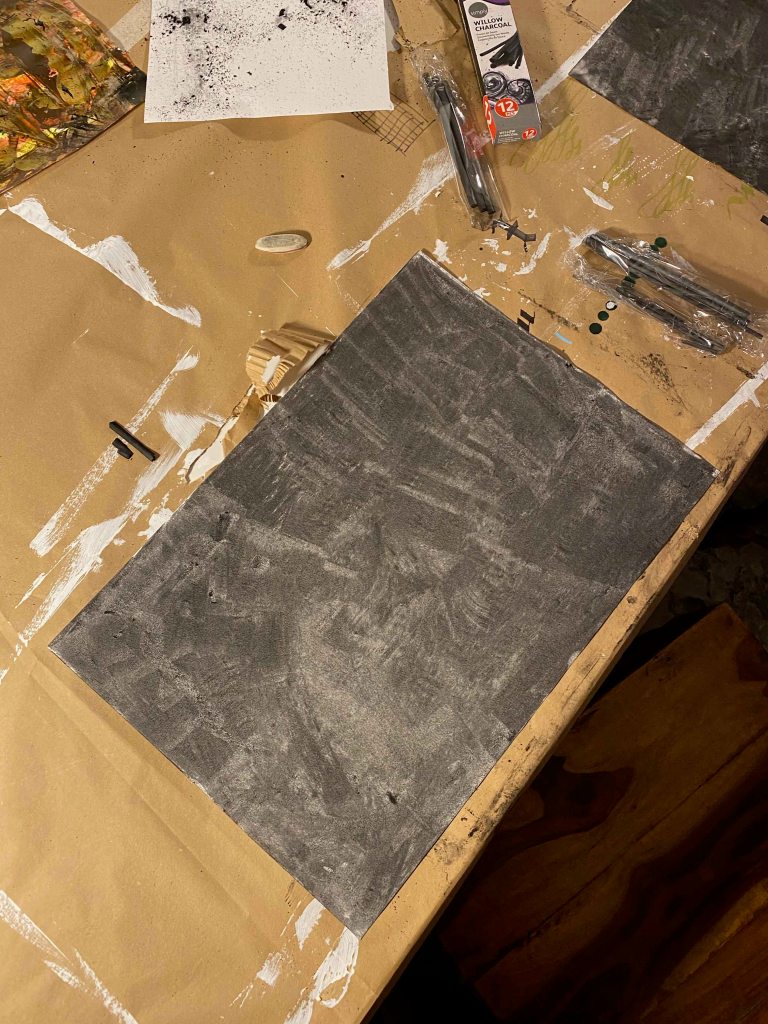
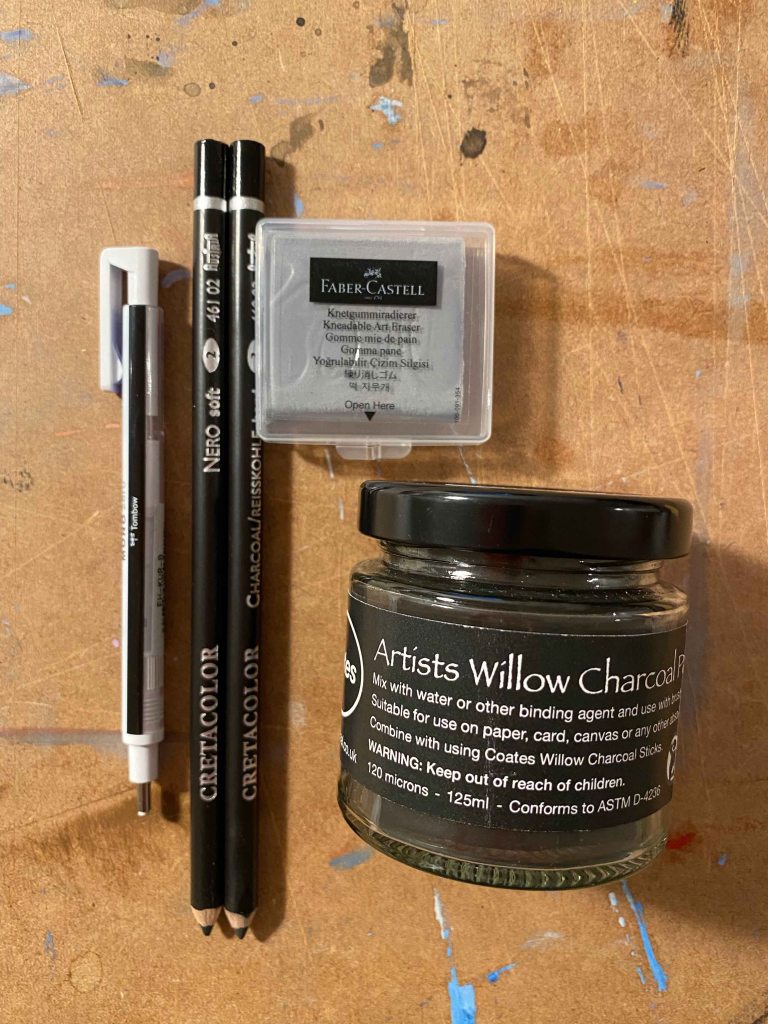
I aquire a few more specific tools for this kind of drawing for my second attempt in my own studio:

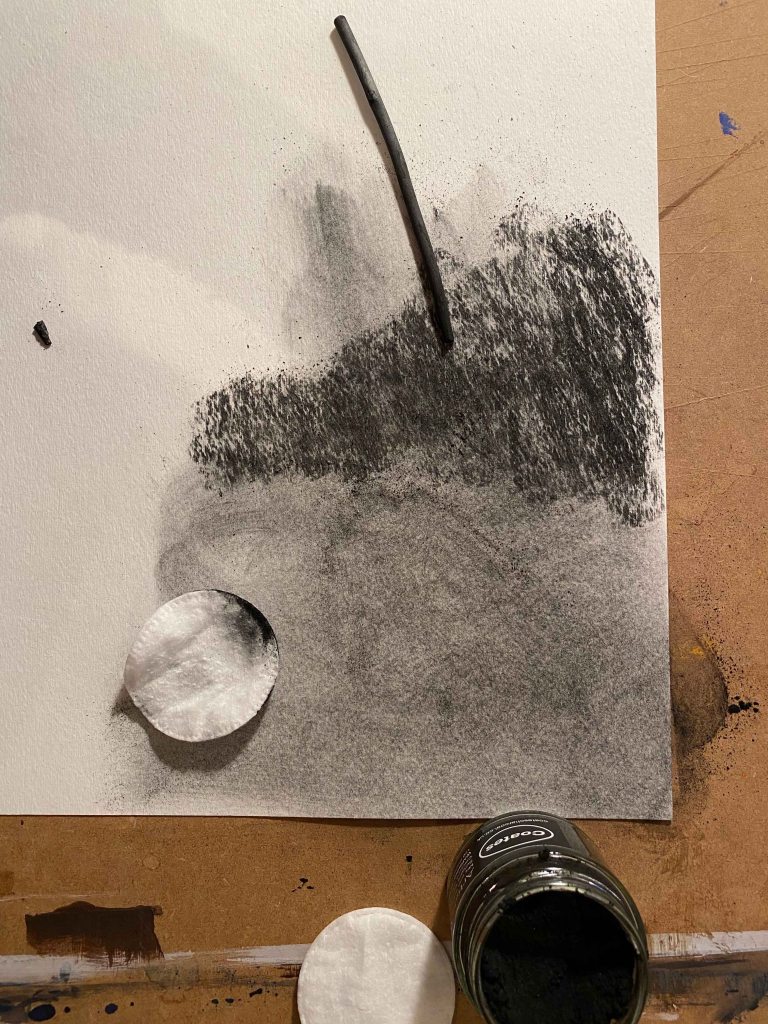
I was excited to try the willow charcoal powder, but find that when using it dry, I can not reach the depth of dark as I can with using the sticks- even if applying many layers:

I am reading the book “that which is not drawn” with conversations between William Kentridge and Rosalind C. Morris. (Kentridge, W & Morris, R.C (2014). That which is not drawn. India: Seagull Books.)

William Kentridge works in large charcoal drawings which he erases and transforms constantly, taking photos to document each step and then creating stop motion animated films. He is depicting transformation.

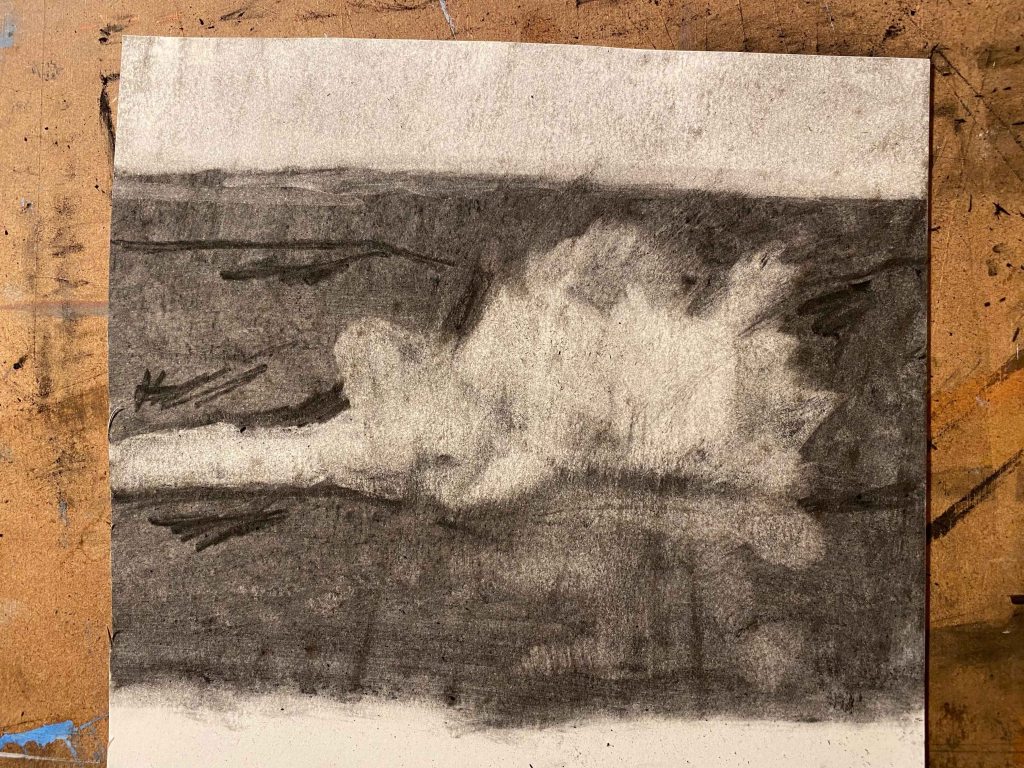
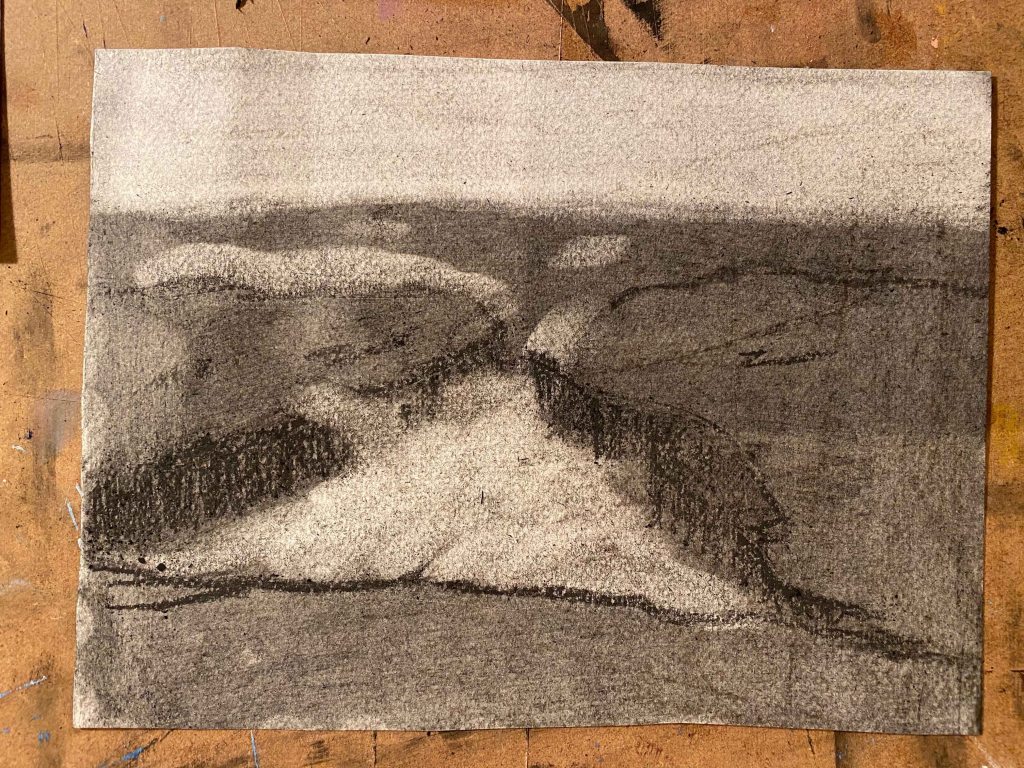
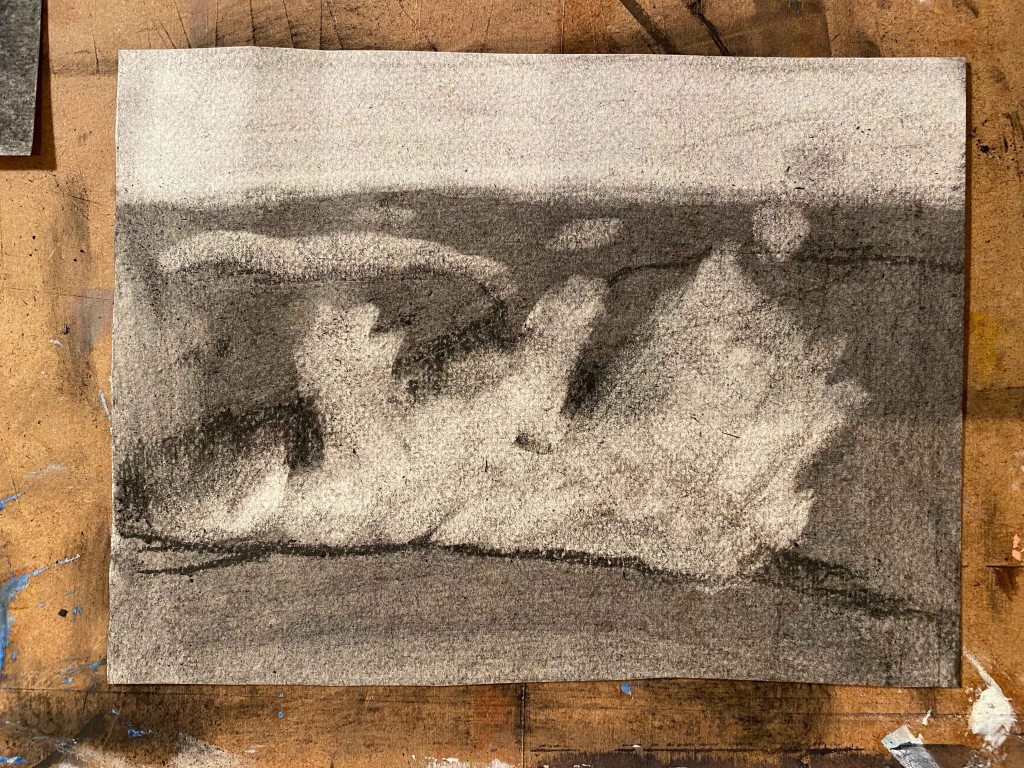
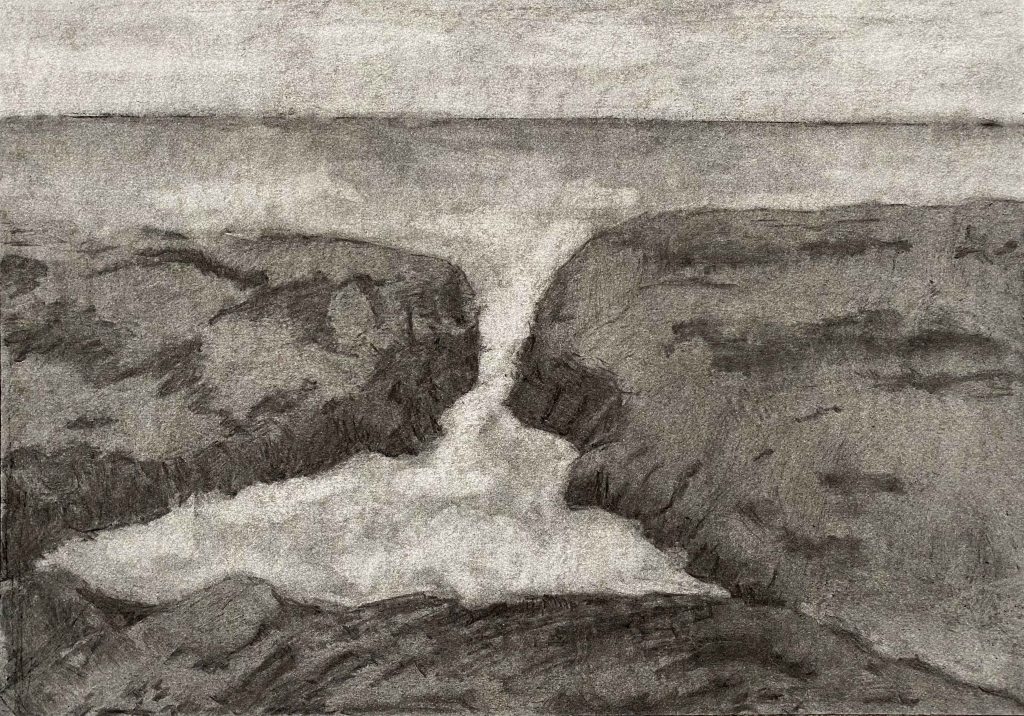
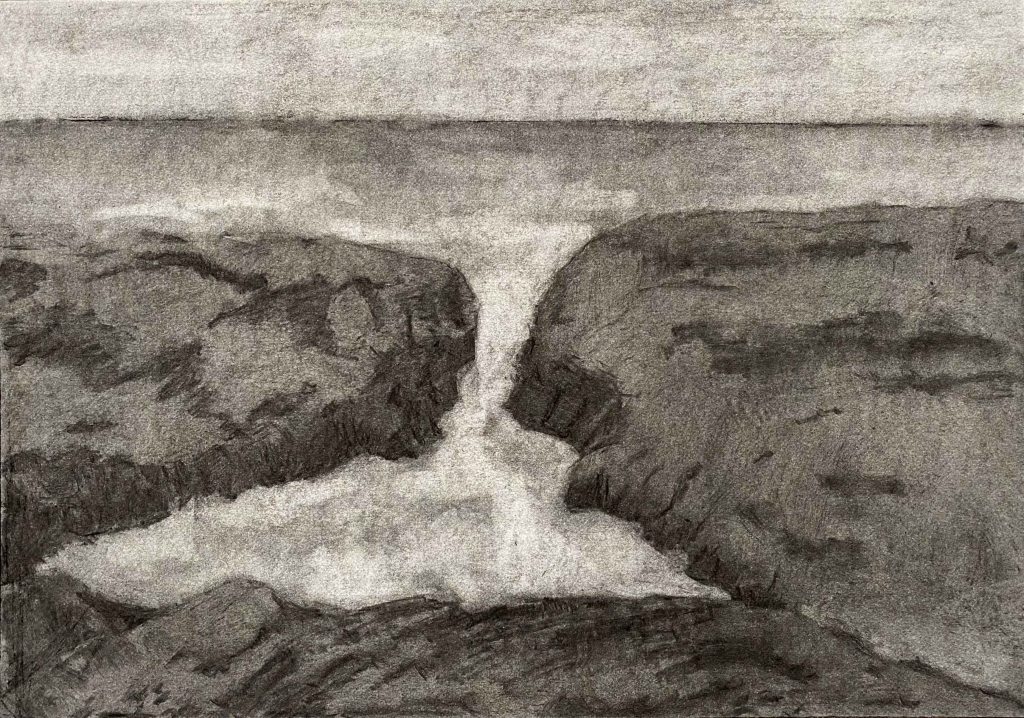
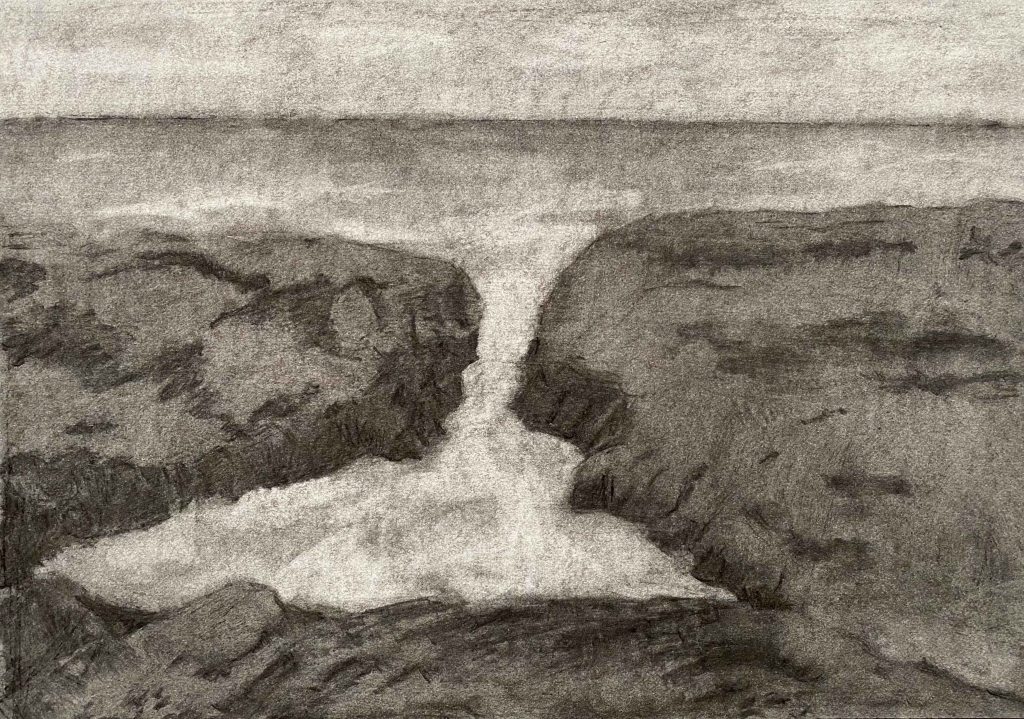
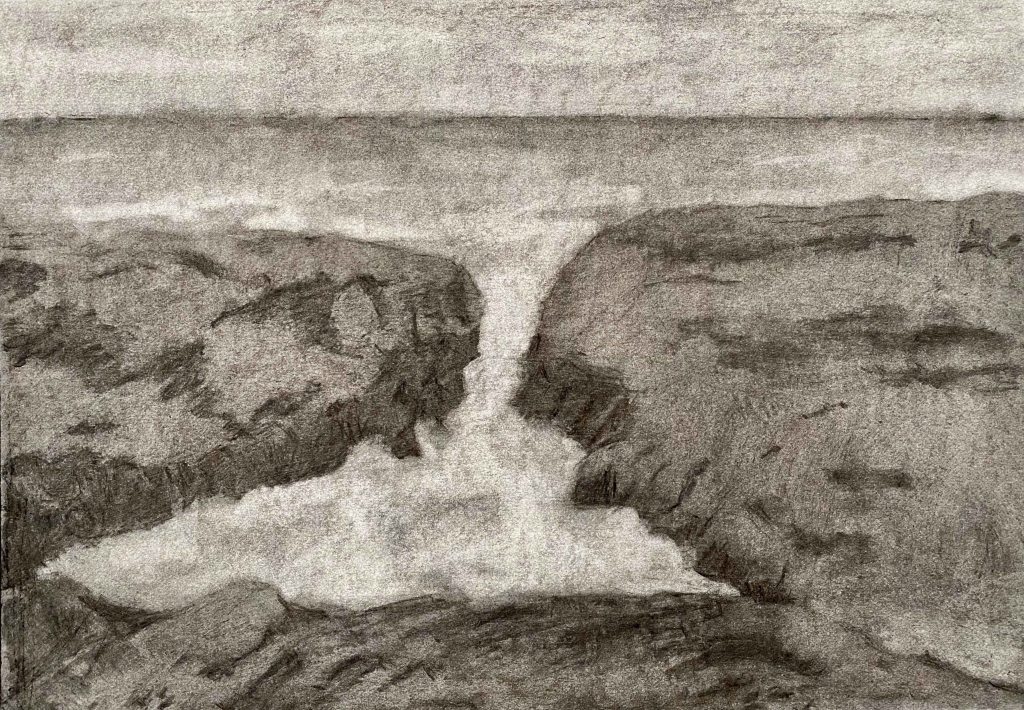
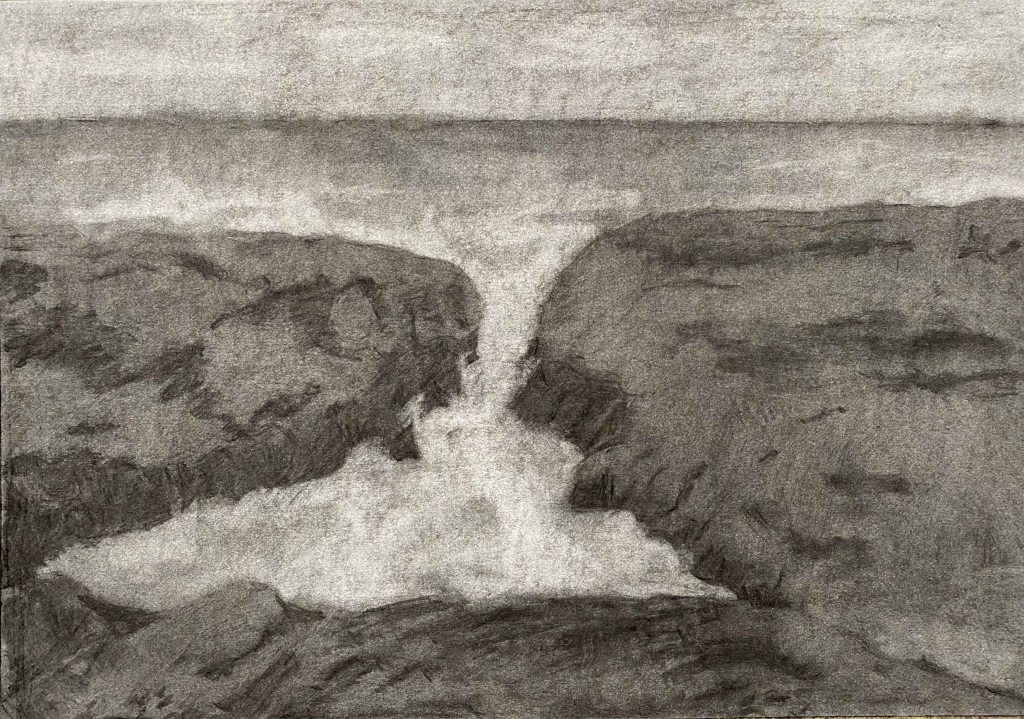
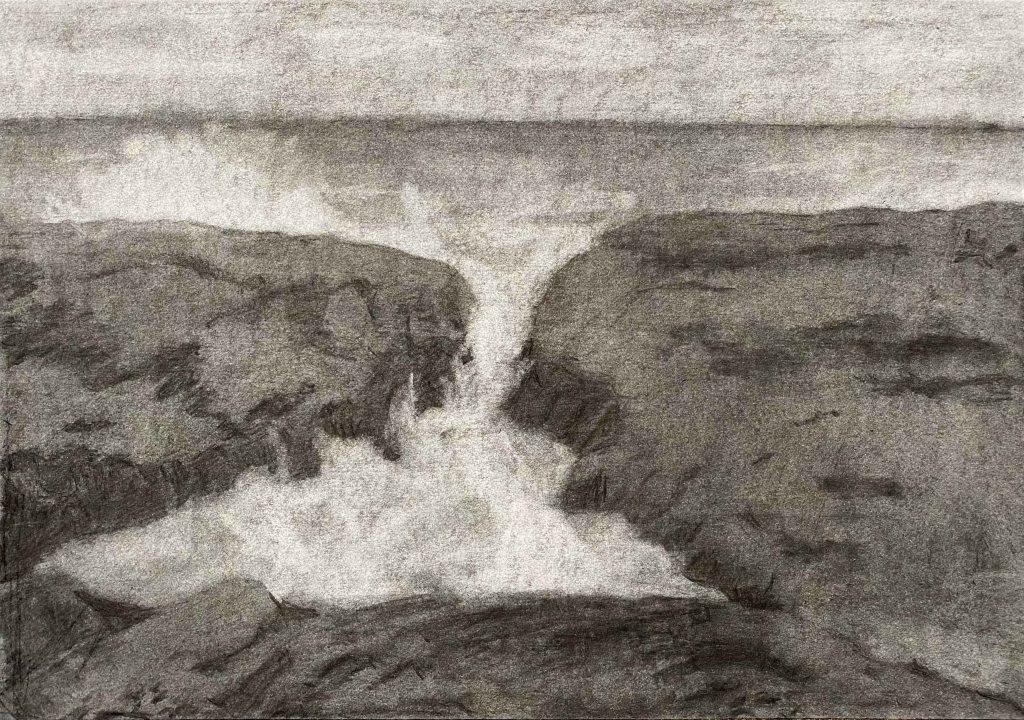
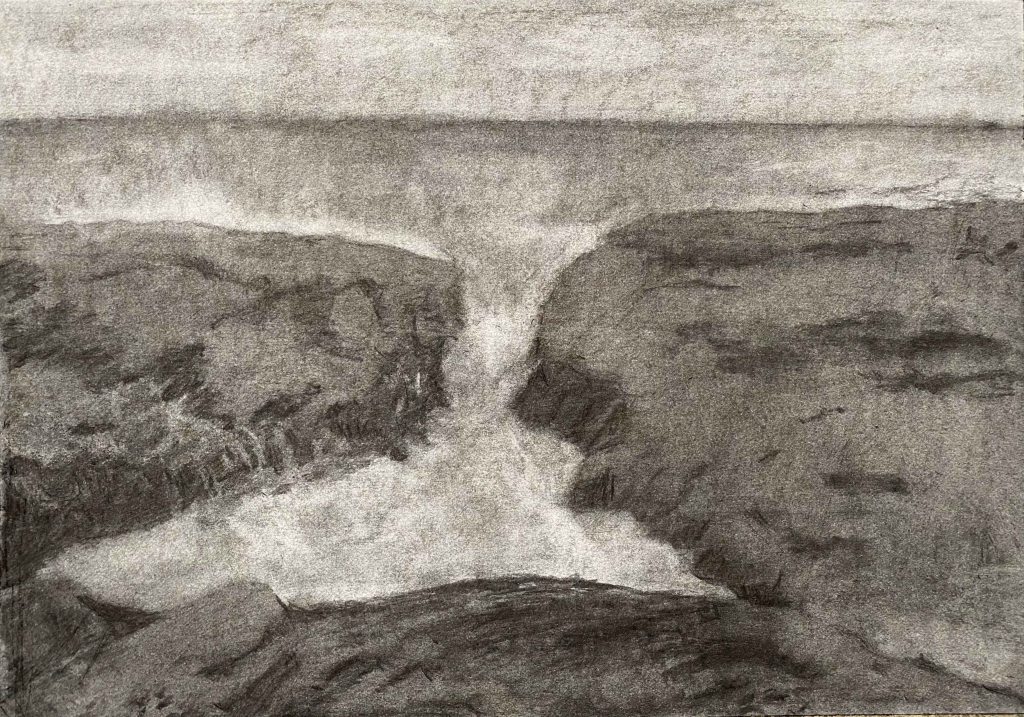
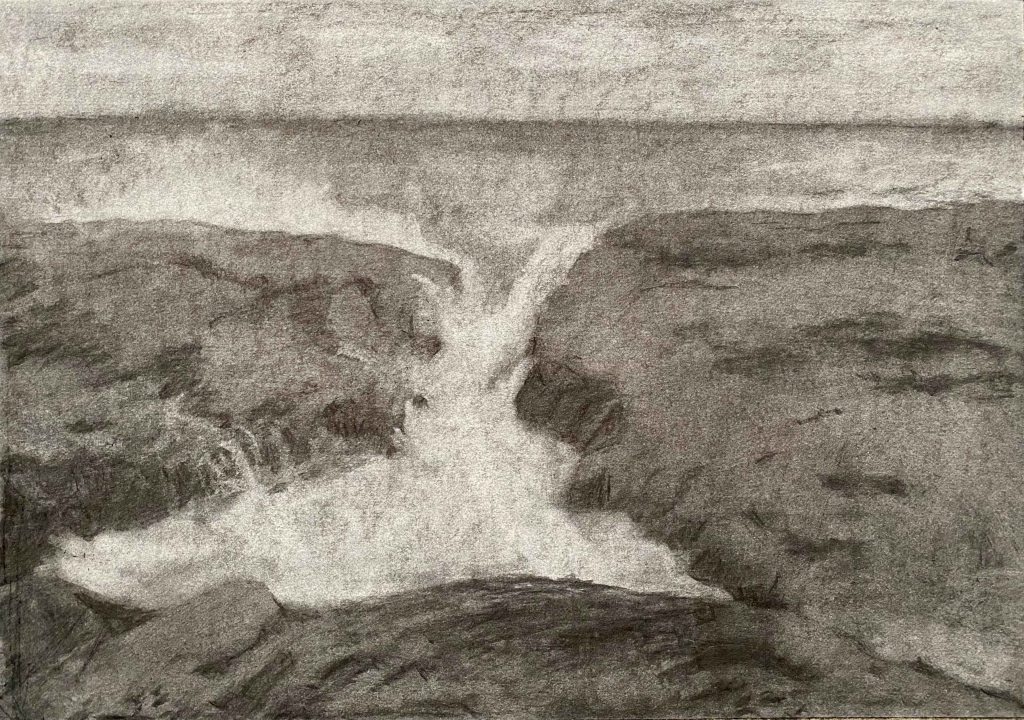
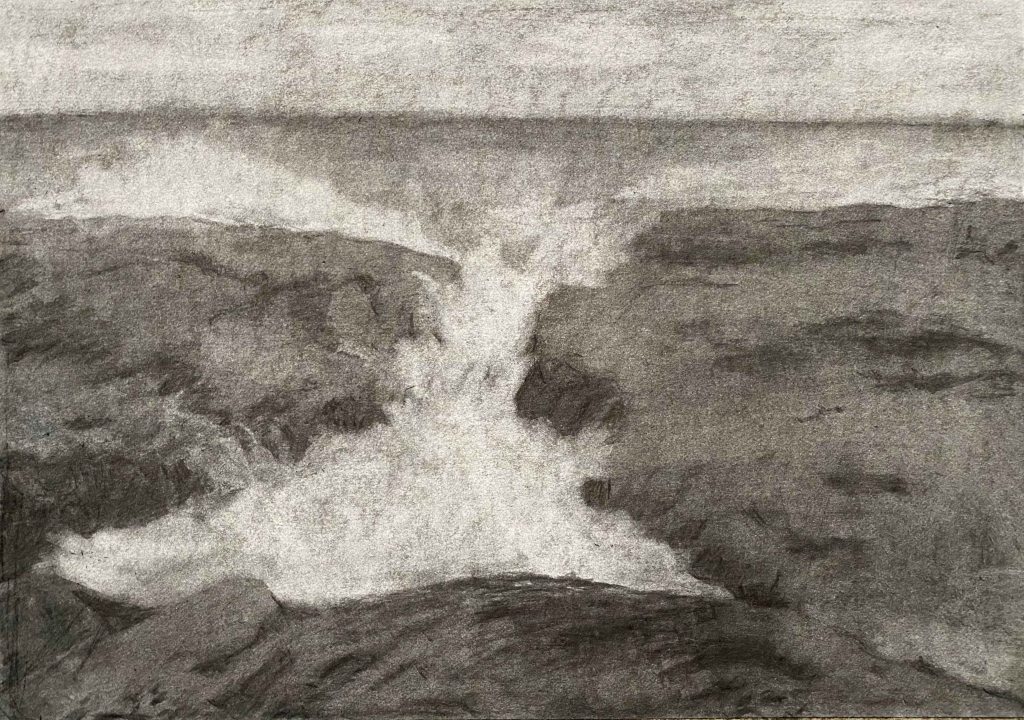
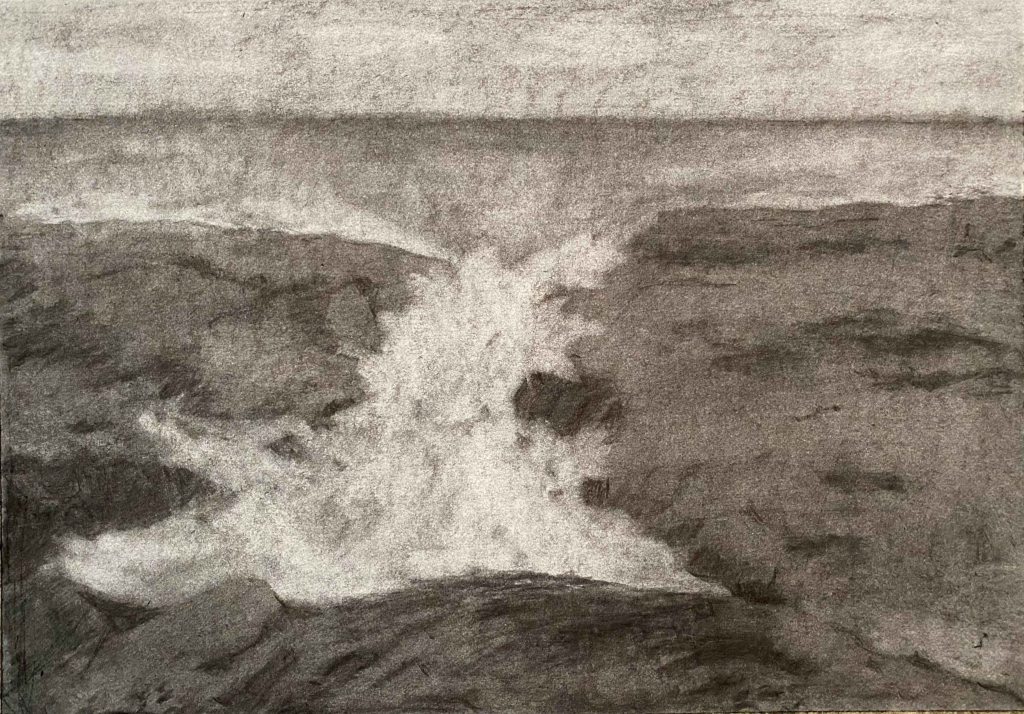
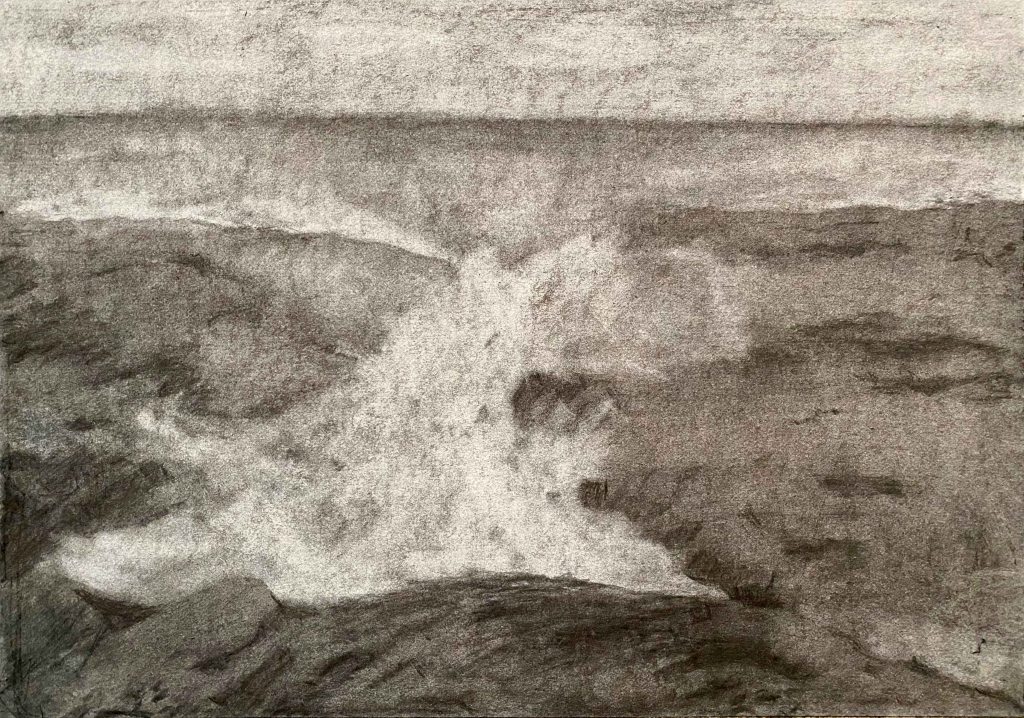
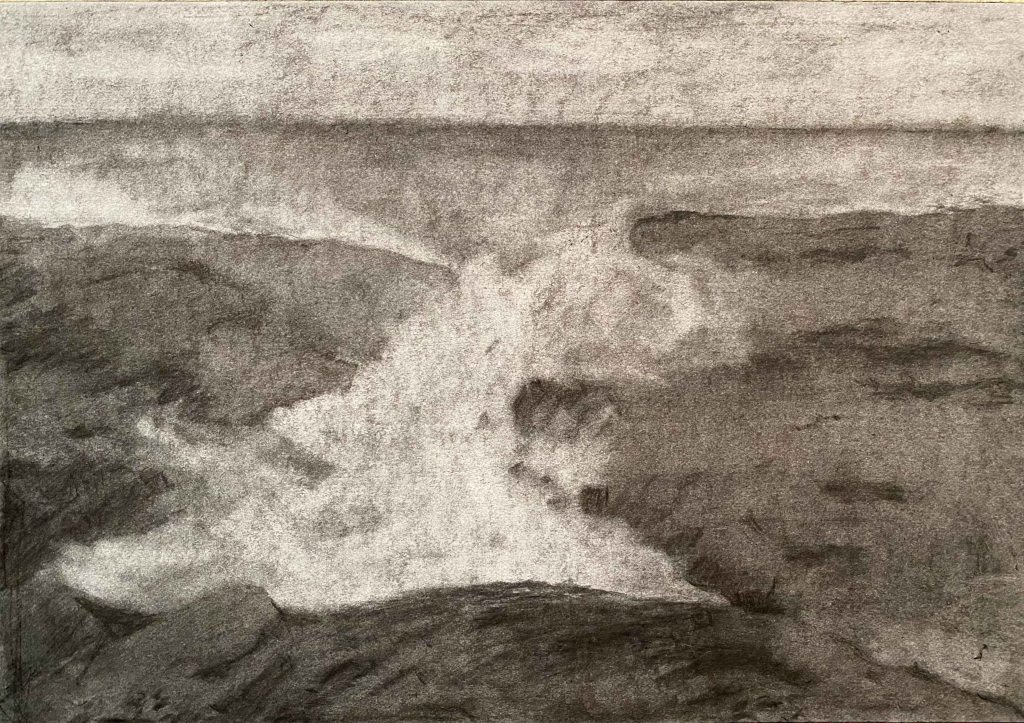
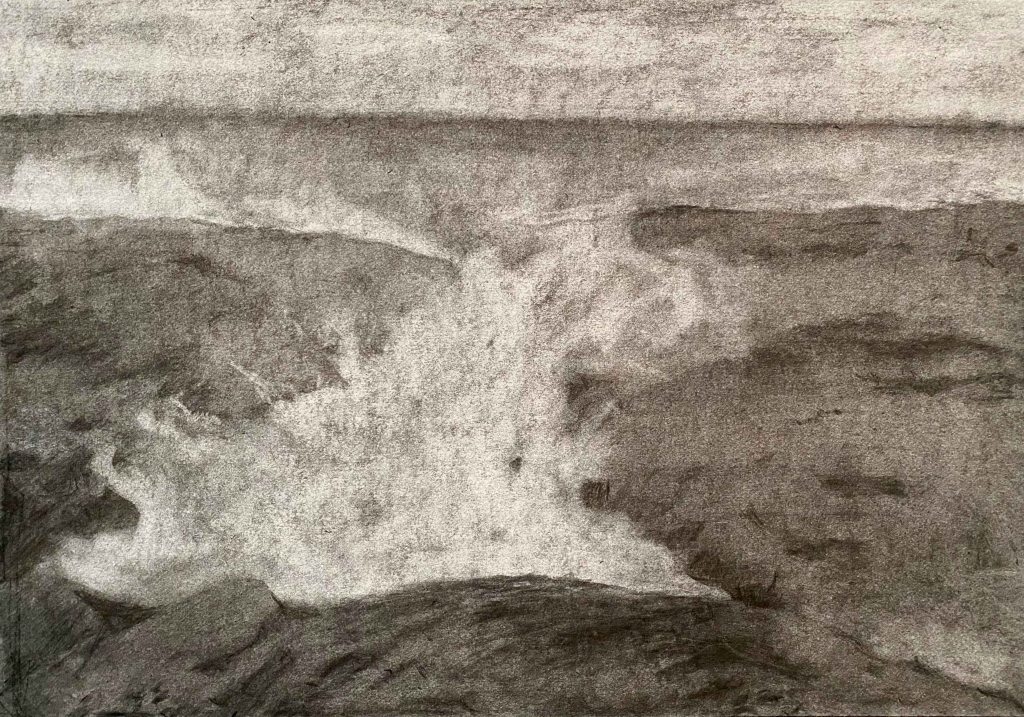
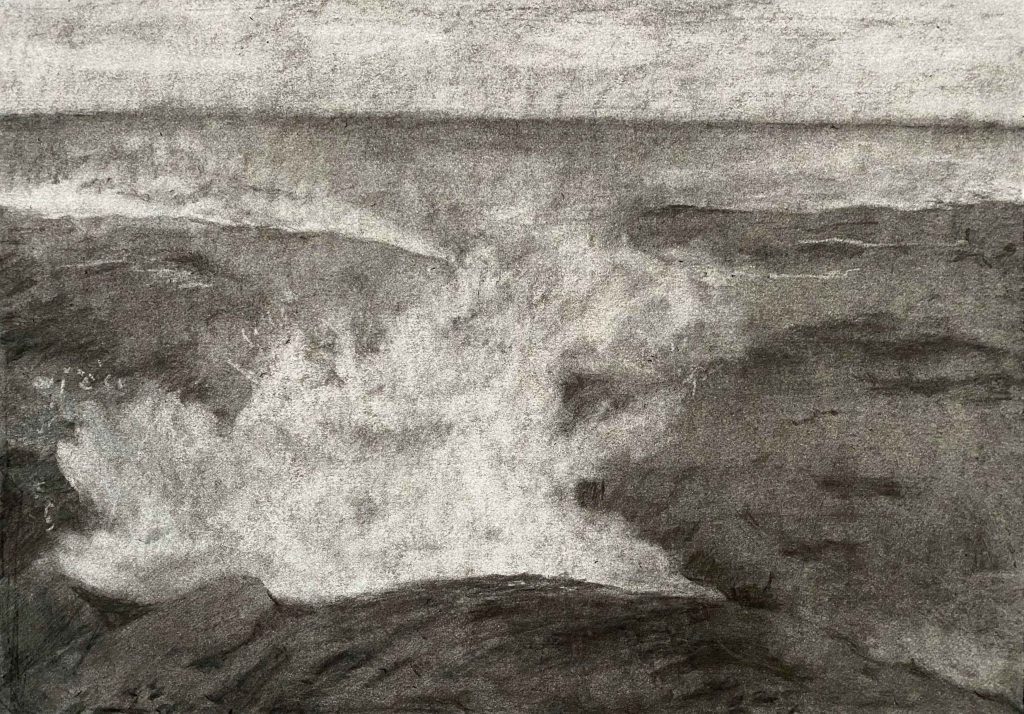
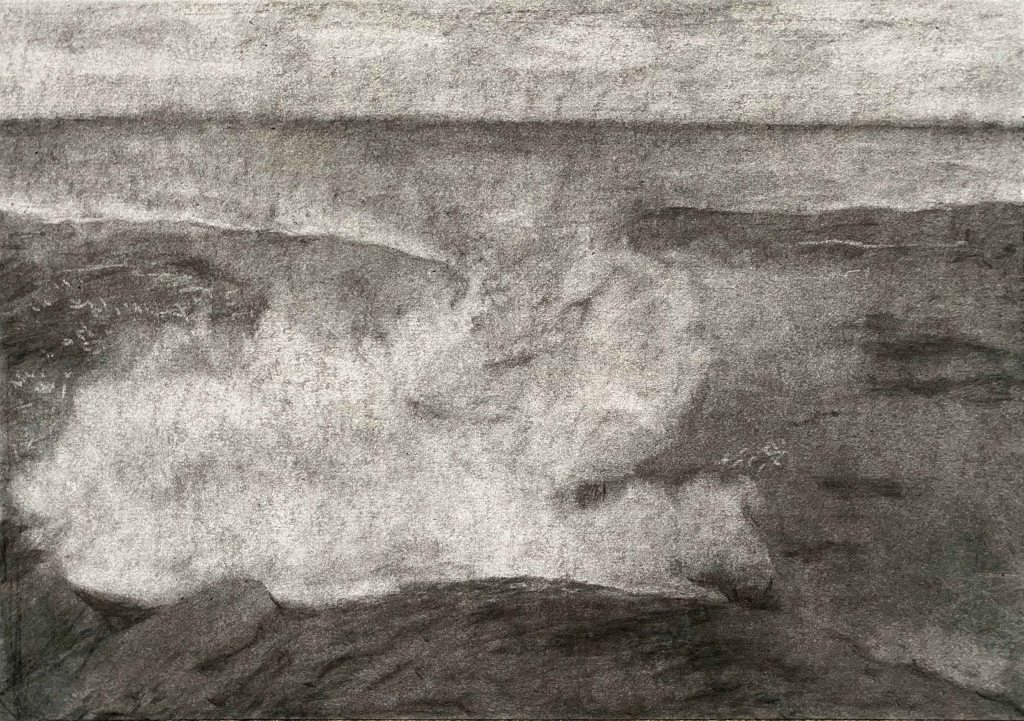
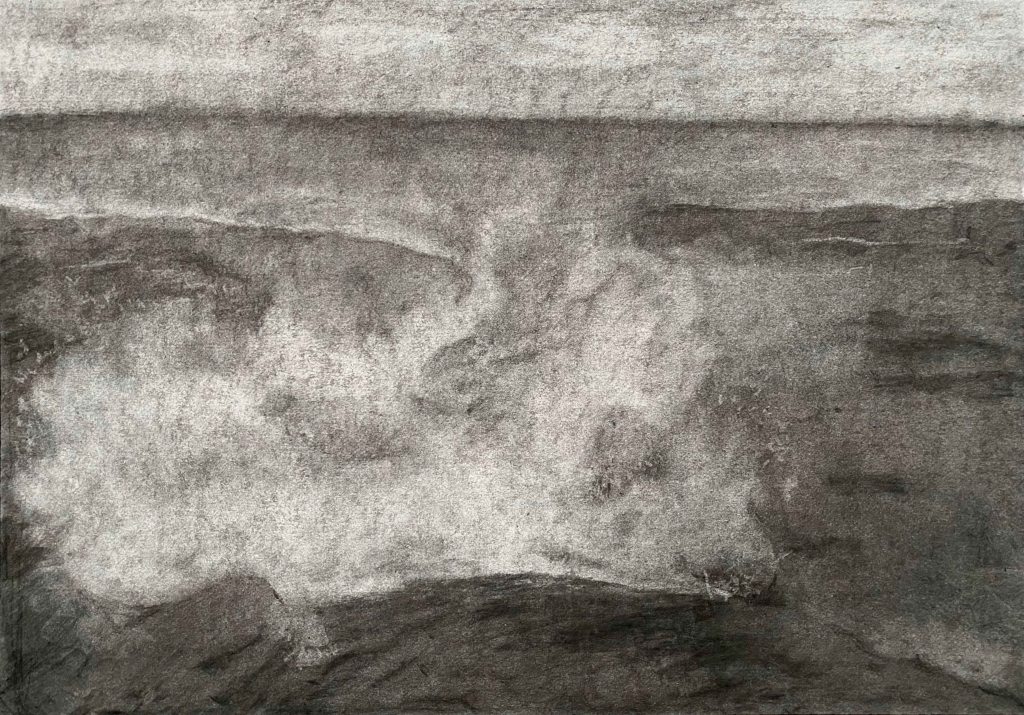
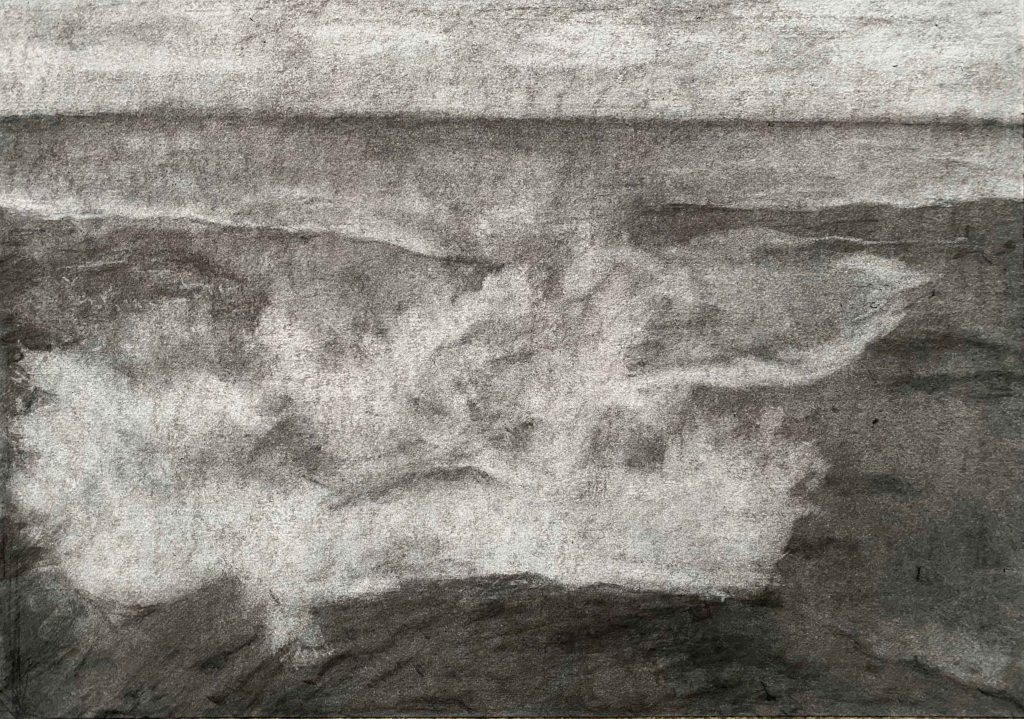
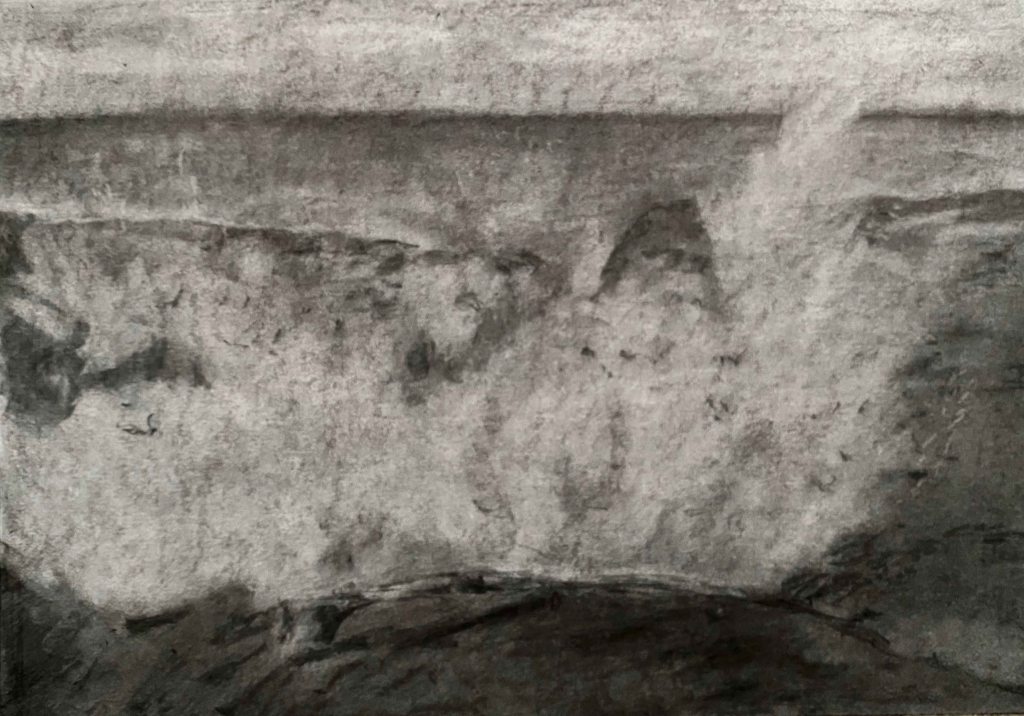
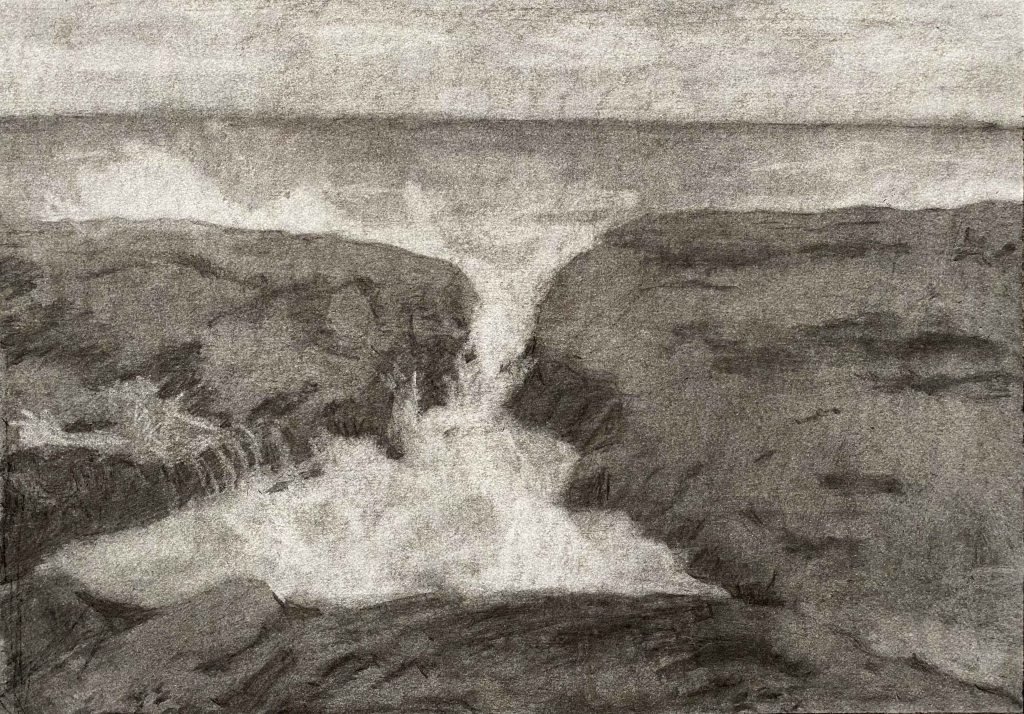
I am really excited to try this out with this project. I am going to use a moving ,crashing wave as my subject, to play with the eraser to create more or less foam on the crest of the wave, without it being a form that has to be too precise to feel right.

I start by trying out different papers:

Canson recycle, Strathmore watercolour 300g and Smooth surface cartridge paper. I had the idea that a rougher paper would give a better tooth and result, but actually the smooth cartridge paper allows for whiter erasing which is a main advantage.

I also try out the different marks my new eraser tools can achieve:

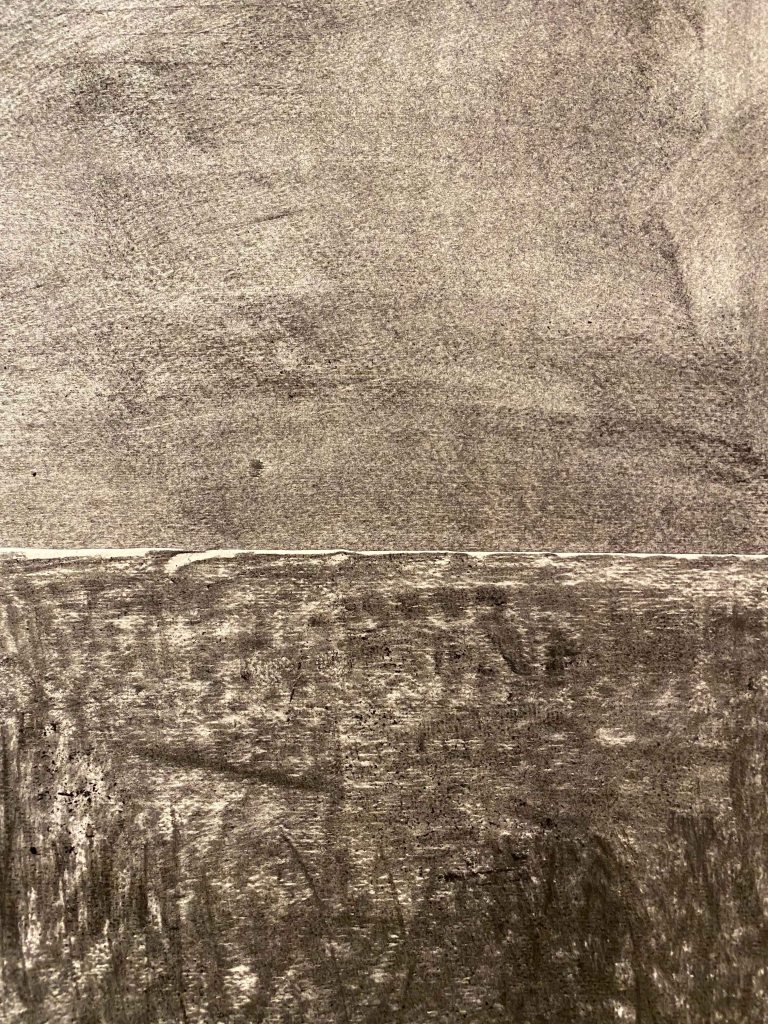
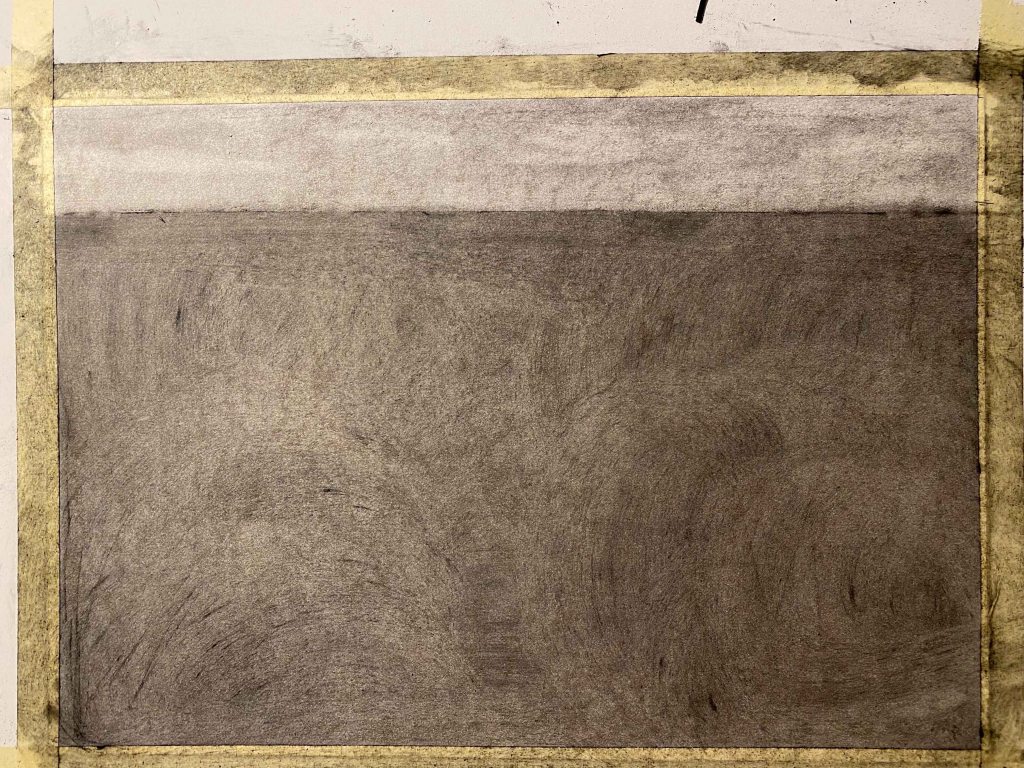
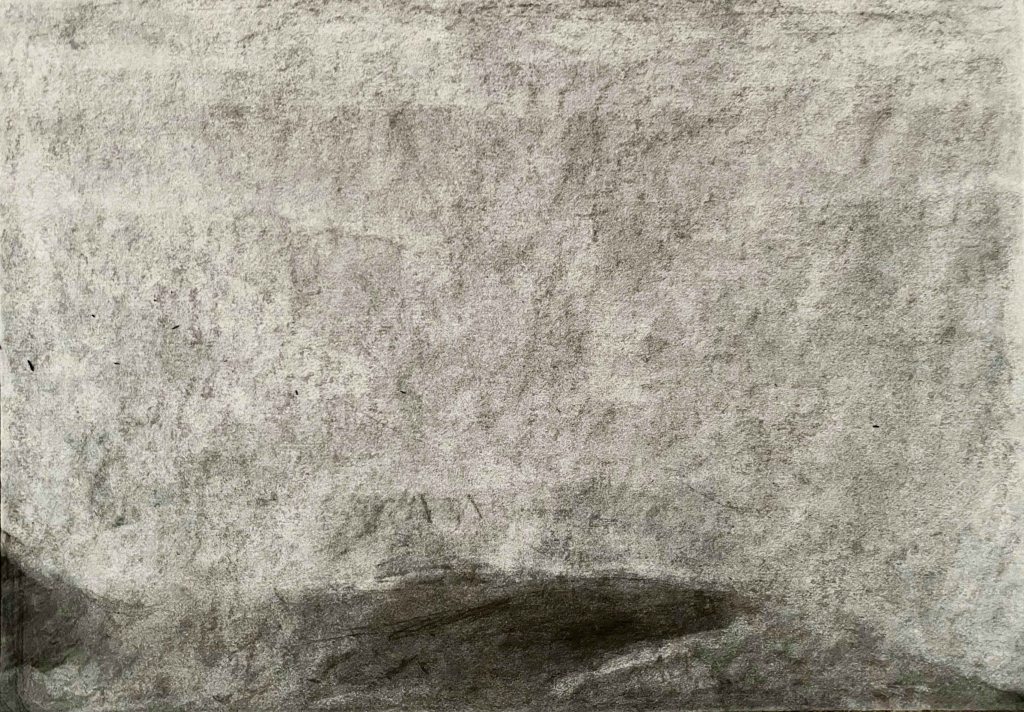
Preparing my smooth cartridge paper A3 with a layer of charcoal and starting to erase the sky:

Here I encounter the problem, that my board under the paper has lines from previous painting that show up as marks through the pressure, that are then not possible to erase- as seen above.

New start on a smooth board:

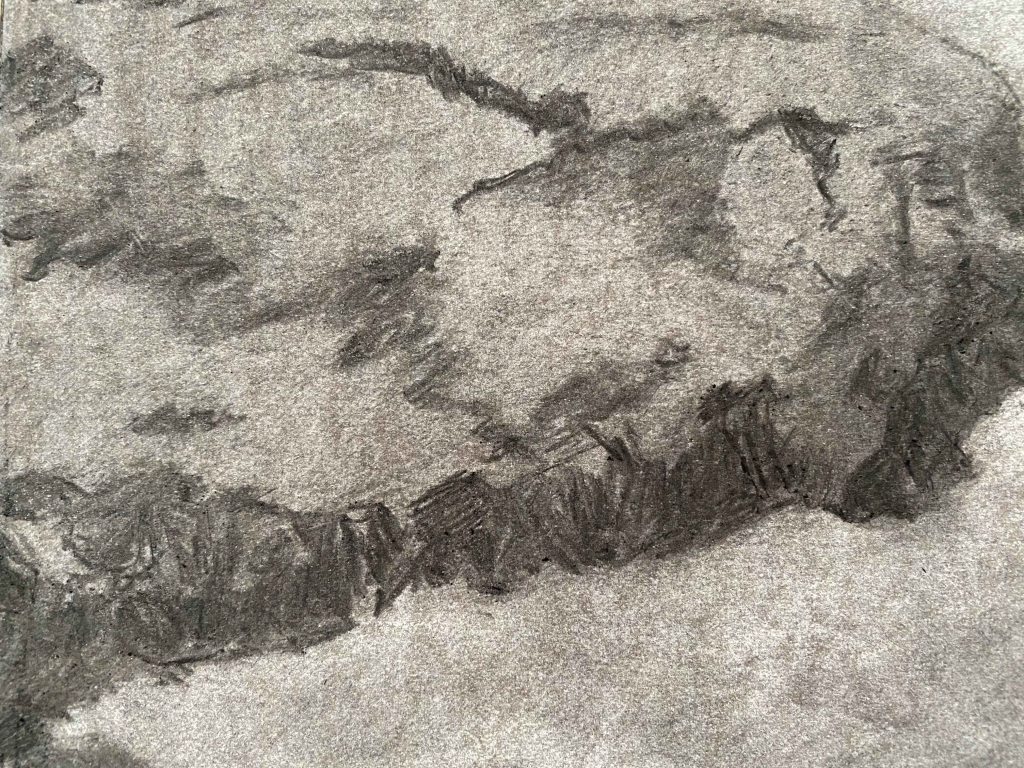
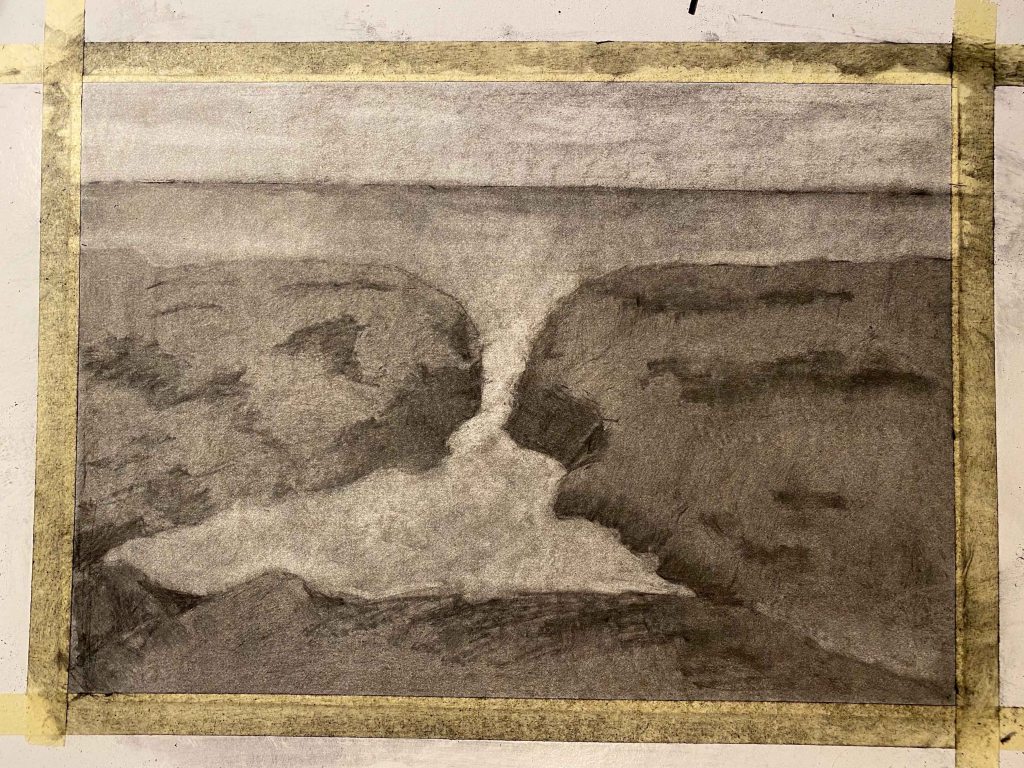
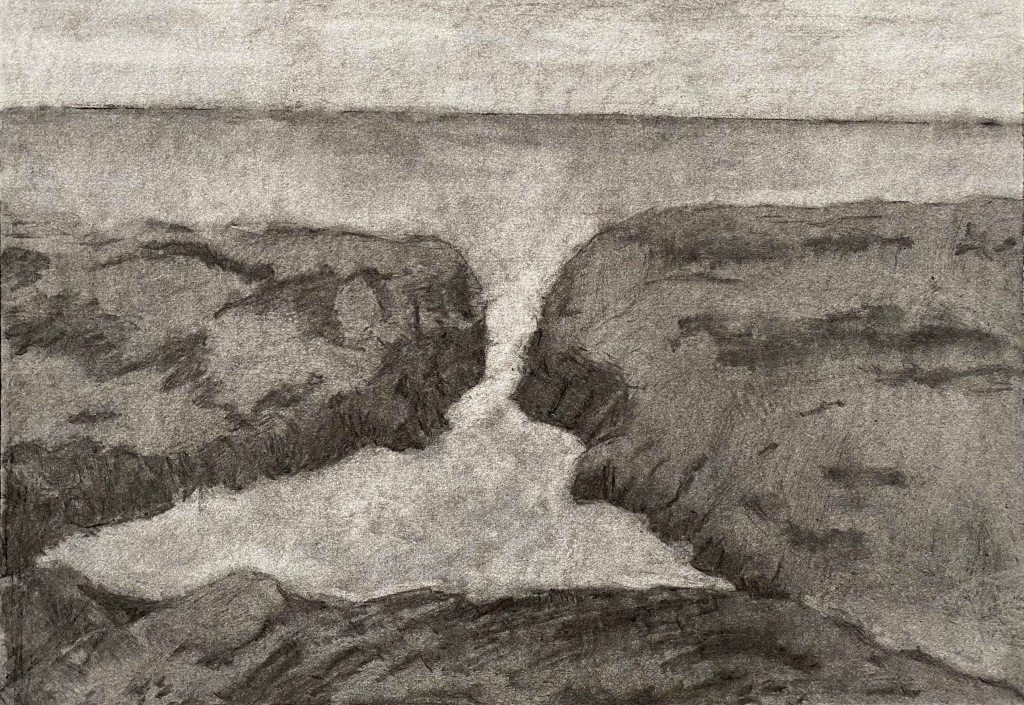
I continue erasing and smudging and filling in til I have a sea landscape as a starting point:

By now it is night and as photography is a main part of this project, I decide to leave the drawing til daylight:

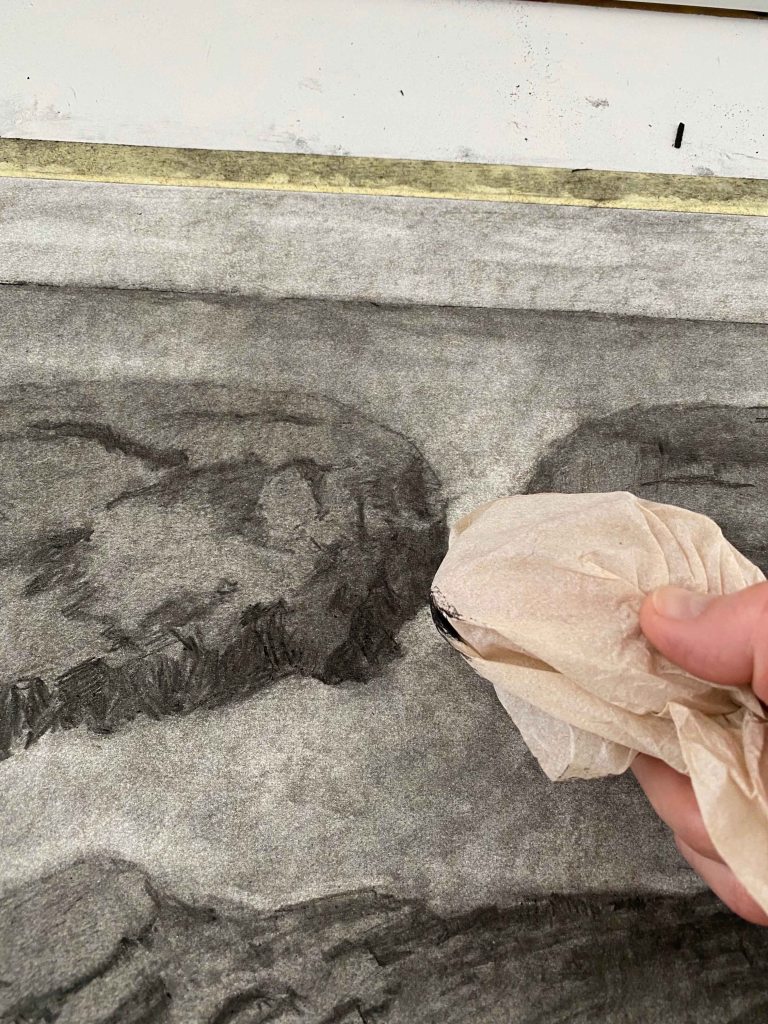
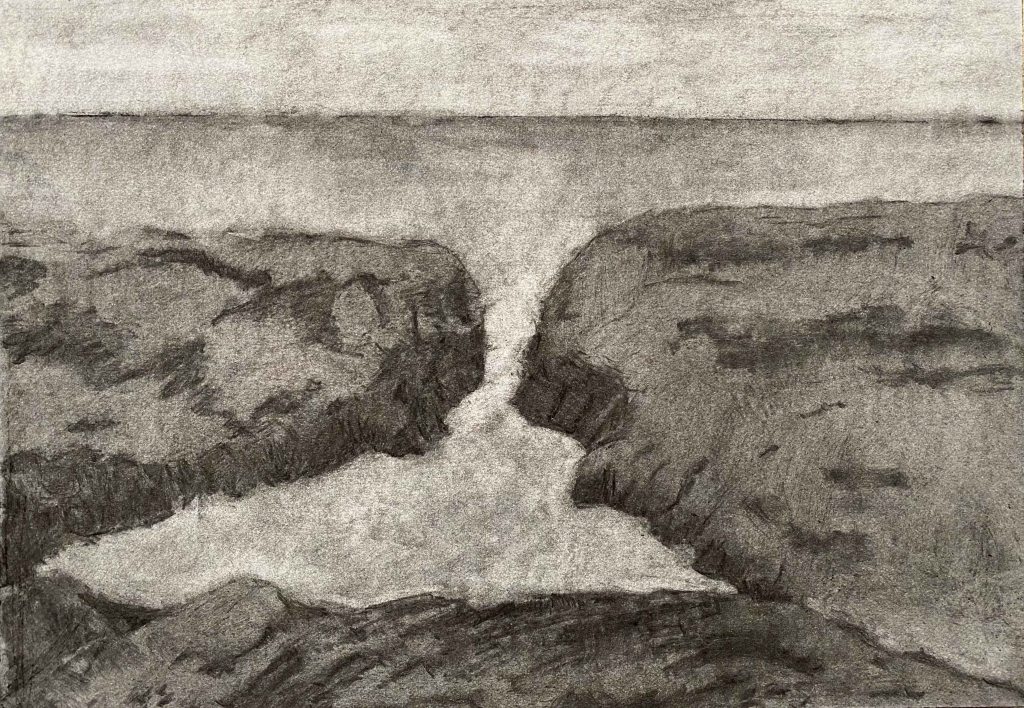
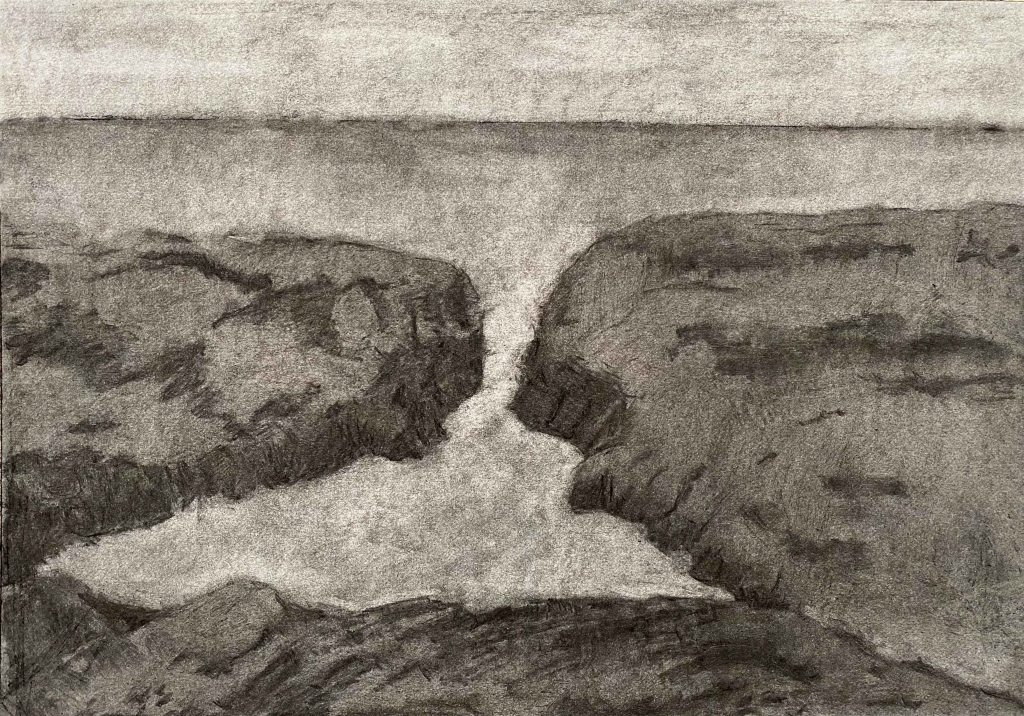
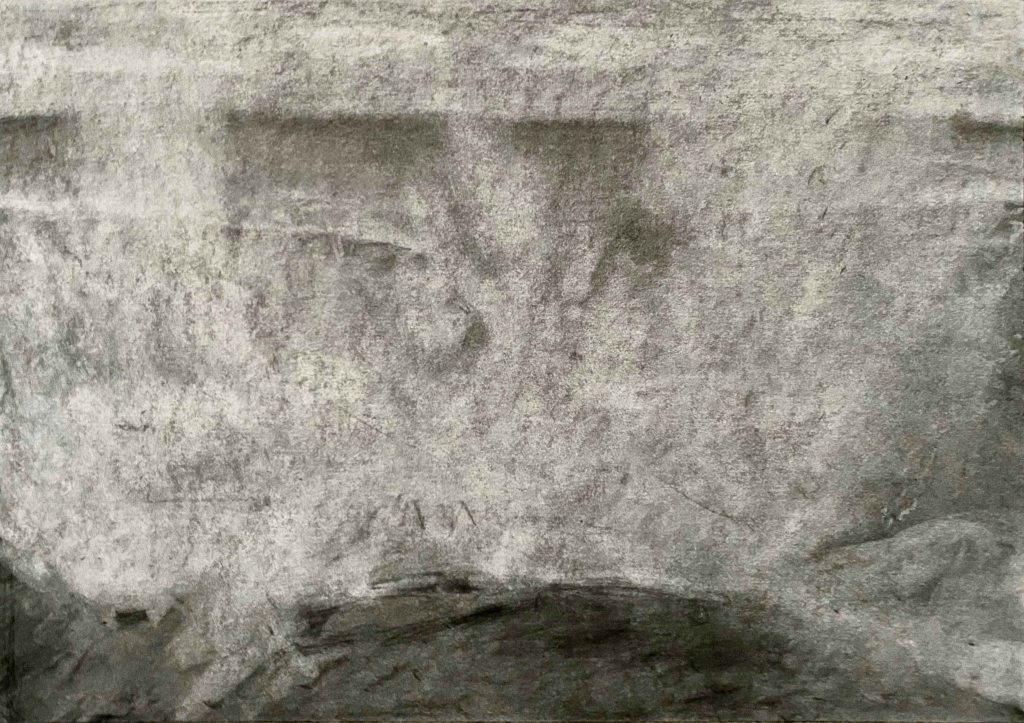
With good light, I start the process of transforming the wave, while taking a total of 27 photos of the change:

Now it is time to use Imovie to try and string these photos together to a stop motion film. I have never done this before and encounter all kinds of technical little hurdles, like a default zoom action between the images. Finally I have a small movie.

For the sound, I am in the city, not at the sea, and this is more a symbolical wave of feeling crushed. I record the sound of the trashtruck coming to pick up the recycled glass, and also the unbearable acoustics of the cafeteria where I often have lunch. I add both soundtracks and play them louder and louder to the increasing of the wave, and finally the silence at the last overwhelming image.

This free WordPress version does not support video, so please follow this link to You tube to see the video:

I am not overly happy with the final result- but I feel thrilled at having rediscovered the pleasure of using charcoal and having tried something very different with this stop motion video. Next time, I definitely need to fix the camera at one place instead of holding it in my hand as to avoid the jumping motions between images.

I think this series of drawings give a good illusion of space and depth, and the stop motion video adds the dimension of time as well.

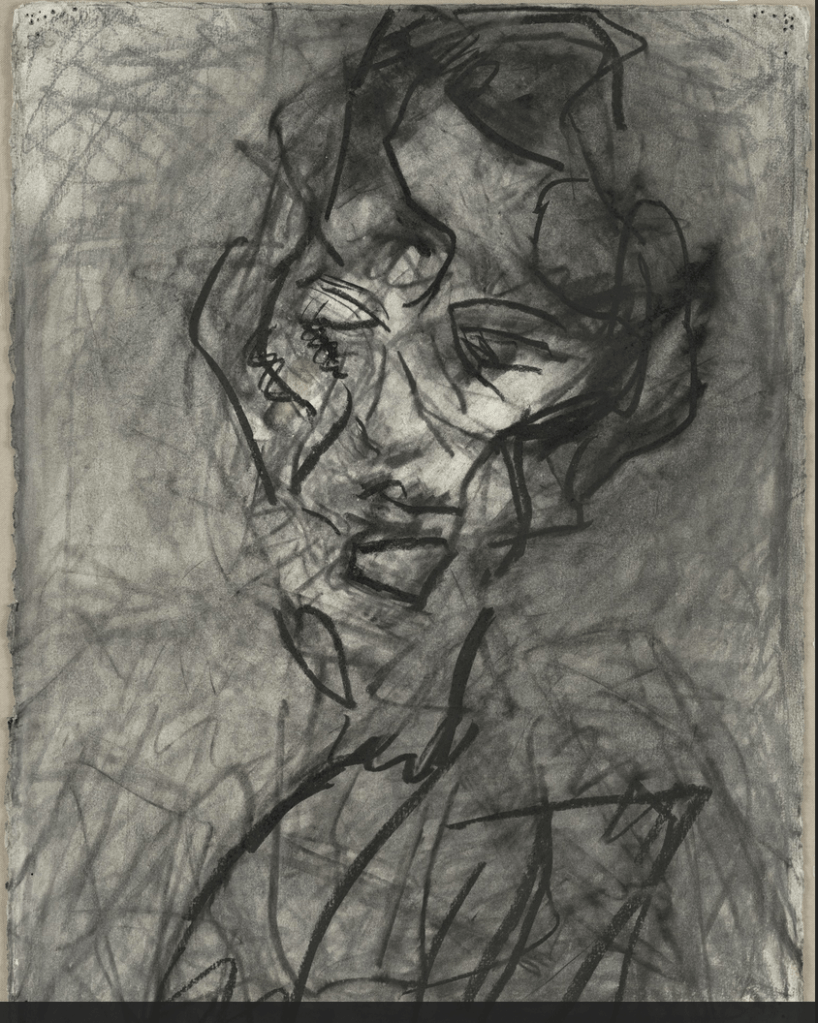
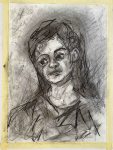
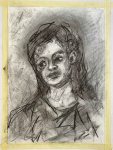
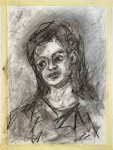
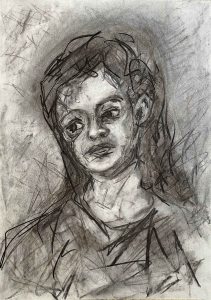
By now, I have come across the charcoal portraits by Frank Auerbach and am absolutely in awe. He documents the many changes and the quest for the perfect form and all the movement in between in one single drawing, sometimes so intensely that the paper rubs off.

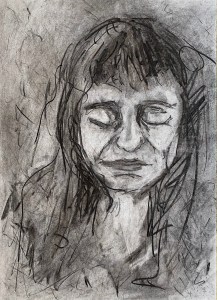
I am particularly fascinated by this portrait of Catherine Lampert with its free squiggles and lines. It conveys a restlessness in capturing the features that I can feel.

(Image from: Moma. 2019. Wwwmomaorg/collection/works/36886. [Online]. [12 February 2020]. Available from: https://www.moma.org/collection/works/36886)

I definitely want to try to draw a portrait inspired by this drawing.

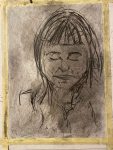
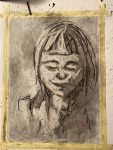
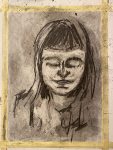
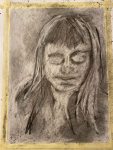
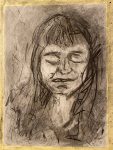
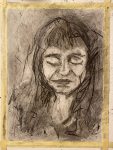
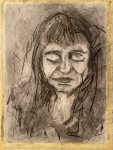
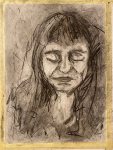
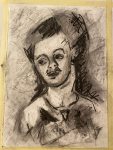
I start by covering the Winsor&Newton Smooth Surface Cartridge Paper in A3 size with a layer of charcoal, and then follow a long process of adding and erasing. I am drawing an imaginary portrait with closed eyes .

This is the final portrait in daylight:

This portrait still lacks some depth, but I am happy with the free marks inspired by Auerbach. I need to try this once more though, with a head turned to the side.

This is the process this time:

This is the final drawing “Beatrice”A3:

This time, there is a better sense of depth and I like the expression and tilt of the head and how the shape sits in the surrounding space. It is still very controlled and boring compared to Auerbachs portraits. It has helped me take one more small step towards loosening up the markmaking though.

Using charcoal in this way has helped me overcoming relying on outline instead of tone and has helped me rediscover this beautiful, versatile medium.


The parallel project

I am most interested in painting and drawing stories.

For POP 1 , I accompanied the emotional and physical changes of my daughter when she went through the different stages of an unplanned teenage pregnancy.


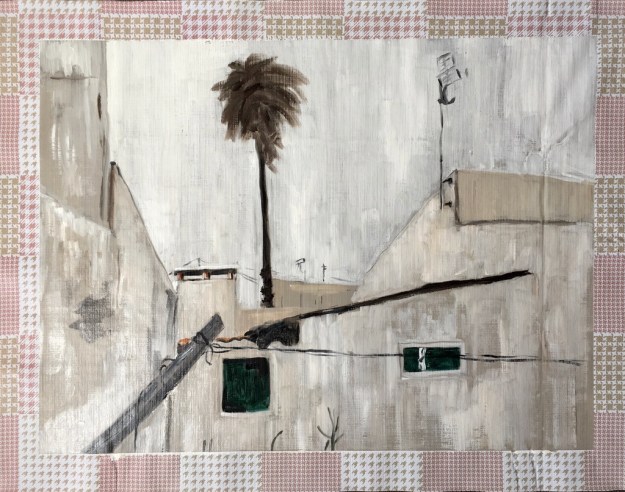
For UPM, I portrayed the village in the South of Portugal where we spent a few months per year, using locally found materials as my supports.

And presented it in the backyard:


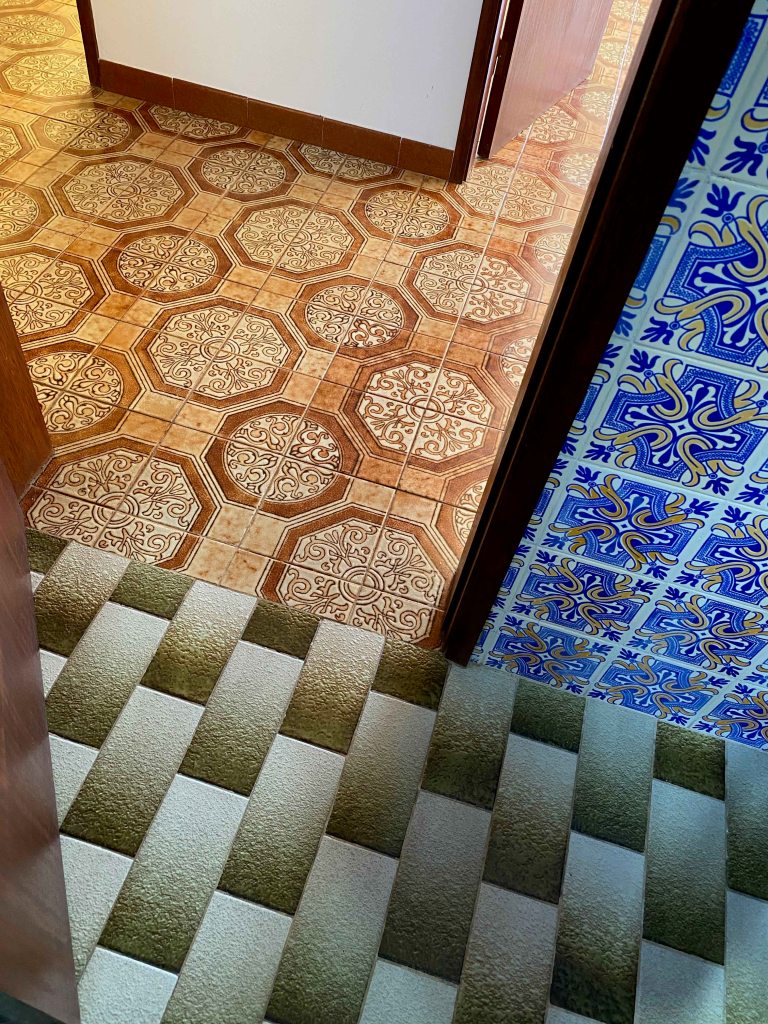
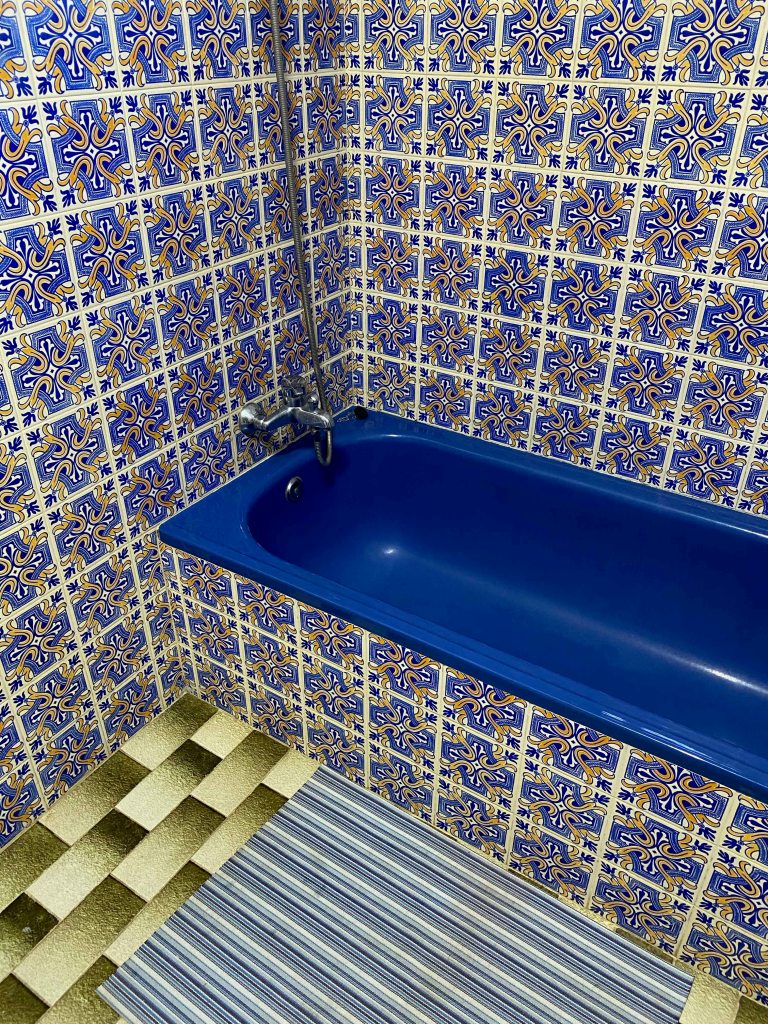
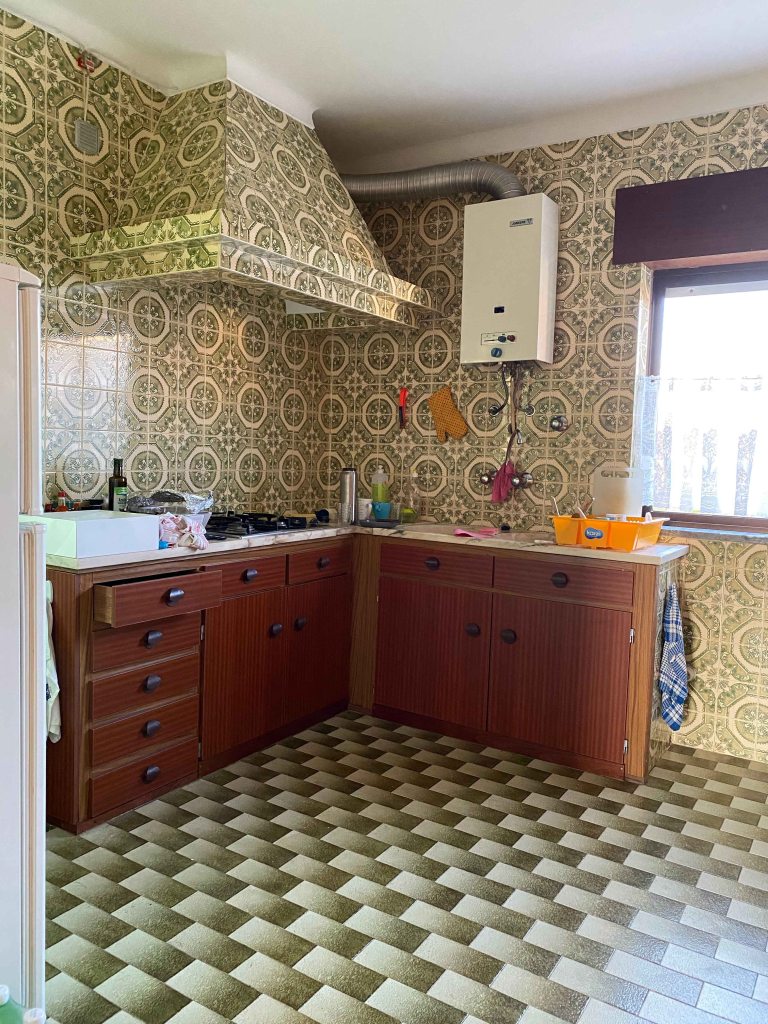
We have just bought a house in this same village and are in the process of renovating it totally. This house is so terribly ugly that it becomes quite fascinating- with an excessive use of tiles in various patterns contrasting with stark whitewashed walls and strange details.

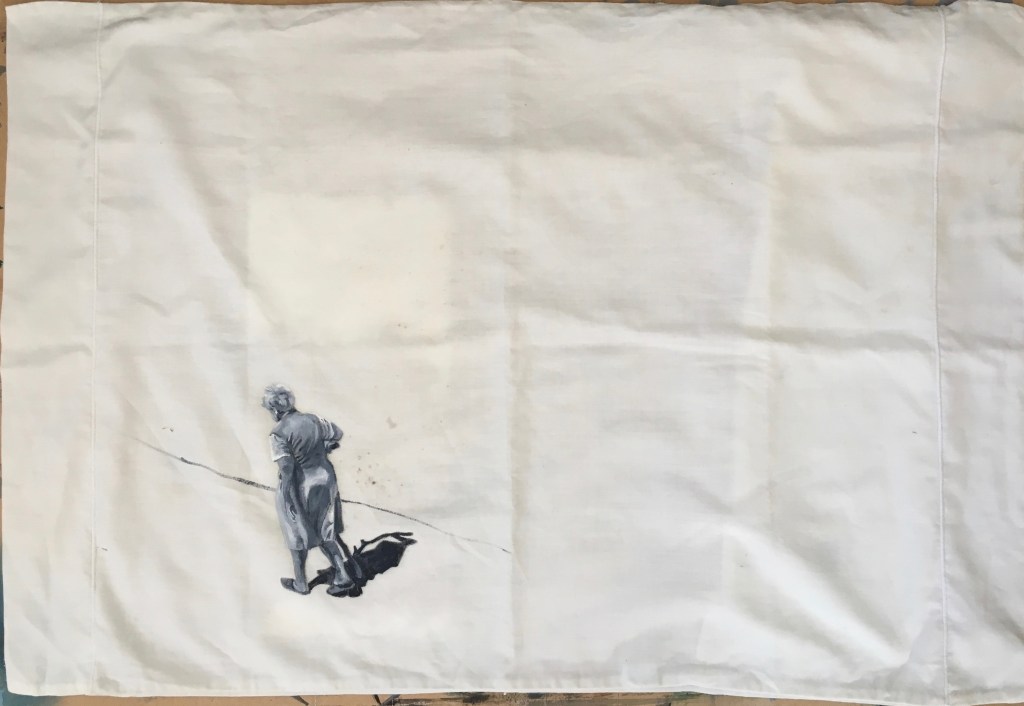
Our neighbour- Dona Maria Jose that I also painted on a pillow cover for UPM, is a well of information and stories about the village and its quirky inhabitants.


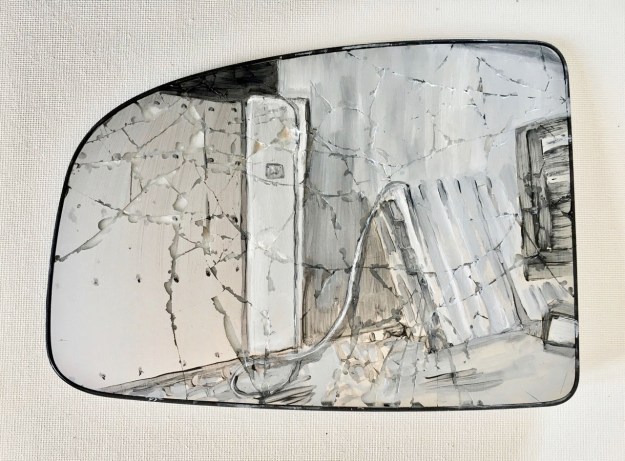
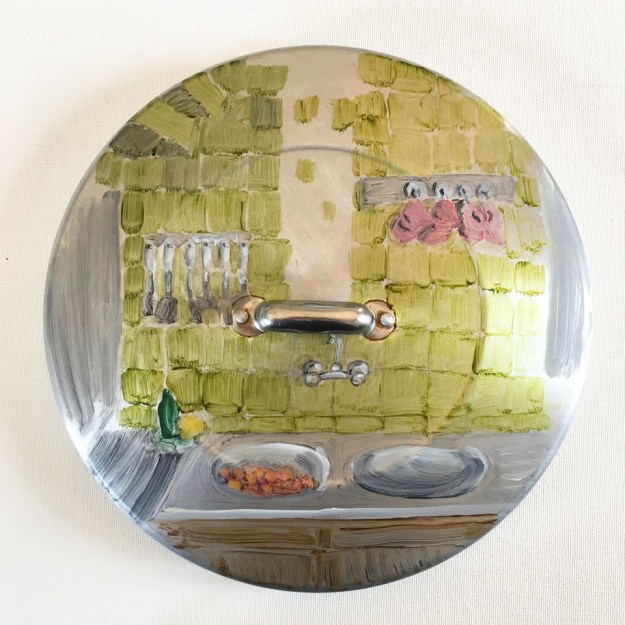
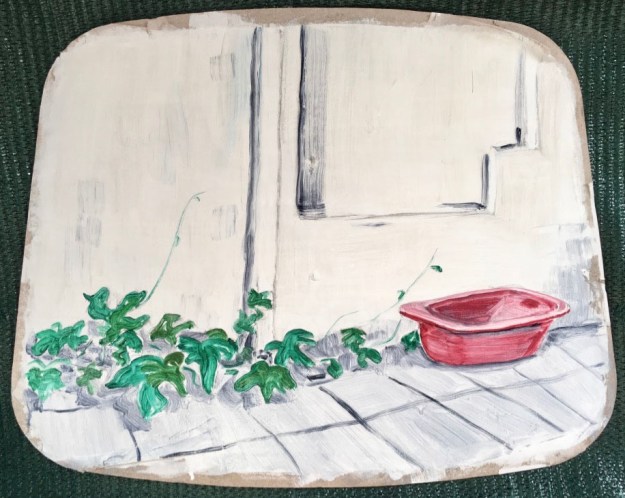
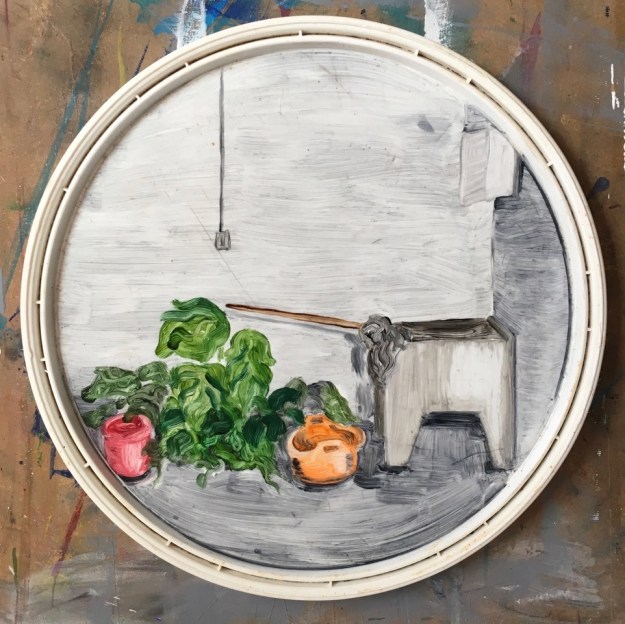
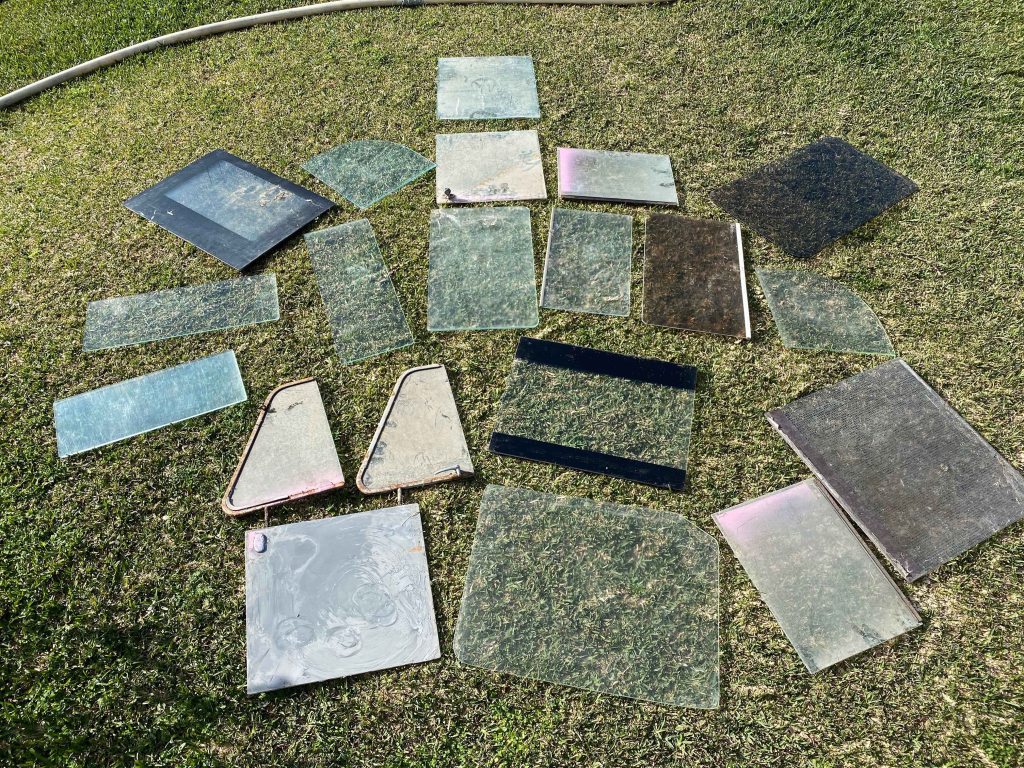
I would like to paint some glimpses of these sometimes tragic, sometimes surreal stories. I would like to use various strange objects that have been left here in the house and around as supports- like lace curtains or vases or lamp shades. I also found an incredible collection of various glass and would like to experiment with painting on them.

Some items might be too heavy or bulky to send and could maybe be included as photos?

I am not sure how yet, but it would be interesting to pick up the patterns of all the tiles used here too, before they will be changed with the renovation. For this project, I would focus more on the figures and their emotions than on things, but use the objects to express the stories.

I am curious what my tutor Emma Drye thinks of these first ideas for a parallel project and how this can develop.

ASSIGNMENT 1

For your first assignment, review your sketchbooks and project work so far. Think about all you’ve learned about scale, cropping, selection, flexibility and judgment and make a decision about which area you’d like to develop for your assignment piece. This could result in one drawing or a series of drawings. Your subject can be anything you like but, whatever you choose, the relationships within your drawing(s) should set up an intriguing and engaging composition.

I start by reviewing some drawings from the projects of this chapter.

1.1 Observational drawing

1.2 Using space

1.3 Changing the scale

1.4 The human form

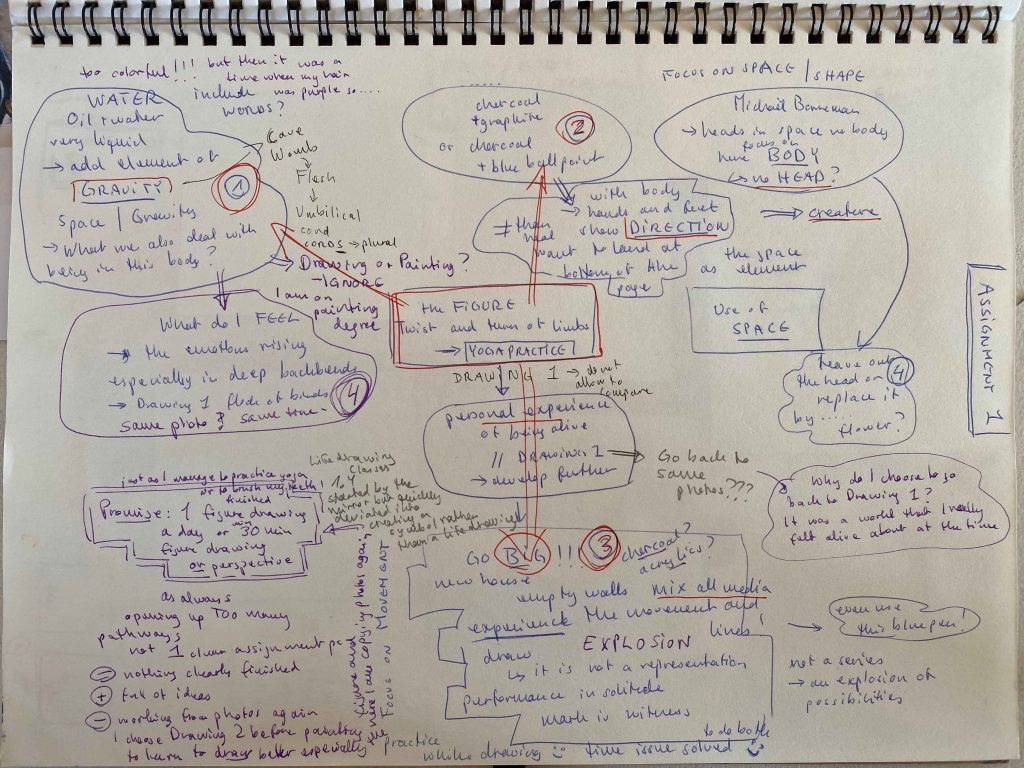
I am very interested in learning to draw and paint the human form and choose to continue exploring this for the first assignment. I am immediately exploding with ideas about where this could go:

For Part 5 of Drawing 1, I explored figure drawing through yoga poses, focusing on how the poses feel while practicing. I produced some mixed media drawings through painting my hands and feet while moving on yogamat sized paper and a concertina book and still remember this as a work I really felt alive about at the time. I practice yoga (almost) daily and have so for the last 15 years, so it is very linked to my experience of the body. For this first assignment of Drawing 2, I want to reconnect to that last of Drawing 1 and bring it further ( and will not even allow my mind to compare or tell me that what I did years ago was better).

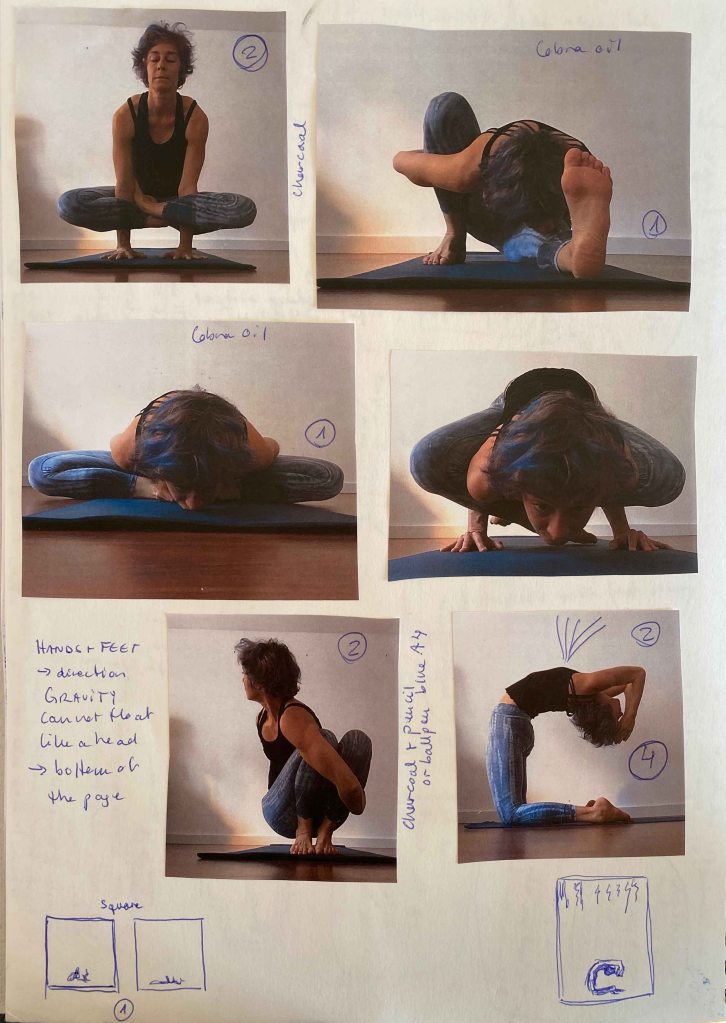
I start by looking for photos of myself practicing and although they are a few years old, they are the best clear photos I will use:

In several of the ideas I have on the Assignment map, I see these figures surrounded by a lot of space. I am thinking of the work by Matthew Carr that I saw during a visit to the National Portrait Gallery in London in 2017:

IMG_2911

I really like the very special composition, with the tiny heads detached from any body or surrounding, floating on the grey page.

(Visit National portrait Gallery August 2017 , my photo)

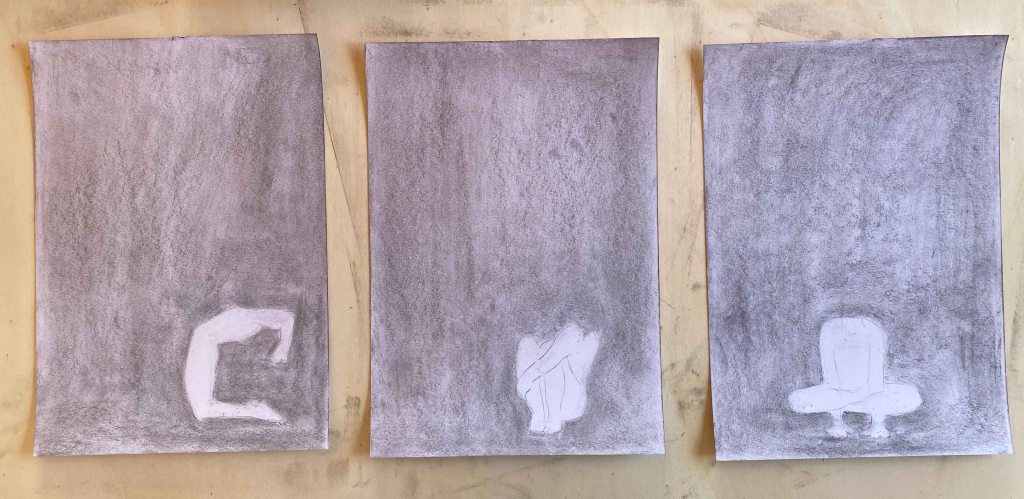
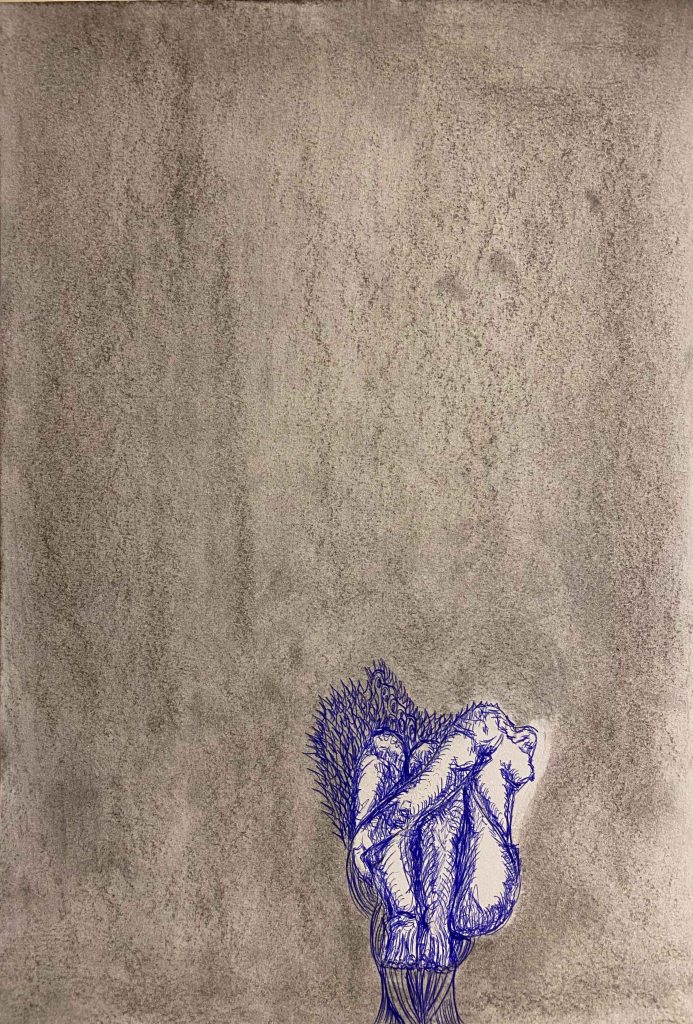
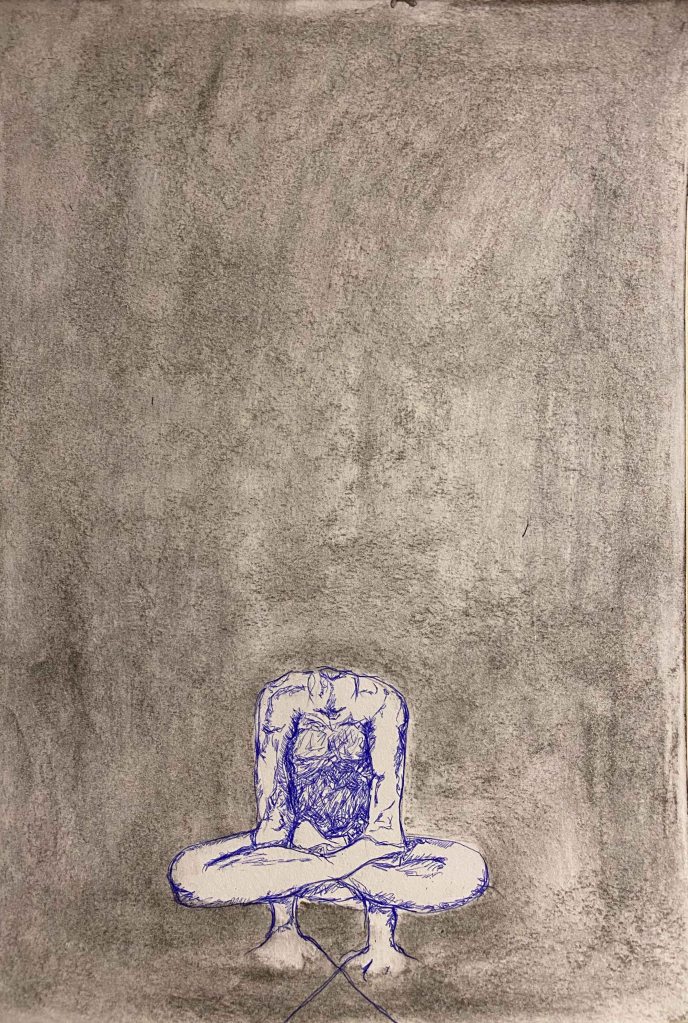
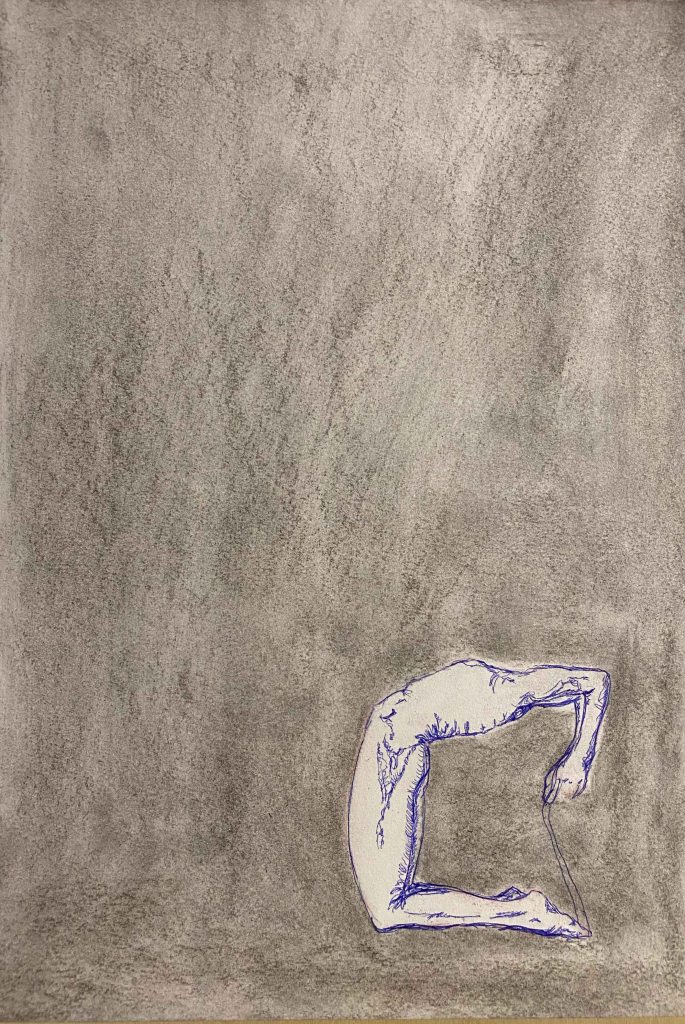
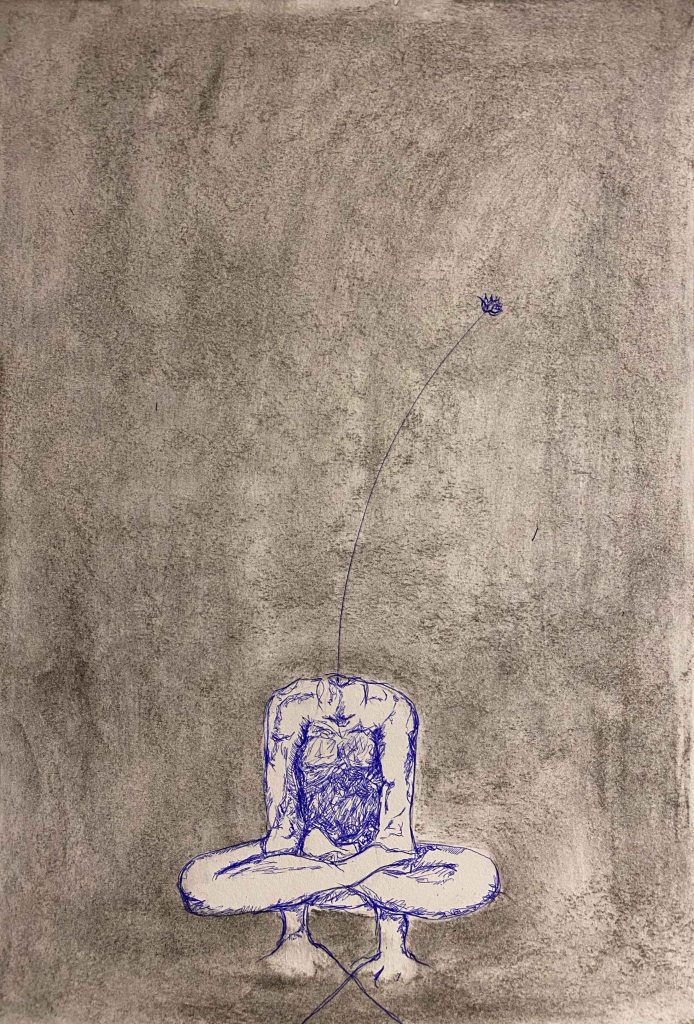
A body, hands and feet connected in a pose, contrary to a head, immediately show direction though and want to land at the bottom of the page. I reverse the idea of Matthew Carr by drawing three bodies without heads. I start with a smeared charcoal background:

I will admit that I had the idea to draw the figures in a detailed realistic graphite drawing but after much erasing switched to a blue ballpoint pen and a free doodle drawing:

And then of course I couldn’t resist to add a flower poking out :

I was aiming for surreal and strange, expressing the mix of deep and weird feelings arising, but I don’t feel these drawings work yet.

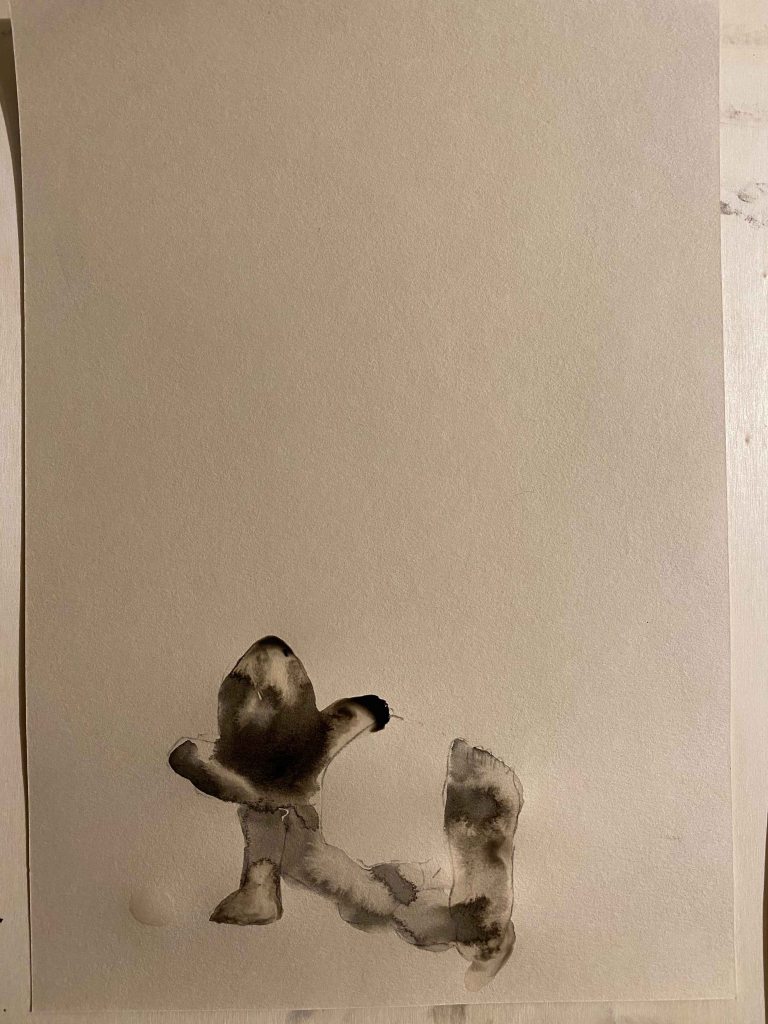
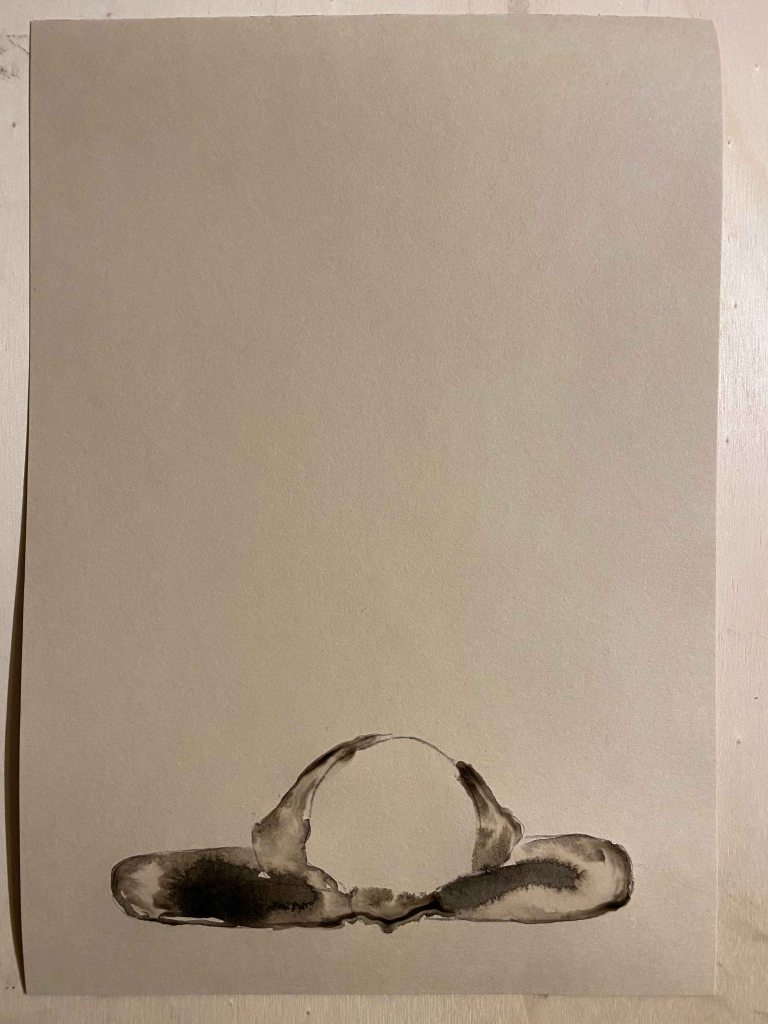
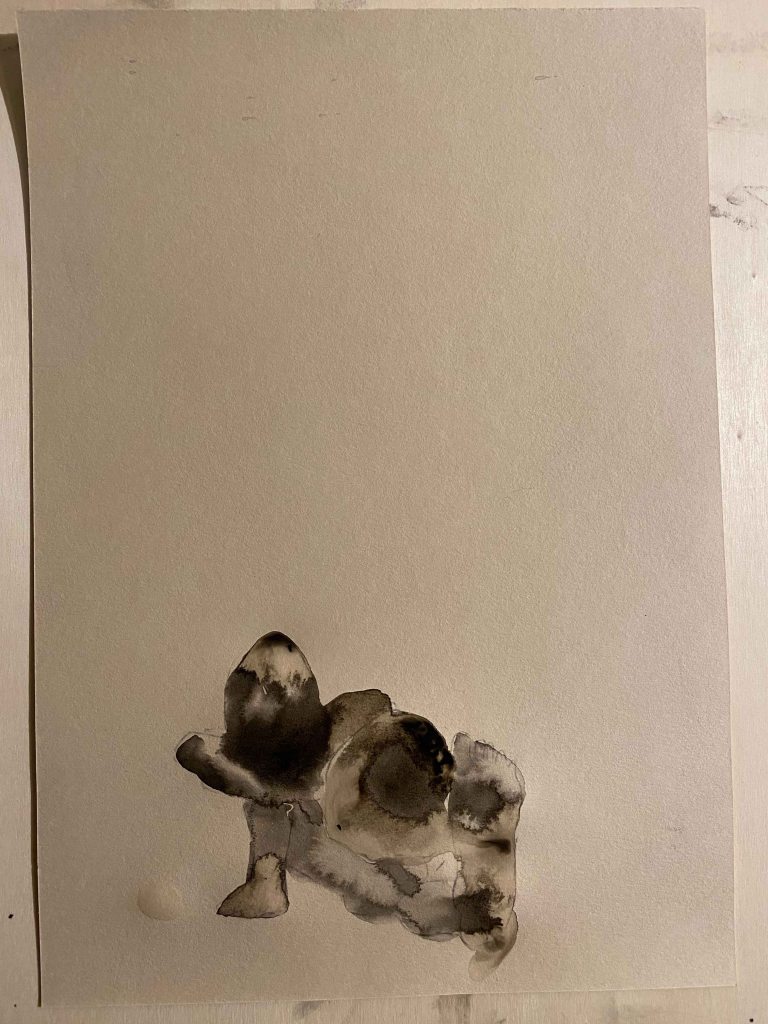
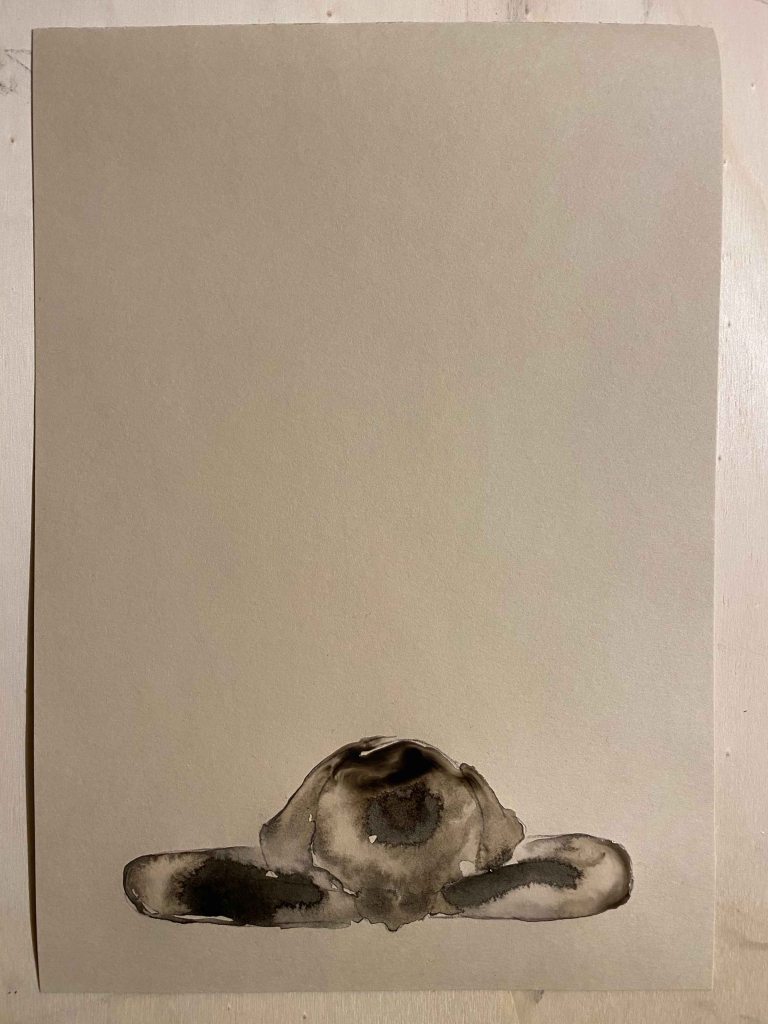
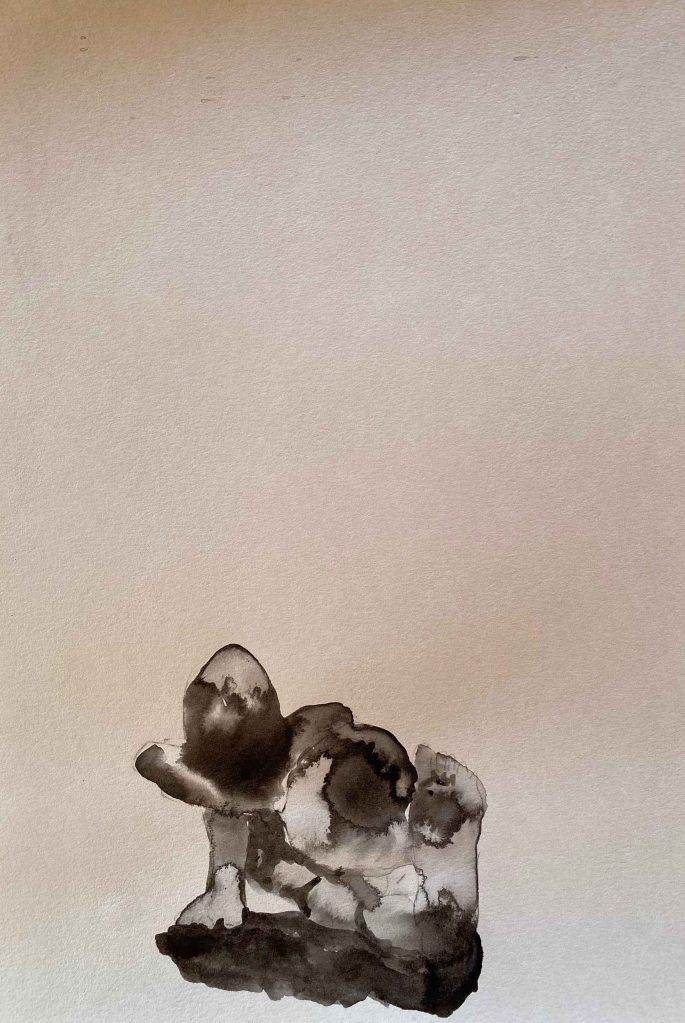
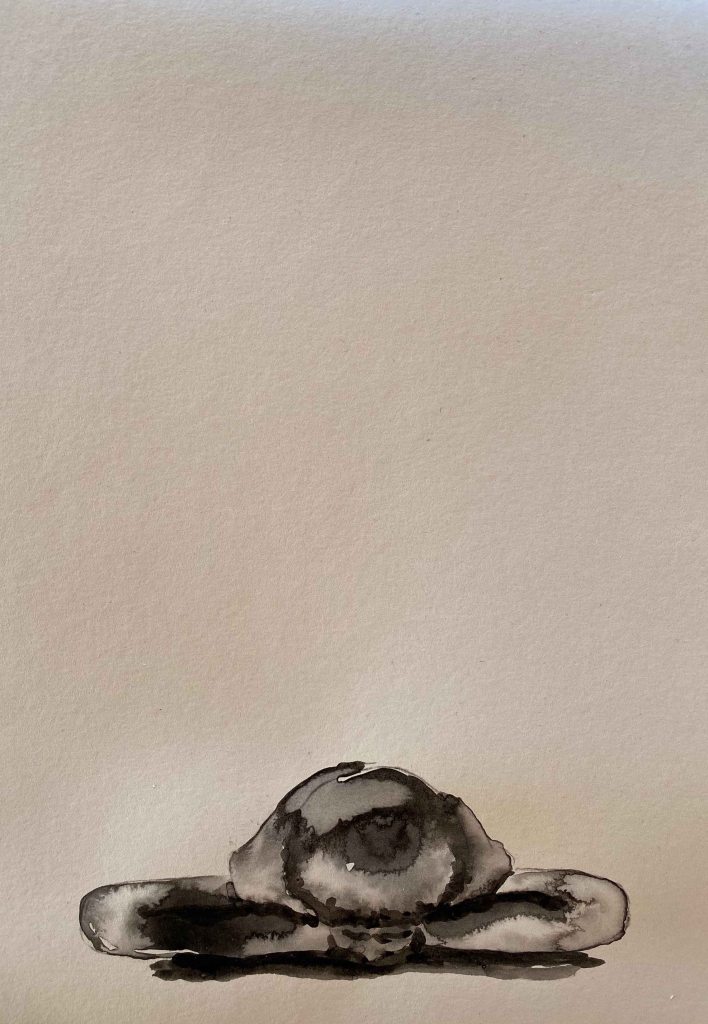
I choose two other poses that are even more anchored to the ground with a heavy sense of gravity from my photos and explore them in a similar composition on the page but with a different media- Indian ink. I am using a nature beige coloured A4 paper. I first draw the figures in water only with a large brush and then add small dots of ink:

I need to add some dark lines to make the drawings more readable:

Within the figure, I like the contradiction between the complexity of the tones and shapes that form in the puddles with the simplicity of the whole. I also like the contrasts here of the dark, heavy figure and the vast emptiness of the surrounding that form an interesting tension. I think using a white paper would have added a sense of void around the figure, while the beige tone is “something” and reminiscent of skin. I am unsure through if you can see what is drawn here if you are not as familiar with the figure as I am.

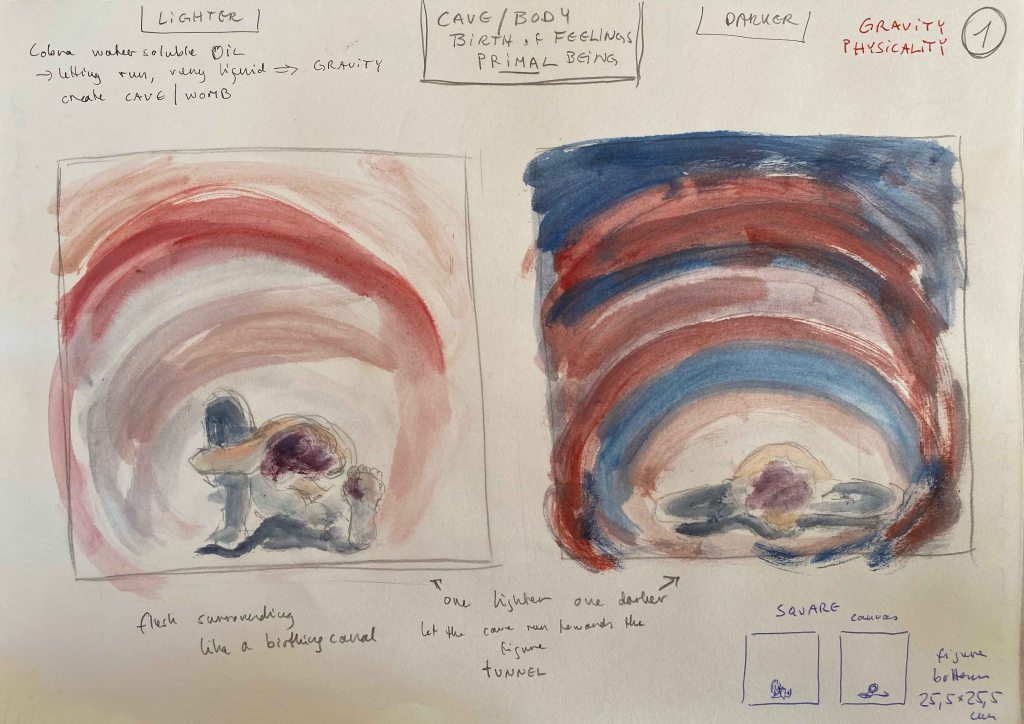
Both postures is a merging in towards my own center, and I want to draw this by placing the figures in a cave, or a womb (a birthing canal) and use flesh colours . After some experimenting in my A4 sketchbook, I decide to use a square format:

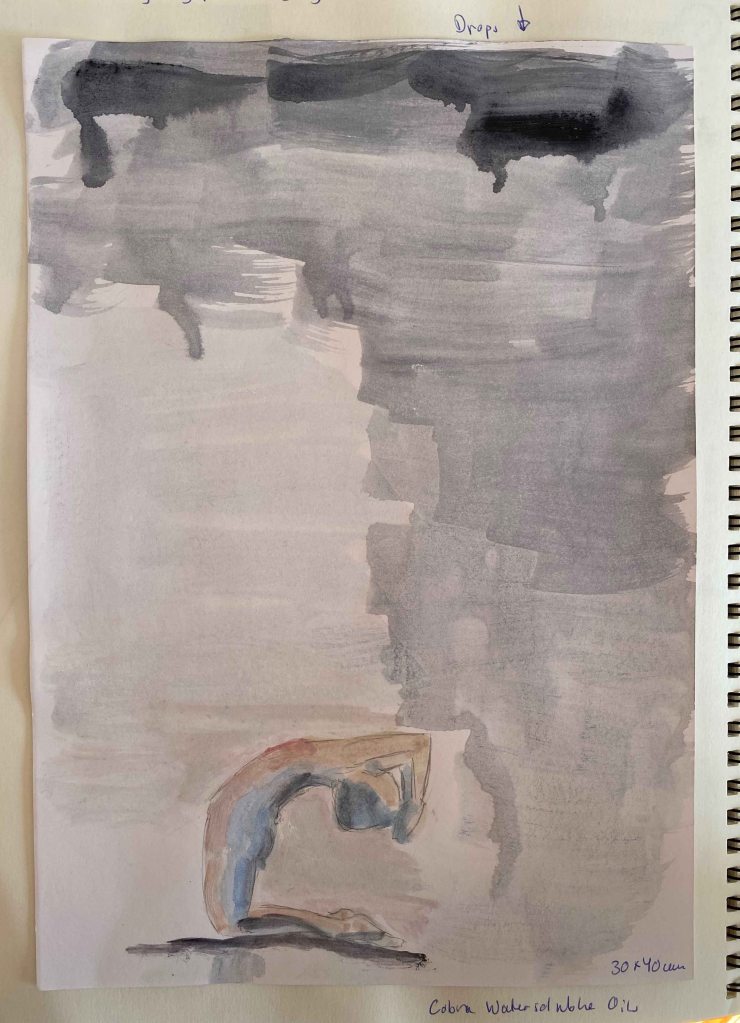
I have been experimenting with Cobra watersoluble oilpaints lately, diluting them too much and letting drops flow and will try this here – letting the element of the drops become one more element of gravity.

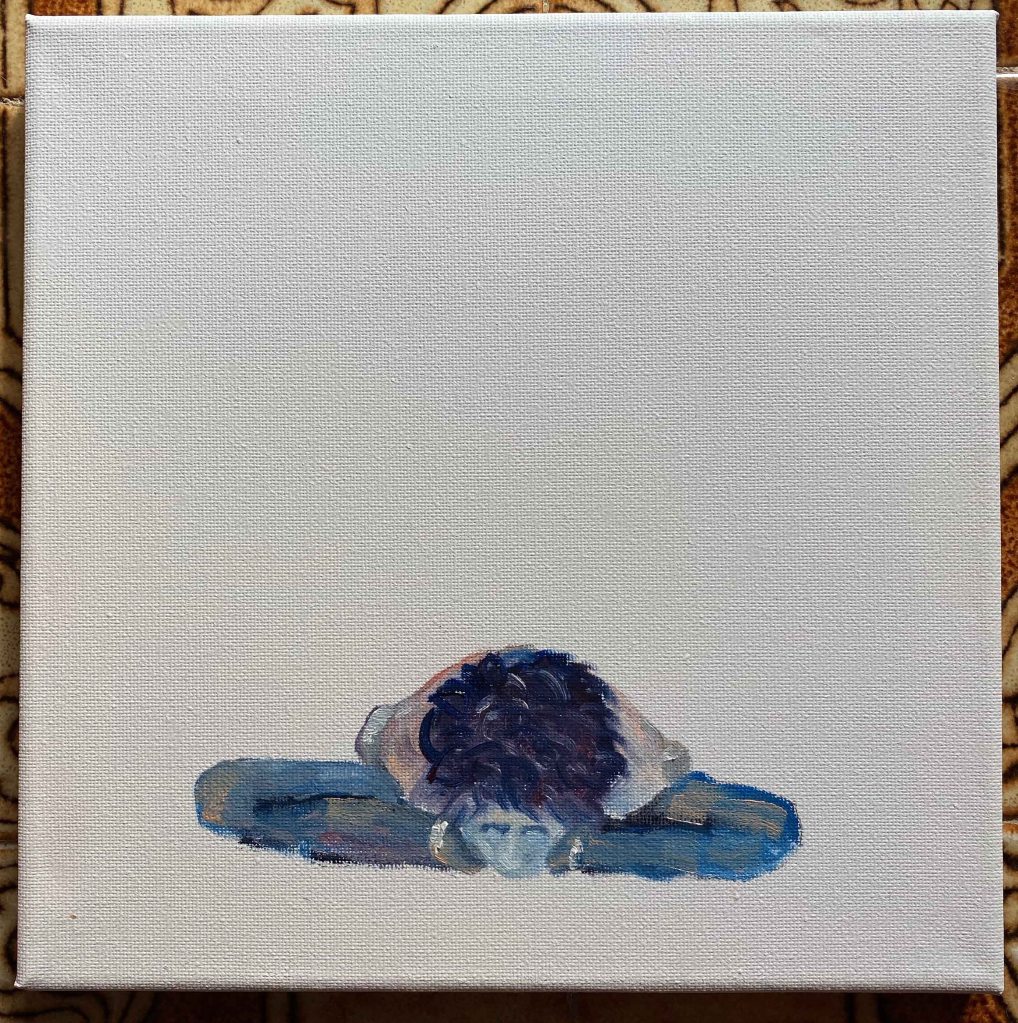
I start by painting the figures on a small square canvas 25,5×25,5 cm:

Then develop the cave/flesh/womb around, diluting the oil paints strongly and using a larger brush in large motions.

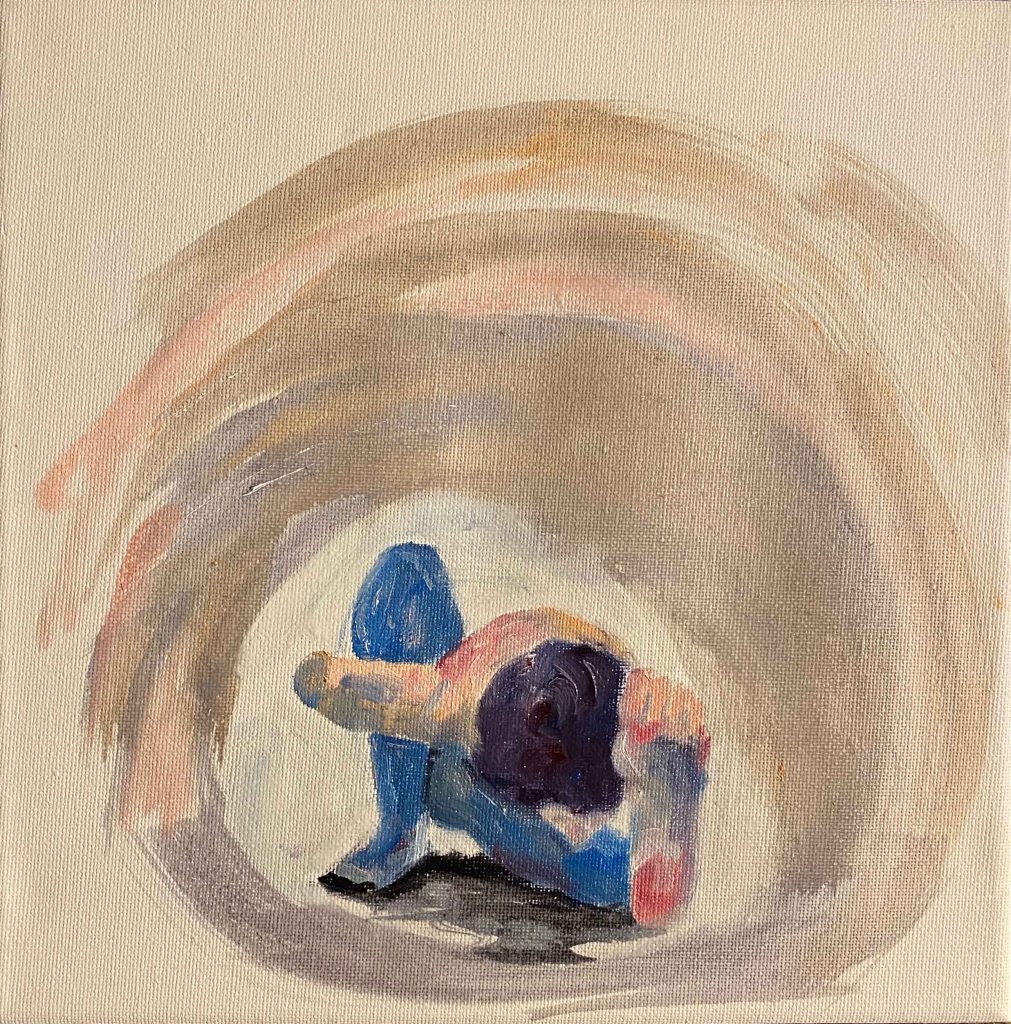
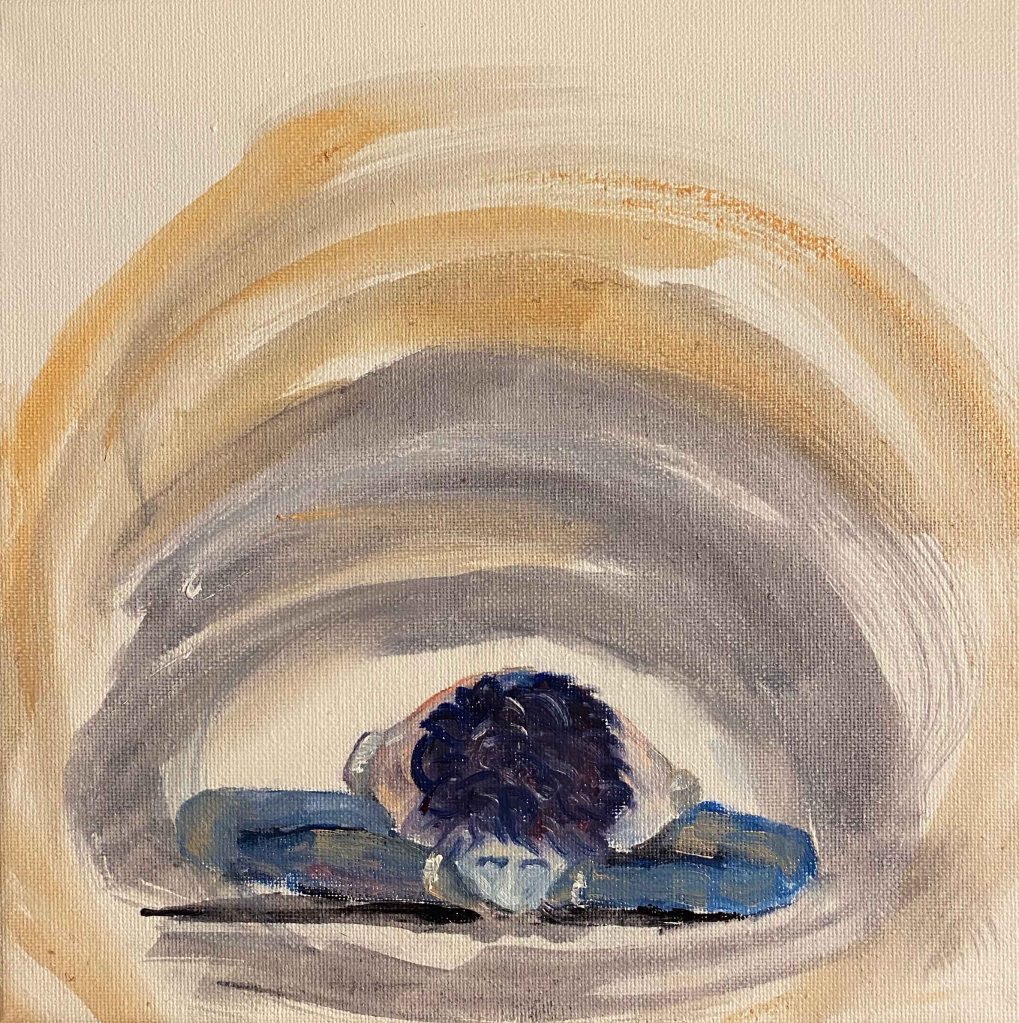
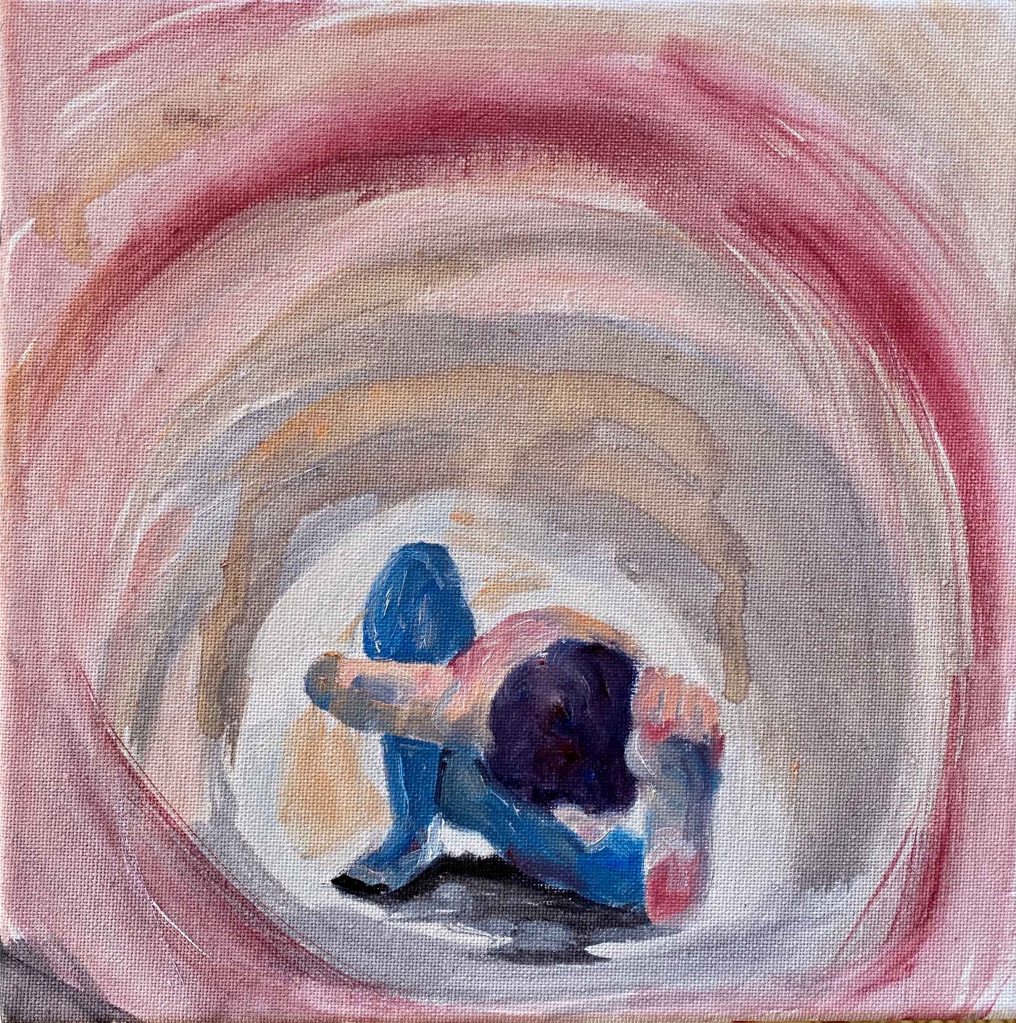
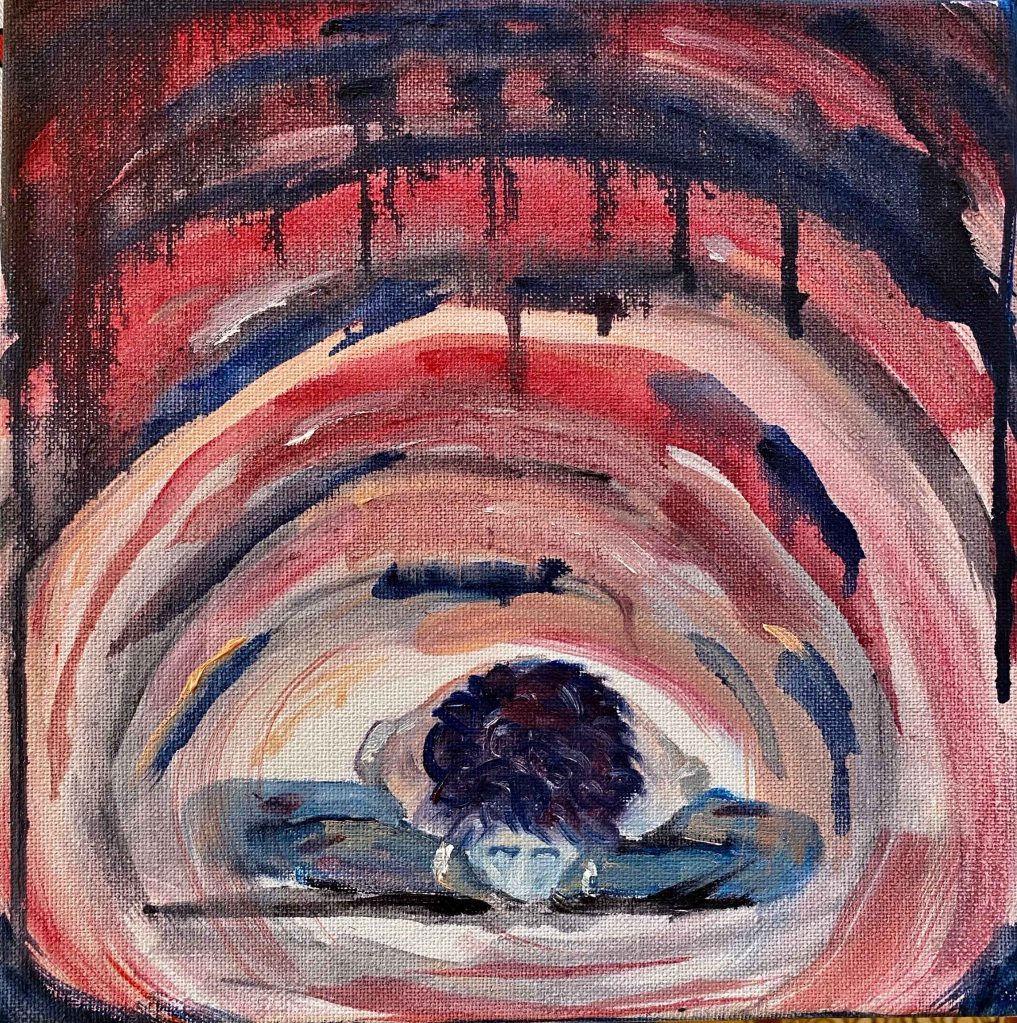
These are the final paintings with the paint dripping, emphasizing gravity:

I was aiming for fleshcolours and the sense of inner organs, but this got more colourful than I intended. I am using photos from a time when my hair was purple though!

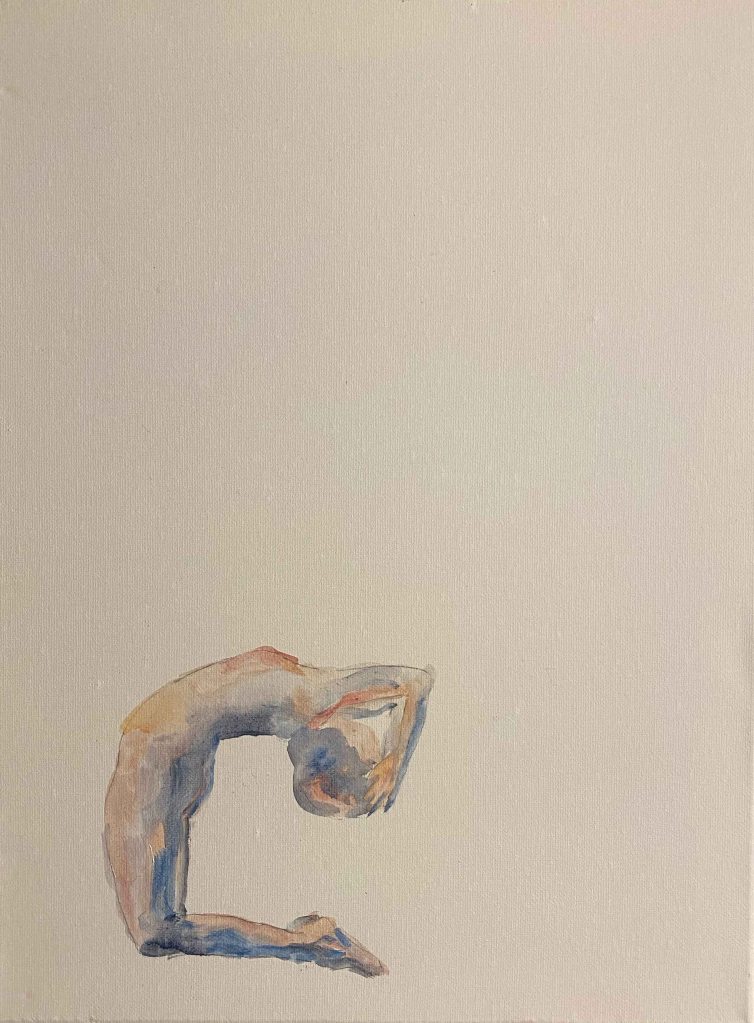
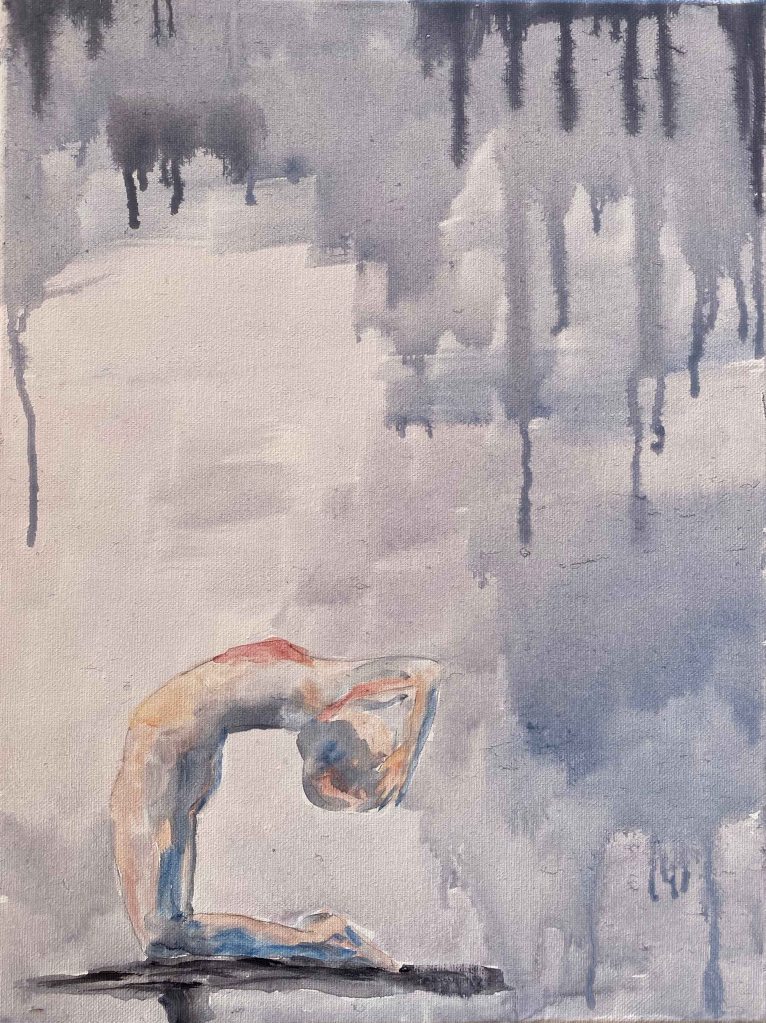
I want to try using the same paints in softer colours for another pose- a deep backbend. Deep backbends are the poses that bring up the strongest floods of emotions, especially fear, during the practice. I decide to come back to the vertical format and already know the title of this panting: Facing those fears.

A quick coloursketch on A4:

I choose a canvas of 30×40 cm and am careful not to overdo the colours this time. The paints are really strongly diluted with water. ( I need to ask my tutor if she has any experience with this and if there is an issue of fading with time.)

Again I start with the figure in the white space:

Then I add the background and let the strong, dark drops represent the fear:

I am surprised how much I like this little painting. Sometimes I spend days and days on a painting. This was such a light and quick sketch/painting and it already feels finished. It really captures my feeling in this pose, such a vulnerable surrender.

I agree that these last three works are rather paintings than drawings, but I have decided to not let that stop me from exploring. I am on the painting pathway after all.

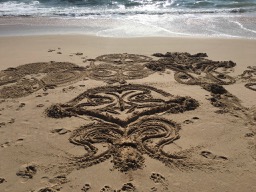
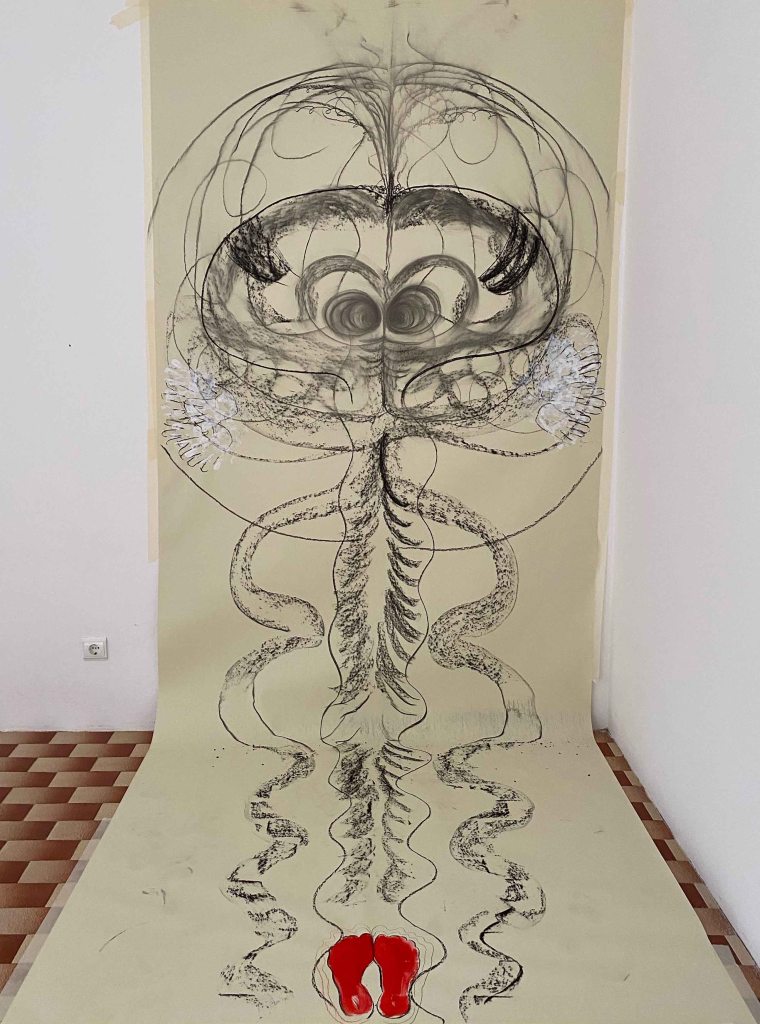
Finally, finally I have arrived at going BIG! I have had this dream of having a huge space where I can move around huge canvases and be messy for around 20 years I think, long before I even started to paint again. Until now I am still painting in our shared livingroom/studio with items from every familymember to watch out for. But NOW! We have just moved into a huge empty house that will be completely renovated- so this is my chance! I buy a big roll of whitish paper and prepare one larger than me canvas on the wall and another on the floor. Last summer I was doing many drawings in the sand by sitting or lying in different poses and moving my arms and legs symmetrically. Since then, I have been wanting to do this on paper.
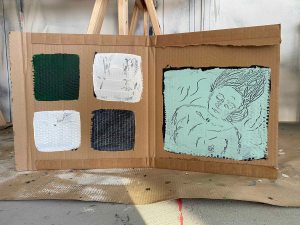
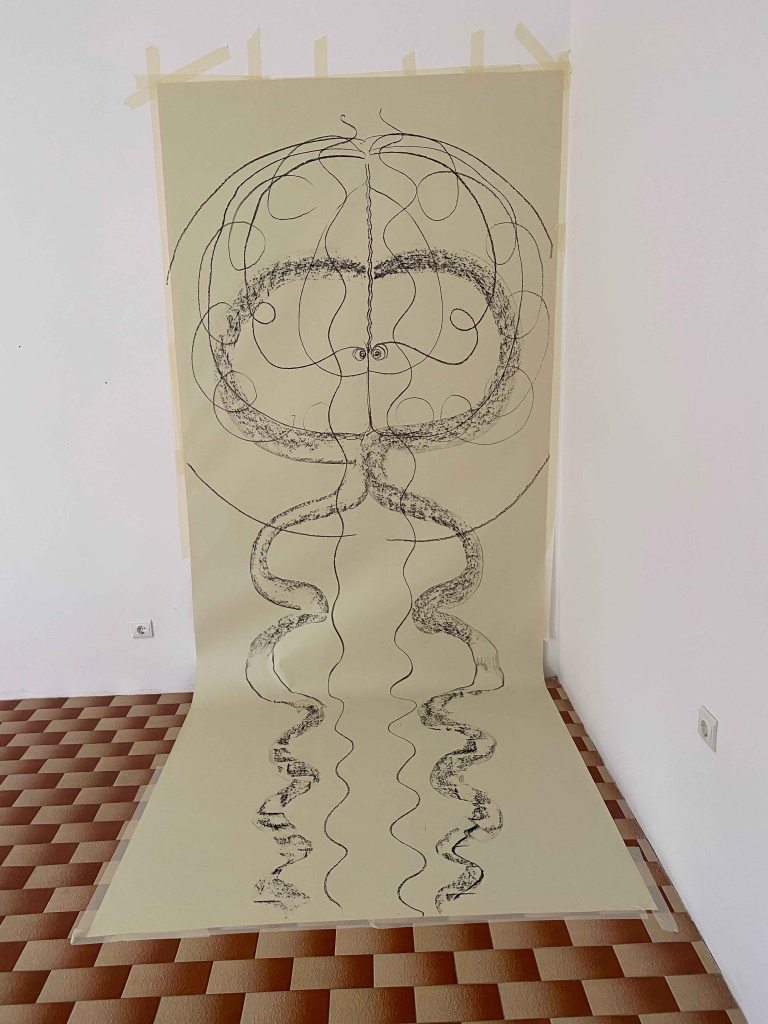
I am prepared:

I am listening to loud music in my headphones and standing in front of the vertical paper with a charcoal stick in each hand. I have promised myself not to be attached to the outcome, but just live the feeling in a sort of solitary performance and raise my arms wide- inhale.

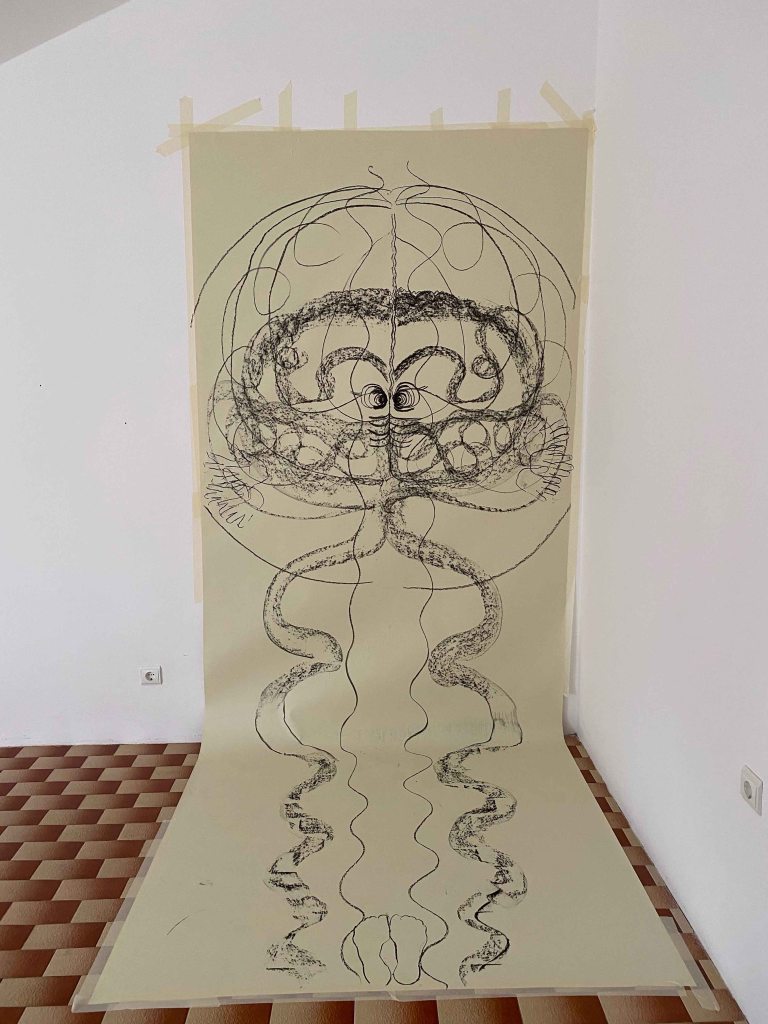
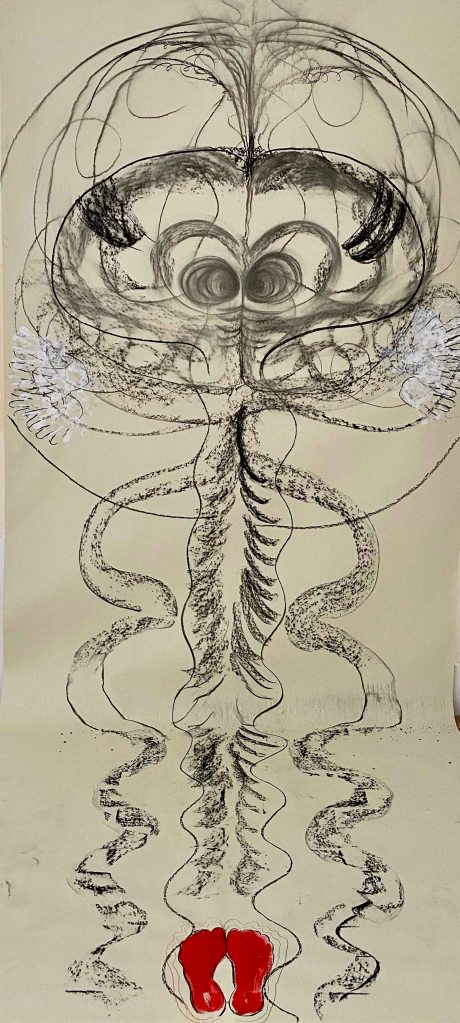
I still tricked myself into seeing something kind of figurative drawing instead of leaving it as an abstract pattern like in the sand. I decide to paint the feet red.

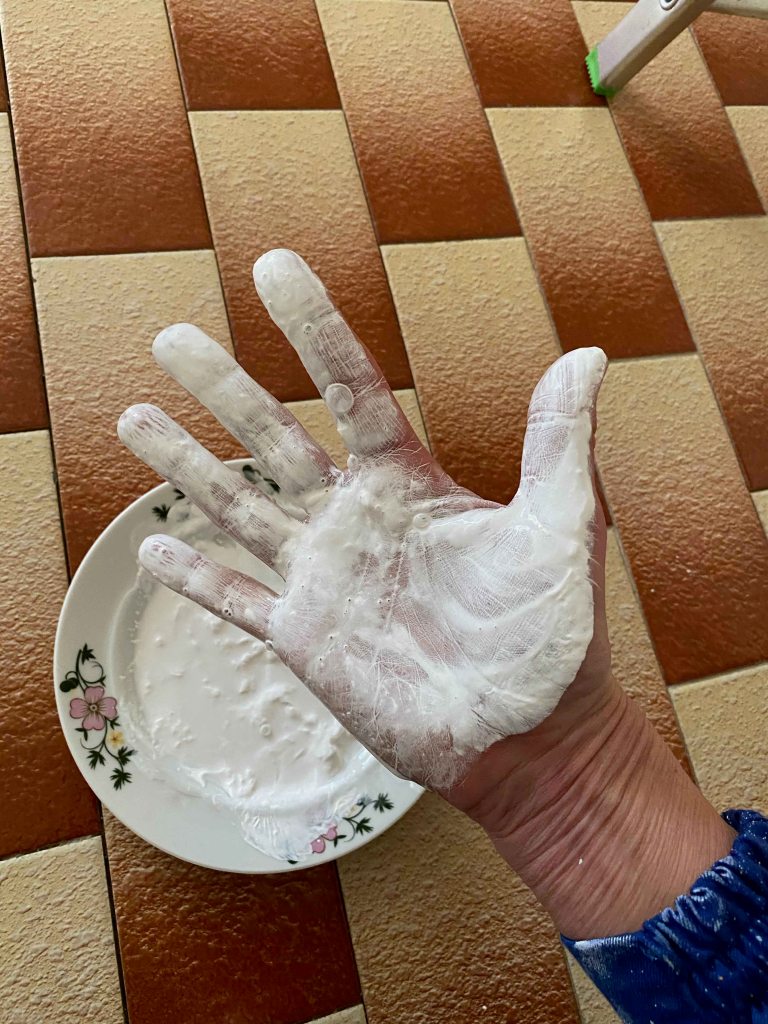
And getting into the paint with my hands..

If I crop the drawing it has more or less the shape of a yogamat and is some snakelike Kundalini energy rising:

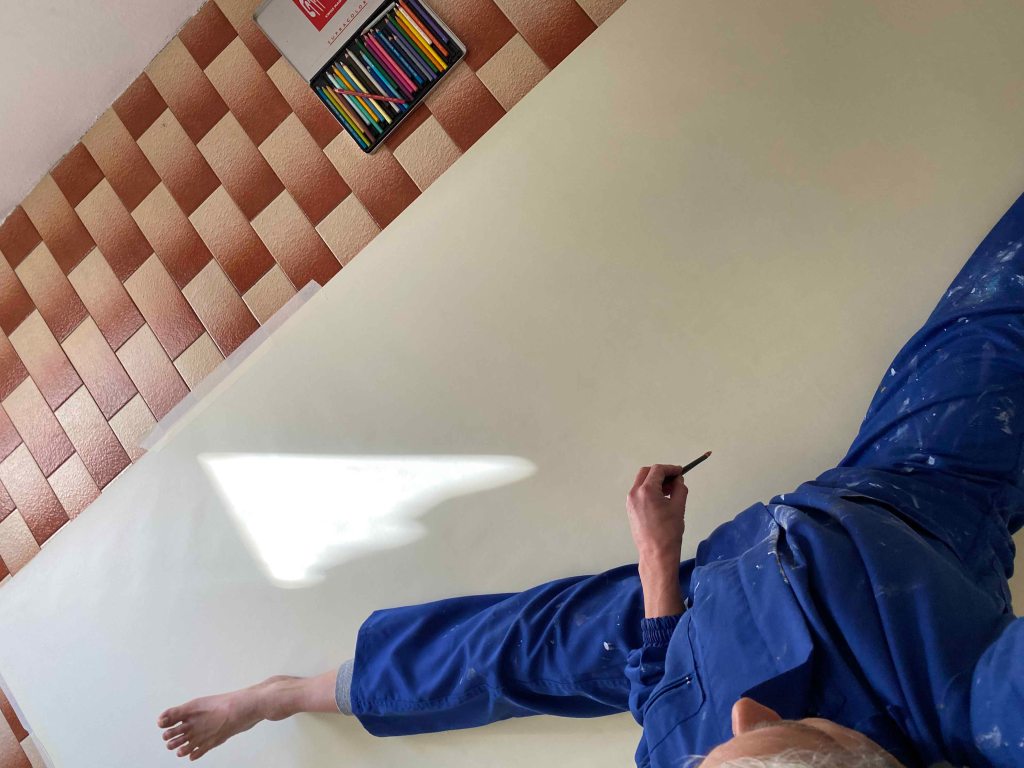
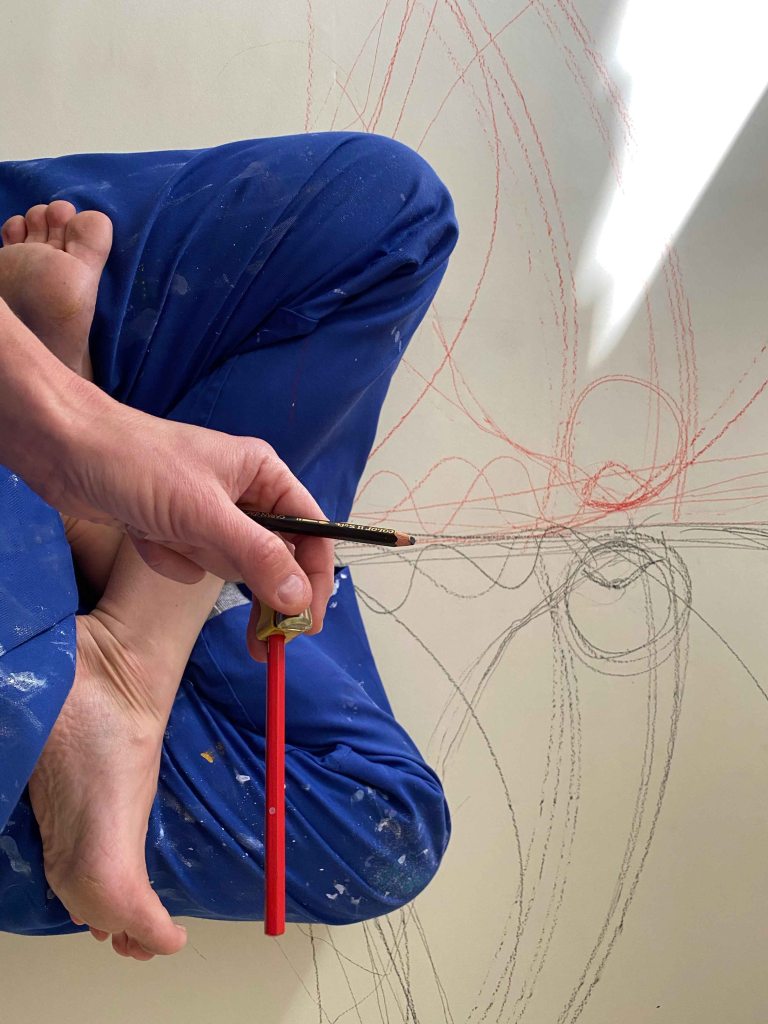
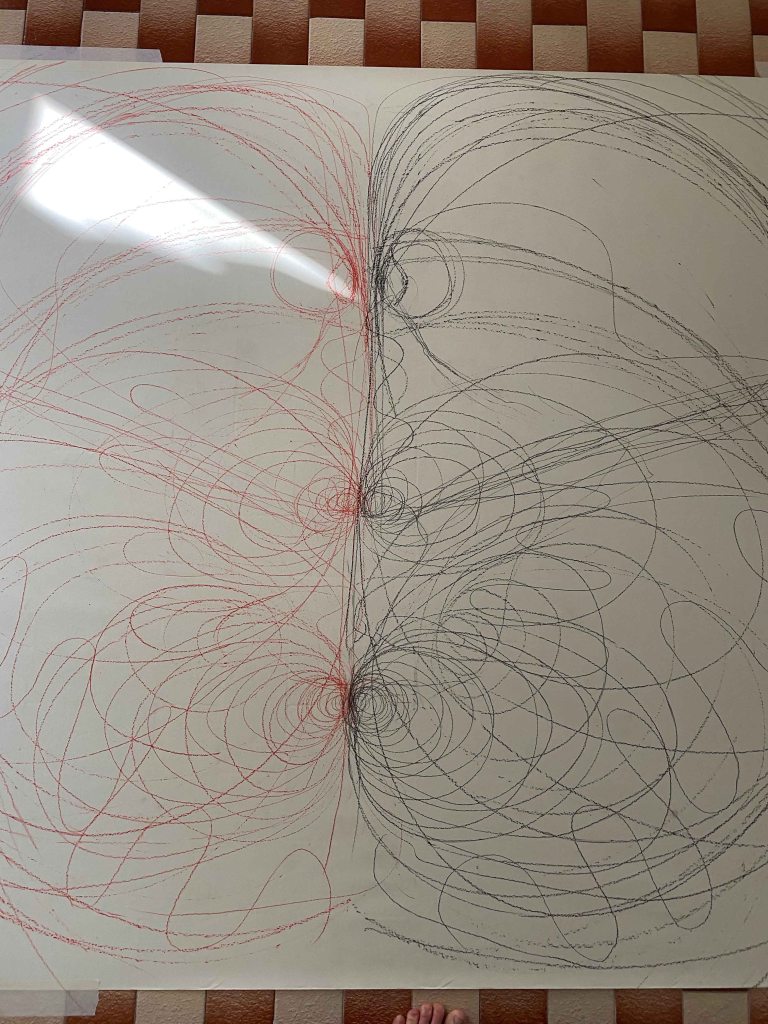
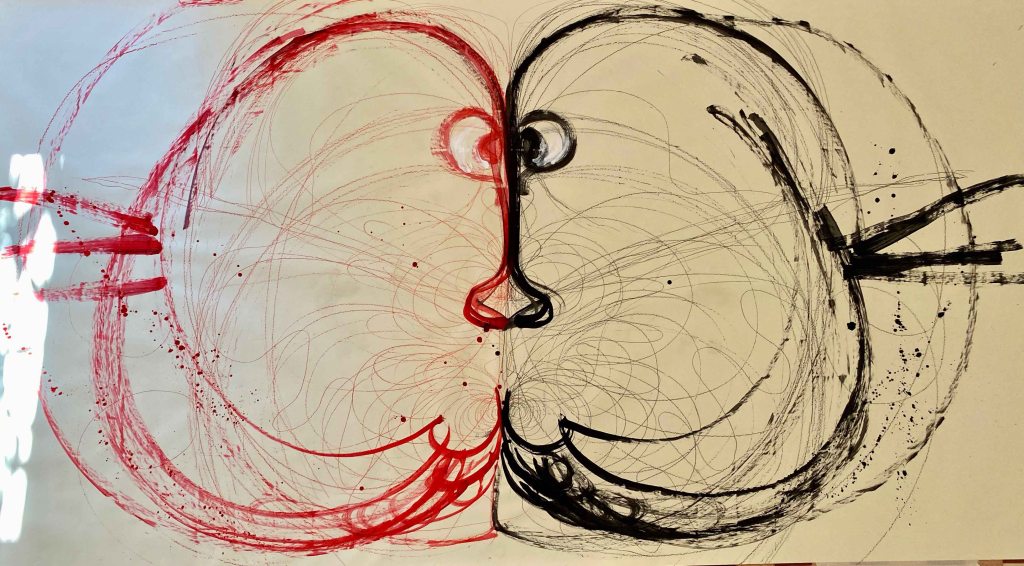
I move on to the paper on the floor and first sit in a center split. I am listening to a Shiva/Shakti song and will draw with a black coloured pencil in one hand and a red in the other.

I try to draw my own shape but am annoyed by my thick coveralls ( it is freezing cold up here in the attic) and my lines are too rugged:

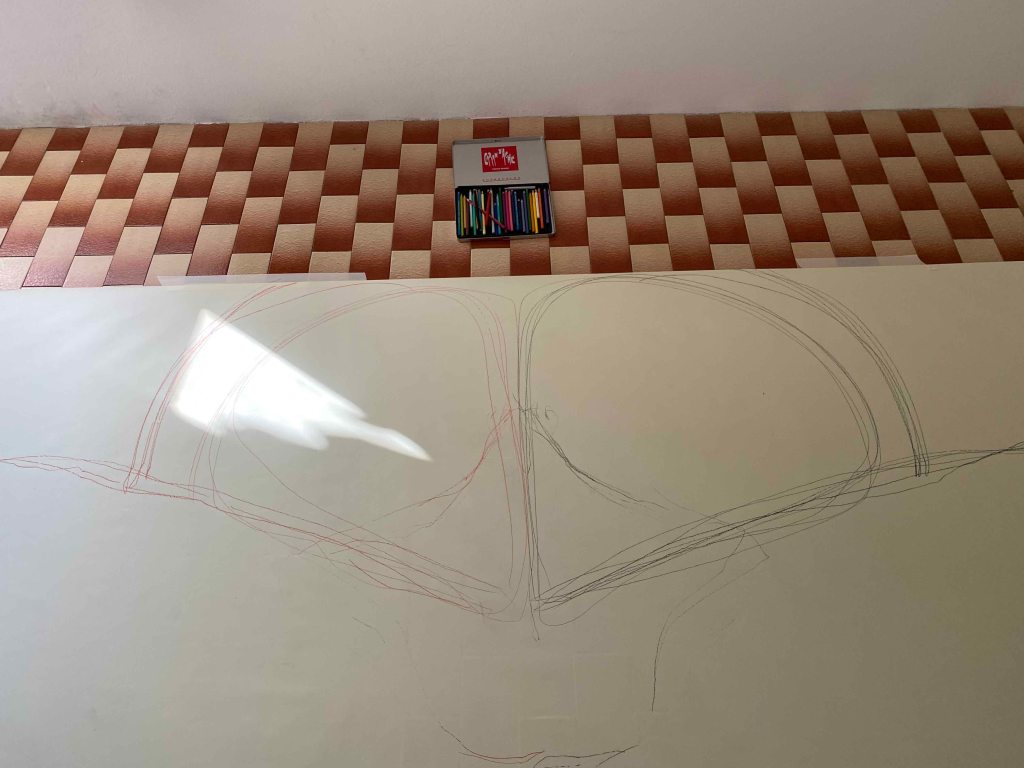
I shift to a lotus posture and draw in various symmetrical shapes as long as my arms can reach. This time I am slightly held back by having to use the sharpener all the time!
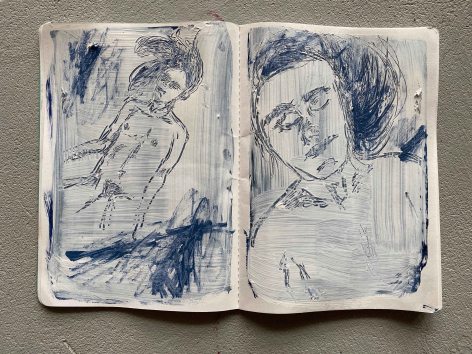
I am quite happy with the shapes produced:

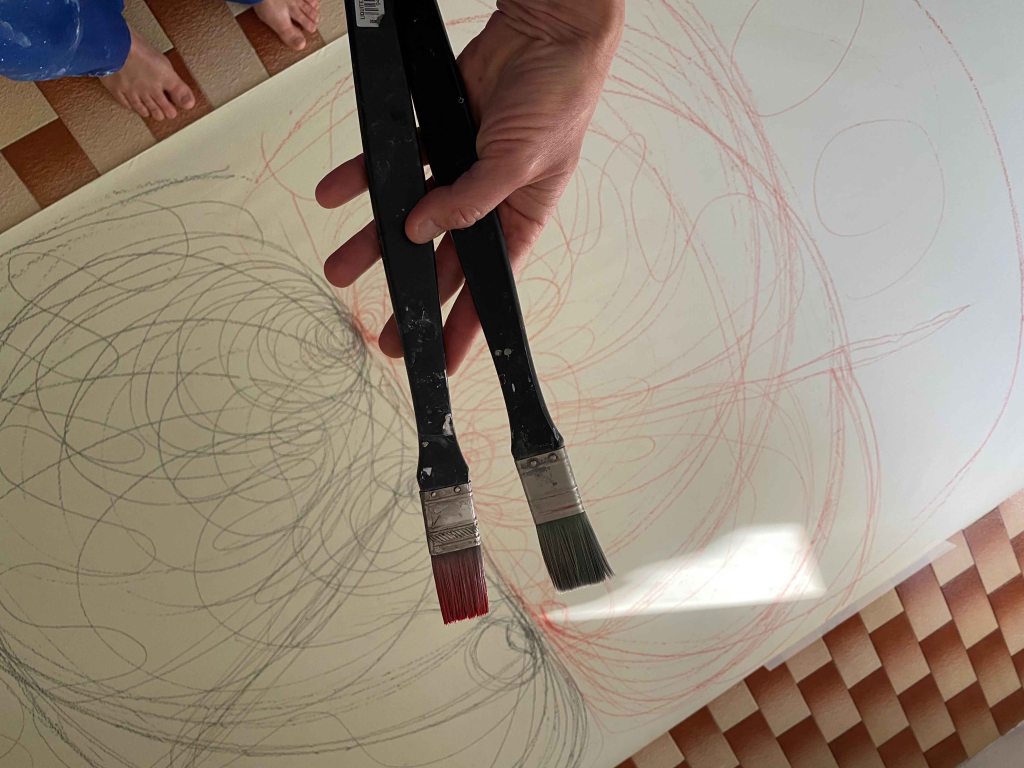
But I haven’t gotten this far to draw carefully in coloured pencils! I unpack my acrylic paints and realize that all my materials are for smaller formats- these are my largest brushes!
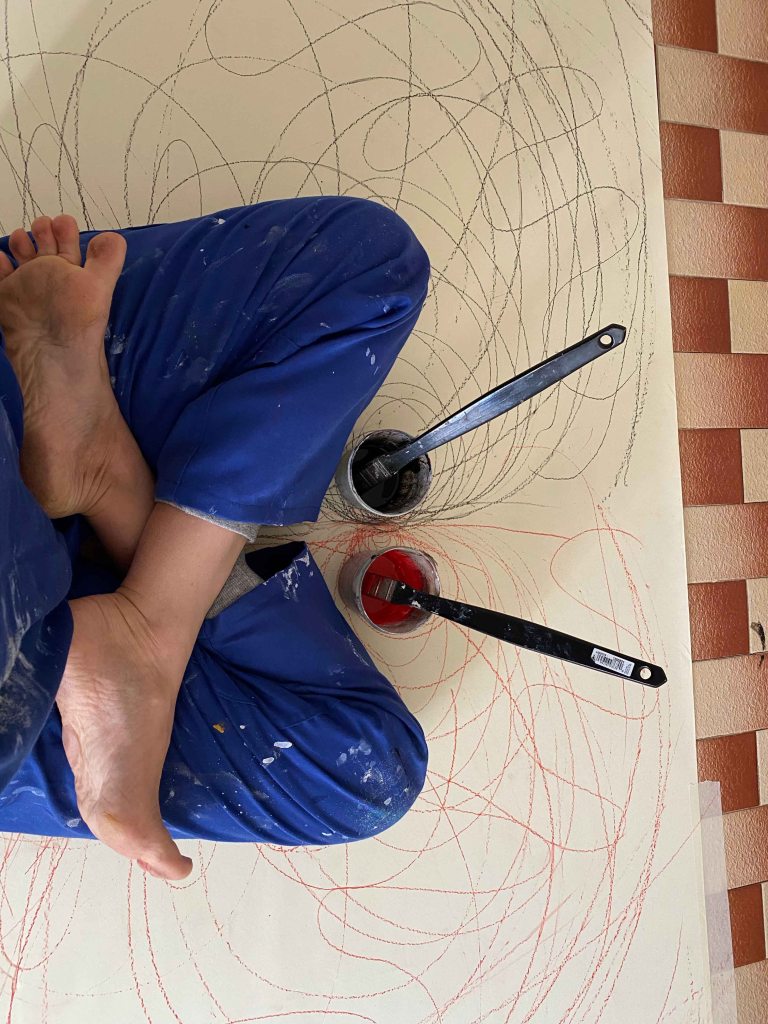
In position again, with one pot of red and one of black acrylics:

And this is where I should have stopped painting! At this stage, I find the drawing successful:

But I did not stop here… As always, I tried to discover a face or something recognizable, so this is the final drawing:

I am not particularly satisfied with these large drawings as results, but it has been an incredible experience of figure drawing in the sense that I have used my whole body in the expression. It has been an absolutely incredibly liberating experience and I definitely want to continue drawing HUGE and using all of my range of motion.

REFLECTION ON ASSIGNMENT 1:

For this Assignment I have neither produced a finished drawing , nor a series, or maybe I have produced several. I have allowed myself to open up lots of different pathways to continue exploring. So as a minus, nothing is clearly finished. On the plus side- I am full of ideas!

I will give myself a big minus for working too closely from photos though for all of the first drawings. During the contextual research about Prunella Clough, I admired the way she used her own photographs and let shapes and elements reappear in her paintings, rather than reproducing them and thought that I would love to work like that. And then, immediately after, I fall into the trap of using all the photos way too closely.The last paintings in huge formats were liberating as I did not have any reference other than my own joy of movement.

I chose to study Drawing 2 before Painting 2 with the precise wish to practice my drawing skills, especially the figure and perspective drawing which are my weakest points. This is definitely something I want to develop through this course, rather than relying too closely on photographs.

1.4 The human form

Coursemanual:

Aim: Drawing the human figure allows you to develop skills in observing underlying structure – the ‘engineering’ of the figure – combined with the natural grace and flow of an organic form. The effects of the way weight is distributed and light falls to reveal volume are hard to pin down but hard to fudge; figure drawing is like a workout for the eyes. By drawing parts of the figure, you can develop your skills in managing several inter-related elements within a drawing – rhythm, weight, volume, structure. The object of this exercise is to create a drawing which leads the eye of the viewer into the overlapping twists and turns of the limbs. Use your judgment to make the most powerful statement you can.

Method: Make a drawing of two combined body parts. This might be two feet crossed over, folded arms or a hand resting on a waist. Look at the curves and the rhythms set up by those curves. Look at the muscles and bones under the skin and the tension and energy they give. Make a drawing which has a curving or sinuous composition using parts of the human figure. If necessary, consider lighting the limbs with an Anglepoise lamp or similar to give yourself more dramatic tones in the manner of chiaroscuro. Don’t leave the limbs to taper off into nothing, even if that means cropping. Don’t be more tentative because you’re working from the figure; redraw and correct vigorously to achieve the most accurate drawing you can.

I am starting this exercise by looking for a pose with two limbs overlapping that creates interesting forms, drawing the eye of the viewer in.

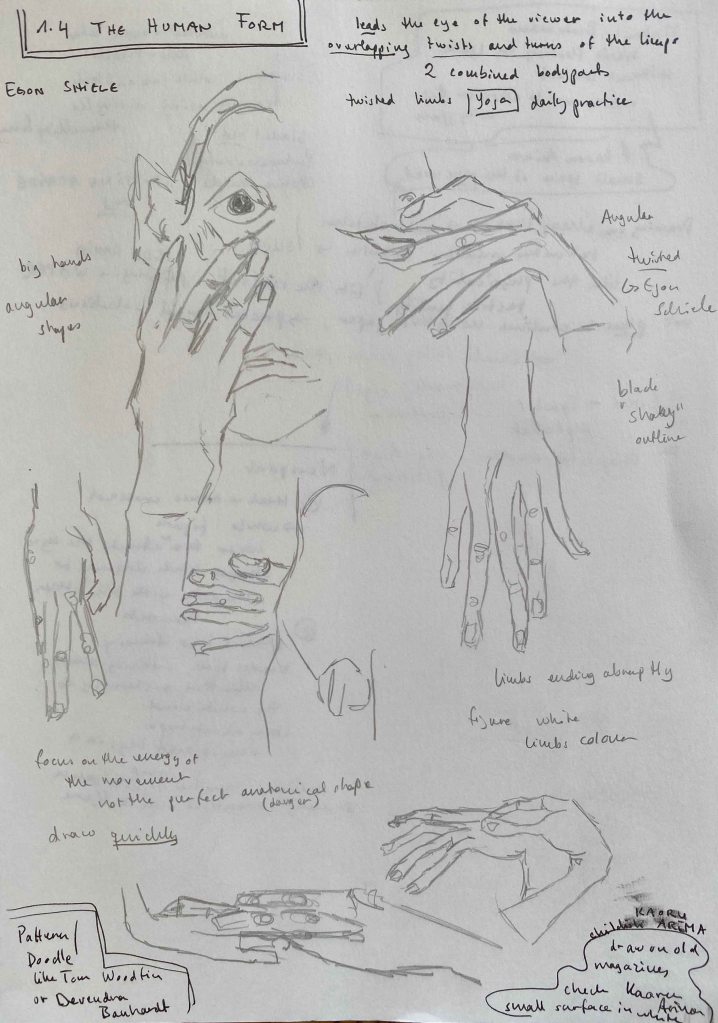
I think it is the wording “twists and turns of the limbs” that immediately guide my thoughts to Egon Schiele’s selfportraits, where there is often a twisted, tense quality of the limbs. He often emphasizes the hands in angular, twisted shapes and is not afraid of letting limbs taper into nothing. There has been quite a heated discussion on the OCA email group about Schiele’s work, but despite his questionable morale, I am still a great admirer of his art.

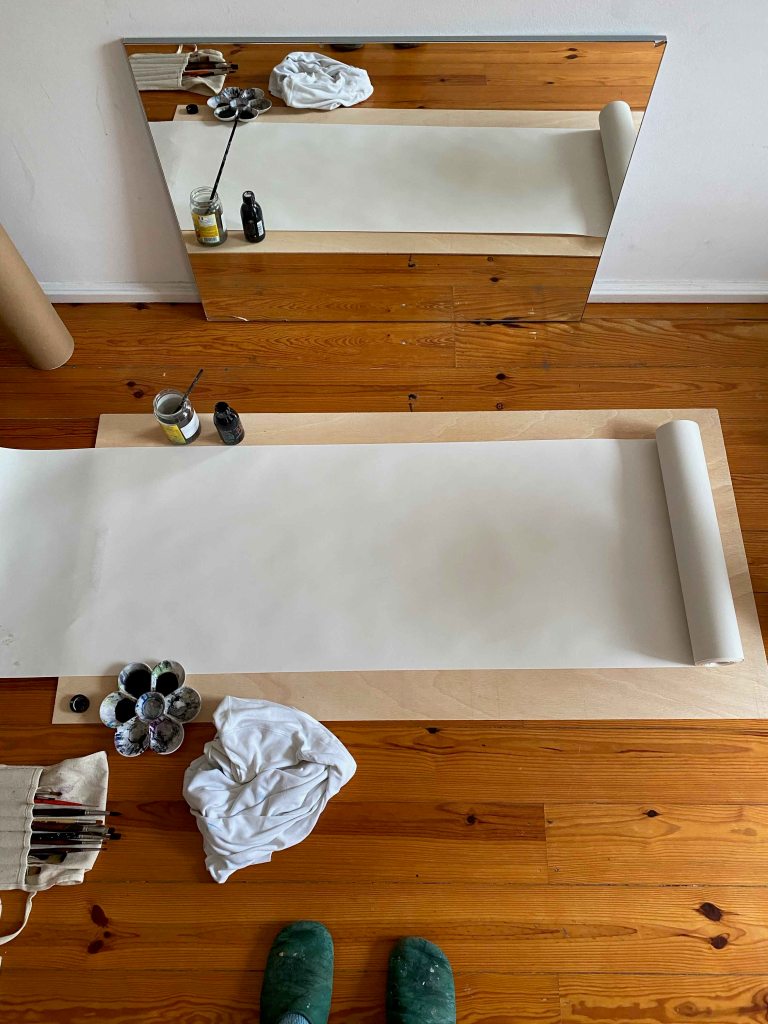
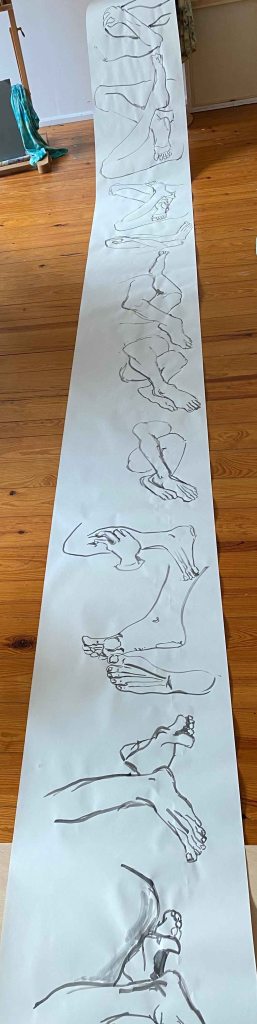
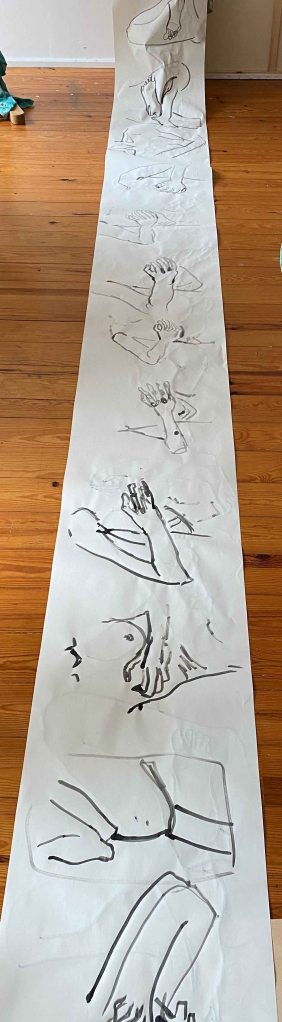
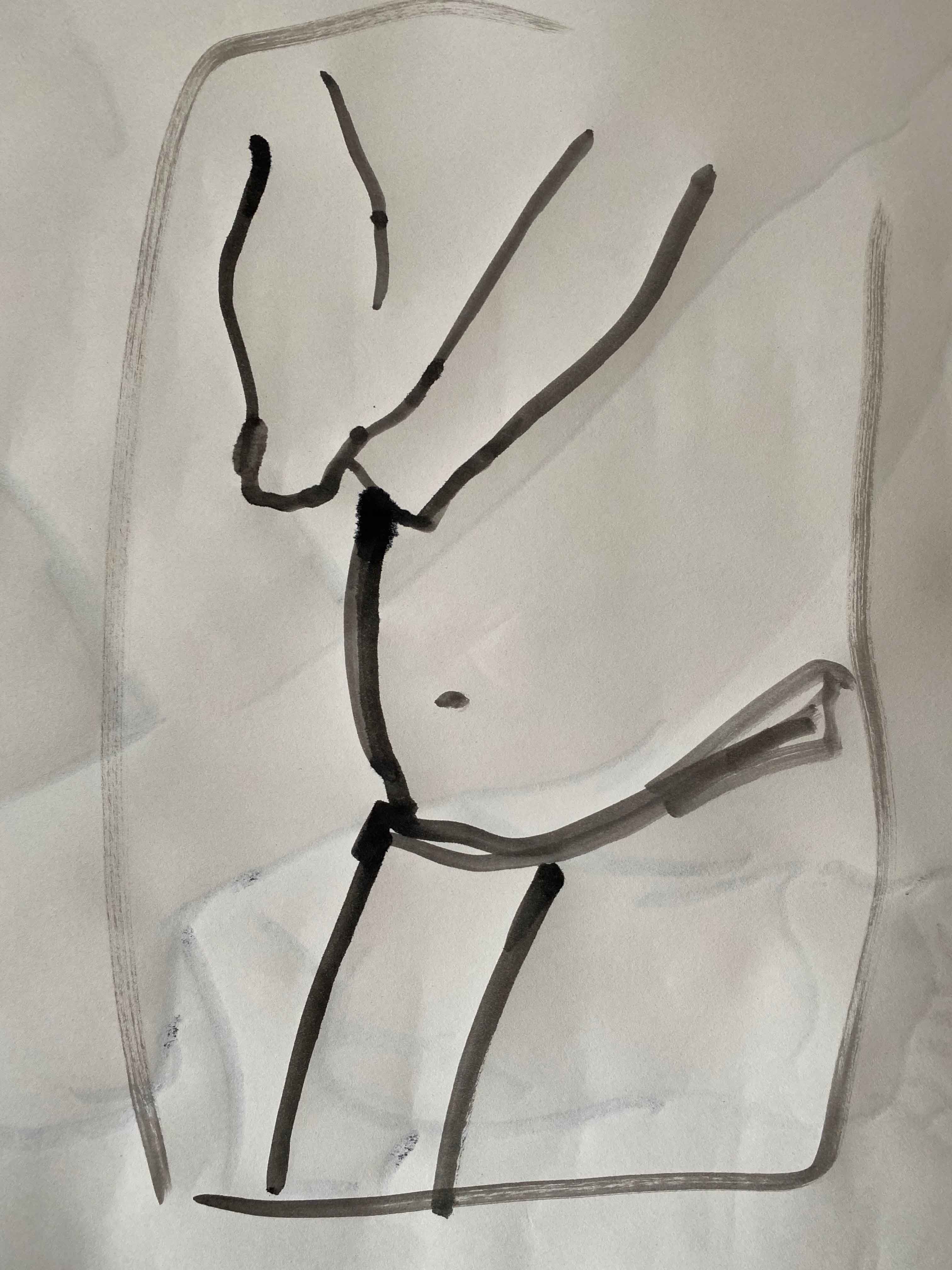
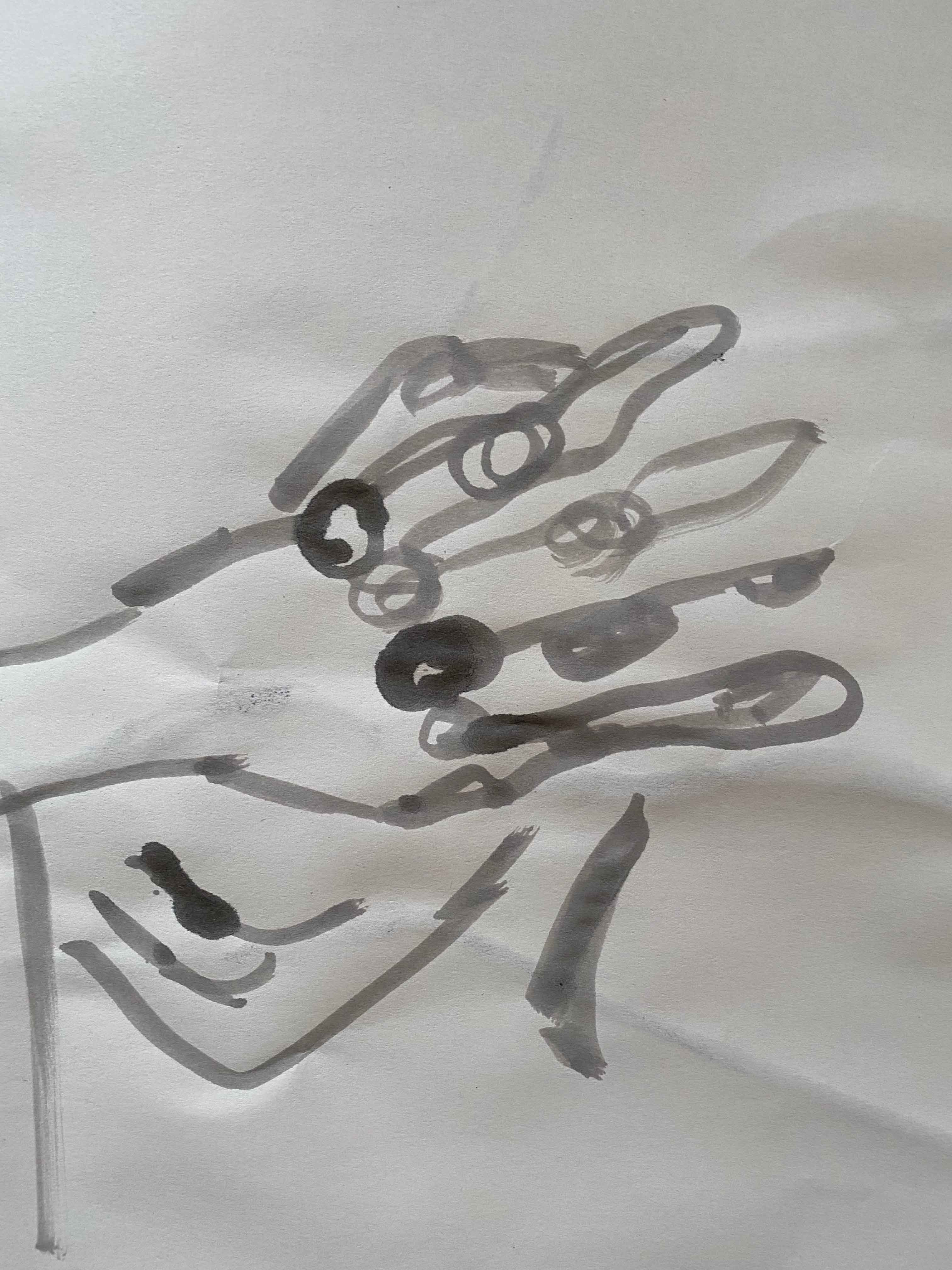
I want to draw a quick series of poses , focusing on the dynamic of the poses more than catching the perfect anatomical shapes. I prepare a long roll of cheap paper from IKEA and place myself in front of the mirror with Indian ink and brushes at the ready.

It is quite confusing at first to draw from the mirror, but I soon get into the flow :

Although the thin paper gets quite wobbly from the ink, I decide to turn it over and continue sketching on the reverse:

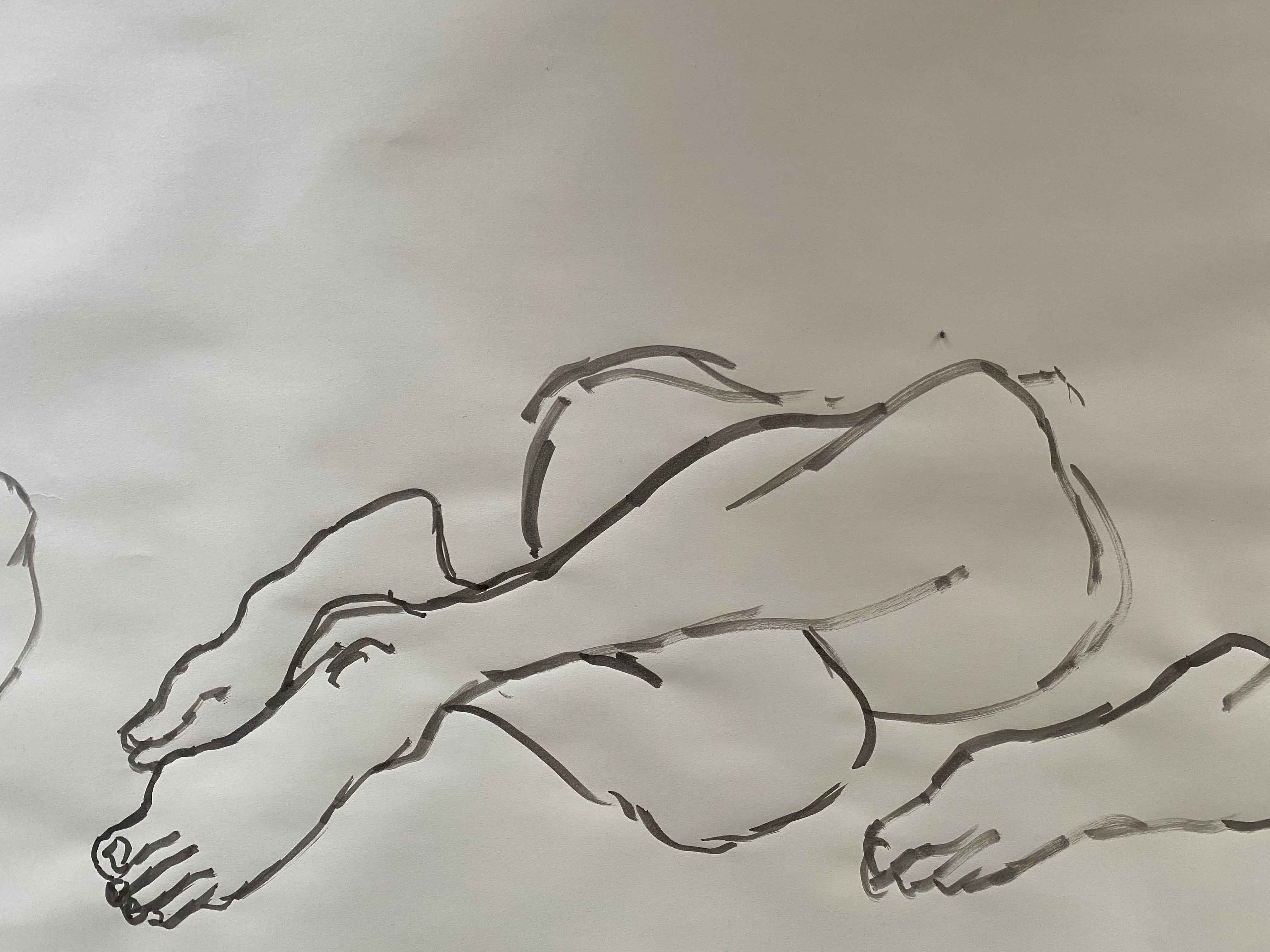
I pick out a few poses that I find most interesting:

I decide to continue with the two legs, one folded backwards and the other draped over. This pose is at the same time simple and a little intriguing, it takes an extra second to realize how the legs are folded. I like the shape of the whole, forming something like a symbol, close to an infinite symbol.

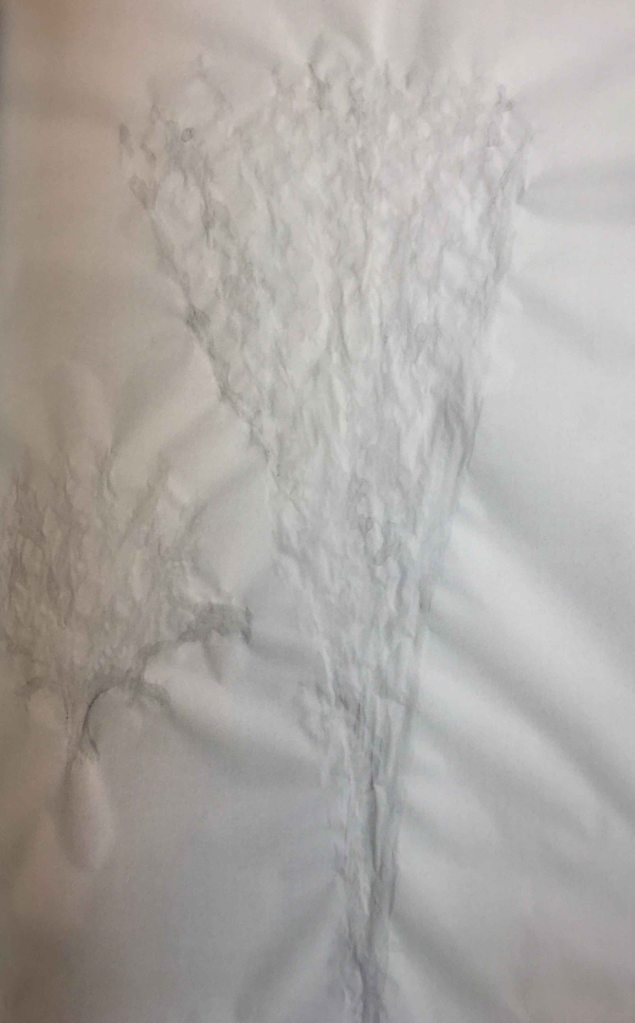
Although I initially started drawing on the cheap paper roll just for quick sketches, I notice how the wrinkles of the paper make me think of skin. I like the physicality of this, the tactile quality it adds, and decide to continue drawing on this too thin paper.

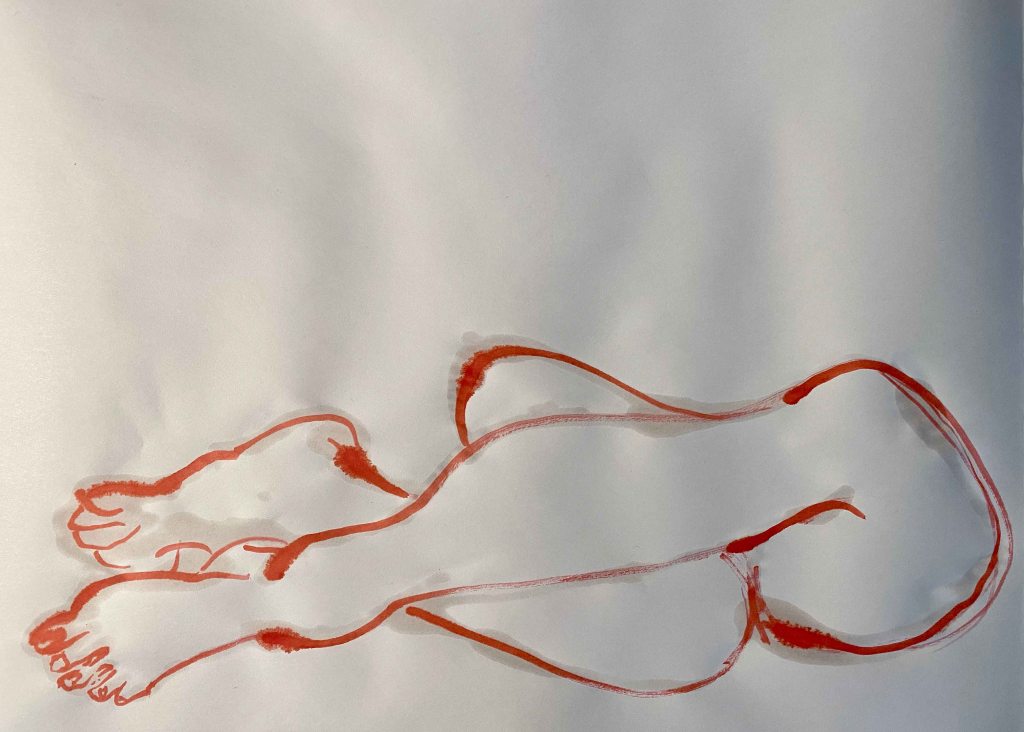
I start experimenting with a Winsor&Newton Vermillion ink. I draw in water first and then in red, so that it bleeds a little. This drawing in red reminds me of Louise Bourgeois’ inkdrawings.

Using the water to create more wrinkles, also reminded me of a drawing by Portuguese artist Ilda David that I really liked from the book “Ilda David from dark to light”, drawn only in water on white paper:

(Image from: Faria, N (2016). Ilda David Do Negro a luz, Desenhos do 1986-2016. Portugal: Dokumenta Fundacao Carmona e Costa.)

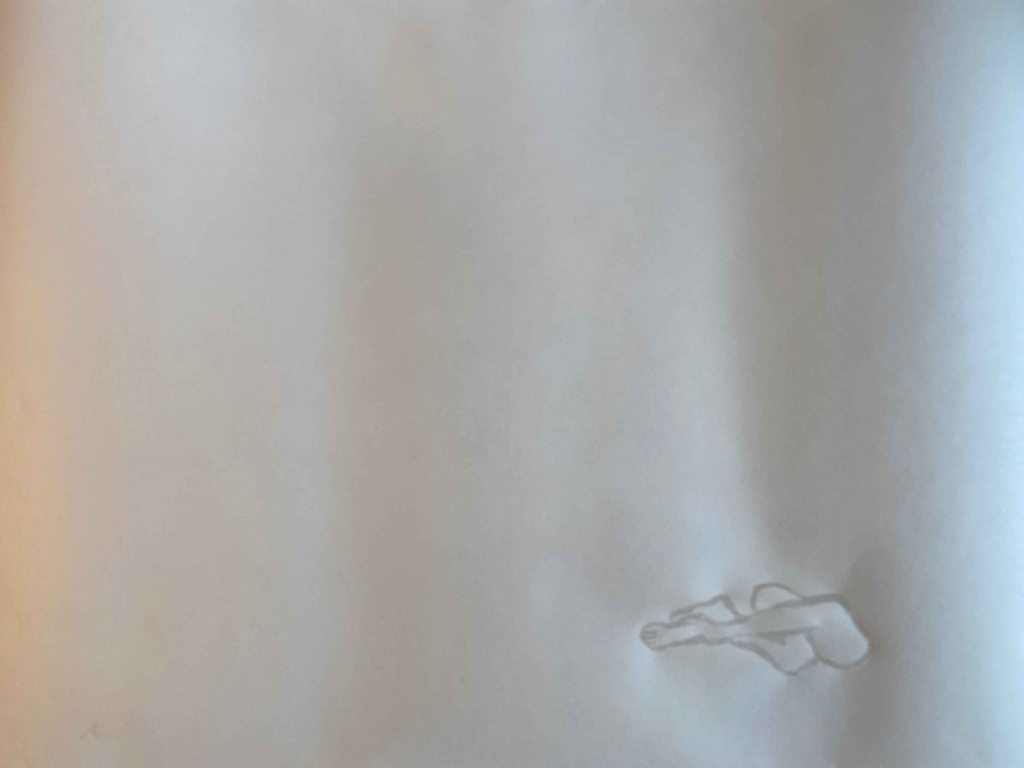
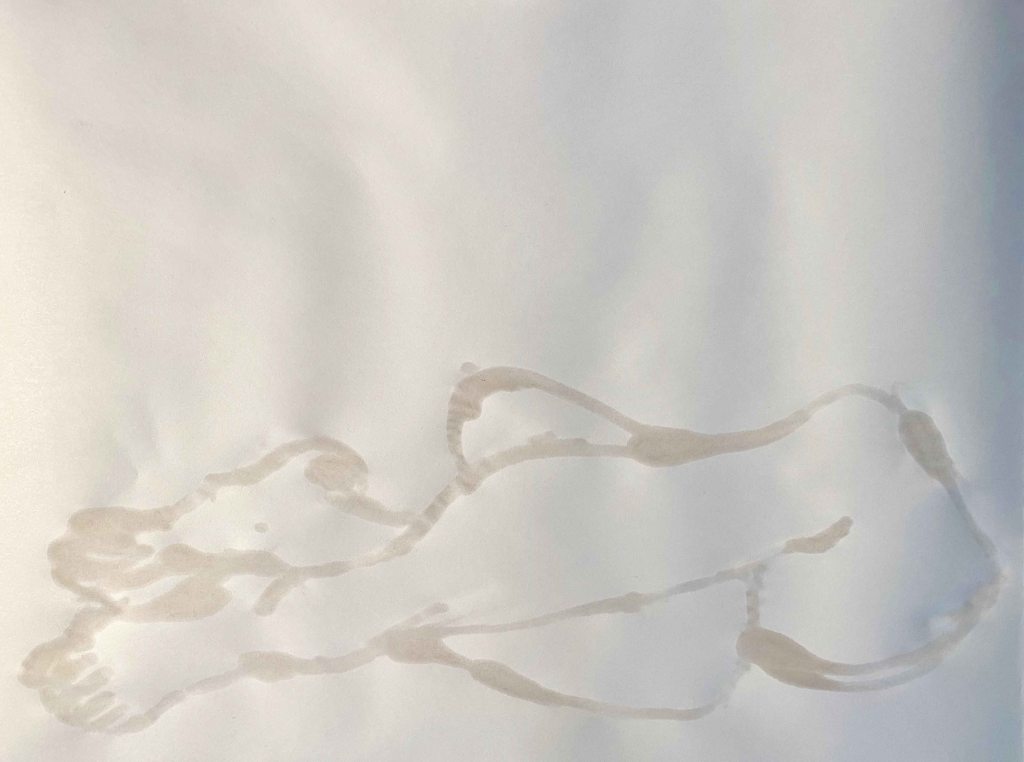
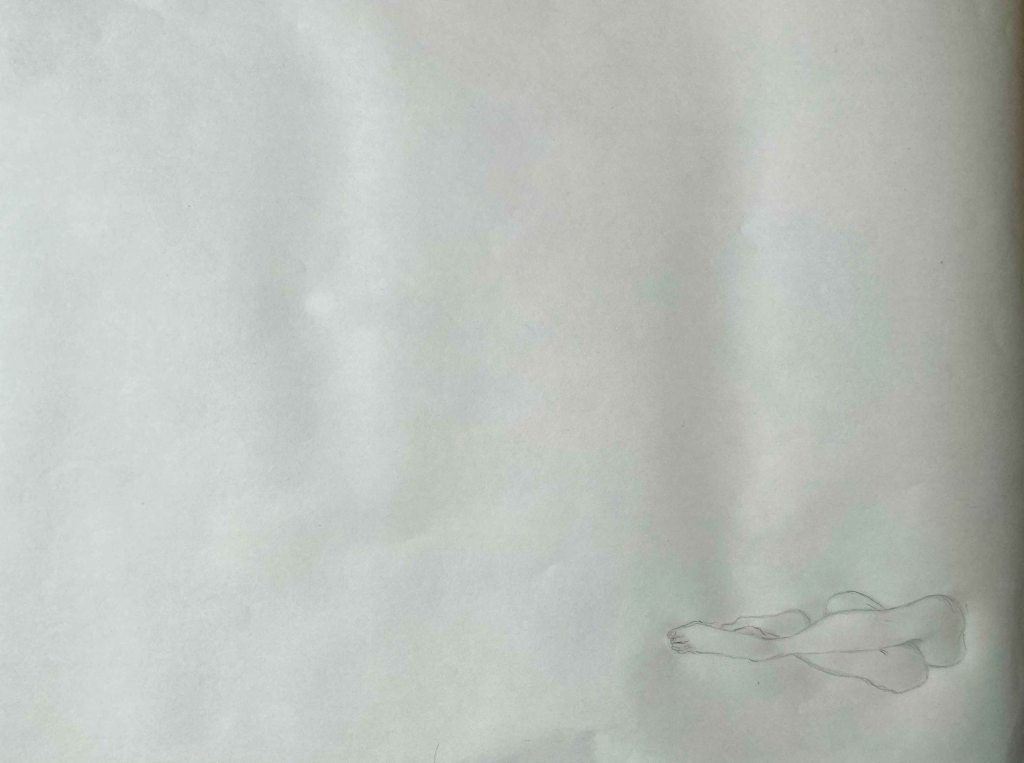
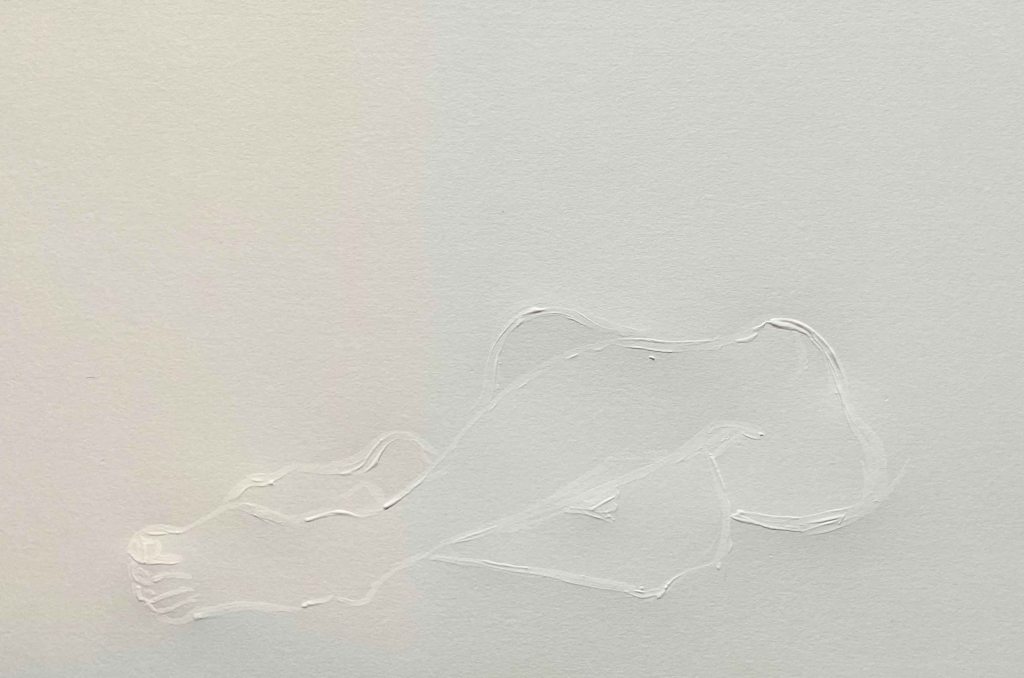
This drawing is so simple and so effective. I try drawing my entwined limbs in water.

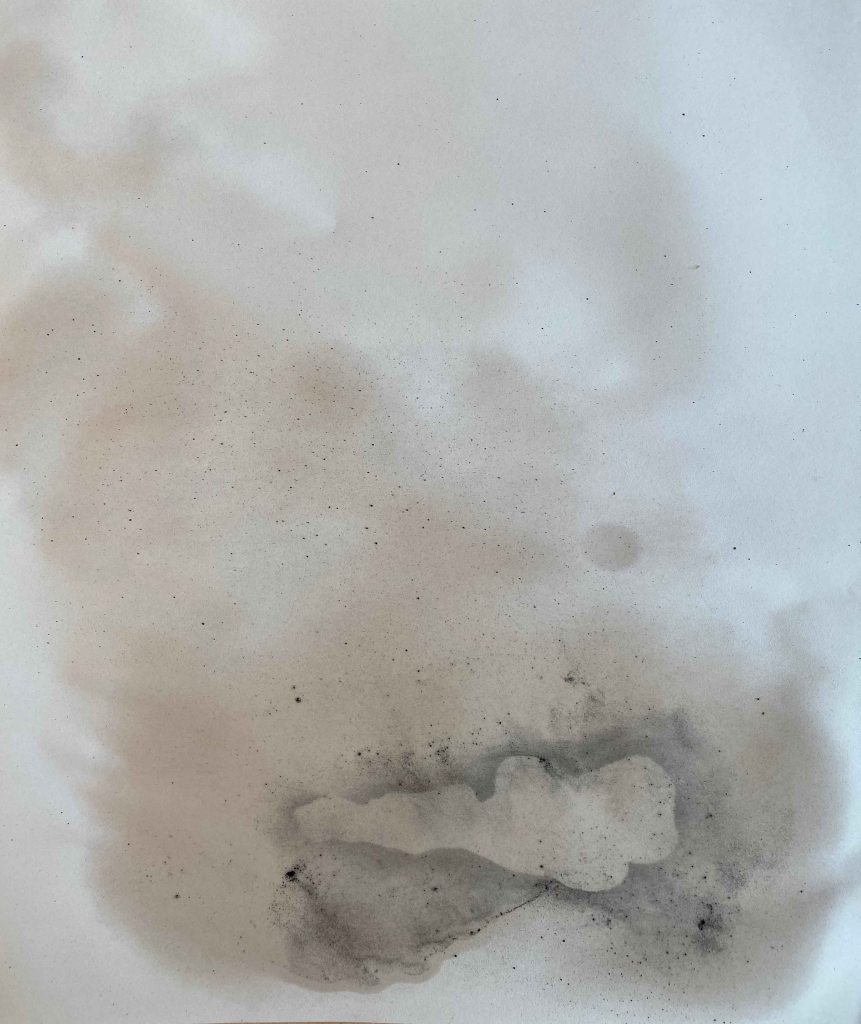
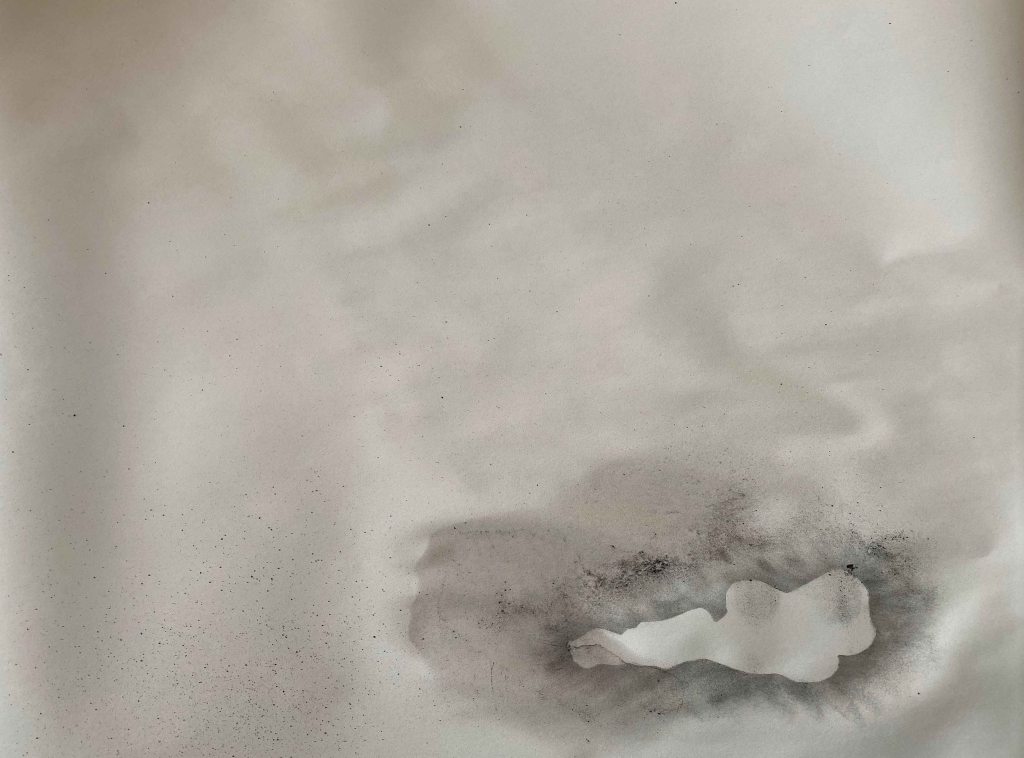
I find that my pose looks like a sign or a symbol. I will draw it small, leaving a large white page around tell the story and let this mark be a symbol.

I find it effective how this very subtle mark sits on the page, but I am not happy with the shape. I decide to try and draw in pencil first and then water

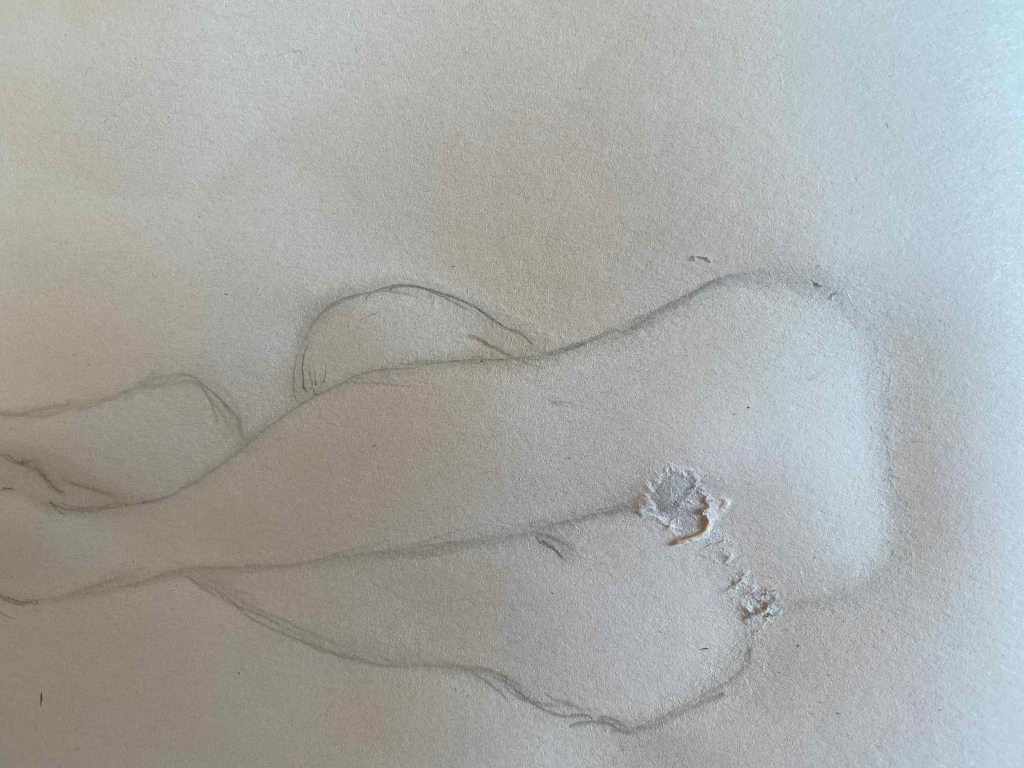
This drawing is much better! But when i try to erase the pencil (close up)…

…I rubbed a hole in the paper…

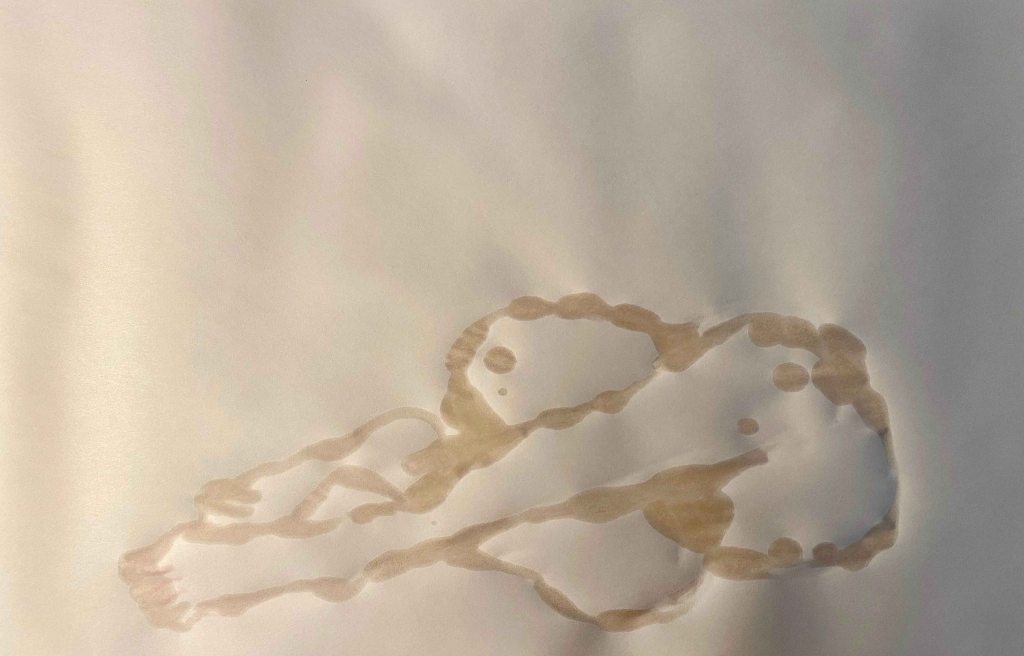
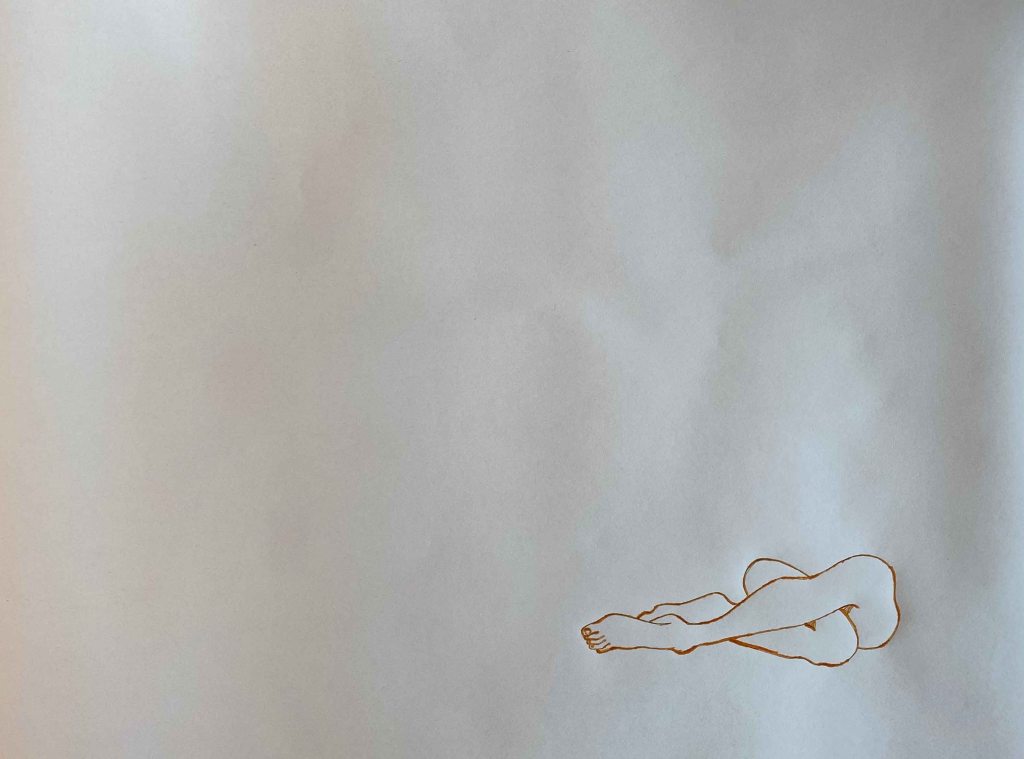
I decide to try this proportion of the white page and the small symbol with a brown ink too:

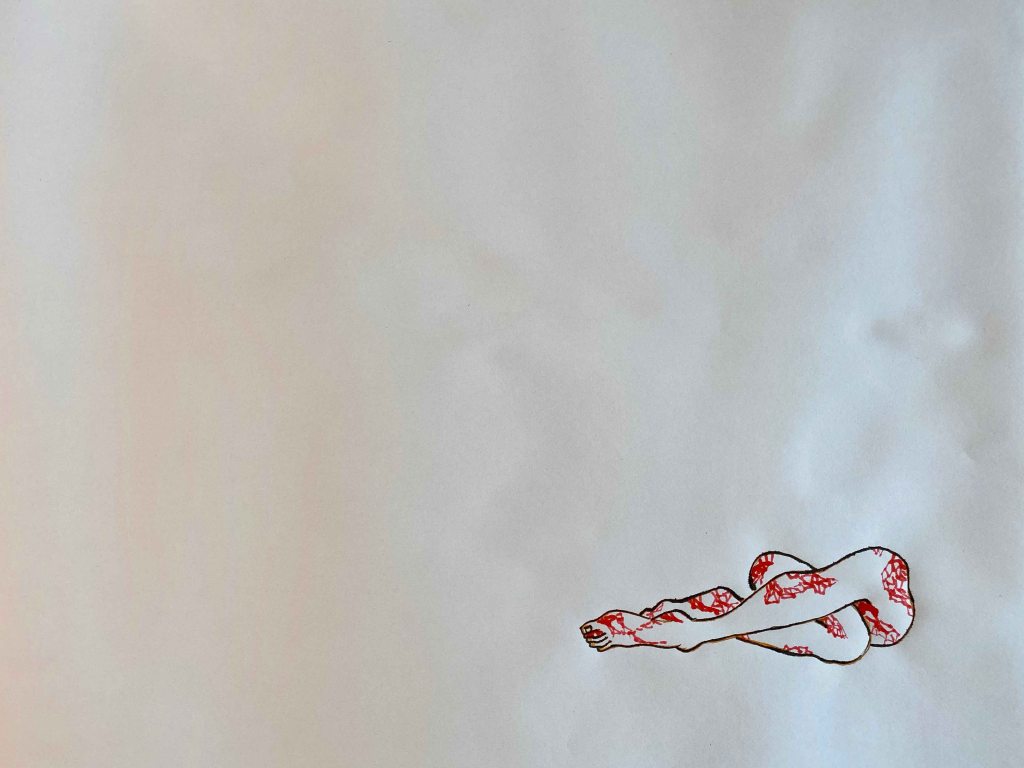
Here the drawing went well, but it is not effective with the brown ink. It needs to be either really subtle, like the water, or stronger on the page. I colour in the brown ink with a black Indian ink and add vermillion details in a cubic pattern:

This drawing works again. It has enough interest to sit so slightly on the large page and still let the page be in balance.With this pattern, the legs have a snakelike character.

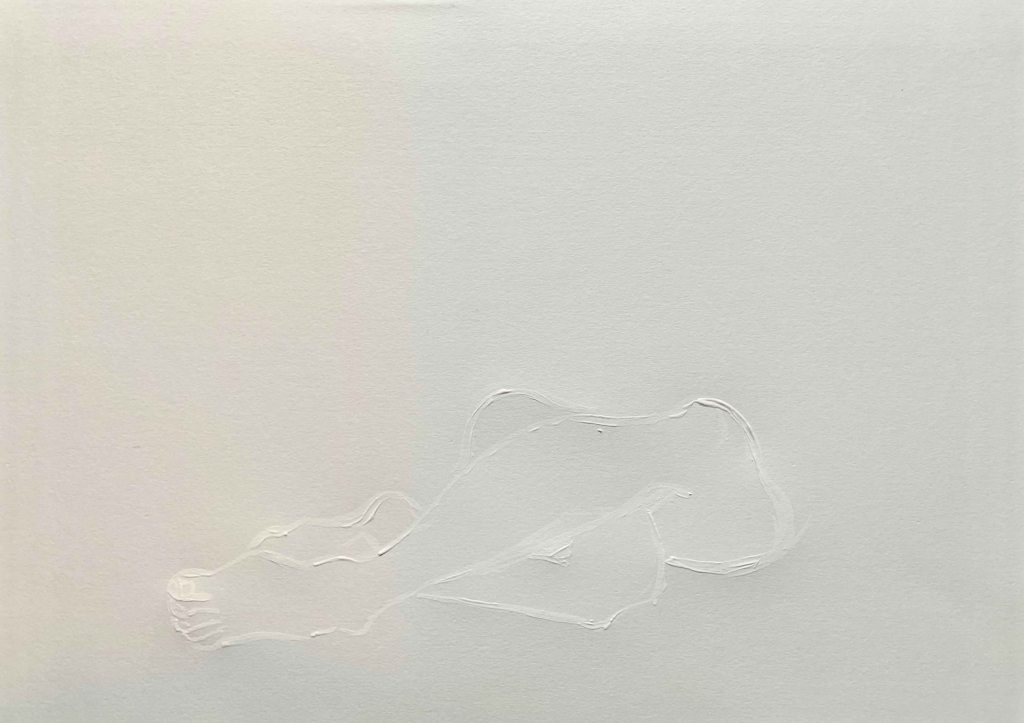
I am still curious about exploring the very subtle though, and decide to try out drawing the same pose twice again, with Winsor& Newton white ink on a Fabriano watercolour paper.

This could work, but is not as appealing and subtle as using only water.

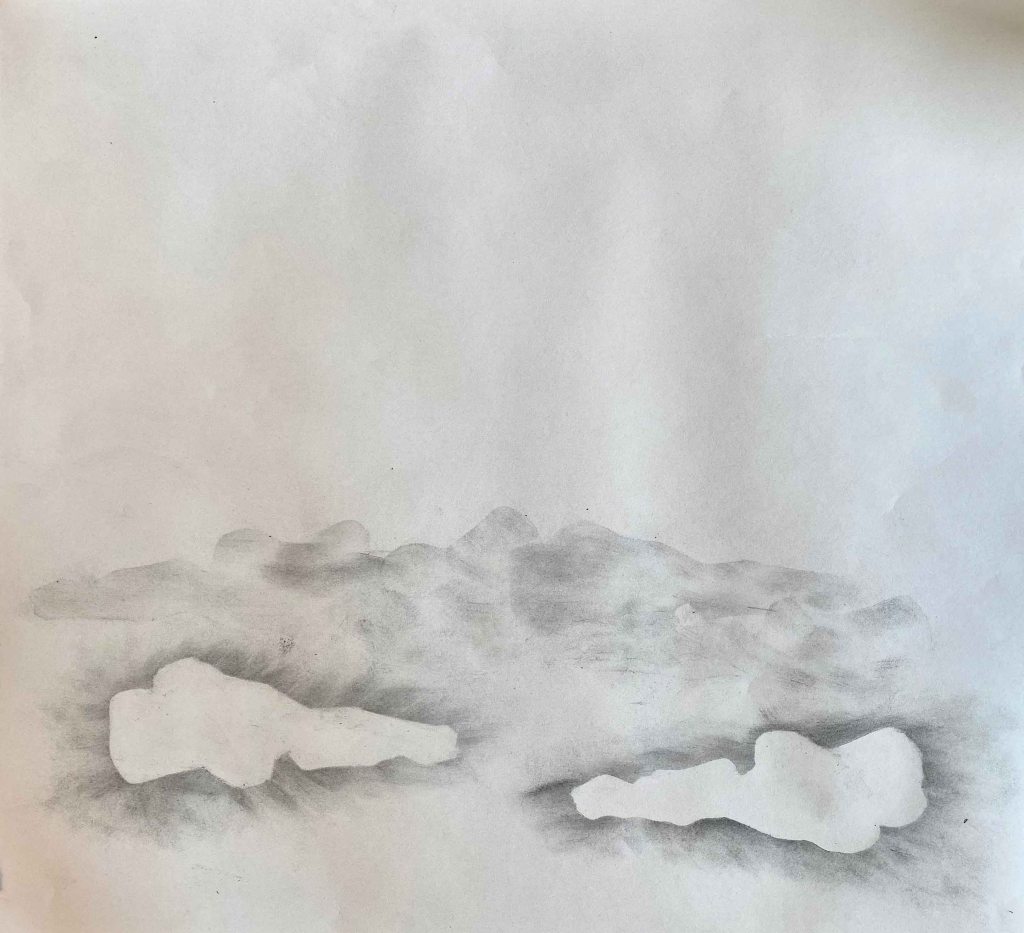
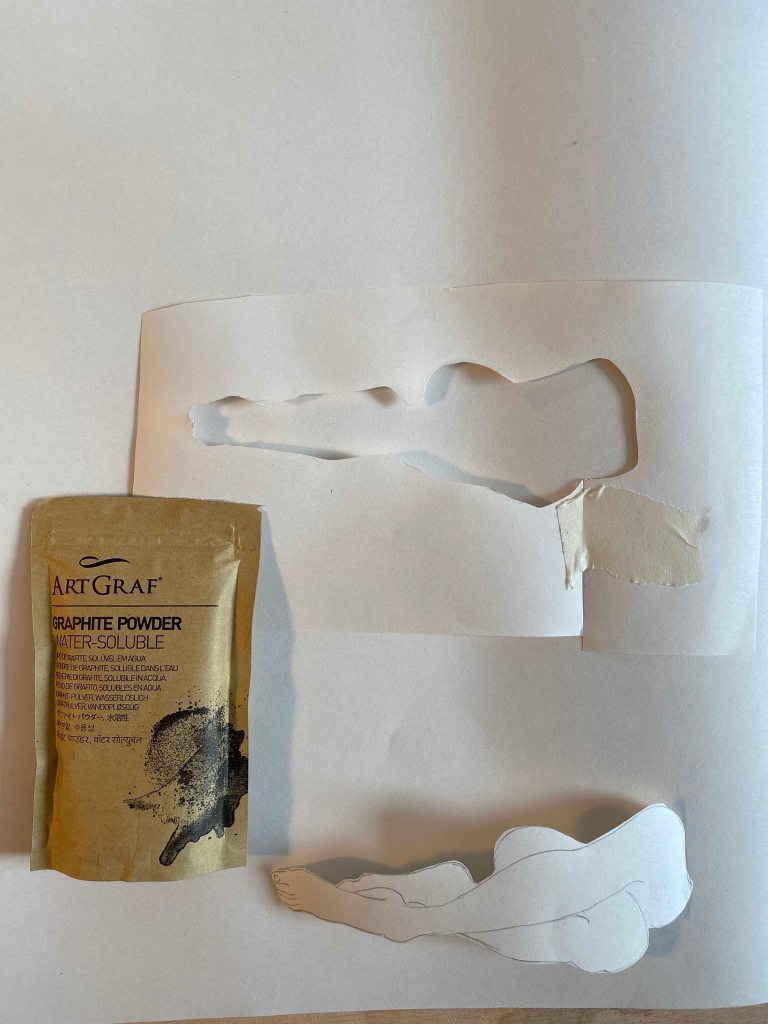
Next, I decide to try out a technique I tried in a lifedrawingclass- cutting out the shape of the pose and then drawing the contours using this positive or the negative mold with graphite powder.

I am using a small drawing of the figure on the bottom of the page again.

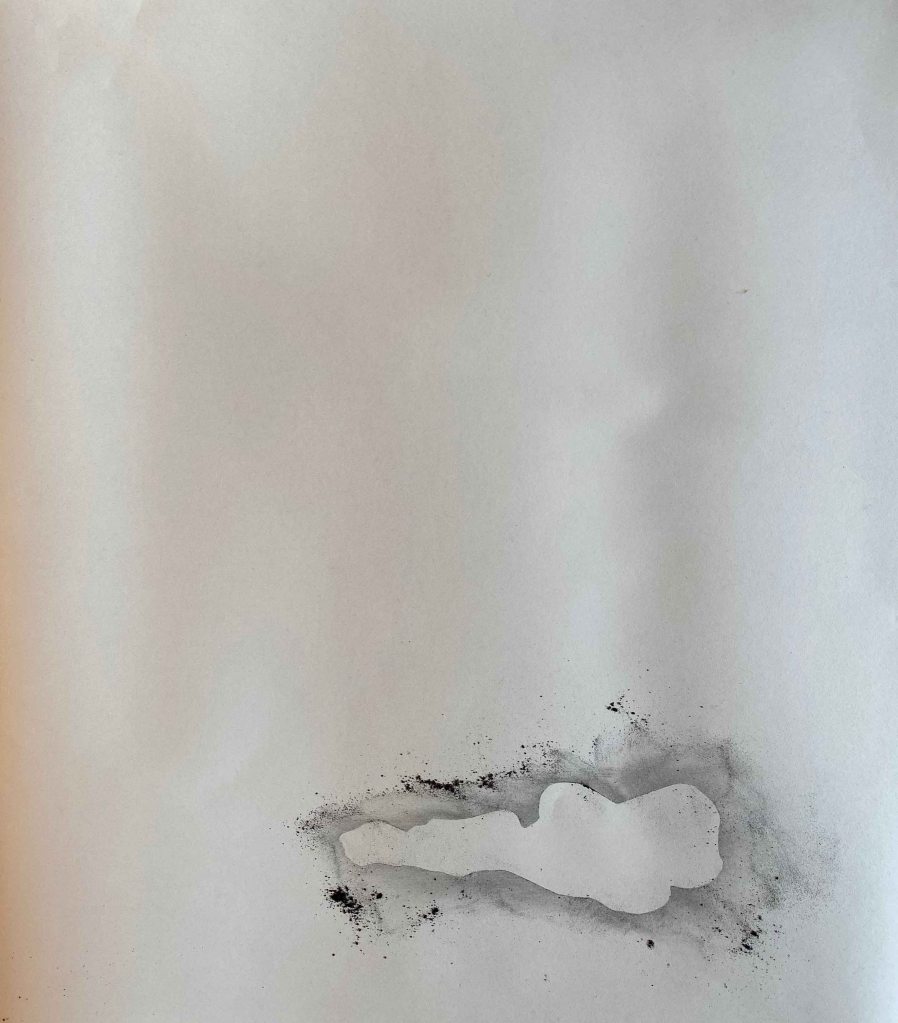
I like how it looks with the surrounding powder and wonder if I can fixate it like this.

The answer is no. I try this twice with different methods.

I find this second less messy version still has some interest, with the different layers of white and then graphite spreading out from the figure. It looks like a creature in a nest.

I continue with making a composition using the positive and the negative molds:

Here my two intertwined limbs have morphed in to a landscape. I see something like fallen soldiers on a battlefield.

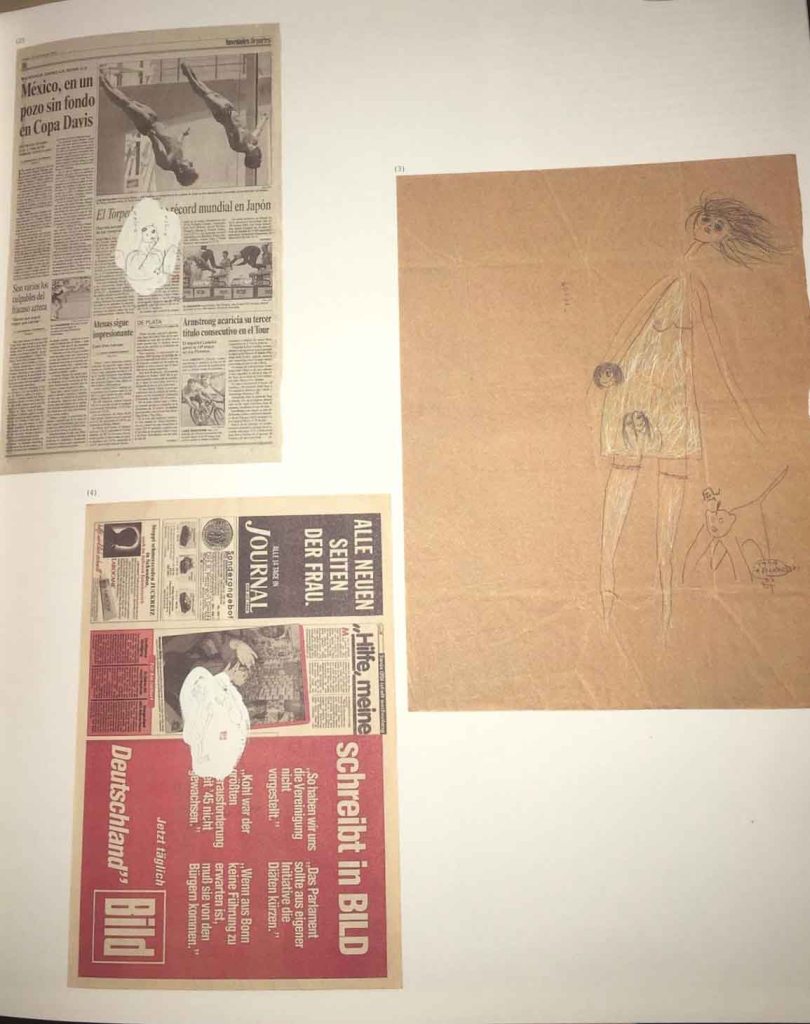
I am still hanging on to the idea of my figure as a symbol and it’s relationship to the page when I discover these works on newsprint by Kaoru Arima in the wonderful book Vitamin D: New Perspectives in Drawing:

(Image from: Dexter, E (2005). Vitamin D: New Perspectives in Drawing . England: Phaidon press)

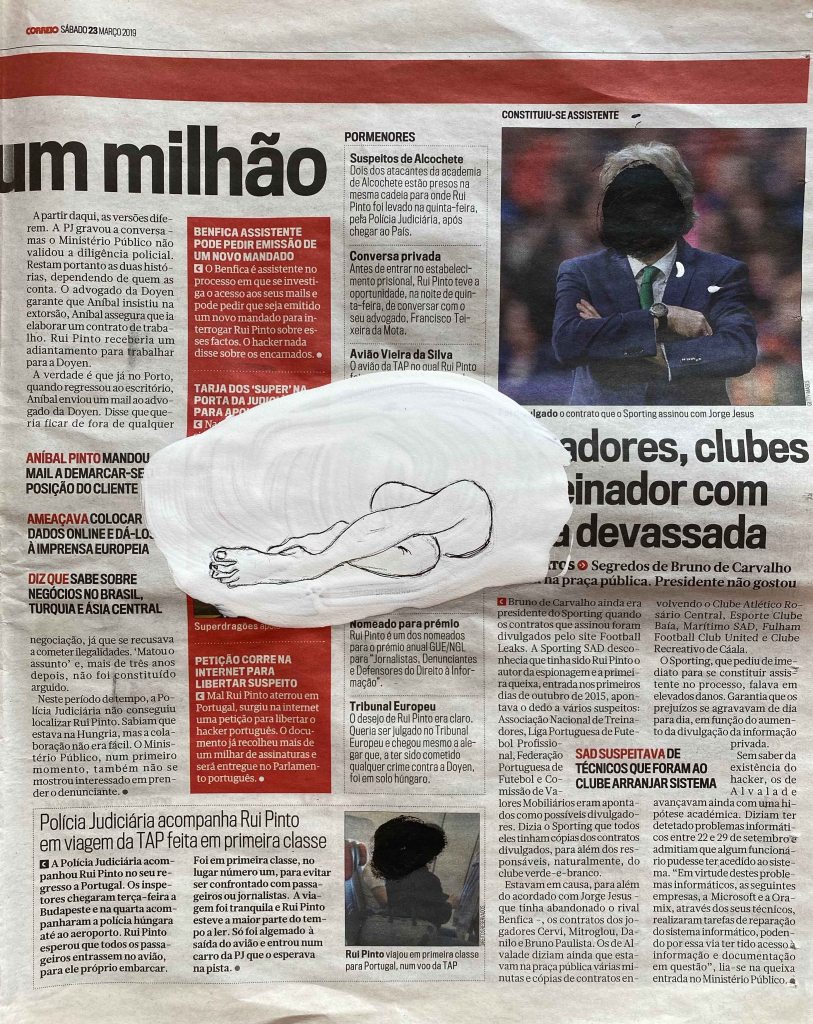
As a final trial for this project, I choose a page of a newspaper and paint a white cloud for my drawing to sit on. I choose a page with an image of a man with the arms crossed, which mirrors my crossed legs. I blacken out the face so that it doesn’t become the main focus .

I like this final of many versions of this pose. I has an interesting interaction with the other elements of the page. It is placed on a different layer through the white dot, but competes in strength with the hard red blocks, the rather strong image top right and the larger texts. The drawing itself is a little caricatured with the foot too large. The man with the now black dot head is looking down at the drawn legs.

Reflection: How far does your drawing direct the viewer’s gaze? Did you manage to retain the tension in the limbs – or do they seem a bit floppy and directionless? Have you managed to add an extra dimension to what could otherwise be a technical or academic exercise?

I think this pose directs the viewers eyes in an interesting loop. When this symbol like drawing is small at the bottom right of the page, it redirects the viewer back towards the center again. It reminds me of an infinity sign or of the letter in an unknown pictorial alphabet. In the last version on newsprint, it competes with the many other strong elements, but I find that after scanning the page, the eyes return to the loop of the legs.

I have allowed the process to guide this project, responding to way the paper wrinkles or the graphite powder blows instead of approaching it from a technical or academical way. Inspired by the previous projects, I have played more with composition and scale than an accurate anatomical drawing. I can think of so many interesting ways this project could have gone. I lost sight of the Egon Schiele inspired way of seeing the limbs. I will choose to continue looking at the human figure for the assignment though and develop this further.

1.3 Changing the scale

From the course manual:

Aim: The focus of this project is to explode notions of scale and experiment with an extreme change of scale to achieve a powerful drawing which suggests monumental landscape or architecture. Before you start work, spend some time thinking about the implications of manipulating scale in drawing composition, for example scaling up a particular feature of a landscape, still life, or even a portrait.

In order to understand the scale of an object, I need to understand it in context. I will always perceive an object in comparison to another that I already have a sense of scale for. For example, If I see a human, or a car, I will have a stored idea of roughly how big they are. If I see a pebble the size of a human, I will perceive it as a rock, not a pebble, and if it is much larger than the human, as a hill or mountain maybe.

Method: Find a handful of small objects, e.g. pebbles, shells, buttons, toys. Cluster these objects together and focus in on a cropped area. Experiment with using a frame for this. Make a large drawing which gives the impression of a landscape view or architectural detail, using these objects as your source material.

“By cropping your subject you’ll ensure that the whole composition has power and energy.”

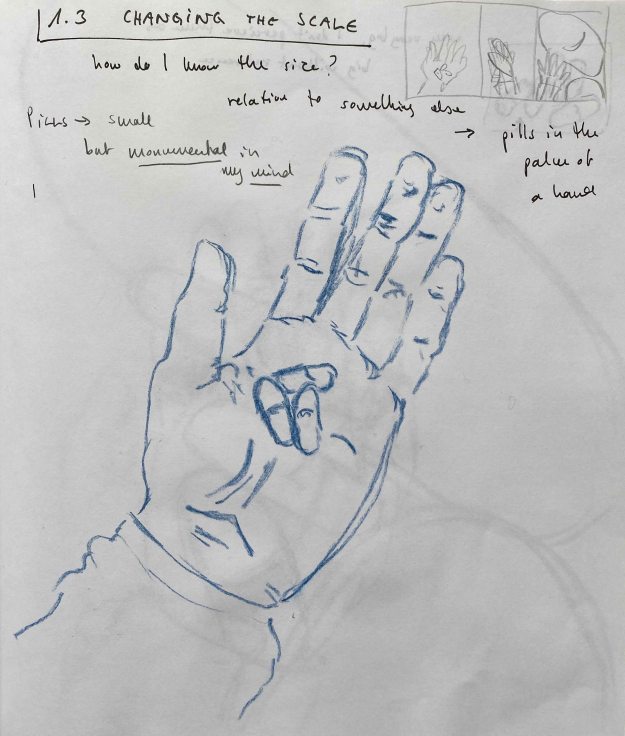
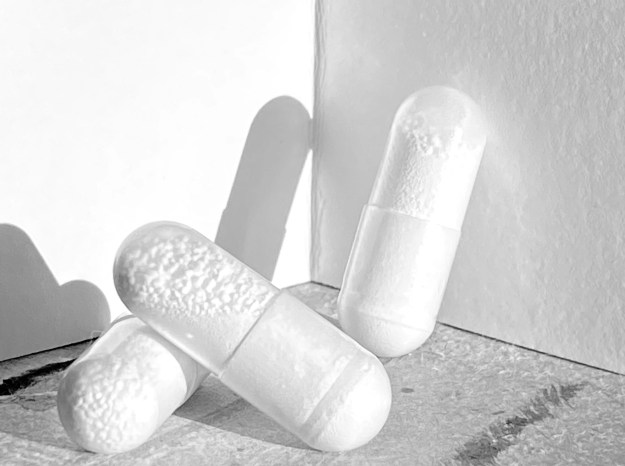
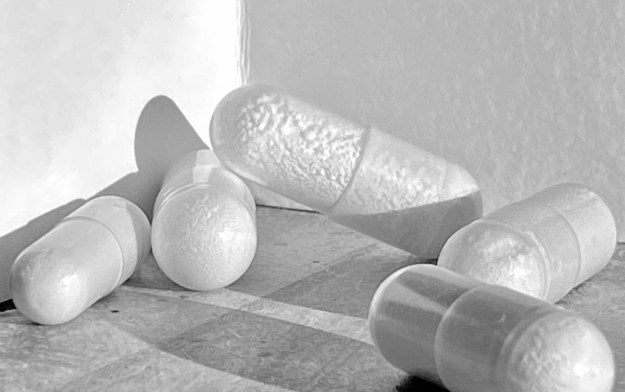
I immediately imagine to use pills as my subject- very small objects that can quickly become very big in our awareness in the case of illness, or addiction or also in the overuse of medication in our society.

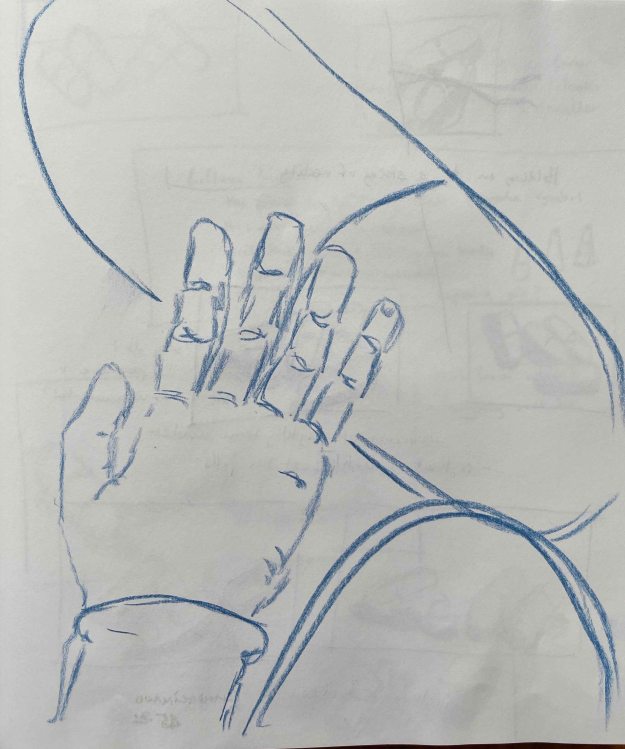
Wanting to create a context that shows the changing scale of the pills, I place them in my hand (quick drawings in my sketchbook)

I know more or less how big a hand is, so when comparing the pills to the hand, I have a sense of their size. When they are much bigger than the hand, they seem huge.

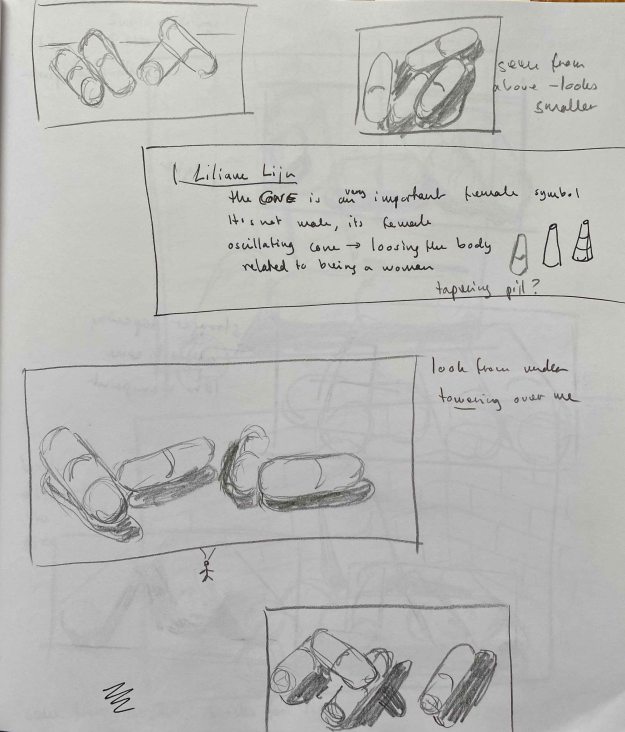
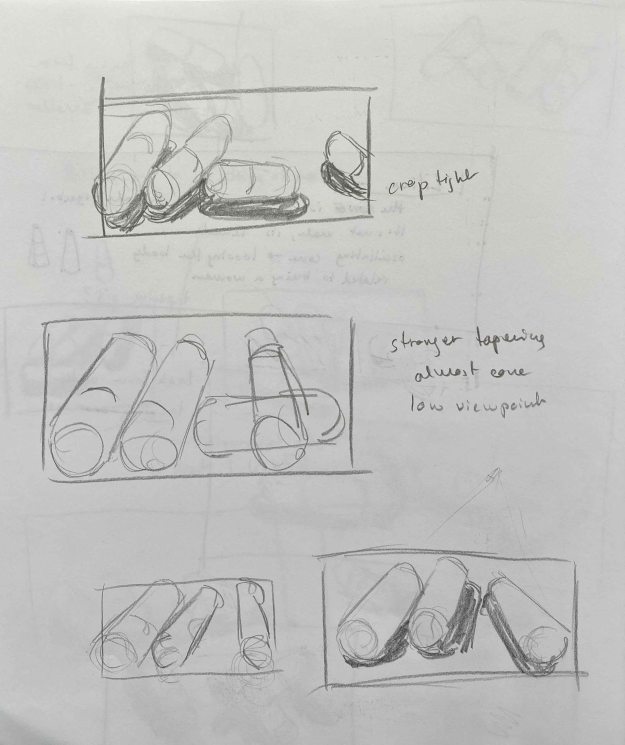
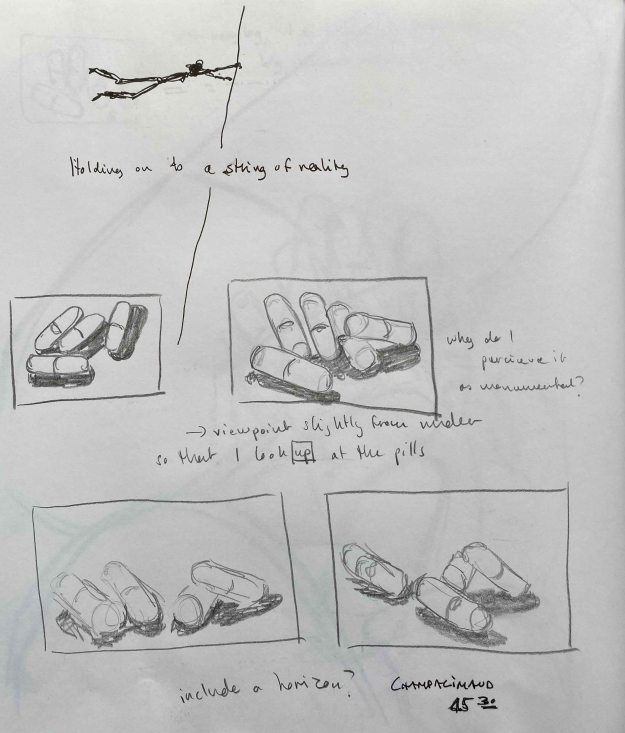
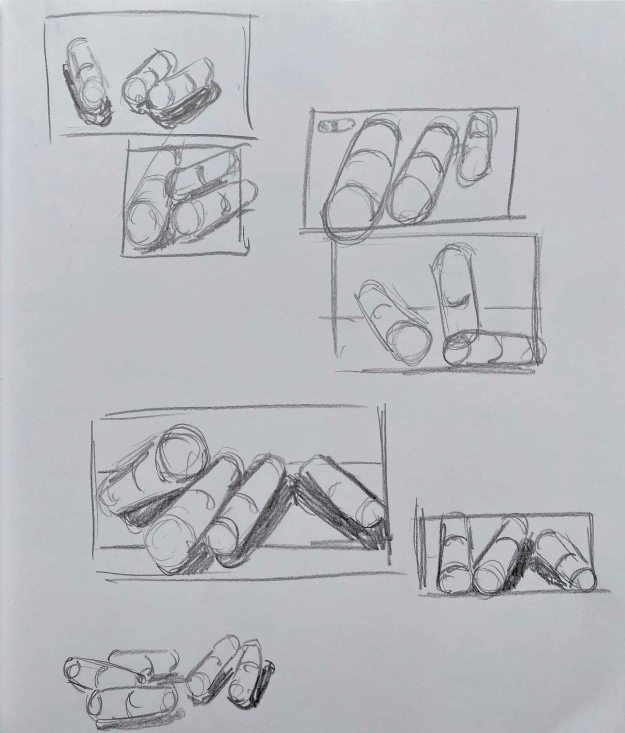
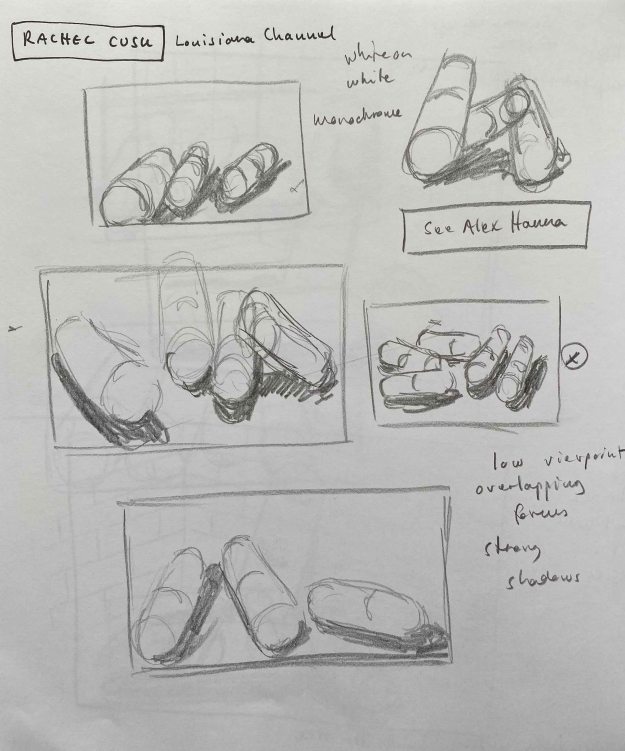
How can I do this without the hand? I can choose a low standpoint, as if I am small and looking up at them. I try out several versions and viewpoints in pencil in my sketchbook:

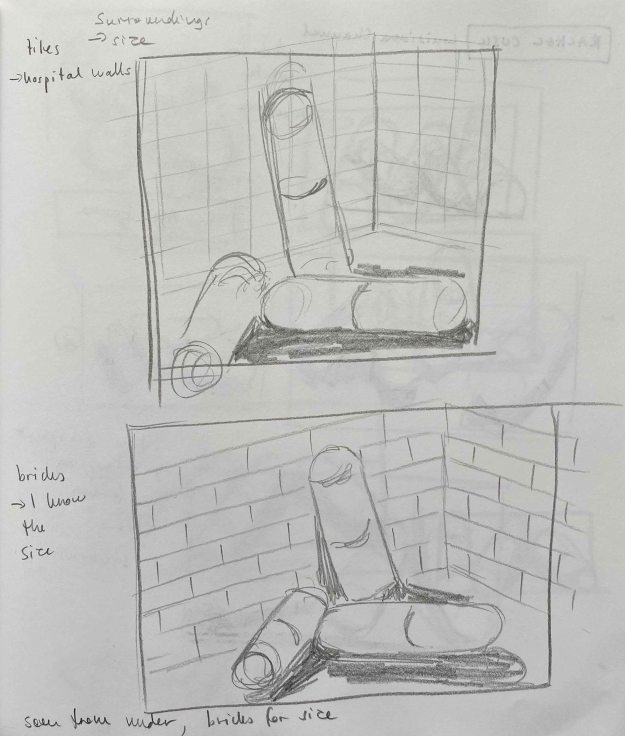
Adding only a horizon line does not give the wanted effect. I try placing the pills against walls, or brick walls, as I intuitively know how big a brick is.

A tiled wall makes me think of a hospital, a brick wall some storage unit maybe.

I have decided that I will include the walls to put the pills in the context of a room.

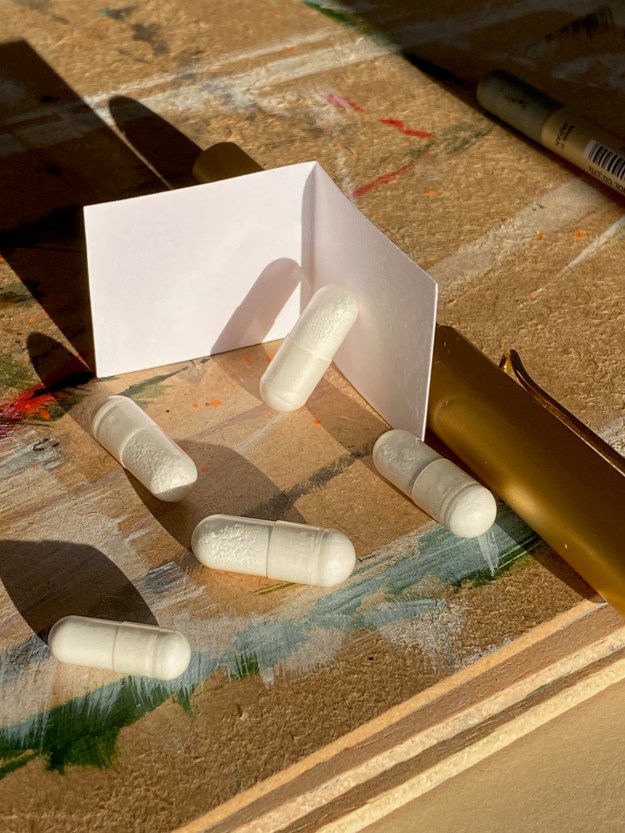
I create a little “miniroom” with a folded paper and try out many compositions by photographing them:

These are the two compositions I choose to explore:

I am remembering the paintings of Alex Hanna, often featuring packages of pills leaning against a wall in monochrome paintings. I will keep the colour scheme very subdued too, echoing the dullness or sadness of the subject.

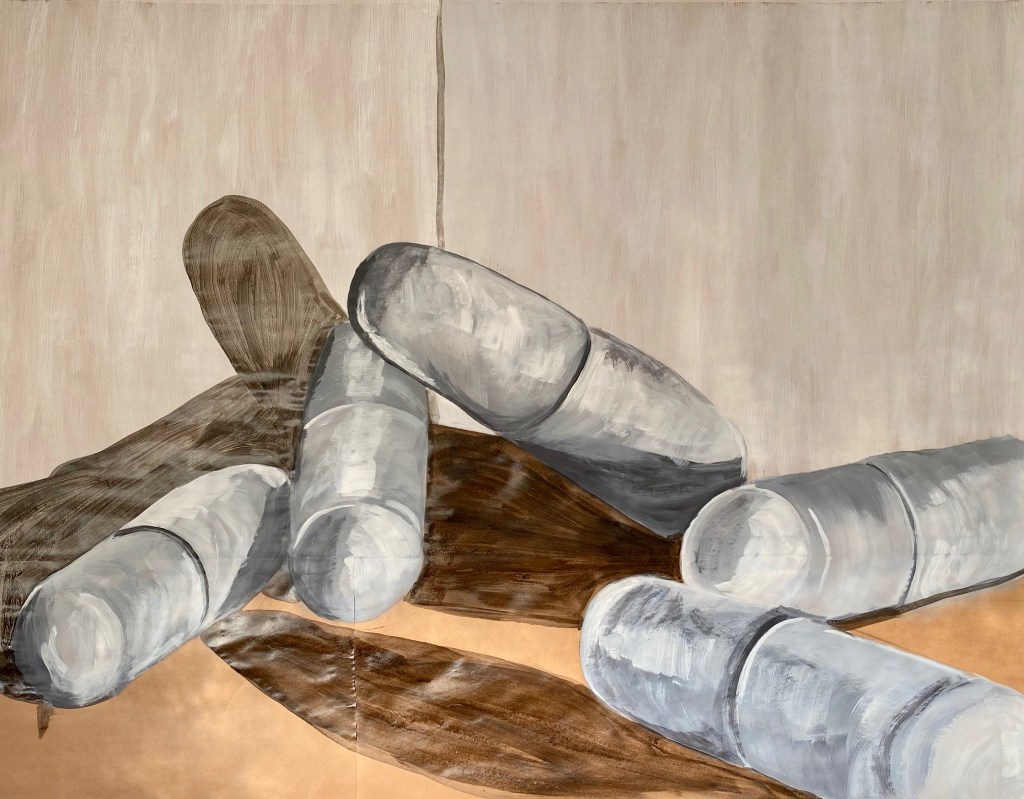
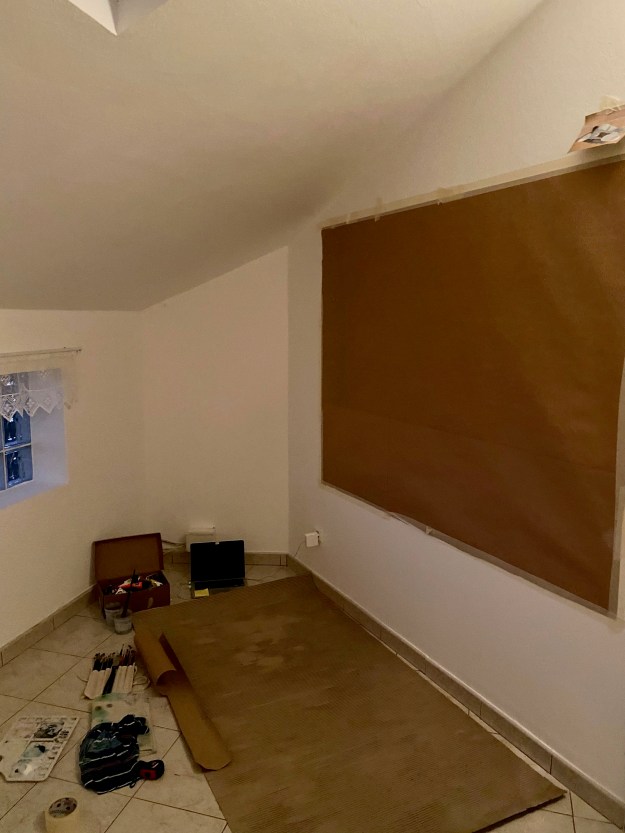
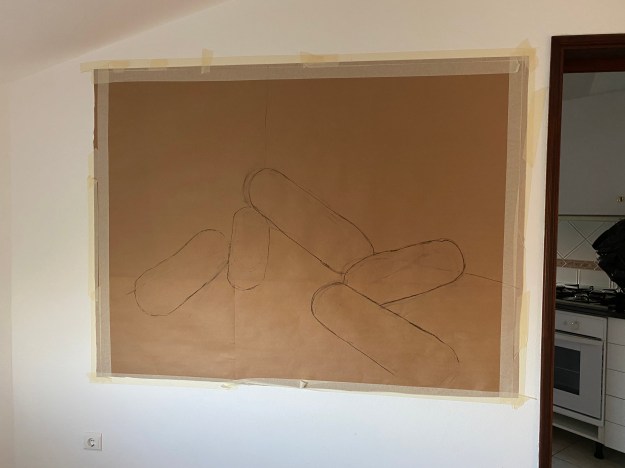
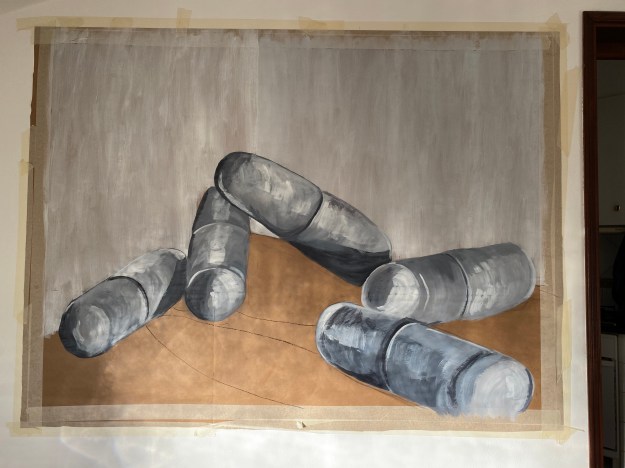
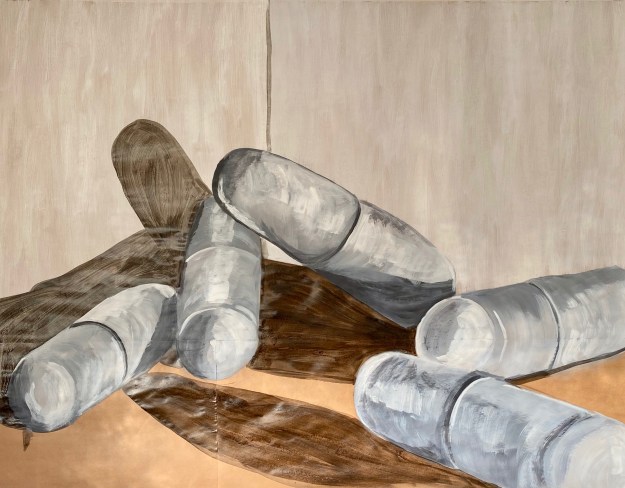
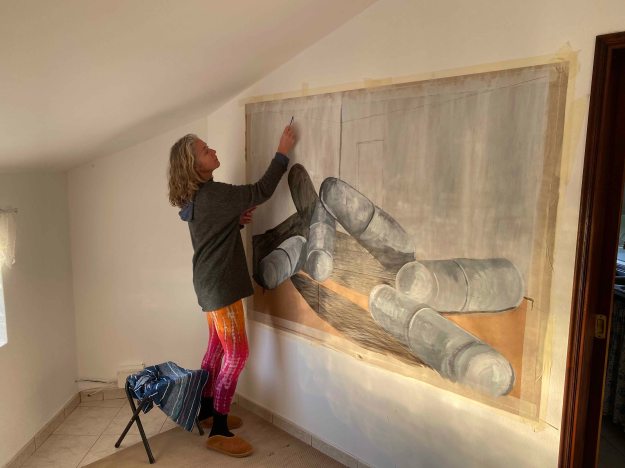
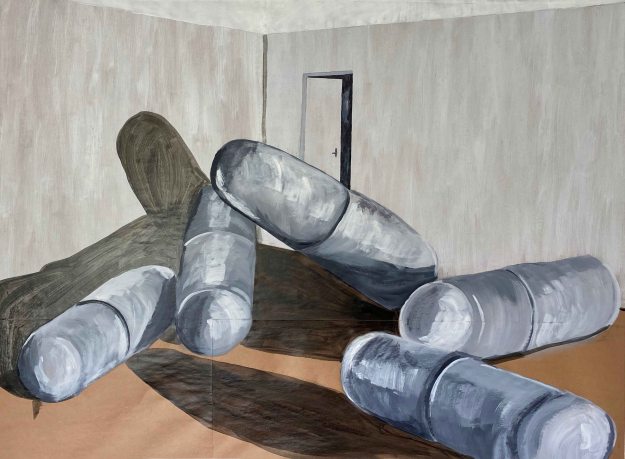
I want to draw as big as I can, so I use a roll of brown packing paper that I stitch together for a piece of 160x 120 cm:

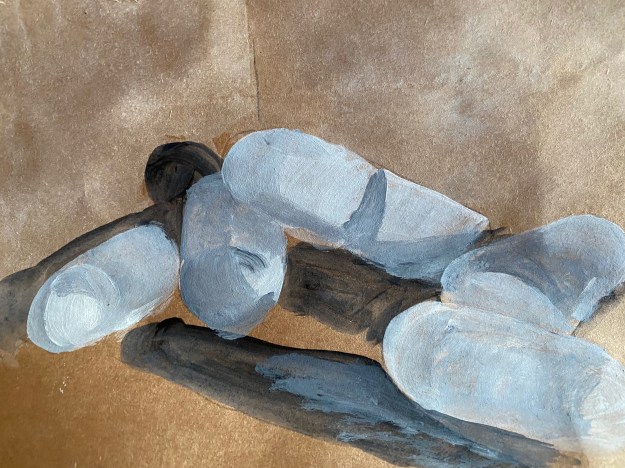
I first try out both compositions in small in diluted acrylic on the same brown paper:

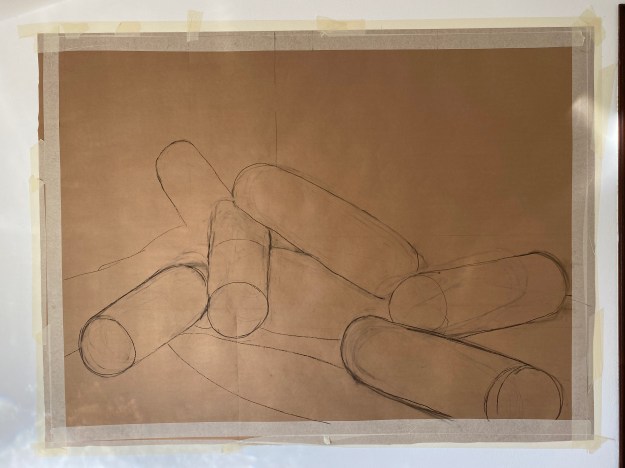
I choose the composition to the left and square it up to my very large paper:

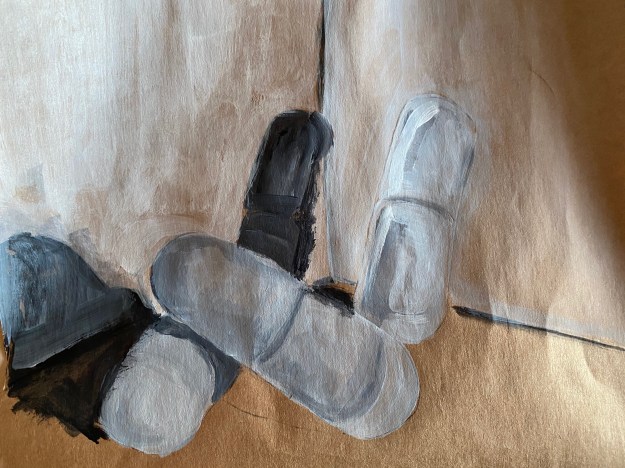
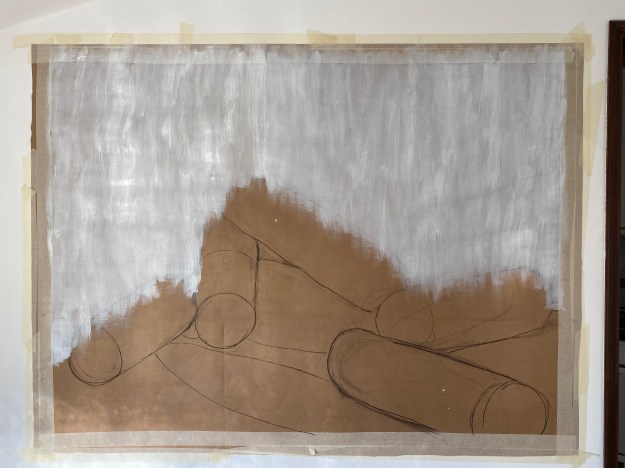
I start with very diluted acrylics, but soon see that I need to use more coats to have the lightness of tone that I want. I am using Titanium White and Payne’s Grey Amsterdam acrylic paints.

I add the shadows in Indian ink:

I choose this paper because it allowed me to draw a very big picture, I might have had an advantage of starting from a white background and achieved subtler tones. In the flesh, as it is so big, the drawing has a rather strong impact already. On the photograph, I see that the composition is not yet enough to show a real change in scale. Maybe the pills are just lying in a small package for example, and are shown on a billboard.

I need to add another element to the context- like the tiles, that I will perceive as having a certain determined size that I know from experience. I will also add a hint of the ceiling of this “room”.

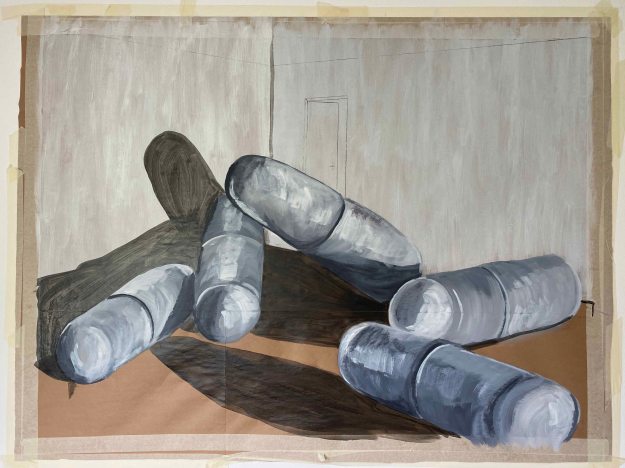
While marking the ceiling in charcoal and plotting out the bricks, I have a spontaneous idea to add the element of a door instead. A door will immediately show that this is a room, and we have an intuitive knowledge of the size of a door. This will be the final element that will really make the change in scale clear:

This is the final image, 160x120cm on brown paper, Amsterdam acrylics and Indian ink:

I think I have achieved an extreme change in scale in this image- the pills look huge put in the context of the room. The dimensions of the room became clearer when adding the elements of the ceiling and the door.

I think the pills have an oppressive, rather threatening quality which also reflects how something so small can become so big in my awareness.

1.2 Using space- Henri Matisse

After studying the work of Elisabeth Blackadder, I will make a different piece inspired by Henri Matisse’s more sophisticated use of space and pattern.

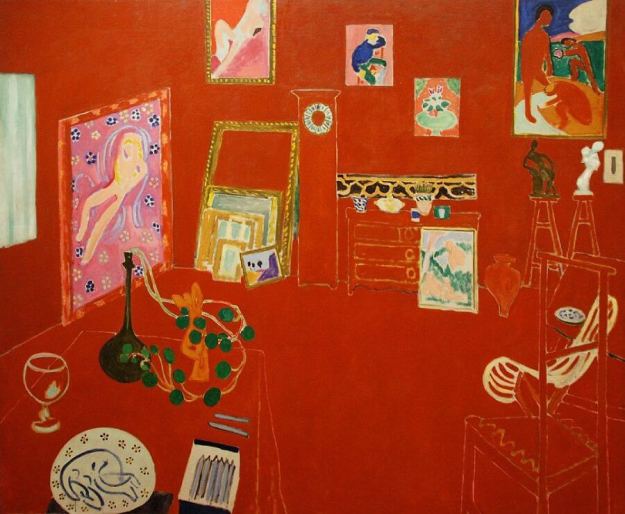
In the blogpost about the composition and use of space by Matisse, I chose to look at “The red studio” from 1911.

Image from: Ars. c2019. https://wwwmomaorg. [Online]. [13 December 2019]. Available from: https://www.moma.org/collection/works/78389

In this painting, I like the combination of the detailed elements and the swirling linedrawing of the furniture that creates depth the sense of space.

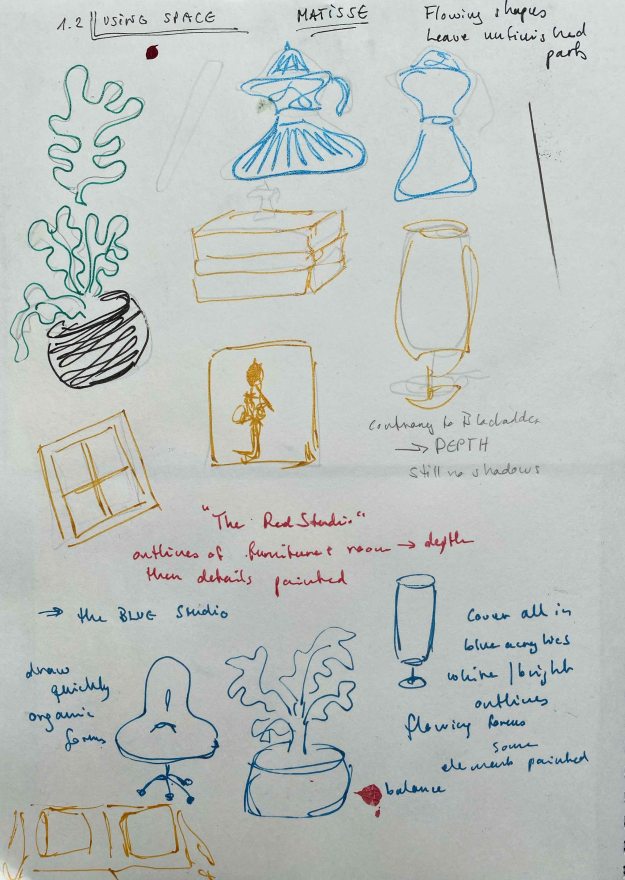
I start by looking at the line and shapes Matisse is using, while using items from my own surroundings.

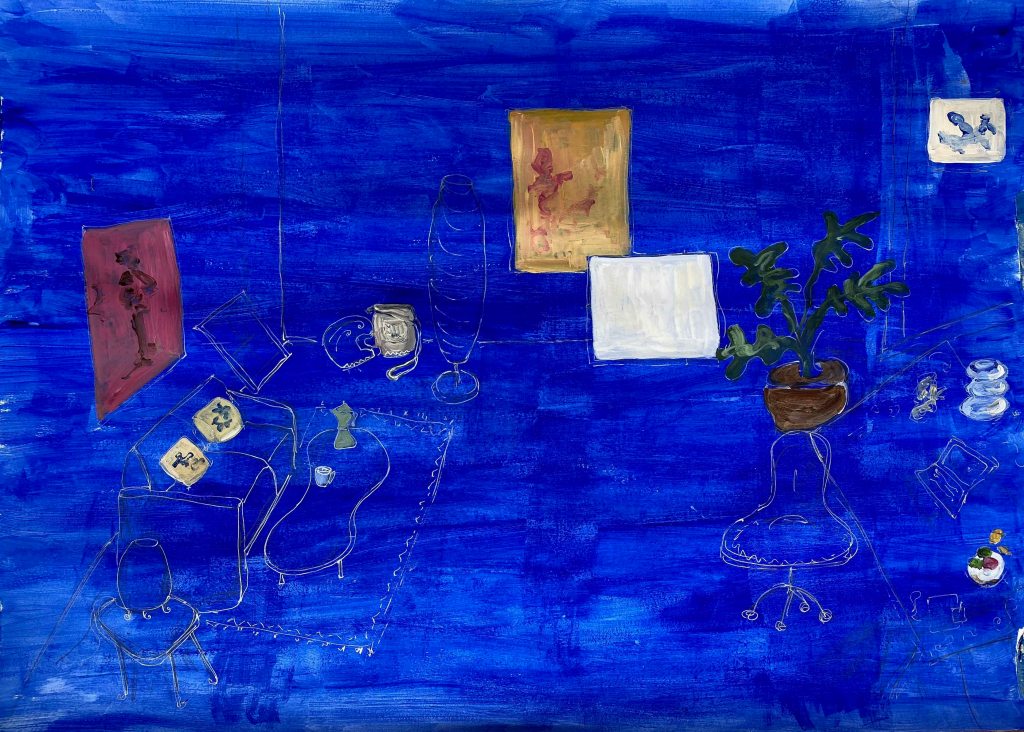
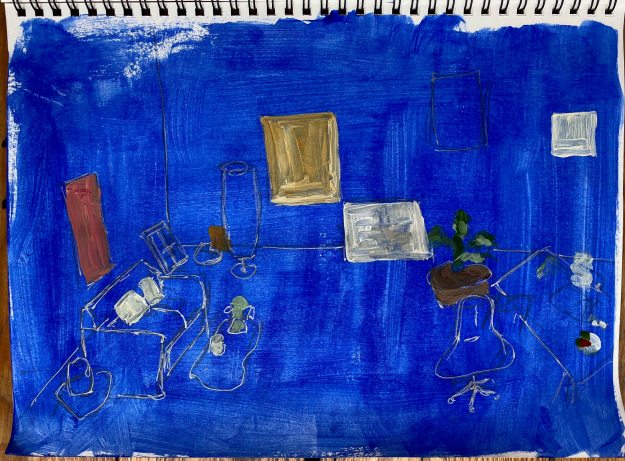
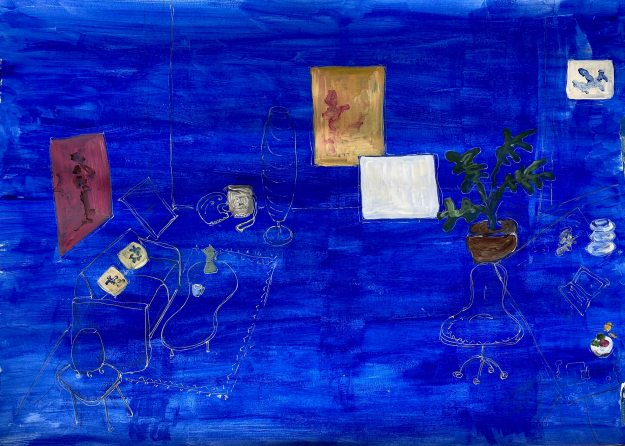
I decide to paint my own livingroom/studio in this manner, but choosing a blue background. My walls are normally white, but I will imagine them blue, and take some freedom in moving the objects as well.

This is a study in acrylics and gel pens in my A4 sketchbook:

I decide to replicate this on an A1 Canson Mixed Media paper using acrylics for the painted items and pens for the linedrawing.

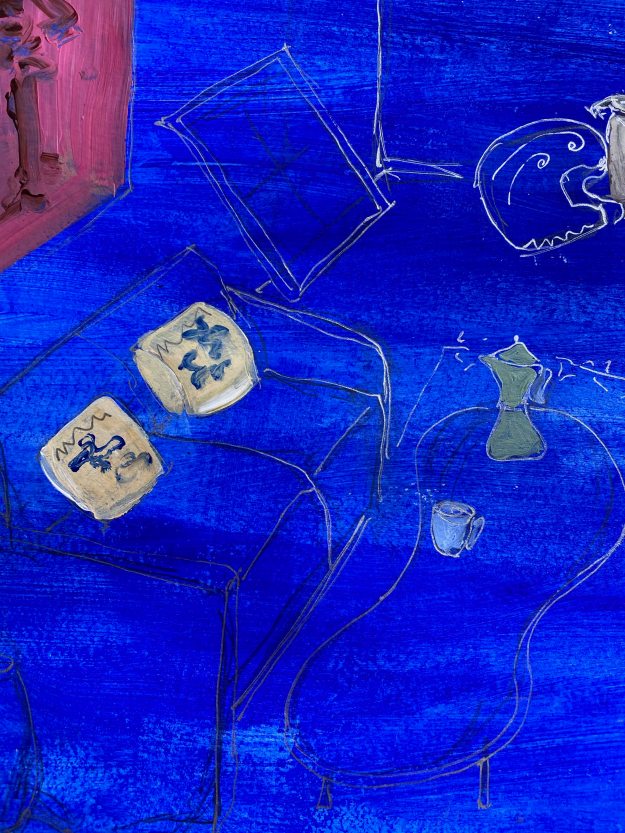
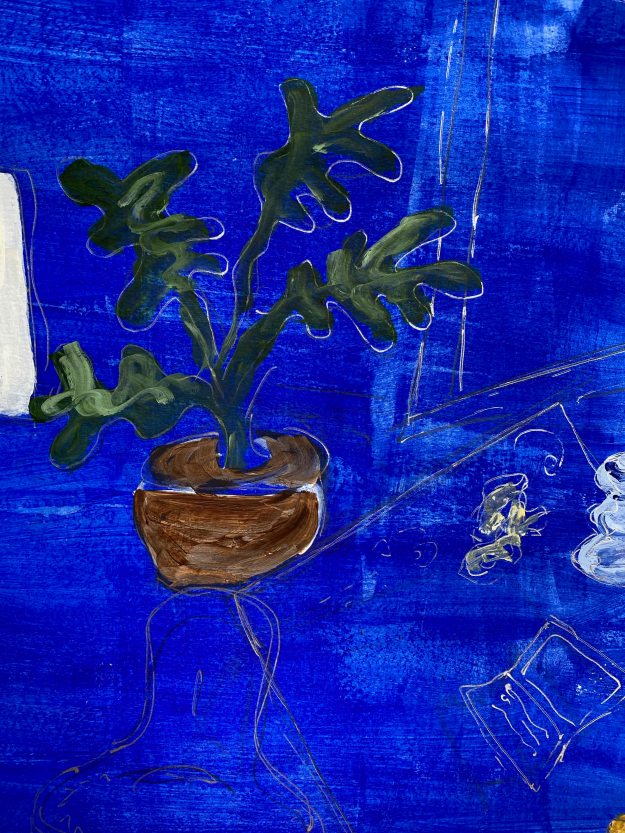
This is the final drawing, with some added decorative elements. It is difficult to see the line well on the photograph, it has a nice gloss in the flesh.

These are close ups:

I think that I have achieved balance between the painted elements that immediately attract the attention, and the space around it in this drawing. I believe the three smaller, lighter items on the right are balanced out by the heavier red frame on the left as well, not letting the drawing tilt to one side or the other.

1.2 Using Space- Elisabeth Blackadder

I have started this project by taking a look at the work of Elisabeth Blackadder and Henri Matisse, as I have described in a separate blogpost found here: https://clarasdrawing2.design.blog/2019/12/13/elisabeth-blackadder-henri-matisse/(opens in a new tab)

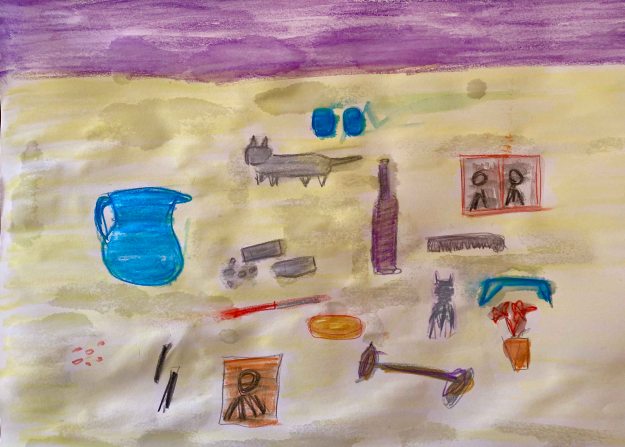
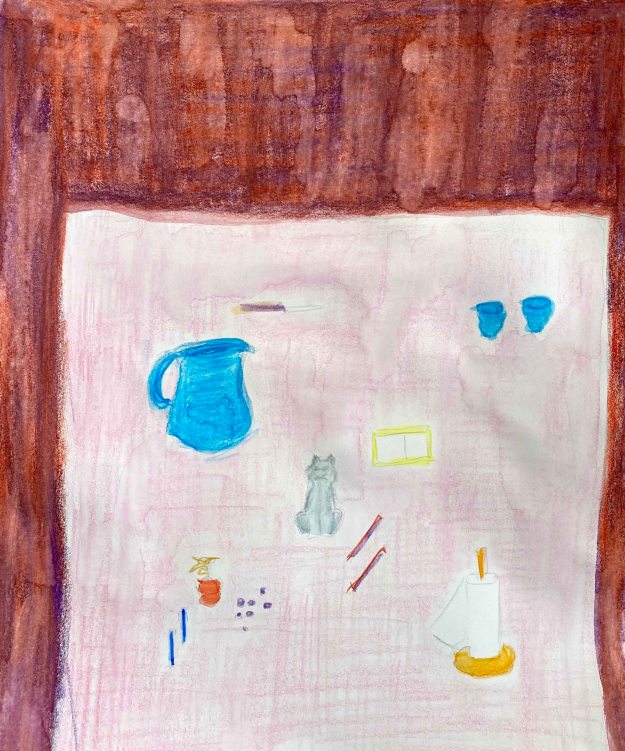
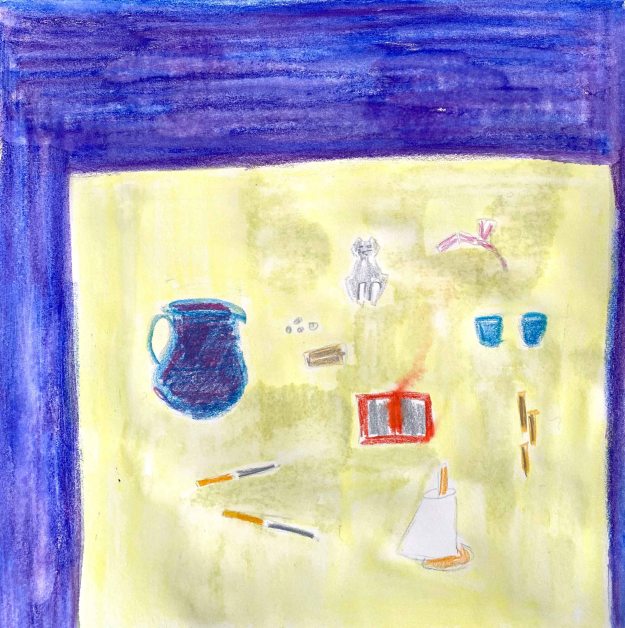
I am currently on an unplanned visit with my mother, so I start exploring different compositions in my small pocket sketchbook, by looking around for interesting objects. I think Elisabeth Blackadder would have found a lot of material here, my mother being somewhat of a collector too. They also share an interest for anything Japanese and cats.

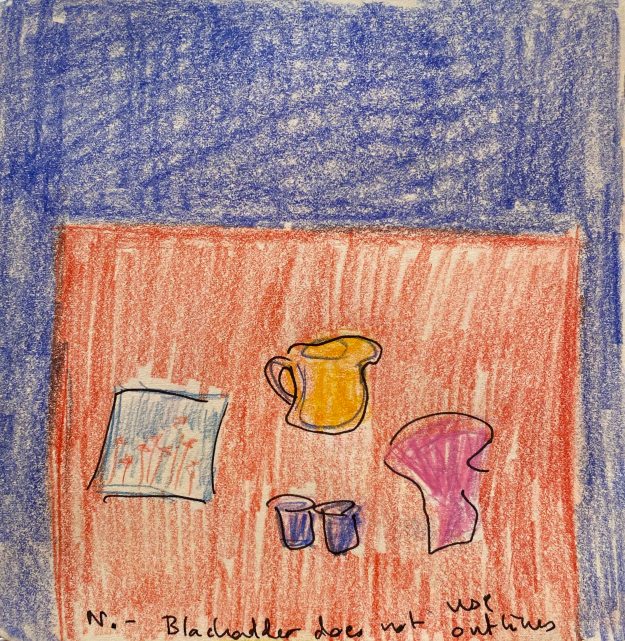
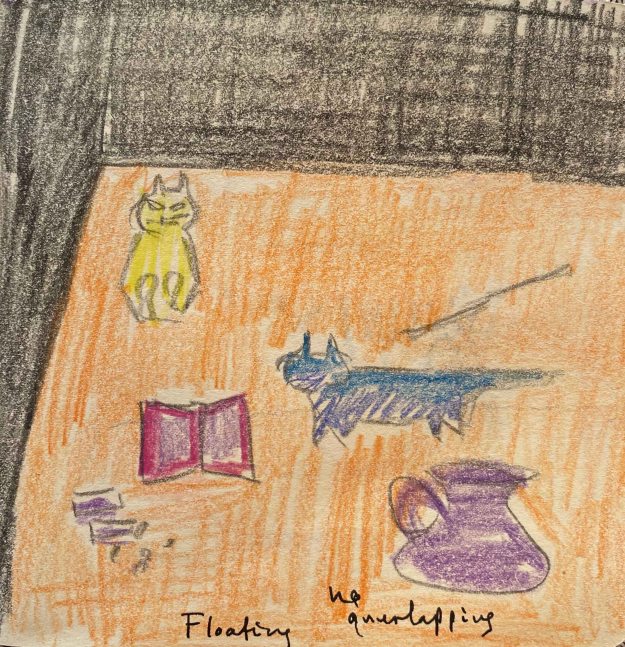
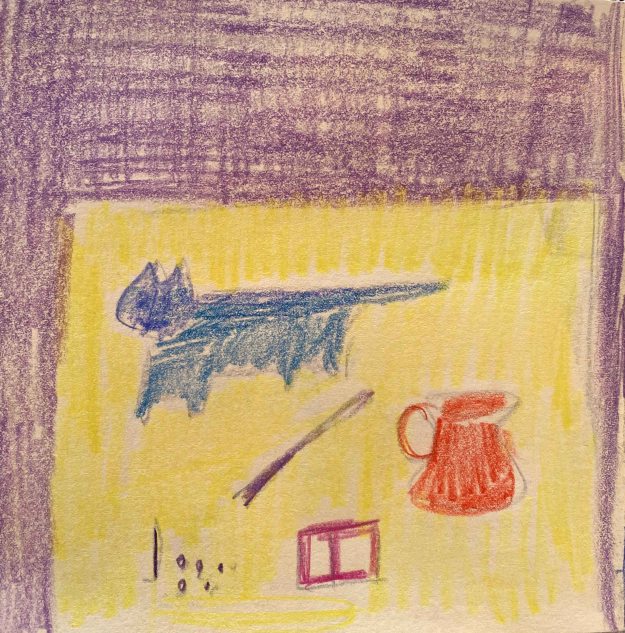
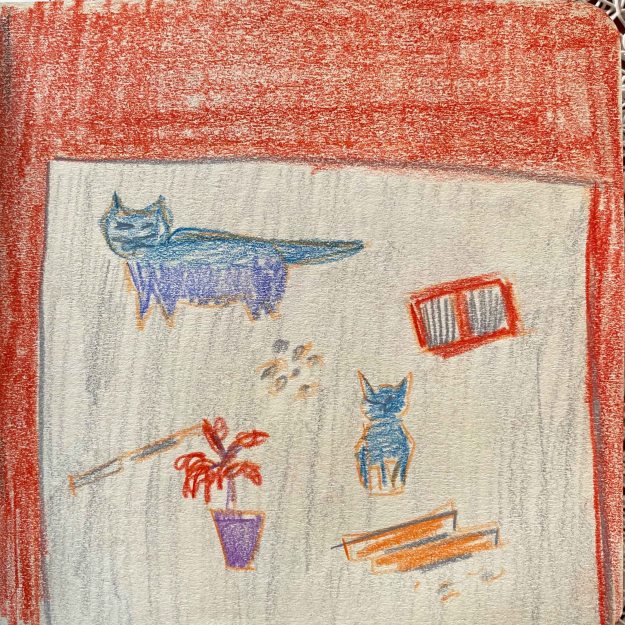
I am placing different collections in various arrangements, working intuitively as I observed Elisabeth Blackadder doing in the videos, moving them around and combining shape and colours, leaving the objects flat, without shadow or sense of depth.

I am using coloured pencils in my small format pocket sketchbook.

I observe how important the weight of the larger colour fields is, without it the collection of little things completely loose interest . Also how a brighter coloured item immediately draws my attention and can balance out a much larger darker colour.

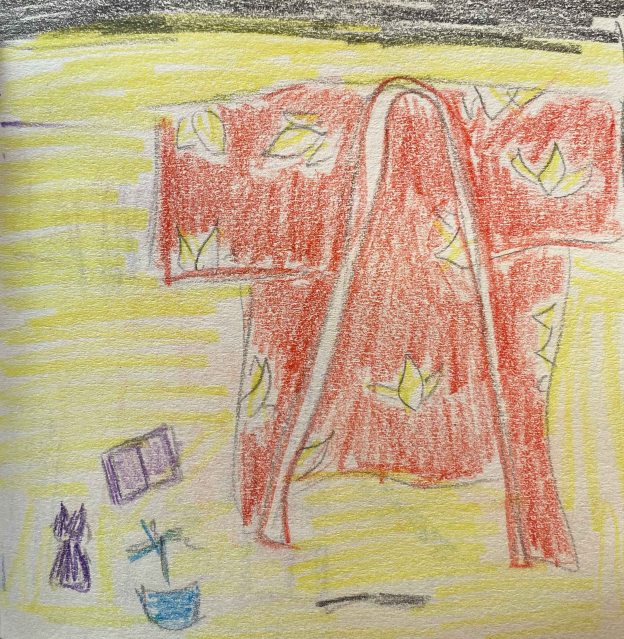
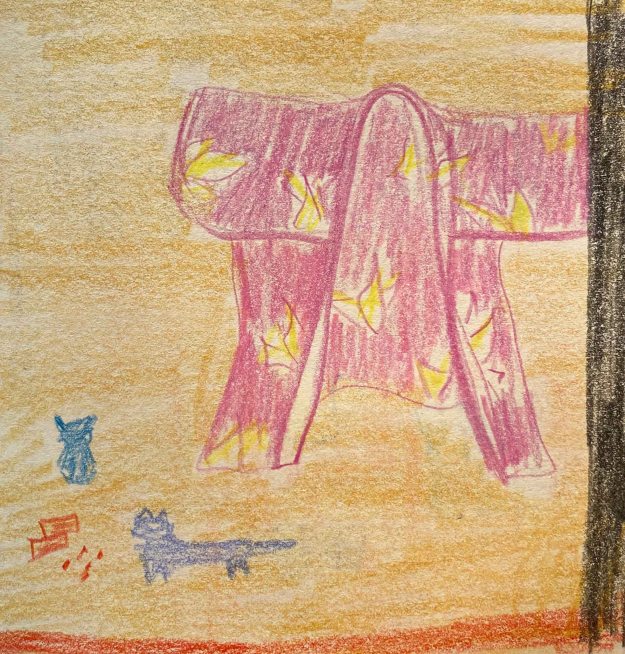
I discover a beautiful kimono and take some freedom with the colours and patterns when including it in the next compositions:

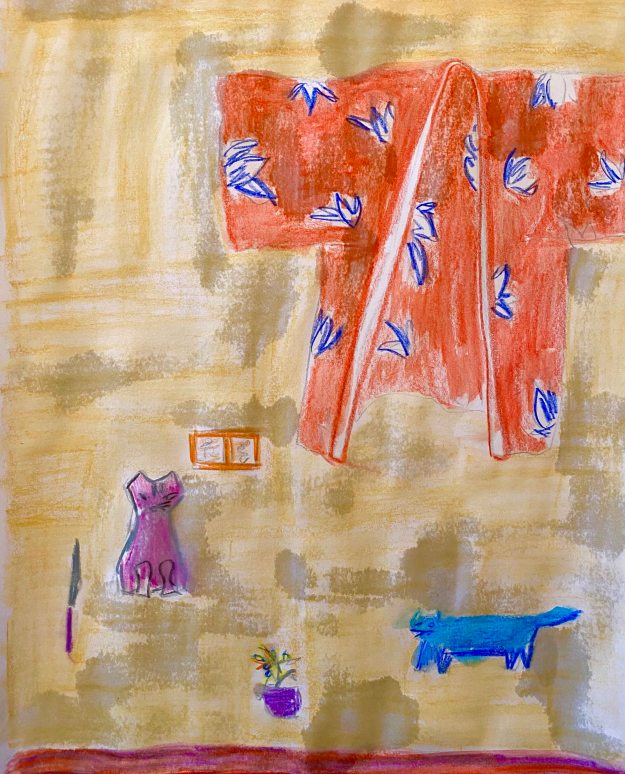
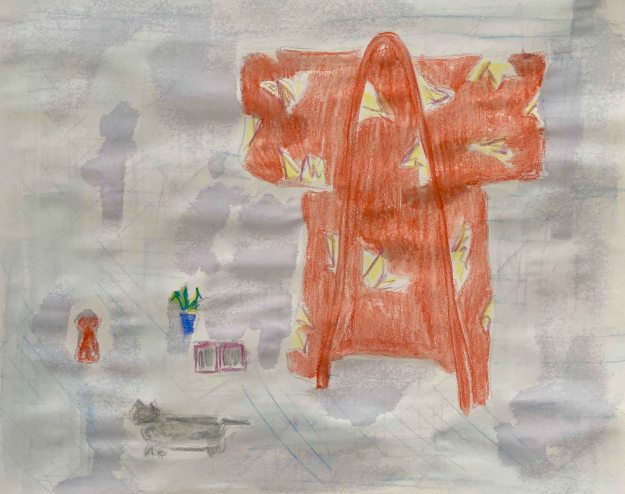
I continue my exploration on A4 sheets with the coloured pencils and water that turns them into watercolours (unfortunately on too thin paper that wobbles)

I think both of the above work- it is helpful to have the large red main object, the kimono, dominating the composition that immediately becomes clear and solid. I could maybe argue that there is more a sense of background in these than in paintings with many smaller objects and clearer balancing separate colour fields.

I think these last three would have benefited from painting the objects somewhat larger and use fewer items, for a clearer composition, they are all somewhat cluttered. The larger colour fields come more to value in the two right hand ones with the middle one being the calmest. Allowing the darker field surround the space where the smaller objects are placed holds the composition more balanced.

I have to leave France again, without the satisfaction of pushing any of these further. After three more stops, I am finally back home in Lisbon and approach this project again. I observe how different it feels to look at my own familiar objects when composing a still life- how I do not only see shapes and colours but my own ideas and preferences.

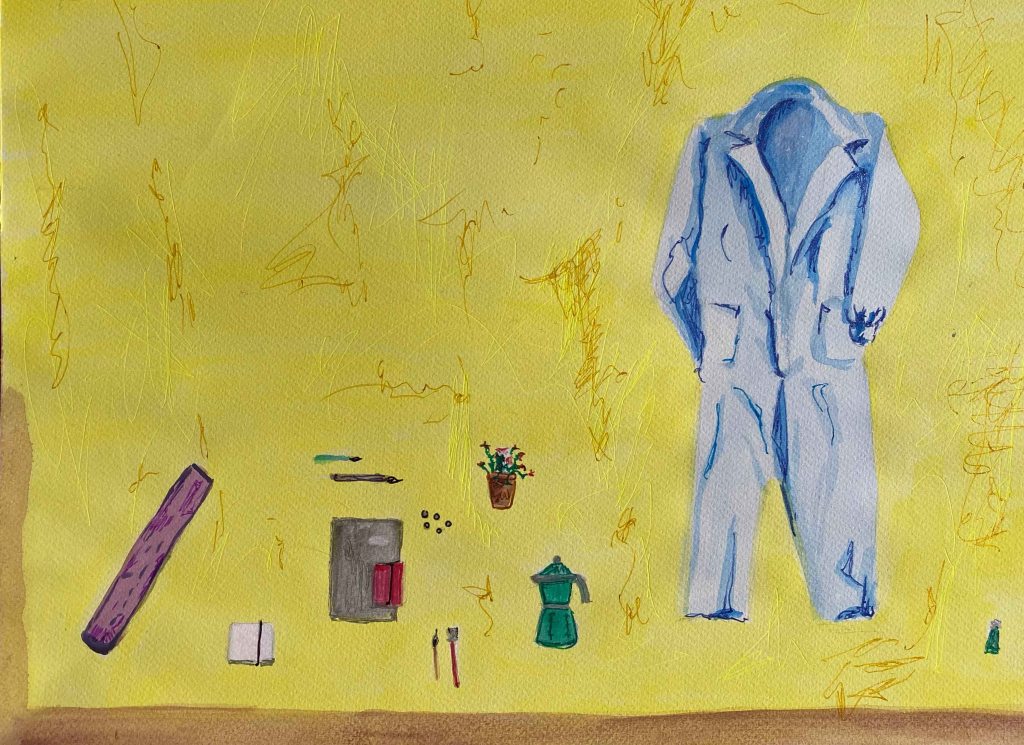
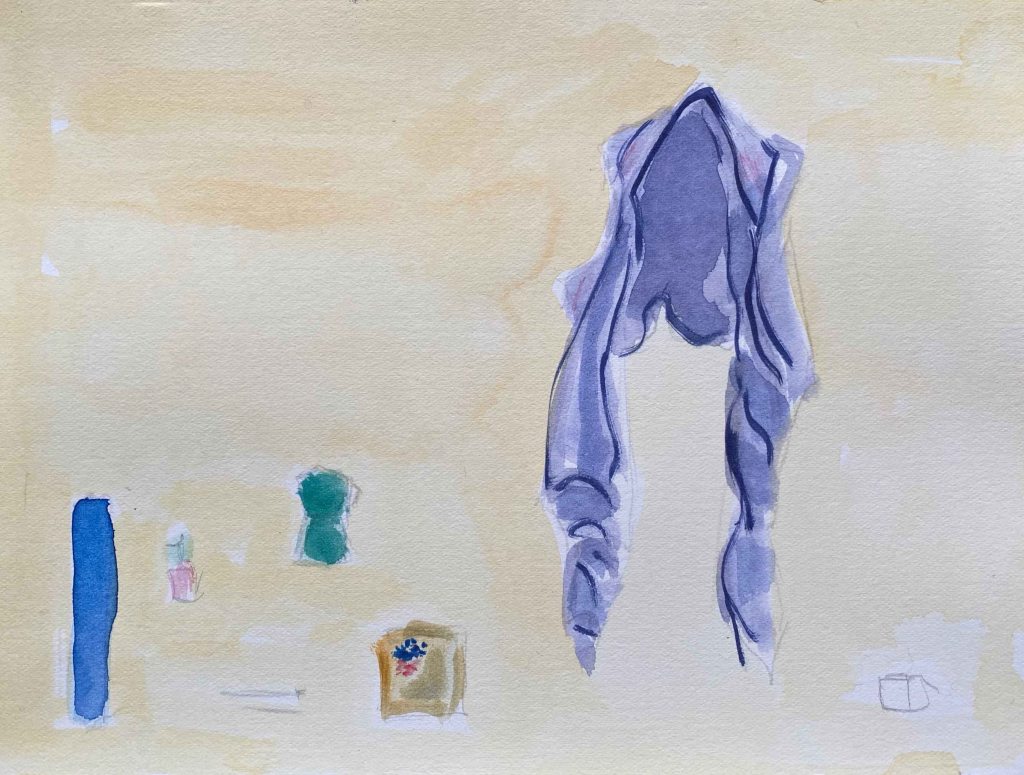
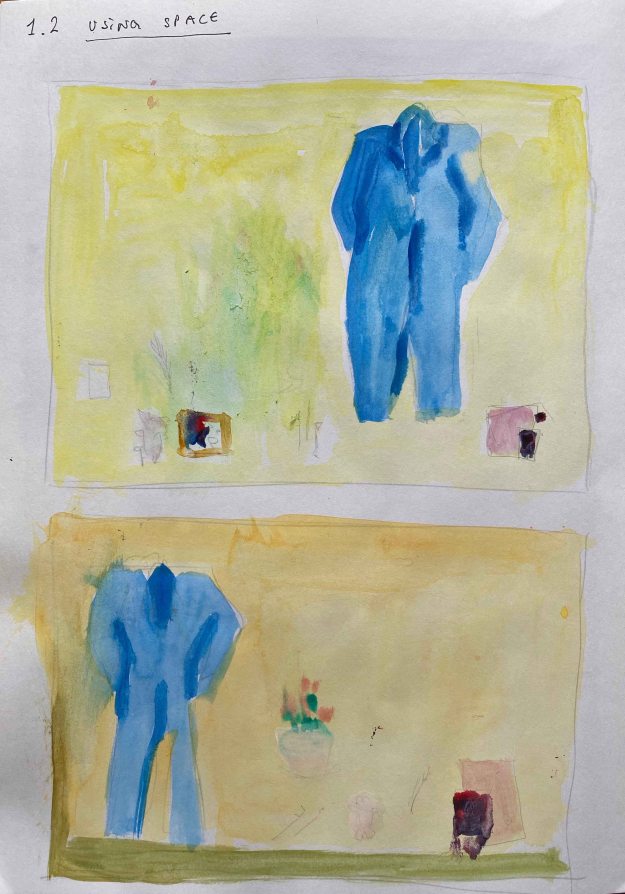
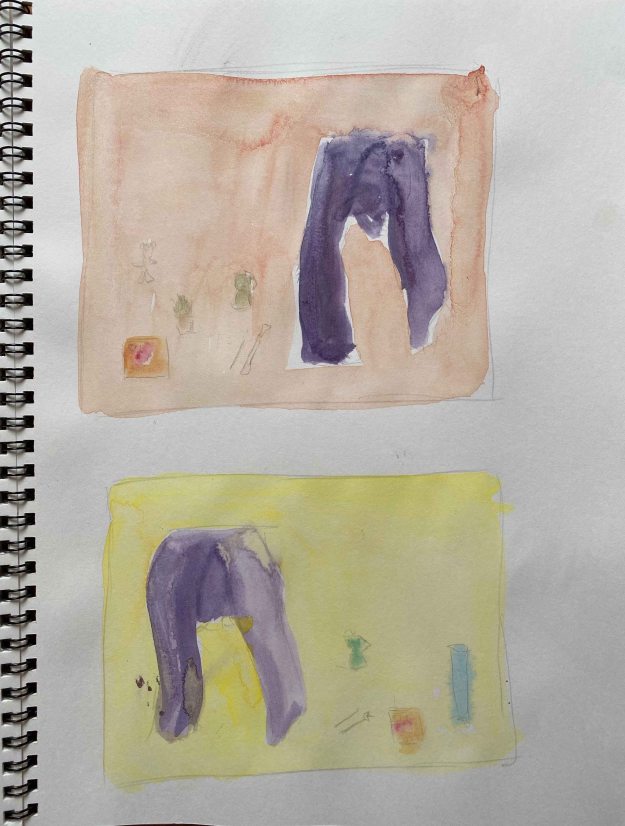
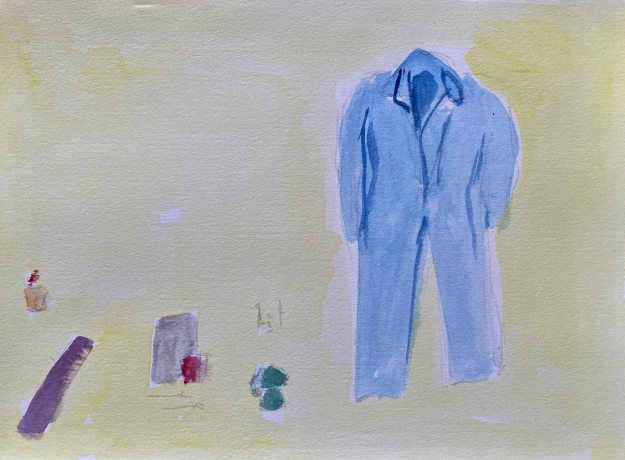
I liked several of the compositions with the kimono above and am continuing the idea of a larger clothes item dominating the image. I chose two for trials- a sloppy purple west and my blue winter painting overalls and start with some compositions in Lascaux Aquacryl in my A4 sketchbook.

I choose to continue the purple west on a slightly orange background and the blue overalls on the lemon yellow background, contrasting larger darker objects on bright backgrounds and in both cases placing the main object to the right side.

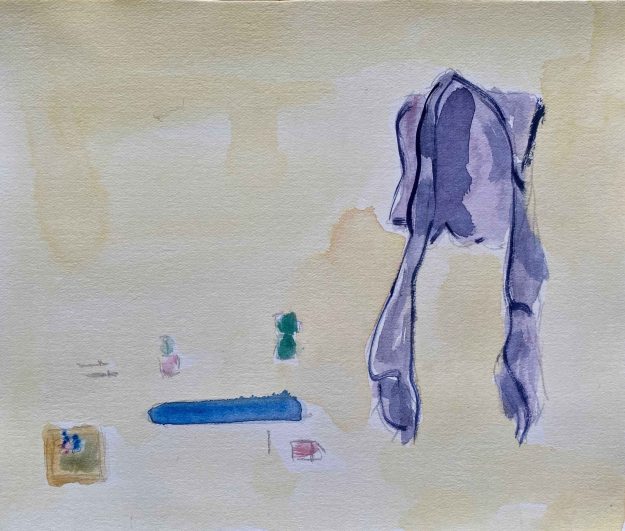
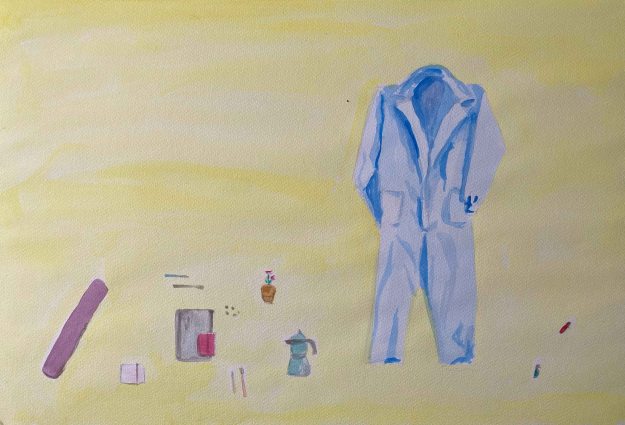
I switch to a Fabriano watercolour paper and continue with quick A5 trials in Lascaux Aquacryl:

I have added other objects that are meaningful to me- my yogamat, the espressomaker, a small plant, brushes and sketchbooks. I find the purple west interesting but too unclear a shape and decide to explore the version with the blue overalls:

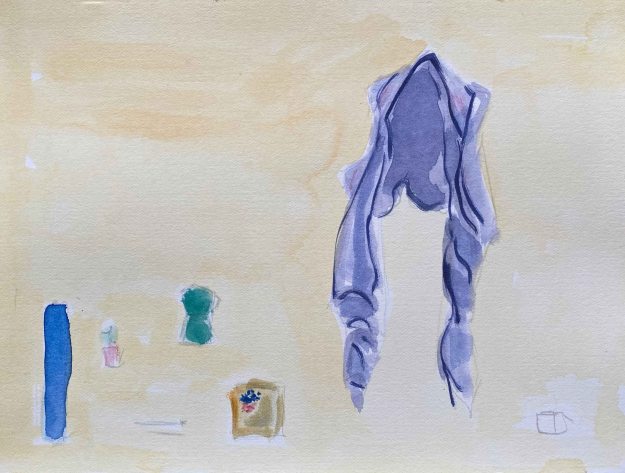
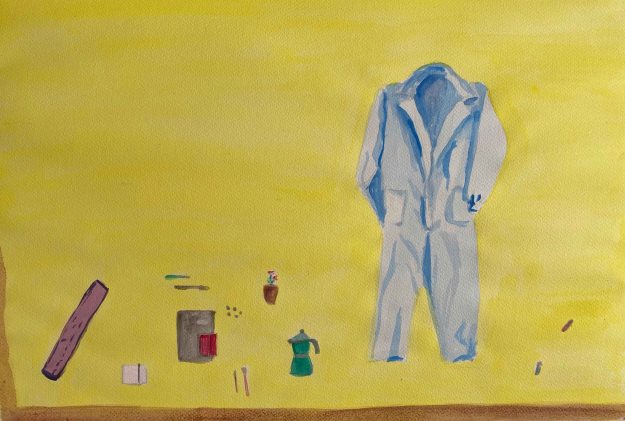
I decide to continue with the composition to the left. I choose a Fabriano A2 watercolourpaper and Lascaux Aquacryl:

The image to the right has two layers of paint for brighter colours, more detail and I added a brown line to give it all some hold- something I observed in one of Blackadder’s kimono paintings.

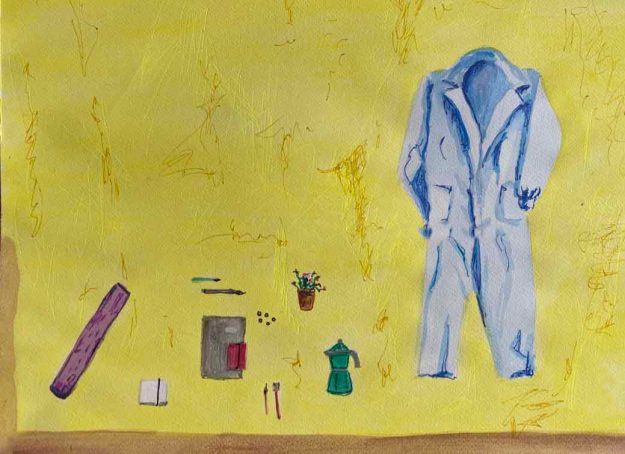
Finally, I decide to go over the drawing with gel pens for some more life and a contemporary touch in this final version:

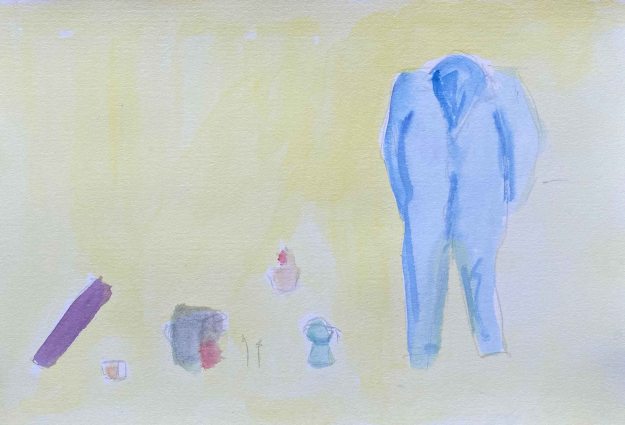
I think it is quite clearly inspired by Elisabeth Blackadder’s paintings, with the objects floating freely in a field without depth. I am still really unsatisfied with this drawing and launch into a final trial directly on the A2 paper, following my initial trials in the small sketchbook while still in France.

The verion on the left is in watercolour only, while the right side is after enhancing with gel pens. The objects are too small and blank to balance out the large surrounding colour fields. I would crop this drawing like this:

As a conclusion, I have used this exercise for a lot of intuitive trials and reflection on space and composition. It has been a lot of flapping around (also sleeping in five cities in 8 days), and I feel unsatisfied with the final outcomes. I feel like I have learnt some precious lessons about composition though, and definitely gained new respect for the art of Elisabeth Blackadder.

Project 1 Observational drawing

This part of the course encourages me to take a closer look at composition through observational drawing.

Drawing 2 coursebook:

Aim: ” This project encourages you to reflect on the wider potential of observational drawing, in particular how you can use what you look at more experimentally as you develop your composition. You probably normally start by finding an interesting subject or setting up a still life. This project asks you to reverse this process by finding what may seem an initially unpromising subject, but one with several elements, and then building up the composition to create an interesting drawing. This will encourage you to reflect on the potential of a more creative and open-ended approach to composing drawings.

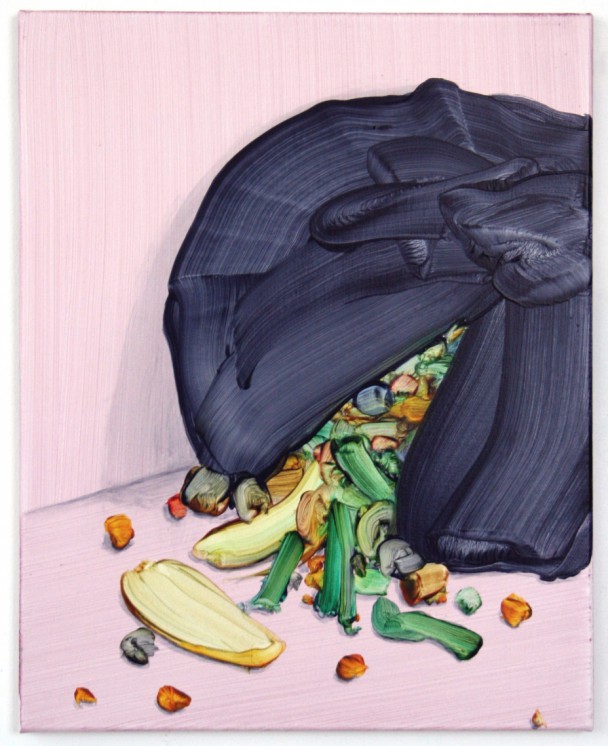
The “unpromising subject” immediately makes me think of the contemporary artist Mimei Thompson who paints beauty in the everyday, in a ripped open trashbag, in a fly, or in the weeds between her house and the studio.

(Images from Thompson, M. c2014-15. Mimei Thompson. [Online]. [7 December 2019]. Available from: http://www.mimeithompson.com/work/collection/2014-15/#, with permission of the author.)

In an interview with Alli Sharma for the “Articulated artists” blog, she sais: “I was interested in looking at neglected corners, with the idea of finding something transformative in the everyday.”

Quote from http://articulatedartists.blogspot.com/2013/10/mimei-thompson-talks-to-alli-sharma-at.html (Blogspotcom. 2019. Blogspotcom. [Online]. [21 September 2019]. Available from: http://articulatedartists.blogspot.com/2013/10/mimei-thompson-talks-to-alli-sharma-at.html)

This is a subject I like very much exploring – transforming the everyday, the so-obvious- we don’t see it, into something that make us reflect again.

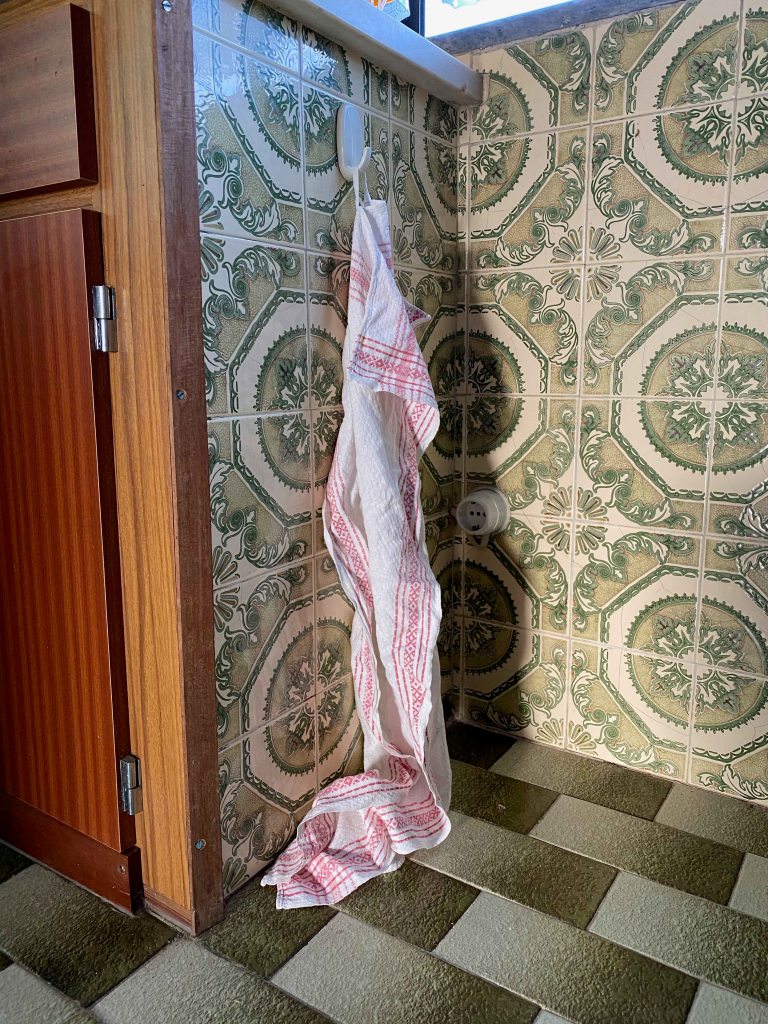
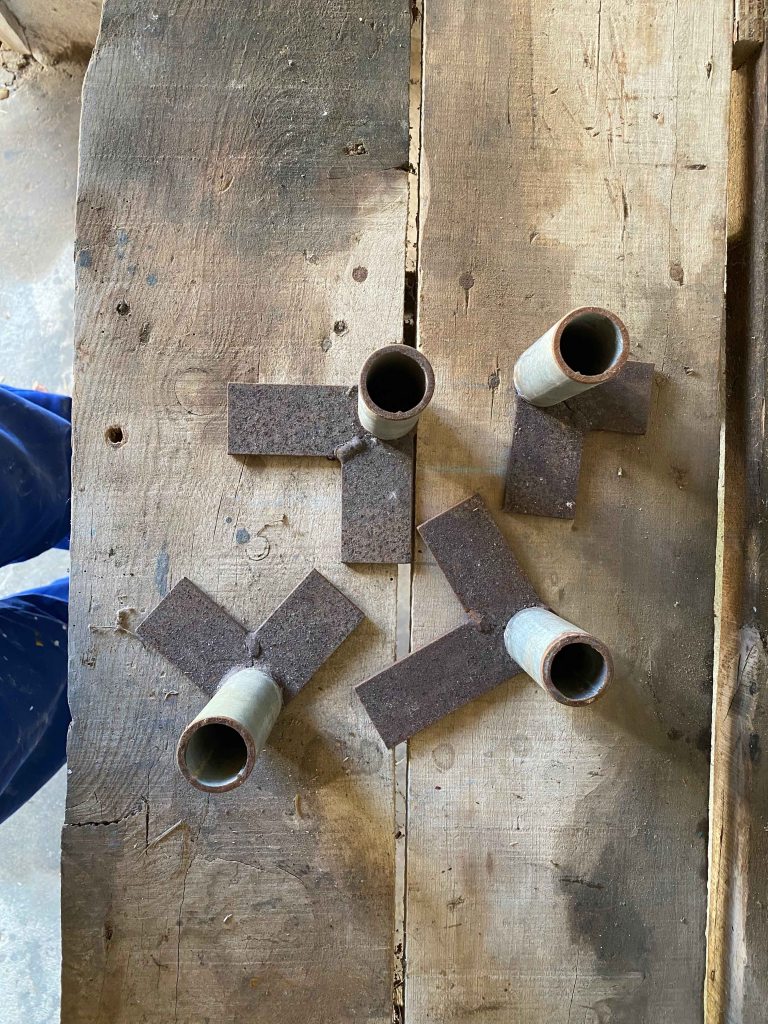
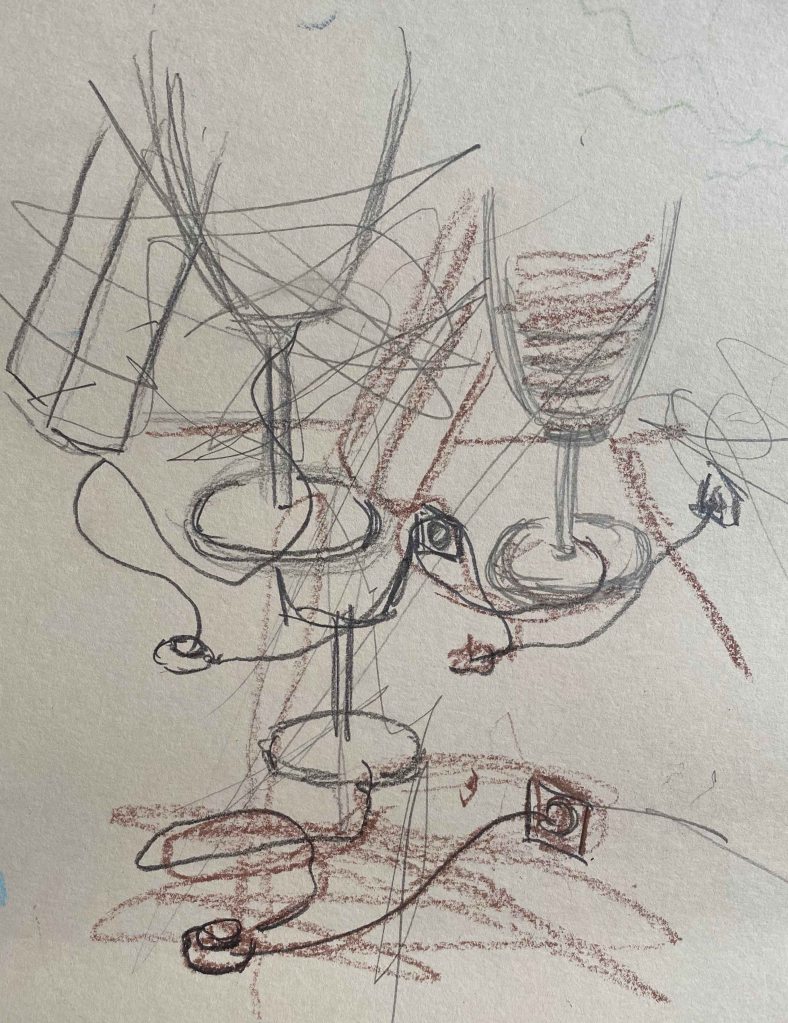
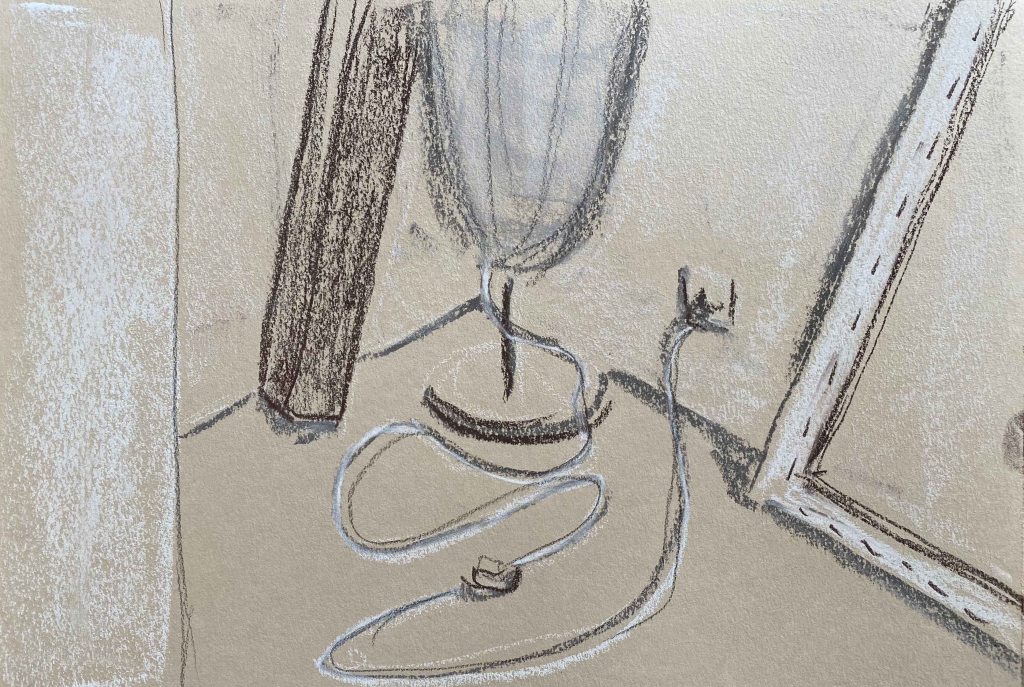
When I look around the room, my glance first falls on a cable and a lamp in the corner- definitely unpromising and I decide to just start here.

I use pencils and soft pastels for a first approach.

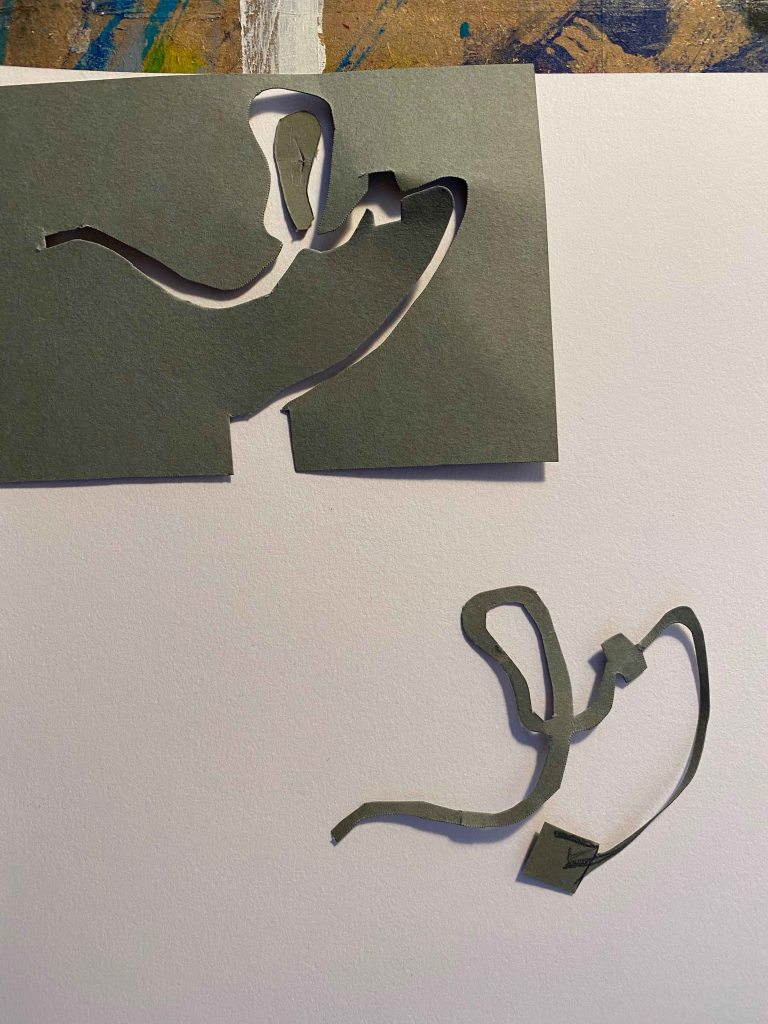
I decide to try using cut out shapes and graphite powder as I experienced in a lifedrawing class recently.

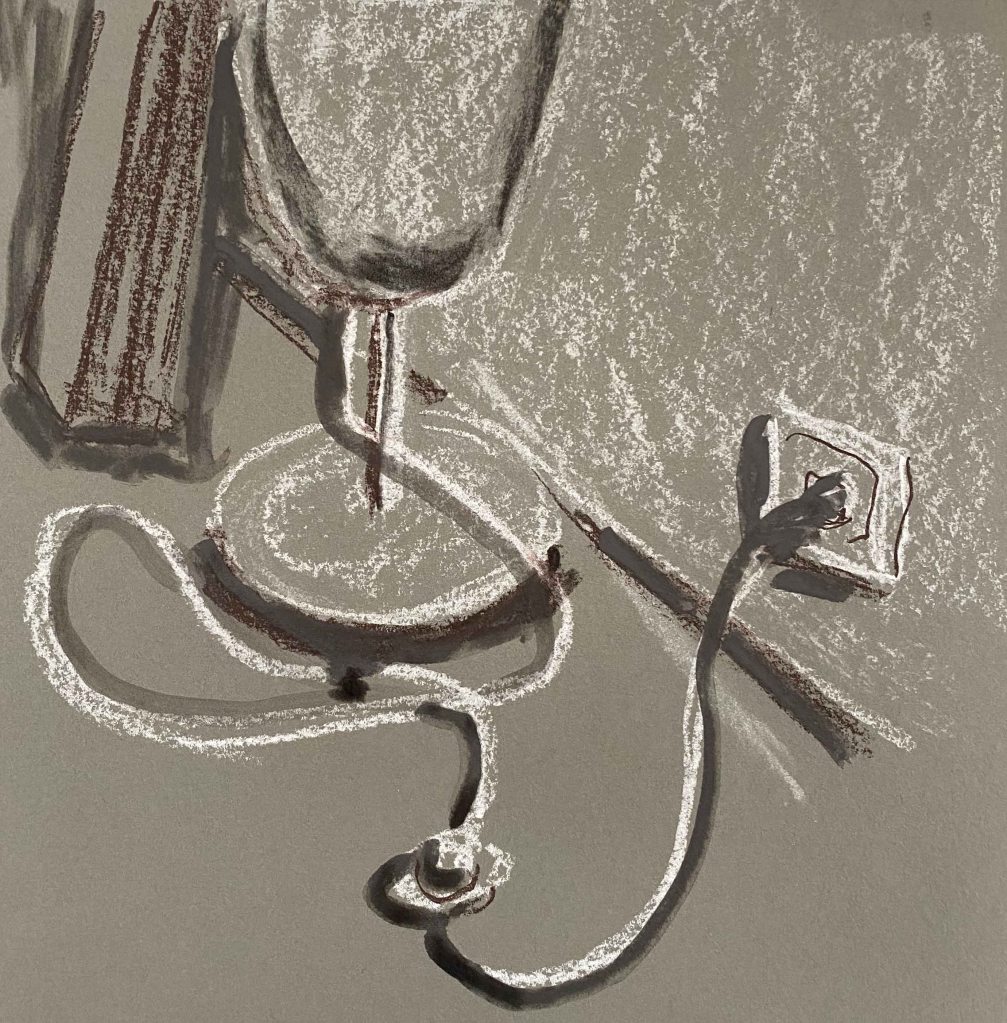
I decide to move away from the initial motive and focus on repeating certain elements.

This was a good warm up, but I am still looking for an unpromising but captivating motive.

I discover it as soon as I step out of my front door the next morning :

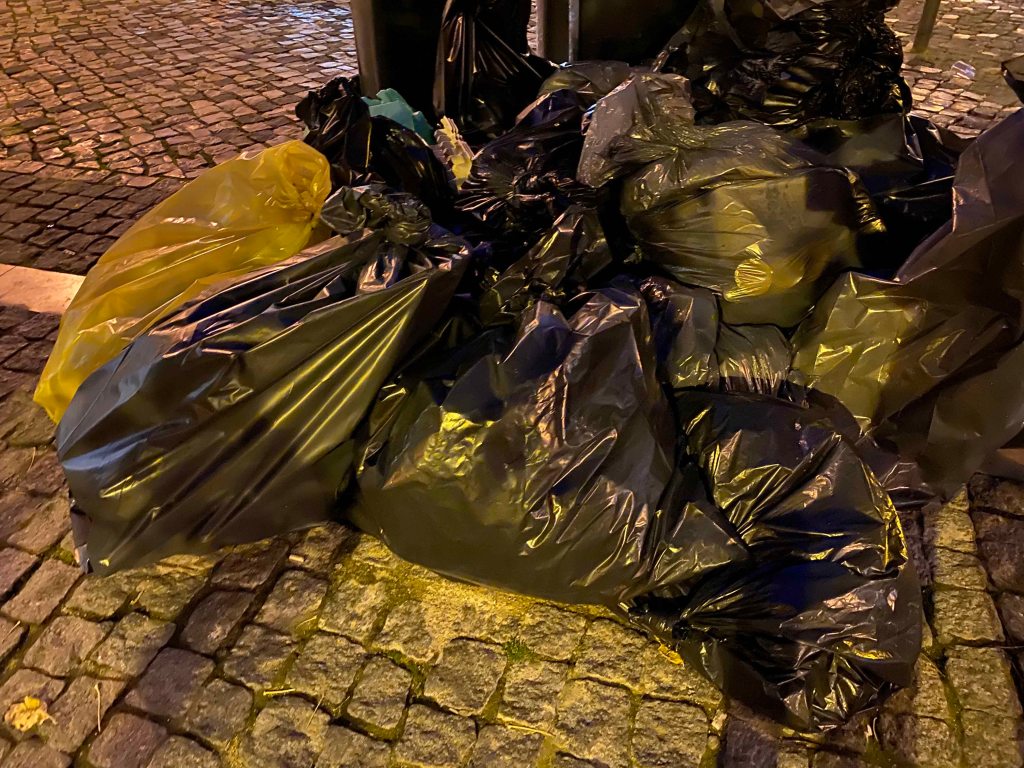
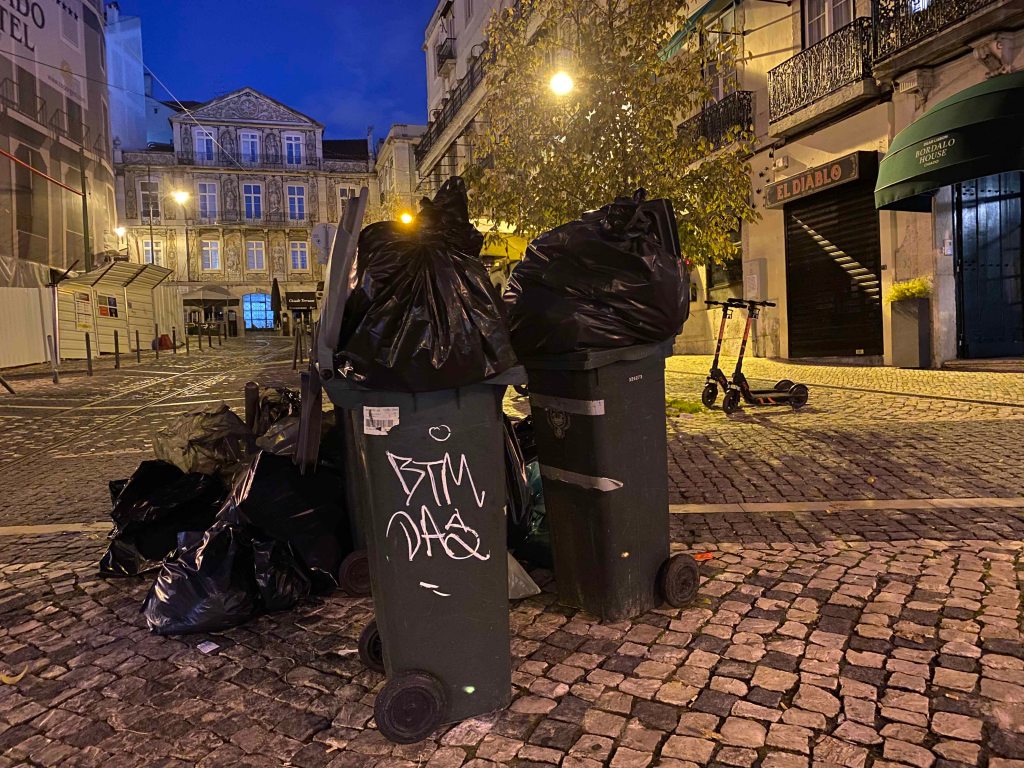
I am a very early riser, and usually see the streets before the garbage van passed by- which is often a desolate sight. The problem of the amount of trash we produce is also one that I can burn for and am excited to look at through this exercise. I have lived years in Asia where the amount of trash, and especially plastic, become very painfully obvious, as the collection system is often lacking, so the issue is not swept away from sight.

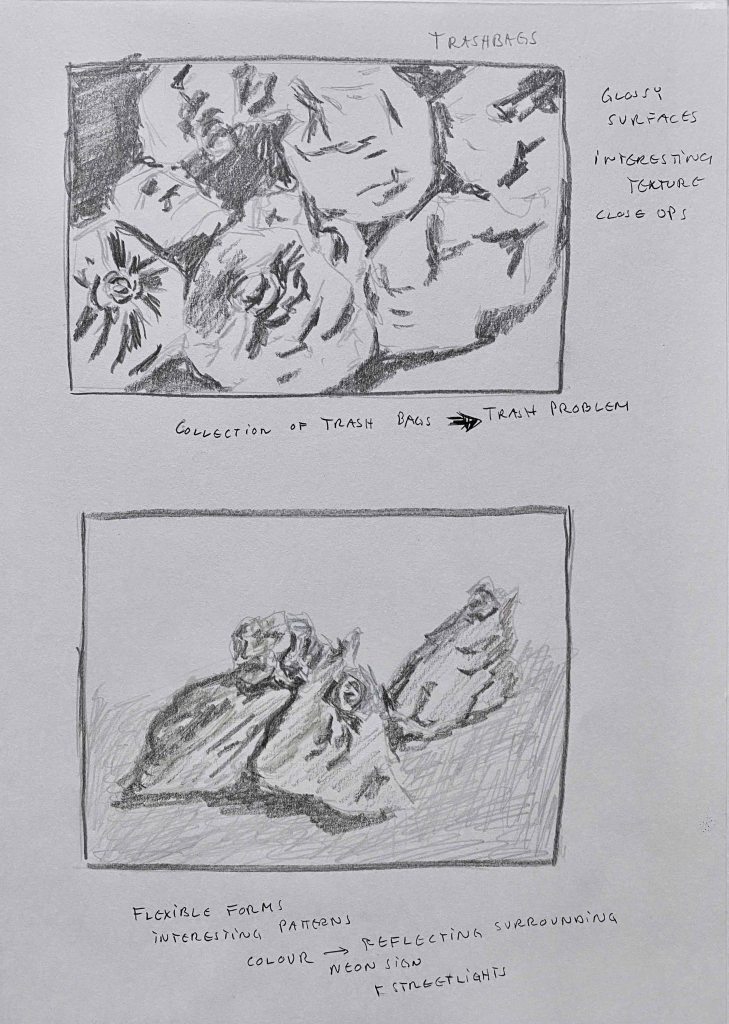
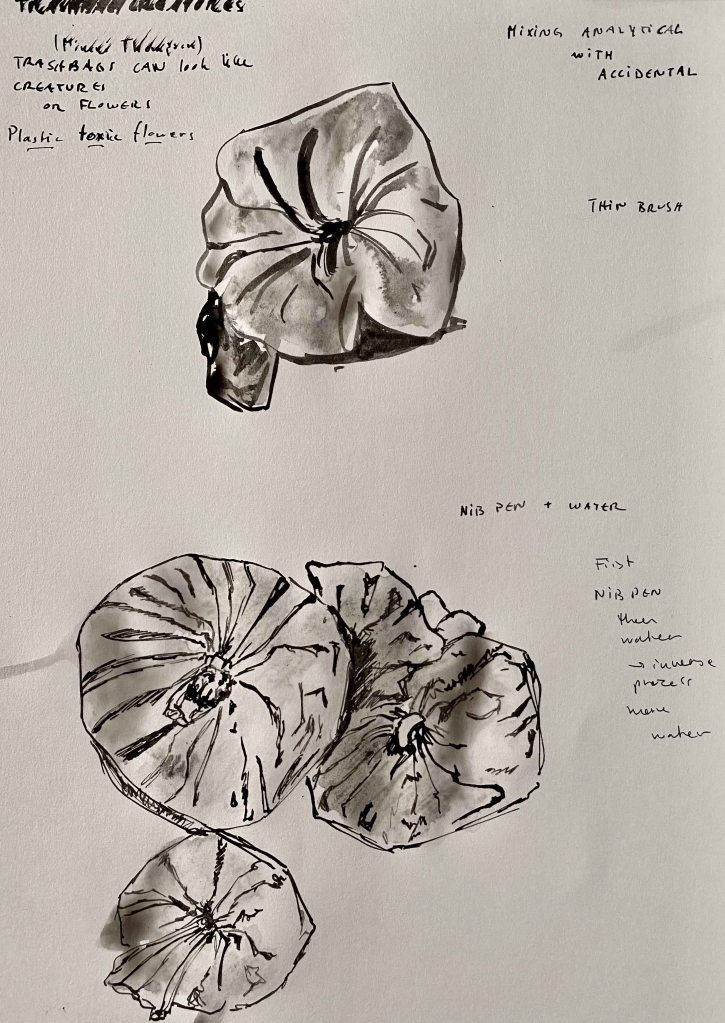
From a visual point of view, I am interested in the glossy surface of the plastic bags and the interesting textures created in the creases. Before the daylight, the plastic reflects the colours of surrounding streetlamps and neon signs.

I start with some pencil sketches in my A4 sketchbook:

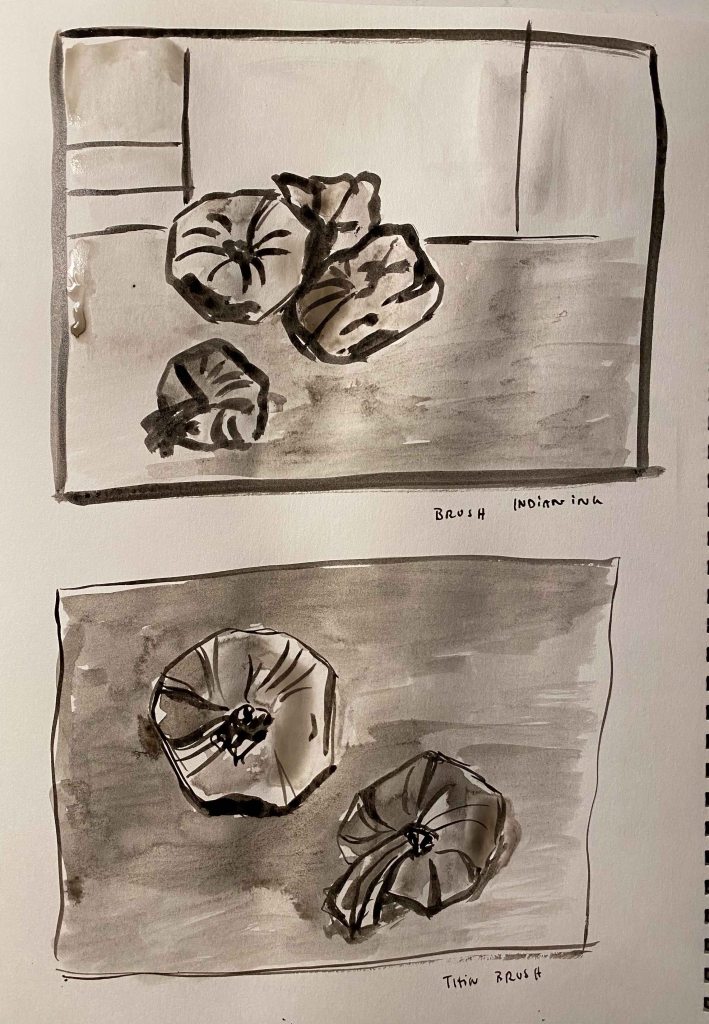
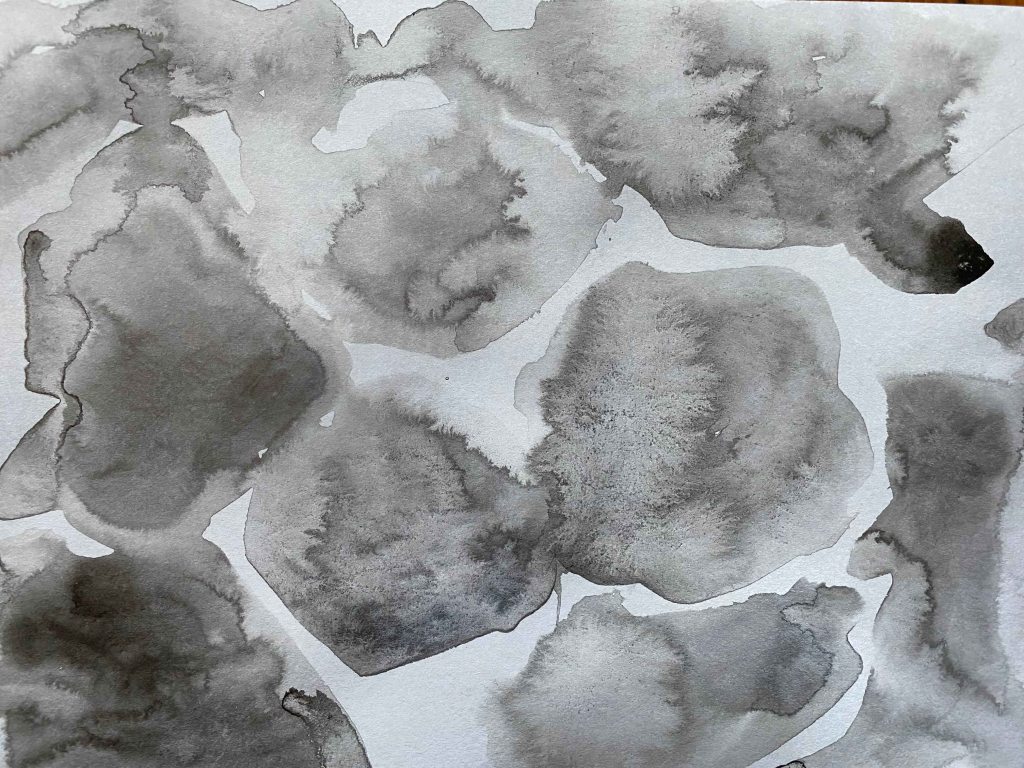
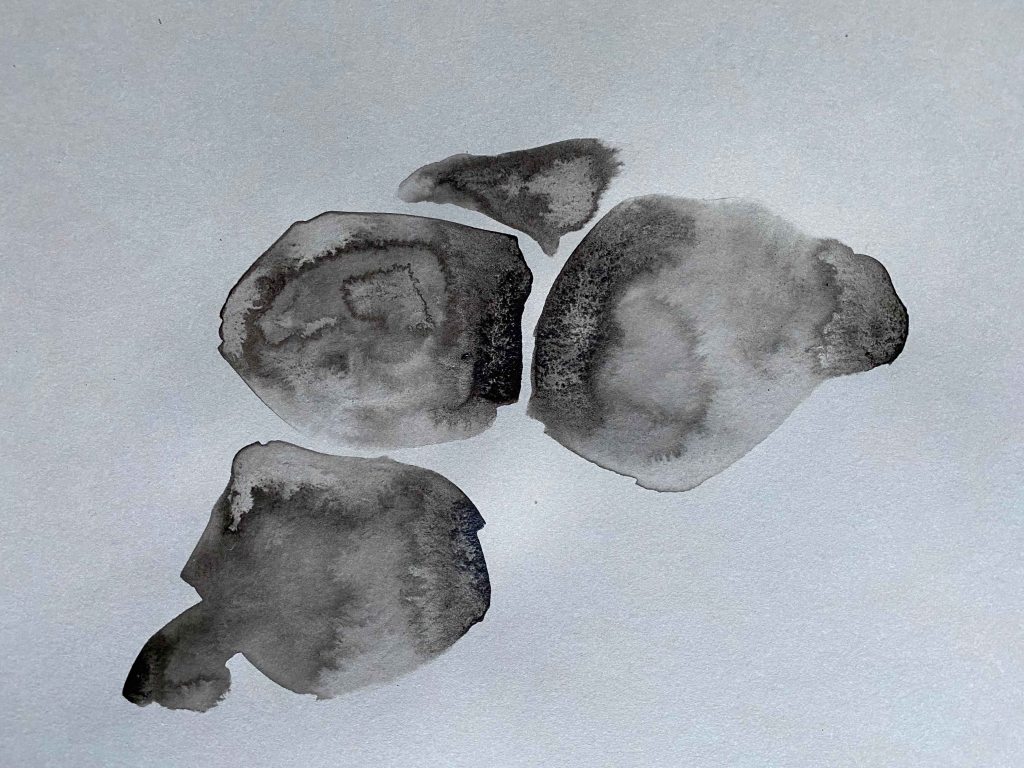
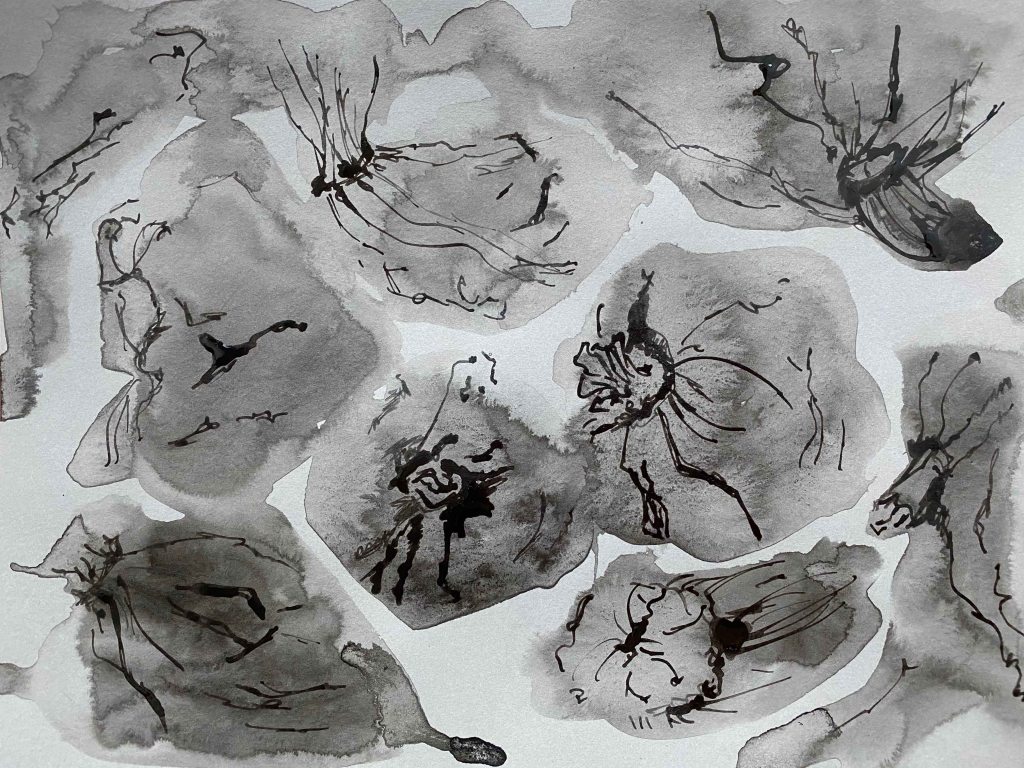
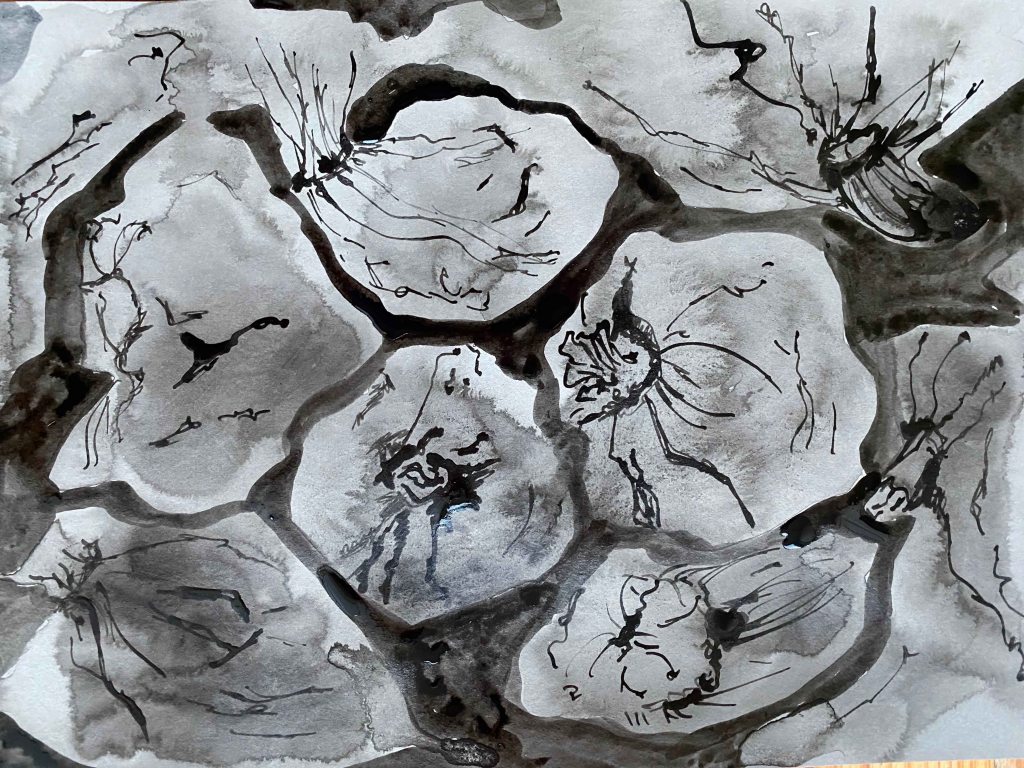
I continue looking for interesting lines with Indian ink. Here I am mixing very “analytical” marks drawn with a nib pen, and more accidental marks when dripping ink on wet places (A4 sketchbook).

Indian ink on grey paper starting with “accidental” blobs:

Then nib pen and brush:

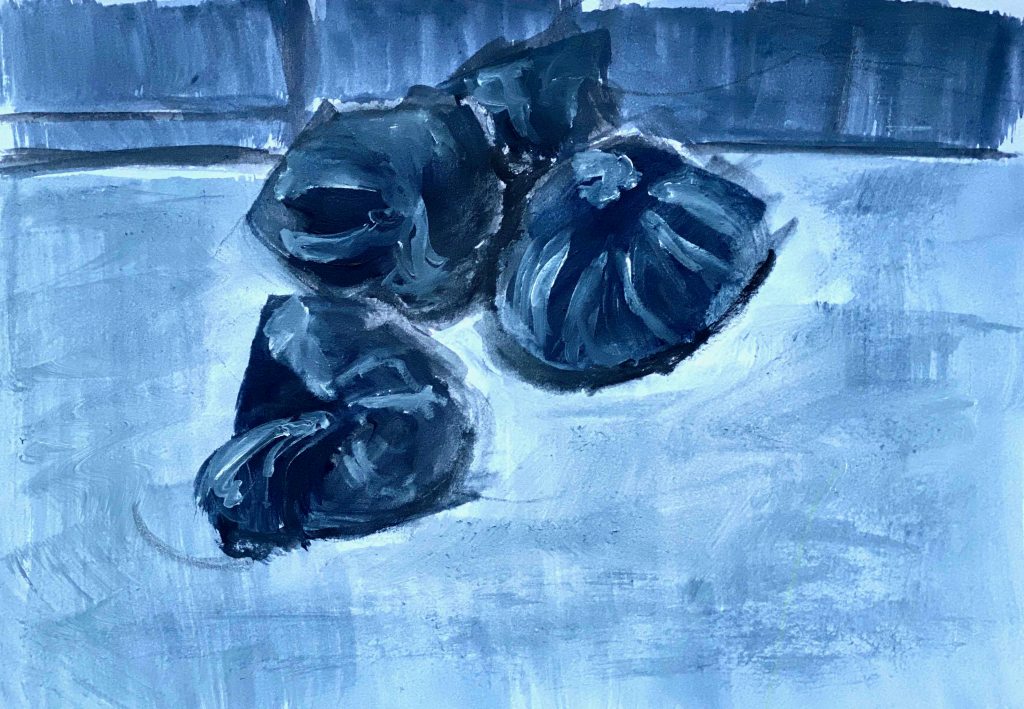
I also do a quick sketch using oil paint on paper, in Payne’s grey and black, to get a feeling for a more painterly approach.

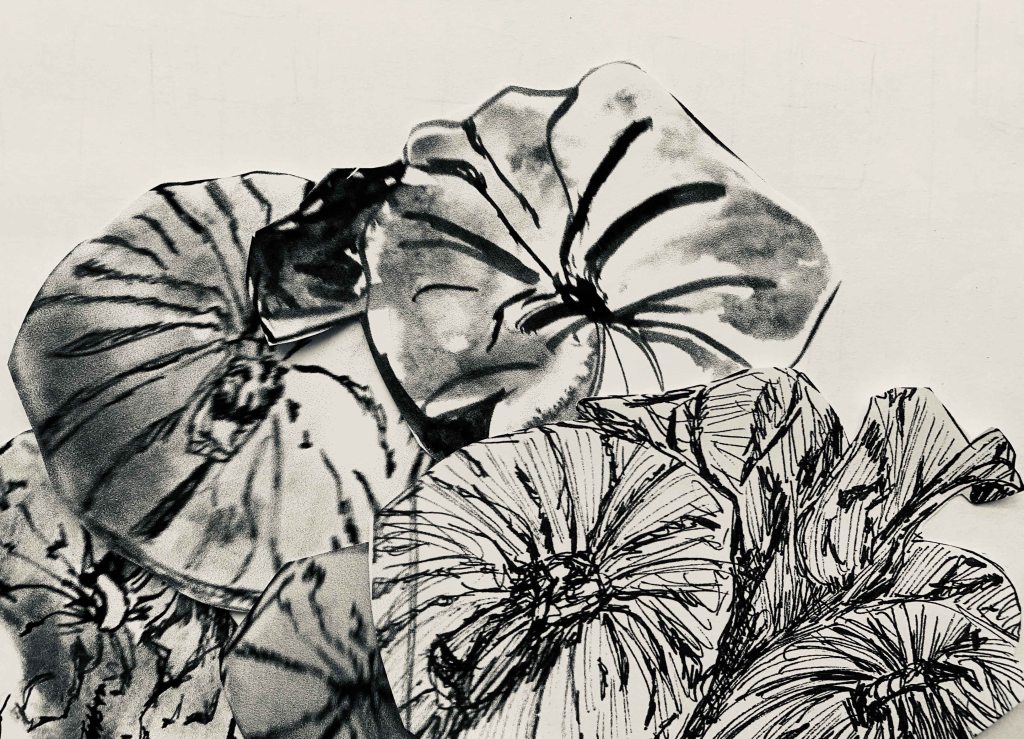
I photocopy the above sketches, as recommended in the course manual, and play around with different combinations and details and patterns.

This is my chosen composition:

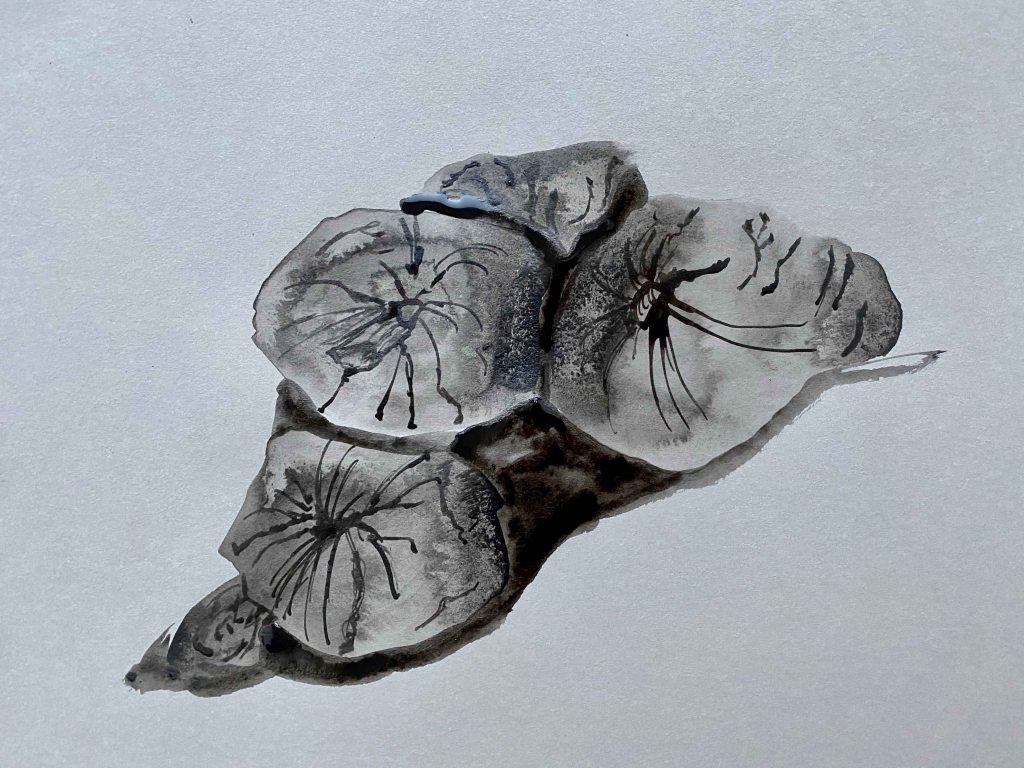
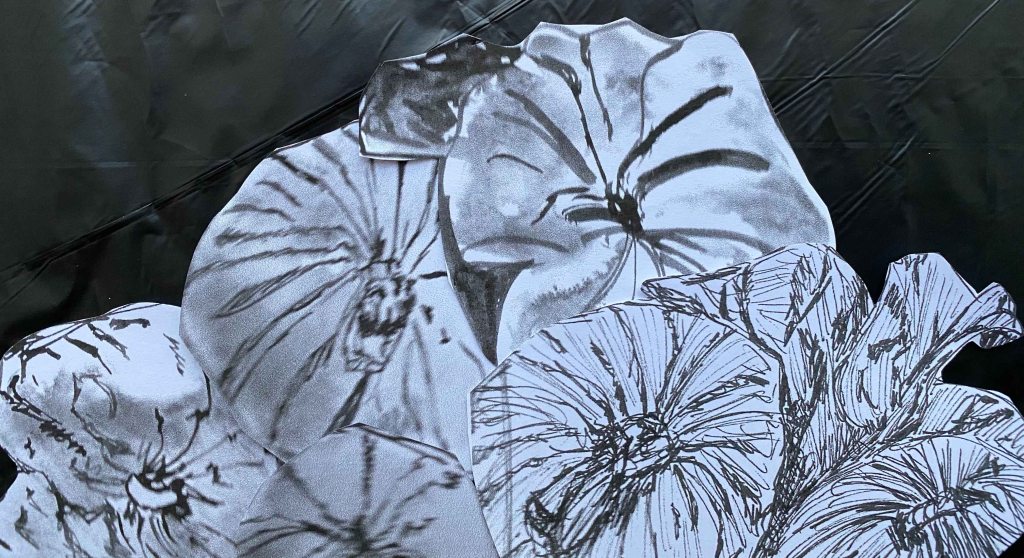
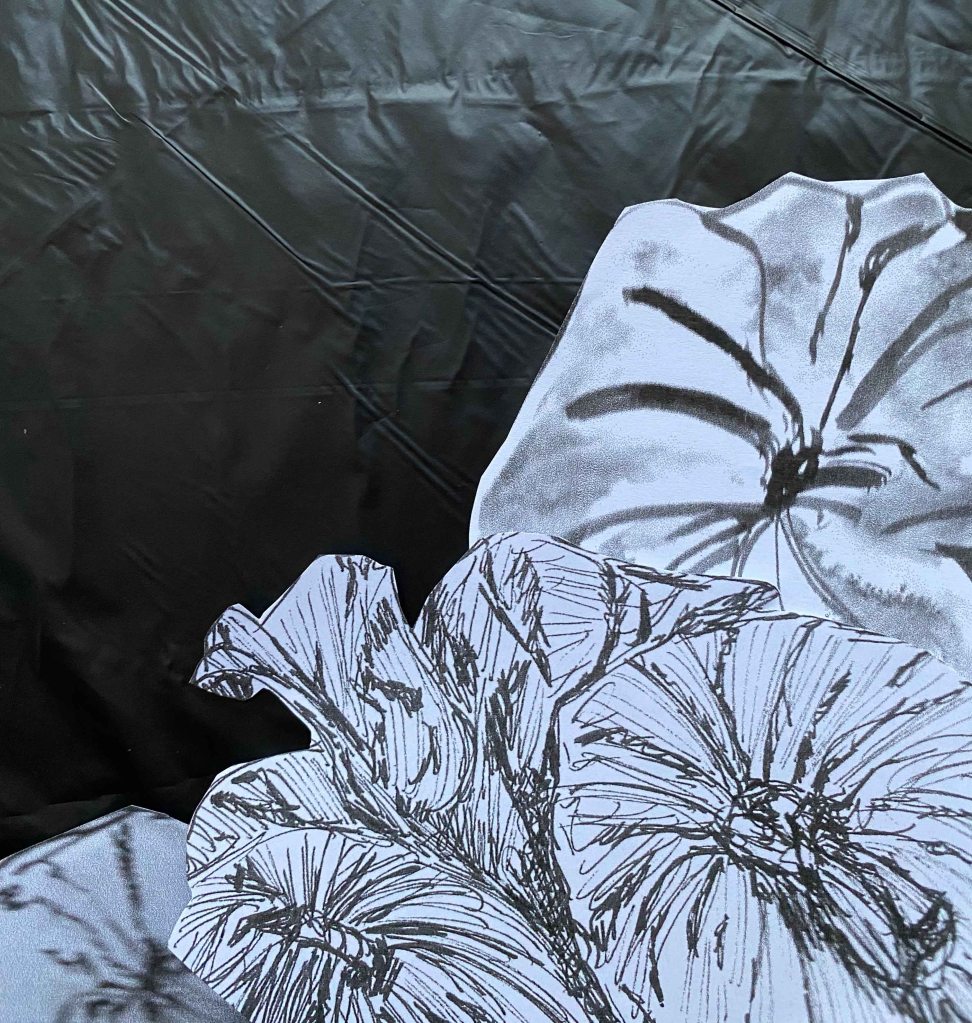
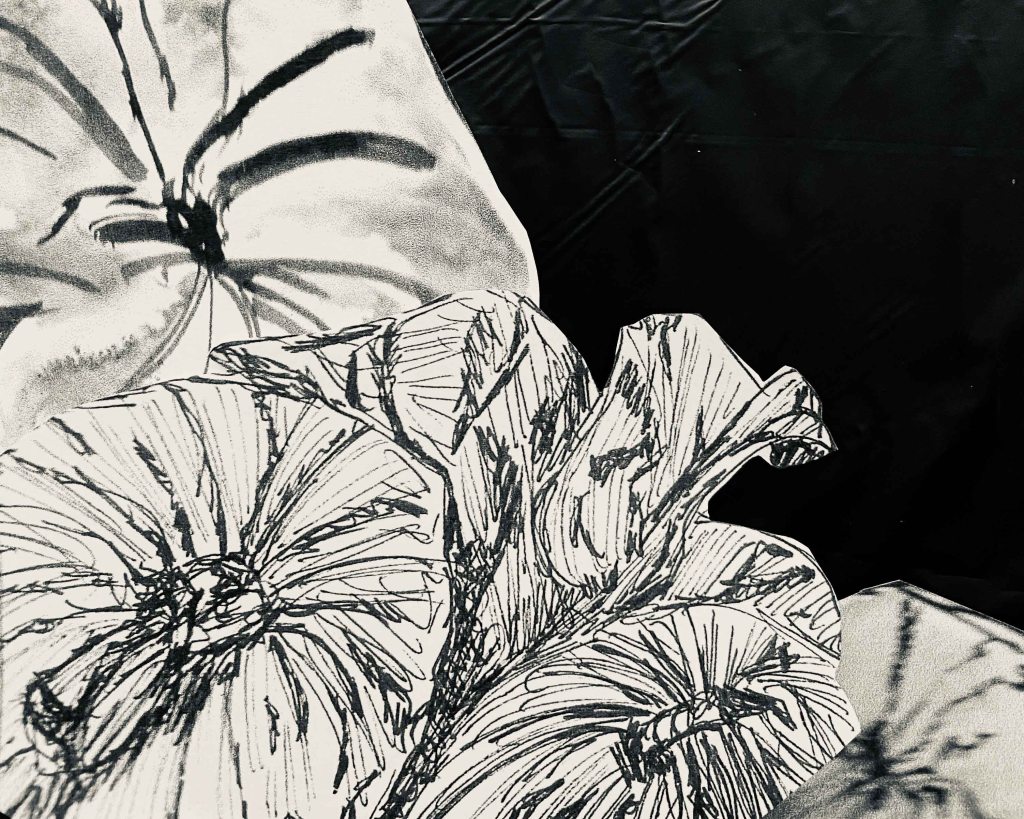
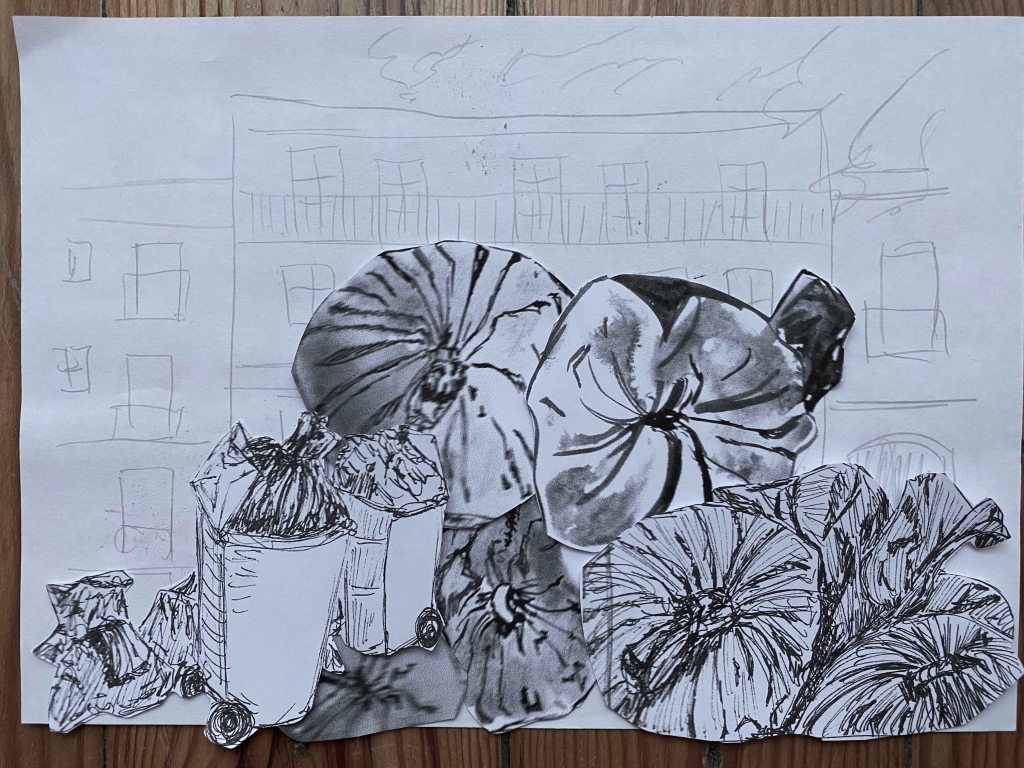
The bin bags look like flowers and I start calling this drawing “toxic flowers”.

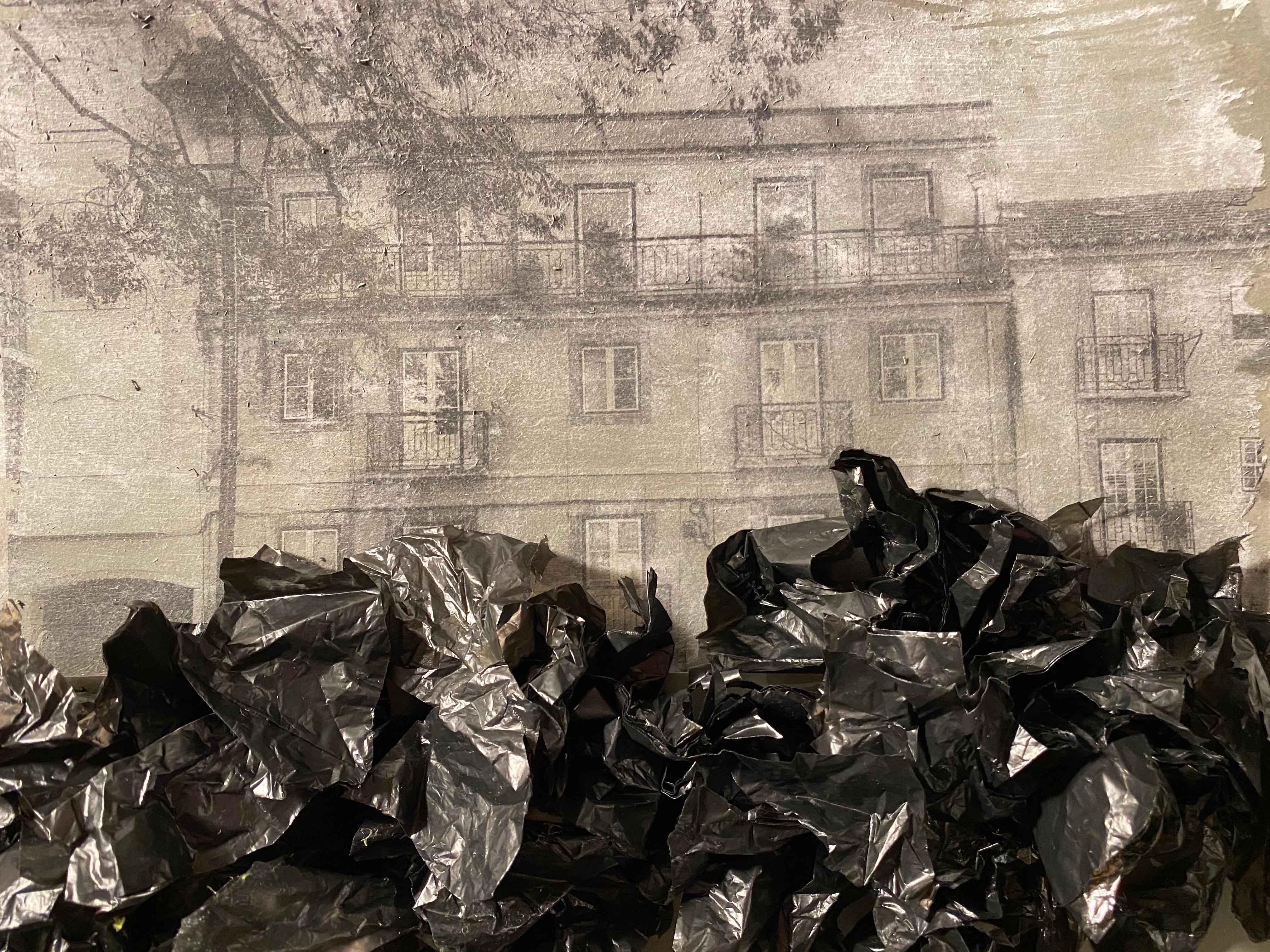
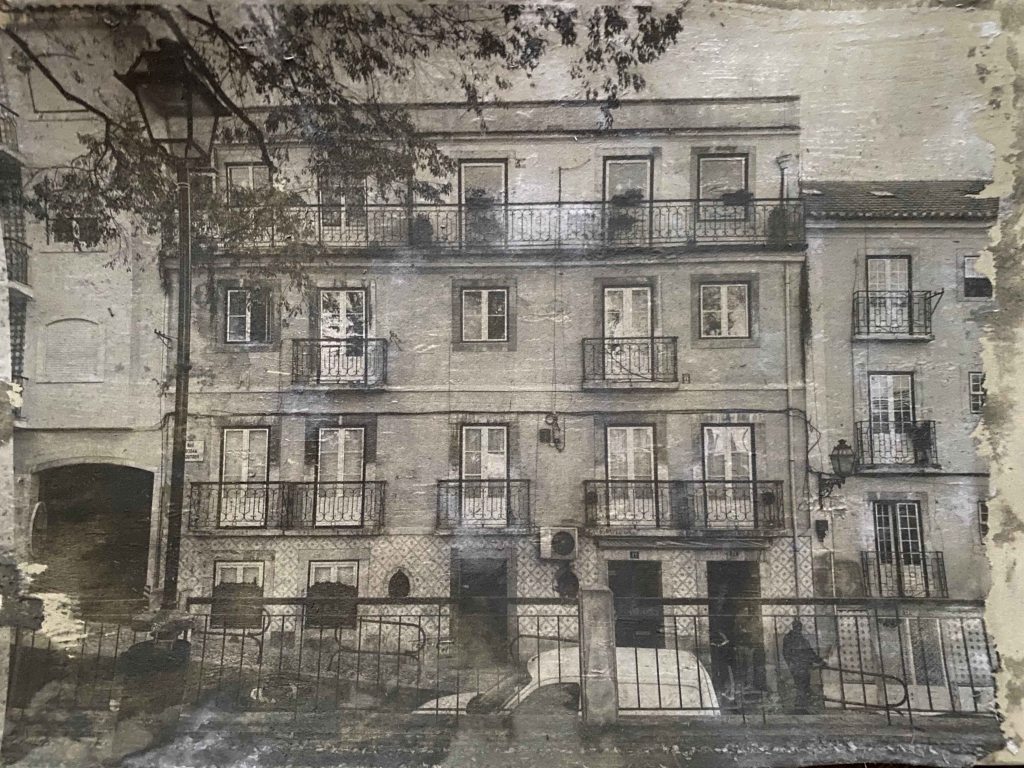
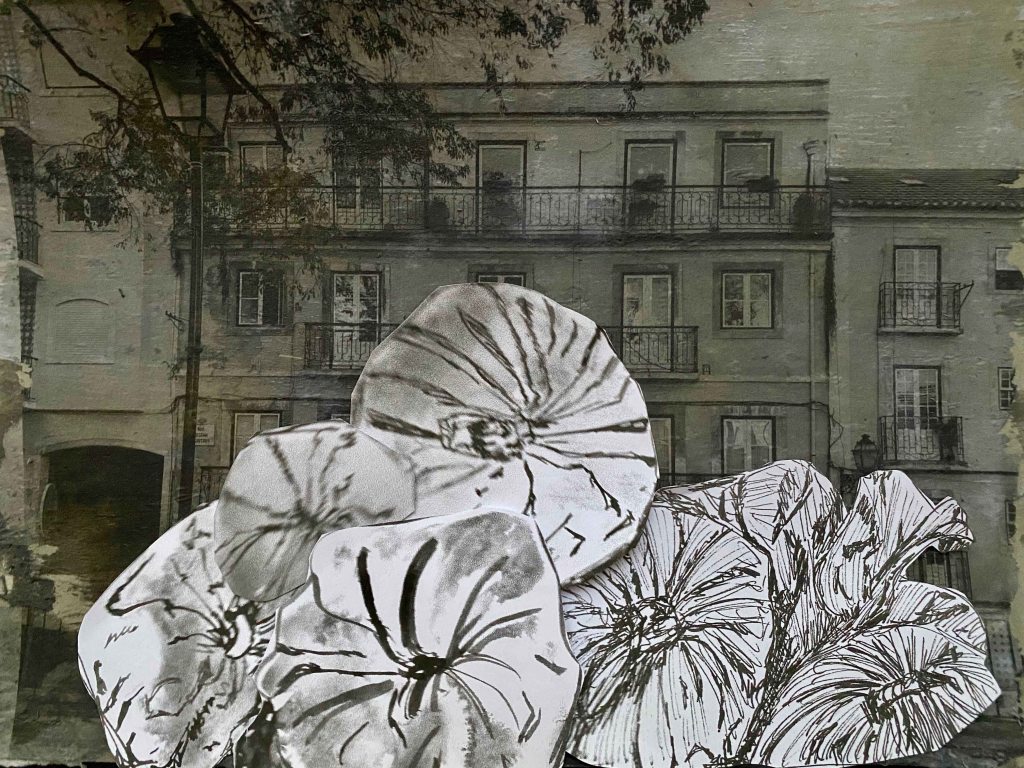
As I started with the bags found outside my own front door, I decide to try out combining a photo of my house and these toxic flowers. Using my own house as a background brings back the question of MY own responsibility in the mountain of trashbags brought out here. This is not a distant problem- how many bags have I brought out myself and how much of that could I have avoided?

A quick test drawing with the photocopied “toxic flowers”:

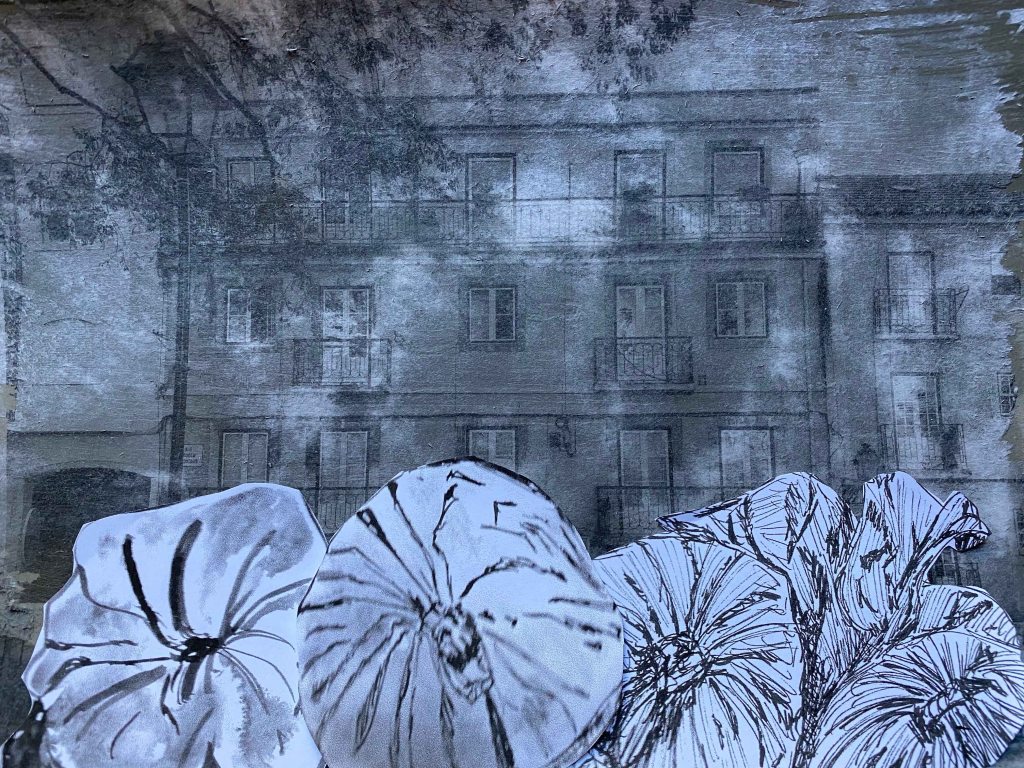
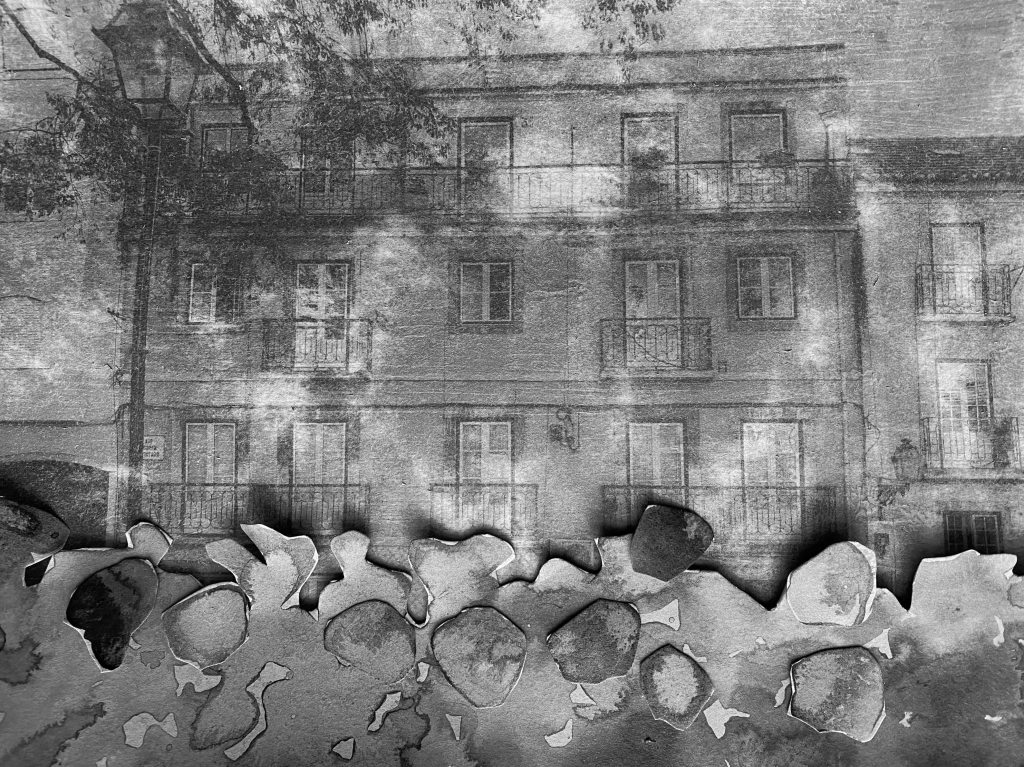
I like the contrast between the image in the background and the sketched details. I decide to take a photo and make a phototransfer of the front of my building, keeping the image black and white, or rather grey and grey.

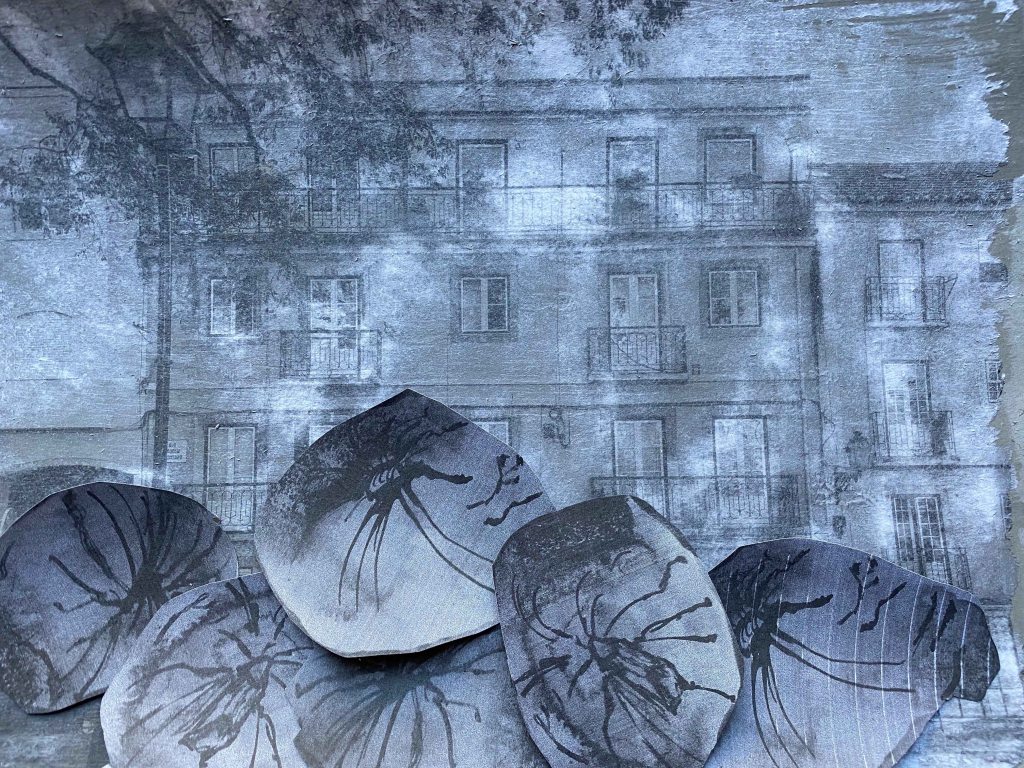
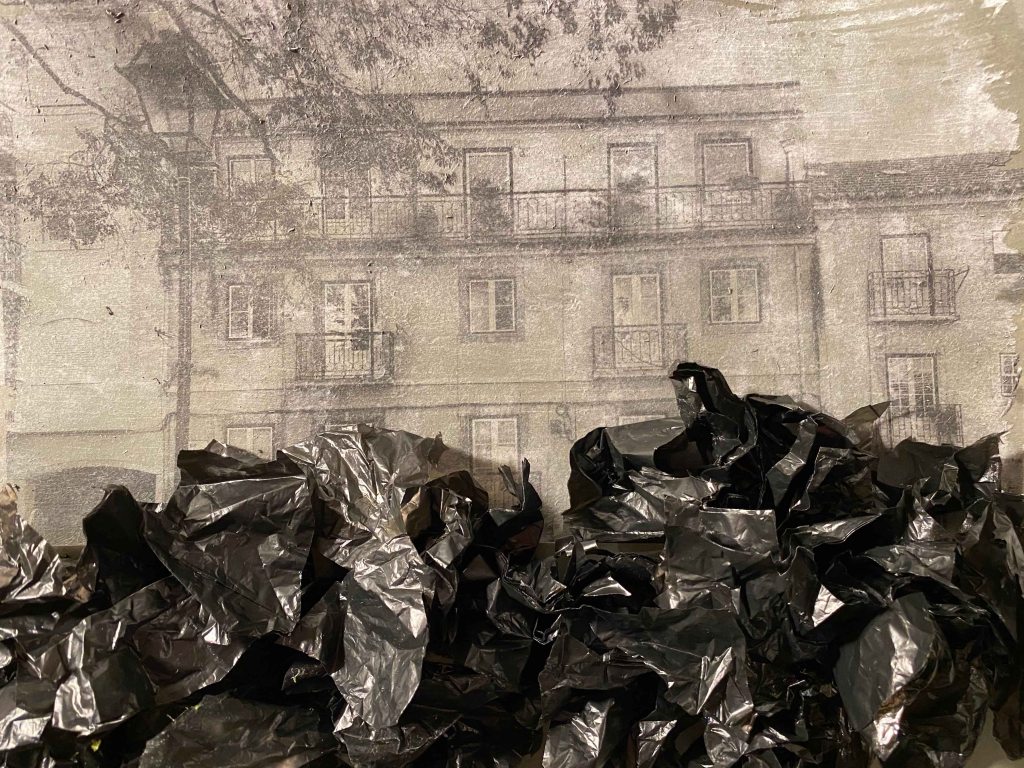
With the difference in scale, I let the trash bags pile up to almost cover the house:

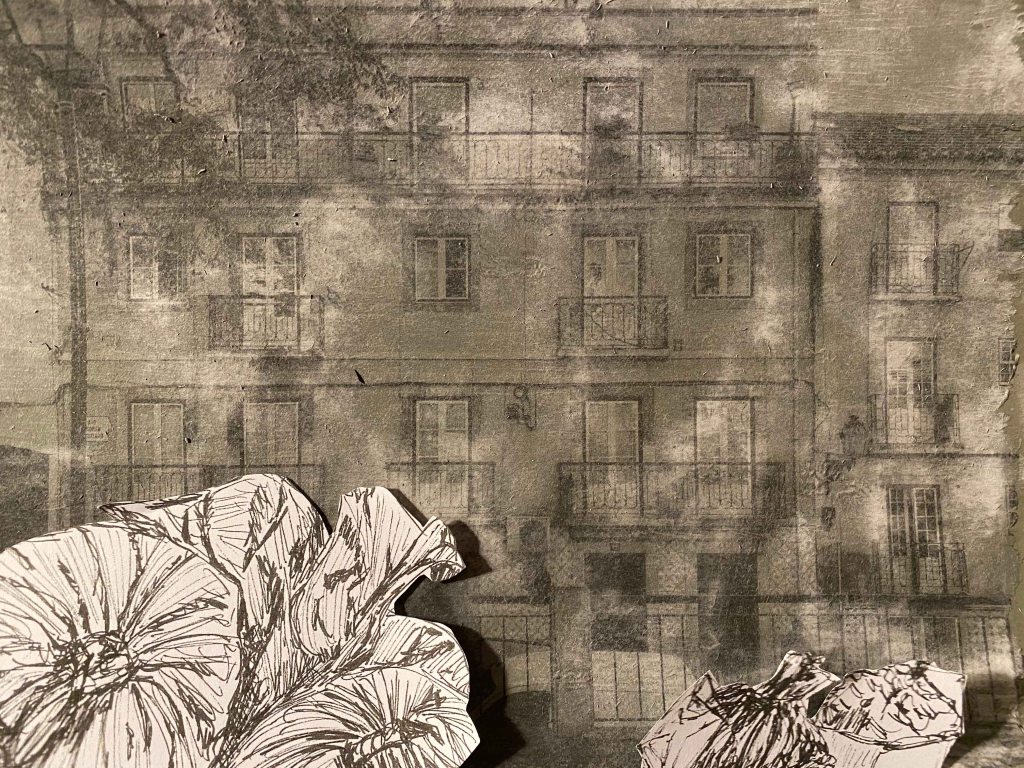
I like the absurdity of these images. I also create small trash bags that are more in scale with the house:

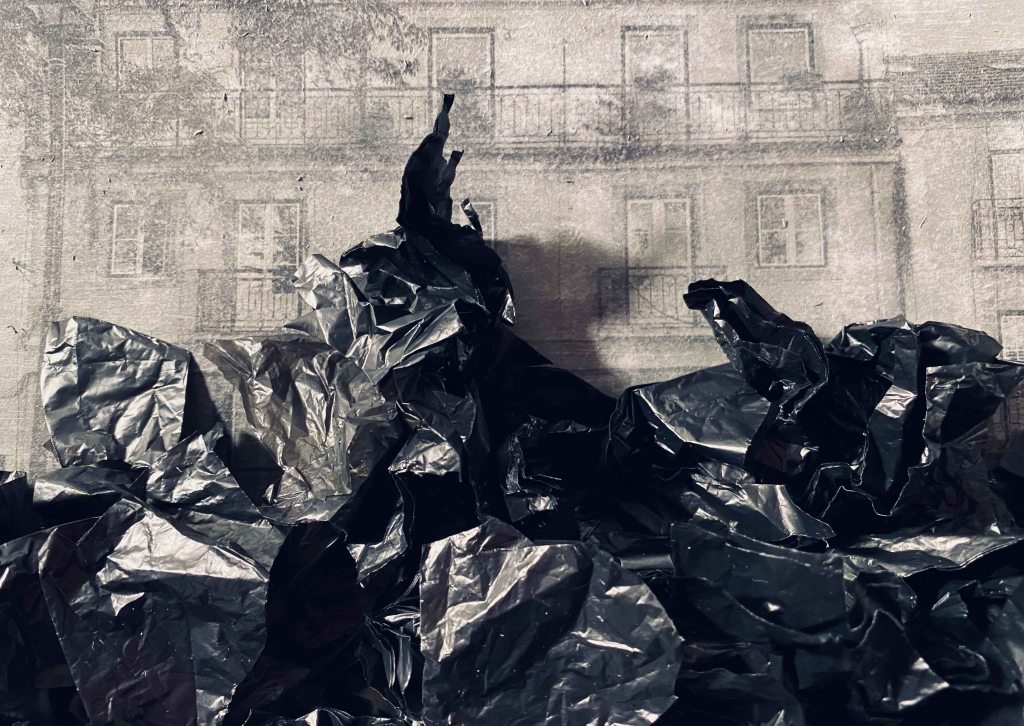
I also try to substitute the drawn bags with some I roll from a trashbag in plastic. In the second one, I allow the plastic to tower up to almost cover the house- really indicating the problem here, with a feeling of drowning in the quantity of trashbags.

Finally, I come back to the photocopied ink drawings with this more “romantical” composition, where the trash become decorative plants.

I like the aesthetic quality of the images above, and also the critical message they convey, but my images are becoming too illustrative, and I have lost track of the aim of the exercise- to work closely on the composition.

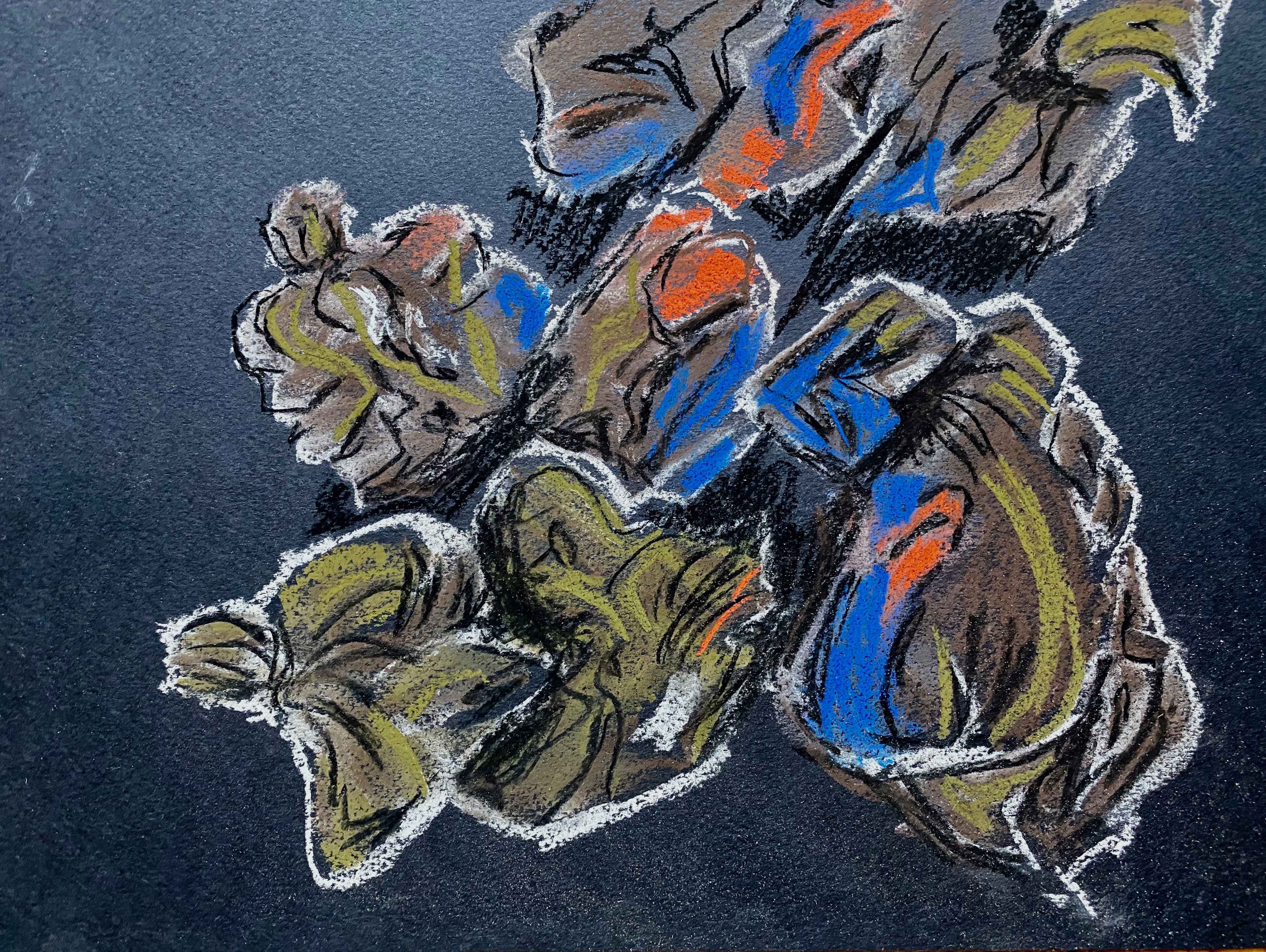
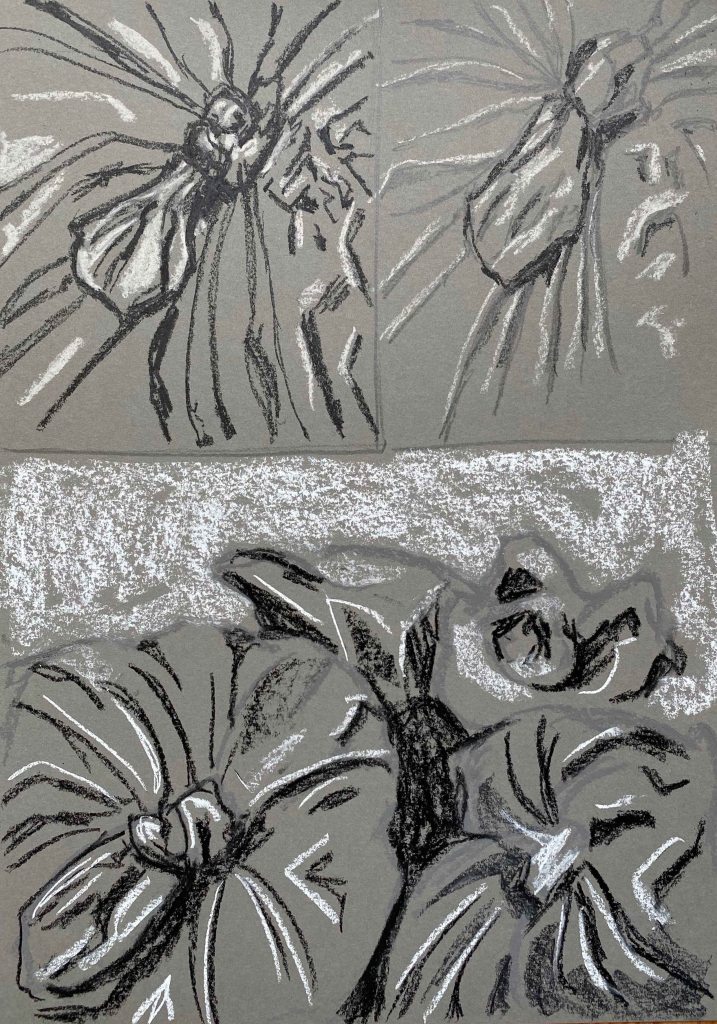
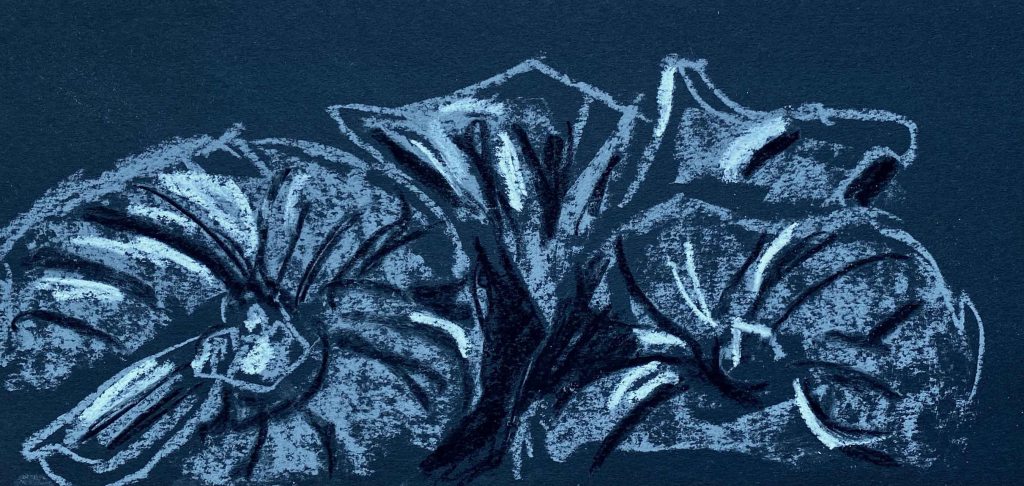
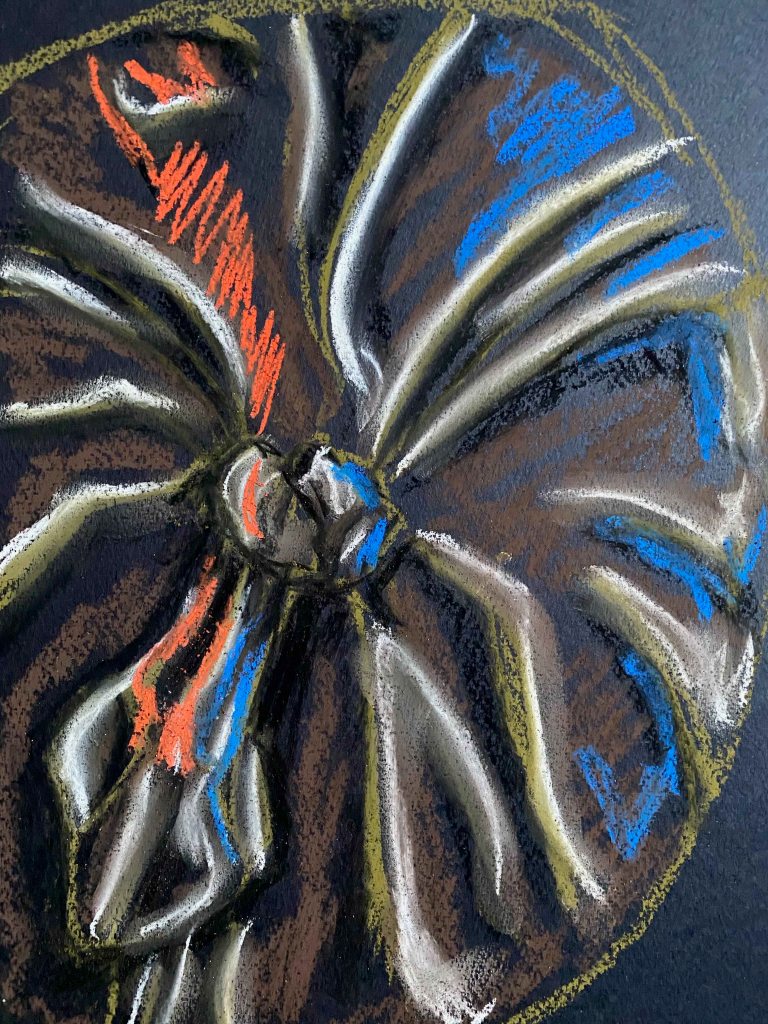
I come back to focusing on shapes and patterns with dry pastels on black paper. Here I am also introducing the colours of reflecting streetlights:

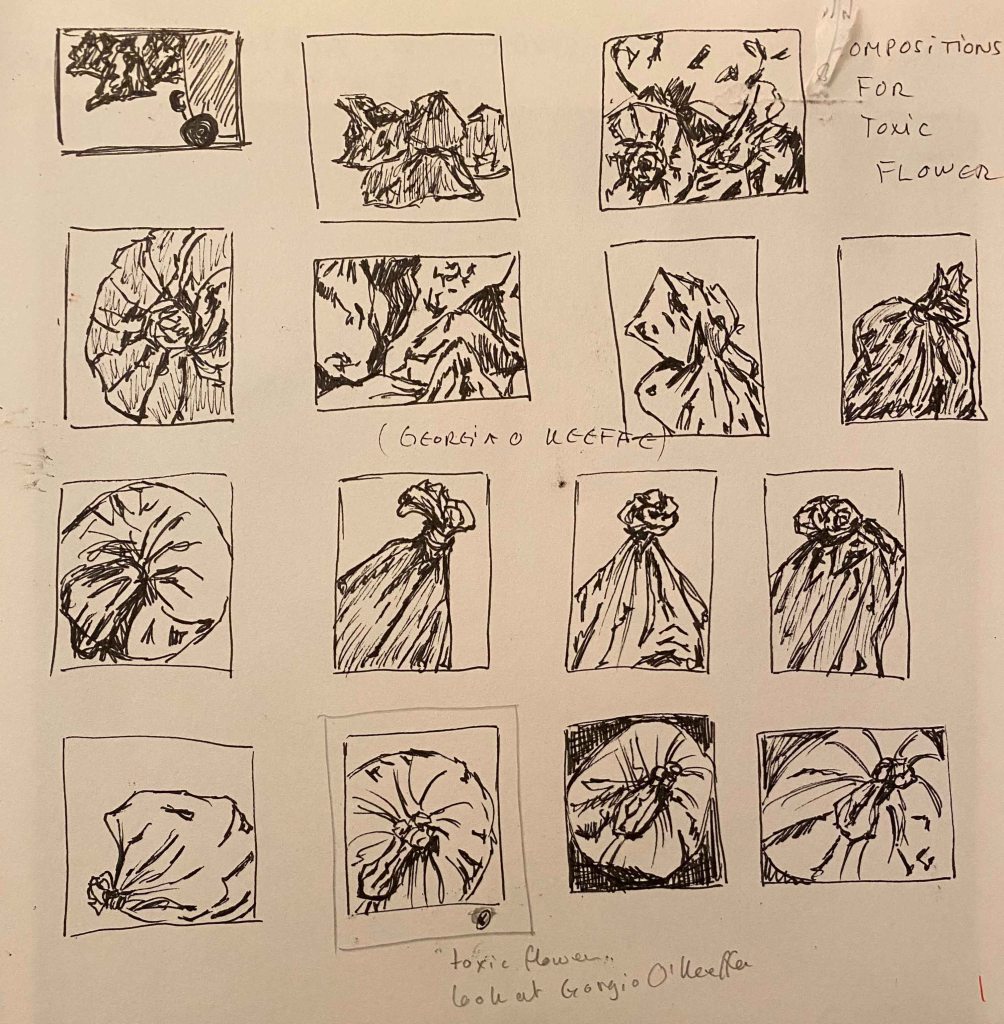
The idea of the plastic bags looking like flowers brings my thoughts to Georgia O Keeffe’s paintings of flowers in close up.

I explore various compositions of close ups of the trash bags, with the idea of a “toxic flower” in mind.

I chose the close up like the second in the bottom row and try it out with dry pastels on grey and black paper as well as ink nib pen.

There is a phallic element with the tied part of plastic, another parallell to Georgia O Keeffee’s orchid close ups.

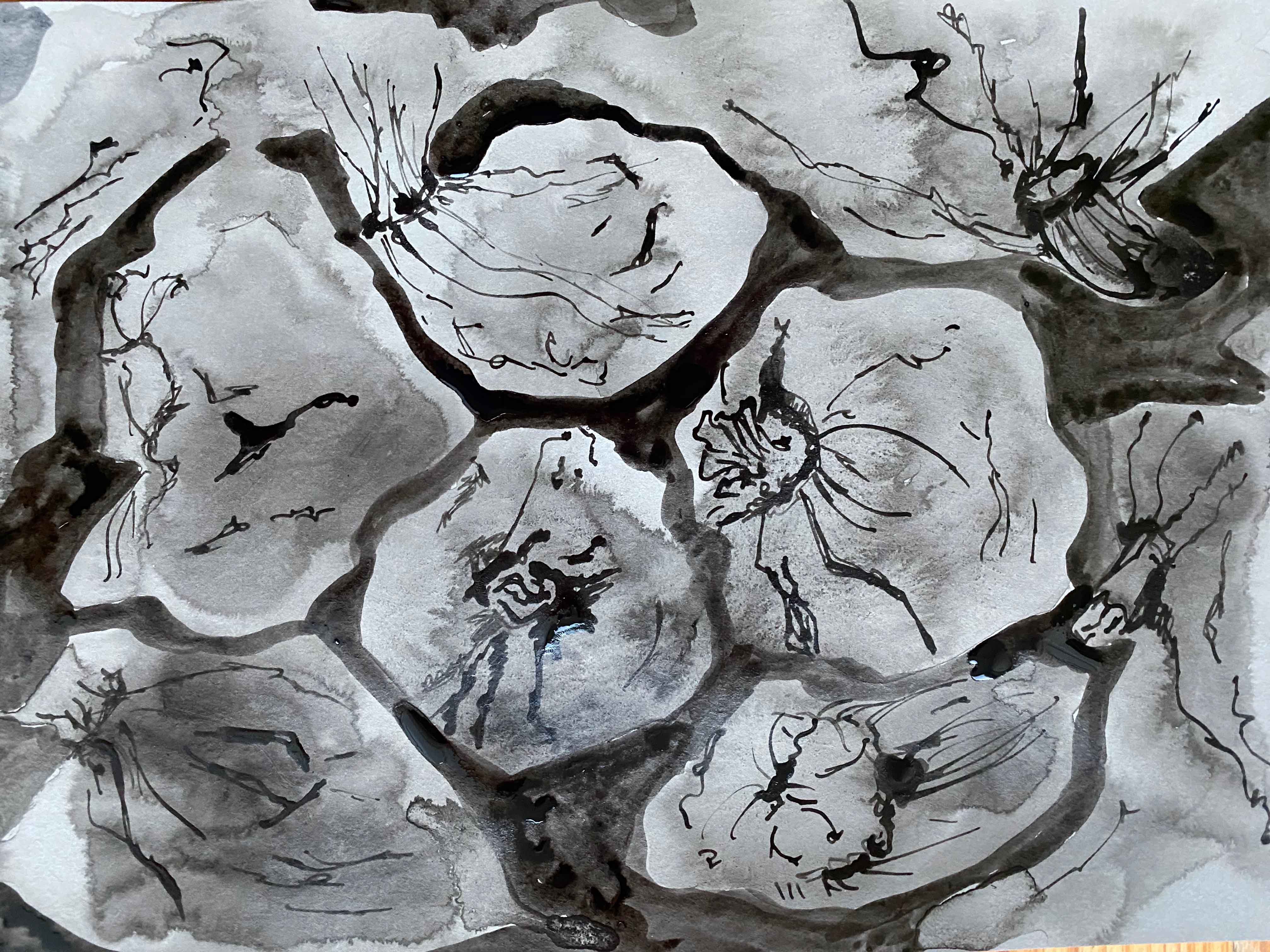
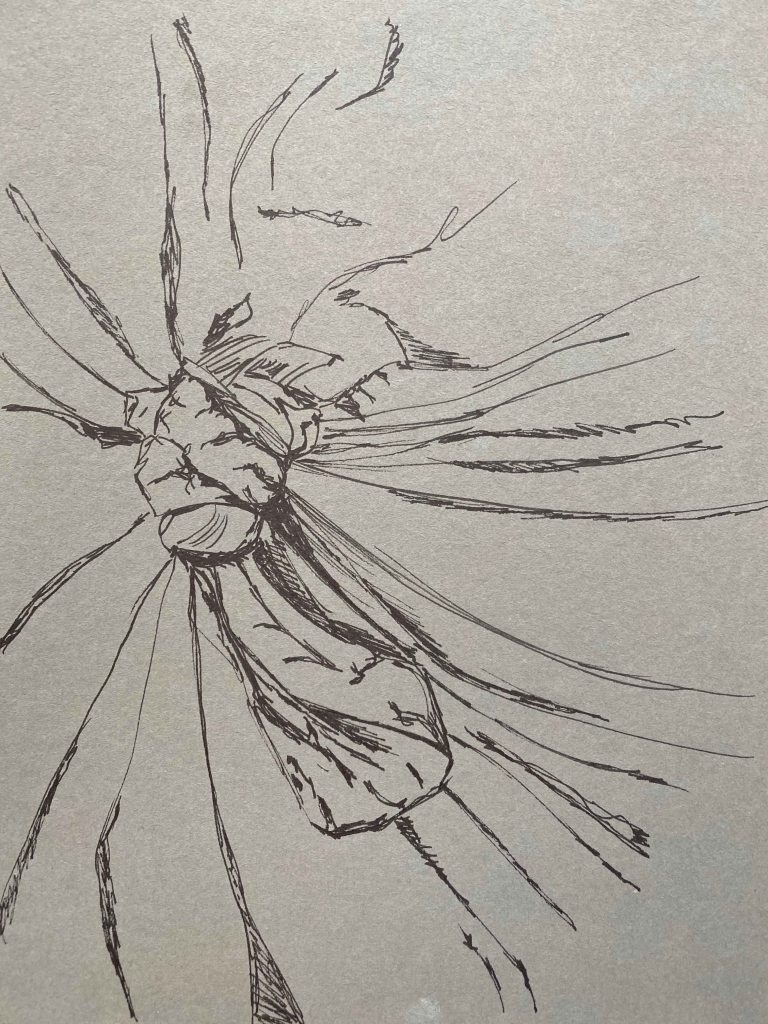
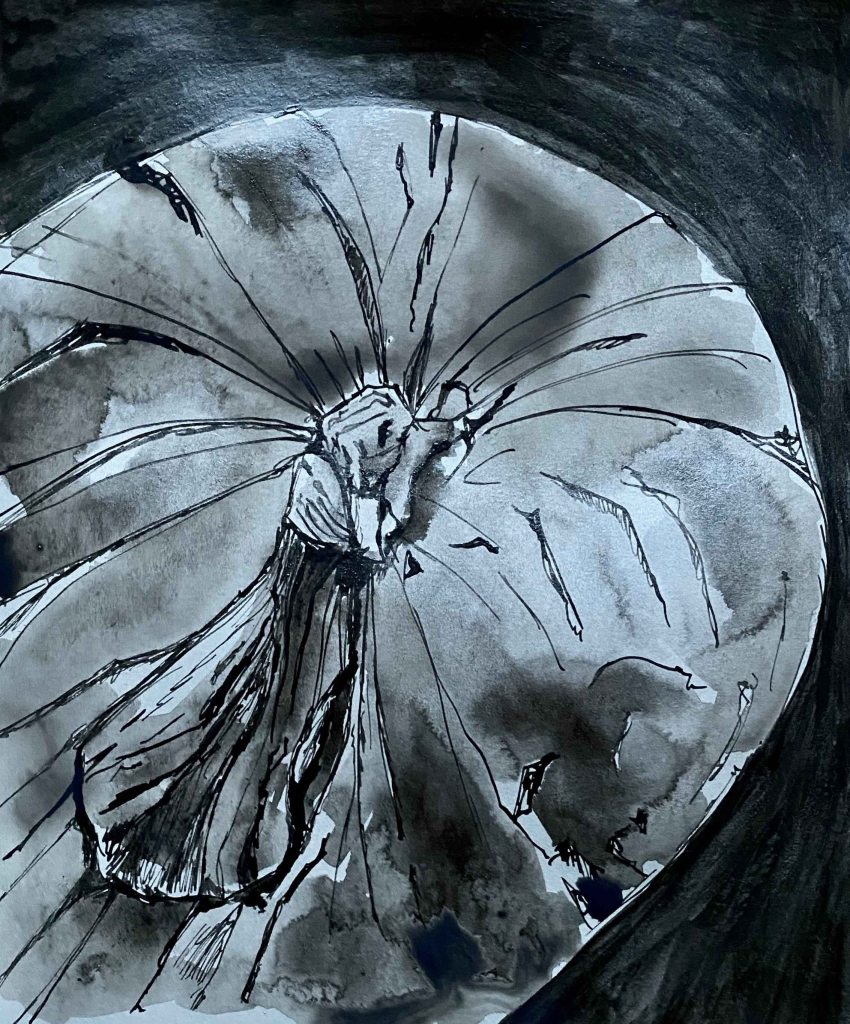
As I liked my first experiments with inks above, I decide to draw this final composition detailed in ink with a nib pen , and then wet the drawing once the ink is dry, and apply random spots of ink around the detailed drawing.

This is the final result- Indian ink on grey paper (21x23cm):

I like the difference between shiny parts where the ink has dried thicker, and matte parts where the ink is thin.

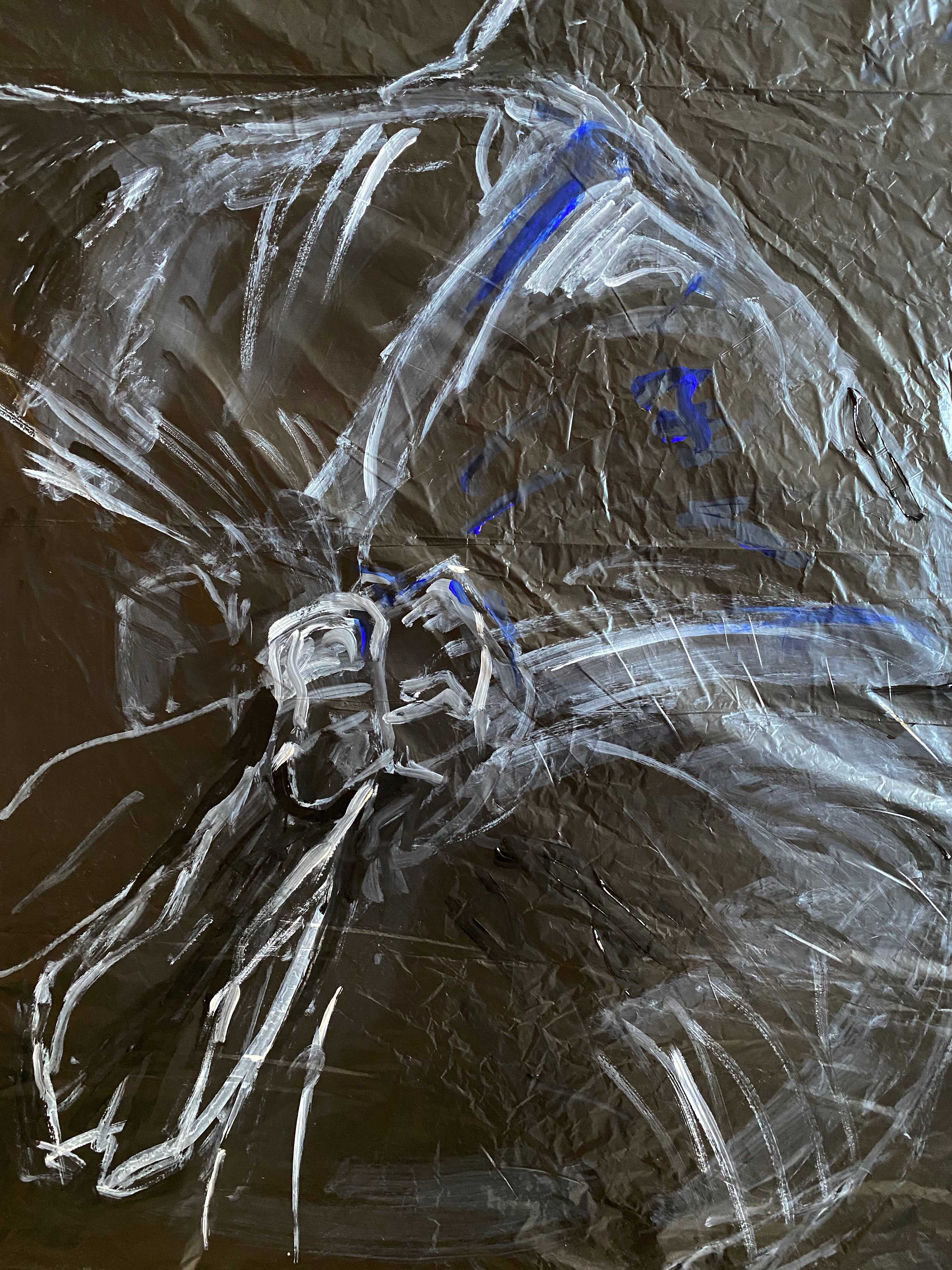
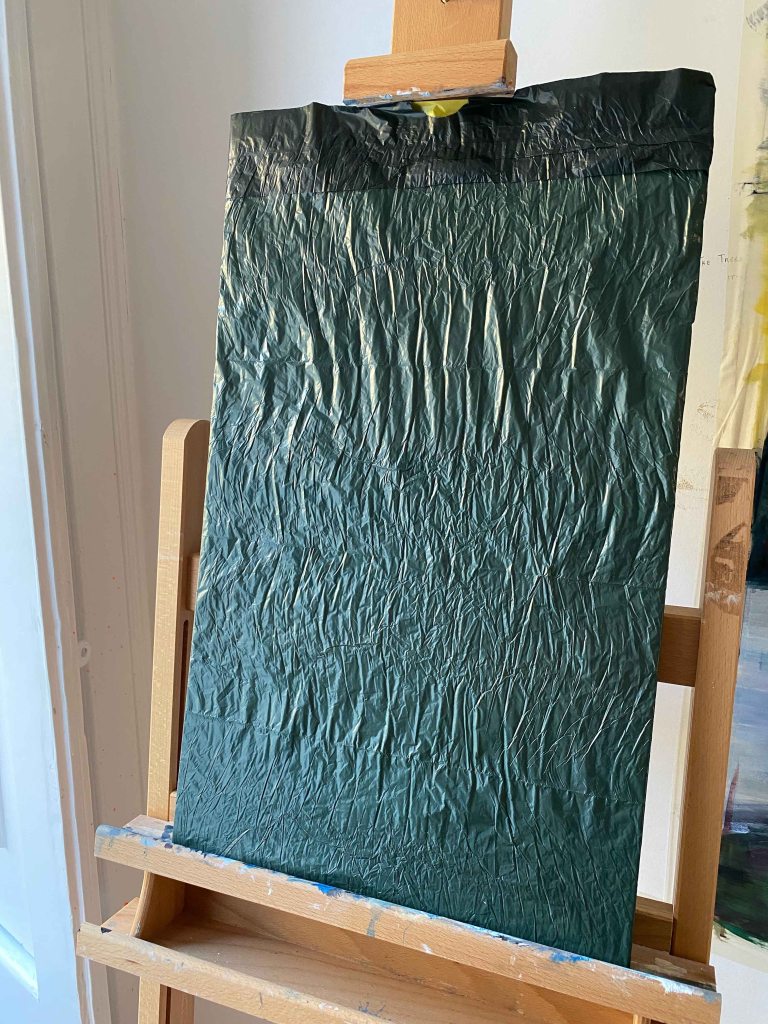
I also want to try and draw this “toxic flower” directly on a dark grey trashbag, elevating the plastic bag to an object of beauty.

I do a quick drawing in pastels on black paper to try out the colours of reflecting neon signs for this composition.

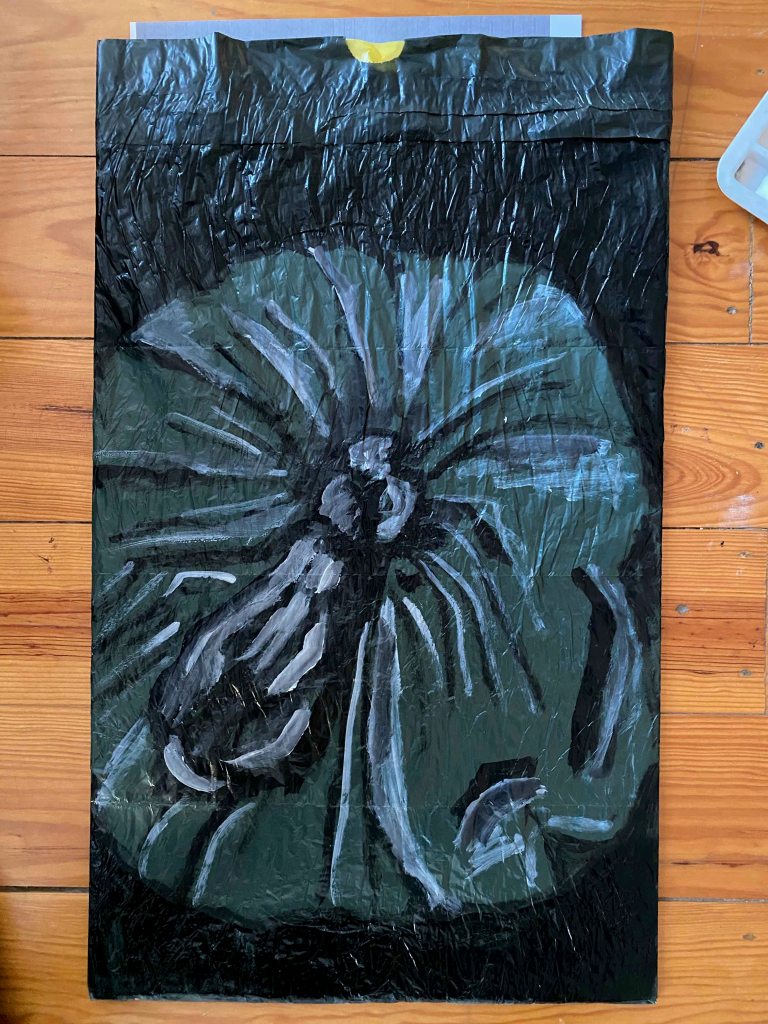
This is the final drawing in colour on trash bag:

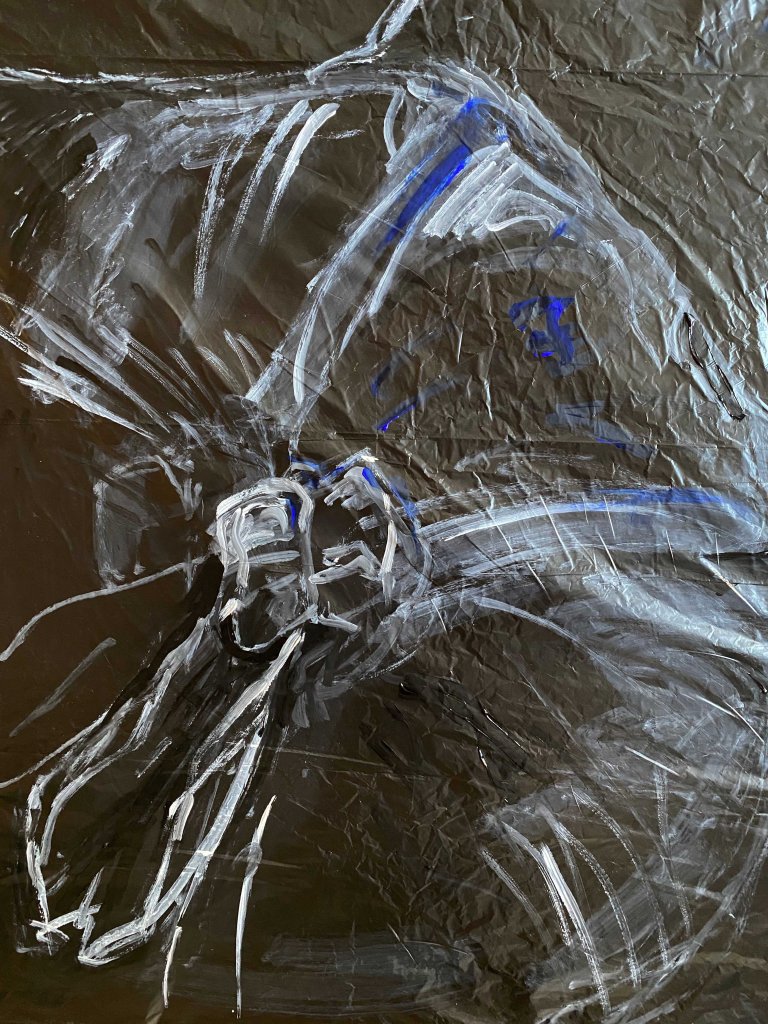
I overworked this drawing and it lost the spontaneity I was aiming for. I decide to give it another try and only add a slight touch of blue, instead of all the different reflected colours. This is the final drawing on a black trash bag:

Reflection: I could just keep going experimenting with this subject, so I have definitely managed to turn an unpromising subject into one that I can become really curious about and continue working on. In the middle, I got sidetracked to looking at it more conceptually and lost the focus on the composition, while using the phototransfer of my house as a background. Finally focusing on detail allowed me to come back to the essence and drawing the trashbags as a toxic flower.

I tried using dry pastels and Indian ink with nib pen and brushes, phototransfer and collage and finally drawing in acrylics on plastic bags.