Course manual: “Find a place of significance to you to create a site-specific artwork. Responding to features of the site, add a drawn element or select a found drawn element which you’ll extend to express something you find interesting about the site. Relate your art work to your research in your log and synthesise what you’ve learned about installative and environmental art with your own interests.
For this assignment, you may have to submit a photograph of your final piece. If so, make sure that this is of an adequate scale and quality for your tutor to gain a true impression of your work.”
For the project 4.3 Installation, I researched the MoMa exhibition On Line from 2010-2011( see blogpost https://clarasdrawing2.design.blog/2020/06/08/research-point-on-line-pierrette-bloch-and-installation/). It opens a fascinating world of new possibilities when drawing moves off the page and into space and time. For the project 4.3 of Installation, I chose to focus on Landart when building a nest. Now I will come back to some of the ideas seen in the “On Line” exhibition for this assignment of a site-specific artwork.
I am very curious to try out drawing in space with wire, inspired by Czech artist Karel Malich, which also will allow me to draw with shadow and light.
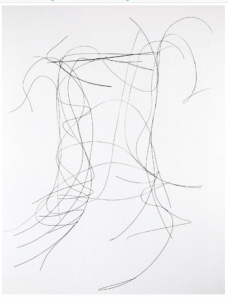
(Image from: 2010. MoMa/On Line. [Online]. [8 June 2020]. Available from: https://www.moma.org/interactives/exhibitions/2010/online/#works/02/68)
Edward Krasinski ‘s use of blue tape to connect the various elements of an installation also really appealed to me. I am planning to use a line to connect the various parts of the work, to create a sense of whole while allowing much space between the objects. I would choose a rugged, hand drawn line though.
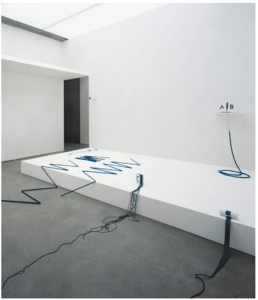
2010. MoMa/On Line. [Online]. [8 June 2020]. Available from: https://www.moma.org/interactives/exhibitions/2010/online/#works/02/66)
Another element that has appeared through this chapter of the course and that I want to include here is painting in “Trompe l’Oeil”.
So I aim at combining trompe l’Oeil painted elements, with elements drawn in wire and light, as well as connecting lines.
My first general impression of the exhibition, was that the works that I was attracted to, are clear, simple and not overloaded. I have a tendency of painting overloaded fairy tale settings on doors and chairs… For this assignment, I will have the challenge to find a harmonious middle way, remembering that sometimes less is more, while still wanting to include all of the above that I want to try out.
MoMa’s website has an incredible treasure of photos of installation work. I am drawn first to the title “Shared Eye” and then to the visual of an installation by Sadie Benning 2016. The first impression is a lot of white walls left between her very small works hung in small groups. Her work consists of these small panels with mixed media, drawings, found images or printed photographs layered. These small works together then evolve into something like a sculptural wall work.
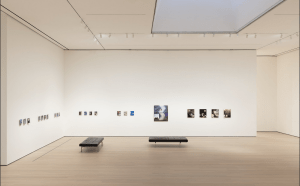
2016. MoMa Collection, Sadie Benning Shared Eye 2016. [Online]. [7 July 2020]. Available from: https://www.moma.org/collection/works/222123?classifications=20&date_begin=Pre-1850&date_end=2020&locale=en&page=1&q=&with_images=1)
This Installation would be too “clean” and too white for my project, but it is soothing and refreshing to see , and will help me moderate the urge to do too much, too full. I am taking from this to keep the separate elements rather small.
In this sentence from the catalogue of the same exhibition showed in Basel in 2017, two key words stand out, that I realize are very important for any site specific project- rhythm and narrative:
“The rhythm of the installation mimics the cuts, pans, pauses, and transitions of time-based media. Each of the panels, and the installation as a whole, suggests parts of a narrative, broken sentences—poems—where space is held for the viewer to make their own connections, seek their own questions, or leave things unresolved.”
(Quote from: 2017. Renaissance society, Sadie Benning:Shared Eye. [Online]. [7 July 2020]. Available from: https://renaissancesociety.org/exhibitions/525/sadie-benning-shared-eye/)
Many of the site specific installations in the MoMa collection rely a lot on large objects, like sofas or large cut outs in the space. In my narrow hallway, I will need to have a clear passage, but still want to include some 3Dobjects to give the installation a more tactile character. I do have a lot of space vertically, and can hang (small) objects from the ceiling. In any case, the work should direct the viewers gaze upwards.
I watched the process of Susan Szu’s installation through different You tube clips. She displays a wide variety of objects together , so that they create a new reality hovering somewhere between the familiar and the imagined. What struck me was the spontaneity with which she reacted to the space- so that an installation always evolved responding to the space. That is a quality I want to carry forward in this project.
So: Rythm, Narrative and spontaneity are my key words.
I am very lucky, for this assignment ties in with my parallel project where I explore the whole house as a nexus of narratives and in a permanent state of transformation. In this special place of significance, my studio is the most special place, as its transformation does not need to be negotiated with anyone else. For this Assignment, I will focus on the long, narrow corridor leading into the studio, where I feel free to play. (I prefer to keep some fresh, white walls in the studio itself after just having quieted the many wild colours and tiles left by the previous owners).
The space
The space is a long, narrow corridor with strange angles and different heights of the ceiling. I have previously painted all the walls white. I will start this project by also covering the rather disturbing tiles. They are not strange enough to be interesting, but are very distracting.
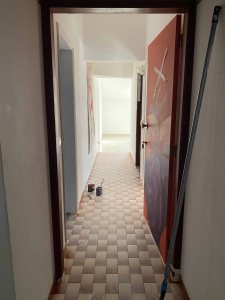

I cover the tiles in a neutral grey (special tile paint), so as to produce a clean canvas to start on.
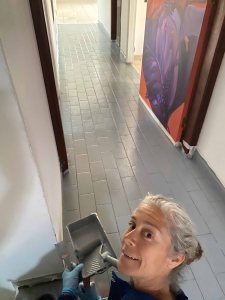
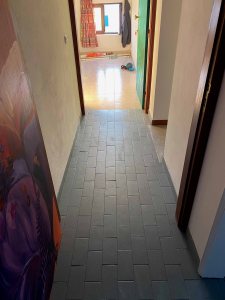
I had already painted the door that leads in to the corridor orange with a wild pink and purple jungle, but this will stay on the outside of the project. The inside of the door is plain orange.
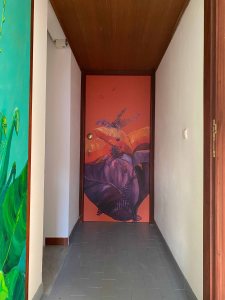
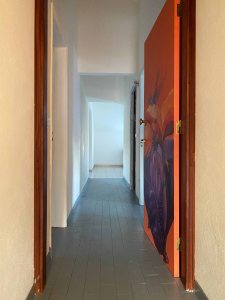
I paint the first door to the left in neutral grey too and the one to the right in a bright yellow. I am planning to create trompe l’ oeils on these doors leading in to different worlds, and the background colour is already setting the tone.
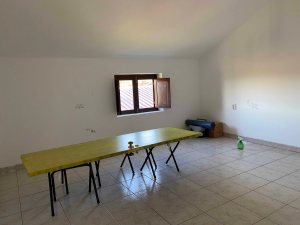
I think this space is really interesting , because it is impossible to comprehend in one glimpse. You have to walk through it and look around in order to see it, so the shape and format of the work already makes it into an immersive experience.
The narrative
This hallway is a transition from one space to another, and connecting it to my parallel project telling the narratives of this house, I want to find a transition between the story of the house and my own story.
One piece of the story of the house that I have not yet explored is the presence of religion. The former owners were very religious and active in their church, and the reason a 90m2 area is divided into nine very small and strangely shaped bedrooms, is that it was always full with visiting members of the congregation. This space has seen a lot of prayer! My prayer is gardening, painting, the ocean and practicing yoga everyday. I am curious how the possible symbolism of these different parts of the story can flow into this project.
The shape of the space- long and narrow- also makes me think of a tunnel, or maybe a birthcanal, a transition, connecting different worlds.
The eyes
The eye is a symbol of higher consciousness, clairvoyance and also religion- the ever seeing eye of God. It is used in many religions or belief systems as the symbol of connection to spirituality, a gateway into the soul.
I am fascinated by eyes and seeing them everywhere at the moment.
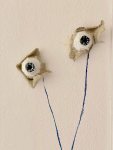
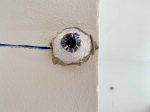
We have just poured concrete for our front porch , and as little pieces to keep the distances, concrete with wire into eggcartons. Suddenly I look at these little scattered pieces and see perfect eyes for this project! My small 3D object has been found.
I paint the little egg carton shaped pieces with eyes.
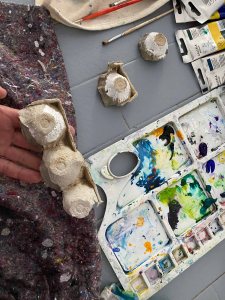
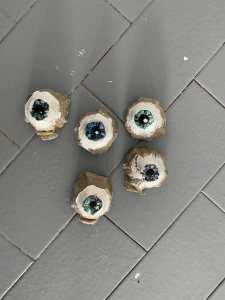
Just your average Sunday morning here in the village…
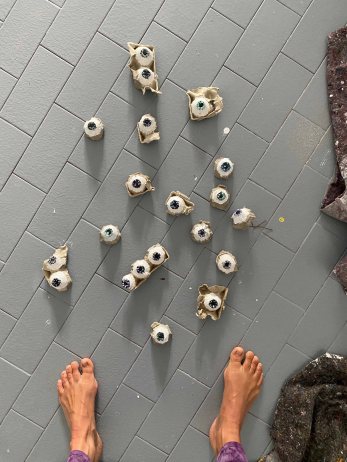
Next, I load a concrete glue gun..
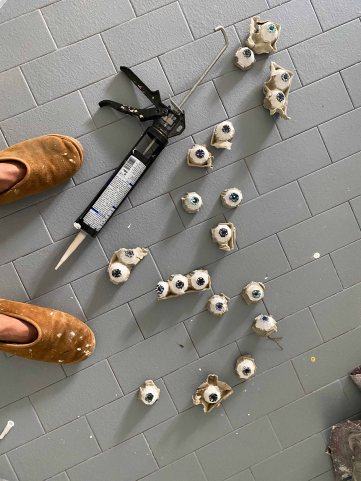
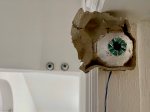
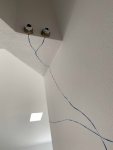
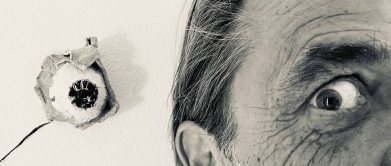
I want to glue the eyes on the walls of the corridor. Seated in the end of the corridor working, I will feel looked after, guarded by a myriad of eyes watching anyone approach. If you are arriving as a viewer, you will be observed, all these eyes are watching you.
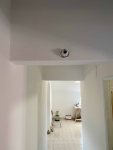
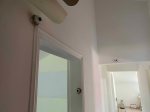
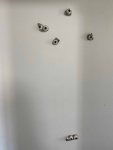
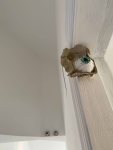
What emotions does this evoke in the viewer?
This is how it looks walking in:
The lines
I explore several patterns or kinds of line to connect the various elements by drawing on prints from the site with the glued eyes:
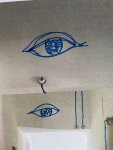
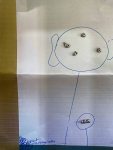
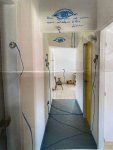
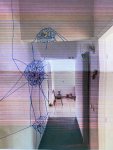
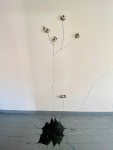
I will opt for the simplest version though, an Ultramarine line with a white lining, drawn by hand freestyle. Using a very controlled precise line or tape does not appeal to me.
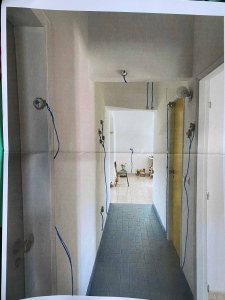
This is how it looks on site:
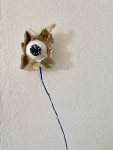
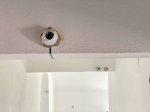
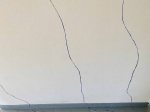
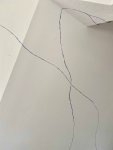
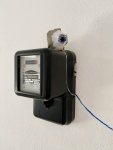
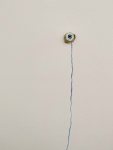
A visit by my friend Jamie:
Trompe l’ Oeils
The main painted elements of the installation, will be trompe l’oeils, as openings to other worlds, to other dimensions in a religious or spiritual context.
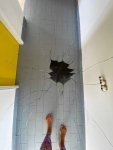
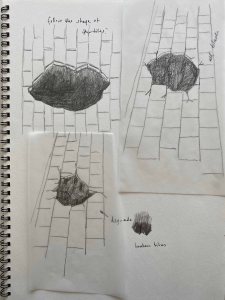
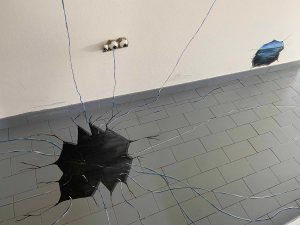
I start with a black hole in the floor- leading to a dark unknown, maybe the subconscious.
First some pencil drawings in my sketchbook.
I try it out on a printed photo of the site:
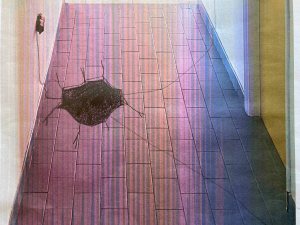
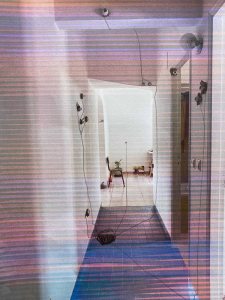
I am using acrylic paints and this is the result on the floor:

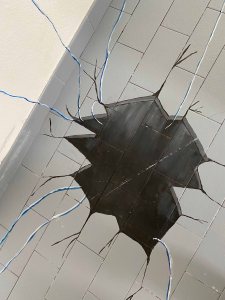
This hole is great fun for some visitors 🙂
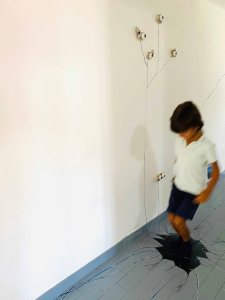
I then continue with planning the trompe l’oeil openings on two of the doors.
Doors are symbols of transition, between one place and the next or between life and death. The Japanese artist Chiharu Shiota for example, has done some wonderful installations including doors with this strong symbolical connotation of passage from life to death.
On the yellow door, the hole will open up to wonderfully lush nature, Paradise, or fairy land. The orange, second door will crack open to darkness and chaos, maybe Hell. Thus between the two, there will be balance again.
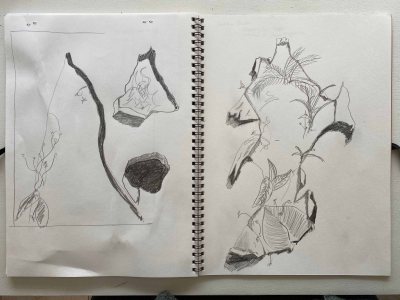
This is the development of the painting on the door:
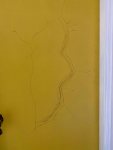
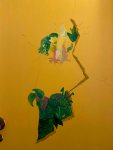
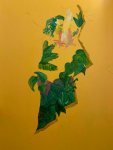
This is the final painting of a trompe l’oeil opening on the yellow door:

Finally, I connect it to the hole in the ground with the same blue thread that connects the eyes. It is unclear if an eye is attached and has crawled into the opening.
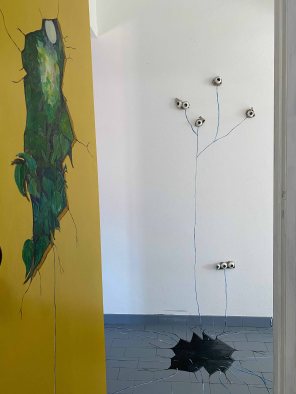
I love the reactions of my curious neighbours
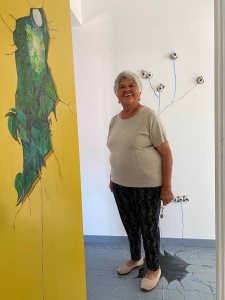
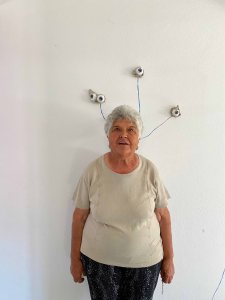
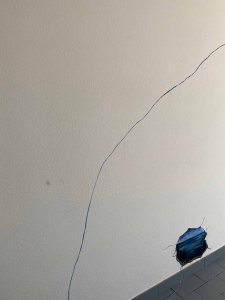
A few days later, I move on to the orange door- creating two cracks towards the darkness.
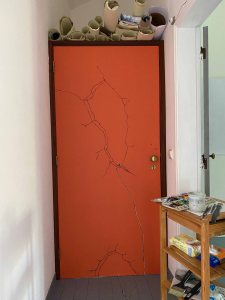
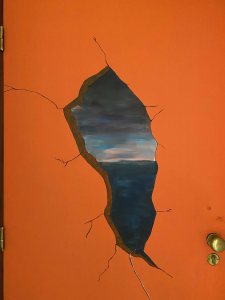
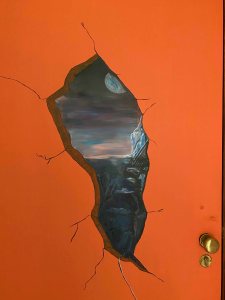
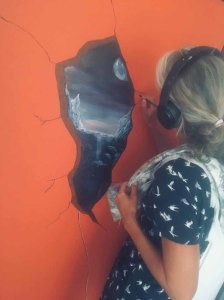
I go through an intermediary phase where I think the dark waters on the bottom can spill out on the floor:

But it takes away from the depth of the 3D effect, so I erase it again.
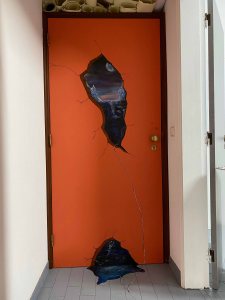
This is the final trompe l’oeil painting on the orange door:
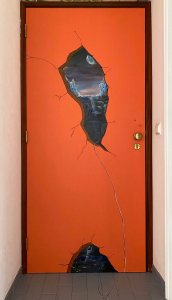
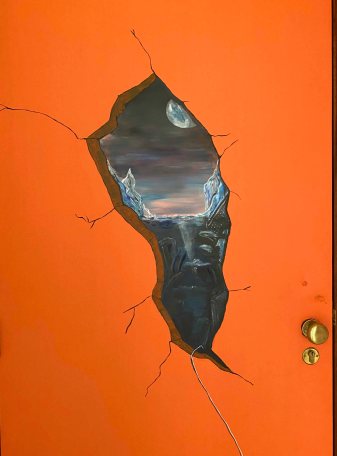
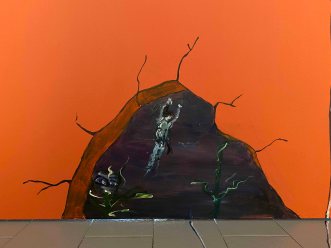
I add one more crack in the wall on the furthest point from the orange door for balance.
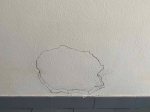
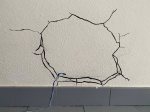
This is the final little painting:
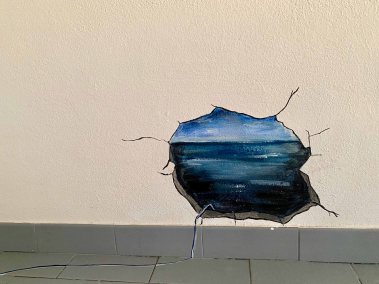
All of the trompe l’oeils have the same string “crawling into them” so they are connected in that way.
Spiders in wire
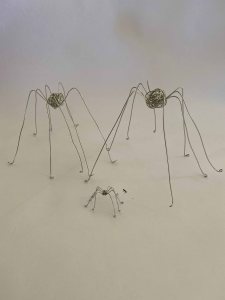
The idea to use spiders in this installation came from the research into Louise Bourgeois sculpture “Spider” and defining it as a drawing. Also, I am keen to use wire in this installation and a spider seems an easy shape to start with.
Symbolically, the spiders represents creativity because of its incessant weaving of their own artistic worlds. It is also a symbol of mystery or mystic power and spiritual growth, so very fitting for this piece.
The spider also has 8 legs- like the eight limbs of yoga, ashtanga , and was an ancient symbol of infinity.
I am using a 1.5mm metal wire and some simple tools.
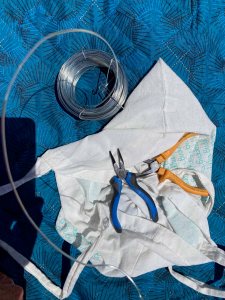
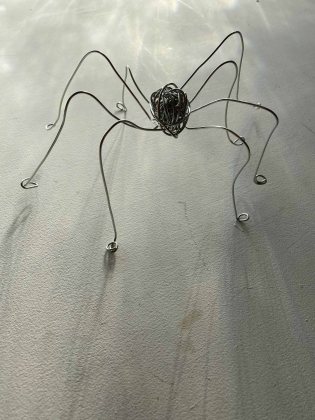
This is a little more challenging than it seems, but finally: here is my first spider:
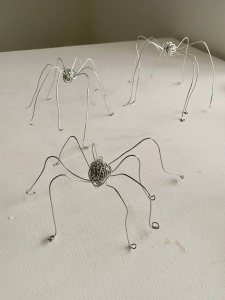
over the next days, the family of spiders grows:
I decide to challenge myself with a human figure:
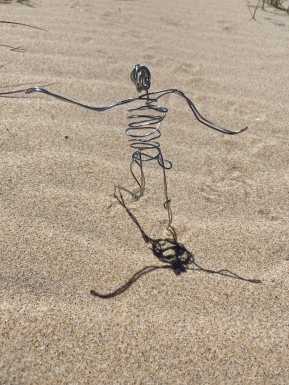
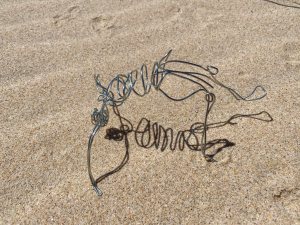
I had the idea of possibly having a large number of small humans falling down as an element, but seeing how much time I am spending creating one of these, I shift that thought.
I also passed by the idea of including a number of bats. The bat is a symbol of transition, from death to rebirth, from the darkness to the light. It also seemed fitting to have bats in my “creative cave”.
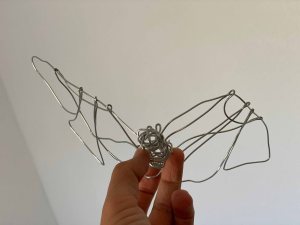
I am not happy with the shape though and decide to focus on spiders and on the beautiful and huge shadows they can cast.

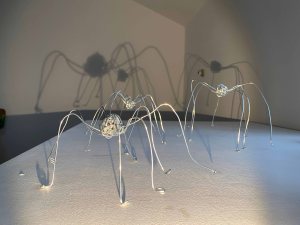
I create five spiders because the number five in numerology symbolizes the link between material and spiritual aspects of our life. We have 5 fingers, 5 toes, 5 senses and 5 sense organs. The Biblical meaning of 5 is God’s grace.
In my family of five spiders, there is a rather clear difference in size between the biggest and the smallest one, and I place them vertically on the wall with the smallest the furthest away, to increase a feeling of perspective looking up.
This is the largest and the smallest (on the floor):
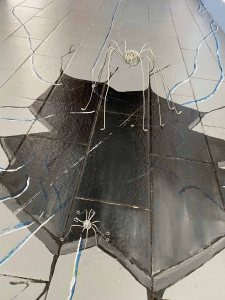
And with my hand to see the difference in size:
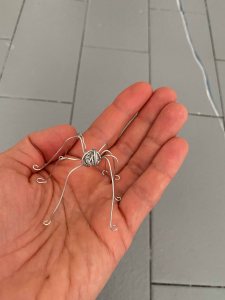
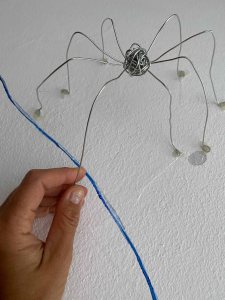
I changed for a thinner wire for the two smallest.
I use a glue gun to mount them on the wall. The spiders are very light and stick easily.
This is how they look looking up:
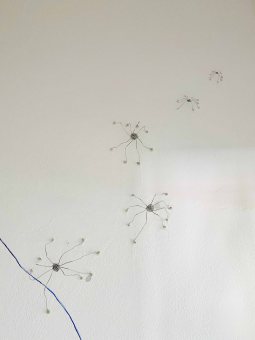
It looks quite amazing with the large shadows on the walls a single light bulb can produce:
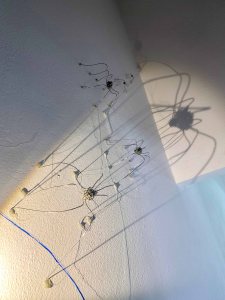
In the end of this post, there is the link to a movie, where this play of shadows is clearer and also shows how the element of movement and sound come in.
I attach the little human with a fishing line, so it looks like it is falling:
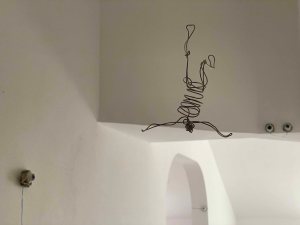
Here too, I can achieve interesting shadows:
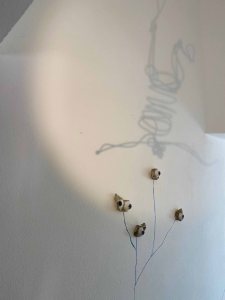
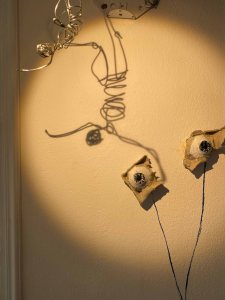
When someone walks into the space, the spiders definitely attract the most attention:
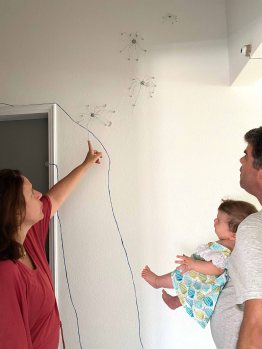

Looking from the eyes to the spiders, I obviously imagine spiders with eyes.
As another religious symbol, I am thinking of the Holy family, with little spider in his eggcarton crib. I start by creating mother, father and baby spider.
To be able to paint on the eyes, I cover the wire of the bodies with clay and let dry. I add a little penis to the masculine spider and breasts to the female 🙂
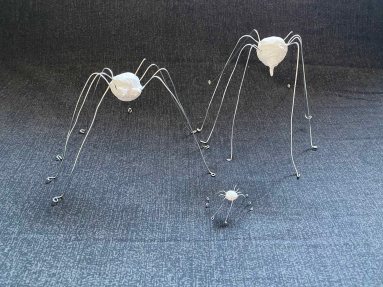
I then paint eyes on the spiders.
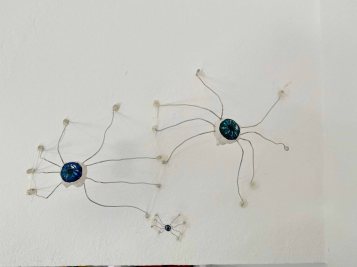
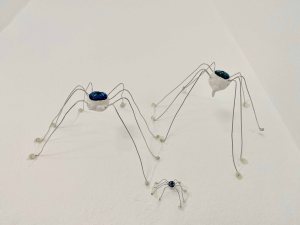
Little spider has eyes on both sides, so that you can see it even if he is lying down in a crib, but finally, I decide to keep it clean and simple and attach all three directly to the wall.
This is how they look on the wall:
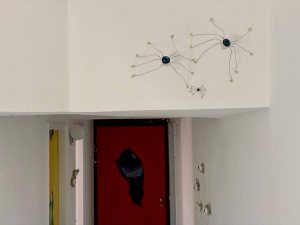
I believe it is difficult to get a sense of this installation from photographs only, so I have created a 4 minutes long video here, taking you through the installation with music and light:
Video editing is a new art for me, so it was a steep learning curve and I am aware that this is a little heavy on the special effects as I wanted to try out everything .
Conclusion
For this site-specific installation, I set the objective to create work with a rhythm, a narrative and elements of spontaneity. I am happy that I managed to not overcrowd the space and I do believe the different elements , the spaces in between and the swinging lines that connect them create a harmonious rhythm. I also stayed within a narrative- connecting symbolical elements of spirituality and religion. Spontaneity was definitely a big part of the work- one element led to the next and they were all conditioned by the peculiar shape of the space of this installation.
The result became a little too creepy for comfort.
If I am not so happy with the result though, I am very happy with the process. I was thrilled to try out so many different aspects that I got curious about during this part of the course. I loved bringing the line away from the 2D surface by incorporating little objects, using the wire and also light, that added movement to the “drawing”. Even the painted elements of the trompe l’oeil gave an added sense of 3D. I also learned a lot about video editing, which feels like an extremely useful tool, and there is a lot more to learn and explore there too.
 Clara's Drawing 2