Course manual: “Aim: Many artists use installative drawings and what these artists are doing positions the viewer or audience member in a totally different way to someone viewing a work on the wall contained within a frame. Using the link below, look at the work curated for On Line, an exhibition of contemporary drawing held in Edinburgh in 2010. Look particularly at the section entitled ‘line extension’ which discusses the work of Robert Rauschenberg, Cy Twombly, Ellsworth Kelly, Karel Malich, Edward Krasinski and Pierrette Bloch: http://www.moma.org/interactives/exhibitions/2010/online/”
“Method: Make a drawing that relates to its environment in a way that creates an interesting dynamic between the artwork and the space around it. Think about ways that drawings could take part in a kind of dialogue with the space they inhabit. Text might be one way, or a drawn object in partnership with its real world equivalent.”
In this chapter, I have really enjoyed exploring the Landart work of Richard Long and Andy Goldsworthy, using materiasl directly from the land around them to create their stunning pieces. I have also felt very moved by the work of Ana Mendieta, that I was less familiar with before. I am especially fascinated by the way she fuses the use of the elements surrounding her and her own body.
For this project, I want to make a Landart installation, using branches and sticks from the land I live on. My idea is to create a giant nest. A nest for me is a symbol of a place to land in, a place that feels safe, that feels like a home.
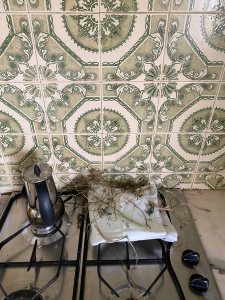
We are currently “nesting” in this big, quirky house after very many years of a nomad lifestyle, so the subject of “creating a nest”, a home, is very present. We also have a small problem with swallows nesting in our chimney and leaving us the offering of some branches on the stove every single morning:
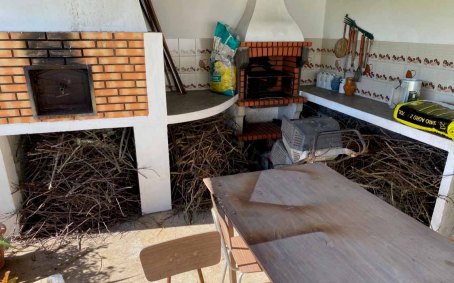
After pruning a lot of old and dry trees, we also have a good supply of prime nest material:
My idea is to create a giant nest, big enough for two persons to sit and converse, drink a cup of tea or meditate in.
This is a site specific installation because it will be a literal nest , on the land where we are nesting, created through branches from the trees growing here. It is deeply connected to this specific place. My intervention will bring a new sense of ordering to elements that were here already.
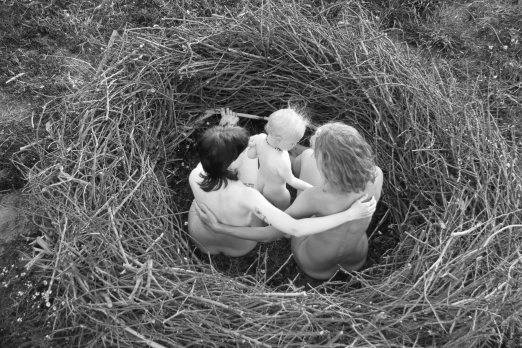
I then plan to create a series of photographs of me and my daughter and granddaughter in the nest, and so connect to the idea of lineage and connection, of creation. This is inspired by the work of Ana Mendieta who often uses her own naked body in a fusion with the natural elements.
Hopefully, I will be able to build a nest that is then possible to move though, so that it could theoretically be placed in a new and different environment, for example a gallery, in a busy city, where a spectator could sit down quietly and feel transported to a calm and safe nest.
Richard Long, who uses circles a lot in his work, speaks about the primal perfection of a circle and the primal feel of standing within one. I hope I can achieve a beautiful, safe circle to spend time in.
THE MAKING:
I choose to build the nest right in front of the house, so that we will be able to take the planned photos from the second floor windows.
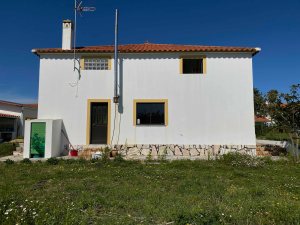
I am hoping that the nest will be solid enough to be possible to transport to a more discreet spot in the garden later (and theoretically to a gallery :))
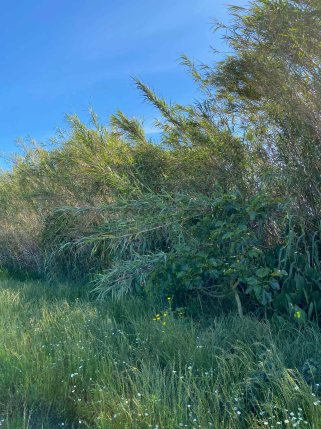
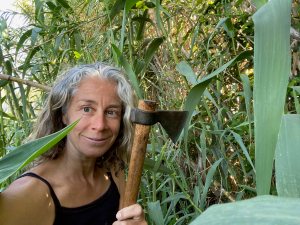
I need to build some sort of light frame to weave the branches onto, and have spotted some canes that have already fallen and are crushing a small fig tree:
Who knew that my years in the Philippine jungle handling a machete and building mud houses would come in so handy in a Drawing course:)
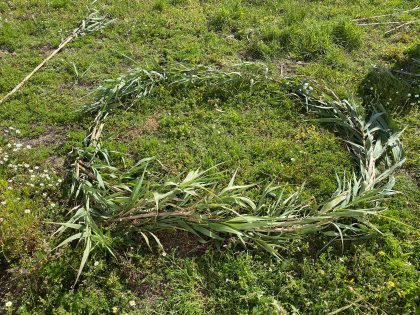
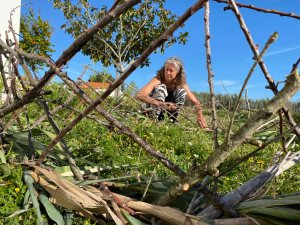
I start by creating a frame with the bendable parts of the canes:
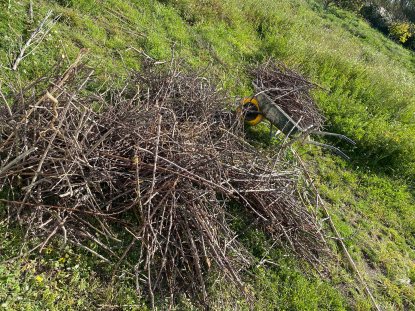
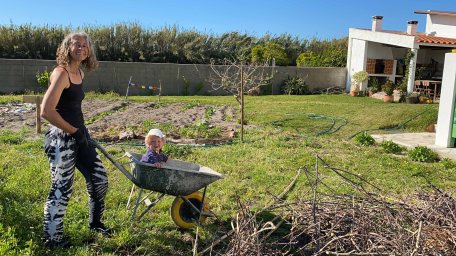
I carry loads and loads of wheelbarrows with sticks from our storage in the outside kitchen to the nesting site. (Trying not to think of how much effort it just took us to store them there before I had this idea to tear them out again.)
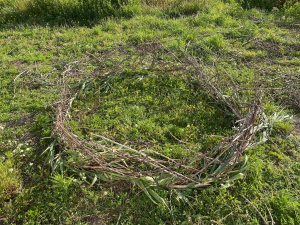
I choose the longest branches, to weave into the cane frame creating loops that I can then fill with smaller branches:
Of course my little helper is present, and enjoys the rides back to the shed.
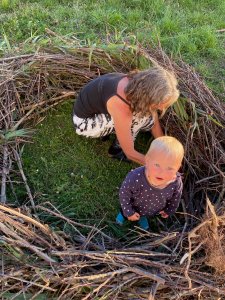
I spend many hours “fleshing out” the frame by weaving sticks and thickening the structure:
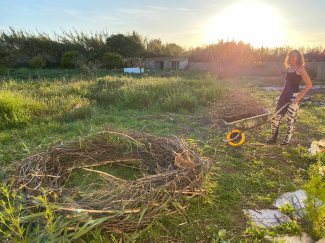
This is how the nest looks when the sun sets on Day 1:
When I see it from the second floor the next morning, I feel real joy. I feel like I am making a statement that reconnects me to this specific place, with my scratched hands touching the earth and the branches from the trees grown here, and at the same time there is something so universal, in this need to create a nest, to order the messy branches into a circle that feels safe.
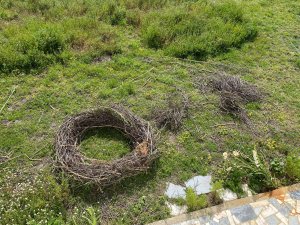
It takes the whole of day 2 to finish building up the bulk of the nest by weaving smaller branches into the longer ones and twinning them so that they would create a stable body.
This is the finished nest:
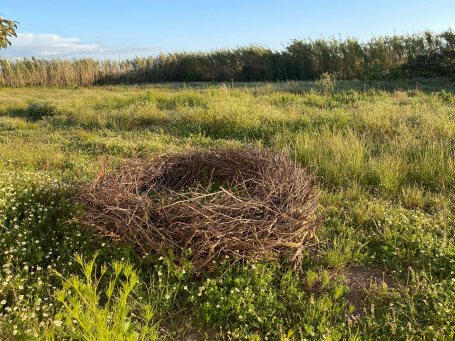
THE PHOTOGRAPHS:
The nest is ready for our photo session.
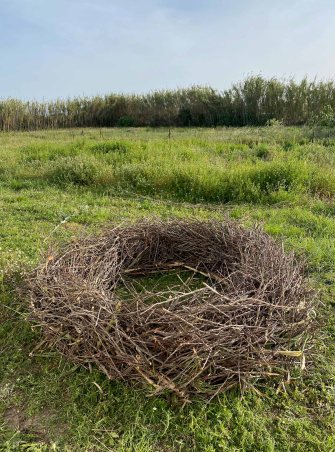
My partner Andre and our best friend Tom are ready with cameras in the second floor window.
Inspired by the work of Ana Mendieta who uses her own naked body and the idea of that body merging with nature as a symbol of rebirth, or regeneration, we will use the bodies of our three generations of women here- we will sit in the nest with my daughter and granddaughter, naked on the earth that has welcomed us, in a ritual of landing safely. It also becomes a ritual of my daughter getting ready to leave the nest- it is time.

We are also creating a series of photos of me lying down on the ground, which feels even more like a vulnerable merging with the earth, and with this specific place.
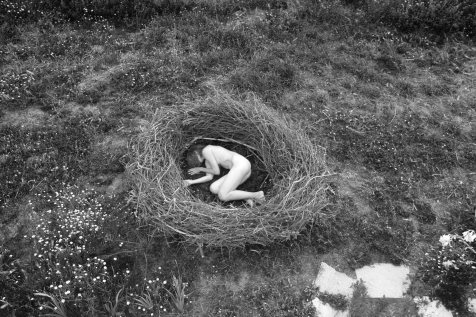
My parallel project is about exploring the history and my own connection to this house and documenting its transformation. This Installation connects to that same quest.
It would be possible to move this nest into a very different environment, where it’s strength could be in the stark contrast between the materials used here and the surroundings- for example a cool concrete floor and shiny white walls. I can imagine a series of photographs on the walls, while the visitor can be invited to sit down in the nest and reflect upon how it feels.
I would argue that this installation is a drawing, as it has been patiently created by intertwined lines in space. It is a drawing using “poor materials” and deeply connected to the environment, constructed with elements of the same environment.
 Clara's Drawing 2