Category Archives: Research and Reflection

ART BASEL Online Viewing Rooms

Due to the Covid 19 situation, Art Basel opened the access to all artworks online through their Online Viewing Rooms from June 19-26. As I have not seen any exhibitions in the flesh for a long time , due to this worldwide situation,  I am keen to browse the online version of this largest art fair in the world, taking place in Europe in Basel, in the USA in Miami and in Asia in Hong Kong.

There is an incredible amount of information and art works here. 282 galleries from 35 countries show over 4000 artworks! As this is a commercial event, it often shows the works with a pricetag, which puts them in an very different context than seeing the same works in an exhibition. They are also organized by gallery instead of by artist or theme, which brings another dynamic to the viewing, clearly placing the work in this commercial context-  a good reality check for a dreaming aspiring artist like me.

I started by watching an introductory video about the event (https://www.artbasel.com/ovr) and was already overwhelmed by the amount of highly successful contemporary artists mentioned that I did not know! This is a list of the artists highlighted that I want to take a more in-depth look at:

Carrie Mae Weems , Glenn Lighton, Deanna Lawson, Theaster Gates, Nicole Eisenmann, Monica Bonvincini, Jeffrey Gibson, Wade Guyton, Cecile B Evans.

Another category named the “Young Voices” highlighted promising emerging artists to look out for:

Issy Wood, Chen Tiangzhuo, Hanna Miletic, Jonathan Lyndon Chase, Paul Mpagi Sepuya, Rafa Esparza.

A search for these artists with the search engine of the website is not very successful though, several are not found at all, so I decide to leave this list for a general internet search afterwards. Instead I wander through the viewing rooms randomly, much like I would a real art fair and just look for something that catches my eye.

At first I am a little disappointed at the amount of Photography and sculpture or installation presented, in comparison to drawing and painting.

These two paintings by Liliane Tomasko presented by Kerlin Gallery are the first interesting works I encounter,  I am drawn into the layers of clear brushstrokes. These is something about these wide, visible brushstrokes that remind me of the work of Mimei Thompson, although Thompsons’ art is figurative with everyday subjects, like weeds from the backyard or a torn open trash bag. These paintings remain abstract, but I find myself following the forms and trying to make out something figurative that seems to just lurk under the surface.
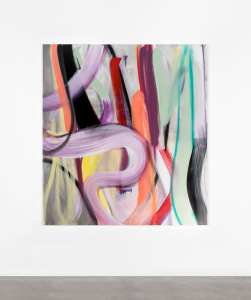
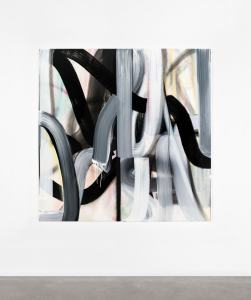
(Tomasko, L. 2020. Https://wwwartbaselcom/catalog/artwork/104940/Liliane-Tomasko-Hold-on-to-Yourself-5-18-2020. [Online]. [25 June 2020]. Available from: https://www.artbasel.com/catalog/artwork/104940/Liliane-Tomasko-Hold-on-to-Yourself-5-18-2020)

Next, I discovered the paintings of Miriam Kahn (Gallery Jocelyn Wolff) where crudely painted humane figures in translucent colours attract my attention. They are clumsy and caricaturist but exude a strange power with their shining limbs and the way they look straight into my eyes with their childishly drawn faces.
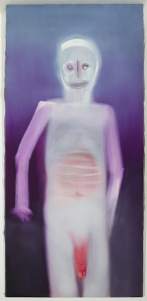
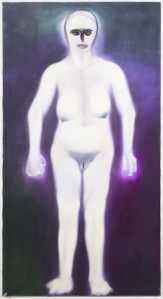
In the midst of the comical, I can feel this insecure uncomfortable humanness.

(Cahn, M. 2020. Artbaselcom/catalog/artwork/113703/Miriam-Cahn-au-travail-27-5-27-6-11. [Online]. [25 June 2020]. Available from: https://www.artbasel.com/catalog/artwork/113703/Miriam-Cahn-au-travail-27-5-27-6-11)

In this artwork by Mariela Scafati (Gallery Isla Flotanta) , I find the composition of small paintings put together really effective and an idea to remember.
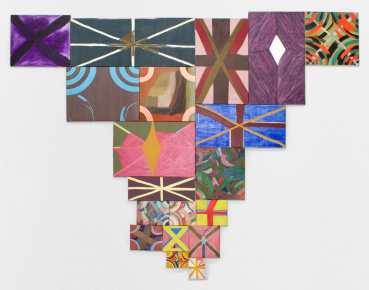
 

(Scafati, M. 2020. Artbaselcom/catalog/artwork/106369/Mariela-Scafati-Montaje-de-los-tiempos-posibles. [Online]. [25 June 2020]. Available from: https://www.artbasel.com/catalog/artwork/106369/Mariela-Scafati-Montaje-de-los-tiempos-posibles)

I am right now working on the art-specific piece for Assignment 4 in a corridor that is not possible to look at in one glimpse, so this could be one way to present images from the separate parts of the artwork.

I really like this painting in only white and blue by A.R Penck from 1976 (Michael Werner Gallery).
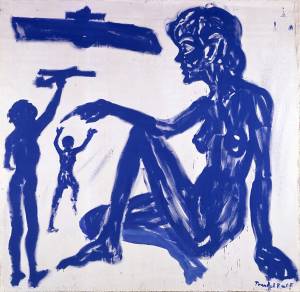
I want to remember how the different figures in different sizes cohabit in flatness- without a sense of perspective.

(Penck, A.R. 2020. Artbaselcom/catalog/artwork/107230/A-R-Penck-Traudel. [Online]. [25 June 2020]. Available from: https://www.artbasel.com/catalog/artwork/107230/A-R-Penck-Traudel)

Looking at Pencks’ work quickly connects me to more viewing rooms with recognized modern masters and I am amazed at the amount of small works on paper on sale in the million dollar range. I try to navigate away from Matisse and Picasso towards more contemporary painting.

The works of Wu Chen (Magician Space Gallery) are somewhere between fairytale and grotesque, like this painting of a fat Christmas man posing nude on the bed in some red and fleshcoloured  boudoir with a mirror over him. The name “Portrait of the Male Female Male” figure also alludes to the classic female nude you would expect in a similar setting.
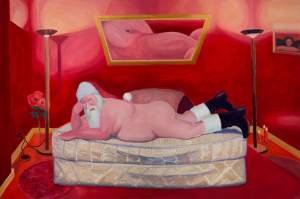
The reflection in the mirror looks more like a female body and the whole feels really strange.

(Chen, W. 2020. Artbaselcom/catalog/artwork/107368/Wu-Chen-Portrait-About-the-Male-Female-Male-Figure. [Online]. [26 June 2020]. Available from: https://www.artbasel.com/catalog/artwork/107368/Wu-Chen-Portrait-About-the-Male-Female-Male-Figure)

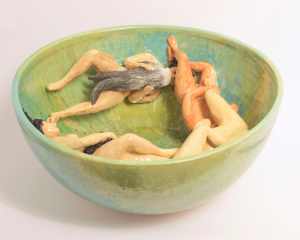
I stopped to take a look at the ceramic bowls by Urara Tsuchiya (Union Pacific Gallery).
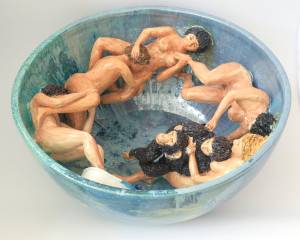
These bowls are full of little nude figures, and some animals intertwined in some unclear postures, opening up some strange narrative. I see that I am always drawn to story and these tell a strange story in a slightly uneasy way while at the same time posing as a colourful decorative item.

(Tsuchiya, H. 2020. Artbaselcom/catalog/artwork/107778/Urara-Tsuchiya-Henry. [Online]. [26 June 2020]. Available from: https://www.artbasel.com/catalog/artwork/107778/Urara-Tsuchiya-Henry)

I found these small works on paper by Cameron Clayborn (Simone Subal Gallery) really attractive in their simplicity.
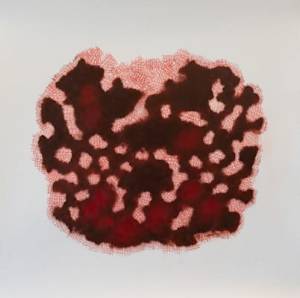
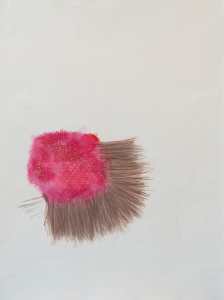
The one on the left is called “a puddle with promise” which I find so fitting.

(Clayborn, C. 2020. Artbaselcom/catalog/artwork/109738/Cameron-Clayborn-a-puddle-with-promise. [Online]. [26 June 2020]. Available from: https://www.artbasel.com/catalog/artwork/109738/Cameron-Clayborn-a-puddle-with-promise)

The same artist presents several inflatable sculptures, like this pillow like one, which also sparks my imagination with its cow like pattern- I can start spinning a lot of ideas from here.
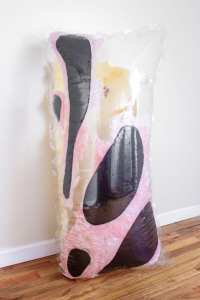
(Clayborn, C. 2020. Artbaselcom/catalog/artwork/111841/Cameron-Clayborn-inflatable-5. [Online]. [26 June 2020]. Available from: https://www.artbasel.com/catalog/artwork/111841/Cameron-Clayborn-inflatable-5)

The Galerie Guido W. Baudach shows several painters that I found worth looking into.

Tamina Amadyar’s clean, abstract painting felt so soothing after the overload of narrative .
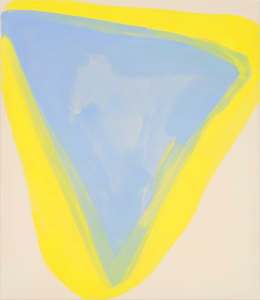
(Amadyar, T. 2020. Artbaselcom/catalog/artwork/104303/Tamina-Amadyar-overlook. [Online]. [26 June 2020]. Available from: https://www.artbasel.com/catalog/artwork/104303/Tamina-Amadyar-overlook)

This painting by Yves Sherer looks abstract at a first glimpse, then it looks like a patterned piece of cloth stamped into the ground, scratched and abandoned.
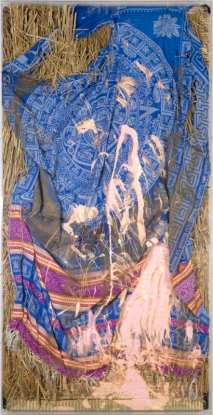
The title “Sirens (Teotihuacan)” can maybe speak about mermaids or maybe about the wailing signal of sirens, and then the name of an Aztec civilization that has disappeared. There seem to be as many layers of meaning here that there is of paint. The pattern on the cloth looks a little like a map, but the whole then scratched and torn.

(Sherer, Y. 2020. Artbaselcom/catalog/artwork/104009/Yves-Scherer-Sirens-Teotihuacan. [Online]. [26 June 2020]. Available from: https://www.artbasel.com/catalog/artwork/104009/Yves-Scherer-Sirens-Teotihuacan)

This painting by Andy Hope from 1930 finds its way my heart with the shriveled figure with twisted eyes and a little unlucky shape.
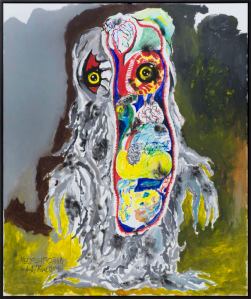
(Hope, A. 2020. Artbaselcom/catalog/artwork/103915/Andy-Hope-1930-HEEDRAHTROPHIA-8. [Online]. [26 June 2020]. Available from: https://www.artbasel.com/catalog/artwork/103915/Andy-Hope-1930-HEEDRAHTROPHIA-8)

Meiro Koizumi’s works  (Annett Gelink Gallery) are called “works on paper” and I am not sure if they are drawings or overworked photographs.
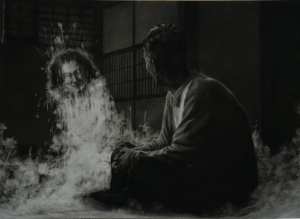
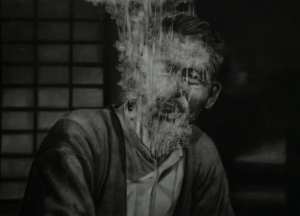
I am drawn in by the fog covering the figures faces creating a sense of mystery- I want to know more. An internet search shows that this Japanese artist is mainly working in video, exploring the domain between public and private. It is true that these scenes look like stills from movies.

(Koizumi, M. 2020. Artbaselcom/catalog/artwork/108829/Meiro-Koizumi-Fog-12. [Online]. [26 June 2020]. Available from: https://www.artbasel.com/catalog/artwork/108829/Meiro-Koizumi-Fog-12)

Here I found a painting that I really like by Kudzanai Chiurai (Goodman Gallery)- a black figure almost not standing out from the black background and a foreground with different types of texts. The posture, the dull colours, the sharp contrast between light and dark, the combination of figure and text- I really appreciate this painting.
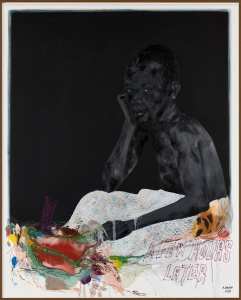
(Chiurai, K. 2020. Artbaselcom/catalog/artwork/103051/Kudzanai-Chiurai-A-few-hours-later. [Online]. [26 June 2020]. Available from: https://www.artbasel.com/catalog/artwork/103051/Kudzanai-Chiurai-A-few-hours-later)

Gallery ChertLuedde presented a long series called “20 th Century alienation” of photographs by David Horvitz showing the same masked person with gloves holding different white sheets of paper with words .
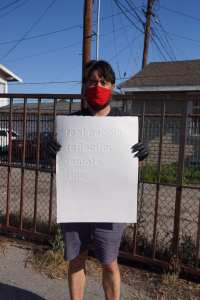
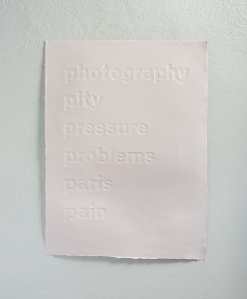
I am not so attracted to the visual here, but I really like the idea and can see more words emerging in my own work.

(Horvitz, D. 2020. Artbaselcom/catalog/artwork/113146/David-Horvitz-20th-Century-Alienation. [Online]. [26 June 2020]. Available from: https://www.artbasel.com/catalog/artwork/113146/David-Horvitz-20th-Century-Alienation)

By now, the Viewing Rooms have already closed, so I turn to an online search of the artists highlighted by the organizers, picking out the ones working with drawing or painting, which is what interests me most.

Carrie Mae Weems (Photography and film)

Deanna Lawson (Photography)

Theaster Gates (Installation, Performance, Dance, Sculpture)

Nicole Eisenmann is the first painter included on the list. She paints the figure because she knows the world through her body, and understands her desires and anxieties through her body, and also the desires and anxieties of our culture.
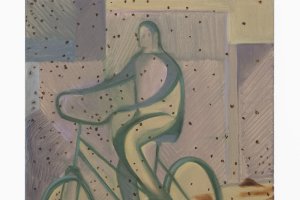
This painting from 2020 is called “Shitstorm”, which is a very evocative title.

The figures look like from caricatures and are often limp or lying, many charged with sexual motives , and many others with words. I like the artists titles, like “Incelesbian” or “Ridykelous”.

I find this painting below interesting because of the unusual cropping.
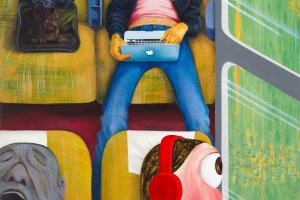
Kern, A. 2020. Anton Kern Gallery. [Online]. [27 June 2020]. Available from: https://www.antonkerngallery.com/artists/nicole_eisenman

Nicole Eisenmann has also created several large scale sculptures. As a whole, this caricature style does not capture me, although I enjoy the artists irony and playfulness.

Monica Bonvincini (Sculpture and performance)

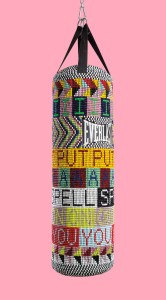
Jeffrey Gibson is the second painter of the list, even if he also works in sculpture and performance. He merges history and ritual from several different traditions to describe the world we live in today, and especially uses the aestetics of Native American cultures.He uses a lot of pattern and text in his paintings.

I was immediately drawn to his painted punching bags. They are multicoloured, multi patterened creations hanging in the room, often also containing a message in text, like here “One becomes the other” and “I put a spell on you”
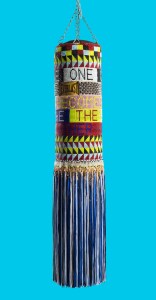
(Sam. 2020. Seattle Art Museum. [Online]. [27 June 2020]. Available from: http://gibson.site.seattleartmuseum.org/)

With these he is fighting using words and ideas rather than fists and guns, he wants to spark the conversation to be more inclusive.

I really like painting on objects myself and found this combination of idea, object, painting and text brilliant.

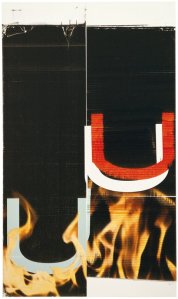
Wade Guyton is mainly making digital paintings on canvas using scanners and digital inkjet that are then worth millions of dollars. So he is combining the traditional support of painting with new technology. On MoMA’s website, his art is being describes as “post-conceptual”.
 

(Image from: Dzewior, Y. 2020. Museum Ludwig. [Online]. [1 July 2020]. Available from: https://www.museum-ludwig.de/en/exhibitions/archive/2020/wade-guyton.html)

The letters X, U and flames are recurring themes, and in the later works- large black and white surfaces.

Again, this is not a style of painting I would like to explore myself.  Although I am aware of the impact and possibilities of digital technology, I am actually drawn to the exact opposite- the non-technological, tactile, physical qualities of paint and also the conceptual- how to express an idea through paint.

Cecile B. Evans (video, installation, sculpture and performance)

It was interesting to then jump to Cecile B Evans work which is exploring how we value emotion in contemporary society, and precisely how digital technology has impacted that.

There is an excellent interview with Evans on the Luisiana Channel : https://channel.louisiana.dk/video/cecile-b-evans-virtual-real

Although video is not my chosen media, I found a lot of the artists ideas around how technology influences us and how it regulates our emotions, very relevant and exciting.

I am moving on to the artists described as “Young Voices”

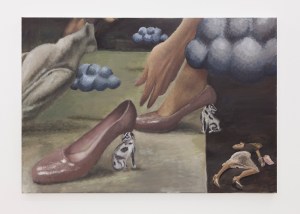
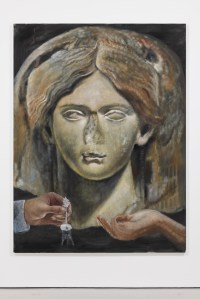
Issy Wood is both a writer and a figurative painter.
(Images from:   Ishikawa, C. 2020. Carlos Ishikawa. [Online]. [1 July 2020]. Available from: http://www.carlosishikawa.com/artists/issywood/)

Her paintings are surreal and dark, with obscure narratives that leaves me with an uneasy feeling. I can understand a certain fascination that these paintings have. Looking at exhibition views, I find it interesting how Wood alternates large paintings with really small ones.

Chen Tiangzhuo (performance video work and installations, music)

Hana Miletic (Textiles)

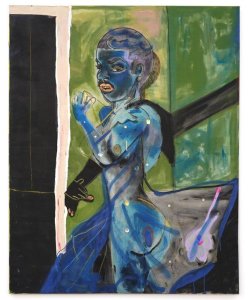
Jonathan Lyndon Chase is a painter focusing mainly on queer. black bodies.
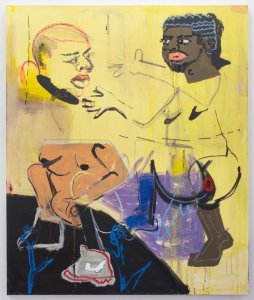
I am quite fascinated by the boldness of these flatly painted, unfinished, unproportional figures. In the painting on the left, I find the unfinished bits and how fragmented the figures become really interesting. In the painting on the left, I am interested in the colour and movement of the figure.

Paul Mpagi Sepuya (Photographer)

Rafa Esparza (Performance and installations using bricks) Rafa Esparza also uses the adobe as supports for his paintings. His work centers around the theme of brown and queer.

As a whole, I am not convinced researching the Art Basel Viewing Rooms and the artists mentioned there was the best approach for an interesting online art visit. I spent a lot of time navigating between rooms and feeling quite overwhelmed with the amount of art, without really seeing much that I felt really touched by. I also had a feeling that I missed many things that would have been really interesting, but I did not chance upon them. Of course this would have been another experience in the flesh and probably incredibly inspiring. For my online art visits, I need to be more focused and clear about what I am looking for and looking at to really appreciate it.
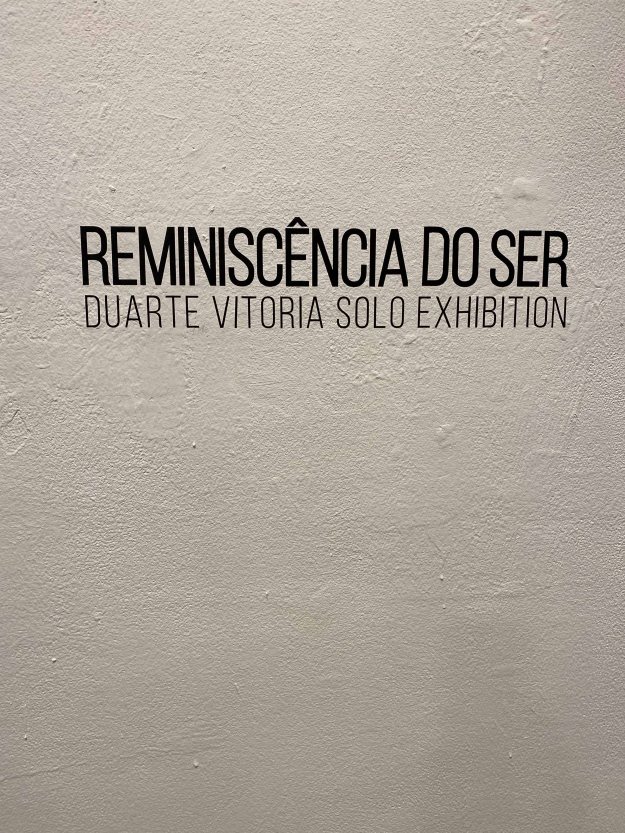
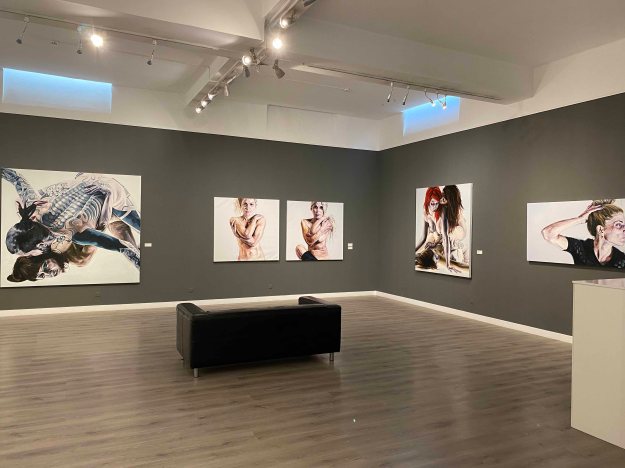


Duarte Vitoria at Espaço Exhibitionista, Lisbon

After what feels like a very long lockdown due to Covid 19, I am back in Lisbon and am visiting a fist exhibition again: Duarte Vitoria at the Espaço Exhibitionista Gallery.

This is one of my favorite Lisbon galleries, showing a new exhibition of contemporary Portuguese artists every month.

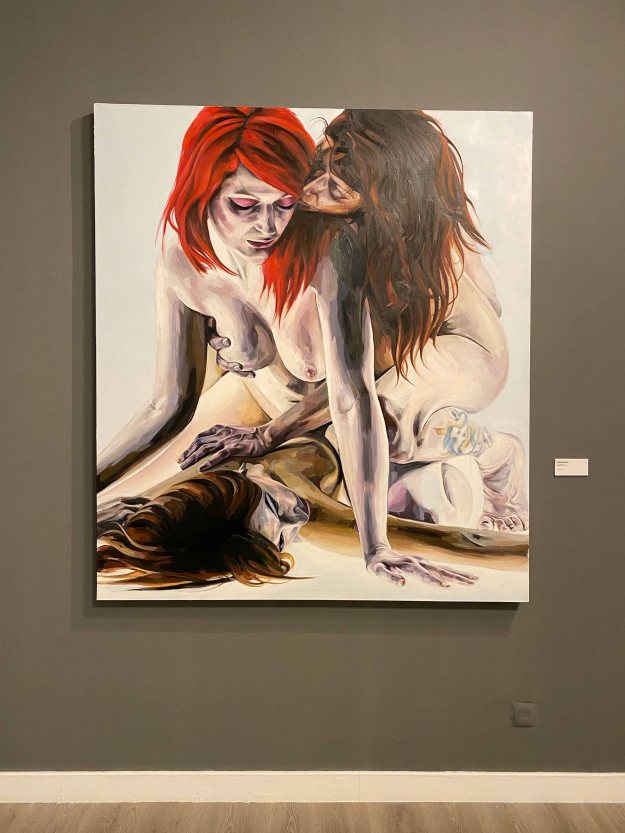
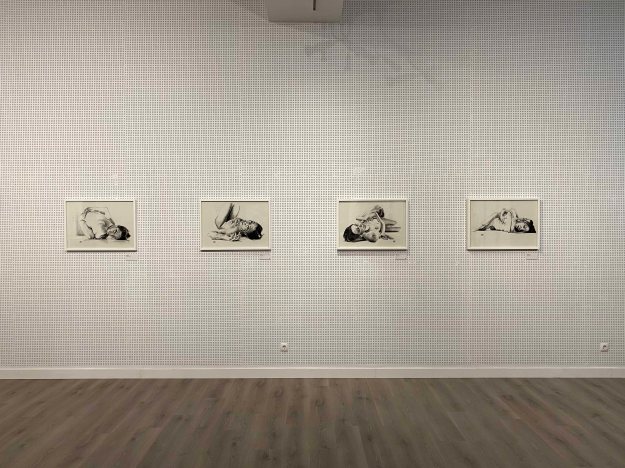
In this exhibition, Duarte Vitoria presents drawings and paintings of female figures. They are unsettling, distorted, foreshortened.

In some of the paintings, the skeleton seems to protrude beneath the skin. In others, the figures are contorted and seem in agony.

Some seem to have a sexual note, but it is unclear what is happening.

In the exhibition catalogue, well known Portuguese writer Valter Hugo Mae describes the work as ” a study on the extremes in physicality. They approach the near abnormality of gesture, searching as the demanding choreographer, for the unforeseen or at least perceptible movement in our daily reading”.

I find that as unclear as the feelings I have when seeing these paintings.

There is definitely a feeling of anguish and some irritation.

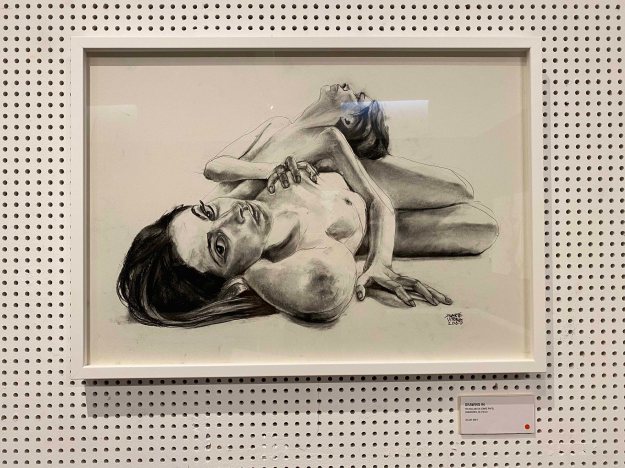
A series of drawings in charcoal are the works that I prefer, and I am told they are drawn with live models, starting as blind drawings, with the artist not looking at the paper.

I can see anguish and pain and the direct eye contact with the viewer has something of a call for help.

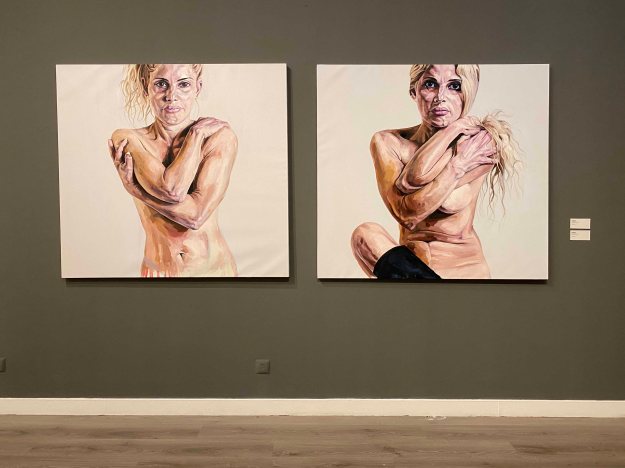
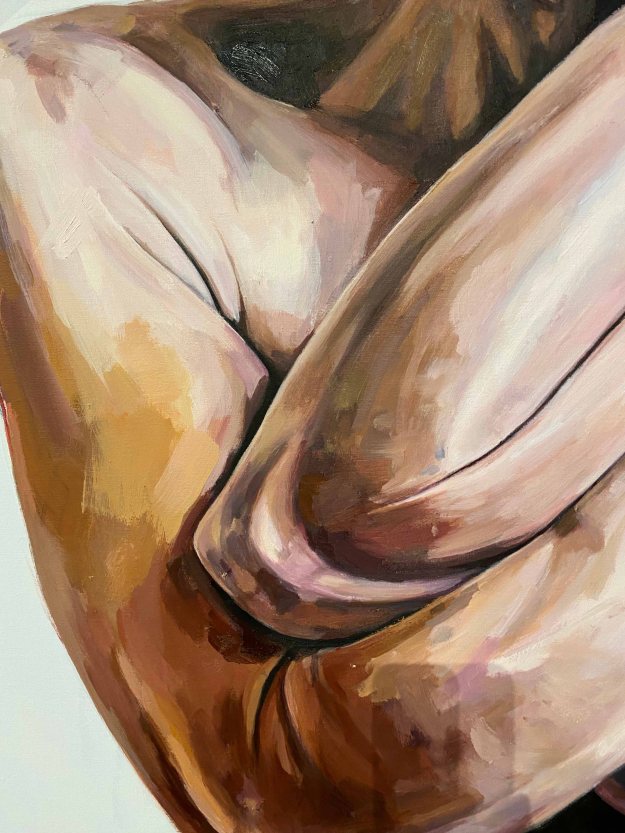
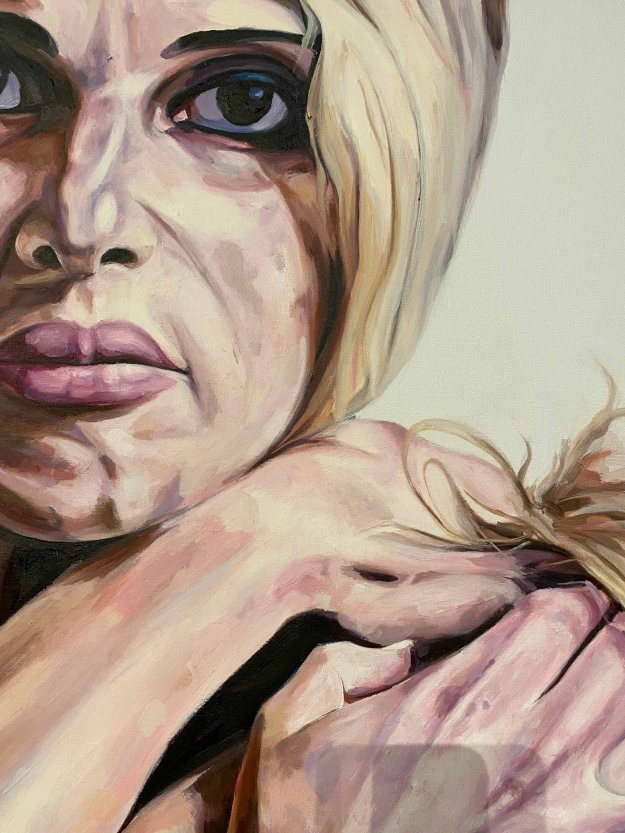
I was puzzling if these two half figure portraits are of the same woman in different roles, with almost the same expression. The titles “Squeeze” and “Memorie” do not give any clue. The way of applying paint is rough, with large patches of colours:

The skin tones are picking up the tone of the background so that the figures seem flatter and paler, again staring straight to the viewer, but here with a more defiant look, almost arrogant.

There is an unease in the poses that is very clearly transferred to me, the viewer. I feel like an uninvited onlooker in some intimate, intriguing and anguishing setting.

Emily Kame Kngwarreye

Emily Kame Kngwarreye was one of Australia’s most significant contemporary artists. Her life story is absolutely fascinating. An indigenous woman, she grew up in a small, remote community named Utopia where she became an established Elder with a lead role in ceremonies. She was often using ceremonial sandpainting and painting on bodies, and later batik.

She was already over 80 years old when she started painting on canvas, but still produced over 3000 paintings in the 8 years to her death, which means in average at least one painting per day! Having started painting late in life myself, this is an incredibly inspiring story!

The shapes and the colours of Kngwarreyes paintings are all taken from the land surrounding her. In “Yam” for example, she builds up multiple layers of dots, each dot a seed from a plant, and each layer symbolic of ancestors.

Her painting “Earths Creation” from 1994, brought immediate international recognition and broke records at auction.

(Images from: Nma. 2008. National Museum Australia. [Online]. [8 June 2020]. Available from: https://www.nma.gov.au/exhibitions/utopia/emily-kame-kngwarreye)

It is fascinating to see how an artist who had so little contact with the outside world and with art history, was exploring painting that could be compared to Pointillist or Impressionist works.

I think the impact of these paintings must be so much stronger if you can stand before them as they are really large in size. Emily was painting them with the canvases laying on the ground, and herself sitting on top of the pieces, like if she was a part of the canvas, just as she was a part of the story and of the surroundings. Because of this, they can also be seen from different directions and are hung differently in various exhibitions. I feel very attracted to this idea of painting directly while sitting on the canvas- something to explore.

The fascination of Kngwarreye’s paintings come from the strong sense of connection and love for the land that emanate from them.  There is a clear feeling of how much respect and love lies behind the dedication of the dots and lines and choices of colours, reflecting the surrounding land. I believe that strong feeling of belonging, and of connection to nature, is something so many of us crave in our contemporary lives and that is why these paintings affect us so.

This importance of place and belonging is something I am exploring in my own work as well. My parallel project is centered around the stories of a house and a village that I have just moved to in the south of Portugal, and how my own story and the story of my family is intertwining with it now.

In this context, I will continue the research about other artists exploring belonging and home in separate blogposts.


Research point: On Line, Pierrette Bloch and Installation

The exhibition “On Line” in the MoMa in 2010-2011 explored “Drawing through the 20 th Century” and ” argues for an expanded history of drawing that moves off the page into space and time.”

I found the linking of drawing and thought fascinating in the following quote from the description of the exhibition on MoMa’s website : “Line, like thought, once understood as linear and progressive, has evolved into a kind of network: fluid, simultaneous, indefinite, and open.”

(quotes from: Moma. 2020. MoMa/ On Line. [Online]. [1 June 2020]. Available from: https://www.moma.org/interactives/exhibitions/2010/online/)

Seen like this, almost anything can be a drawing, which opens up exhilarating possibilities.

During this chapter of the course, I have become more sensible to seeing lines and drawings all around me. In many works of this exhibition, a spontaneous or accidental line , is moved back into the art context. So for example Pierrette Bloch’s five sculptures, titled “Horsehair lines” , each made of a horsehair extended on a nylon thread. I imagine the horsehair curls up naturally, and Bloch then took this scribbled line in space and mounted it and presented it as the sculpture it is.

(Image from: Moma. 2010. MoMa/On Line. [Online]. [8 June 2020]. Available from: https://www.moma.org/interactives/exhibitions/2010/online/#works/02/55)

It looks like something could be written in space. Pierrette Bloch is described as using “Poor materials” as besides these horsehair drawings, she is often using ink on found paper or cardboard. She is also very sparse in her mark-making, and very repetitive, using repeated dots, lines or hyphens. I feel that, because she is not “elevating” the marks she makes to a painting, or a fancy drawing on thick paper with an expensive frame- they transport more a message of being a written note, a message or a musical chord, that seems like it should be easily readable, but then has the intriguing elusive quality of only being understood by the artist herself.

(Image from: Fyfe, J. 2009. Artcriticalcom. [Online]. [8 June 2020]. Available from: https://artcritical.com/2009/05/11/pierrette-bloch-at-haim-chanin/)

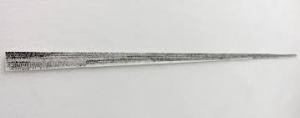
The support also becomes an important part of the message, for example in her very, very long drawings, where the paper is already a very long line. Here it is an interesting tension between the line, the paper, and the repetitive dots that punctuate it, with the paper being as much the drawing as the ink.

(Image from: Musee fabre. 2009. Musee Fabre en Montpellier. [Online]. [8 June 2020]. Available from: https://museefabre-en.montpellier3m.fr/Exhibitions/Pierrette_Bloch).

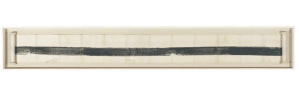
Robert Rauschenbergs’s “Automobile Tire Print” from 1953, is also presented on a long scroll of paper.

Here, he let a friend drive through a pool of black paint and then over the prepared paper. This piece is closer to performance art, than to the gestural approach of Pierrette Bloch. The drawing is a direct record of the movement of the tyre over the paper. This work was a pioneering piece between a ready-made, a performance and an automated drawing.

This long format, adds a feeling of representing a landscape, an idea that then collides with the subjects of a mark made by a tyre.

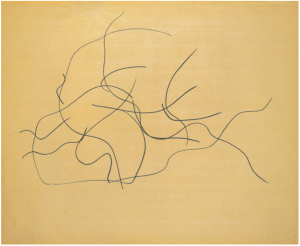
Ellsworth Kelly was represented with some automated drawings, like here a drawing from pine branches from 1950 :

It was really fun exploring different ways of producing automated drawings for Part 3 of this course, but I am not sure I would be so fascinated at looking at them in an exhibition.

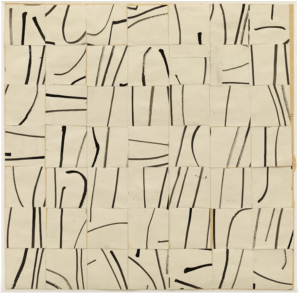
I found the following piece by the same artist much more interesting- here he has intervened and cut up the drawing in 49 different pieces and then placed them together randomly. I find this piece more engaging and exciting with the interesting pattern it creates, as well as being attracted to the idea of trying this.

(Images from: Moma. 2010. MoMa/On Line. [Online]. [8 June 2020]. Available from: https://www.moma.org/interactives/exhibitions/2010/online/#works/02/45)

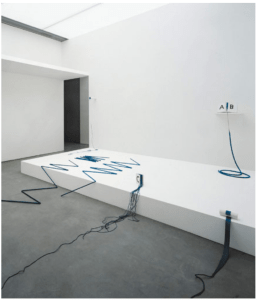
As described in the course manual, Edward Krasinski extends his lines into the environment, so his drawings exist somewhere between 2 D drawings and sculpture.

His signature is the use of blue line, which can be drawn with tape or cable.

(Image from: Moma. 2010. MoMa/On Line. [Online]. [8 June 2020]. Available from: https://www.moma.org/interactives/exhibitions/2010/online/#works/02/66)

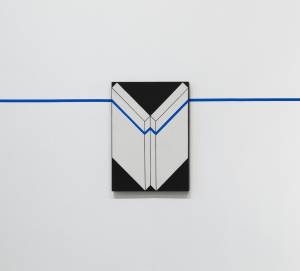
His paintings are site-specific, in that they connect the work with the surroundings through the tape, but in many works, like here in “Intervention 15” from 1975, by the geometrical form on the painting relating to the architectural shapes in the gallery around it.

Intervention 15 1975 Edward Krasinski 1925-2004 Presented by Tate International Council 2007 http://www.tate.org.uk/art/work/T12568

The stripe of tape does not just pass through the painting, but follows the contours of the form depicted, so that it emphasizes the 3-dimensional form.

(Image from: Butakova, E. 2010. Tateorguk. [Online]. [8 June 2020]. Available from: https://www.tate.org.uk/art/artworks/krasinski-intervention-15-t12568)

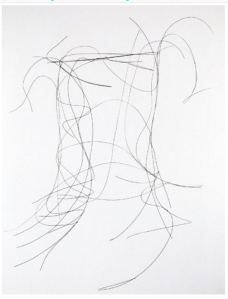
I became quite fascinated with the wireworks of Czech artist Karel Malich .

The name of this drawing from 1974 is “Energy”, and I can certainly feel the swirling energy emanating from it.
(Image from: Moma. 2010. MoMa/On Line. [Online]. [8 June 2020]. Available from: https://www.moma.org/interactives/exhibitions/2010/online/#works/02/68)

If this drawing would have been two-dimensional on a piece of paper, it would not have the impact as it has when the space around it becomes part of the drawing, and when a light is directed towards it, it adds shadows that are another new level of the drawing.

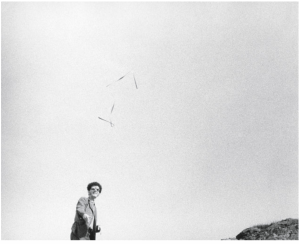
Another work that I found fascinating from the exhibition is Tom Marioni’s “One second sculpture”.

(Image from: Moma. 2010. MoMa/On Line. [Online]. [8 June 2020]. Available from: https://www.moma.org/interactives/exhibitions/2010/online/#works/02/69)

Here the artist holds a metal line in his hand and throws it in the air where it forms a shape for one second and then falls flat to the ground. This work exists in an interesting crossroads of drawing in the sky, momentary ephemeral sculpture, performance and even music with the sound it creates in the air. Adding this element of time really stretches the concept of drawing to a place that I had not considered before.

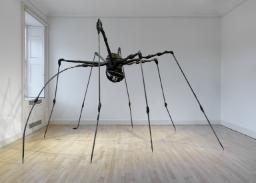
After studying these works from the exhibition On Line and further, and seeing how a drawing can extend into space, I would consider Louise Bourgeois “Spider” from 1995 a drawing without hesitating.

Spider 1994 Louise Bourgeois 1911-2010 ARTIST ROOMS Tate and National Galleries of Scotland. Lent by the Easton Foundation 2013 http://www.tate.org.uk/art/work/AL00354

(Image from: Adamou, N. 2016. Tateorguk. [Online]. [8 June 2020]. Available from: https://www.tate.org.uk/art/artworks/bourgeois-spider-al00354)

This monumental bronze sculpture truly feels like a line drawing that has stepped out from the confinement of a two- dimensional drawing into space.

ALL IMAGES REPRODUCED FOR EDUCATIONAL PURPOSES ONLY


Contextual focus point: Erased De Kooning

In 1953, Robert Rauschenberg asked Willem De Kooning for one of his drawings. Amazingly, he agreed. Rauschenberg then proceeded to rub out De Kooning’s drawing and exhibit the resulting near blank sheet. This is such a beautiful moment in art history as it brings together the mood of the time and the lasting legacy of both Abstract Expressionism and what would later become post modernism. Find a reproduction of this drawing on the web and make notes on how you feel about it at first sight. Then look a little into the background and try to get an understanding of why Rauschenberg might have done this. There are video interviews online with both artists. Use Google to find the videos and make notes on your thoughts about what happened.
I was lucky enough to see the “Erased De Kooning” drawing in the flesh in the Robert Rauschenberg exhibition at Tate Modern in London in 2017, even if there is not that much to look at.

The erased drawing is framed in a golden frame and bears an inscription “Erased de Kooning drawing” by Robert Rauschenberg. By framing it and labelling it, it becomes elevated to a piece that we can look at and understand the process behind. Without this, we would have no clue what we are looking at.

canvas

(Image from: Roberts , S. 2013. SFMoMa. [Online]. [15 April 2020]. Available from: https://www.sfmoma.org/artwork/98.298/)

Robert Rauschenberg was experimenting with different art forms at the time, and stretching the limits of what could be an art work- continuing the legacy of the ready made by Duchamps. The question was, if the act of erasure could create an artwork. Rauschenberg understood that he would have to begin with a drawing that was recognized as art to start with that he would then erase, so he contacted de Kooning who was already recognized in the art world, and greatly admired by Rauschenberg.

In an interview on You tube (https://www.youtube.com/watch?v=tpCWh3IFtDQ), Rauschenberg explains that if de Kooning had not been home that day- that would have been the work. If he would not have been willing to give out a drawing to erase- then that would have been the work. But de Kooning agreed, and added that it would have to be a drawing that he would miss. Rauschenberg sais that the drawing was VERY difficult to erase. It had crayons and charcoal and took a month to erase.

“It is not a negation, it is a celebration” sais Rauschenberg in another Youtube interview for the SFMoMa (https://www.youtube.com/watch?v=nGRNQER16Do).

Hearing these interviews added another level of understanding of the work for me- that whatever had happened, if De Kooning would not have been home or not given a drawing, would have been the work. Here the process is really the work. These other situations would not have been possible to frame and hang in a museum half a century later- but they would still have been the work.

I am only beginning to grasp the importance of process in my own drawings, as I am experimenting with drawings where the process is more important than the final drawing, like the body prints I did for Assignment 2. I am excited to push this further by drawing to music for Assignment 3, without being focused on an outcome, but accepting the marks inspired in the moment.


Abstract Expressionism

Research point:

“The Abstract Expressionists’ use of gesture was caught up with notions of authenticity and even of purity of intent. The influential critic Clement Greenberg wrote in his article ‘Avant Garde and Kitsch’ in 1939 about the good artist painting ‘cause’ and the bad artist painting ‘effect’. He also talks about what he describes as ‘the inflections of the personal’ becoming a legitimate subject. For example, the artist Jackson Pollock talked about wanting to paint from his emotions, not to illustrate them. What’s your response to these comments?”

I first researched Abstract Expressionism for the Practice on Painting course- a shortlink to the blogpost is here: https://wp.me/p94hP8-Z1

The essence of Abstract Expressionism is a spontaneous, highly charged, impulsive way of painting, where the artist works with large gestures without a pre-concieved plan or sketch or even idea. Guided by emotions and impulse, the artist allows and exploits accidental effects.

The documentary made by Hans Namuth  (http://www.youtube.com/watch?v=6cgBvpjwOGo) is a great way to understand Pollock’s way of painting .Jackson Pollock developed his individual form of spilling and dripping paint onto a canvas usually placed on the ground. Hans Namuth shows this brilliantly in the movie in a moment where he has placed the camera under a glass onto which Pollock is working so we witness the action from the perspective of the canvas.

In the movie Pollock sais that he enjoys working on a large canvas because he can feel part of it. This is something that I am only myself beginning to explore, and the statement really felt true. A large canvas, that allows much larger and less controlled gestures, invites me into being part of it in a very different way than a smaller controlled painting can.

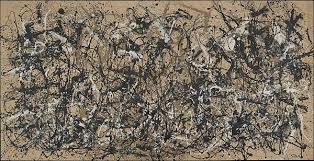
This is Autumn Rythm from 1950:

Autumn rythm

(Image from: Metmuseum. 2020. The Metropolitan Museum of Art. [Online]. [15 April 2020]. Available from: https://www.metmuseum.org/pt/art/collection/search/488978)

For POP1, I tried out Pollocks’ method to feel how it feels- using sticks to drip and splatter household enamel paint onto brown wrapping paper on the floor:


IMG_7316

This is my painting when it felt complete:

IMG_8762


Pollock said: “I want to express my feelings rather than illustrate them”. I think he found a method of painting, where he could literally pour his feelings onto the canvas, as in letting his motions be guided by his emotions and then let himself react to that immediately, instead of trying to create an image of what he was feeling, that would become an illustration. An illustration in that sense would have a gap, a time of thinking and planning, between the feeling and the painting, whereas with an abstract expressionist method, there is no such gap. It is a simultaneous feeling and painting. The focus is on the moment, on the physical act of painting, as much as on the resulting painting.

I believe this is what the art critic Clement Greenberg was referring to when he talks about the good artist painting ‘cause’ and the bad artist painting ‘effect’. He compares the impact of a painting by Picasso that requires patience and dedication to understand and a painting by Repin where there is a story told and even exaggerated for effect, on an ignorant Russian peasant. His article ‘Avant Garde and Kitsch’  was written in 1939, so before the dripping experiments of Jackson Pollock and the rise of other Abstract Expressionist painters though.

“It has been in search of the absolute that the avant-garde has arrived at “abstract” or “nonobjective” art — and poetry, too. The avant-garde poet or artist tries in effect to imitate God  by creating something valid solely on its own terms, in the way nature itself is valid, in the way a landscape — not its picture — is aesthetically valid; something given, increate, independent of meanings, similars or originals. Content is to be dissolved so completely into form that the work of art or literature cannot be reduced in whole or in part to anything not itself. ” (Quote from: Mehdi hamedi/greenberg, C. 2020. Academiaedu on AVANT-GARDE_AND_KITSCH-_Clement_Greenberg. [Online]. [15 April 2020]. Available from: https://www.academia.edu/7515241/AVANT-GARDE_AND_KITSCH-_Clement_Greenberg)

Later, Greenberg would redefine some of the concepts in his essay and it is interesting to think of how “Kitsch” rose to high art through the Pop art movement.

Revisiting the Abstract Expressionists and especially Jackson Pollocks’ work, has unlocked some new enthusiasm in me to let emotion and accidental movements guide me through the next projects, and especially Assignment 3, where I plan to use a very large paper to move and draw intuitively to music.


Rebecca Horns’ Drawing Machines

After my own trials with creating some simple drawing machines, it was really interesting to explore Rebecca Horns’ work.

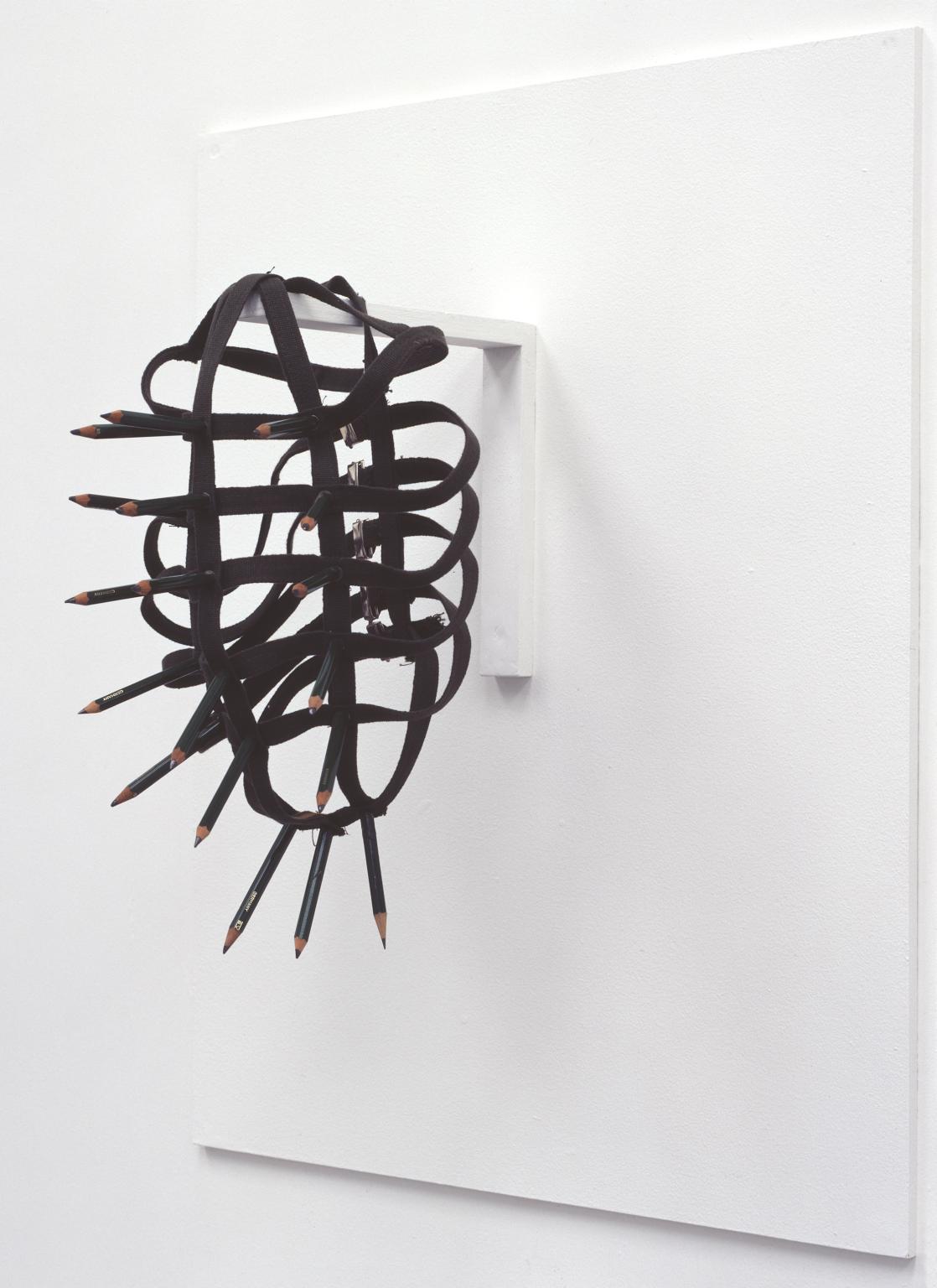
In her earlier works from the 1970’s, she created sculptural constructions that were most often extensions of her own body, like “Pencilmask” below, or a variety of feather masks.

Pencil Mask 1972 by Rebecca Horn born 1944

(Image from: Tate. 2020. Tate, Art, artworks. [Online]. [13 April 2020]. Available from: https://www.tate.org.uk/art/artworks/horn-pencil-mask-t07847)

This Pencilmask still required the artists’ presence and physical movements to leave  marks. In that way, Horn explored her own body and limitations or feelings when extended. While wearing these constructs, she could also explore various levels of control and interaction. Some masks, like her “Black Cockfeathers mask” or “Cocatoo mask” were designed to look at and meet another person with the altered vision that these masks would give the wearer, questioning her own views and subjectivity. After severe lung poisoning she spent a year very sick and in isolation. After that a lot of her work deals with interaction. She used a variety of media, but came to fame through these sculptural constructions that were then used in performances and for films.

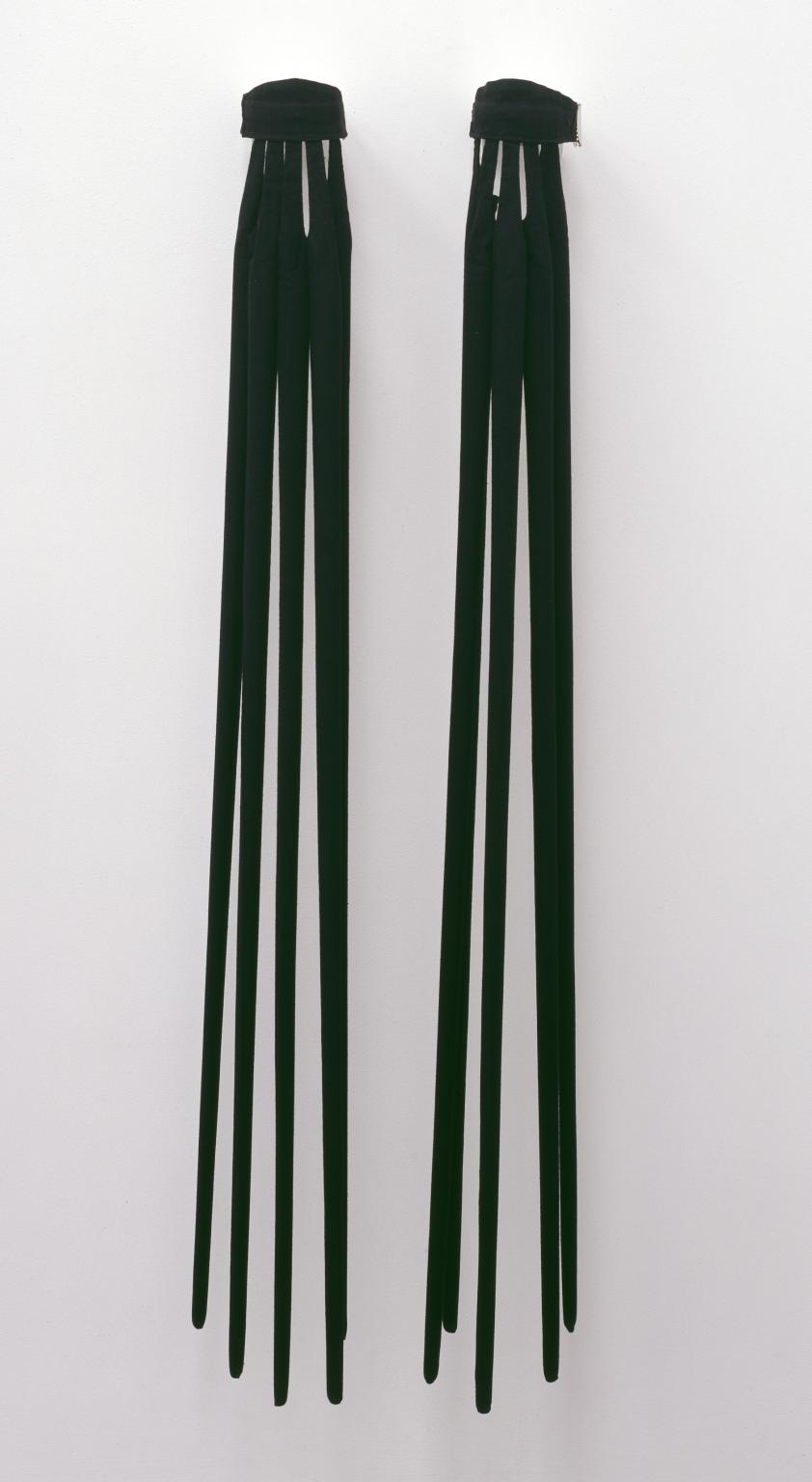
In “Finger gloves” from 1972, Horn created gloves with really long fingers. She is exploring the limitations of her own body by reaching beyond it, and also exploring the space beyond the own body and the objects she can reach with her constructed fingers.

Finger Gloves 1972 by Rebecca Horn born 1944

“I feel myself touching, see myself grasping, and control the distance between myself and the objects.” (Quote and image from Tate website: Tate. 2020. Tate, Finger Gloves Rebecca Horn. [Online]. [13 April 2020]. Available from: https://www.tate.org.uk/art/artworks/horn-finger-gloves-t07845).

I find these constructs fascinating and would just love to try any of them!

I am watching the beautiful documentary about Rebeccas journey called “Rebecca Horn is travelling” on You Tube. ( https://www.youtube.com/watch?v=2vqiFRZfCMw)

For many of her installations, Horn used very varied objects- from violins and a piano to hospital beds. She likes to combine very fragile objects, like feathers, and others that evoke a feeling of danger to create tension between them. The violin that plays itself is a recurring object- a symbol of a person, or a person that has left. In the documentary, we follow the installation of “Free as a bird” from 1999, a spiral of hospital beds where violins play. She increasingly withdrew from performing herself, letting the objects take center stage and creating mechanical sculptures with movements and sounds. These sculptures are not perfect- and she explains how their imperfections and hesitations make them more human.

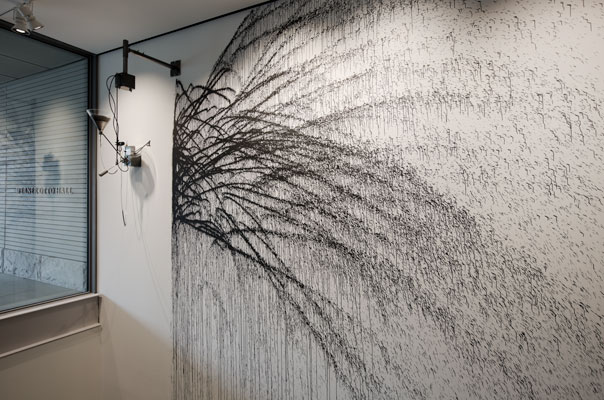
Later she started constructing automated drawing machines, where she has removed more of her own control. In “Flying books under Black rain painting” from 2015 at Harvard University, she lets a machine spray black paint over a white wall and three books.

Index_A-Refresh-for-Rebecca-Horn-01

(Image from: Harvard. 2020. Harvard Art Museums, Collections, Rebecca Horn. [Online]. [13 April 2020]. Available from: https://www.harvardartmuseums.org/collections?q=Rebecca+Horn+)

There is an interesting tension in the drawing machines, between the cold, mechanical, calculated construction, and then the element out of control, the way the drops fall through gravity and mark the wall. This feels like a big step away from the control of the earlier works where the body was still initiating the movement and in itself an essential element of the investigation. The artist seems to imbue the machines with almost human qualities though, and sees how they can express emotions.


Contextual focus point: Cornelia Parker


Research the work of Cornelia Parker. Make notes in your own words in response to the following:

  • What do you think Parker is trying to do in her piece Poison and Antidote Drawing (2010)?
  • Poison and Antidote Drawing is created using rattlesnake venom and black ink, anti-venom and white ink. Parker often uses bits of her subject to make her artwork. Why do you think she does this?
  • How do you think it feels to stand in the presence of artworks that are constructed from original objects of great cultural significance? How does that differ from, say, standing in front of a painting of the same object?


By researching the work of Cornelia Parker and understanding the connection between her subjects and the materials she is using, I have gained a whole new appreciation for her work.

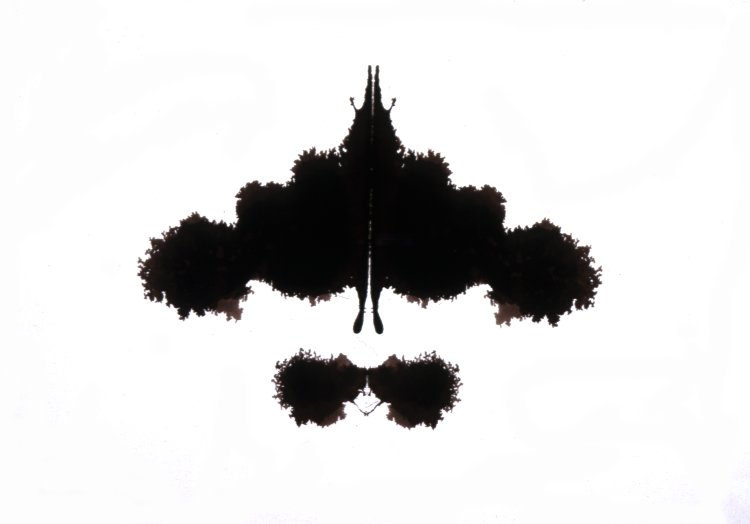
In her piece “Poison and Antidote Drawing” mentioned in the course manual, she used rattle snake poison in black ink and an antidote in white ink in a drawing that was folded in the middle in order to create identical impression of abstract shapes on either side of the crease.

AN00454763_001_l

(Image from: Trustees of the british museum. 2019. British Museum Image Gallery. [Online]. [30 March 2020]. Available from: https://research.britishmuseum.org/research/collection_online/collection_object_details/collection_image_gallery.aspx?assetId=454763001&objectId=691360&partId=1)

This mirror drawing is an image of duality, and it pushes the duality of concepts like black and white, poison or antidote to literally a question of life and death by the qualities of the materials.

So the materials used and the process become the work- this is what characterizes Cornelia Parker’s art.

In the movie ” Cornelia Parker – What Do Artists Do All Day ?”, available on Youtube (https://www.youtube.com/watch?v=cuAF55BN-Ak), Parker said “The material is important, the process is important- the combination of those two things together make the work”.

Rattlesnake venom is maybe not the most common commodity, but often Parker uses familiar every day objects that she transforms into her work. In the above movie, we see Parker driving around London and photographing a withered road sign and cracks in the pavement.

She took rubber molds of the pavement cracks and then had them cast in bronze- elevating them to something really extraordinary.

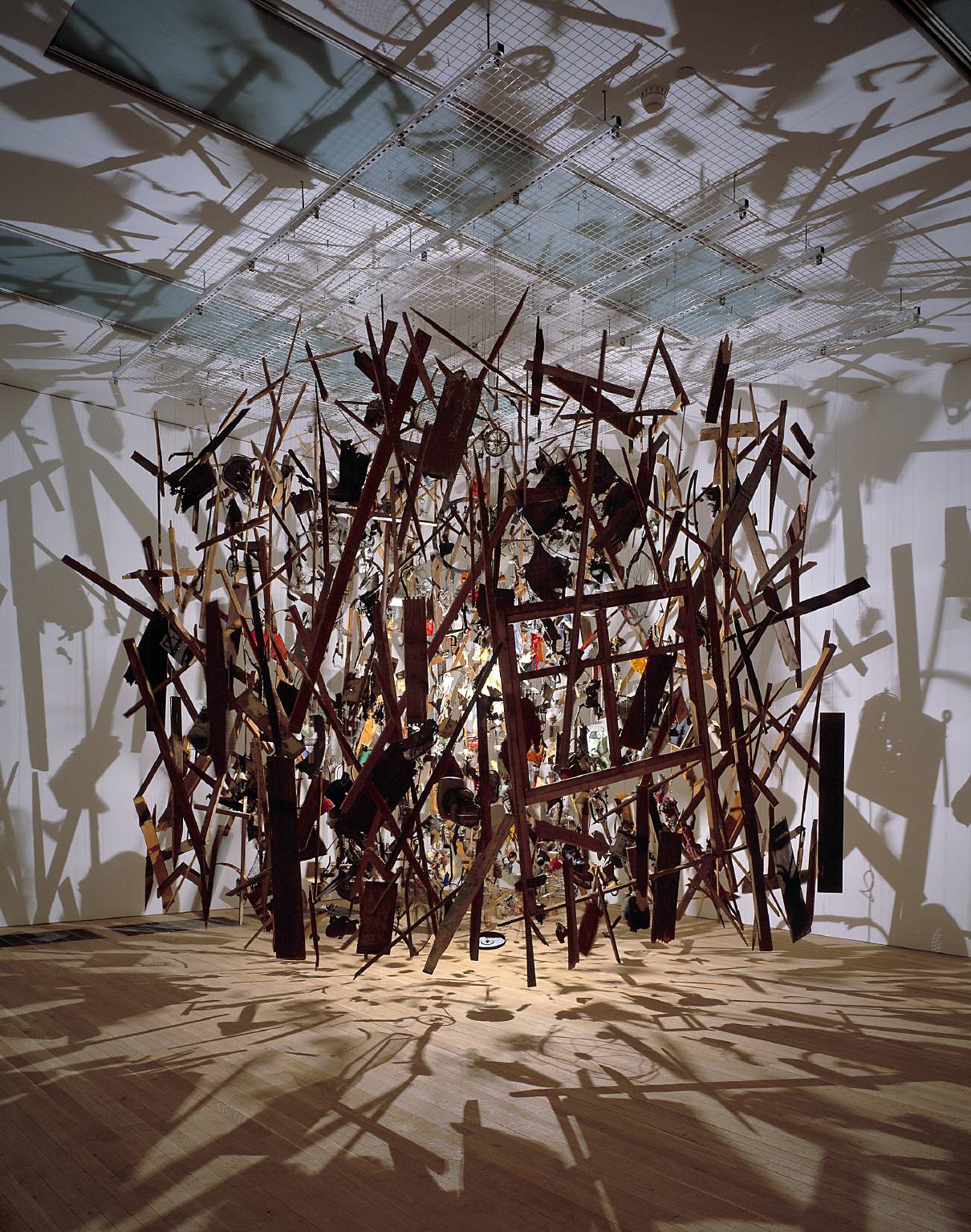
In Cornelia Parker’s probably most well known work, “Cold dark matter” from 1991, she asked the British army to blow up a garden shed.

A shed is a very familiar thing, and a place where often very personal items are stored- items that are not in use but too good to get rid of. It seems to be incongruous with the violence of an explosion. Explosions are such a common sight in comics or news or at the time bombings in major cities, so this was a very unsettling way of bringing that violence close to home, to the familiar.


Cold Dark Matter: An Exploded View 1991 by Cornelia Parker born 1956

(Image from: Tate. 2020. Tateorguk. [Online]. [30 March 2020]. Available from: https://www.tate.org.uk/art/artworks/parker-cold-dark-matter-an-exploded-view-t06949/story-cold-dark-matter)

This work looks really impressive on photographs, the blown up pieces of the shed hanging on transparent strings from the ceiling and lit up so they are casting strong shadows around. I can imagine the impact being even stronger in the flesh. By hanging the pieces instead of laying them on the floor, it seems like they are suspended in time and space- still in the middle of the explosion.  This hanging of objects in different groups is recurring in Parker’s work. It creates an interesting tension in the space around the objects too, and for someone seeing the installation in the flesh, an interesting blurring of the line between work and spectator.

In another body of work, Parker is “drawing” by puncturing holes in the grids used as targets while shooting and then stitching with a wire made of melted down bullets literally drawn into a wire. Like this, she uses bullets, with their violent energy and potential for death, to draw something formal and considered.

I am fascinated by how Parker uses bits of her subject to make her artwork. This is not an aspect I have considered in my own making before and it will be interesting to consider for the upcoming assignment.


Research point Part 2


The artists below all make work which both creates and denies three dimensions at the same time. Take a look at their websites then make notes in your learning log about these artists, your response to their work and how their work relates to what you’ve been attempting in this project.

Angela Eames: http://www.angelaeames.com/

Angela Eames is a drawer, and uses the computer to draw. In a video interview with Miles Corley available on You tube (https://www.youtube.com/watch?v=mDriWgY9Gd0) she states:

“Manipulating virtual lines in space- for me that is drawing, it is a constructed approach to drawing. And a virtual approach to drawing. And a head approach.”

On my first approach, I find Eames’ art difficult to engage with. I see grids and objects manipulated in space and find it very organized and intellectual. I do not have an emotional response to it. Eames works in series, here are excerpts from the series “Red Skyripper” and “Green Skyripper”:

It seems very mathematical, and I can find a certain pleasure in the rhythm of the images.

In the series “Spoon”, I can recognize a red spoon being manipulated in the gridlike structure:

I find it more interesting with this recognizable object.

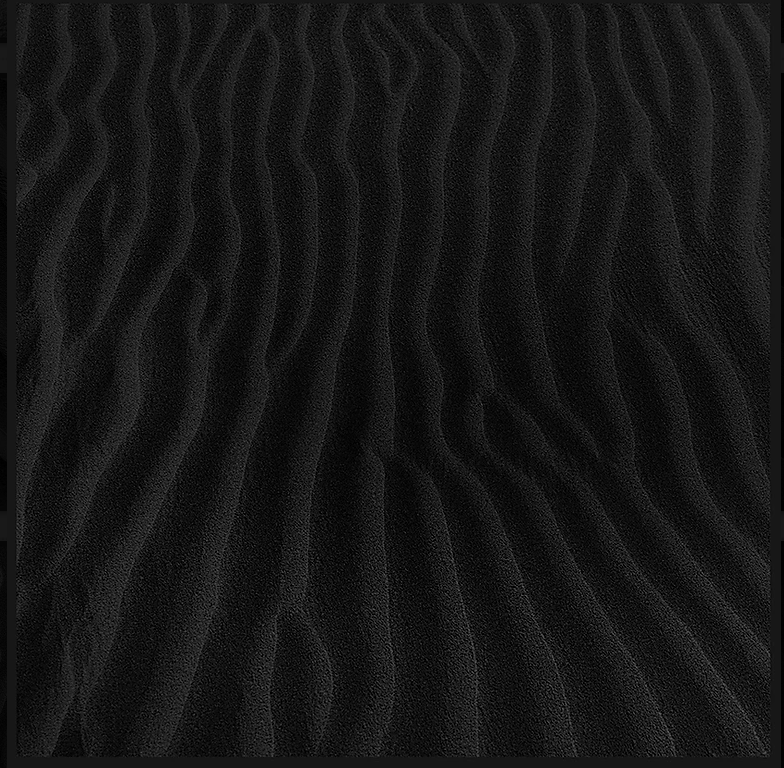
Maybe it is because of the familiarity of the view that I also like the series “Sand” exploring the waves created in the sand in different shades, like here “Black sand”:

Angela Eames , black sand

This feels like a view that I have seen and photographed myself.

I understand why we are asked to look at Angela Eames’ work in relationship to “work which both creates and denies three dimensions at the same time“.

When working in the computer, the work does not have a size or a shape. Eames works within the computer, a 3D space, using photographs she has taken in the past- which adds an element of time and 2D elements to the work, then she wants to see it in physical space and prints it on canvas, where it becomes 2 D again, and receives a size and a surface.

In the video mentioned above, she speaks about her series “Puddles”: “The puddles are constructs in 3D space, they reflect something that comes from 2D imagery that I have taken in the past, and then you bring it out flat- on canvas, a soft absorptive surface that has nothing to do with that screen space.”

Eames’ is often using grids or tiles, and bend them in space so that there is a 3D illusion. She names that her work is about the inbetween of 2D and 3D.

Looking at this aspect of the work has made it more interesting and accessible to me than it was when I was looking for an emotional response.

(All images from: Eames , A. 2017. Angela Eames. [Online]. [19 March 2020]. Available from: https://www.angelaeames.com/)

Michael Borremans:  http://www.zeno-x.com/artists/MB/michael_borremans.html

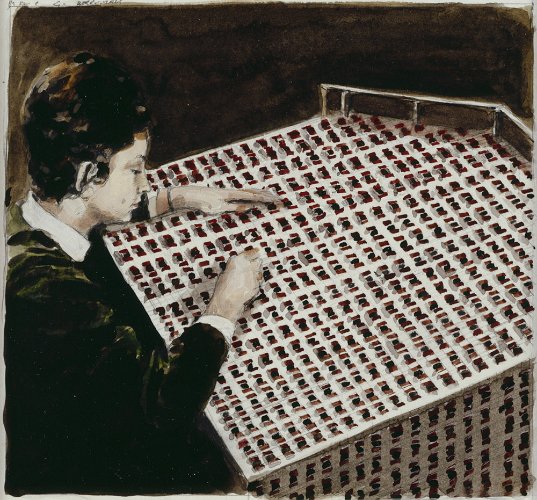
Michael Borreman’s art feels like the opposite of Angela Eames’s- it goes straight to the gut. At a first glimpse, his drawings might look like from some historical archive, like part of some research maybe, but very quickly it becomes strange and exciting, often scary. There is a mysterious narrative in the work. It always contains figures that are performing some sort of ritual that remains unclear. I find Borreman’s work fascinating!

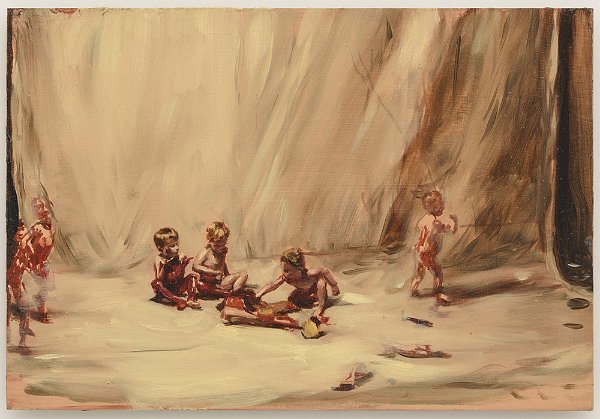
“Fire from the sun” below is probably the most macabre series of paintings, with children gathered, blood spilled, the story unclear:

MB2017_29

It does not deny that it is set up as a sort of stage, so in that sense removed from reality.

I am also fascinated by the many paintings where the faces or sometimes whole bodies of the figures are covered in some sack like masks, like “Amy” or “Melon” from 2017:


I particularly like the “The Angel” from 2013, where the blackened covered face and defeated posture contrasts to the pretty pink dress and also to the title. There is a fascinating tension in this contrast.

MB2013_18

I really enjoy watching movies about the artists as it often shows their method of working and their spaces. Here I watched the documentary “Michaël Borremans: A Knife in the Eye” from 2011, available on Youtube: https://www.youtube.com/watch?v=dhhUmwmlMtc&t=2191s.

Borreman’s method is to create his scenarios with models and take pictures, that he then paints. He said in this movie, that painting is rather fast, although he is incredibly skilled at painting in a very classical manner. The idea, and the time between the photo session and knowing how he wants to paint it, in what scale and tones, is what takes the longest time.

He often introduces different planes in his imagery- like a model biting into a glass plate, or the model being cut off at the waist by a box created. I think here there is an interesting play between 2D and 3 D, because in a way Borreman creates dimensions that do not exist, or that we are not used to seeing.

The hidden parts becomes mysteriously absent, exciting our imagination.

Borreman’s first passion is drawing though. He sais in the above movie that he has always drawn- it is a “literary function”. His drawings are full of narrative too, and I particularly like how freely Borreman is combining elements of different scale.

Here in “The House of opportunity-Vodoo” the house becomes small enough for the person to manipulate.

TMB2005_11

In many drawings there is a lot of “unfinished” space, something that always catches my attention, but then I go on filling up my own drawings.

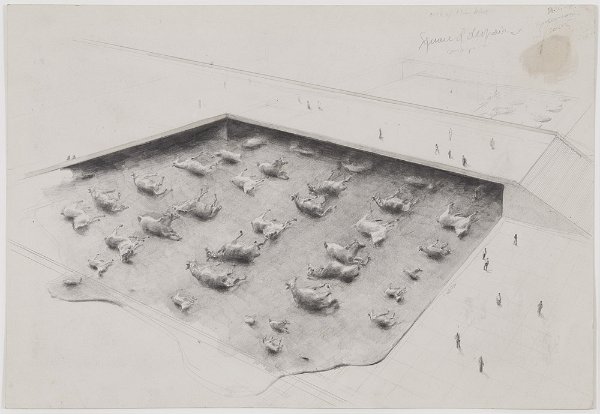
Here in “Square of despair”, all the cattle are lying on their side with tiny persons walking around, and I like how the drawing is becoming less finished til the edges.

TMB2005_06

I found it interesting that Borreman always draws on found paper, he never buys blocks of paper. He likes when the paper is imperfect, with some spots or grease. Similarly he never starts a painting on a white canvas. He always puts down a beige or grey foundation. That way he can leave parts open rather freely and they will still blend into the image. This is definitely something to remember!

Borreman also works with film, but they are special films that he calls “tableau vivant”- living paintings. There is no plot or no activity whatsoever in the film. A model is placed in a position and then he films it rotating around the model. This way the figure is reduced to an object maybe, it is a mysterious, unusual way of looking at a person. So if his paintings are very cinematographic, his movies are very much like paintings.

(All images from: Zeno , X. 2019. Zeno X Gallery, Antwerp. [Online]. [23 March 2020]. Available from: http://www.zeno-x.com/artists/MB/michael_borremans.html)


Jim Shaw: http://www.simonleegallery.com/Artists/Jim_Shaw/Selected_Works

Jim Shaw’s work plays with a very different spectrum of feelings than Michael Borreman’s. Here there is satire, a sharp commentary of especially American society and politics.

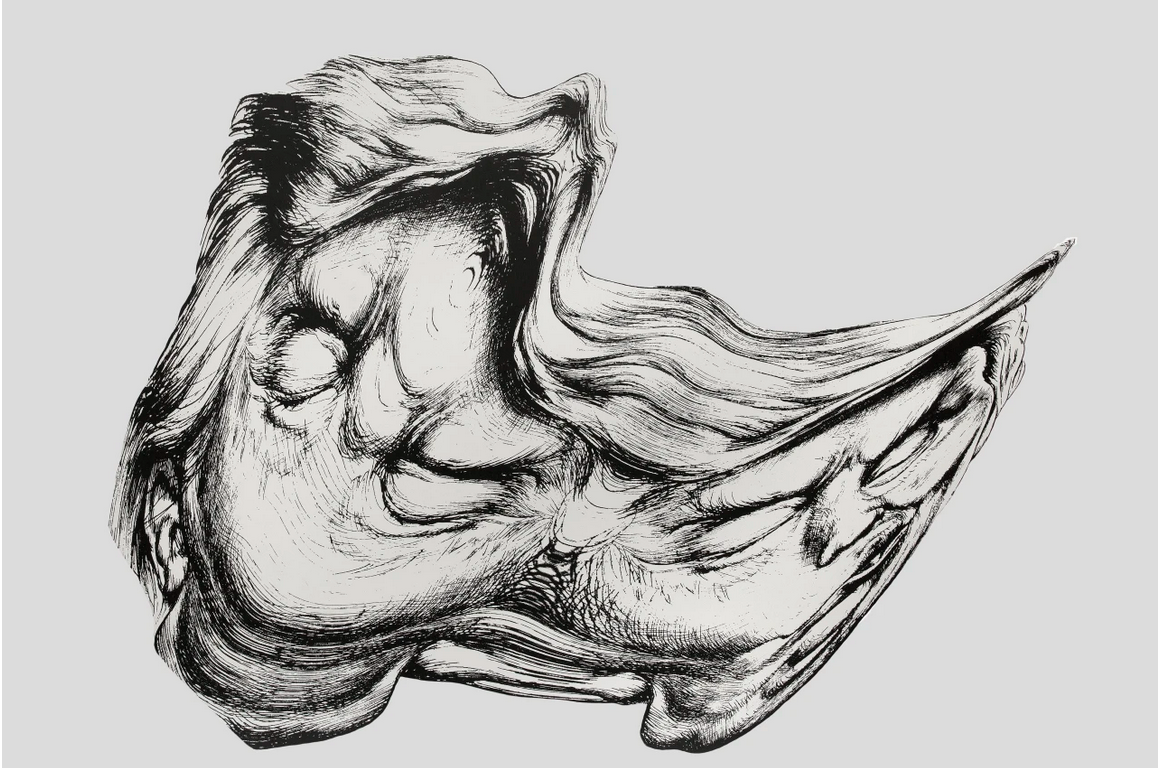
 “The Trump smear”, from 2018 is a brilliant really poignant and critical portrait of the American president, with a black and white line drawing on plywood.

Screen Shot 2020-03-23 at 10.46.31 PM


Shaw is often working in installations with these drawing cutouts. In that sense he is playing with a shift from 2D to 3D, as the figures appear as objects in space, while still remaining only 2D though.

These are installation views from “Issue of my loins ” 2019 and “The Wig museum” 2017, where you can see how Shaw is creating this interplay between 2D and 3D impressions.


Shaw mixes influences from art history, crackpot science, conspiracy theories and his own personal experiences into the work that then becomes an apocalyptic, end of the world narrative. He can be very meticulous and spend a decade researching his subjects.

One of his most famous subjects is the invented religion “Oism” with its mythical beasts and false history.

I find many of Jim Shaw’s pieces brilliant- his work is personal and at the same time closely bound to current events with  sharp humor and criticism.

(Images from: Shaw, J. 2020. Simon Lee. [Online]. [23 March 2020]. Available from: https://www.simonleegallery.com/artists/jim-shaw/)

ALL IMAGES REPRODUCED FOR EDUCATIONAL PURPOSE ONLY


Rebecca Fontaine- Wolf, Between Worlds

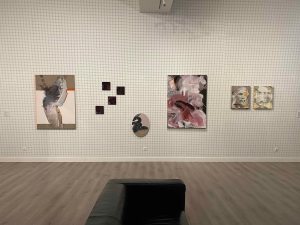
Yesterday I visited the exhibition “Between Worlds” by British painter Rebecca Fontaine Wolf in the Espacoexhibitionista Gallery in Lisbon.

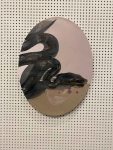
I already loved the diversity of formats, surfaces and shapes that the artist used- smaller works behind perplex glass, ovals, large format linen canvases or very small canvases.

It was also a combination of figurative works and some abstract. I feel how I immediately relate to these works with the female figure. The title “Between worlds” relates to the artist being between different stages of her life, and also to being a woman and experiencing different cycles of life.

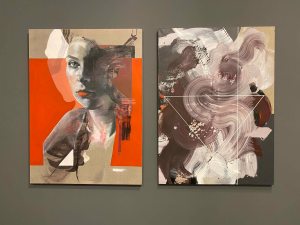
Several of the paintings contained self portraits of the artist, like here “Blood Moon”, combined with an abstract painting, which also had some triangles symbolizing womanhood.

The second self portrait  ” Milk Moon” was hanging on the opposite wall.

Together these two portraits captured two different sides of the artist, two different phases or moods.

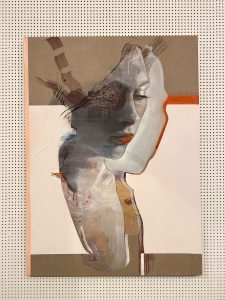
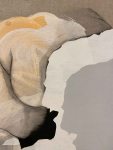
Another portrait that spoke to me strongly had a smear over the eyes that pulled in my attention. A quick effect, but I felt how it really worked here, in combination with the squares and lines behind the head.

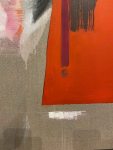
I am quite fascinated by this combination recurring in all the paintings, of figure and some abstract colour fields and lines. I especially like how the artist knows exactly when to stop- and leave parts of the linen canvas untouched.

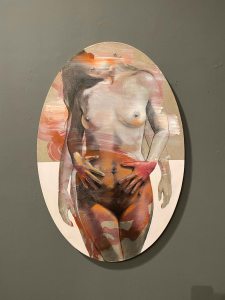
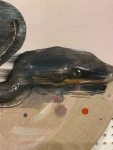
The oval painting of a serpent seems a little more illustrative and different from the rest, but the title ” Moon Serpent” ties it to the other “Moon Paintings”.

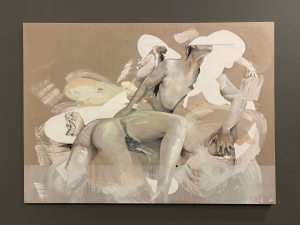
The largest and more monochrome painting contained several female figures, intertwined into impossible postures.

There is a lot of confusion and pain in this painting, some anxiety in the hands grabbing or even digging into the flesh. I can relate to the feelings that this painting expresses for me.

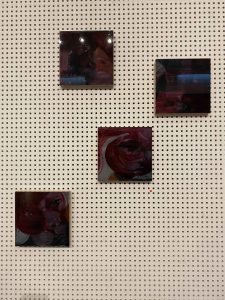
I also really liked this little series of close ups of the expressions in the faces painted on wood and then covered by a dark sheet of perplex- a technical idea to remember!

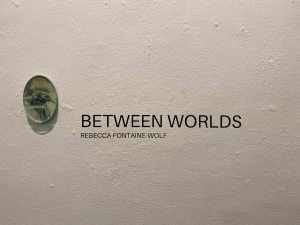
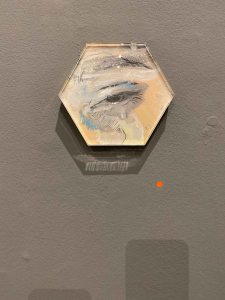
The artist used wood and perplex for some other smaller paintings too, in interesting different shapes, like the oval eye beside her name on the top image by the entrance, or like here in a hexagonal.

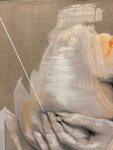
I am definitely fascinated by the way Rebecca Fontaine Wolf applies paint. First thing to remember is to leave parts uncovered. Then she combines acrylics with oil paints and boldly leaves parts in charcoal drawings:

I am intrigued by the way the paint pearls- is she applying acrylics on top of oil paints or what is happening here? Something to explore…

This was a wonderful art visit for me- I felt inspired by the subject and by the many technical new ideas I carried away. I heard that the artist is staying in Portugal for art residencies and hope to catch more of her work soon.