Category Archives: Part 3

Contextual focus point: Erased De Kooning

In 1953, Robert Rauschenberg asked Willem De Kooning for one of his drawings. Amazingly, he agreed. Rauschenberg then proceeded to rub out De Kooning’s drawing and exhibit the resulting near blank sheet. This is such a beautiful moment in art history as it brings together the mood of the time and the lasting legacy of both Abstract Expressionism and what would later become post modernism. Find a reproduction of this drawing on the web and make notes on how you feel about it at first sight. Then look a little into the background and try to get an understanding of why Rauschenberg might have done this. There are video interviews online with both artists. Use Google to find the videos and make notes on your thoughts about what happened.

I was lucky enough to see the “Erased De Kooning” drawing in the flesh in the Robert Rauschenberg exhibition at Tate Modern in London in 2017, even if there is not that much to look at.

The erased drawing is framed in a golden frame and bears an inscription “Erased de Kooning drawing” by Robert Rauschenberg. By framing it and labelling it, it becomes elevated to a piece that we can look at and understand the process behind. Without this, we would have no clue what we are looking at.

canvas

(Image from: Roberts , S. 2013. SFMoMa. [Online]. [15 April 2020]. Available from: https://www.sfmoma.org/artwork/98.298/)

Robert Rauschenberg was experimenting with different art forms at the time, and stretching the limits of what could be an art work- continuing the legacy of the ready made by Duchamps. The question was, if the act of erasure could create an artwork. Rauschenberg understood that he would have to begin with a drawing that was recognized as art to start with that he would then erase, so he contacted de Kooning who was already recognized in the art world, and greatly admired by Rauschenberg.

In an interview on You tube (https://www.youtube.com/watch?v=tpCWh3IFtDQ), Rauschenberg explains that if de Kooning had not been home that day- that would have been the work. If he would not have been willing to give out a drawing to erase- then that would have been the work. But de Kooning agreed, and added that it would have to be a drawing that he would miss. Rauschenberg sais that the drawing was VERY difficult to erase. It had crayons and charcoal and took a month to erase.

“It is not a negation, it is a celebration” sais Rauschenberg in another Youtube interview for the SFMoMa (https://www.youtube.com/watch?v=nGRNQER16Do).

Hearing these interviews added another level of understanding of the work for me- that whatever had happened, if De Kooning would not have been home or not given a drawing, would have been the work. Here the process is really the work. These other situations would not have been possible to frame and hang in a museum half a century later- but they would still have been the work.

I am only beginning to grasp the importance of process in my own drawings, as I am experimenting with drawings where the process is more important than the final drawing, like the body prints I did for Assignment 2. I am excited to push this further by drawing to music for Assignment 3, without being focused on an outcome, but accepting the marks inspired in the moment.


Abstract Expressionism

Research point:

“The Abstract Expressionists’ use of gesture was caught up with notions of authenticity and even of purity of intent. The influential critic Clement Greenberg wrote in his article ‘Avant Garde and Kitsch’ in 1939 about the good artist painting ‘cause’ and the bad artist painting ‘effect’. He also talks about what he describes as ‘the inflections of the personal’ becoming a legitimate subject. For example, the artist Jackson Pollock talked about wanting to paint from his emotions, not to illustrate them. What’s your response to these comments?”

I first researched Abstract Expressionism for the Practice on Painting course- a shortlink to the blogpost is here: https://wp.me/p94hP8-Z1

The essence of Abstract Expressionism is a spontaneous, highly charged, impulsive way of painting, where the artist works with large gestures without a pre-concieved plan or sketch or even idea. Guided by emotions and impulse, the artist allows and exploits accidental effects.

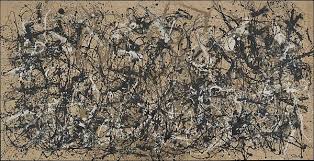
The documentary made by Hans Namuth  (http://www.youtube.com/watch?v=6cgBvpjwOGo) is a great way to understand Pollock’s way of painting .Jackson Pollock developed his individual form of spilling and dripping paint onto a canvas usually placed on the ground. Hans Namuth shows this brilliantly in the movie in a moment where he has placed the camera under a glass onto which Pollock is working so we witness the action from the perspective of the canvas.

In the movie Pollock sais that he enjoys working on a large canvas because he can feel part of it. This is something that I am only myself beginning to explore, and the statement really felt true. A large canvas, that allows much larger and less controlled gestures, invites me into being part of it in a very different way than a smaller controlled painting can.

This is Autumn Rythm from 1950:

Autumn rythm

(Image from: Metmuseum. 2020. The Metropolitan Museum of Art. [Online]. [15 April 2020]. Available from: https://www.metmuseum.org/pt/art/collection/search/488978)

For POP1, I tried out Pollocks’ method to feel how it feels- using sticks to drip and splatter household enamel paint onto brown wrapping paper on the floor:


IMG_7316

This is my painting when it felt complete:

IMG_8762


Pollock said: “I want to express my feelings rather than illustrate them”. I think he found a method of painting, where he could literally pour his feelings onto the canvas, as in letting his motions be guided by his emotions and then let himself react to that immediately, instead of trying to create an image of what he was feeling, that would become an illustration. An illustration in that sense would have a gap, a time of thinking and planning, between the feeling and the painting, whereas with an abstract expressionist method, there is no such gap. It is a simultaneous feeling and painting. The focus is on the moment, on the physical act of painting, as much as on the resulting painting.

I believe this is what the art critic Clement Greenberg was referring to when he talks about the good artist painting ‘cause’ and the bad artist painting ‘effect’. He compares the impact of a painting by Picasso that requires patience and dedication to understand and a painting by Repin where there is a story told and even exaggerated for effect, on an ignorant Russian peasant. His article ‘Avant Garde and Kitsch’  was written in 1939, so before the dripping experiments of Jackson Pollock and the rise of other Abstract Expressionist painters though.

“It has been in search of the absolute that the avant-garde has arrived at “abstract” or “nonobjective” art — and poetry, too. The avant-garde poet or artist tries in effect to imitate God  by creating something valid solely on its own terms, in the way nature itself is valid, in the way a landscape — not its picture — is aesthetically valid; something given, increate, independent of meanings, similars or originals. Content is to be dissolved so completely into form that the work of art or literature cannot be reduced in whole or in part to anything not itself. ” (Quote from: Mehdi hamedi/greenberg, C. 2020. Academiaedu on AVANT-GARDE_AND_KITSCH-_Clement_Greenberg. [Online]. [15 April 2020]. Available from: https://www.academia.edu/7515241/AVANT-GARDE_AND_KITSCH-_Clement_Greenberg)

Later, Greenberg would redefine some of the concepts in his essay and it is interesting to think of how “Kitsch” rose to high art through the Pop art movement.

Revisiting the Abstract Expressionists and especially Jackson Pollocks’ work, has unlocked some new enthusiasm in me to let emotion and accidental movements guide me through the next projects, and especially Assignment 3, where I plan to use a very large paper to move and draw intuitively to music.


Rebecca Horns’ Drawing Machines

After my own trials with creating some simple drawing machines, it was really interesting to explore Rebecca Horns’ work.

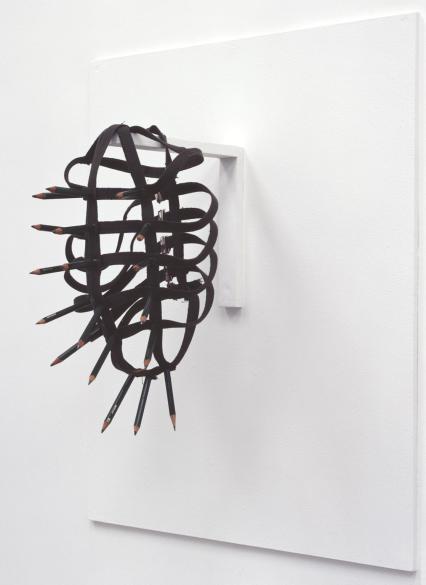
In her earlier works from the 1970’s, she created sculptural constructions that were most often extensions of her own body, like “Pencilmask” below, or a variety of feather masks.

Pencil Mask 1972 by Rebecca Horn born 1944

(Image from: Tate. 2020. Tate, Art, artworks. [Online]. [13 April 2020]. Available from: https://www.tate.org.uk/art/artworks/horn-pencil-mask-t07847)

This Pencilmask still required the artists’ presence and physical movements to leave  marks. In that way, Horn explored her own body and limitations or feelings when extended. While wearing these constructs, she could also explore various levels of control and interaction. Some masks, like her “Black Cockfeathers mask” or “Cocatoo mask” were designed to look at and meet another person with the altered vision that these masks would give the wearer, questioning her own views and subjectivity. After severe lung poisoning she spent a year very sick and in isolation. After that a lot of her work deals with interaction. She used a variety of media, but came to fame through these sculptural constructions that were then used in performances and for films.

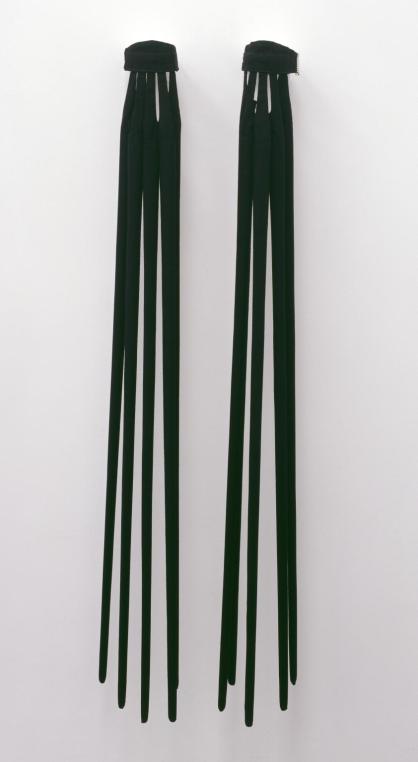
In “Finger gloves” from 1972, Horn created gloves with really long fingers. She is exploring the limitations of her own body by reaching beyond it, and also exploring the space beyond the own body and the objects she can reach with her constructed fingers.

Finger Gloves 1972 by Rebecca Horn born 1944

“I feel myself touching, see myself grasping, and control the distance between myself and the objects.” (Quote and image from Tate website: Tate. 2020. Tate, Finger Gloves Rebecca Horn. [Online]. [13 April 2020]. Available from: https://www.tate.org.uk/art/artworks/horn-finger-gloves-t07845).

I find these constructs fascinating and would just love to try any of them!

I am watching the beautiful documentary about Rebeccas journey called “Rebecca Horn is travelling” on You Tube. ( https://www.youtube.com/watch?v=2vqiFRZfCMw)

For many of her installations, Horn used very varied objects- from violins and a piano to hospital beds. She likes to combine very fragile objects, like feathers, and others that evoke a feeling of danger to create tension between them. The violin that plays itself is a recurring object- a symbol of a person, or a person that has left. In the documentary, we follow the installation of “Free as a bird” from 1999, a spiral of hospital beds where violins play. She increasingly withdrew from performing herself, letting the objects take center stage and creating mechanical sculptures with movements and sounds. These sculptures are not perfect- and she explains how their imperfections and hesitations make them more human.

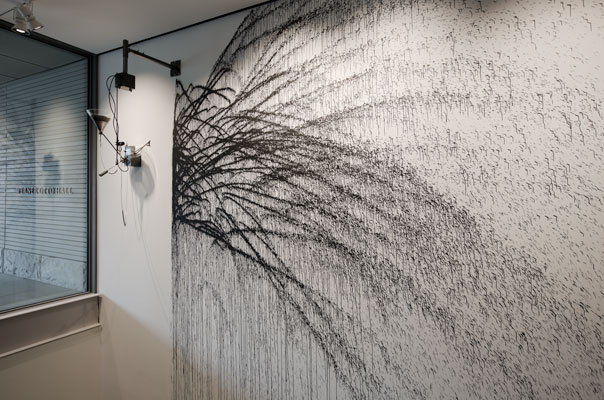
Later she started constructing automated drawing machines, where she has removed more of her own control. In “Flying books under Black rain painting” from 2015 at Harvard University, she lets a machine spray black paint over a white wall and three books.

Index_A-Refresh-for-Rebecca-Horn-01

(Image from: Harvard. 2020. Harvard Art Museums, Collections, Rebecca Horn. [Online]. [13 April 2020]. Available from: https://www.harvardartmuseums.org/collections?q=Rebecca+Horn+)

There is an interesting tension in the drawing machines, between the cold, mechanical, calculated construction, and then the element out of control, the way the drops fall through gravity and mark the wall. This feels like a big step away from the control of the earlier works where the body was still initiating the movement and in itself an essential element of the investigation. The artist seems to imbue the machines with almost human qualities though, and sees how they can express emotions.