Due to the Covid 19 situation, Art Basel opened the access to all artworks online through their Online Viewing Rooms from June 19-26. As I have not seen any exhibitions in the flesh for a long time , due to this worldwide situation, I am keen to browse the online version of this largest art fair in the world, taking place in Europe in Basel, in the USA in Miami and in Asia in Hong Kong.
There is an incredible amount of information and art works here. 282 galleries from 35 countries show over 4000 artworks! As this is a commercial event, it often shows the works with a pricetag, which puts them in an very different context than seeing the same works in an exhibition. They are also organized by gallery instead of by artist or theme, which brings another dynamic to the viewing, clearly placing the work in this commercial context- a good reality check for a dreaming aspiring artist like me.
I started by watching an introductory video about the event (https://www.artbasel.com/ovr) and was already overwhelmed by the amount of highly successful contemporary artists mentioned that I did not know! This is a list of the artists highlighted that I want to take a more in-depth look at:
Carrie Mae Weems , Glenn Lighton, Deanna Lawson, Theaster Gates, Nicole Eisenmann, Monica Bonvincini, Jeffrey Gibson, Wade Guyton, Cecile B Evans.
Another category named the “Young Voices” highlighted promising emerging artists to look out for:
Issy Wood, Chen Tiangzhuo, Hanna Miletic, Jonathan Lyndon Chase, Paul Mpagi Sepuya, Rafa Esparza.
A search for these artists with the search engine of the website is not very successful though, several are not found at all, so I decide to leave this list for a general internet search afterwards. Instead I wander through the viewing rooms randomly, much like I would a real art fair and just look for something that catches my eye.
At first I am a little disappointed at the amount of Photography and sculpture or installation presented, in comparison to drawing and painting.
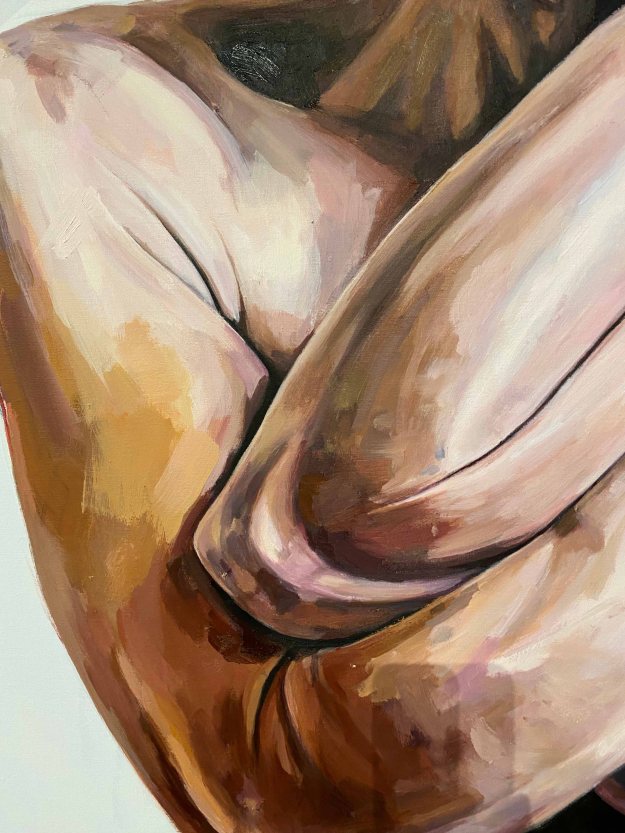
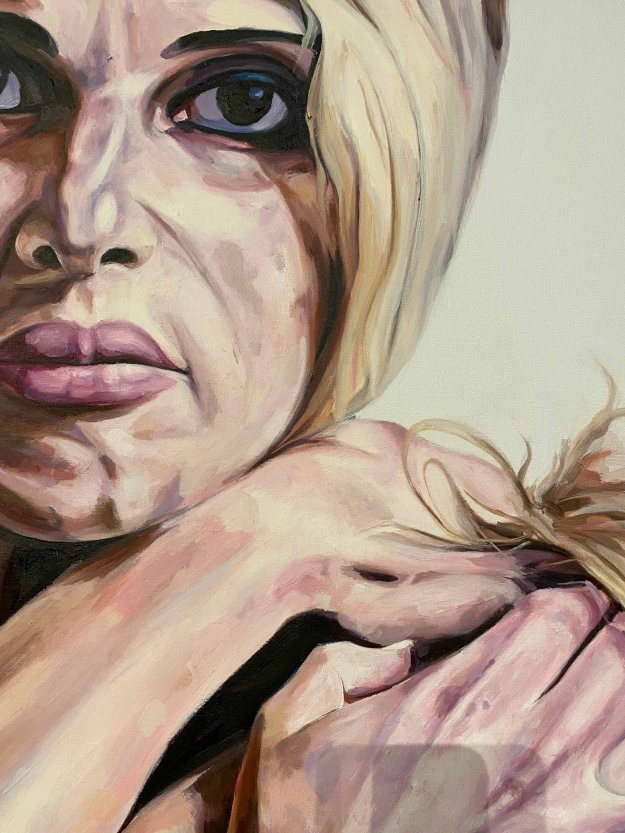
These two paintings by Liliane Tomasko presented by Kerlin Gallery are the first interesting works I encounter, I am drawn into the layers of clear brushstrokes. These is something about these wide, visible brushstrokes that remind me of the work of Mimei Thompson, although Thompsons’ art is figurative with everyday subjects, like weeds from the backyard or a torn open trash bag. These paintings remain abstract, but I find myself following the forms and trying to make out something figurative that seems to just lurk under the surface.
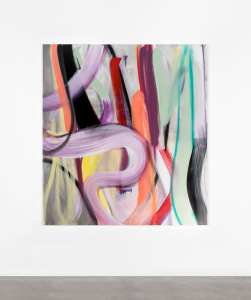
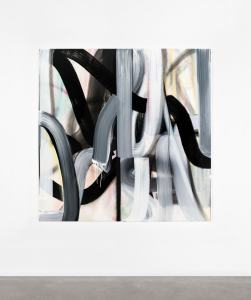
2020. Https://wwwartbaselcom/catalog/artwork/104940/Liliane-Tomasko-Hold-on-to-Yourself-5-18-2020. [Online]. [25 June 2020]. Available from: https://www.artbasel.com/catalog/artwork/104940/Liliane-Tomasko-Hold-on-to-Yourself-5-18-2020)
Next, I discovered the paintings of Miriam Kahn (Gallery Jocelyn Wolff) where crudely painted humane figures in translucent colours attract my attention. They are clumsy and caricaturist but exude a strange power with their shining limbs and the way they look straight into my eyes with their childishly drawn faces.
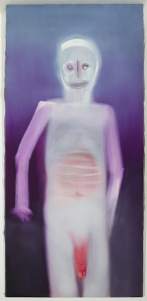
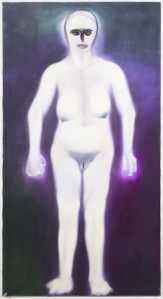
2020. Artbaselcom/catalog/artwork/113703/Miriam-Cahn-au-travail-27-5-27-6-11. [Online]. [25 June 2020]. Available from: https://www.artbasel.com/catalog/artwork/113703/Miriam-Cahn-au-travail-27-5-27-6-11)
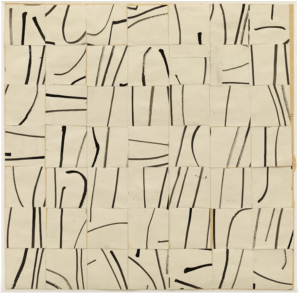
In this artwork by Mariela Scafati (Gallery Isla Flotanta) , I find the composition of small paintings put together really effective and an idea to remember.
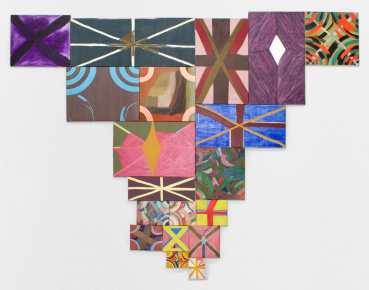
2020. Artbaselcom/catalog/artwork/106369/Mariela-Scafati-Montaje-de-los-tiempos-posibles. [Online]. [25 June 2020]. Available from: https://www.artbasel.com/catalog/artwork/106369/Mariela-Scafati-Montaje-de-los-tiempos-posibles)
I am right now working on the art-specific piece for Assignment 4 in a corridor that is not possible to look at in one glimpse, so this could be one way to present images from the separate parts of the artwork.
I really like this painting in only white and blue by A.R Penck from 1976 (Michael Werner Gallery).
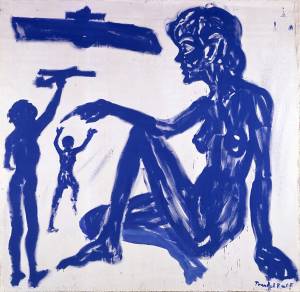 I want to remember how the different figures in different sizes cohabit in flatness- without a sense of perspective.
2020. Artbaselcom/catalog/artwork/107230/A-R-Penck-Traudel. [Online]. [25 June 2020]. Available from: https://www.artbasel.com/catalog/artwork/107230/A-R-Penck-Traudel)
Looking at Pencks’ work quickly connects me to more viewing rooms with recognized modern masters and I am amazed at the amount of small works on paper on sale in the million dollar range. I try to navigate away from Matisse and Picasso towards more contemporary painting.
The works of Wu Chen (Magician Space Gallery) are somewhere between fairytale and grotesque, like this painting of a fat Christmas man posing nude on the bed in some red and fleshcoloured boudoir with a mirror over him. The name “Portrait of the Male Female Male” figure also alludes to the classic female nude you would expect in a similar setting.
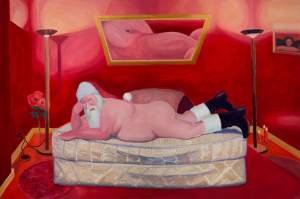
The reflection in the mirror looks more like a female body and the whole feels really strange.
2020. Artbaselcom/catalog/artwork/107368/Wu-Chen-Portrait-About-the-Male-Female-Male-Figure. [Online]. [26 June 2020]. Available from: https://www.artbasel.com/catalog/artwork/107368/Wu-Chen-Portrait-About-the-Male-Female-Male-Figure)
I stopped to take a look at the ceramic bowls by Urara Tsuchiya (Union Pacific Gallery).
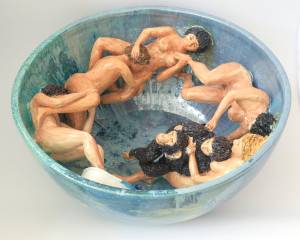
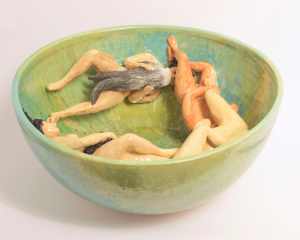
These bowls are full of little nude figures, and some animals intertwined in some unclear postures, opening up some strange narrative. I see that I am always drawn to story and these tell a strange story in a slightly uneasy way while at the same time posing as a colourful decorative item.
2020. Artbaselcom/catalog/artwork/107778/Urara-Tsuchiya-Henry. [Online]. [26 June 2020]. Available from: https://www.artbasel.com/catalog/artwork/107778/Urara-Tsuchiya-Henry)
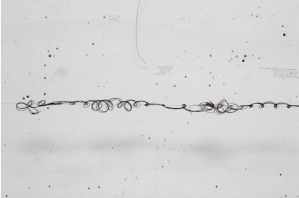
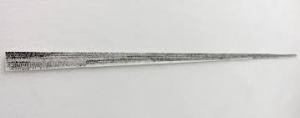
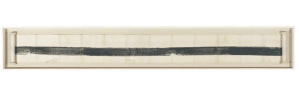
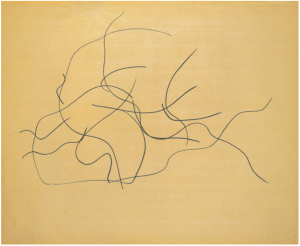
I found these small works on paper by Cameron Clayborn (Simone Subal Gallery) really attractive in their simplicity.
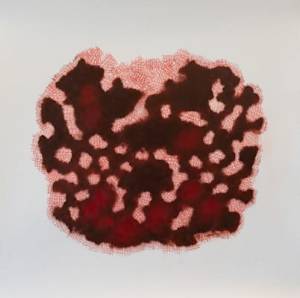
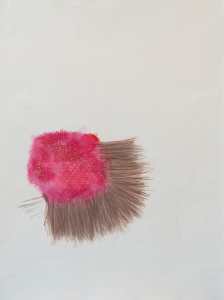
The one on the left is called “a puddle with promise” which I find so fitting.
2020. Artbaselcom/catalog/artwork/109738/Cameron-Clayborn-a-puddle-with-promise. [Online]. [26 June 2020]. Available from: https://www.artbasel.com/catalog/artwork/109738/Cameron-Clayborn-a-puddle-with-promise)
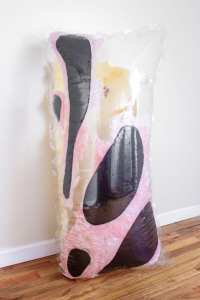
The same artist presents several inflatable sculptures, like this pillow like one, which also sparks my imagination with its cow like pattern- I can start spinning a lot of ideas from here.
2020. Artbaselcom/catalog/artwork/111841/Cameron-Clayborn-inflatable-5. [Online]. [26 June 2020]. Available from: https://www.artbasel.com/catalog/artwork/111841/Cameron-Clayborn-inflatable-5)
The Galerie Guido W. Baudach shows several painters that I found worth looking into.
Tamina Amadyar’s clean, abstract painting felt so soothing after the overload of narrative .
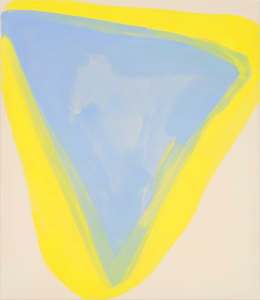
2020. Artbaselcom/catalog/artwork/104303/Tamina-Amadyar-overlook. [Online]. [26 June 2020]. Available from: https://www.artbasel.com/catalog/artwork/104303/Tamina-Amadyar-overlook)
This painting by Yves Sherer looks abstract at a first glimpse, then it looks like a patterned piece of cloth stamped into the ground, scratched and abandoned.
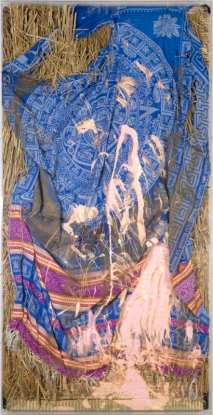
The title “Sirens (Teotihuacan)” can maybe speak about mermaids or maybe about the wailing signal of sirens, and then the name of an Aztec civilization that has disappeared. There seem to be as many layers of meaning here that there is of paint. The pattern on the cloth looks a little like a map, but the whole then scratched and torn.
2020. Artbaselcom/catalog/artwork/104009/Yves-Scherer-Sirens-Teotihuacan. [Online]. [26 June 2020]. Available from: https://www.artbasel.com/catalog/artwork/104009/Yves-Scherer-Sirens-Teotihuacan)
This painting by Andy Hope from 1930 finds its way my heart with the shriveled figure with twisted eyes and a little unlucky shape.
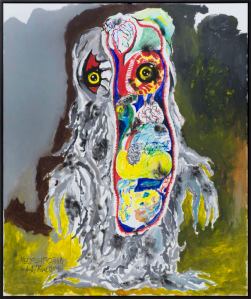
2020. Artbaselcom/catalog/artwork/103915/Andy-Hope-1930-HEEDRAHTROPHIA-8. [Online]. [26 June 2020]. Available from: https://www.artbasel.com/catalog/artwork/103915/Andy-Hope-1930-HEEDRAHTROPHIA-8)
Meiro Koizumi’s works (Annett Gelink Gallery) are called “works on paper” and I am not sure if they are drawings or overworked photographs.
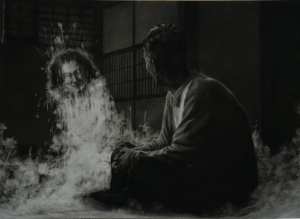
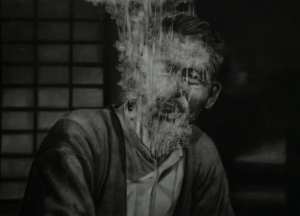
I am drawn in by the fog covering the figures faces creating a sense of mystery- I want to know more. An internet search shows that this Japanese artist is mainly working in video, exploring the domain between public and private. It is true that these scenes look like stills from movies.
2020. Artbaselcom/catalog/artwork/108829/Meiro-Koizumi-Fog-12. [Online]. [26 June 2020]. Available from: https://www.artbasel.com/catalog/artwork/108829/Meiro-Koizumi-Fog-12)
Here I found a painting that I really like by Kudzanai Chiurai (Goodman Gallery)- a black figure almost not standing out from the black background and a foreground with different types of texts. The posture, the dull colours, the sharp contrast between light and dark, the combination of figure and text- I really appreciate this painting.
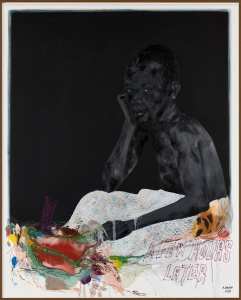
2020. Artbaselcom/catalog/artwork/103051/Kudzanai-Chiurai-A-few-hours-later. [Online]. [26 June 2020]. Available from: https://www.artbasel.com/catalog/artwork/103051/Kudzanai-Chiurai-A-few-hours-later)
Gallery ChertLuedde presented a long series called “20 th Century alienation” of photographs by David Horvitz showing the same masked person with gloves holding different white sheets of paper with words .
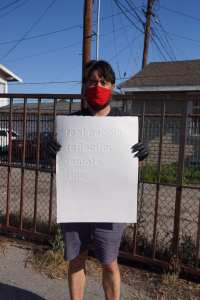
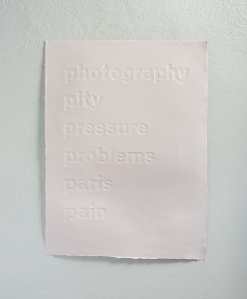
I am not so attracted to the visual here, but I really like the idea and can see more words emerging in my own work.
2020. Artbaselcom/catalog/artwork/113146/David-Horvitz-20th-Century-Alienation. [Online]. [26 June 2020]. Available from: https://www.artbasel.com/catalog/artwork/113146/David-Horvitz-20th-Century-Alienation)
By now, the Viewing Rooms have already closed, so I turn to an online search of the artists highlighted by the organizers, picking out the ones working with drawing or painting, which is what interests me most.
Carrie Mae Weems (Photography and film)
Deanna Lawson (Photography)
Theaster Gates (Installation, Performance, Dance, Sculpture)
Nicole Eisenmann is the first painter included on the list. She paints the figure because she knows the world through her body, and understands her desires and anxieties through her body, and also the desires and anxieties of our culture.
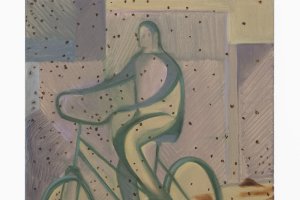
This painting from 2020 is called “Shitstorm”, which is a very evocative title.
The figures look like from caricatures and are often limp or lying, many charged with sexual motives , and many others with words. I like the artists titles, like “Incelesbian” or “Ridykelous”.
I find this painting below interesting because of the unusual cropping.
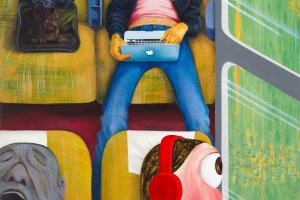
2020. Anton Kern Gallery. [Online]. [27 June 2020]. Available from: https://www.antonkerngallery.com/artists/nicole_eisenman
Nicole Eisenmann has also created several large scale sculptures. As a whole, this caricature style does not capture me, although I enjoy the artists irony and playfulness.
Monica Bonvincini (Sculpture and performance)
Jeffrey Gibson is the second painter of the list, even if he also works in sculpture and performance. He merges history and ritual from several different traditions to describe the world we live in today, and especially uses the aestetics of Native American cultures.He uses a lot of pattern and text in his paintings.
I was immediately drawn to his painted punching bags. They are multicoloured, multi patterened creations hanging in the room, often also containing a message in text, like here “One becomes the other” and “I put a spell on you”
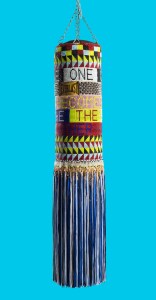
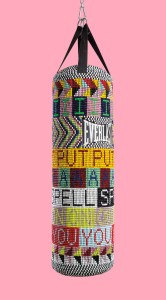
2020. Seattle Art Museum. [Online]. [27 June 2020]. Available from: http://gibson.site.seattleartmuseum.org/)
With these he is fighting using words and ideas rather than fists and guns, he wants to spark the conversation to be more inclusive.
I really like painting on objects myself and found this combination of idea, object, painting and text brilliant.
Wade Guyton is mainly making digital paintings on canvas using scanners and digital inkjet that are then worth millions of dollars. So he is combining the traditional support of painting with new technology. On MoMA’s website, his art is being describes as “post-conceptual”.
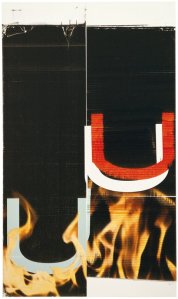
2020. Museum Ludwig. [Online]. [1 July 2020]. Available from: https://www.museum-ludwig.de/en/exhibitions/archive/2020/wade-guyton.html)
The letters X, U and flames are recurring themes, and in the later works- large black and white surfaces.
Again, this is not a style of painting I would like to explore myself. Although I am aware of the impact and possibilities of digital technology, I am actually drawn to the exact opposite- the non-technological, tactile, physical qualities of paint and also the conceptual- how to express an idea through paint.
Cecile B. Evans (video, installation, sculpture and performance)
It was interesting to then jump to Cecile B Evans work which is exploring how we value emotion in contemporary society, and precisely how digital technology has impacted that.
There is an excellent interview with Evans on the Luisiana Channel : https://channel.louisiana.dk/video/cecile-b-evans-virtual-real
Although video is not my chosen media, I found a lot of the artists ideas around how technology influences us and how it regulates our emotions, very relevant and exciting.
I am moving on to the artists described as “Young Voices”
Issy Wood is both a writer and a figurative painter.
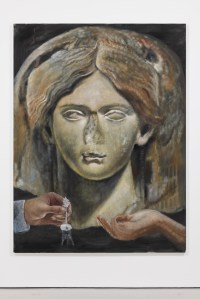
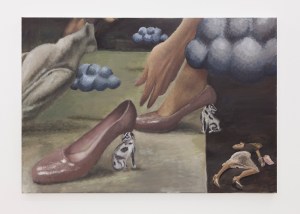
(Images from: 2020. Carlos Ishikawa. [Online]. [1 July 2020]. Available from: http://www.carlosishikawa.com/artists/issywood/)
Her paintings are surreal and dark, with obscure narratives that leaves me with an uneasy feeling. I can understand a certain fascination that these paintings have. Looking at exhibition views, I find it interesting how Wood alternates large paintings with really small ones.
Chen Tiangzhuo (performance video work and installations, music)
Hana Miletic (Textiles)
Jonathan Lyndon Chase is a painter focusing mainly on queer. black bodies.
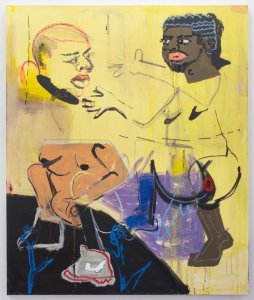
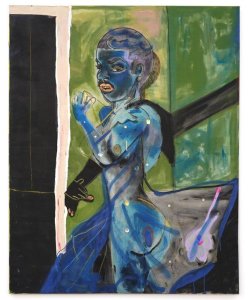
I am quite fascinated by the boldness of these flatly painted, unfinished, unproportional figures. In the painting on the left, I find the unfinished bits and how fragmented the figures become really interesting. In the painting on the left, I am interested in the colour and movement of the figure.
Paul Mpagi Sepuya (Photographer)
Rafa Esparza (Performance and installations using bricks) Rafa Esparza also uses the adobe as supports for his paintings. His work centers around the theme of brown and queer.
As a whole, I am not convinced researching the Art Basel Viewing Rooms and the artists mentioned there was the best approach for an interesting online art visit. I spent a lot of time navigating between rooms and feeling quite overwhelmed with the amount of art, without really seeing much that I felt really touched by. I also had a feeling that I missed many things that would have been really interesting, but I did not chance upon them. Of course this would have been another experience in the flesh and probably incredibly inspiring. For my online art visits, I need to be more focused and clear about what I am looking for and looking at to really appreciate it.



 Clara's Drawing 2