Category Archives: Uncategorized

Parallell project- Lampshades

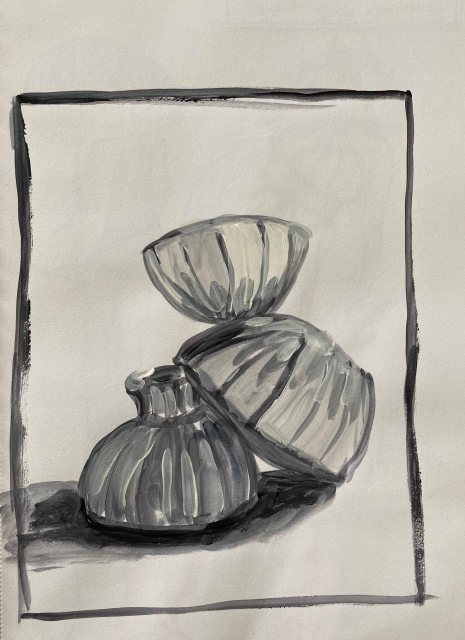
In some of the rooms, a solitary lampshade was left dangling when we arrived here. I have collected them and planned to use them both as a support to paint on and as a subject for still life.

They first appeared in Part 3, Project 2, Experiments with mark-making:

And I used one as a support for a fun way to close my rather dark drawings with masks  in 2.3 Narrative:

I am now arranging the lampshades in various ways for still life, piling them up instead of hanging them to take them out of their context.

Pencilsketches A4:
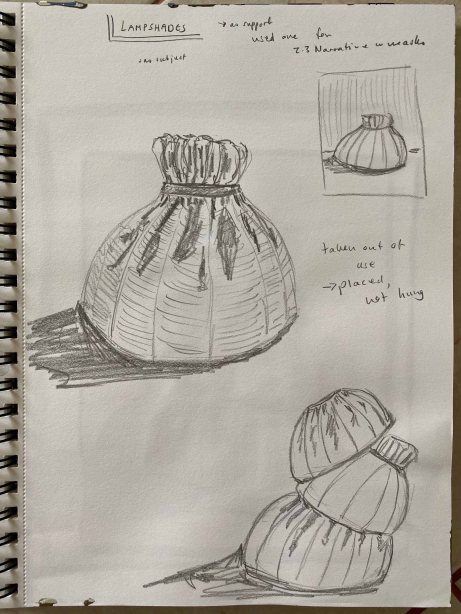
IMG_6484

Sketches in Payne’s grey and Titanium White acrylics, A4:
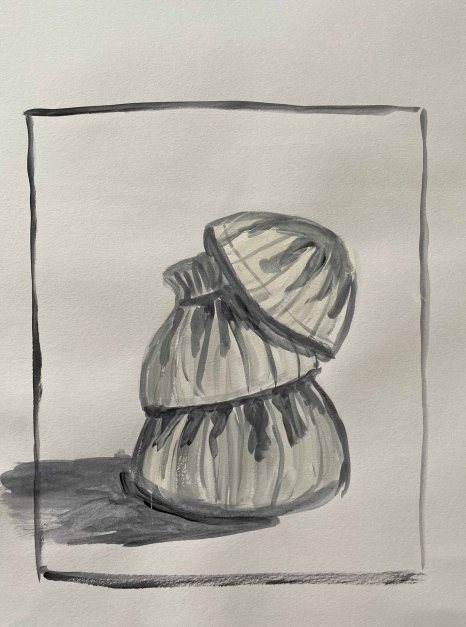
IMG_6489

IMG_6492

I like these shapes and see that they have potential, but it is when I imagine to include the figure that I really start getting excited about this subject.

One advantage with the Covid 19 lockdown, is that my daughter and granddaughter have time to model.

Pencil sketches A4 in sketchbook:
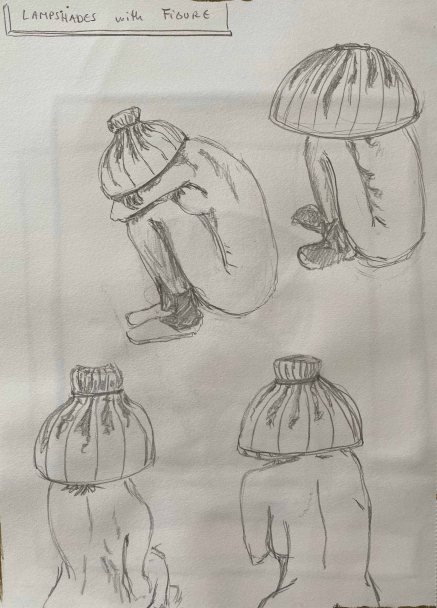
IMG_6496

IMG_6499

Sketches on the walls of “Parallel project- empty room, modern cavepainting” ( see separate post):

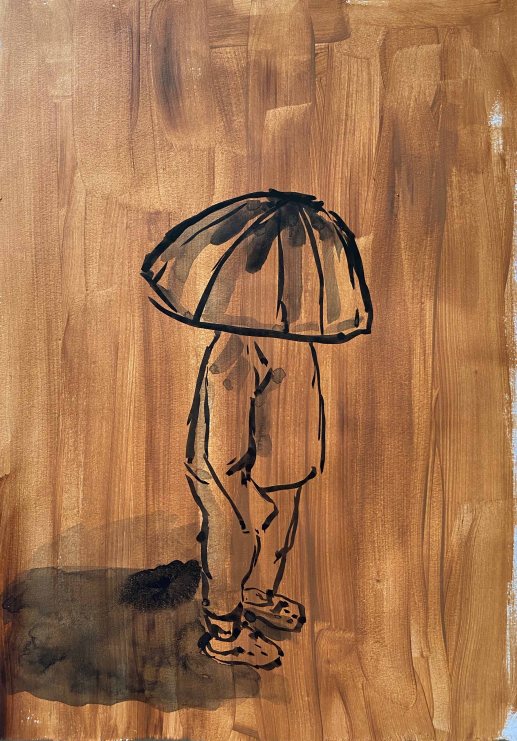
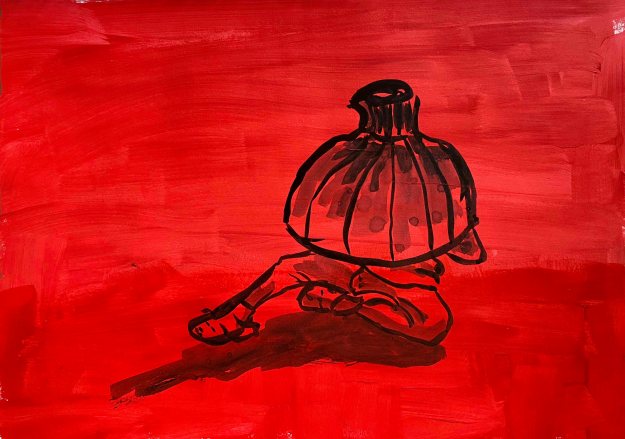
A4 sketches in acrylics with Indian ink:
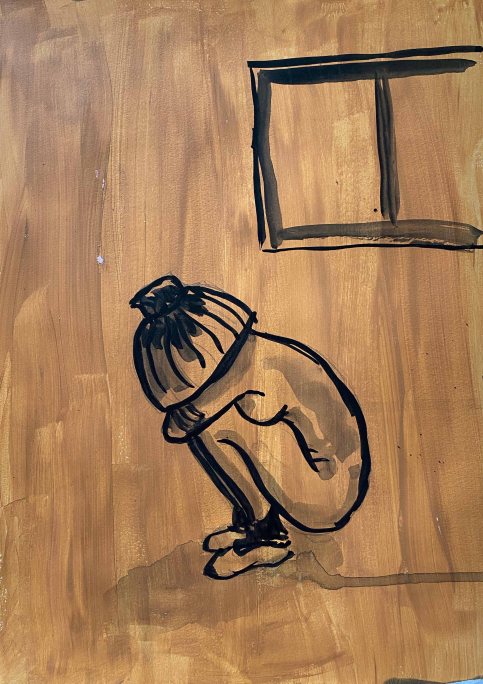
IMG_6507

IMG_6510

IMG_6517

IMG_6524

From here, I took a big leap to starting three big (100×120 cm) paintings in oil on canvas all at the same time:

IMG_5878

This is unprecedented. What is happening here is that I am making a very clear and loud statement to the universe that “I am going to paint!”. I spent the last 20 years doing very sensible things before finally starting, so I am not ready to stop. Being in a household where very suddenly we do not have any foreseeable income at the moment, could bring up different ideas, but no- I will food garden and renovate and babysit and work- and I will definitely paint- on big expensive canvases in oil even 🙂

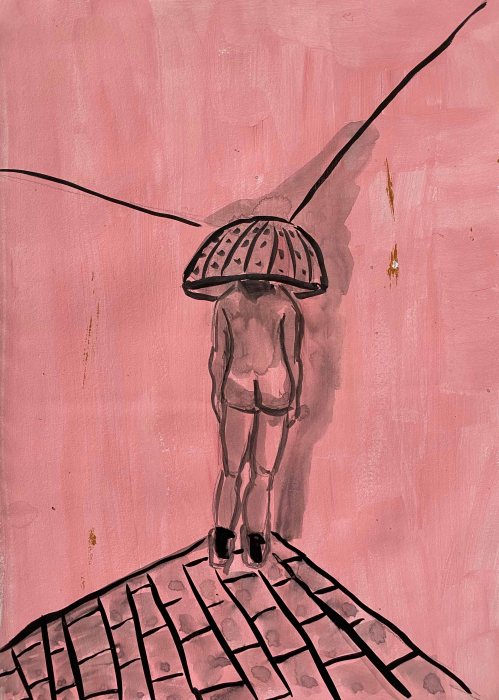
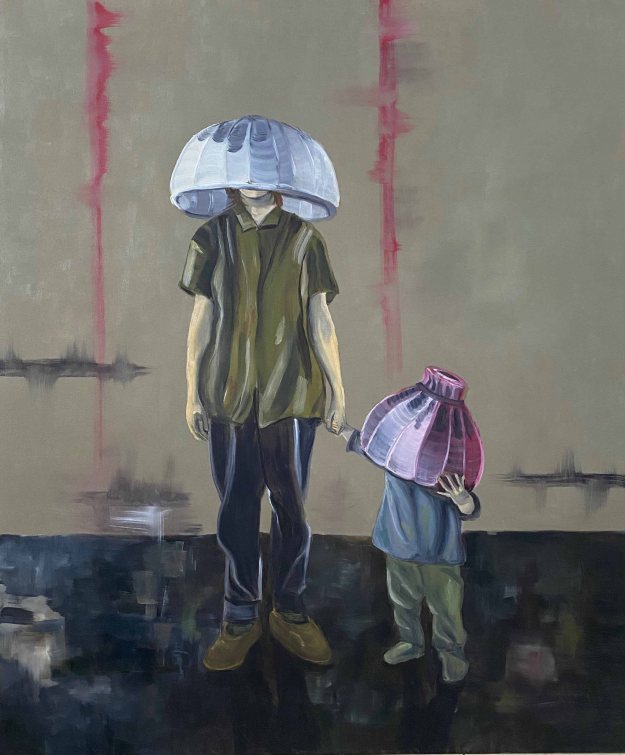
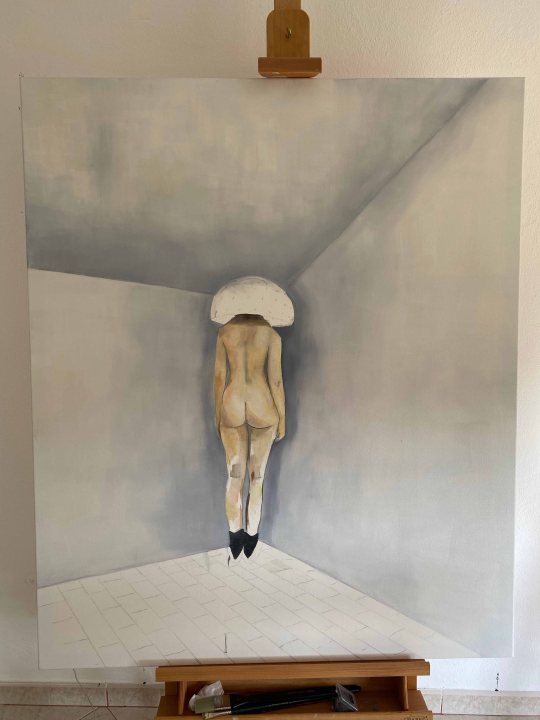
Letting my daughter and the little One wear the lampshades on their heads is a way I find to speak about a lot of the feelings coming up in these times. There is the feeling of not seeing where we are going, or even standing in front of a wall. There is an element of hiding as well. In one motive, my daughter poses nude, emphasizing the vulnerability of the now. In the other, where I photoshop my daughter and granddaughter together before painting them, they are wearing the soggy casual sweatpants that I see almost every day.

I start by covering a white canvas 100×120 cm with a military green acrylic coat.
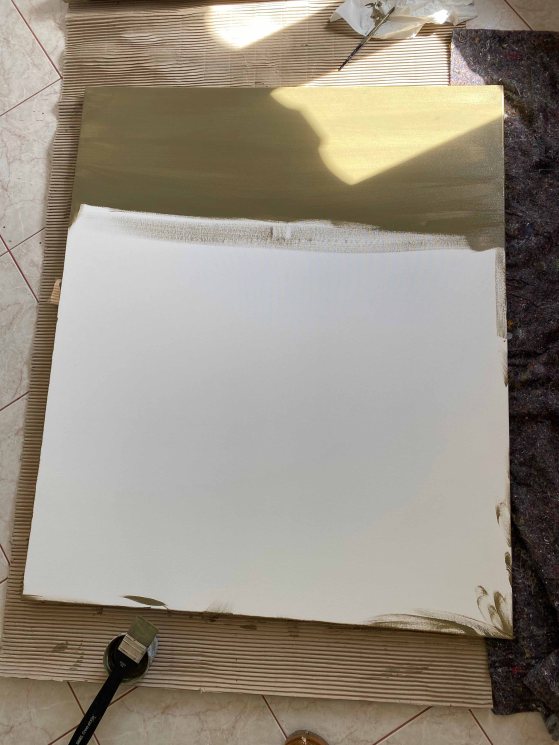
IMG_5704

Once starting in oils, I struggle for a really long time with the background. I have the idea to use a camouflage pattern, but then smudge it, so it is a camouflaged camouflage pattern.


I try this is many unsatisfying ways.

Finally I cover up the whole background with a rather monotonous military green in oil, similar to the acrylic background I started out with 2 days prior. The red stripes just happened, after I listened to a podcast about statistics on Soundcloud, which had similar wave patterns.

I am using a big flat brush all along for the figures, to avoid overworking.

This is the final painting.
IMG_6152

I call it “Spring Summer 2020” like a fashion collection. I really like this painting myself. It shows the mixture of humor and fear I feel at the moment and I have captured something very personal in both my daughters and granddaughters postures that make them recognizable to me even with their heads covered.  I also like that this painting connects us and our unplanned time here all together with some of the odd old elements of the house that I connect to this parallel project- the lampshades.

The second painting is a nude with lampshade. I choose to paint this much more carefully and try to achieve the right flesh tones. I find that the more careful approach reflects the more vulnerable feeling of this painting.
IMG_5874

I placed her in the corner, feeling trapped or without direction. The walls are crashing down on her, there is no spaciousness. I hesitate long about what to do with the floor, but decide to paint brick coloured tiles similar to the ones that are really here, to have a solid floor, instead of letting her hover in something more grey or non distinct.

IMG_5914

These brickcoloured tiles could also be outside, which maybe brings more confusion to the painting, which I like.

This is the final painting:

IMG_5947

I am happy with the motive and the feeling this painting transmits, but I was too careful in my choice of colours and precious little brushstrokes. I enjoy a bolder approach more.

The last painting does not exactly belong to this post, as it has lost the lampshade. I place it here though because it is a part of the same experience and just a few photos before the one that I chose for this painting, Ria was actually wearing the lampshade, but I prefer to paint her longing expression.

IMG_4781 (1).jpg

In all three , Ria is also wearing the same slippers and socks- an allusion to this time closed in the house.

I have started this last painting on a linen canvas that I have stretched ( also a new experience.)

IMG_6076

I will post the painting here once completed.

At this point, I am just starting on Part 4 of the course, and can see how these lampshades may reappear in the project of Installation or maybe be used for the site specific artwork fro Assignment 4.

I also want to experiment further with using the lampshades as supports.

To be continued


Assignment 3

Course Manual: “Select a piece of music (preferably classical or at least rhythmically complex) and allow your movements to be affected or generated by it whilst producing a drawing. To begin with, generate your lines and marks solely in response to the music. After the first hour, develop this further. For example, you could introduce an observational element such as self-portraiture and begin to explore the interplay between gesture and representation. Alternatively you might decide to video yourself making the work to emphasise the performative nature of gesture.”

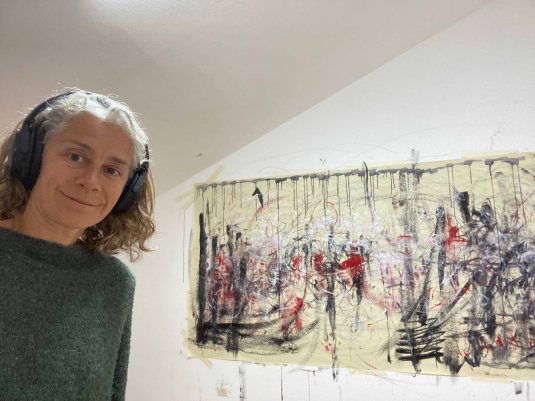
I always listen to music in my headphones when I draw or paint, often as a tool to close out other sounds from what is happening around me.

I do not think I have ever made a drawing solely as a response to the music though, without a pre-concieved idea.

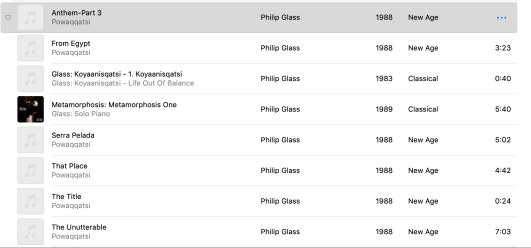
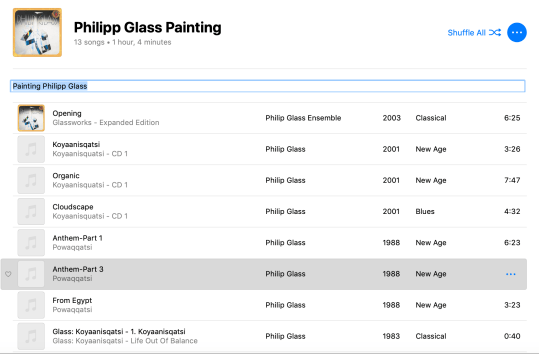
For this assignment, I created a playlist with music from Philipp Glass, mixed from the three albums Koyaaniqatsi, Solo Piano and Powaqqatsi. I choose this composer, as his music is definitely rhythmically complex and because it brings me through a very wide range of emotions with anything from very dark, hard stomping sounds, to light flute or calming piano. This is the playlist:

Screen Shot 2020-04-18 at 1.52.15 PM

Screen Shot 2020-04-18 at 1.52.54 PM


The whole is a few minutes over one hour long, and I plan to play it twice. The first round, I will just draw wildly, mainly keeping my eyes closed and really letting myself go and just feel the music. The focus will be entirely on the process. Then after that first hour, I will step back and see if I can pick out any figurative elements in the drawing. Then, I will listen to the same playlist again for the next hour, accentuating those figurative elements, while still moving to the music and letting the music inform my marks.

I start with a few test marks on approximately A2 papers while listening to the beginning of each song to see what materials feel appropriate.

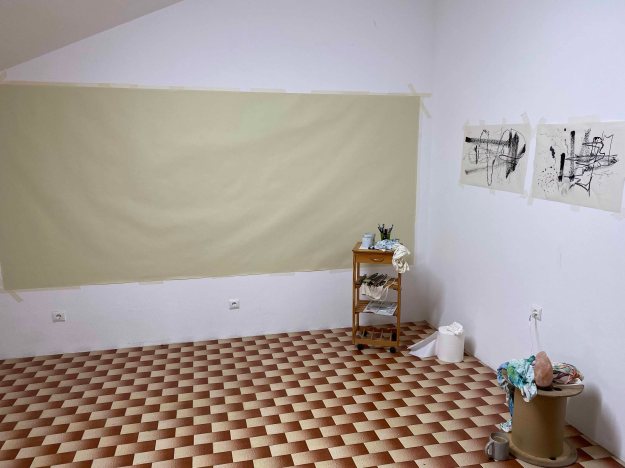
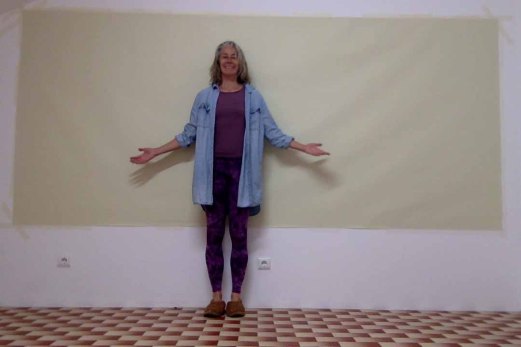
I am going to move and dance to the music while drawing- so I prepare a large sheet of paper- it is approximately 150×300 cm.

IMG_4967


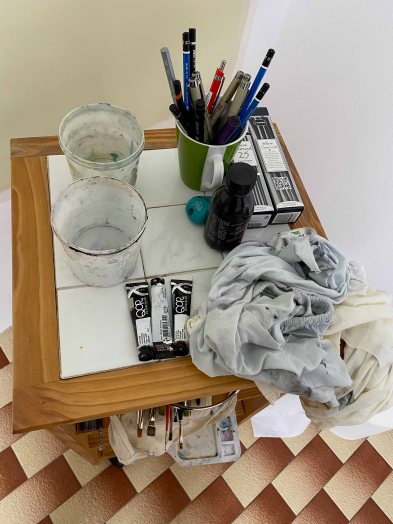
I prepare a wide array of black and white media- charcoal, graphite pencils, markers, Indian ink, watercolour and acrylics with lots of different brushes. As for the previous emotional response exercise, I decide to use only black and white media, to emphasize the focus on the mark-making rather than colour.

IMG_4969

I am ready to start!

Photo on 4-11-20 at 10.59 AM #2

I am aware that this is more of a performance, focusing on the dancing and moving my body while translating movement and emotions into physical marks on the paper, rather than expecting any finished “good” drawing as an outcome.

Luckily, Tom is in COVID 19 lockdown with us and he agrees to document the process by filming it.

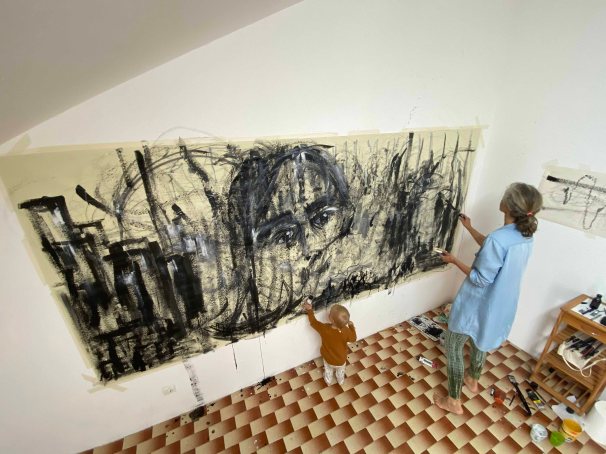
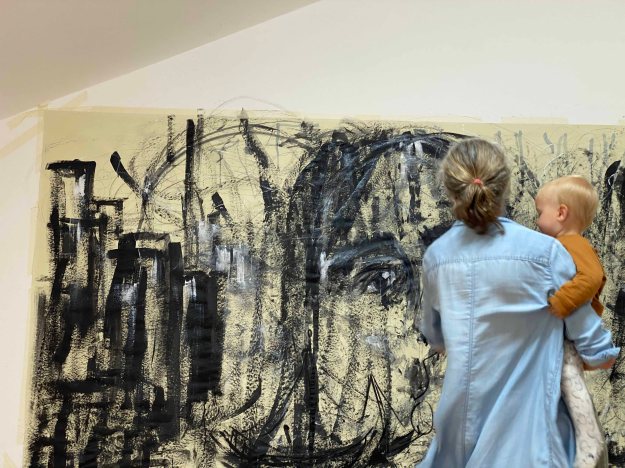
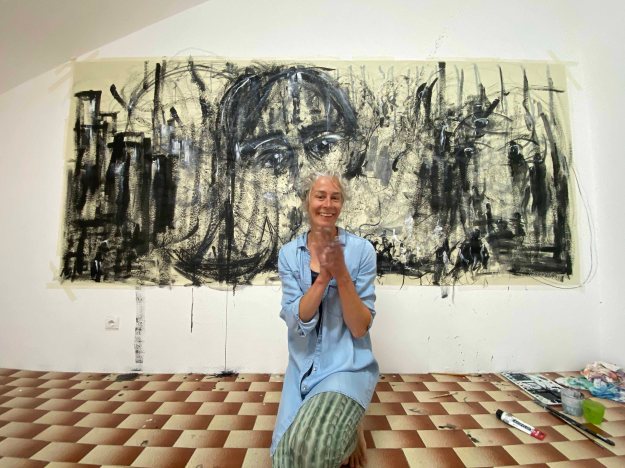
After one hour of non stop dancing and drawing, I am exhilarated and exhausted! I take a 15 minute break, shower and have a look if we can find some figurative elements. It seems like a face hovering over Hong Kong harbor is coming out.

I am ready for round 2 and set the music to play again. This time I work more aware of the figurative elements. I still move intuitively in pace with the music, but keep track of what I do. My granddaughter wakes up from her nap and joins in the dancing and drawing.

IMG_5017

IMG_5023

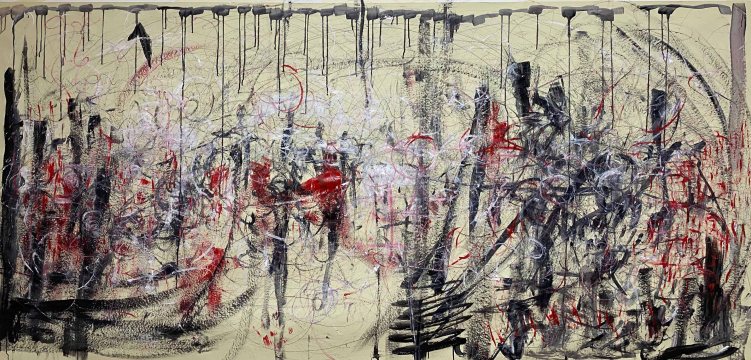
After the second hour, this is how the drawing looks (150x300cm):

IMG_5047


This movie, documenting the process, filmed and edited by Tom Woodfin (@perceptionarchitecture), is my final piece for Assignment 3:


Drawing for two hours intensely to music was an absolutely incredibly profound process. I was tingling of excitement and exhaustion after these two hours, and can not begin to tell what rollercoaster of emotions I experienced during the drawing.

IMG_5037

It was very interesting for me to experience the difference between my state of almost trance during the first hour, where I felt no need to even look at the result, and could just loose myself in the music, and the second hour, where I was still dancing, but remaining focused on the outcome. This opens up to a new, intense and rich way of approaching drawing and painting. I am really surprised that something as figurative as this could come out of this dance. And I am pleased to see that the final drawing still transmits the movement and the power of the dance.


Tom who was present and filming during large parts of the process, was so fascinated by what was happening, that he asked me to repeat the experience for his breathwork session. Tom is a breathwork facilitator, and is working on Zoom from my studio at the minute, due to the Covid 19 restrictions.

So the very next day, we set up two large papers on opposite walls, one for each of us.

IMG_5098

42 people from various parts of the world joined the session over Zoom, and all through the one hour 20 minute long session of music and breath exercises, Tom and I were dancing and drawing. This time, I pushed the concept of a performance even further, by having an audience, even if this audience was online and mostly eyes closed while they were breathing.

This is how my drawing looked after the 1 hour 20 minutes very varied music.

IMG_5108

I decided to repeat the exercise above, and came back alone the next day, playing the same tracks while continuing the drawing consciously.

IMG_5137

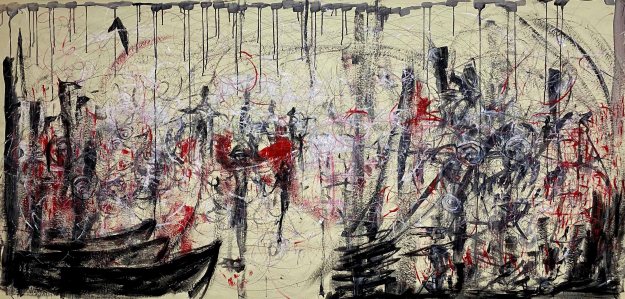
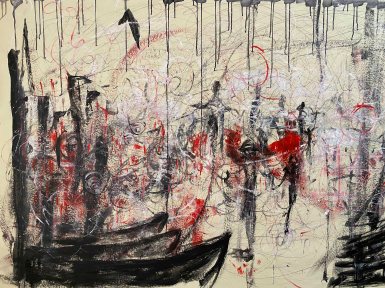
This time I had a really hard time seeing any figurative elements to start with, except for three boats in the left bottom corner. I decided to not change the overall composition,by inventing what I did not see, but lift out elements that jumped out at me.

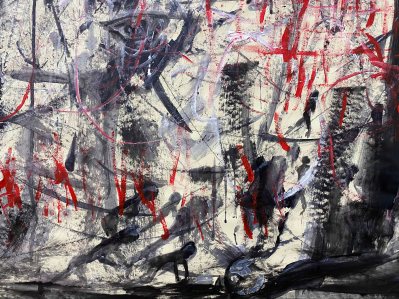
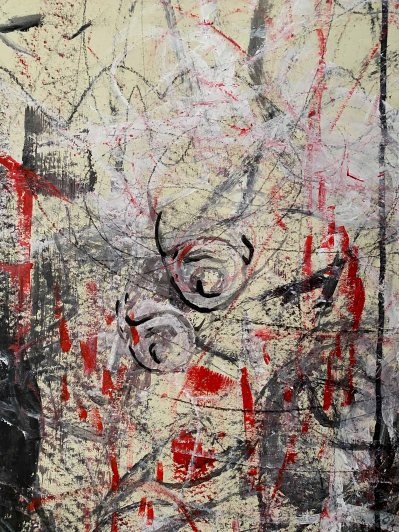
This is the final drawing- rather apocalyptic with Covid 19 masks appearing again (150×300 cm):

IMG_5164

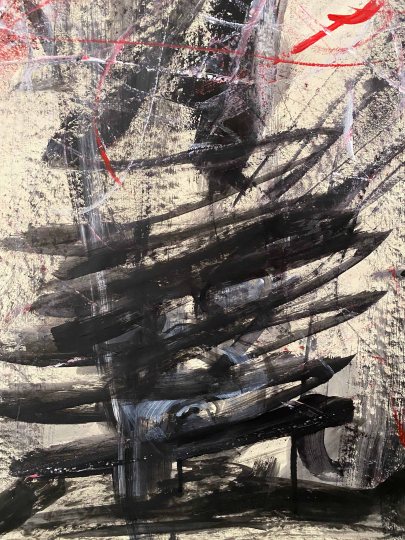
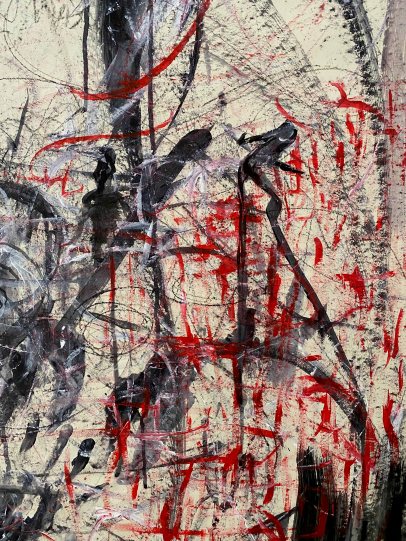
Here are some details that I like:

IMG_5213

IMG_5187

IMG_5215

IMG_5223

IMG_5232

IMG_5236


The experiences of these drawings to music have been profound. They have pushed me further towards performance and let me loosen the need for a clear or “good” outcome. I feel like a whole new ways of approaching drawing and painting  are opening up here, a more intuitive and gestural approach. I am curious to explore how I can incorporate these experiences into more conceptual work as well.


Contextual focus point: Erased De Kooning

In 1953, Robert Rauschenberg asked Willem De Kooning for one of his drawings. Amazingly, he agreed. Rauschenberg then proceeded to rub out De Kooning’s drawing and exhibit the resulting near blank sheet. This is such a beautiful moment in art history as it brings together the mood of the time and the lasting legacy of both Abstract Expressionism and what would later become post modernism. Find a reproduction of this drawing on the web and make notes on how you feel about it at first sight. Then look a little into the background and try to get an understanding of why Rauschenberg might have done this. There are video interviews online with both artists. Use Google to find the videos and make notes on your thoughts about what happened.

I was lucky enough to see the “Erased De Kooning” drawing in the flesh in the Robert Rauschenberg exhibition at Tate Modern in London in 2017, even if there is not that much to look at.

The erased drawing is framed in a golden frame and bears an inscription “Erased de Kooning drawing” by Robert Rauschenberg. By framing it and labelling it, it becomes elevated to a piece that we can look at and understand the process behind. Without this, we would have no clue what we are looking at.

canvas

(Image from: Roberts , S. 2013. SFMoMa. [Online]. [15 April 2020]. Available from: https://www.sfmoma.org/artwork/98.298/)

Robert Rauschenberg was experimenting with different art forms at the time, and stretching the limits of what could be an art work- continuing the legacy of the ready made by Duchamps. The question was, if the act of erasure could create an artwork. Rauschenberg understood that he would have to begin with a drawing that was recognized as art to start with that he would then erase, so he contacted de Kooning who was already recognized in the art world, and greatly admired by Rauschenberg.

In an interview on You tube (https://www.youtube.com/watch?v=tpCWh3IFtDQ), Rauschenberg explains that if de Kooning had not been home that day- that would have been the work. If he would not have been willing to give out a drawing to erase- then that would have been the work. But de Kooning agreed, and added that it would have to be a drawing that he would miss. Rauschenberg sais that the drawing was VERY difficult to erase. It had crayons and charcoal and took a month to erase.

“It is not a negation, it is a celebration” sais Rauschenberg in another Youtube interview for the SFMoMa (https://www.youtube.com/watch?v=nGRNQER16Do).

Hearing these interviews added another level of understanding of the work for me- that whatever had happened, if De Kooning would not have been home or not given a drawing, would have been the work. Here the process is really the work. These other situations would not have been possible to frame and hang in a museum half a century later- but they would still have been the work.

I am only beginning to grasp the importance of process in my own drawings, as I am experimenting with drawings where the process is more important than the final drawing, like the body prints I did for Assignment 2. I am excited to push this further by drawing to music for Assignment 3, without being focused on an outcome, but accepting the marks inspired in the moment.


Parallel project : glass- the car

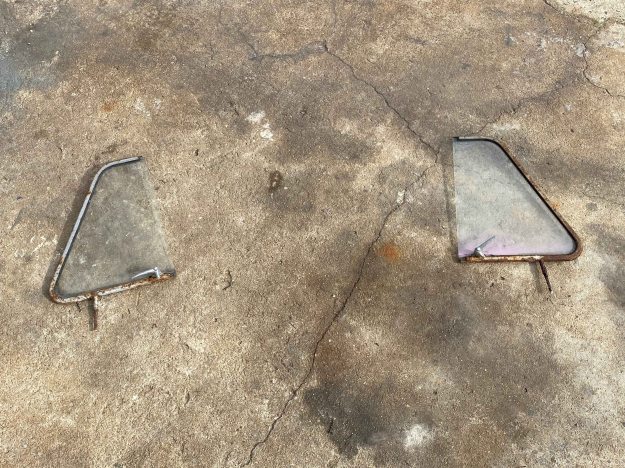
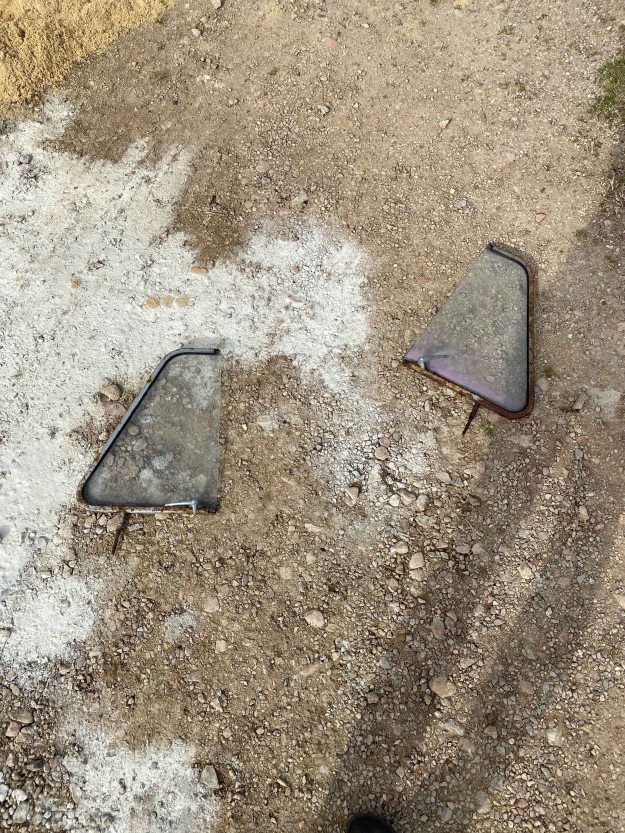
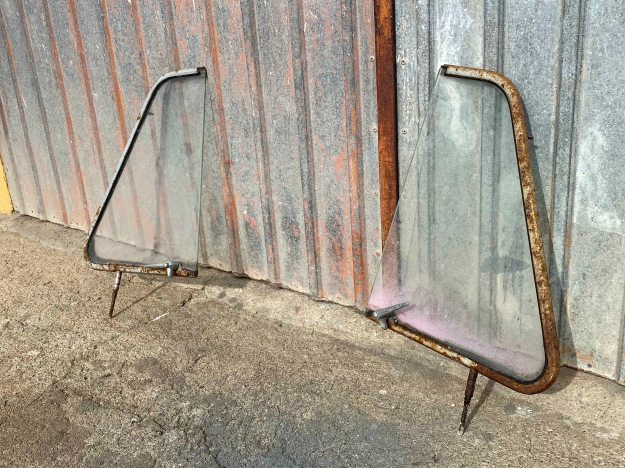
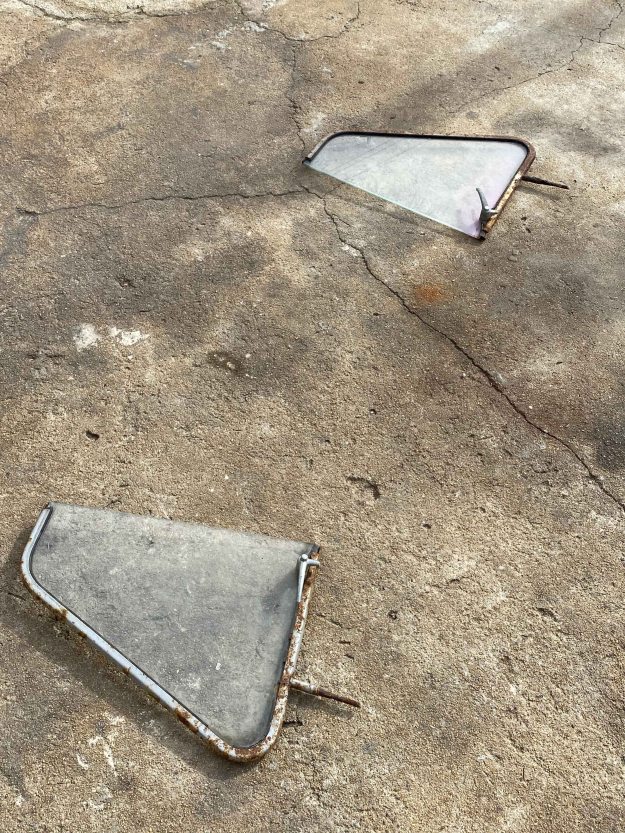
I have used various glass panes as supports for a series on drowning around the well. Now I am considering how these pieces of glass already tell a story of their own. Especially, there is a couple of triangular pieces of glass, that tell the story of coming from a old car. I started out by imagining what narratives I would paint on these pieces of glass, when I realized that just looking at them, the imagination of the viewer could already see so many different stories around this car.

Maybe the pride of driving it shining new all those years ago, a kiss, a road trip, shopping, an accident…

I let these pieces tell their story themselves, by simply placing them in different spots on the entrance driveway or outside the garage.

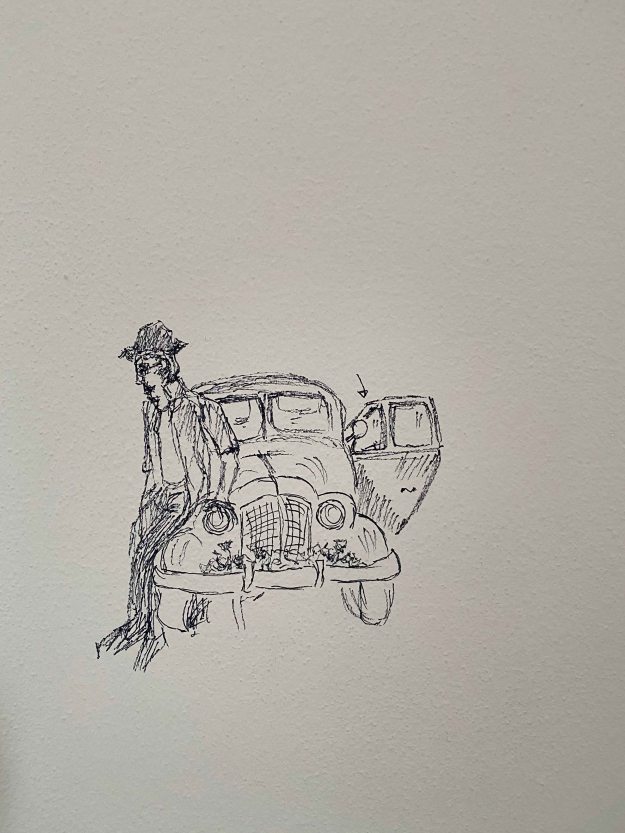
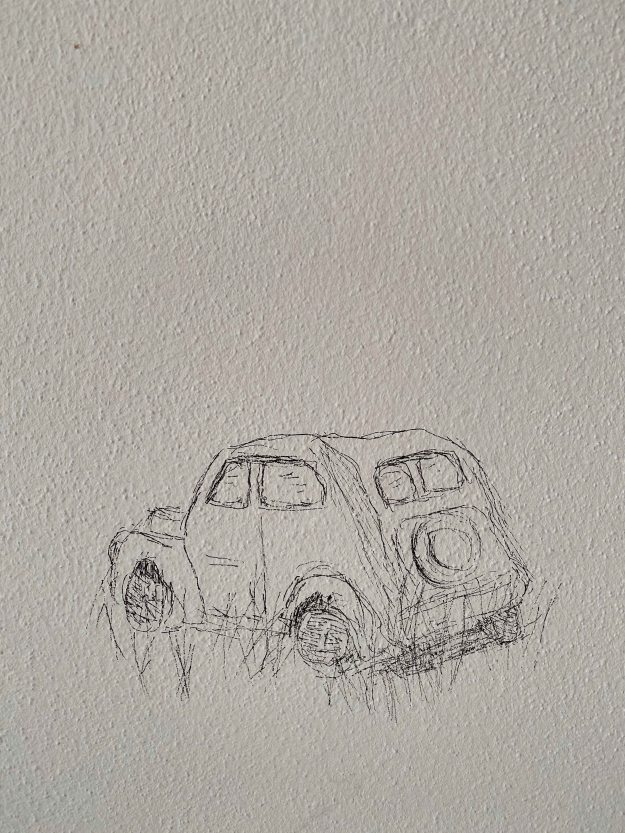
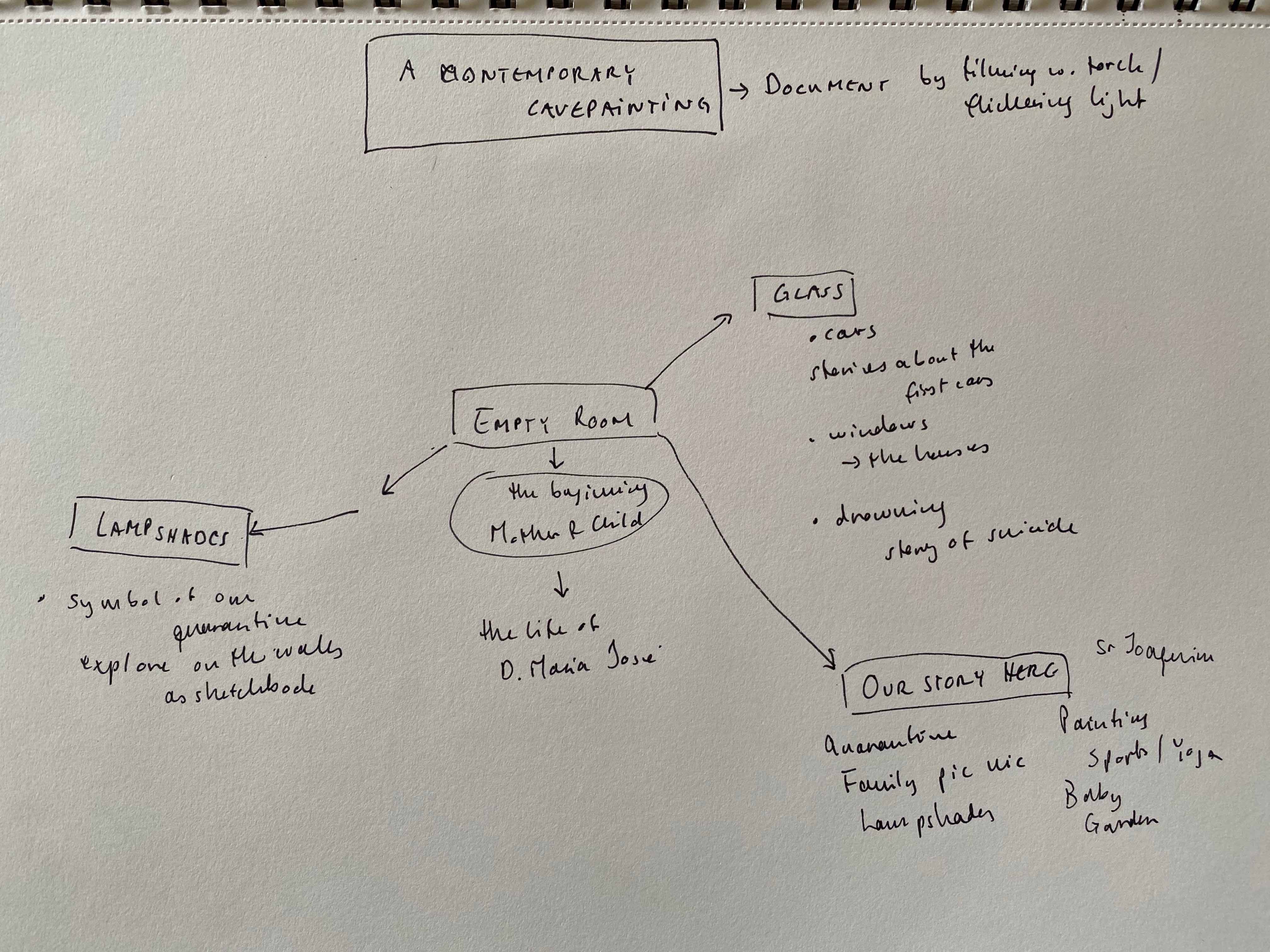
I am using “the empty room” that I describe in another blogpost as a sketchbook and include two small drawings on the walls about this car:


Parallel project- Empty room/ Modern cavepainting

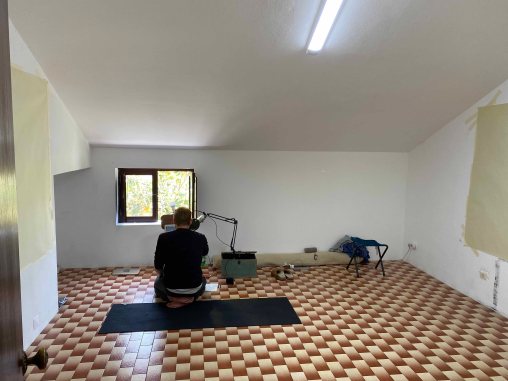
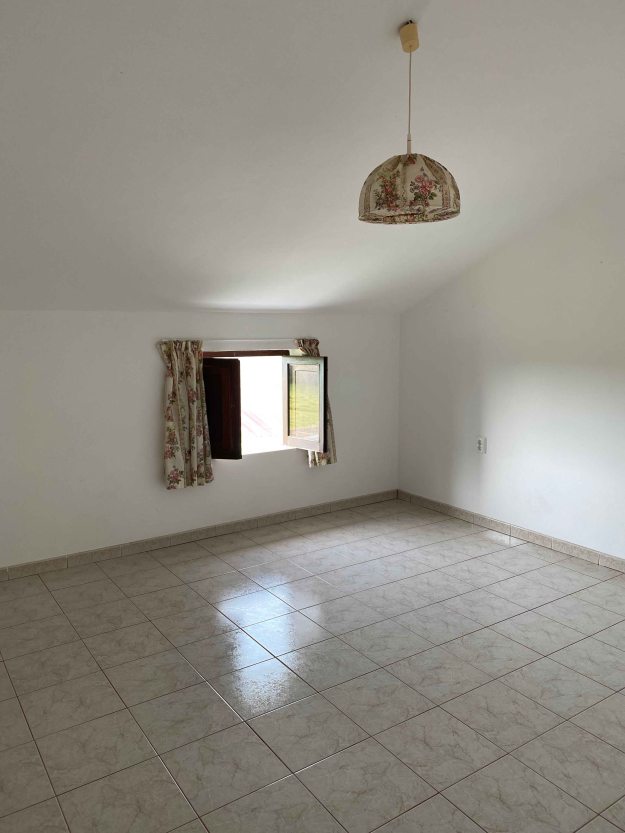
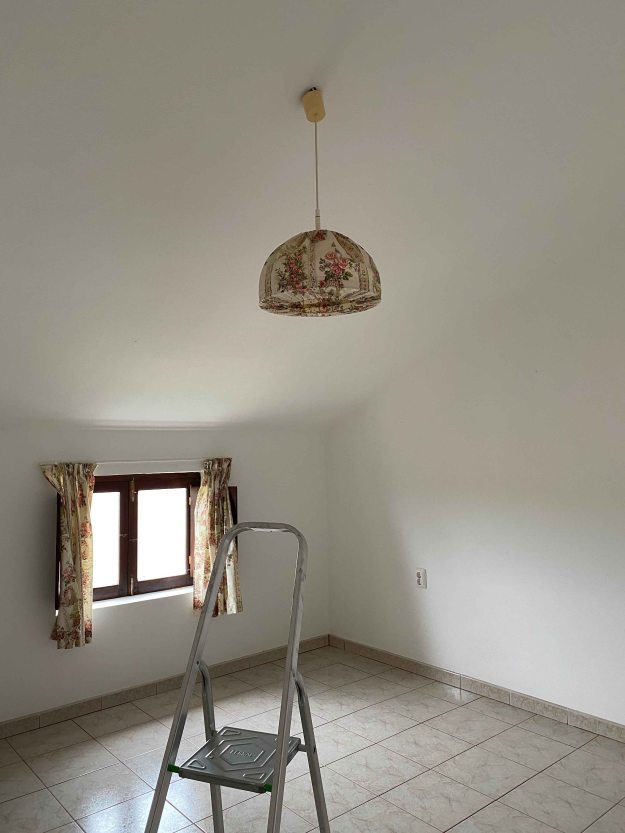
In several of the rooms, a lampshade is left dangling from the ceiling and some curtains left on the window. In a way, these lonely left over objects just emphasize the emptiness of the room.

This room is to the North and always cold and dark. It has a weird shape and really low ceiling to one side. When I first saw it, it had very much very dark, heavy furniture in it and I can still feel the energy of this dark heaviness lingering. It took me a good while to even clean it out and it is definitely the space I have spent less minutes in.

I will change this by making “an empty room” one of the objects for the parallel project and by using this whole room as my sketchbook to record many of the stories I hear about the village.

I plan to start different stories at different parts of the walls and then continue the narratives til they meet and create a pattern over the room. At some point, these walls will be smashed and I will collect the stories as dust in a suitable box.

Hera I am, ready to start. A whole white room as my white page. And now I need to decide where to put down the tip of my pen.

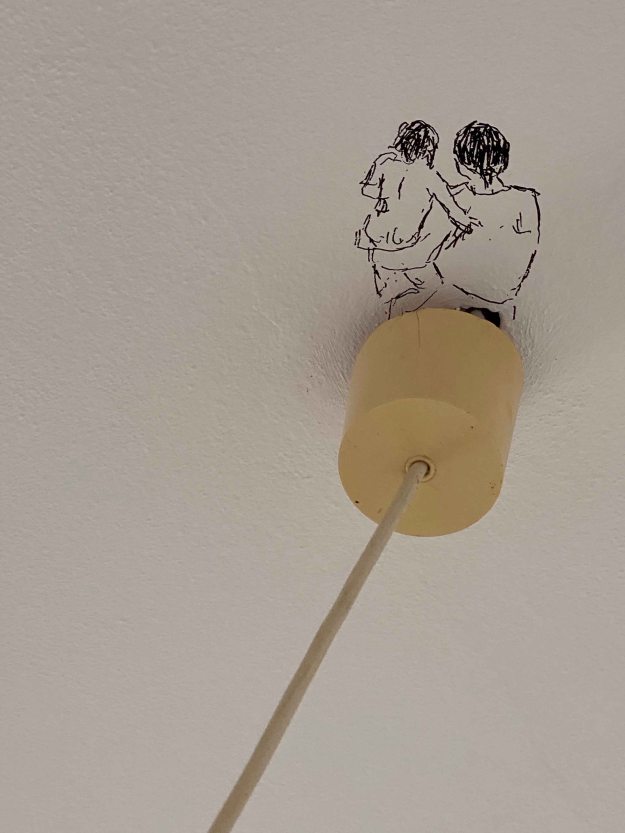
The dangling lampshade seems to be the center around which the space moves and I climb the ladder to start there.

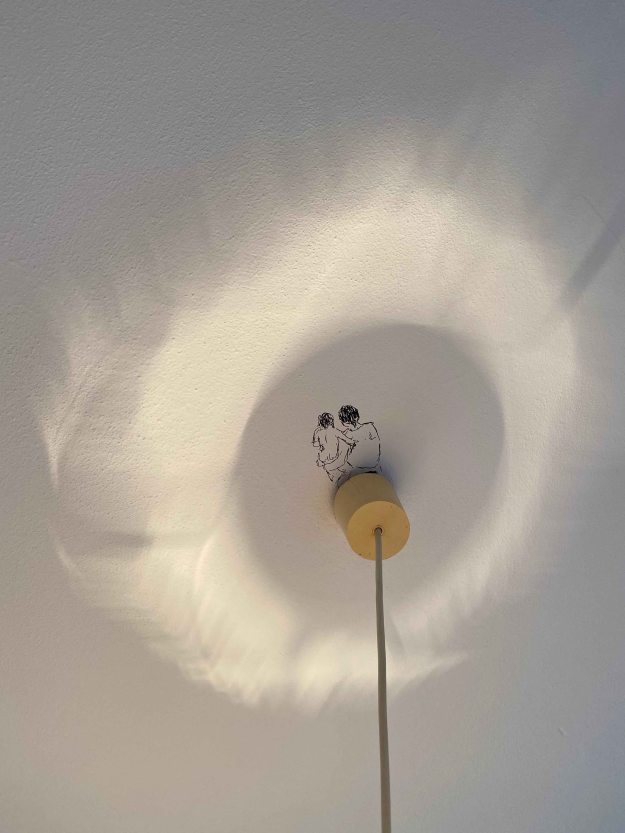
I start with my neighbor Donna Maria’s account of her first memory from when she was 3 or 4 years old and still little enough to be carried by her mother.

When I switch on the light, I am so happy I chose to start at this point in the room:

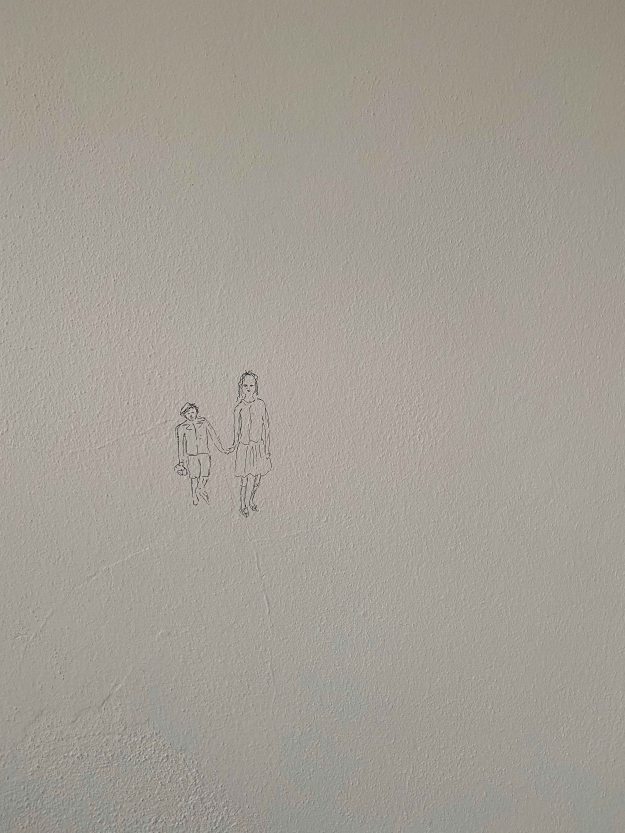
I start another story on the wall to the East, about Maria Jose walking to school with her little brother, the 4 km to the nearest primary school.

On the back wall, her granddaughter has a dog called Boss.

I realize that all three stories start with relationships- to the mother, to the dog, to the brother. I decide to leave the Western wall to a lonely figure- Donna Laura from the house on the other side of ours.

Her story is very sad. I will let it evolve around the figure in time.

I have written another blogpost about all the glass I have found, and some of the pieces are clearly from a car. I decide to let other parts of the walls start with stories about the cars from which these glasses came- using this room as a sketchbook:

I prepared several different pens, with the idea of letting fainter drawings lie further back in time than thicker, clearer drawings. I will let go of this though, as I will use the walls more freely and allow myself to grab whatever pen is at hand at the moment.

Spinning these drawings together in stories adds the dimension of time engrained in the piece, as well as the two-dimensionality of the drawings and the three-dimensionality of the whole room.

I will resume the drawings now again on this fresh coat of paint. There will probably not be any grand finale with breaking the walls and collecting the dust, but this room will still be the sketchbook for the stories.

Suddenly we also live full time in the unrenovated house with all the family, due to the lock down, so today it occurred to me that our presence, our life here will weave into the sketchbook entries on these walls too. We already belong to the story of this house.

The new map of this “empty room” looks like this:

IMG_6478

The motives of the sketches on the walls here will connect to all other parts of the parallell project.

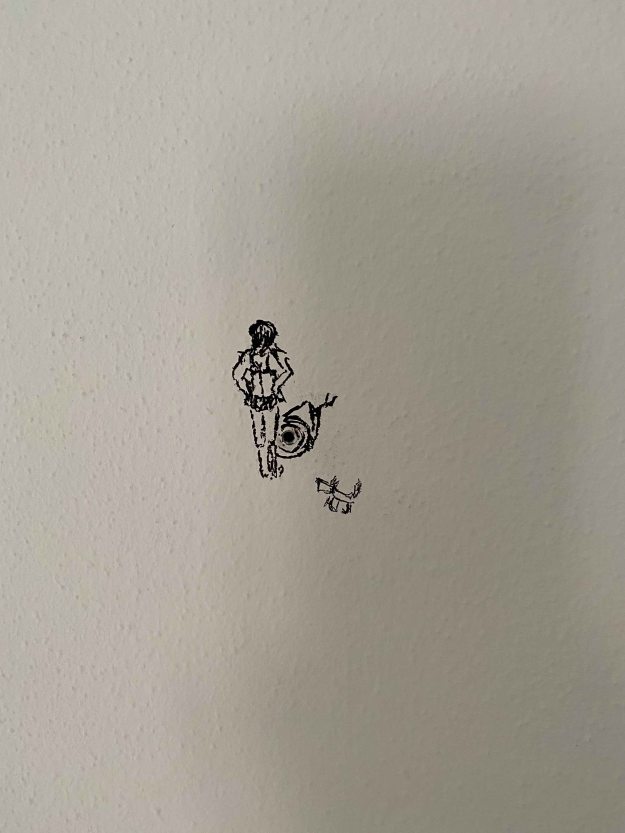
Our presence here first appeared with small sketches from a photoseries I did with my daughter and granddaughter wearing  lampshades on their heads:


These are sketches for oil paintings that I logged more about under the part of the parallel project “lampshades”.

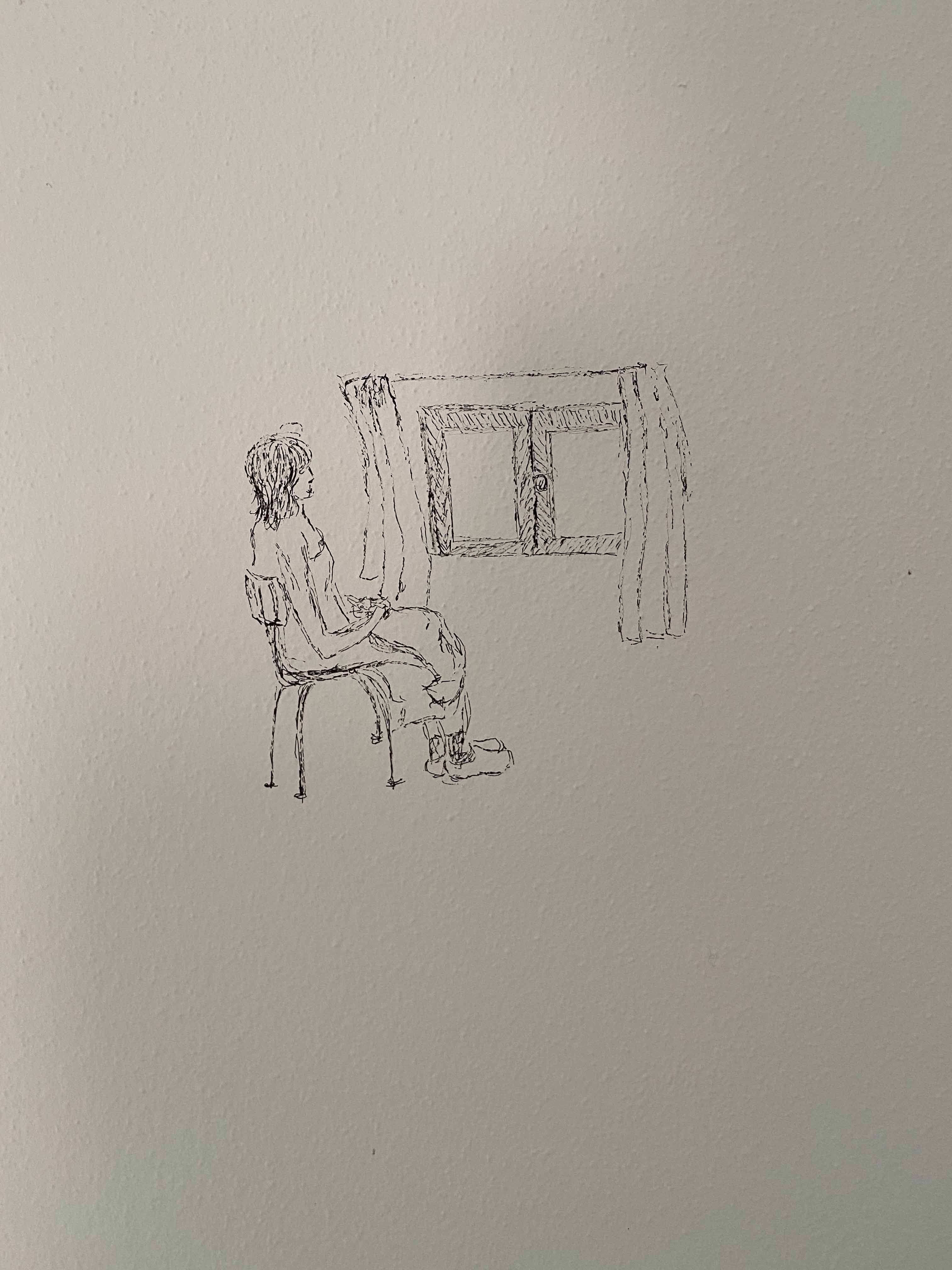
Also a sketch of my daughter longingly looking through the window after way too long in this house for quarantine:

IMG_6475

To be continued

 

My name is Clara Maciulis. I just completed Understanding Painting Media and really enjoyed experimenting and trying new methods, supports and media. I am excited to come back to drawing now with a wider understanding than I had for Drawing1.
I studied Photodesign in Munich, Germany, still in the last days of darkrooms and paper photos and worked in fashion and editorial photography for about five years . Then I started an interior decoration and retail business that has kept me busy and traveling a lot til now.

I am 49 and originally Swedish but haven’t lived in Sweden for over 30 years. My family including a one year old granddaughter and I now live in Lisbon, Portugal since two years. Before this we spent 12 years in Asia, and are still frequently going back and forth.